
Life, 1925-12-03 · page 28 of 84
Life — December 3, 1925 — page 28: what you’re looking at
What you’re looking at
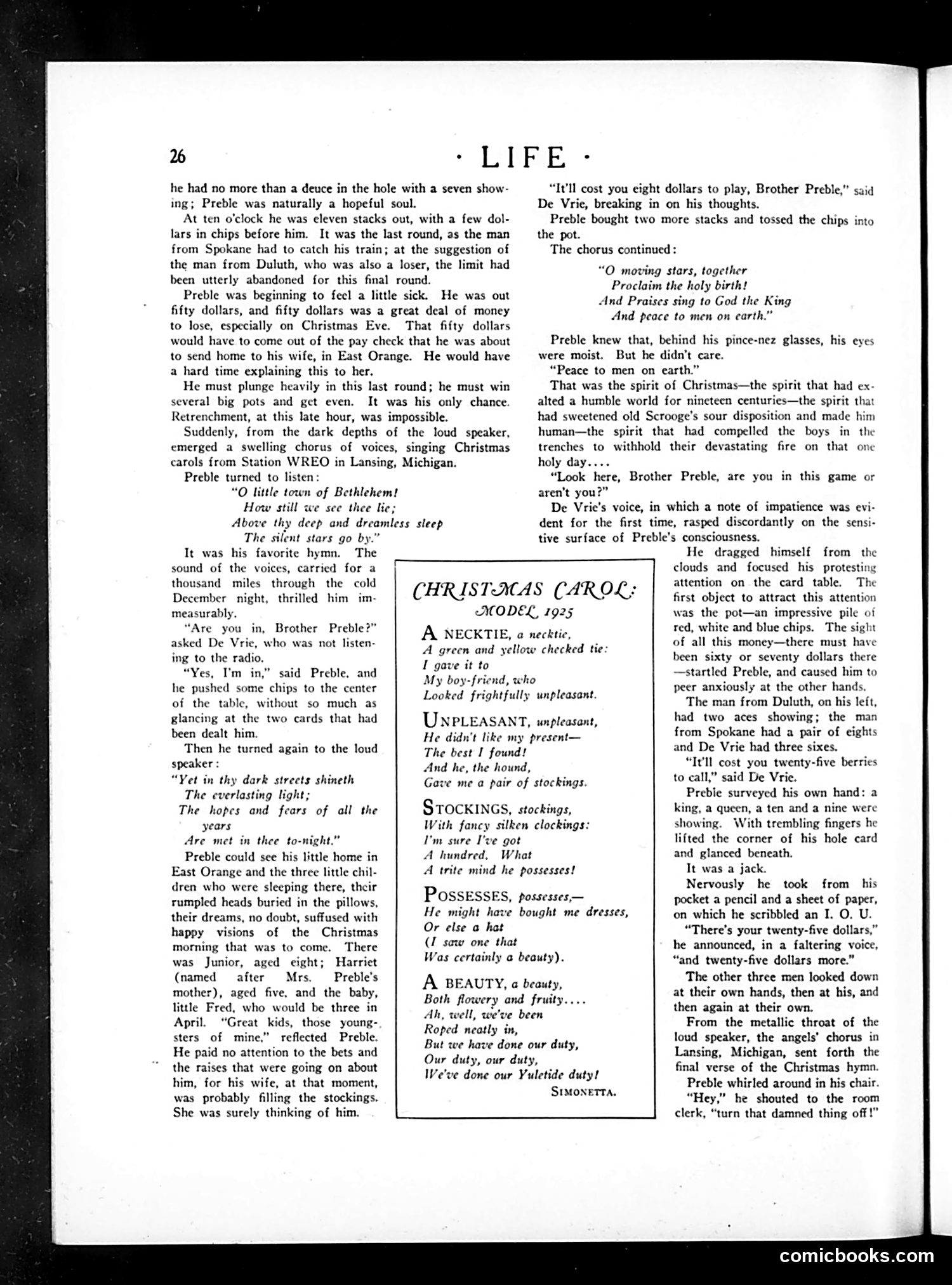
This page presents a short story about Brother Preble, a man gambling on Christmas Eve while hearing carols broadcast over the radio—a then-modern technology. The narrative contrasts his sacred duty (supporting his family in East Orange) with worldly temptation (the poker game). The satire targets 1920s materialism and spiritual hypocrisy. Despite hearing "Peace to men on earth," Preble abandons moral restraint, betting his family's money. His sentimentality about home and children coexists with reckless gambling—he doesn't even look at his cards. The boxed "Christmas Carol: Model 1925" parodies modern commercialism, reducing the carol tradition to complaints about unwanted consumer goods (a necktie). This mocks how 1920s consumer culture had commodified Christmas. The overall message: radio-age Americans are distracted by novelty and materialism, losing sight of genuine Christmas values despite constant reminders of them.
📄 Transcribed text from this page (OCR, searchable)
Machine-transcribed from the original scan — historical spelling and the odd misread are preserved.
2% * TAPE, = he had no more than a deuce in the hole with a seven show- ing; Preble was naturally a hopeful soul. At ten o'clock he was eleven stacks out, with a few dol- lars in chips before him. It was the last round, as the man from Spokane had to catch his train; at the suggestion of the man from Duluth, who was also a loser, the limit had been utterly abandoned for this final round. Preble was beginning to feel a little sick. He was out fifty dollars, and fifty dollars was a great deal of money to lose, especially on Christmas Eve. That fifty dollars would have to come out of the pay check that he was about to send home to his wife, in East Orange. He would have a hard time explaining this to her. He must plunge heavily in this last round; he must win several big pots and get even. It was his only chance. Retrenchment, at this late hour, was impossible. Suddenly, from the dark depths of the loud speaker, emerged a swelling chorus of voices, singing Christmas carols from Station WREO in Lansing, Michigan. Preble turned to listen: “O little town of Bethlehem! How still we see thee lie; Above thy deep and dreamless sleep The silent stars go by.” It was his favorite hymn. The “It'll cost you eight dollars to play, Brother Preble,” said De Vrie, breaking in on his thoughts. Preble bought two more stacks and tossed the chips into the pot. The chorus continued: “O moving stars, together Proclaim the holy birth! And Praises sing to God the King And peace to men on earth,” Preble knew that, behind his pince-nez glasses, his eyes were moist. But he didn’t care. “Peace to men on earth.” That was the spirit of Christmas—the spirit that had ex- alted a humble world for nineteen centuries—the spirit that had sweetened old Scrooge’s sour disposition and made him human—the spirit that had compelled the boys in the trenches to withhold their devastating fire on that one holy day.... “Look here, Brother Preble, are you in this game or aren’t you?” De Vrie’s voice, in which a note of impatience was evi- dent for the first time, rasped discordantly on the sensi- tive surface of Preble’s consciousness. He dragged himself from the sound of the voices, carried for a clouds and focused his protesting thousand miles through the cold December night, thrilled him im- measurably, “Are yi in, Brother Preble?” asked De Vrie, who was not listen- ing to the radio. “Yes, I'm in,” said Preble, and he pushed some chips to the center of the table, without so much as glancing at the two cards that had been dealt him. Then he turned again to the loud speaker: “Yet in thy dark streets shineth The everlasting light; The hopes and fears of all the years Are met in thee to-night.” Preble could see his little home in East Orange and the three little chil- dren who were sleeping there, their rumpled heads buried in the pillows, their dreams, no doubt, suffused with happy visions of the Christmas morning that was to come. There was Junior, aged eight; Harriet (named after Mrs. —_Preble’s mother), aged five, and the baby, little Fred, who would be three in April. “Great kids, those young- sters of mine,” reflected Preble. He paid no attention to the bets and the raises that were going on about him, for his wife, at that moment, was probably filling the stockings. She was surely thinking of him. CHRISTMAS CAROL: MODEL, 1925 A NECKTIE, a necktie, ‘A green and yellow checked tie: I gave it to My boy-friend, who Looked frightfully unpleasant. UNPLEASANT, unpleasant, He didn't like my present— The best I found! And he, the hound, Gave me a pair of stockings. STOCKINGS, stockings, With fancy silken clockings: I'm sure I've got A hundred. What A trite mind he possesses! POSSESSES, possesses— He might have bought me dresses, Or else a hat (I saw one that Was certainly a beauty). A BEAUTY, a beaut Both flowery and fru Ah, well, we've been Roped neatly in, But we have done our duty, Our duty, our duty, Ie've done our Yuletide duty! Srtonett, attention on the card table. The first object to attract this attention was the pot—an impressive pile of red, white and blue chips. The sight of all this money—there must have been sixty or seventy dollars there —startled Preble, and caused him to peer anxiously at the other hands, The man from Duluth, on his left, had two aces showing; the man from Spokane had a pair of eights and De Vrie had three sixes. “I'll cost you twenty-five berries to call,” said De Vrie. Preble surveyed his own hand: a king, a queen, a ten and a nine were showing. With trembling fingers he lifted the corner of his hole card and glanced beneath. Tt was a jack. Nervously he took from his pocket a pencil and a sheet of paper, on which he scribbled an I. O. U. “There's your twenty-five dollar: he announced, in a faltering voice, “and twenty-five dollars more.” The other three men looked down at their own hands, then at his, and then again at their own. From the metallic throat of the loud speaker, the angels’ chorus in Lansing, Michigan, sent forth the final verse of the Christmas hymn. Preble whirled around in his chair. “Hey,” he shouted to the room clerk, “turn that damned thing off!” comicbooks.com