
A complete issue · 44 pages · 1925
Life — November 26, 1925
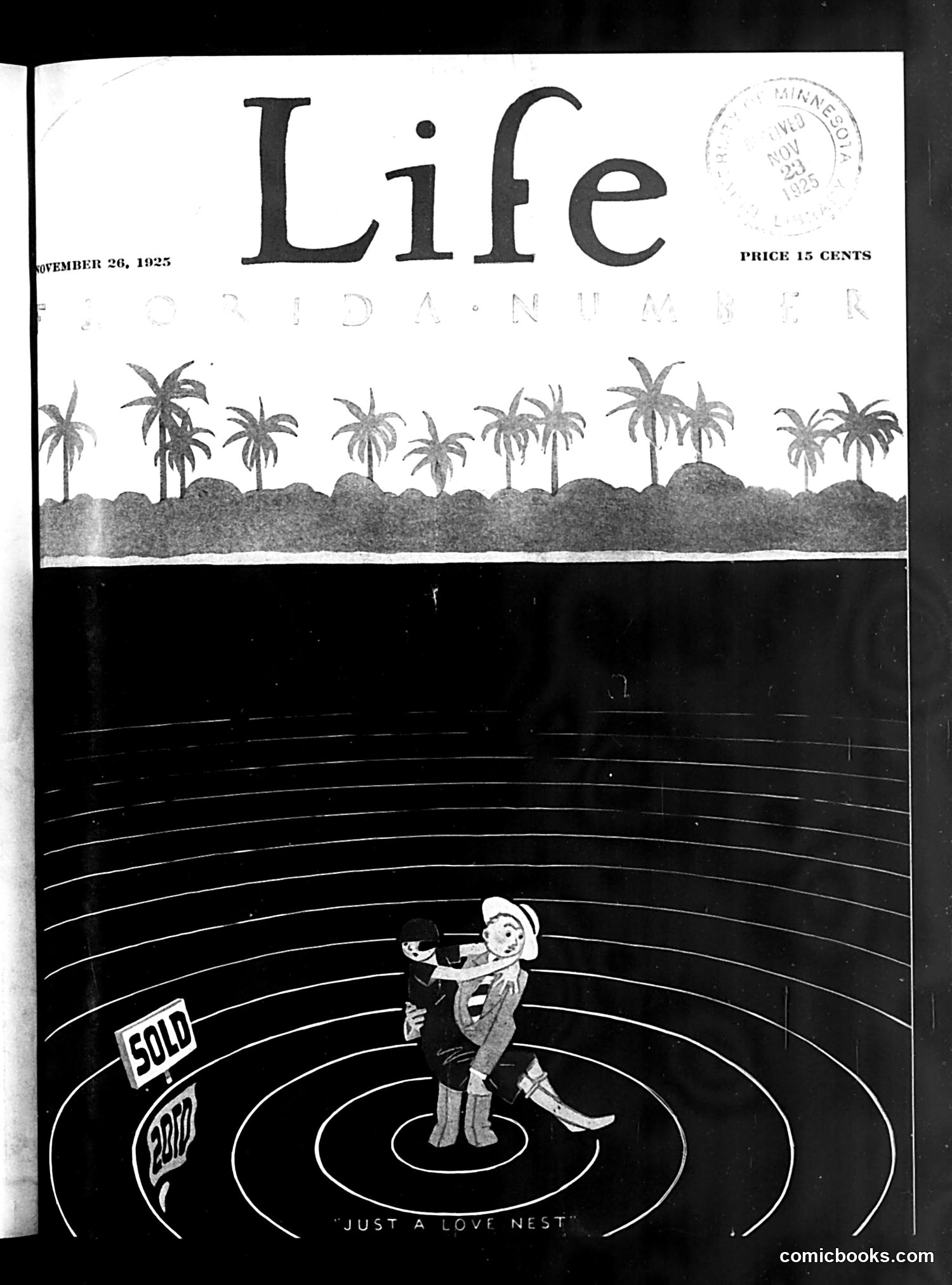
This cover satirizes the real-estate boom of the 1920s, particularly Florida's speculative land craze. The cartoon shows a figure in concentric circles labeled "SOLD" and "SOLD," standing in what appears to be a barren pit or development site. Palm trees visible above suggest a Florida setting. The caption "JUST A LOVE NEST" is ironic—the figure apparently purchased worthless land, believing it would be developed into an attractive property. The satire targets investors who bought Florida real estate sight unseen during the speculative bubble, often purchasing swampland or undeveloped plots at inflated prices. Many such investments proved worthless when the Florida boom collapsed in the mid-1920s. The cartoon mocks the naive optimism of everyday speculators caught in the investment frenzy.
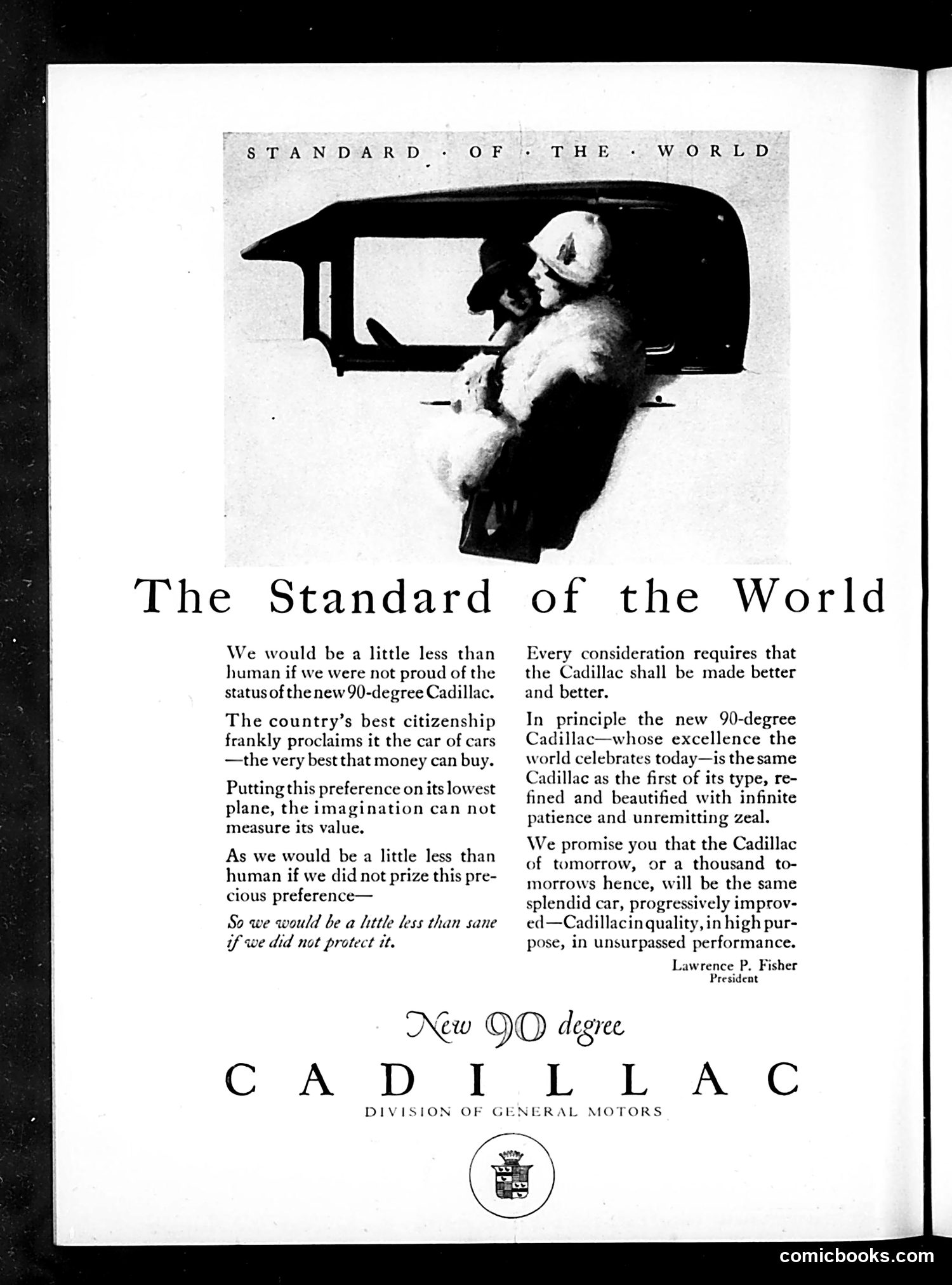
This is **primarily an advertisement**, not satirical content. It's a Cadillac ad from an early 20th-century Life magazine, featuring a silhouetted figure driving a car with the headline "STANDARD OF THE WORLD." The ad uses patriotic and aspirational language, claiming the 90-degree Cadillac represents "the country's best citizenship" and reflects American pride. President Lawrence P. Fisher vouches for the car's quality and promised improvements. The satirical element—if any—is subtle: the ad equates car ownership with patriotism and human worth ("we would be a little less than human if we were not proud"), which is humorous hyperbole even by early advertising standards. The silhouetted driver appears to be a well-dressed gentleman, suggesting the car's luxury status. This reflects the era's aggressive marketing linking consumer goods to national identity.
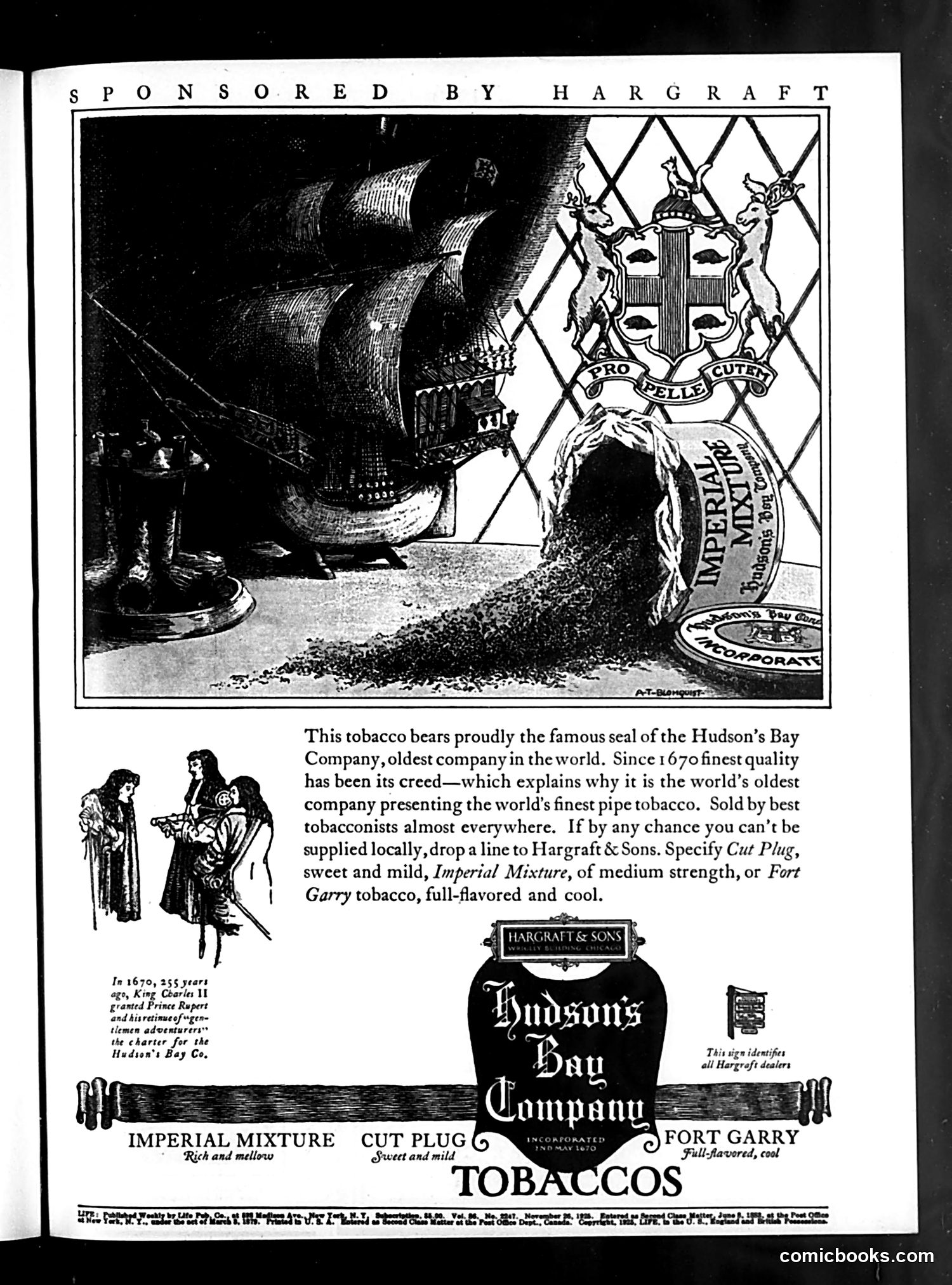
This page is **primarily an advertisement**, not satire or political commentary. Harcraft & Sons advertises Hudson's Bay Company tobacco products. The top illustration shows a period sailing ship (evoking the Hudson's Bay Company's 17th-century fur-trading origins) alongside the company's coat of arms. The left side includes figures in 17th-century dress, referencing the company's 1670 founding. The advertisement emphasizes brand prestige: "oldest company in the world" since 1670, claiming this heritage guarantees quality. It promotes three tobacco varieties: Cut Plug, Imperial Mixture, and Fort Garry. **No political satire is evident.** This is straightforward nostalgic marketing leveraging historical legitimacy to sell consumer goods—a common early 20th-century advertising strategy.
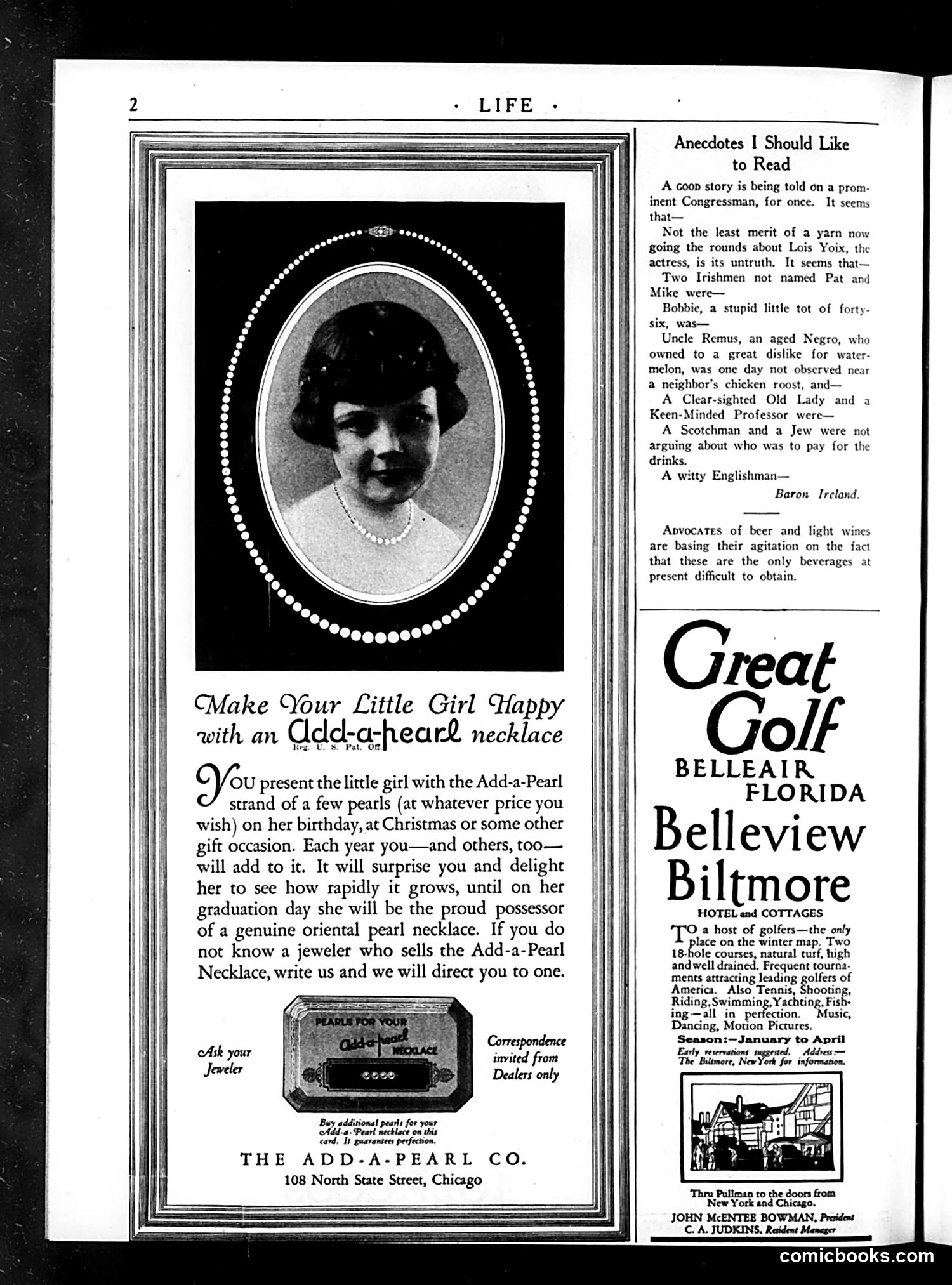
This page contains **no political cartoon**. The left side features a commercial advertisement for the "Add-a-Pearl Necklace" by The Add-a-Pearl Co. of Chicago—a jewelry marketing concept where parents would gift their daughter a strand that relatives could add pearls to over years, eventually creating a complete oriental pearl necklace by her graduation day. The right column includes two unrelated items: a brief humorous section titled "Anecdotes I Should Like to Read" (containing short jokes about various characters), and a resort advertisement for Belleview Biltmore Hotel in Florida promoting golf and winter activities. This is primarily an **advertising page** with minimal editorial content.
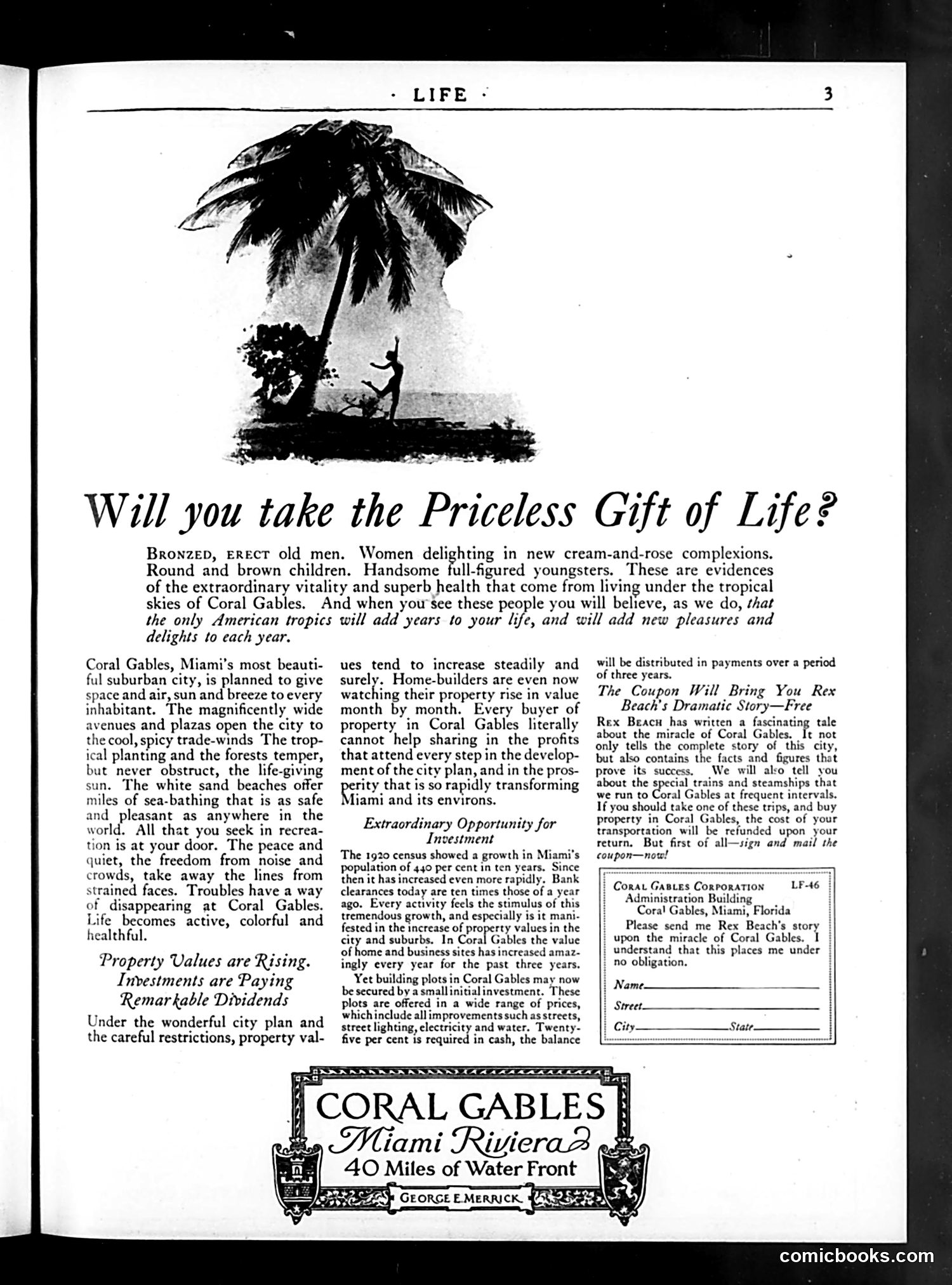
This page is primarily **advertising, not satire or political commentary**. It's a real estate advertisement for Coral Gables, a planned suburban development near Miami, Florida. The illustration shows a silhouetted figure relaxing under a palm tree—depicting the leisurely tropical lifestyle being marketed. The ad copy makes explicit promises: living in Florida's "tropical skies" will add years to your life and improve your health. It emphasizes property values rising monthly and frames real estate investment as financially sound. This reflects 1920s Florida's real estate boom, when developers aggressively promoted Miami-area developments to northern investors and residents seeking both health benefits and profitable investments. The "priceless gift of life" framing was typical hyperbolic marketing of that speculative era.
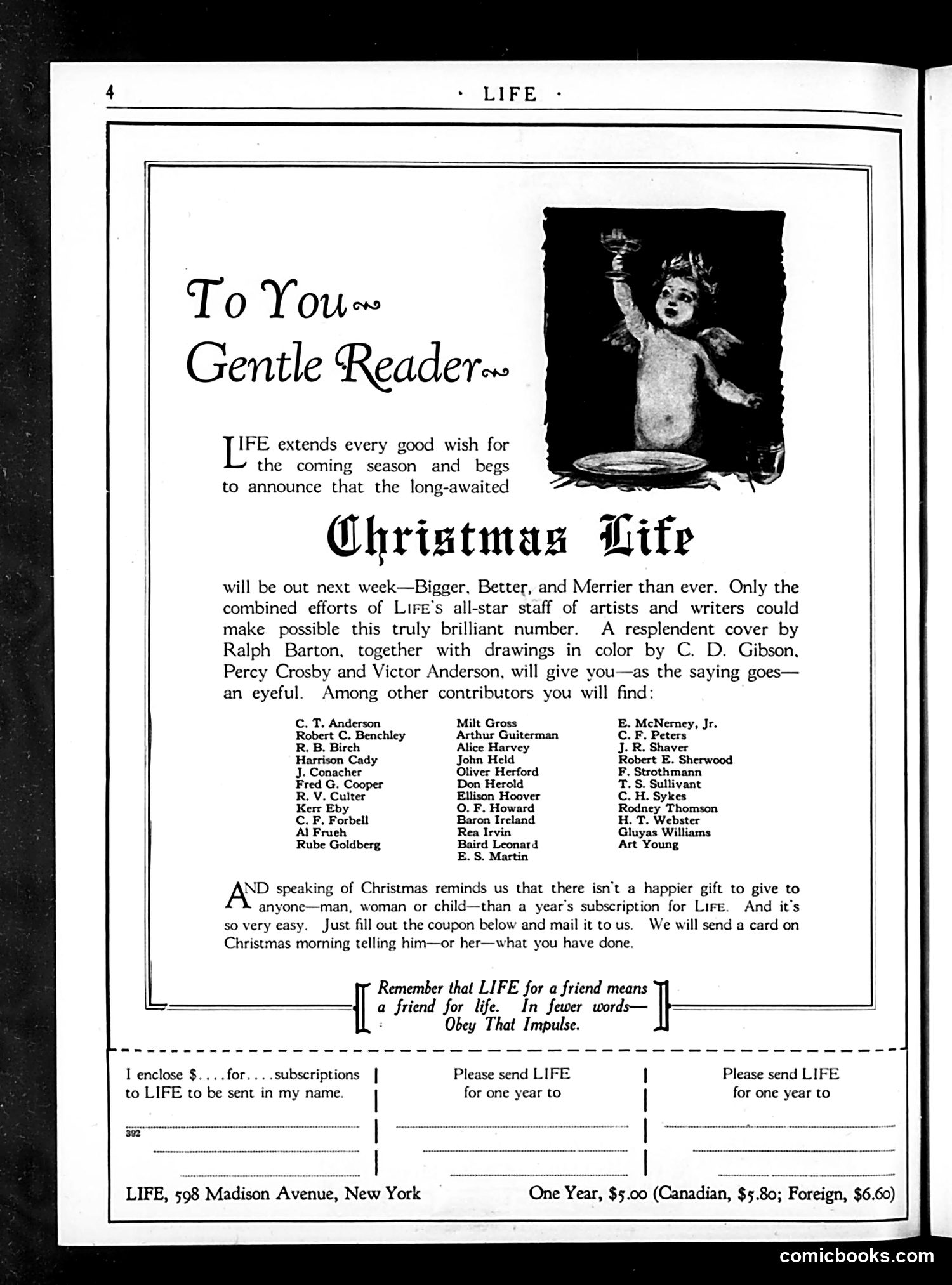
This page is primarily **advertising, not satire or political commentary**. It's a Christmas subscription promotion for *Life* magazine itself. The image shows a **cherub or cupid figure** holding aloft what appears to be a torch or light source—a generic symbol of joy and enlightenment used for holiday marketing. The text pitches *Life* magazine subscriptions as gift ideas, listing numerous contributors (artists and writers) to an upcoming "Christmas Life" issue. The implicit message: *Life* offers quality entertainment and humor worth gifting. The tagline "LIFE for a friend means a friend for life" is a pun designed to make subscriptions seem like meaningful presents. **Context for modern readers**: This reflects early 20th-century magazine culture, when annual subscriptions were common luxury gifts, and *Life* positioned itself as essential reading for educated, cultured audiences.
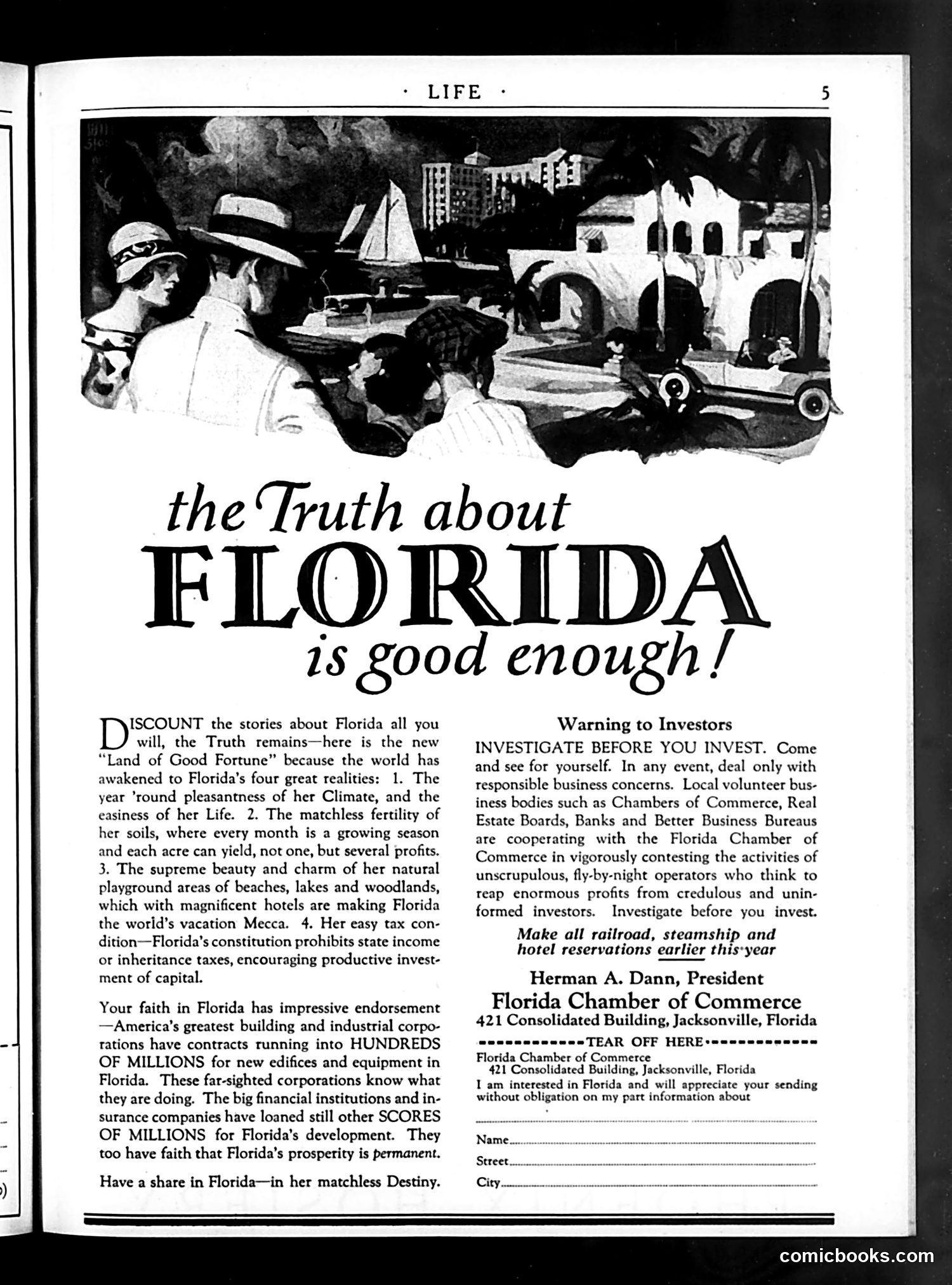
This page is primarily a **promotional advertisement**, not satire. It promotes Florida investment and tourism during what appears to be the 1920s Florida land boom. The illustrated vignette at top shows wealthy tourists enjoying leisure activities—boats, cars, beach resorts, and tropical architecture—depicting Florida as a glamorous vacation destination. The text makes four main selling points: year-round pleasant climate, fertile soil, natural beauty, and favorable tax conditions for investors. Notably, there's a **"Warning to Investors"** section cautioning against "unscrupulous, fly-by-night operators" and recommending investigation before investing. This warning suggests the Florida boom attracted fraudulent schemes, and legitimate business organizations sought to maintain credibility by policing dishonest competitors. The advertisement includes a tear-off coupon for interested parties to request information.
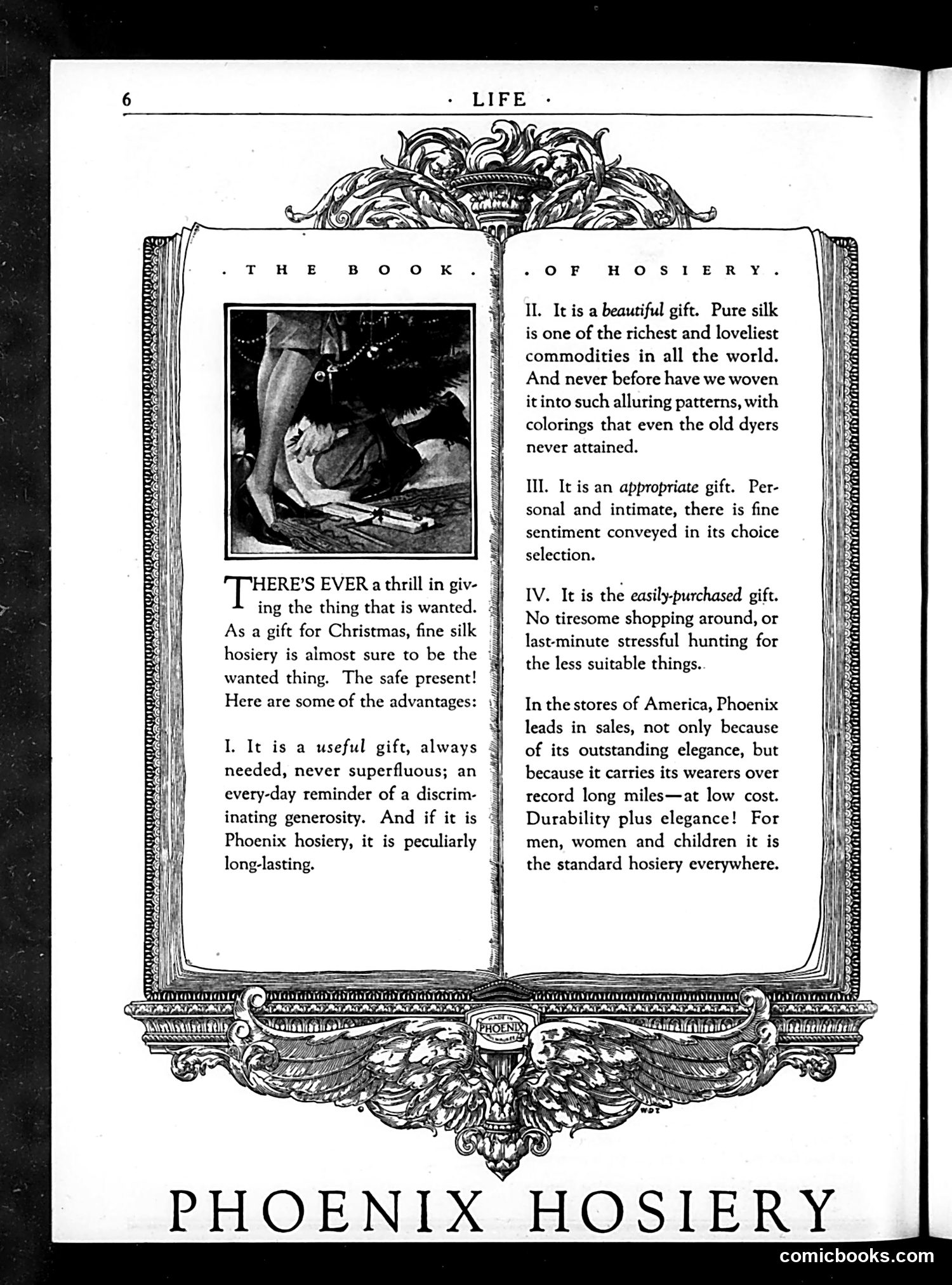
This is a **Phoenix Hosiery advertisement**, not a political cartoon. The page features promotional content for silk stockings as Christmas gifts, presented as an editorial-style article in *Life* magazine. The image shows a woman's legs and feet, emphasizing the product. The text argues silk hosiery merits consideration as an ideal Christmas present based on four points: it's useful and durable, beautiful with superior patterns and dyes, appropriately personal and intimate as a gift, and easily purchased without tedious shopping. The advertisement emphasizes Phoenix brand's market leadership in America, touting "durability plus elegance" as appeals for "men, women and children." This reflects early 20th-century marketing strategies that blended advertising with magazine editorial content to appear more credible to readers.
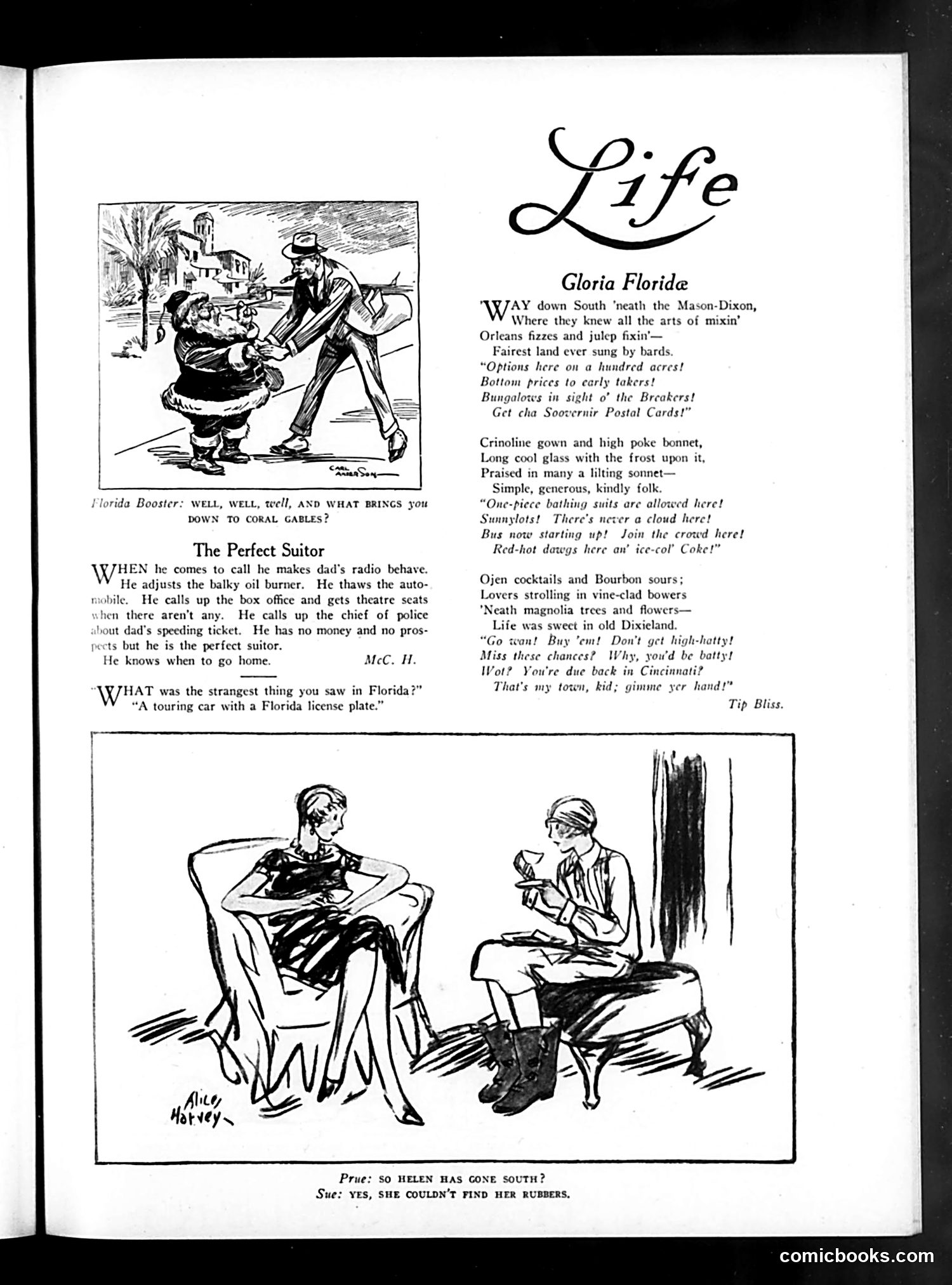
This page contains three satirical pieces about Florida and social behavior: 1. **"Gloria Floridae"** - A poem mocking Florida tourism advertising and Southern stereotypes, referencing real estate schemes ("Options here on a hundred acres!") and romanticized imagery of the Old South ("Life was sweet in old Dixieland"). 2. **"The Perfect Suitor"** - A brief satire about a man who impresses dates by making phone calls to important people (radio stations, police chiefs, etc.) to appear powerful and connected—satirizing status-seeking behavior through performative importance. 3. **Bottom cartoon** - A domestic scene where a woman asks if her friend has "gone south," and the punchline reveals she couldn't find her rubbers (galoshes), making a double entendre about traveling to Florida versus losing footwear. The humor relies on the period's casual double meanings.
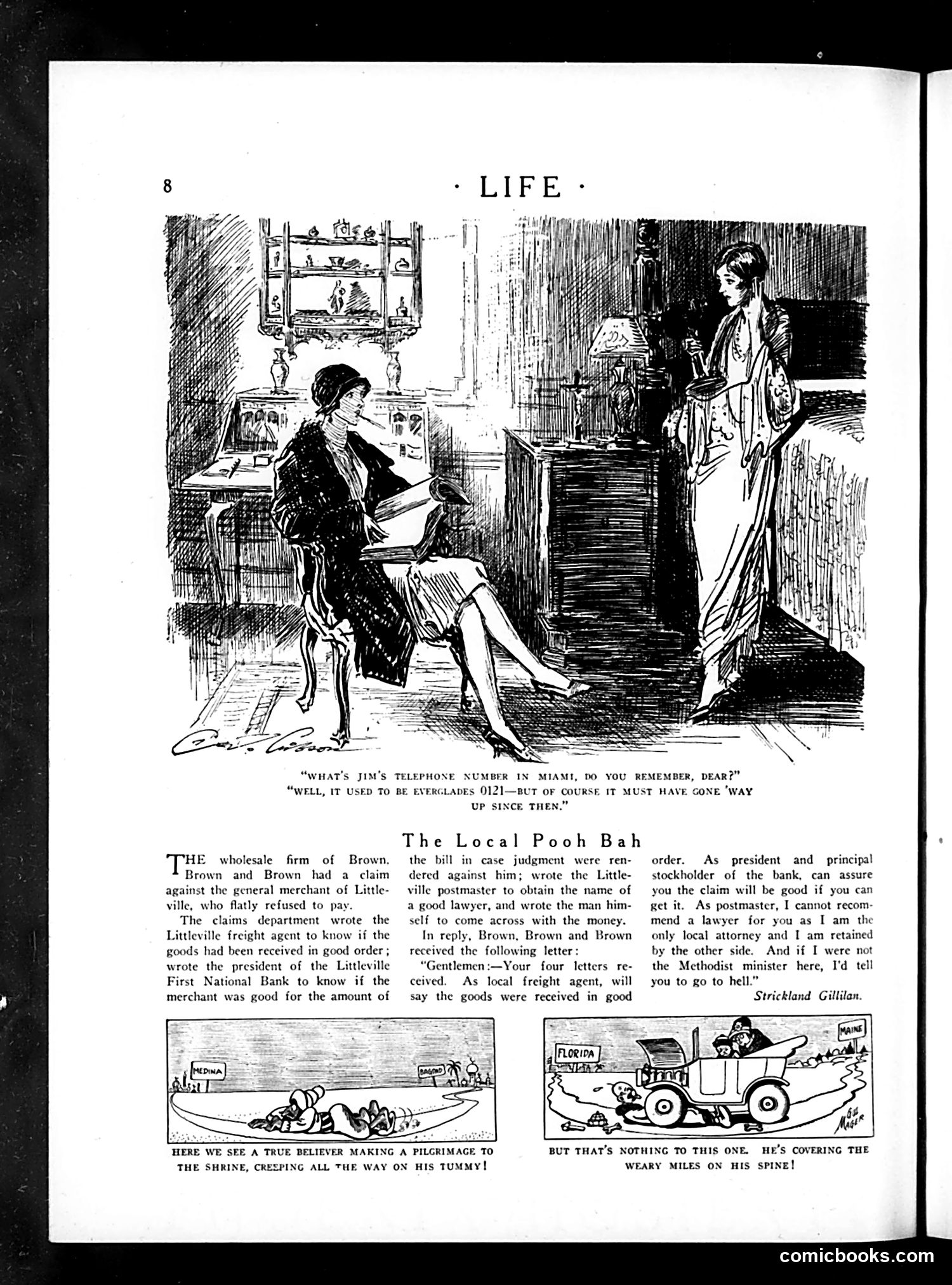
This page contains a sketch-style cartoon depicting two women in an interior setting, with dialogue about a telephone number in Miami. Below is a short story titled "The Local Pooh Bah" about a wholesale firm (Brown, Brown and Brown) disputing payment with a merchant, involving various officials and legal maneuvering—a satire on bureaucratic red tape and passing blame between institutions. Two small cartoon panels at the bottom mock religious pilgrims and a traveler covering "weary miles," with captions suggesting endurance contests. The overall theme appears to satirize both outdated communication systems and institutional inefficiency. The specific Miami reference and Everglades imagery suggest early 20th-century Florida setting, likely mocking local business practices or infrastructure of that era.
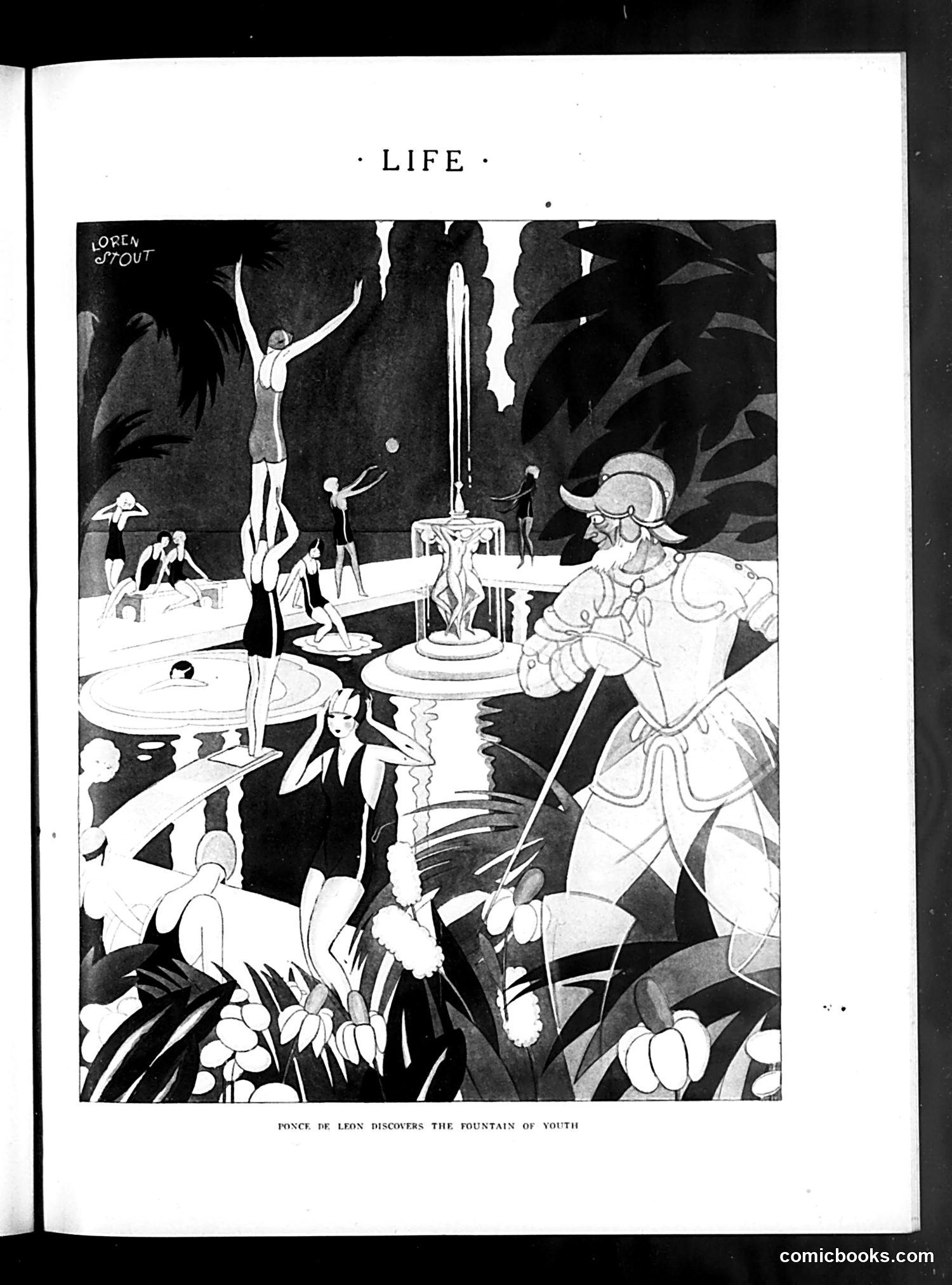
This is a section-title page for "LIFE" magazine featuring an Art Deco illustration titled "Ponce de Leon Discovers the Fountain of Youth." The image depicts the legendary Spanish explorer Ponce de León in ornate period costume, discovering a fantastical fountain surrounded by nude or semi-nude figures in a lush, exotic landscape. The stylized figures appear youthful and idealized. The satire likely mocks the enduring fascination with youth and beauty in American society—suggesting that the search for eternal youth (symbolized by the historical legend) remains as fantastical and foolish as it was in Ponce de León's era. The exaggerated Art Deco styling and theatrical composition reinforce this as social commentary on vanity and impossible dreams, common themes in Life magazine's satirical approach.
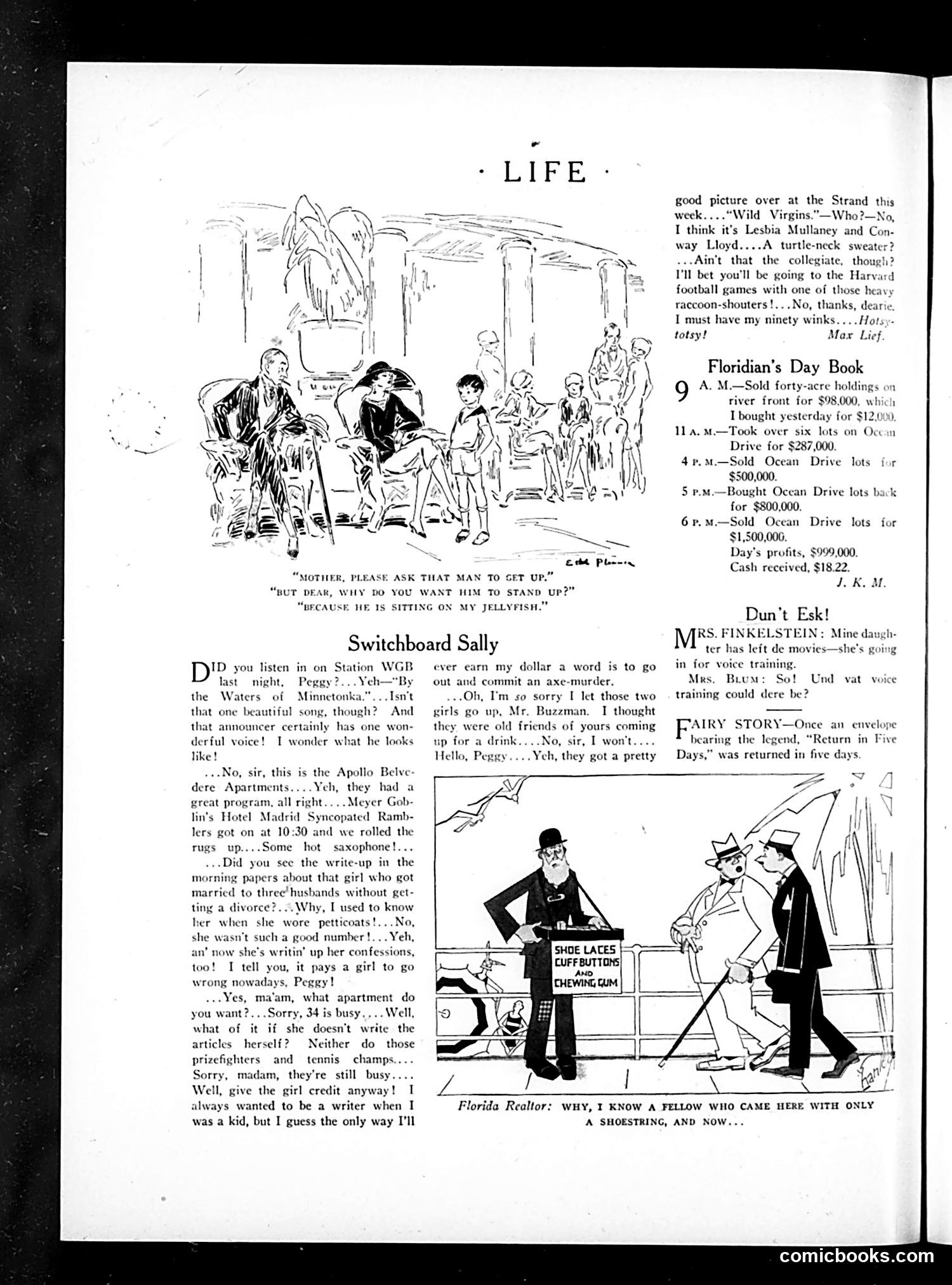
This page contains three distinct sections: 1. **"Mother, Please Ask That Man to Get Up"** — A sketch showing crowded public transportation where a man sits on what appears to be a jellyfish, satirizing inconsiderate behavior in shared spaces. 2. **"Switchboard Sally"** — A gossip column featuring workplace chatter about radio programming, marriages, divorces, and social scandals. It mocks the trivial conversations of office workers and reflects 1920s-30s interest in celebrity gossip. 3. **"Fairy Story" / "Florida Realtor"** — A cartoon about real estate fraud during Florida's boom period, showing a con artist who sold a property to a buyer with only a "shoestring," now appearing with expensive purchases, satirizing get-rich-quick schemes and deceptive land sales. The page satirizes urban inconvenience, workplace gossip culture, and real estate swindles common to the era.
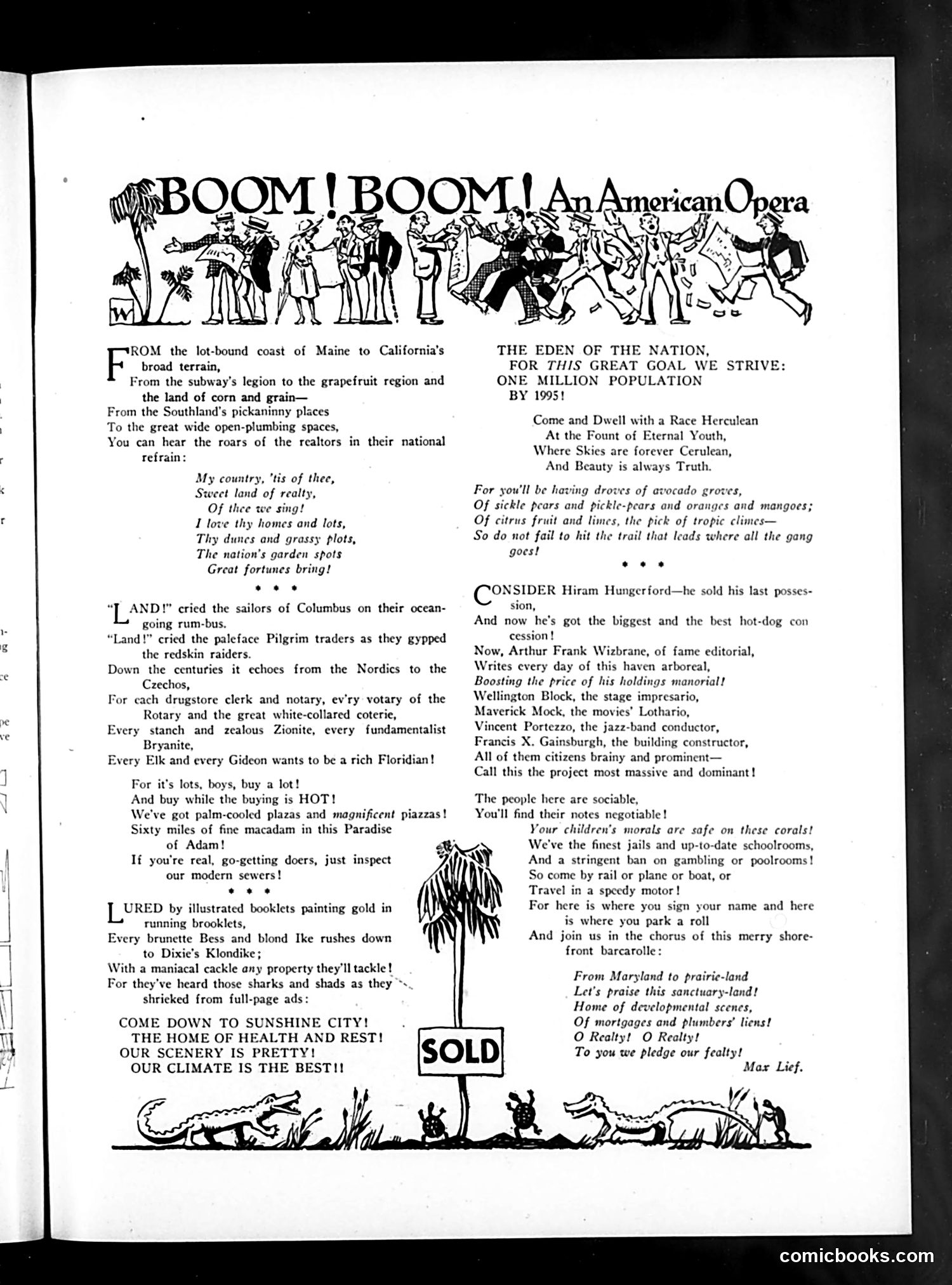
This is a satirical advertisement promoting Florida real estate development, specifically "Sunshine City." The piece mocks the 1920s Florida land boom—a speculative frenzy where salesmen aggressively marketed swampland and undeveloped property to gullible buyers nationwide. The satire targets the grandiose marketing language of real estate promoters, listing absurd promises: avocado groves, magnificent plazas, and claims of health benefits. It names specific Miami boosters (Hiram Hungerford, Arthur Frank Wizbrane, etc.), portraying them as opportunistic hucksters profiting from hype. The "SOLD" sign and crocodile at the bottom reinforce the con-artist message: buyers get swampland, not paradise. The opera format itself parodies how aggressively salesmen pitched Florida as an "Eden" to desperate Americans seeking wealth and escape.
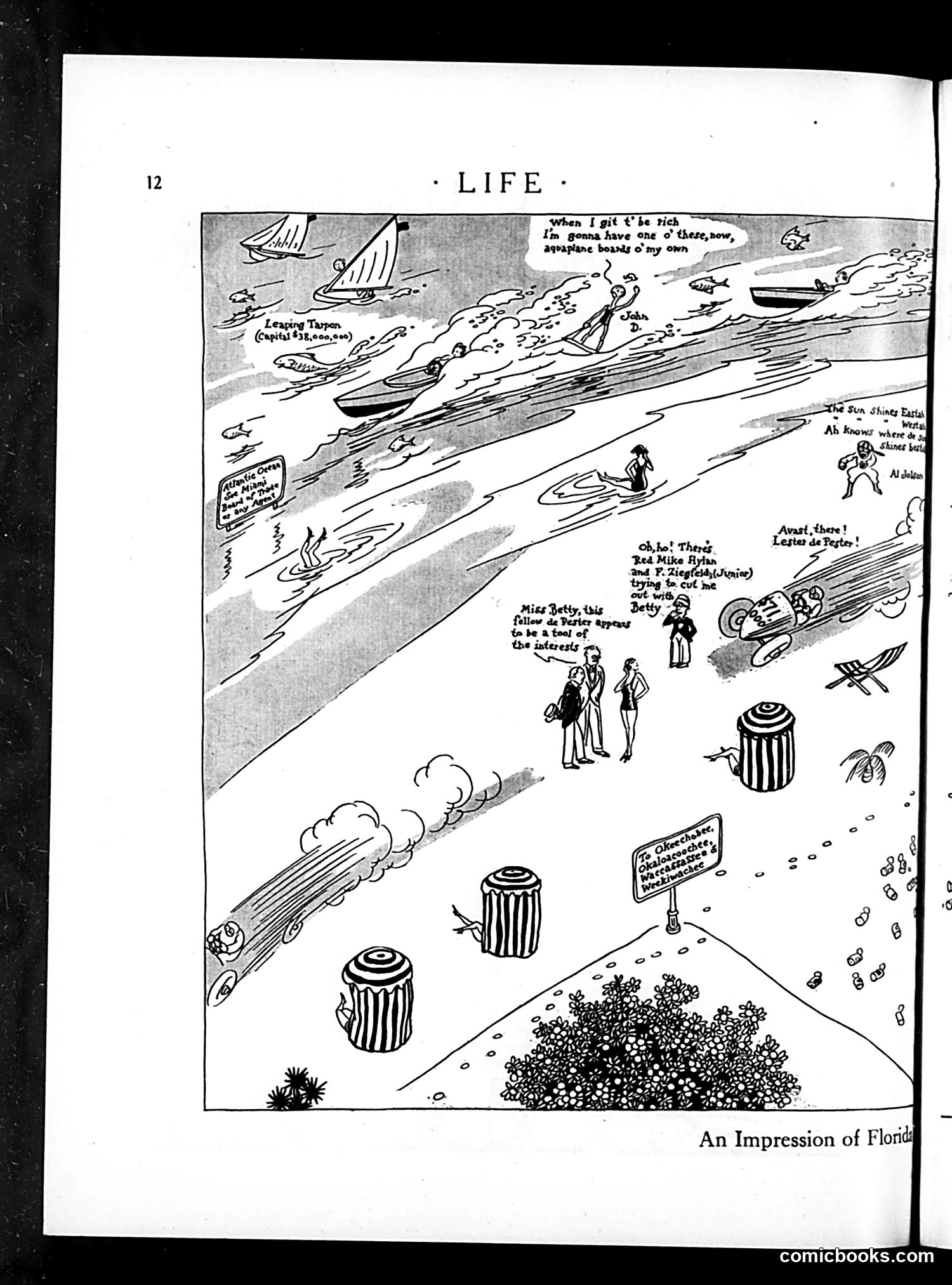
This satirical cartoon depicts Florida as a chaotic beach scene during what appears to be the state's real estate boom era. The illustration mocks Florida's rapid development and commercial exploitation through exaggerated elements: steamships labeled "Leaping Tarpon" (referencing tourist attractions), wealthy visitors conducting business on the beach, construction activity with railroad cars, and promotional signage. The humor targets the speculative nature of Florida development—the contrast between natural beauty (fish, vegetation) and commercial greed. Figures like "Mike Betty" appear to represent real estate promoters or investors discussing land deals. The crowded, disorderly composition suggests chaos masquerading as progress, satirizing how Florida was being aggressively marketed and developed for profit rather than preservation.
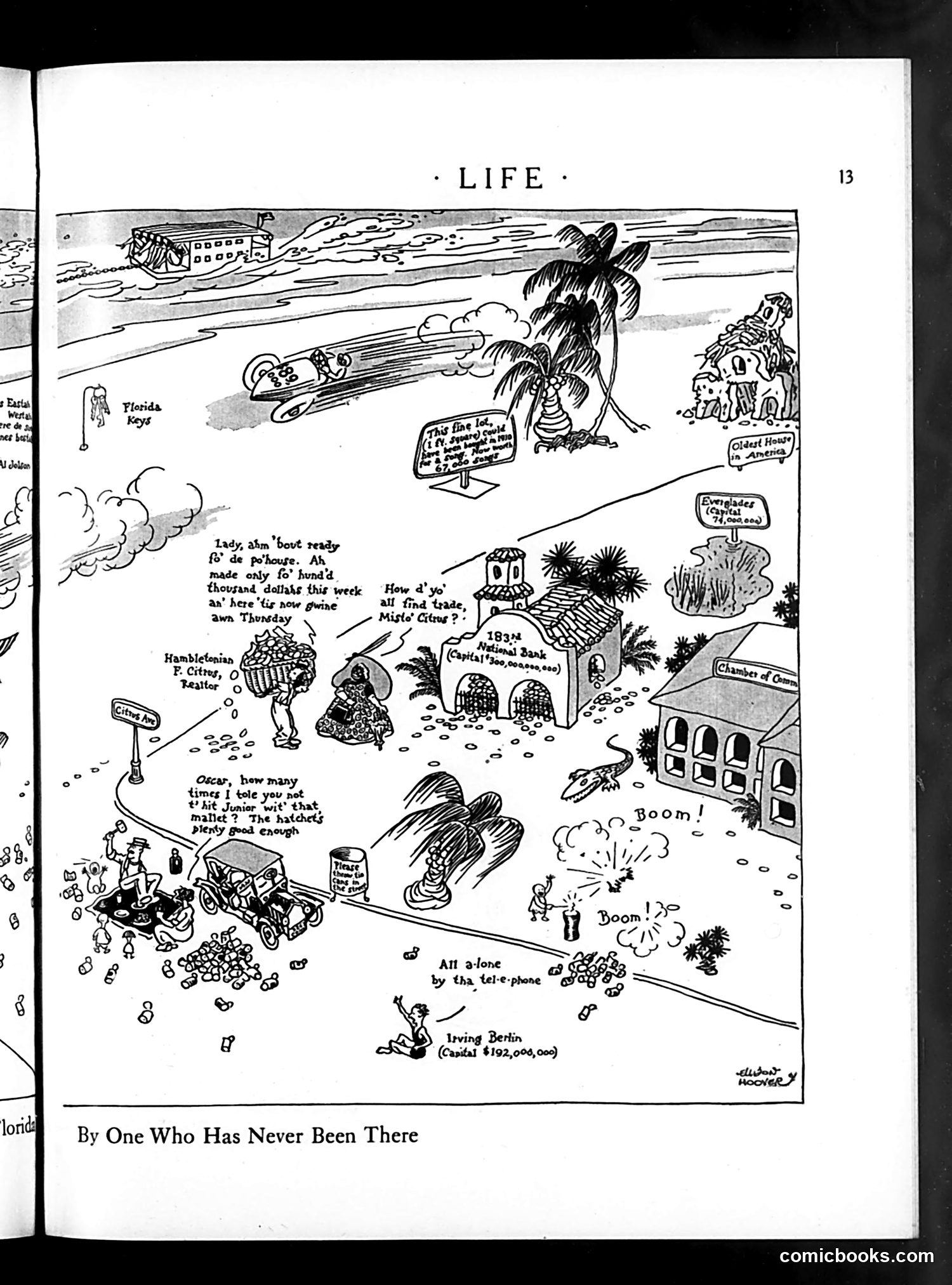
This is a satirical map of Florida by cartoonist Herb Hoover, mocking visitors' exaggerated accounts of the state. The drawing depicts an absurdly fantastical Florida with impossible features: a racetrack that launches cars into the air, a giant alligator, buildings labeled with inflated property values ("1834 National Bank"), and tourist attractions presented as architectural wonders. The title indicates this is a response to tall tales told by people who've visited or relocated to Florida, likely during the 1920s real estate boom. The cartoon ridicules both the exaggerated claims made by boosters promoting Florida development and the gullibility of those believing such stories. Various speech bubbles contain boastful, contradictory claims typical of promotional hype, revealing the satire's target: Florida's oversold image and speculative investment craze.
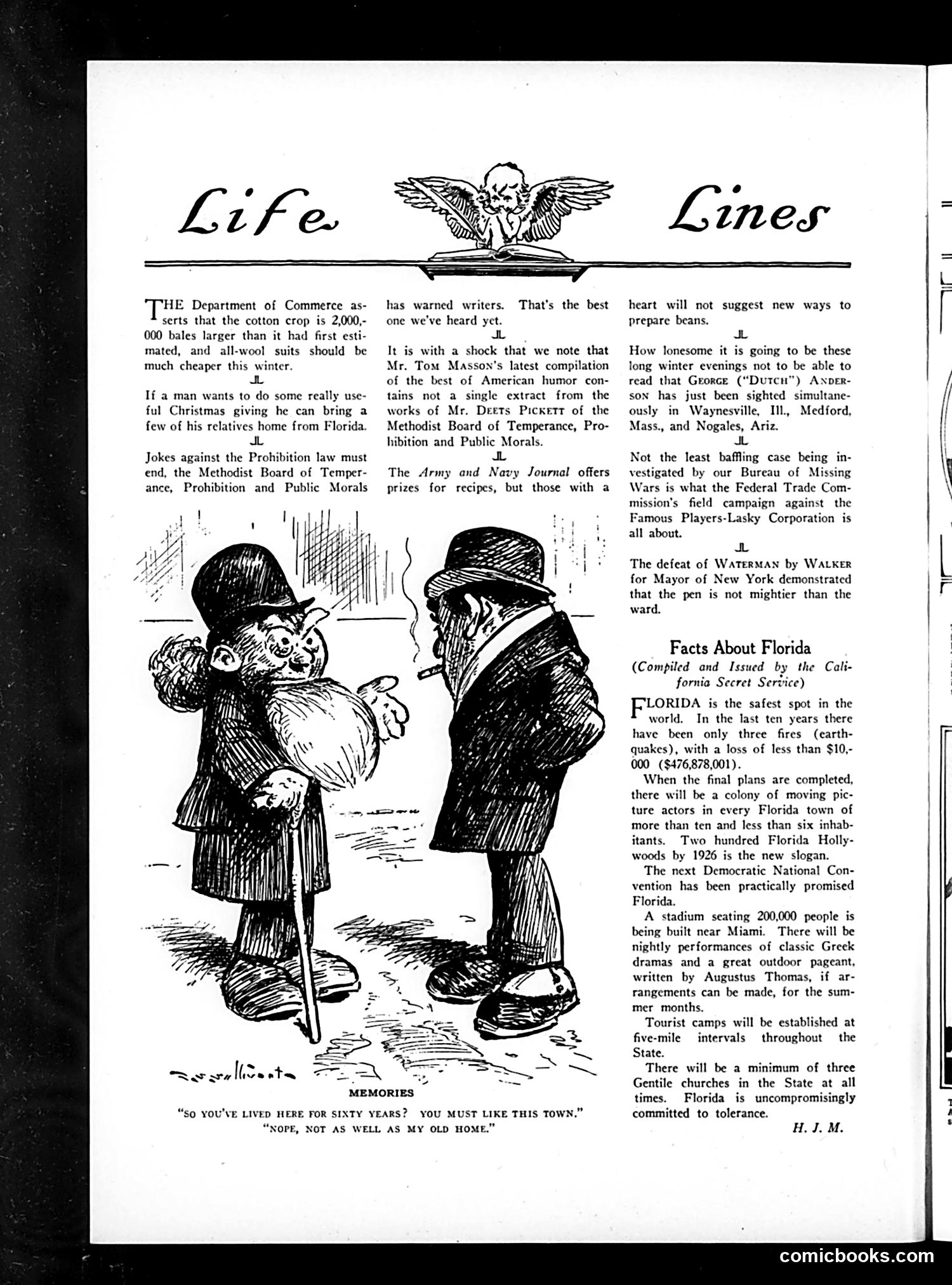
This satirical page mocks Prohibition-era complaints about long winters and homesickness. The cartoon depicts two men—one a long-time resident claiming sixty years in town, the other apparently a newcomer or transplant. The resident's complaint that he'd prefer to leave despite his decades there satirizes the paradox of staying somewhere you dislike. The text criticizes the Methodist Board of Temperance for publishing anti-Prohibition humor while supporting Prohibition itself, highlighting perceived hypocrisy. References include Tom Masson's humor compilation and mentions of various contemporary figures and scandals (Waterman's mayoral defeat, trade disputes). The "Facts About Florida" section promotes the state as safe and developing, listing planned theaters, stadiums, and religious institutions—essentially acting as tourism propaganda masked as factual reporting.
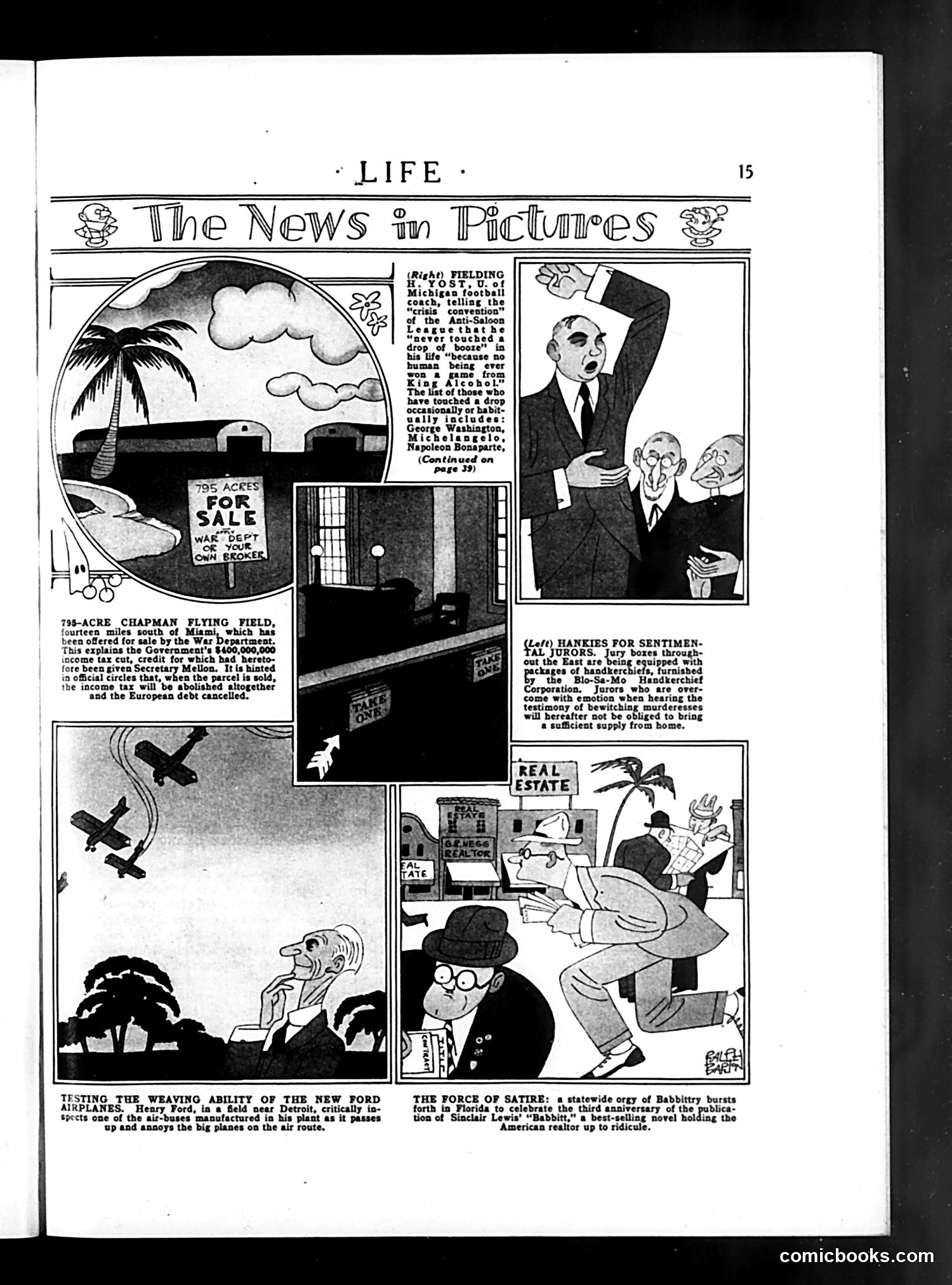
This page contains four satirical cartoons addressing early 1920s American issues: 1. **Chapman Flying Field**: Satirizes a government land sale south of Miami, mocking the income tax credit justification. 2. **Jury Box Sentiment**: Depicts three men (appearing to be judges or legal officials) discussing how jurors equipped with "Bio-Sa-Mo Handkerchief Corporation" products will no longer be obligated to provide emotional testimony in murder cases—mocking commercial manipulation of the legal system. 3. **Ford Airplane Testing**: Henry Ford's experimental aircraft design near Detroit receives critical commentary about safety. 4. **Force of Satire**: A Florida real estate agent is shown being kicked by a prospective buyer, satirizing the aggressive hype and deception in Florida's land boom of the 1920s, specifically mocking exaggerated promotional claims.
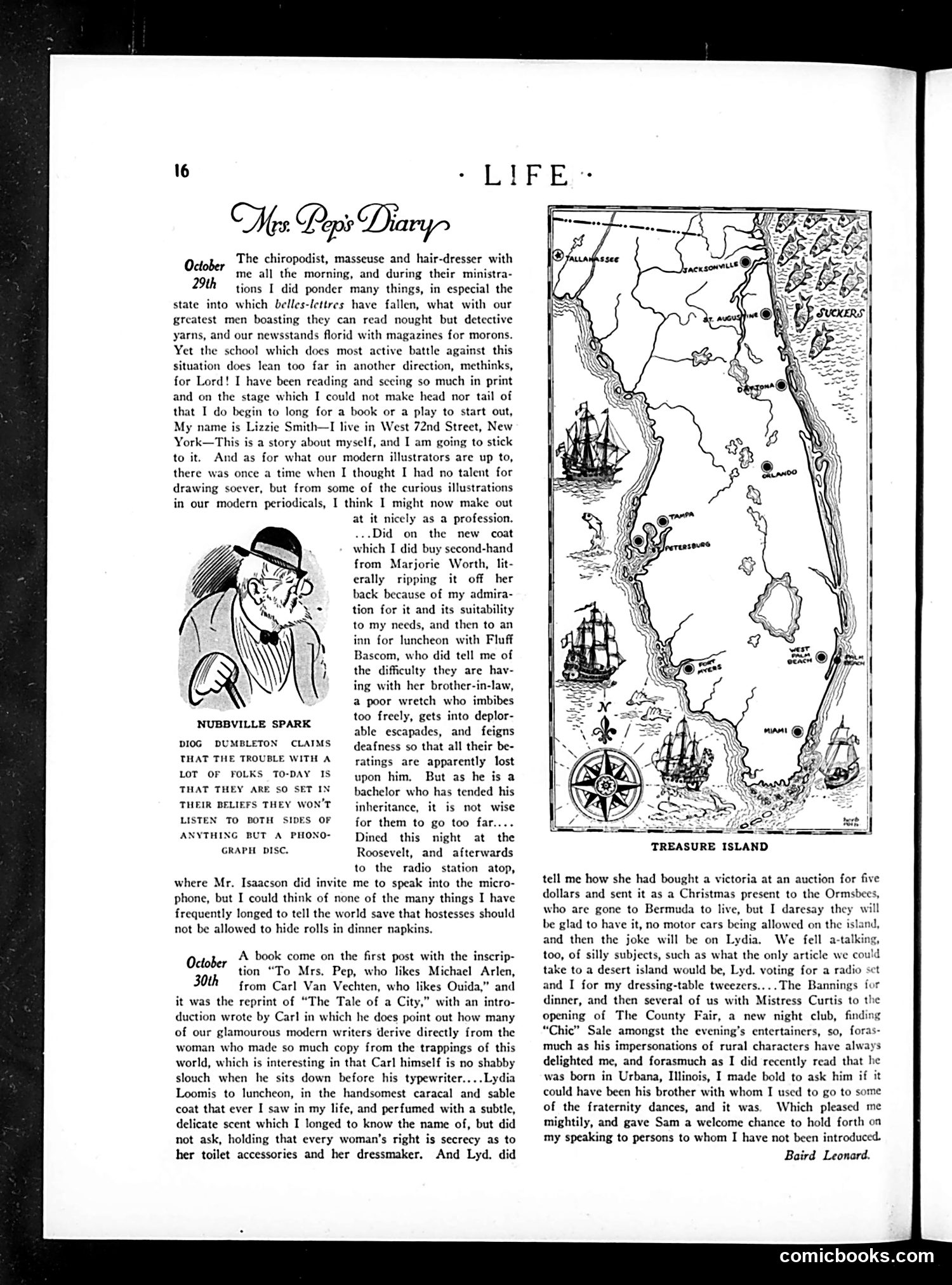
This page features a satirical diary entry from "Mrs. Peps" (Lizzie Smith of West 72nd Street, New York) dated October 29th-30th. The accompanying caricature depicts "Nubbyville Spark" — appearing to mock a pretentious or affected male figure, likely satirizing urban social pretension. The diary discusses the author's observations about modern illustrators, a secondhand coat purchased from Marjorie Worth, and various social encounters. There's a map labeled "Treasure Island" and references to radio broadcasts and social events. The satire appears to target early 20th-century urban middle-class affectations, social climbing, and the nouveaux riches's attempts at sophistication. The cartoonish illustration emphasizes this mockery through exaggerated features, typical of Life magazine's satirical approach to contemporary American society and manners.
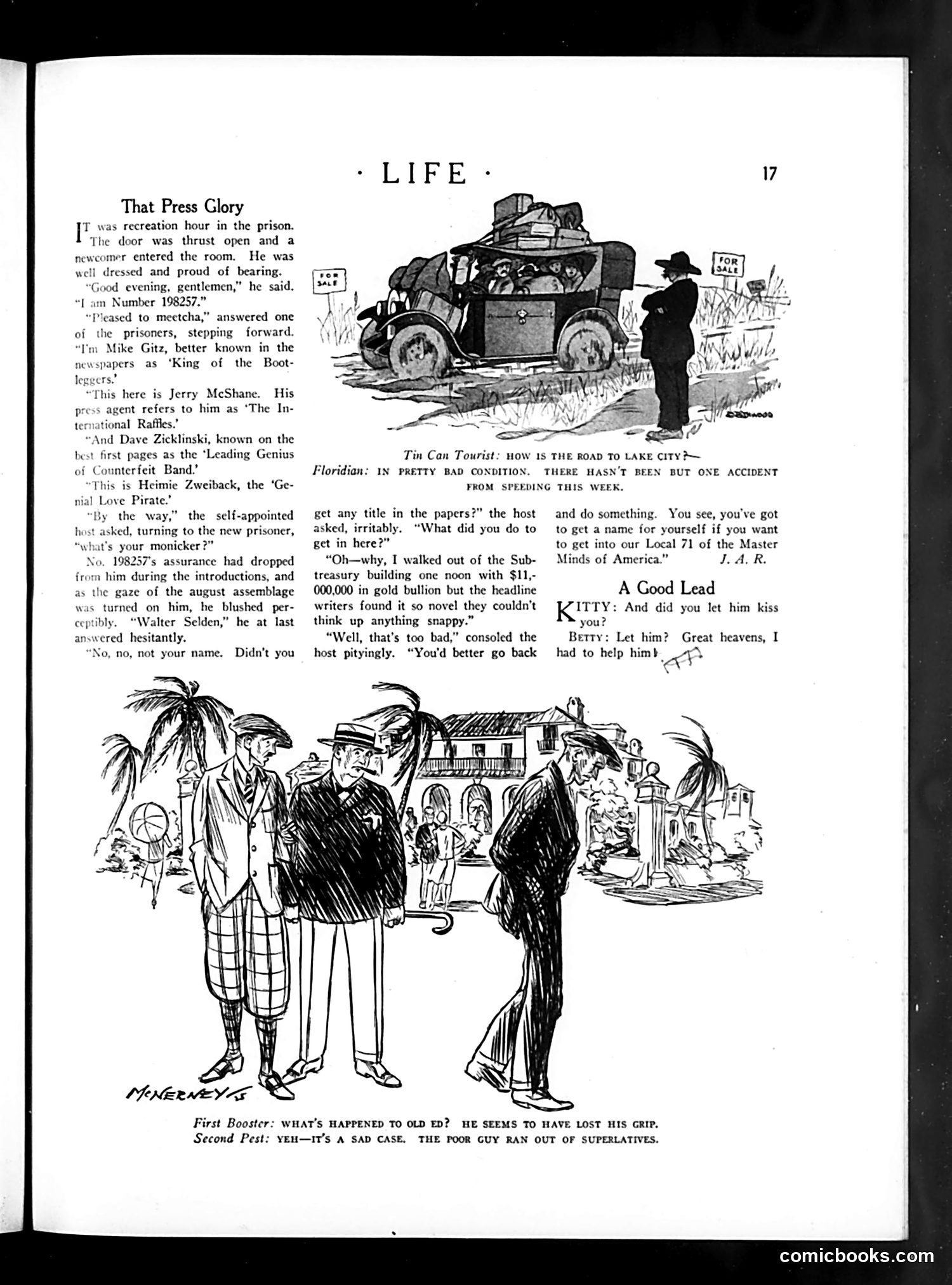
This satirical piece mocks criminals who gain notoriety through sensational newspaper coverage. A new prisoner, Walter Selden, enters a jail cell where hardened criminals proudly display their "press titles"—nicknames earned from lurid headlines. Selden admits to stealing $11 million in gold bullion, yet newspapers found the crime too ordinary to sensationalize. The established criminals pity him, explaining he needs a catchy alias to join their exclusive group, "Local 71 of the Master Minds of America." The satire targets both the criminals' vanity and newspapers' complicity in creating celebrity from crime through sensational reporting. The humor lies in criminals valuing press notoriety as social currency—they're less concerned with the crimes themselves than with achieving memorable headlines. The bottom cartoons offer additional comic commentary: one about deteriorating Florida roads, another mocking a man who's exhausted superlatives in praise.
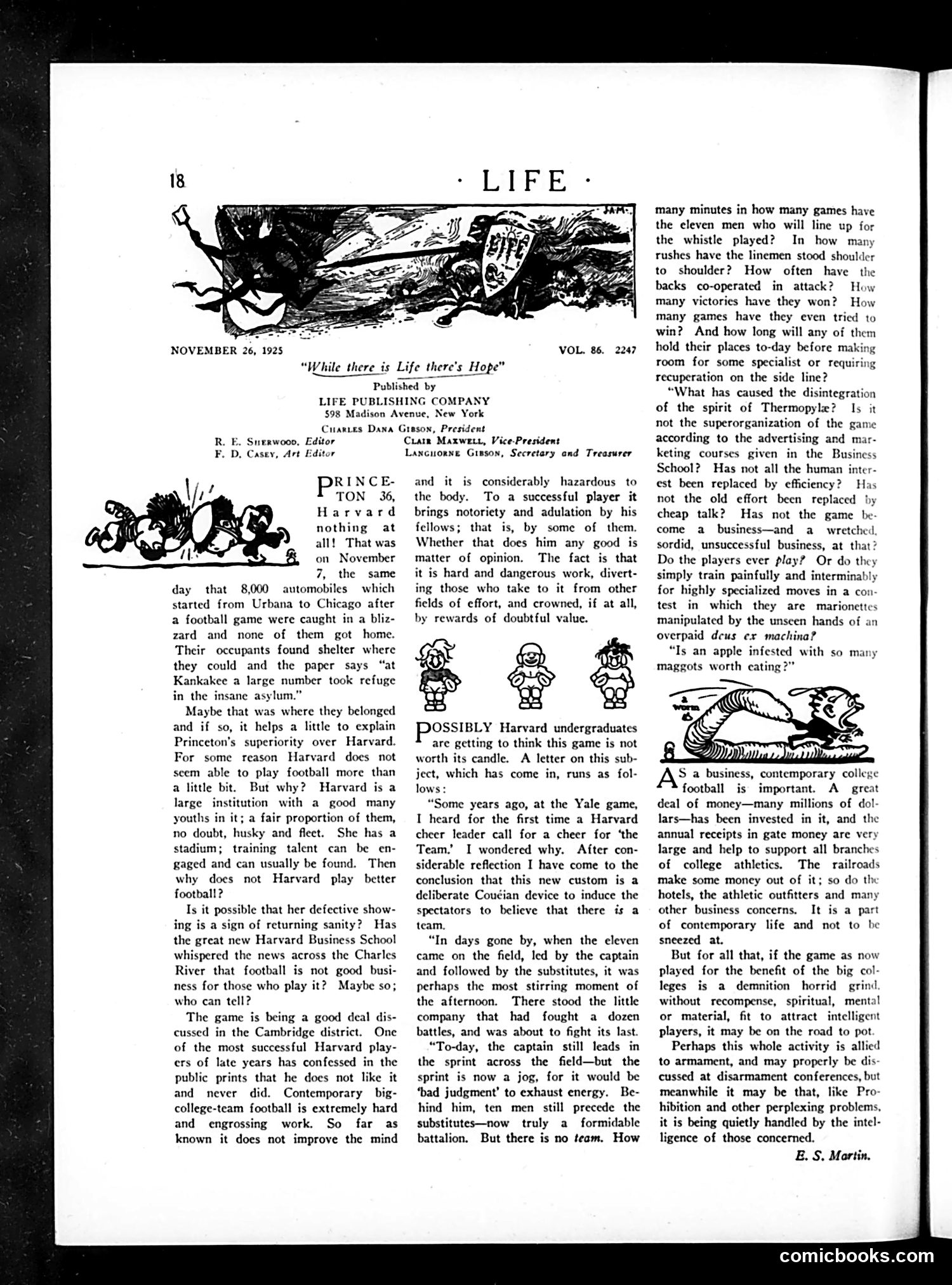
This page critiques Harvard University's poor football performance relative to Princeton. The article mocks Harvard's athletics program, suggesting its weakness may paradoxically indicate "returning sanity"—implying competitive college football is dangerous, time-consuming, and morally questionable. A reader's letter argues that Harvard no longer fields a true "team." It sarcastically notes that cheerleaders now must call for cheers for "the Team" as if willing it into existence—a reference to Émile Coué's popular "autosuggestion" self-help method. The letter laments that modern Harvard football lacks the cohesion and fighting spirit of past years, instead fielding constantly rotating specialists with no genuine unity. The cartoon (top) appears to show Princeton football players in contrast to Harvard's perceived weakness. The satire targets both the corruption of college athletics and Harvard's institutional decline in this competitive arena.
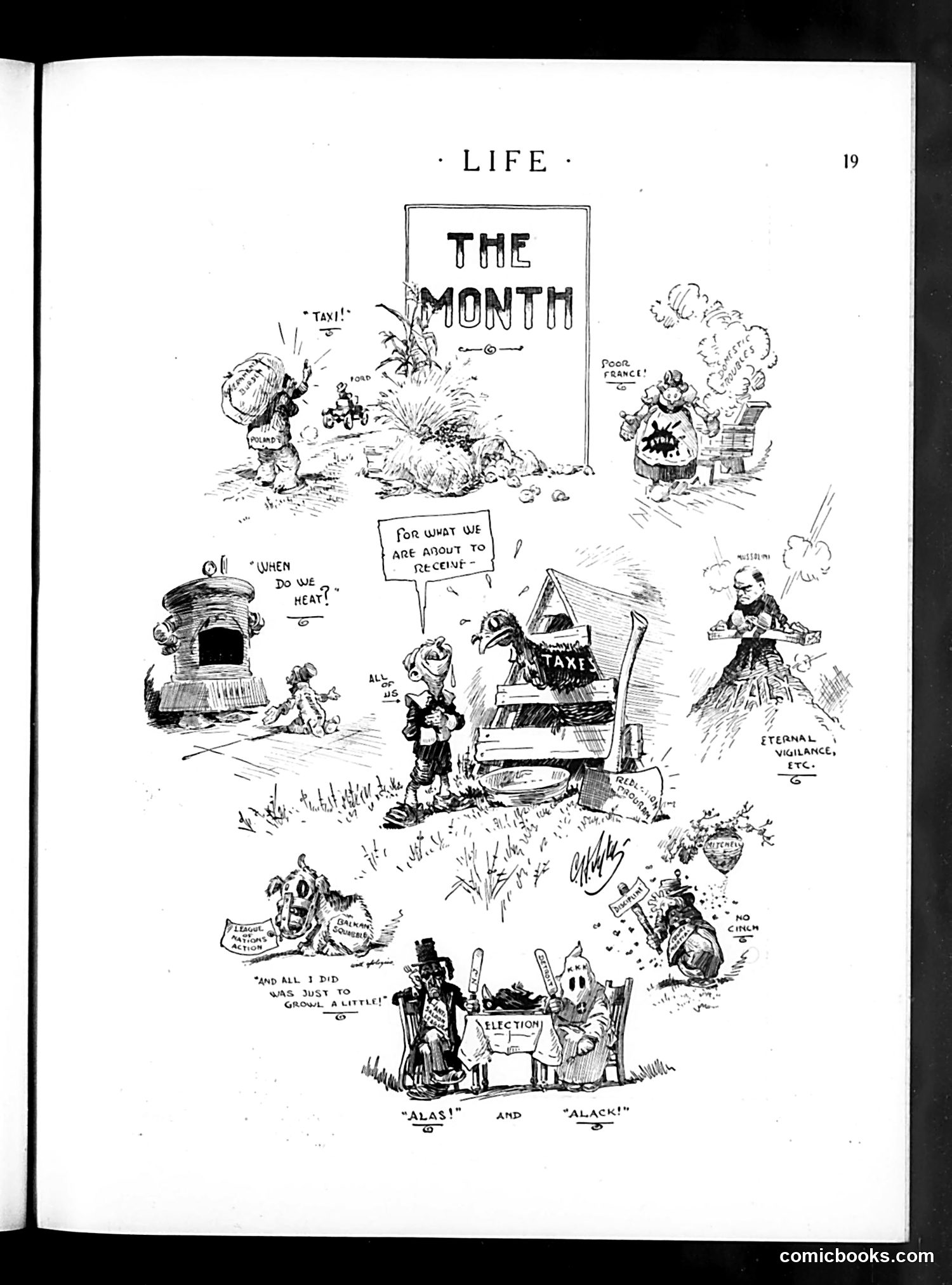
This is a satirical cartoon montage titled "The Month," depicting various American anxieties and grievances. The central figure holds a sign reading "For what we are about to receive," a prayer phrase suggesting foreboding. The surrounding vignettes represent different sources of public complaint: a taxi driver (transportation costs), a homeowner in distress ("When do we heat?"), France (post-WWI tensions), election politics ("Alas!" and "Alack!"), and various labeled concerns like "Eternal Vigilance." The overall message appears to satirize Americans bracing for hardship—whether economic troubles, housing/heating issues, international tensions, or political uncertainty. The phrase "all I did was just to growl a little" suggests citizens merely complained before accepting their fate. This likely dates to the interwar period, reflecting post-war anxieties about inflation, housing shortages, and political instability.
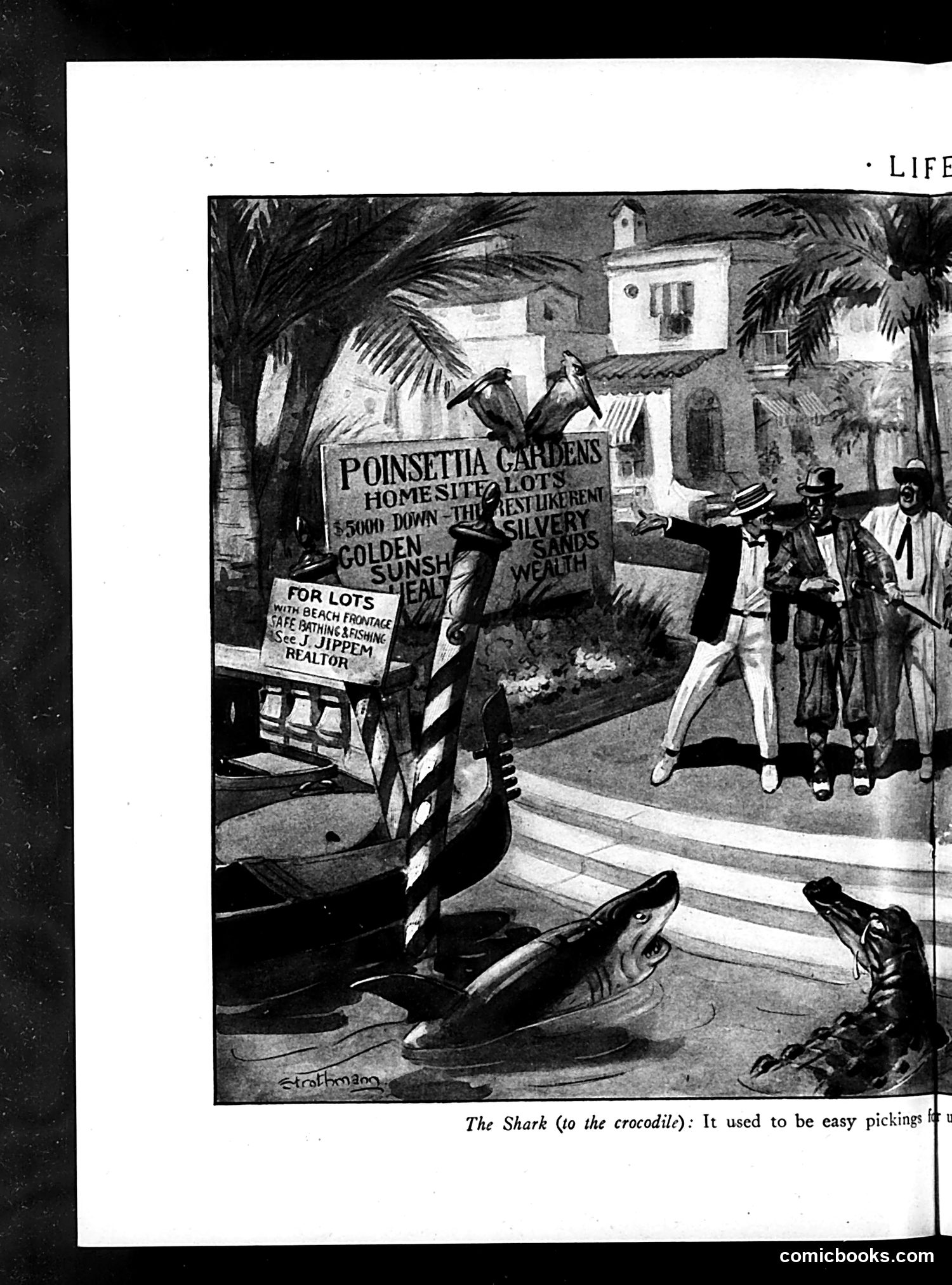
This cartoon satirizes real estate fraud in what appears to be Florida development schemes. The image shows a tropical setting with palm trees and Spanish colonial architecture, featuring signs advertising "Poinsettia Gardens" and similar developments with promises of "home site lots," "golden sunshine," and "wealth." Two predatory figures (a shark and crocodile, depicted as con artists) discuss "easy pickings"—referring to gullible investors. The well-dressed men observing the scheme represent victims or potential buyers. The satire targets the Florida land boom era when developers sold worthless or swampy properties to unsuspecting buyers through exaggerated marketing claims. The predator metaphor emphasizes how investors were being swindled by unscrupulous real estate promoters exploiting dreams of tropical paradise.
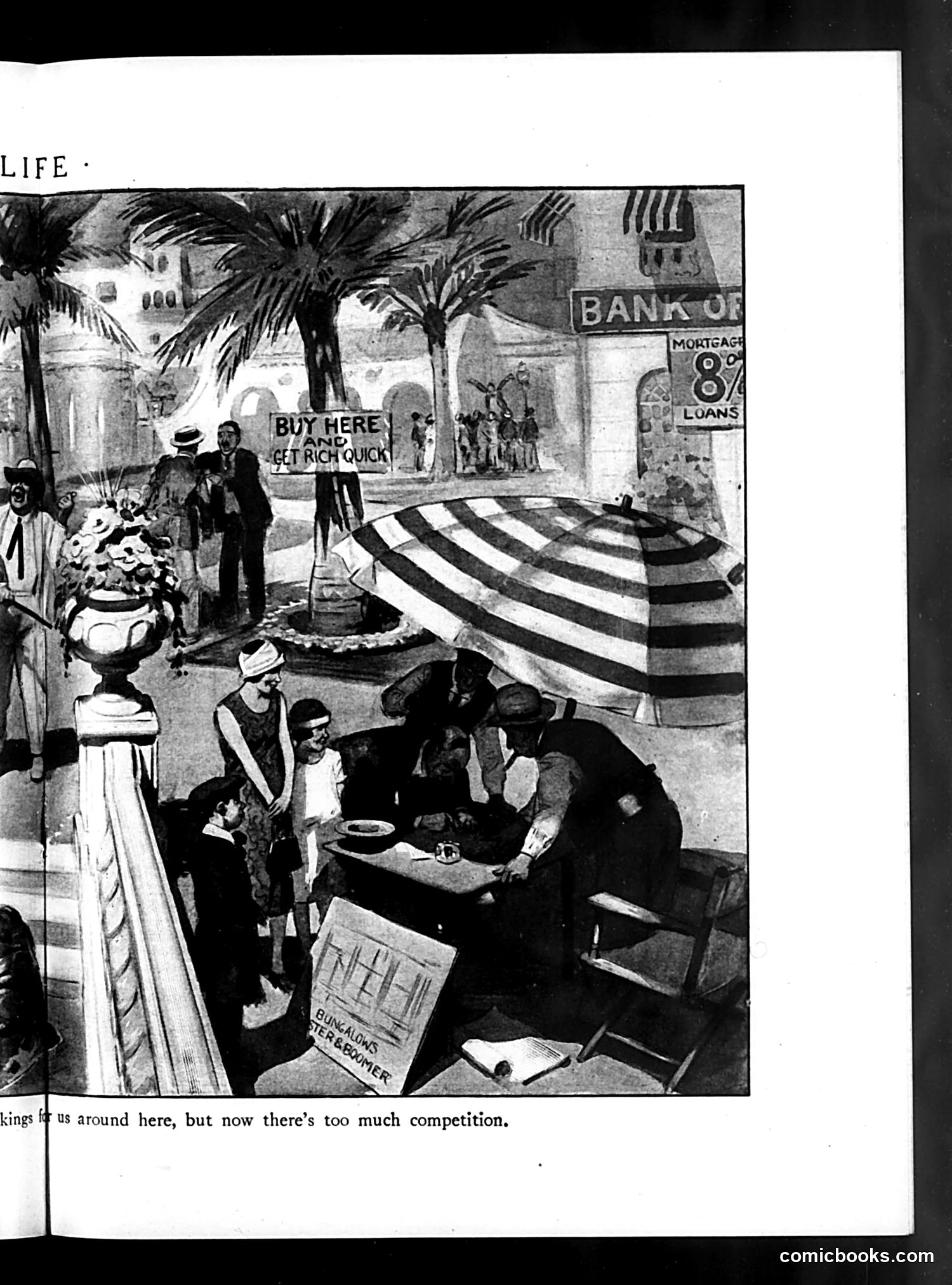
This appears to be a satirical illustration about real estate or land speculation, likely from the 1920s Florida land boom era. The scene depicts a tropical setting with palm trees, a "Bank of" building advertising "Mortgage 8% Loans," and a prominent sign reading "BUY HERE GET RICH QUICK." A striped umbrella shields people gathered around what appears to be a sales transaction or pitch. The incomplete caption references that "kings" used to dominate ("us around here"), but now "there's too much competition"—suggesting satire about how aggressive salesmen and speculators have flooded the market. The "BUNGALOWS" sign visible in the crowd reinforces the real estate theme. The cartoon mocks the get-rich-quick mentality and fraudulent land schemes that characterized speculative booms, with the bank and aggressive marketing symbolizing predatory financial practices.
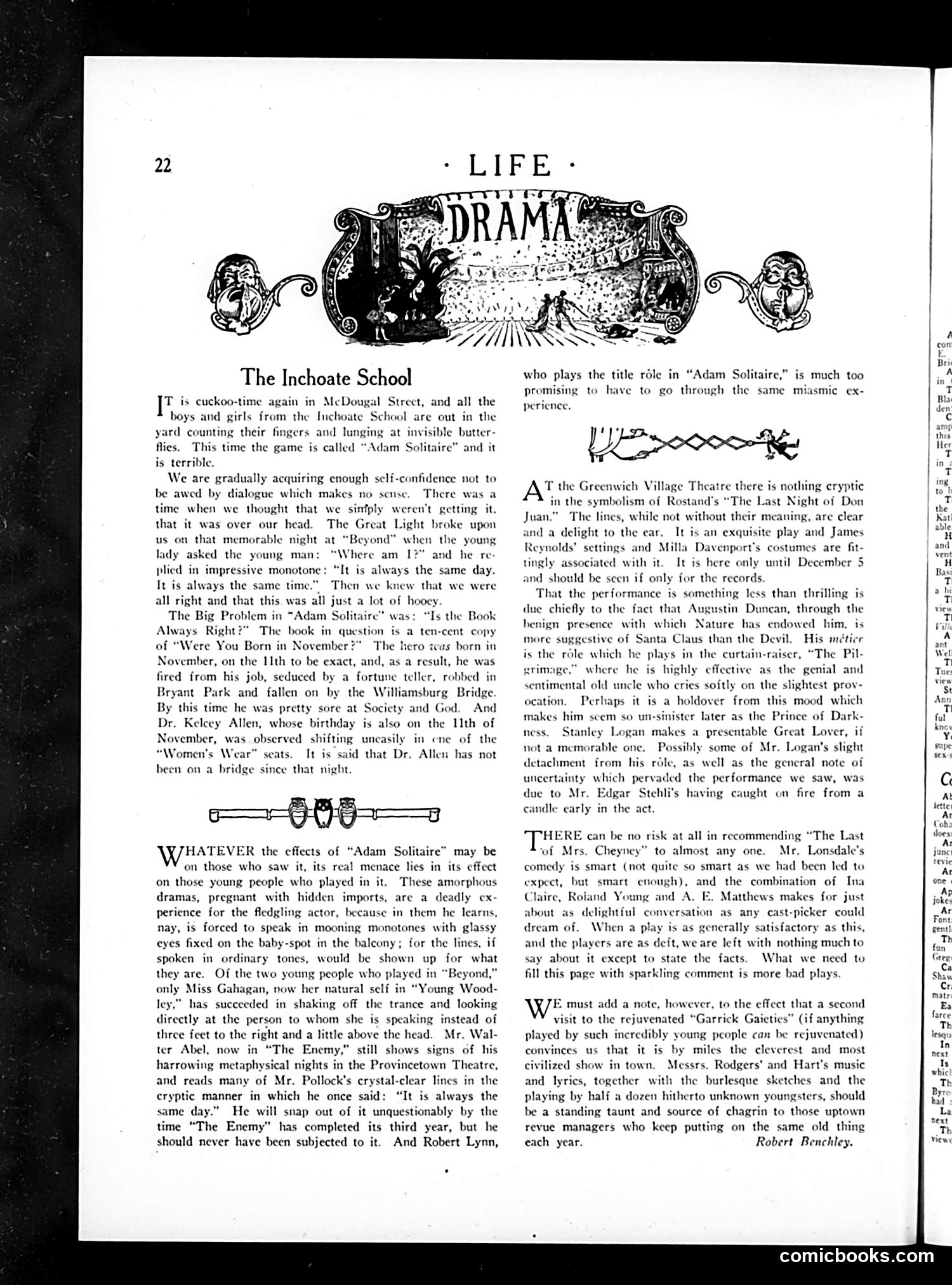
This page reviews several experimental/avant-garde theatrical productions. The satire targets the "Inchoate School" of drama—deliberately obscure, nonsensical plays performed in Greenwich Village's Provincetown Theatre. The critic ridicules plays like "Adam Solitaire" and "Beyond" for their pretentious meaninglessness. The joke: audiences initially felt stupid not understanding these works, until realizing the plays themselves were "just a lot of hooey." The review mocks actors forced to deliver meaningless dialogue in affected, monotone styles—staring at nothing, eyes "fixed on the baby-spot in the balcony." Young performers like Helen Gahagan and Walter Abel are pitied for being subjected to this "deadly experience." The contrast comes via Rostand's "The Last Night of Don Juan" at Greenwich Village Theatre—a genuinely sophisticated play with clear meaning and beautiful language—demonstrating that complexity need not mean incomprehensibility. The satire attacks modernist theater's obscurantism while praising genuine artistic merit.
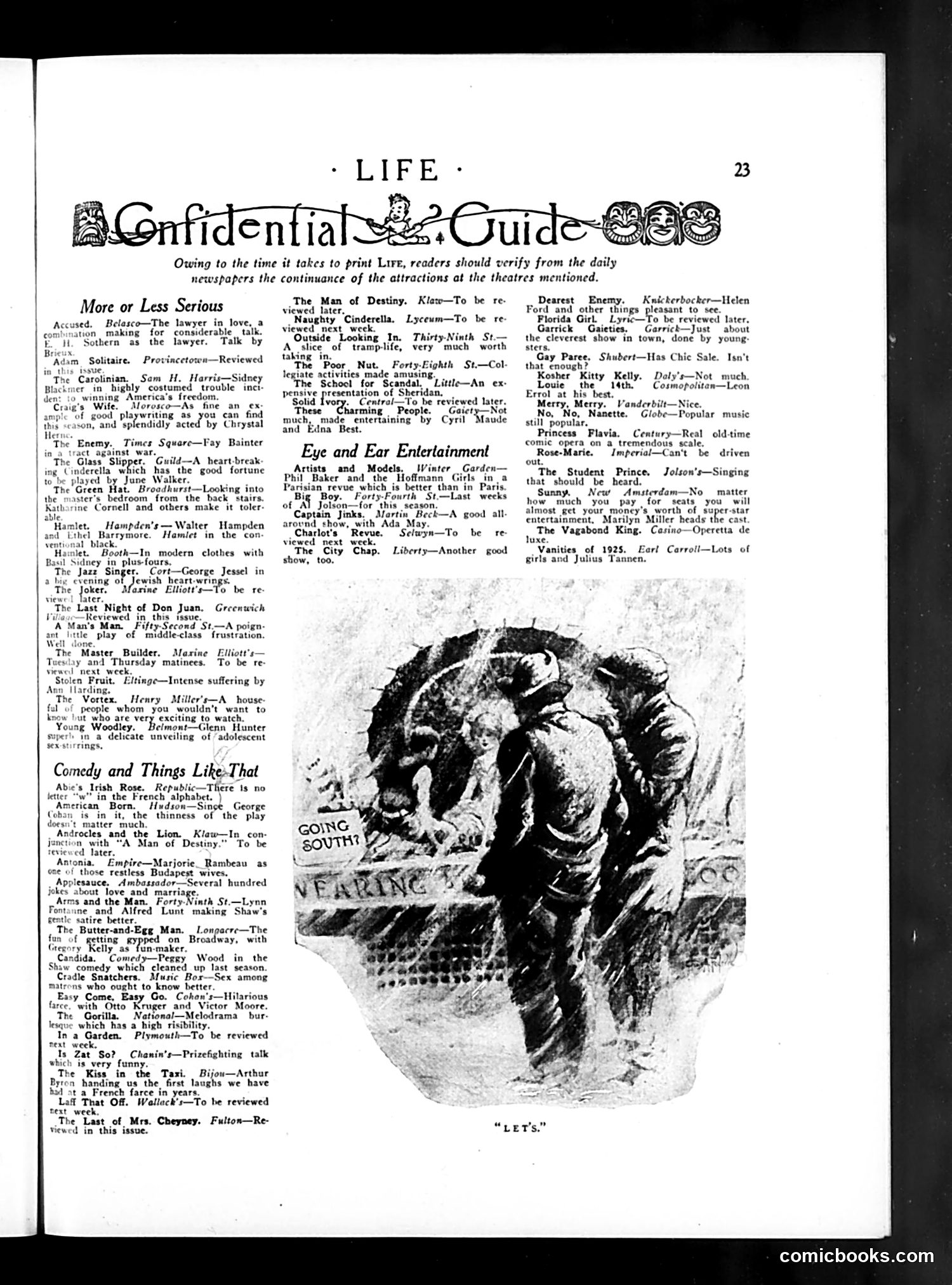
This page from *Life* magazine presents theater reviews alongside a political cartoon titled "Let's." The cartoon depicts two figures in what appears to be a rowboat labeled "Going South" and "Marking Time"—likely referencing post-WWI American politics and the sense of stagnation or drift in national direction. The figures appear to be caricatures of political leaders or public figures (unclear which specific individuals from the image alone), seemingly trapped or stuck in indecision about the nation's course. The "Going South" reference suggests either economic decline or a loss of progress, while "Marking Time" emphasizes inaction. The satire critiques political leadership for failing to move the country forward decisively—a common *Life* magazine theme during the 1920s era when this appeared. The boat imagery suggests they're adrift without clear direction, unable to commit to either action or policy.
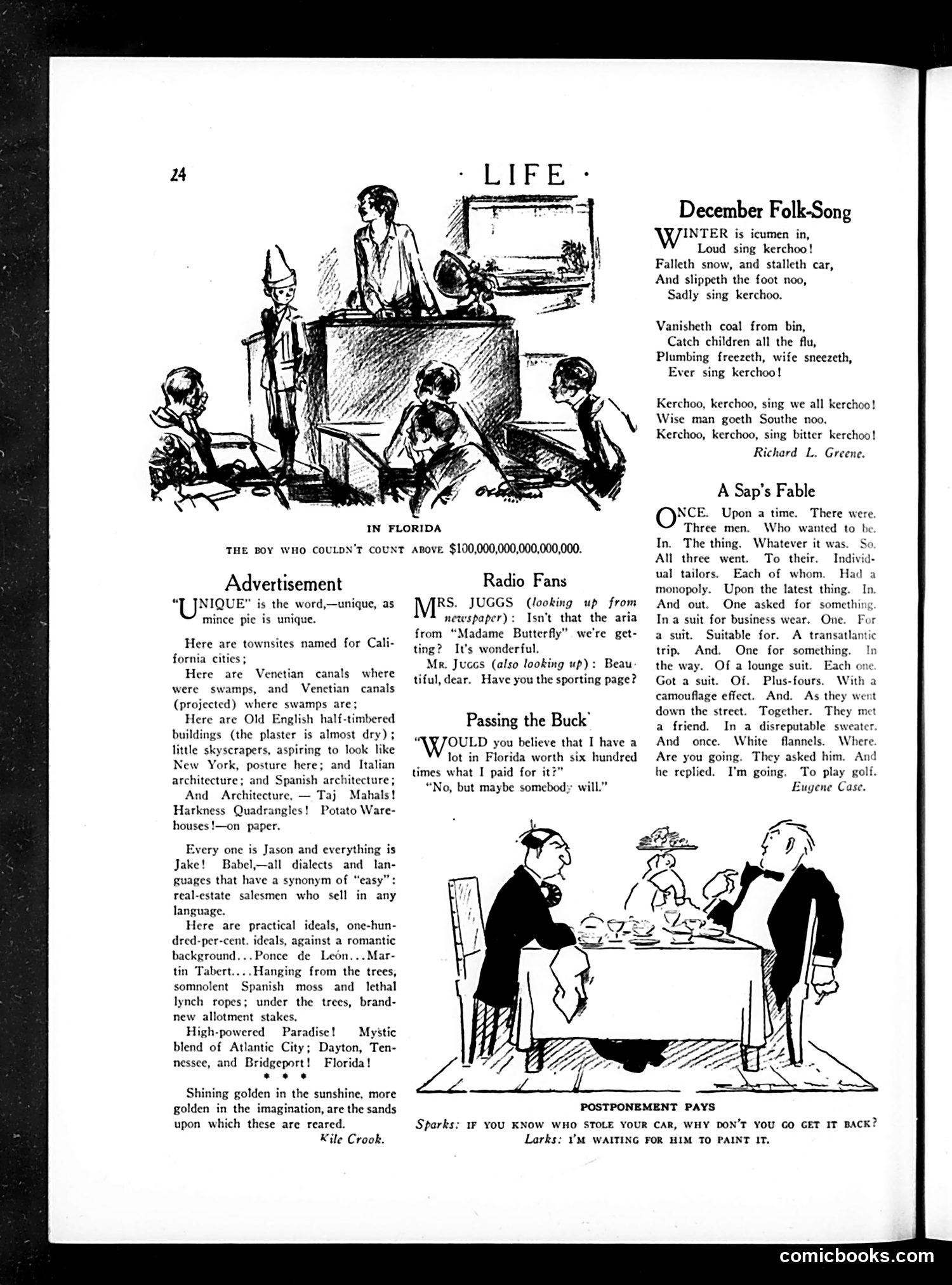
This page satirizes the **Florida real estate boom of the 1920s**, a speculative bubble where developers sold overpriced, largely imaginary properties to gullible investors. **The Main Advertisement** mocks Florida development schemes: grandiose architectural pastiches (Taj Mahals, Venetian canals on drained swamps), fake European atmospheres, and con-artist salesmen peddling "easy" investments. The title cartoon—"The Boy Who Couldn't Count Above $100,000,000,000,000,000"—suggests the absurd valuations involved. **"Passing the Buck"** presents a direct con: someone claims Florida property worth 600 times their investment, and the listener replies cynically: "No, but maybe somebody will"—implying endless marks willing to buy inflated claims. The other content (folk songs, fables, radio humor) fills space but remains tangential. The overall message: Florida real estate was pure speculation built on false promises, designed to fleece naive buyers through exaggerated claims and slick salesmanship.
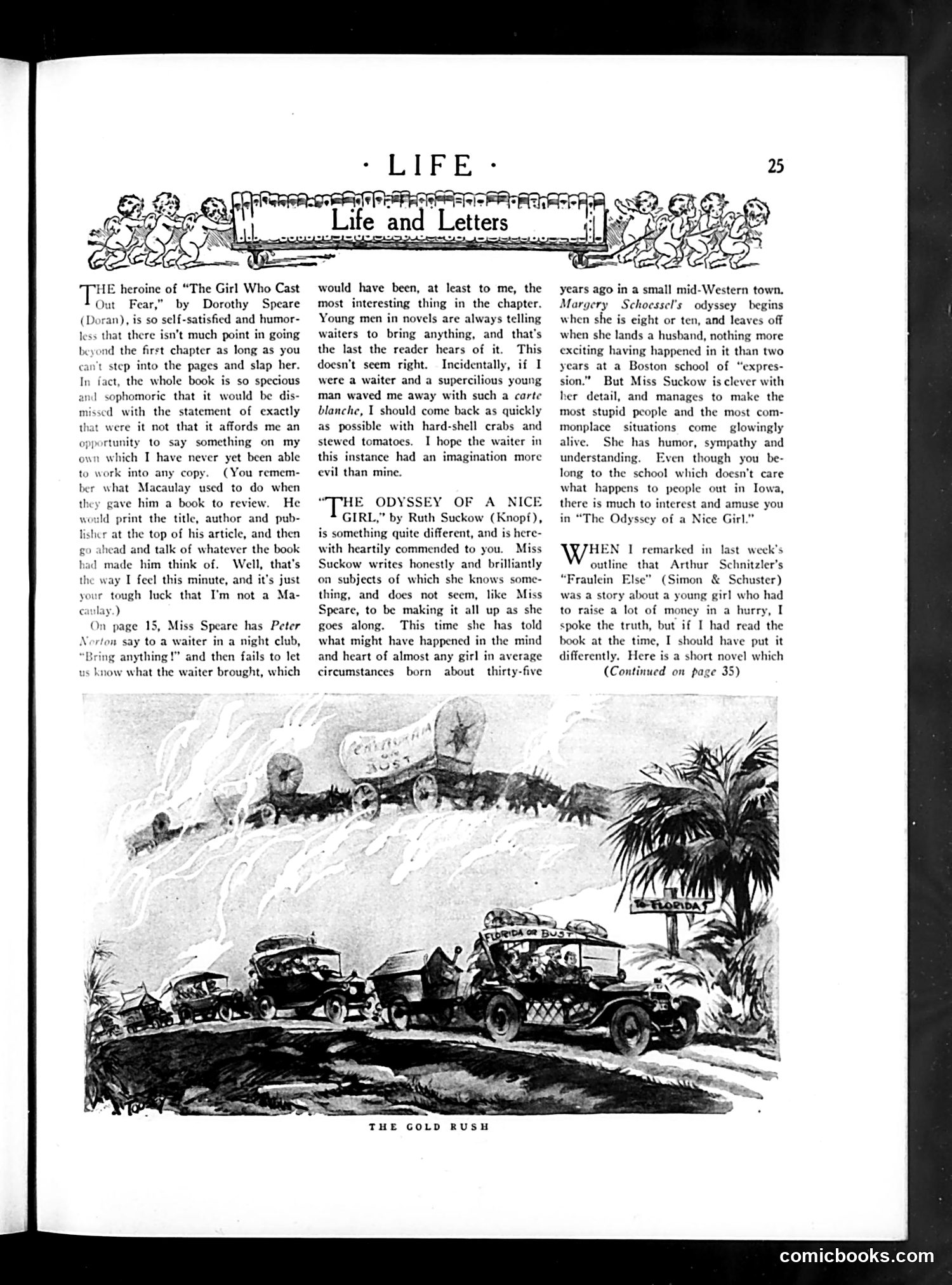
This is a literary criticism page featuring book reviews. The main content is a satirical essay by the columnist (likely Edmund Wilson or similar era critic) reviewing three novels: 1. **"The Girl Who Cast Out Fear"** by Dorothy Speare—dismissed as pretentious and boring, with the critic using it as a springboard to complain about a narrative gap (a waiter never returns with the ordered food). 2. **"The Odyssey of a Nice Girl"** by Ruth Suckow—praised for honest, detailed storytelling about an ordinary Midwestern woman's life from childhood to marriage. 3. **"Fräulein Else"** by Arthur Schnitzler—briefly mentioned as a short novel about a girl needing to raise money quickly. **The illustration** titled "The Gold Rush" depicts vehicles and crowds heading toward Florida (marked on a palm tree), likely satirizing the 1920s Florida land boom speculation craze where Americans rushed to invest in Florida real estate. The column exemplifies Life's blend of literary criticism with humorous social commentary.
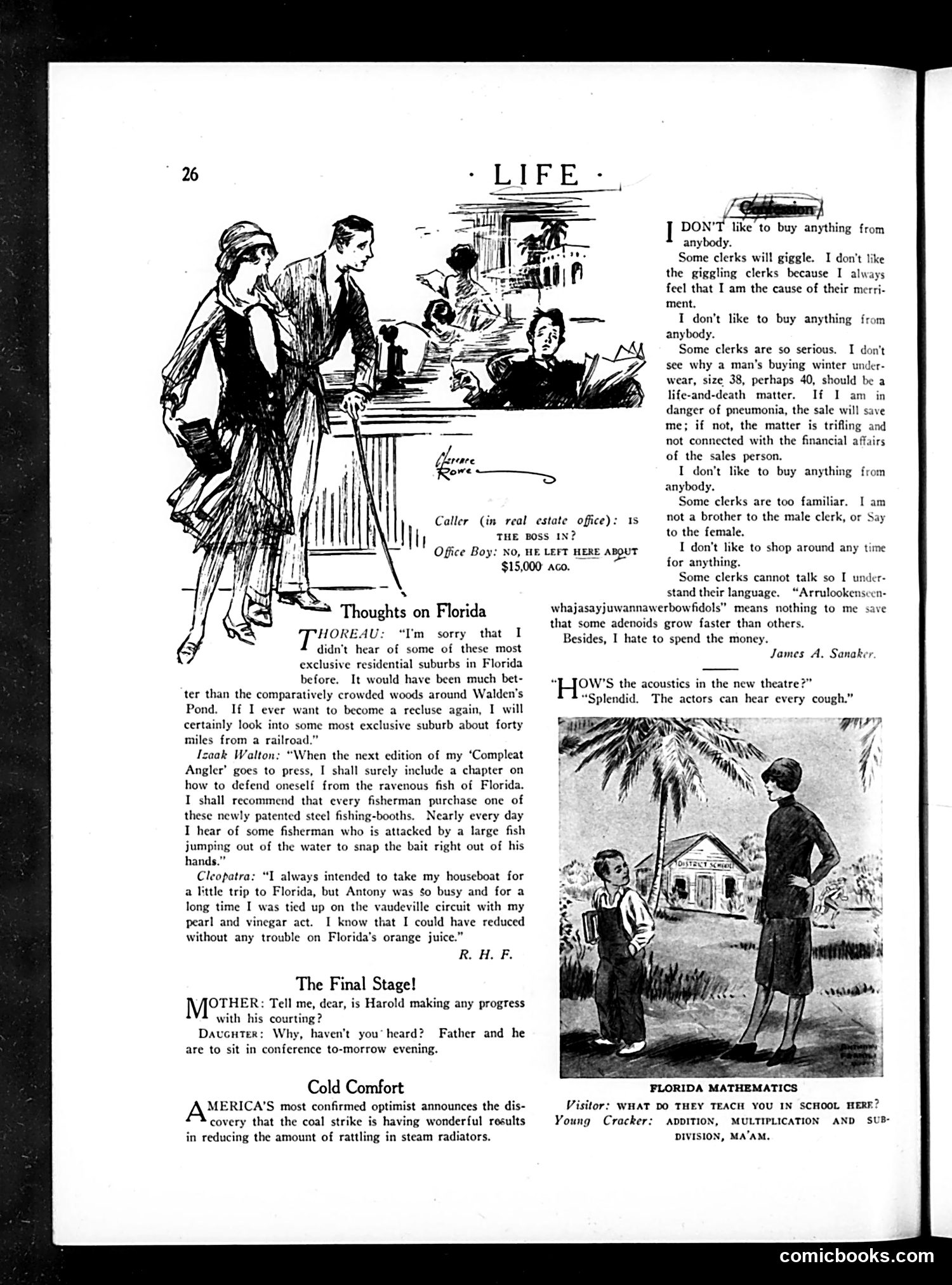
**Main Cartoon (top):** A real estate office caller asks if the boss is in; the office boy replies he left "$15,000 ago"—satirizing the Florida real estate bubble where salesmen absconded with clients' money. **"Thoughts on Florida" Section:** Famous historical figures (Thoreau, Izaak Walton, Cleopatra) are humorously imagined commenting on Florida. The satire mocks Florida's dangerous wildlife (aggressive fish requiring steel "fishing-booths") and its attractions as a resort destination, presenting it as simultaneously exclusive and hazardous. **"The Final Stage" Comic:** A mother asks about her daughter's suitor's progress; the daughter reveals he and her father will "sit in conference tomorrow"—suggesting the courtship has reached formal, bureaucratic negotiations rather than romantic moments. **"Cold Comfort" Item:** Darkly jokes that America's coal strike (a labor dispute causing heating fuel shortages) has an unexpected benefit: reduced radiator rattling. The page reflects 1920s anxieties: Florida's speculative boom-and-bust, labor unrest, and courtship formalities.
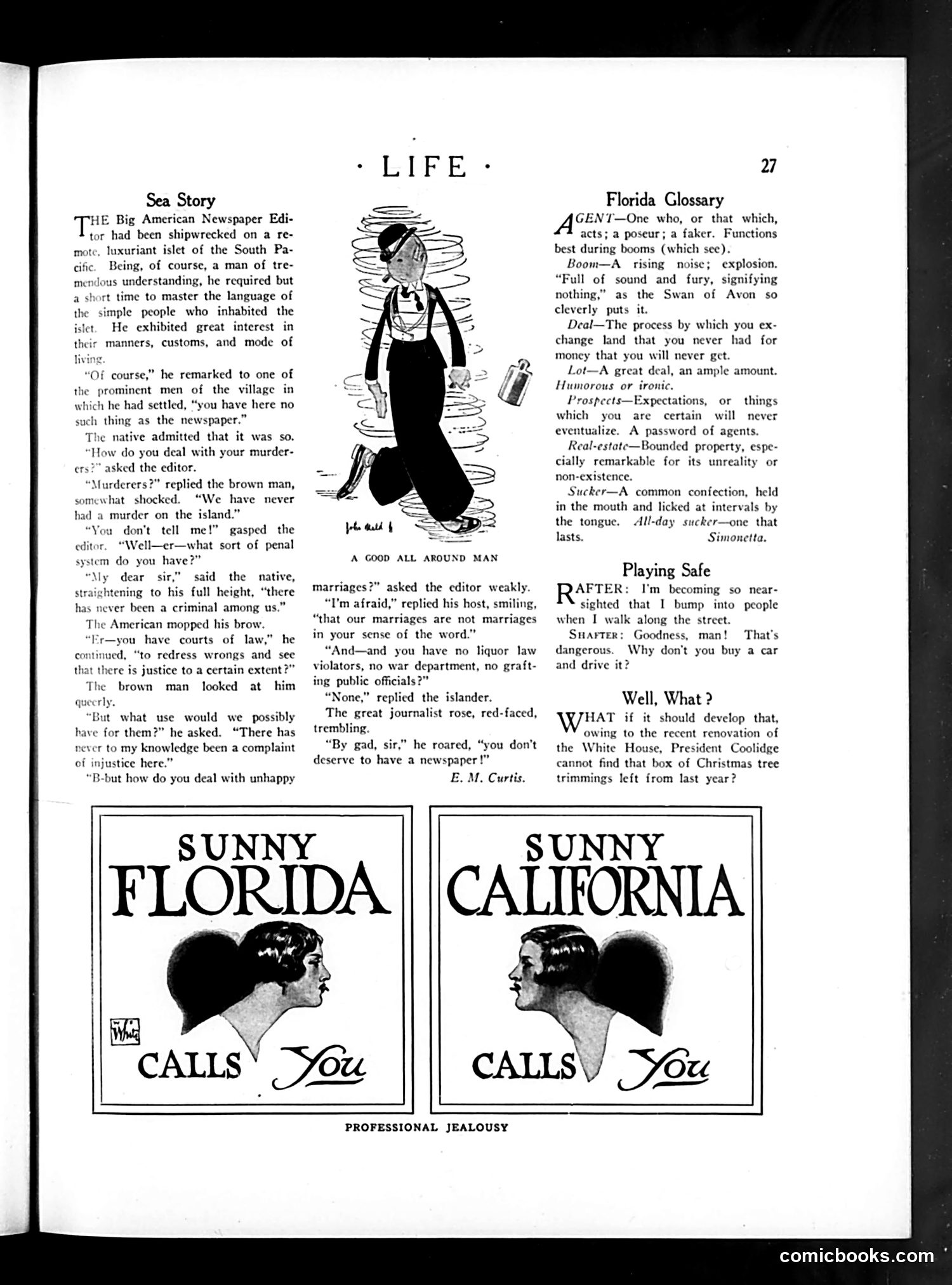
This page contains three distinct satirical pieces mocking early 20th-century American society: **"Sea Story"** (main narrative): A shipwrecked American newspaper editor encounters a peaceful Pacific island society with no crime, courts, or corruption. Horrified by their lack of conflict, he declares they "don't deserve to have a newspaper." The satire skewers American journalism's dependence on sensationalism and crime reporting—suggesting newspapers require societal dysfunction to exist. **"Florida Glossary"**: A comedic glossary mocking Florida real estate fraud. Terms like "Real-estate" (property with "unreality or non-existence") and "Lot" (land you never owned exchanged for money you'll never get) satirize the era's land speculation bubble and dishonest developers. **"Professional Jealousy"** (bottom cartoons): Two competing state tourism advertisements ("Sunny Florida Calls You" / "Sunny California Calls You") represent competitive boasting between states—the "jealousy" of rival destinations vying for visitors. These reflect 1920s concerns: press sensationalism, real estate fraud, and regional competition.
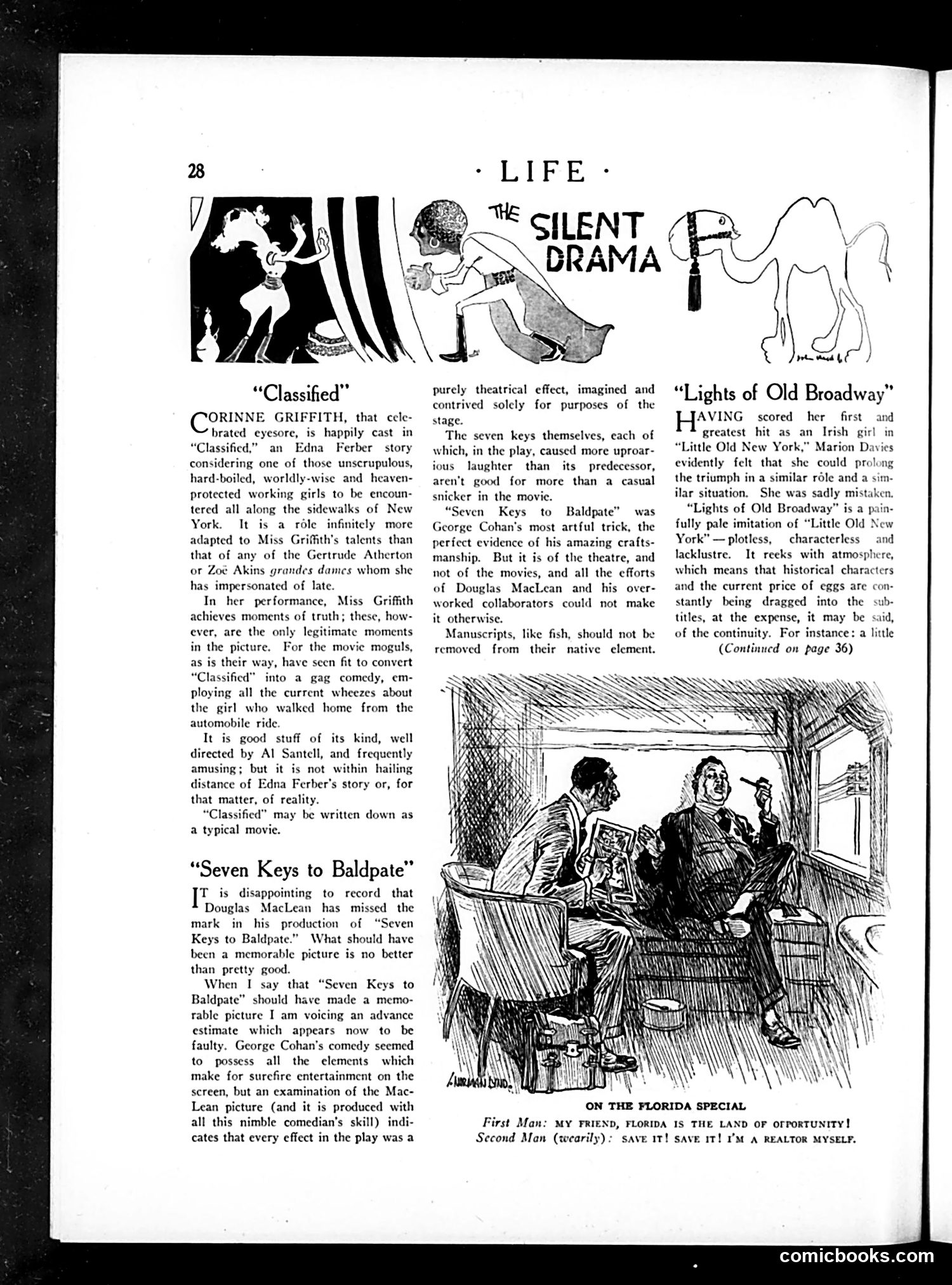
This page contains three film reviews from Life's "Silent Drama" section, critiquing recent movies. **"Classified"** stars Corinne Griffith (described sarcastically as a "celebrated eyesore") in an adaptation of Edna Ferber's story about a working girl. The reviewer praises Griffith's occasional moments of authenticity but criticizes the filmmakers for converting the serious material into a cheap comedy with tired jokes about women and automobiles. **"Seven Keys to Baldpate,"** based on George Cohan's celebrated stage play, fails because theatrical effects don't translate to cinema. The reviewer argues the play's carefully crafted comedy bits (the "seven keys") that worked brilliantly on stage fall flat on screen—a central problem when adapting stage work: "manuscripts, like fish, should not be removed from their native element." **"Lights of Old Broadway"** is panned as a pale imitation of Marion Davies' earlier success "Little Old New York." It's dismissed as plotless and characterless, drowning in historical atmosphere at the expense of narrative coherence. The cartoon at bottom satirizes real estate salesmen in Florida, warning against their overused pitch about opportunity.
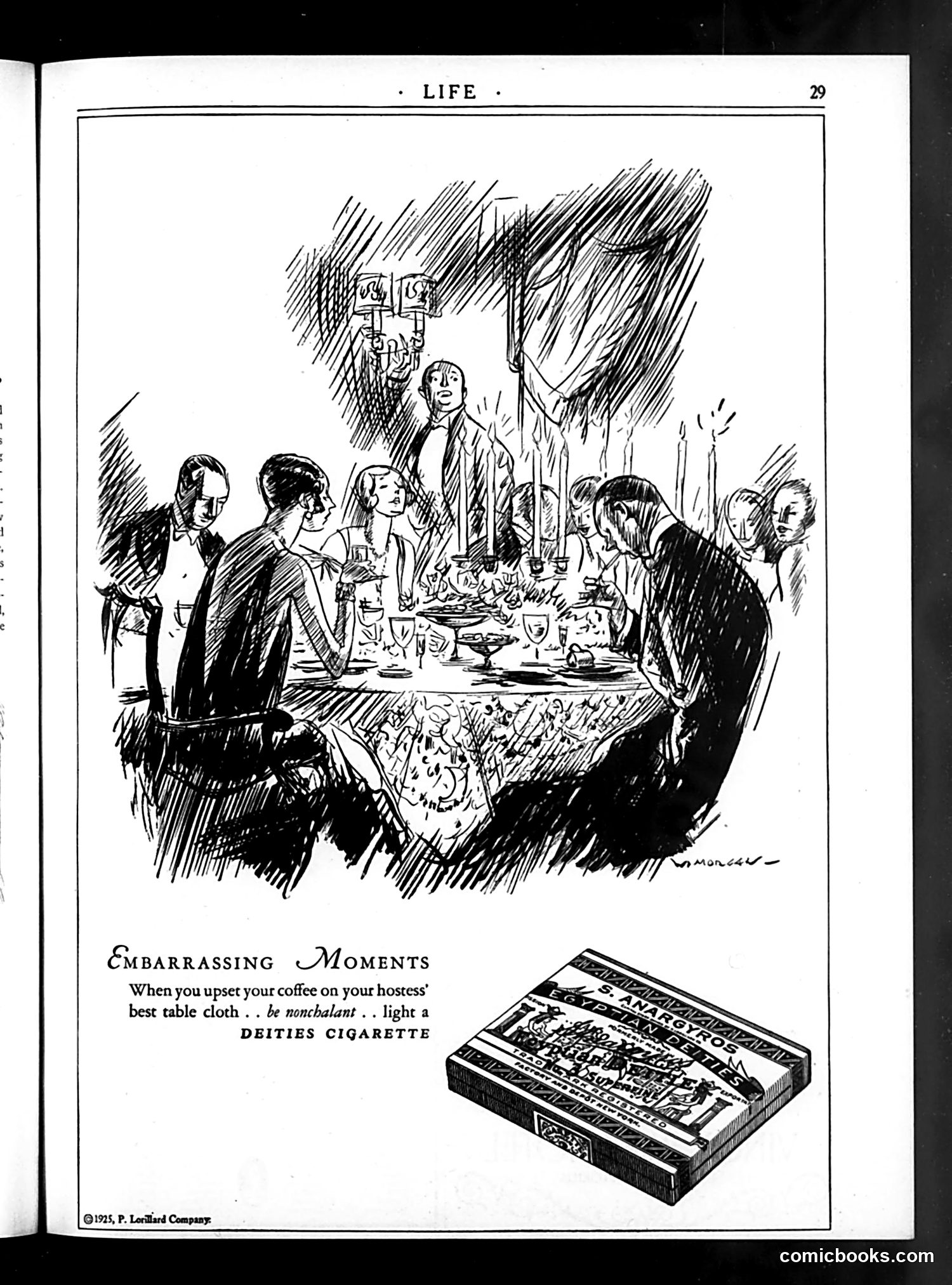
This is a 1920s cigarette advertisement disguised as humorous social commentary. The illustration depicts an embarrassing dinner party scene: a guest has spilled coffee on the hostess's tablecloth, causing visible distress among the assembled diners. The "joke's" solution is absurdly cynical by modern standards: respond to this social disaster by casually lighting a Deities cigarette, apparently using nonchalance and smoking to deflect from the mishap. This reflects early 20th-century advertising logic—positioning cigarettes as props for social confidence and sophistication. The ad exploits common anxieties about etiquette while promoting smoking as a casual, confident response to embarrassment. Such messaging would be considered both tasteless and illegal in modern advertising.
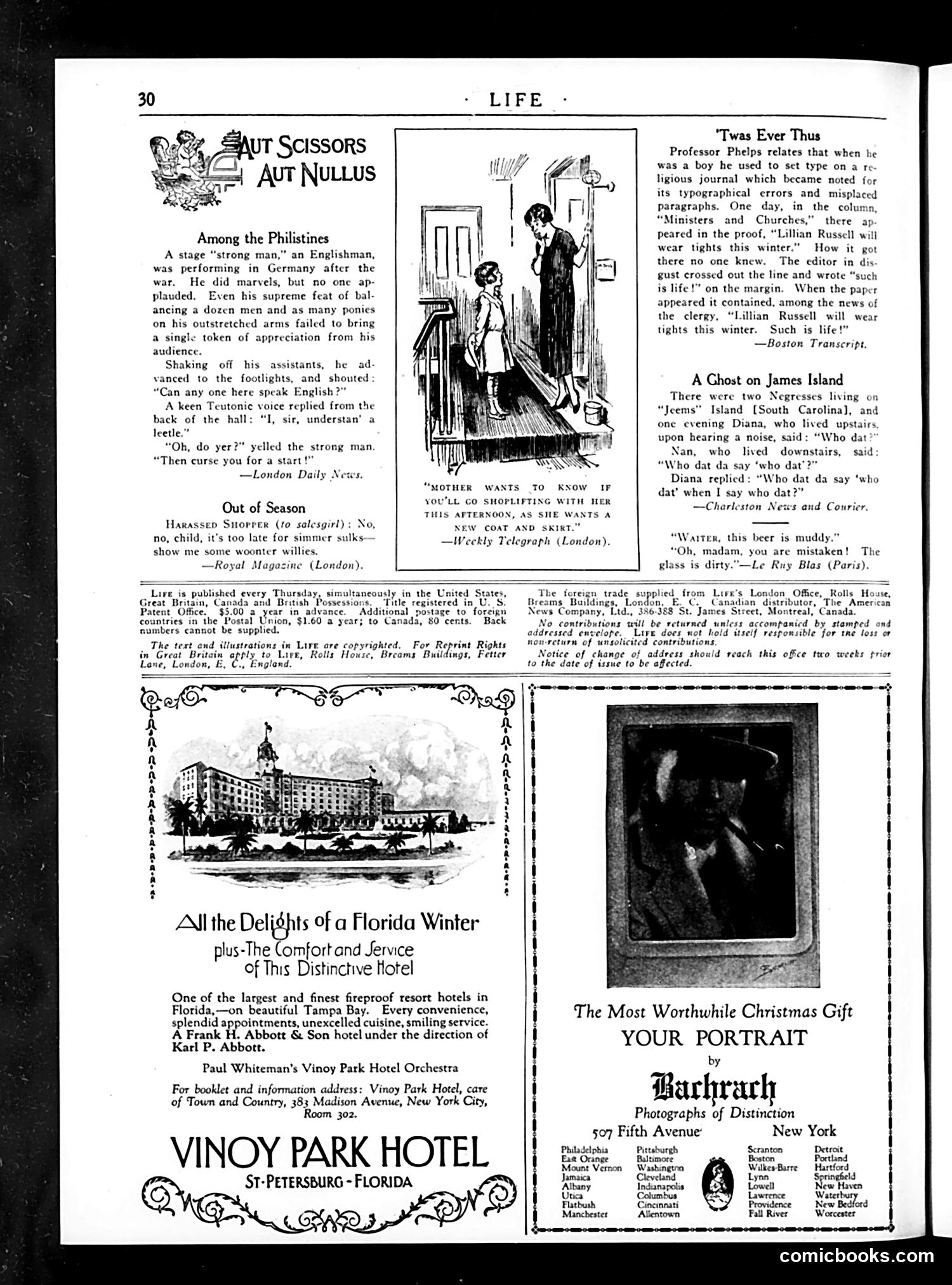
This page contains humorous short anecdotes and advertisements typical of Life's satirical format. The cartoons illustrate brief jokes: **"Among the Philistines"**: A post-WWI story where a British strongman performs acrobatic feats for a German audience who offer no applause. When he demands if anyone speaks English, a German replies he understands a little. The strongman's response—cursing the German—satirizes Anglo-German tensions and cultural misunderstanding after World War I. The "Philistines" reference suggests the German audience lacks appreciation for art/performance. **Other anecdotes** (printed alongside a sketch showing what appears to be a domestic scene) include brief jokes about typographical errors, a dialect piece featuring African American characters, and European witticisms—typical of Life's eclectic humor format. The page is predominantly advertising: the Vinoy Park Hotel promotes Florida tourism, and a Bachrach photography studio advertises portrait services as Christmas gifts.
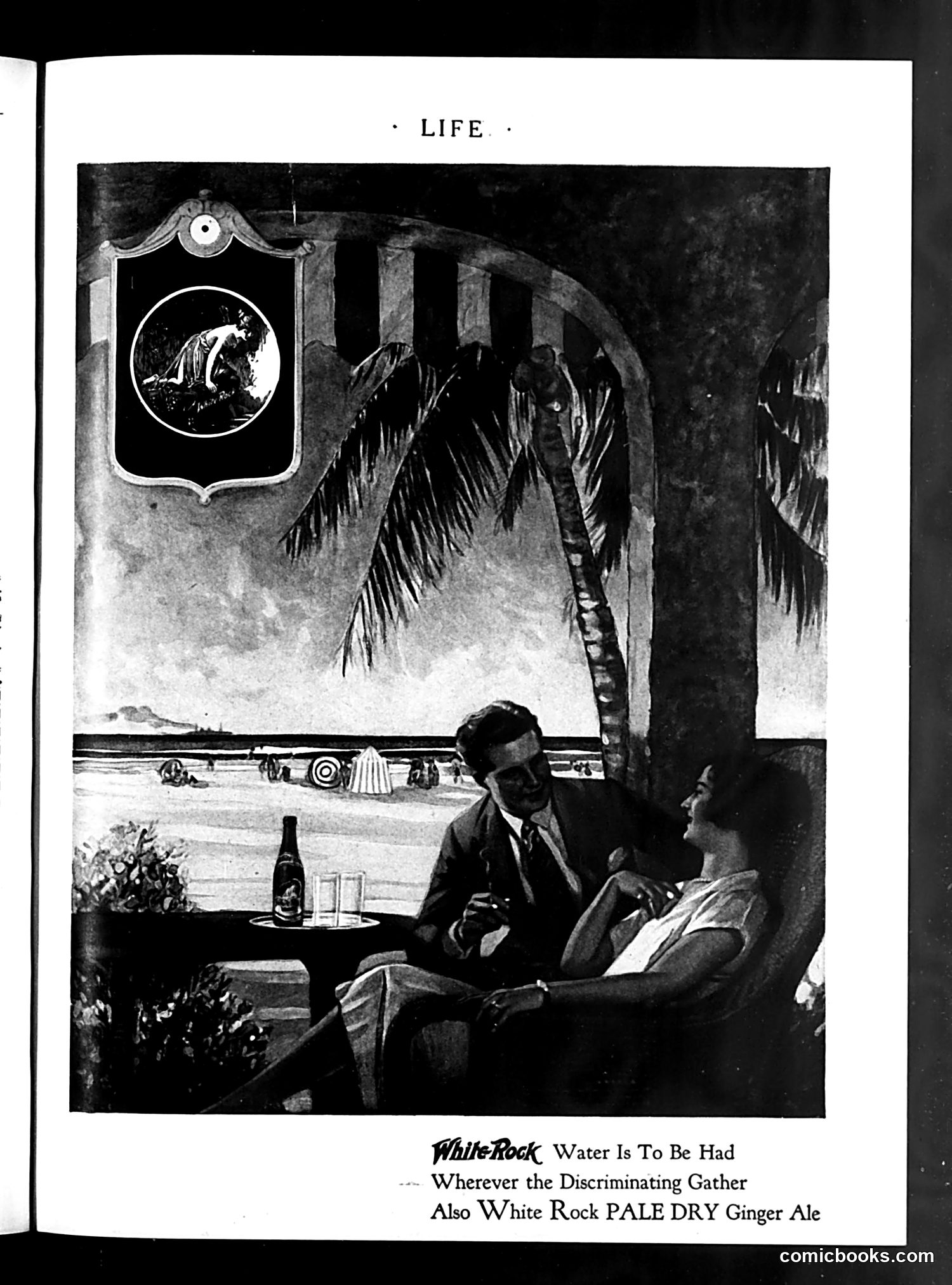
This is an advertisement for White Rock brand beverages—specifically water and pale dry ginger ale. The image depicts a tropical scene with two well-dressed people relaxing under a colonnade near a beach, with a bottle and glasses on a small table between them. The tagline "Water Is To Be Had Wherever the Discriminating Gather" positions White Rock as a beverage for affluent, refined consumers. The elegant setting, fashionable clothing, and leisurely atmosphere are designed to associate the product with sophistication and upscale leisure. This appears to be a vintage advertisement (likely early-to-mid 20th century) emphasizing that discerning people choose White Rock products. There is no satirical content here—it's straightforward luxury brand marketing targeting the upper-class reader.
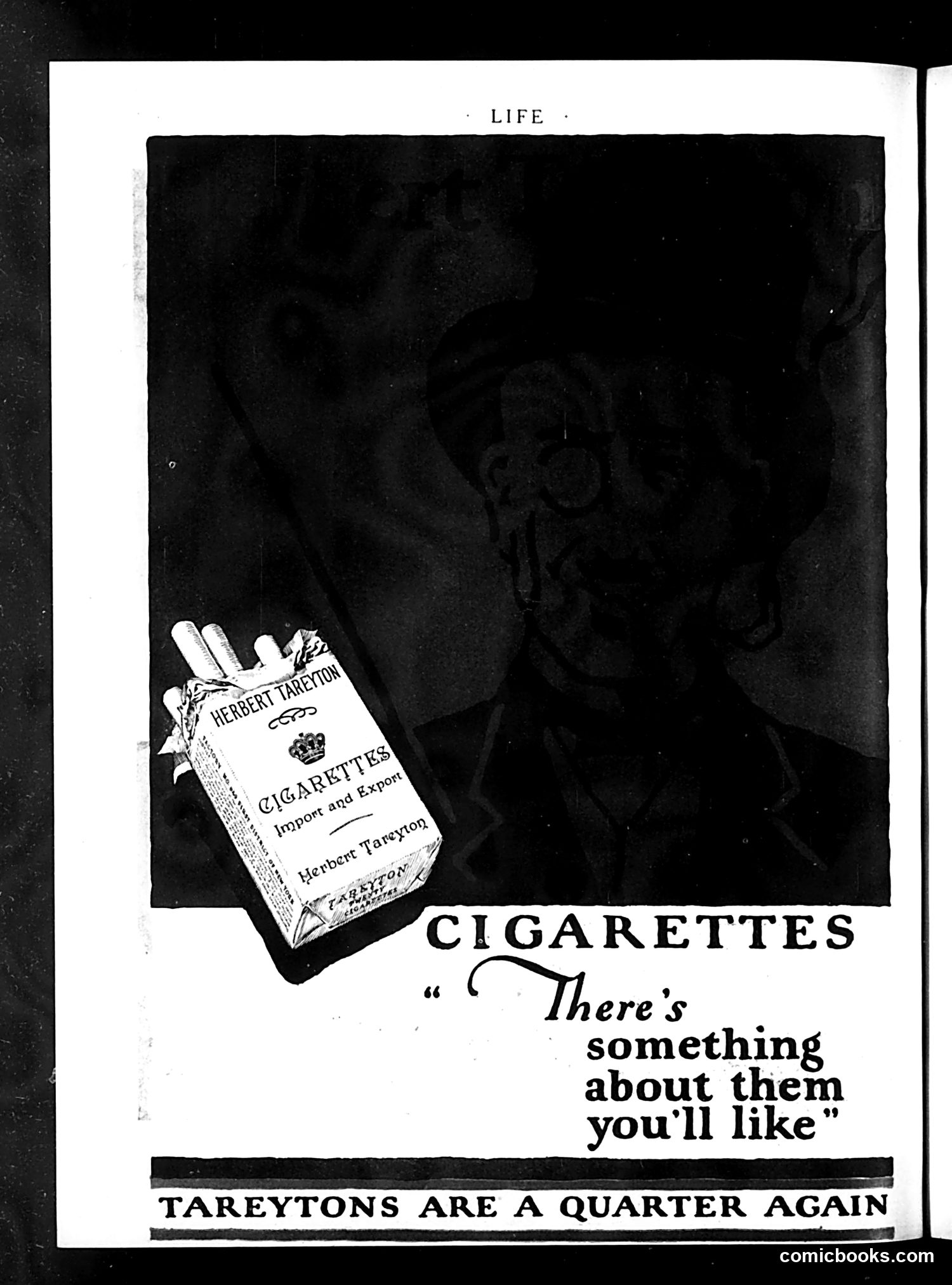
This is a **cigarette advertisement**, not political satire. Herbert Tareyton cigarettes are being marketed with the slogan "There's something about them you'll like" and promoted as "a quarter again"—meaning they cost 25% more than competitor brands, likely positioning them as premium quality. The dark photographic image (upper half) is vague and atmospheric, possibly suggesting sophistication or allure. The prominent cigarette package display emphasizes the product's branding as an "Import and Export" item. The ad employs a common early-to-mid 20th century marketing strategy: justifying higher prices by implying superior quality and desirability. There is no political commentary or caricature present—this is straightforward product advertising from *Life* magazine's commercial pages.
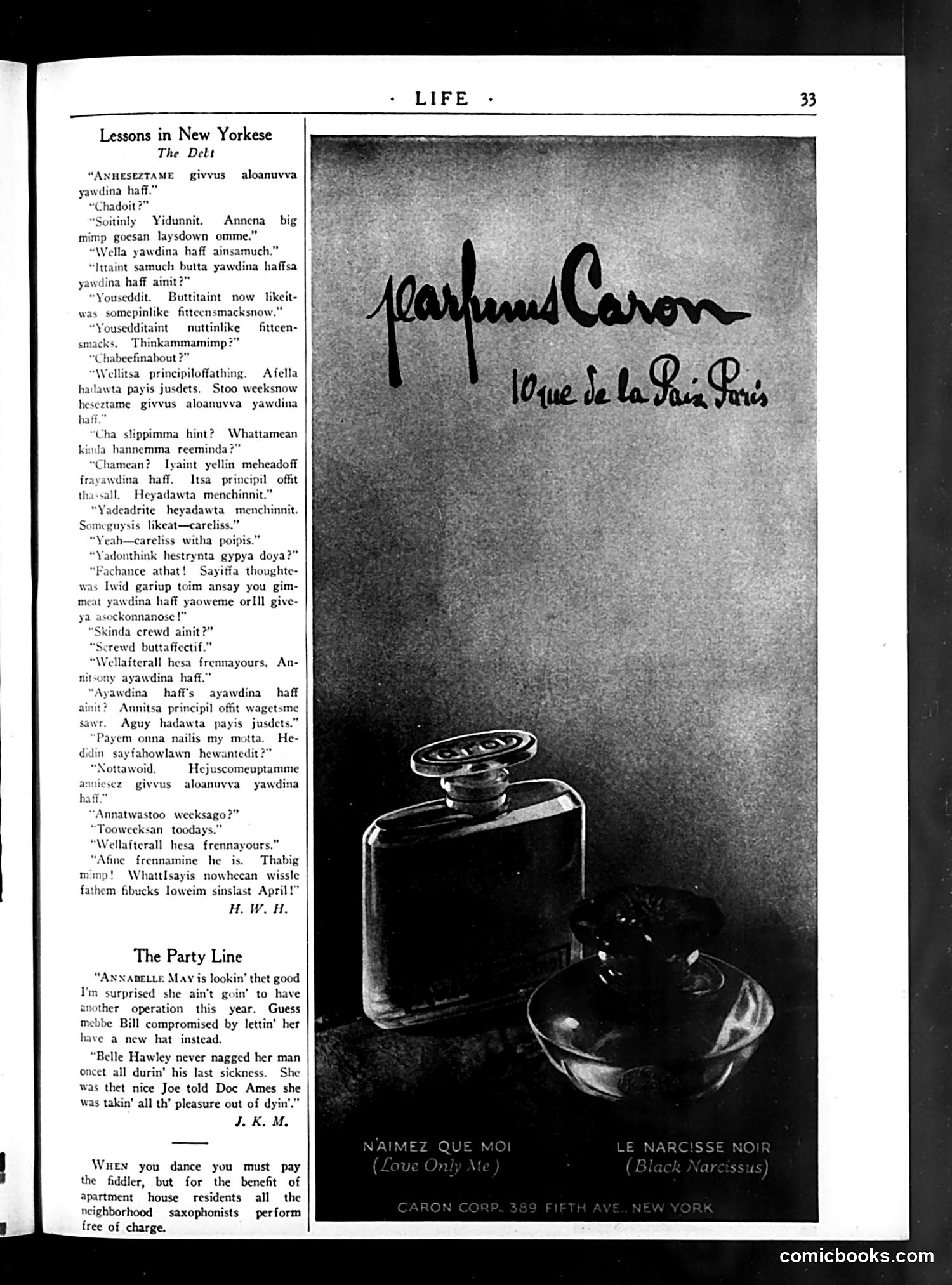
This page contains humorous dialect sketches satirizing New York City speech patterns, likely from the 1920s-30s. **"Lessons in New Yorkese: The Debt"** is a comedic dialogue mocking working-class New York accents and speech habits. Two characters debate lending money ("a yard and a half"—$1.50), with exaggerated phonetic spelling and malapropisms capturing stereotypical NYC vernacular ("Youseddit," "Thinkammamimp?"). The humor derives from depicting immigrant or working-class New Yorkers as argumentative, principle-obsessed about trivial financial matters, and prone to colorful, fractured English. **"The Party Line"** offers brief social commentary jokes about suburban/small-town life—poking fun at women's cosmetic surgery culture and domestic dynamics. The **right-side advertisement** for Caron perfume ("Naimez Que Moi," "Le Narcisse Noir") represents luxury goods marketing. The satire reflects early 20th-century American attitudes toward urban immigrant populations and regional speech patterns, now considered dated and potentially offensive ethnic humor.
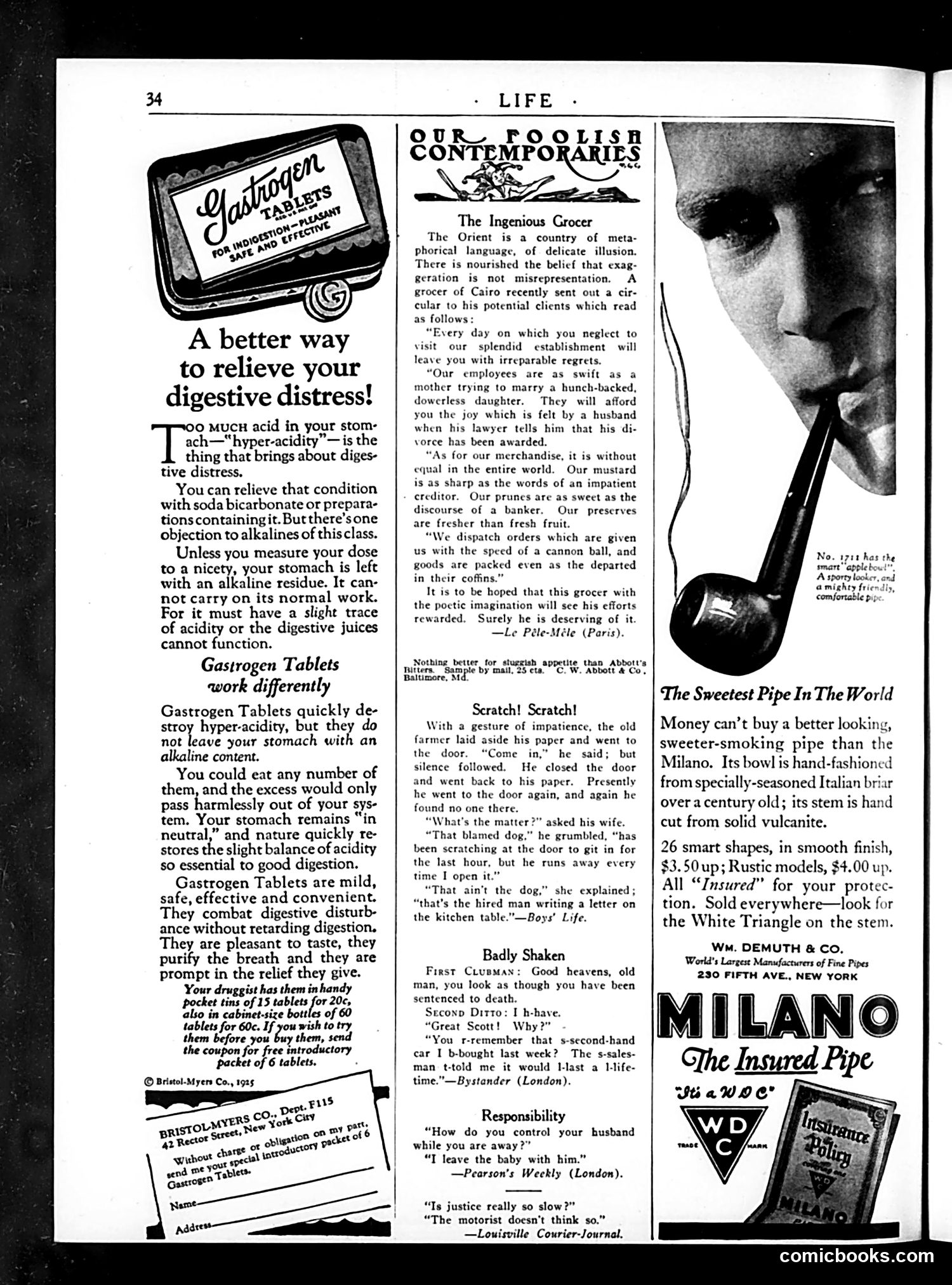
This page is primarily **advertising**, featuring a 1925 patent medicine ad for Gastrogen Tablets (digestive relief). The surrounding content includes three brief humorous anecdotes under "Our Foolish Contemporaries"—a satirical section mocking absurd stories from other publications. **The jokes:** 1. **"The Ingenious Grocer"**: Mocks an Egyptian grocer's absurdly flowery advertising circular using overwrought metaphors (employees "swift as a mother marrying off a hunch-backed daughter"; mustard "sharp as an impatient creditor's words"). The satire targets exaggerated marketing language. 2. **"Scratch! Scratch!"**: A misunderstanding where a farmer thinks his dog scratches at the door, but it's actually the hired man writing a letter on the kitchen table—a visual/auditory pun. 3. **"Badly Shaken"**: A salesman's claim that a second-hand car will "last a lifetime" backfires when the buyer interprets it as a death sentence. These are light, wordplay-based humor pieces typical of 1920s magazines—no political content. The page reflects era-specific concerns about digestive health and consumer skepticism toward salesmen.
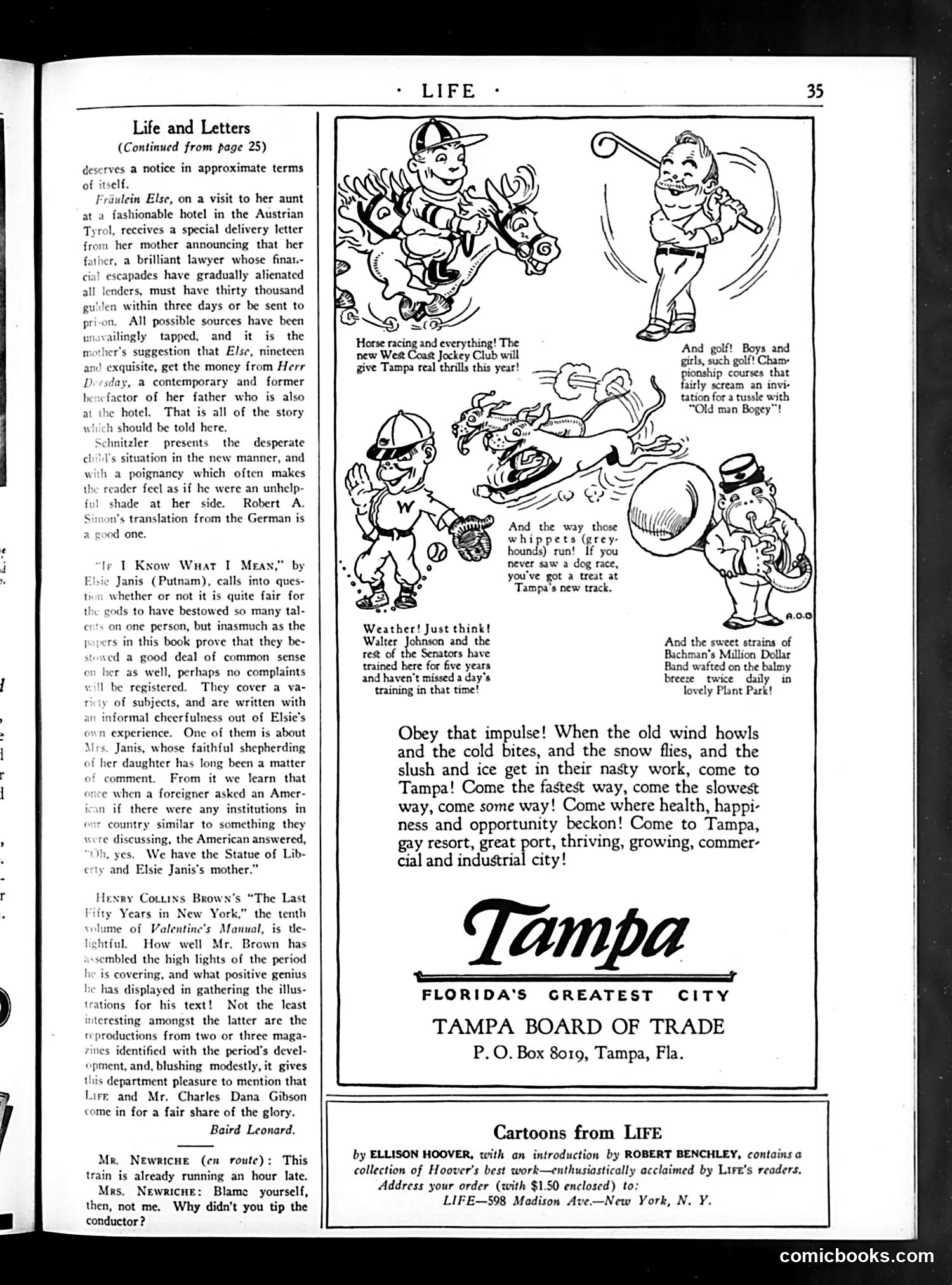
This page is primarily a **tourism advertisement** for Tampa, Florida, disguised as editorial content in *Life* magazine. The illustrated cartoons promote Tampa's attractions to wealthy northerners fleeing harsh winters: horse racing at the new West Coast Jockey Club, greyhound racing, championship golf courses, and a military training presence (the Washington Senators baseball team trained there). The text uses exuberant language ("Come to Tampa, gay resort, great port") typical of 1920s boosterism. The satire is subtle—*Life* magazine's readers would recognize this as obvious civic promotion masquerading as news. The cartoons and breathless copy parody the overwrought enthusiasm of real estate and tourism marketing of the era. By running it alongside actual book reviews, the magazine gently mocks both Tampa's promotional zeal and the credulity of readers tempted by such appeals. The bottom section advertises Ellison Hoover's cartoon collection, suggesting *Life* used such promotional pages partly as revenue.
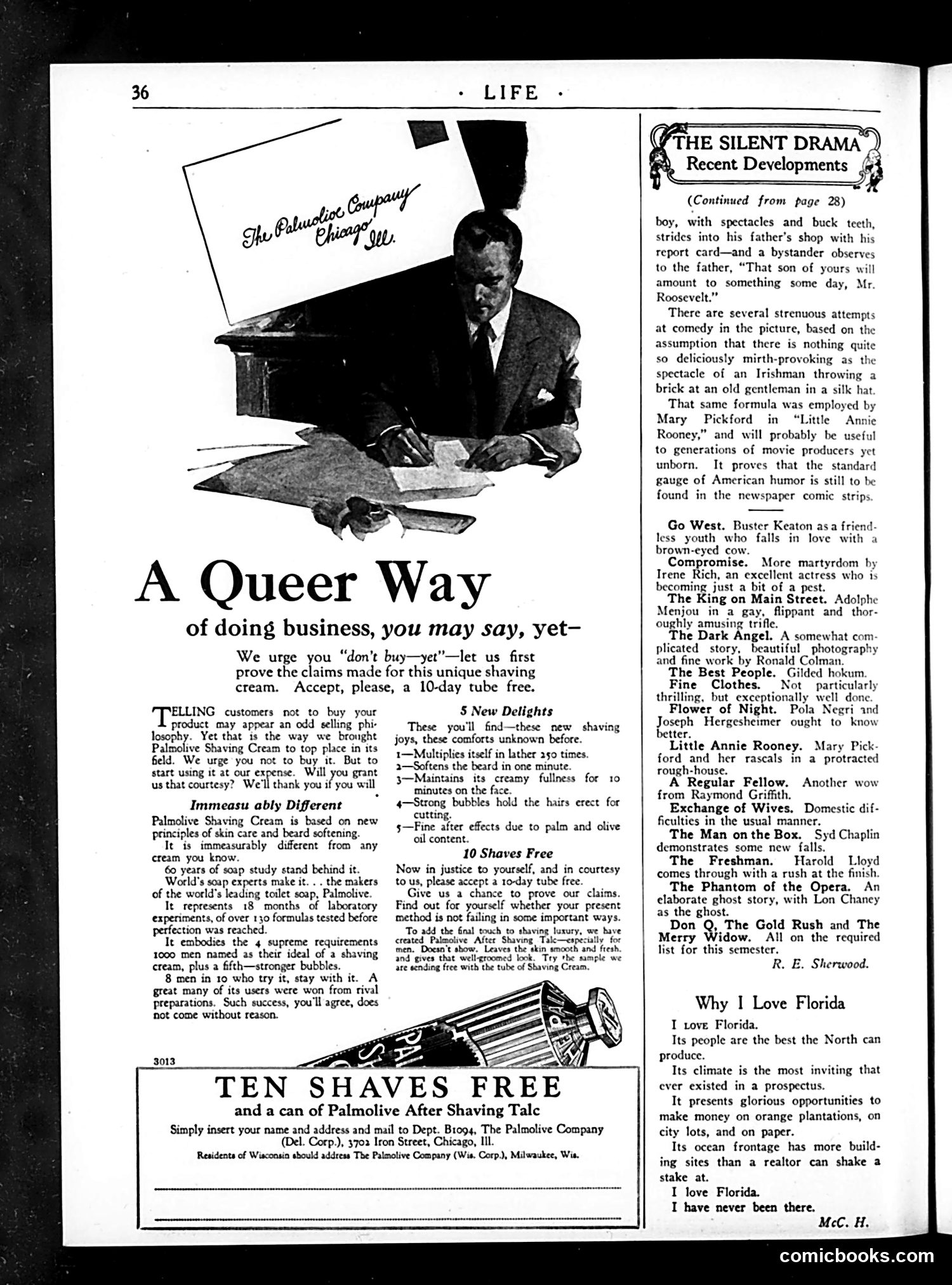
This is primarily a **Palmolive shaving cream advertisement** occupying the left two-thirds of the page. The "queer way" refers to the counterintuitive sales strategy of urging customers *not* to buy immediately, but instead to accept a free 10-day trial tube. The ad emphasizes that Palmolive's confidence in product quality justifies this approach—claiming superior formulation (60 years of research, 130+ formulas tested) and citing that 8 in 10 trial users become repeat customers. The accompanying illustration shows a businessman at his desk examining the product, suggesting professional endorsement. The right column contains brief film reviews under "The Silent Drama: Recent Developments," discussing movies including works by Buster Keaton, Mary Pickford, and others—typical of Life magazine's entertainment coverage from this era (appears to be 1920s based on film references and styling).
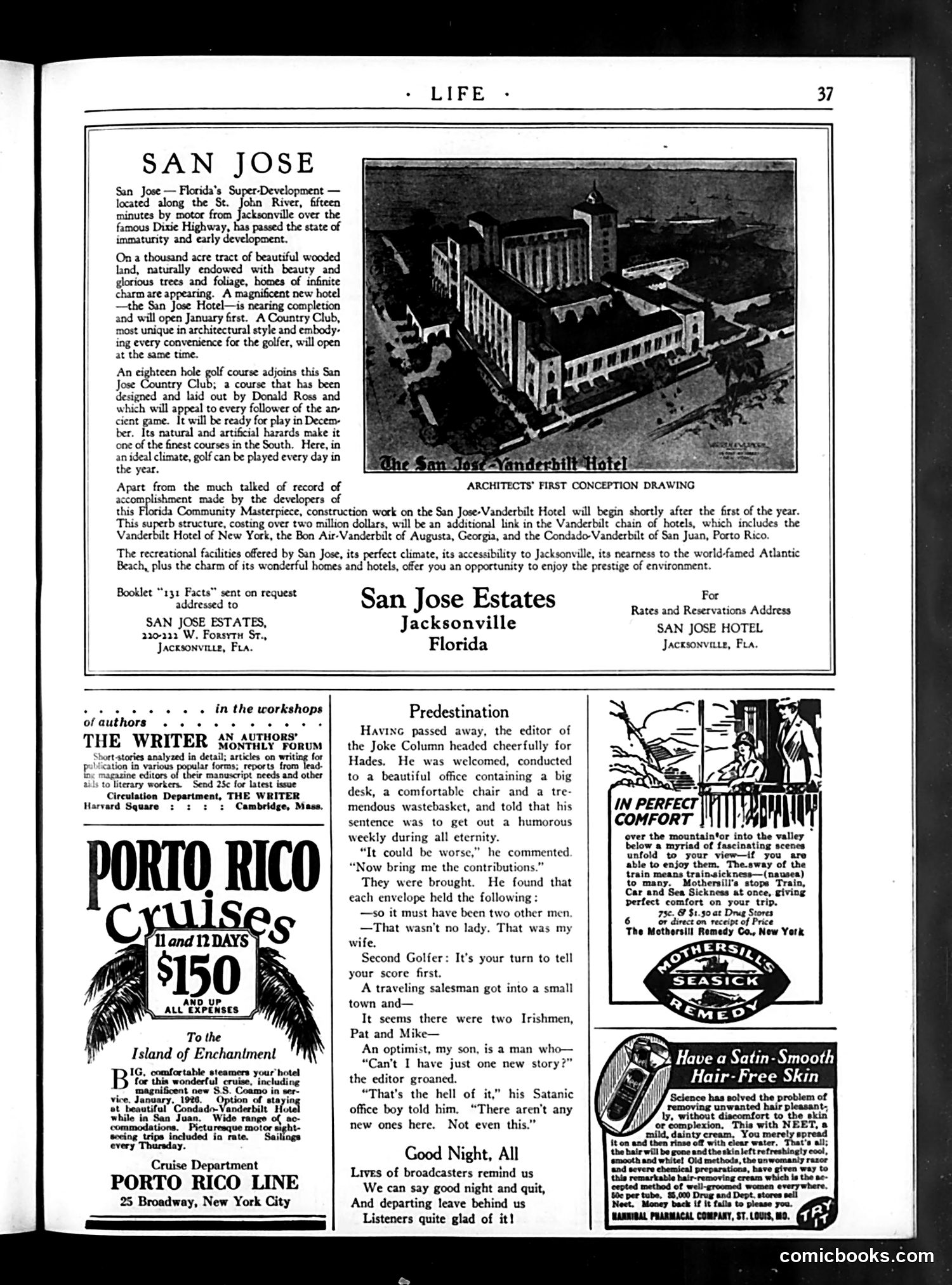
This page is primarily **real estate and travel advertising** rather than political satire. The dominant content promotes San Jose Estates, a Florida development near Jacksonville, featuring a new hotel, country club, and golf course designed by Donald Ross. The only comic/satirical element is "**Predestination**," a brief joke about a deceased joke-column editor condemned to write humorous content in Hell for eternity. The joke's premise: even in damnation, he receives the same stale, recycled joke submissions (Irish characters named Pat and Mike, traveling salesmen, etc.). The satire targets the exhaustion of comedy tropes and the thankless work of editors processing endless derivative material. The remaining content comprises **classified advertising**: writing workshops, cruise lines to Puerto Rico, and patent medicine ads—typical magazine filler of the era. The page captures 1920s consumer culture: Florida's real estate boom, leisure travel expansion, and professional writing opportunities.
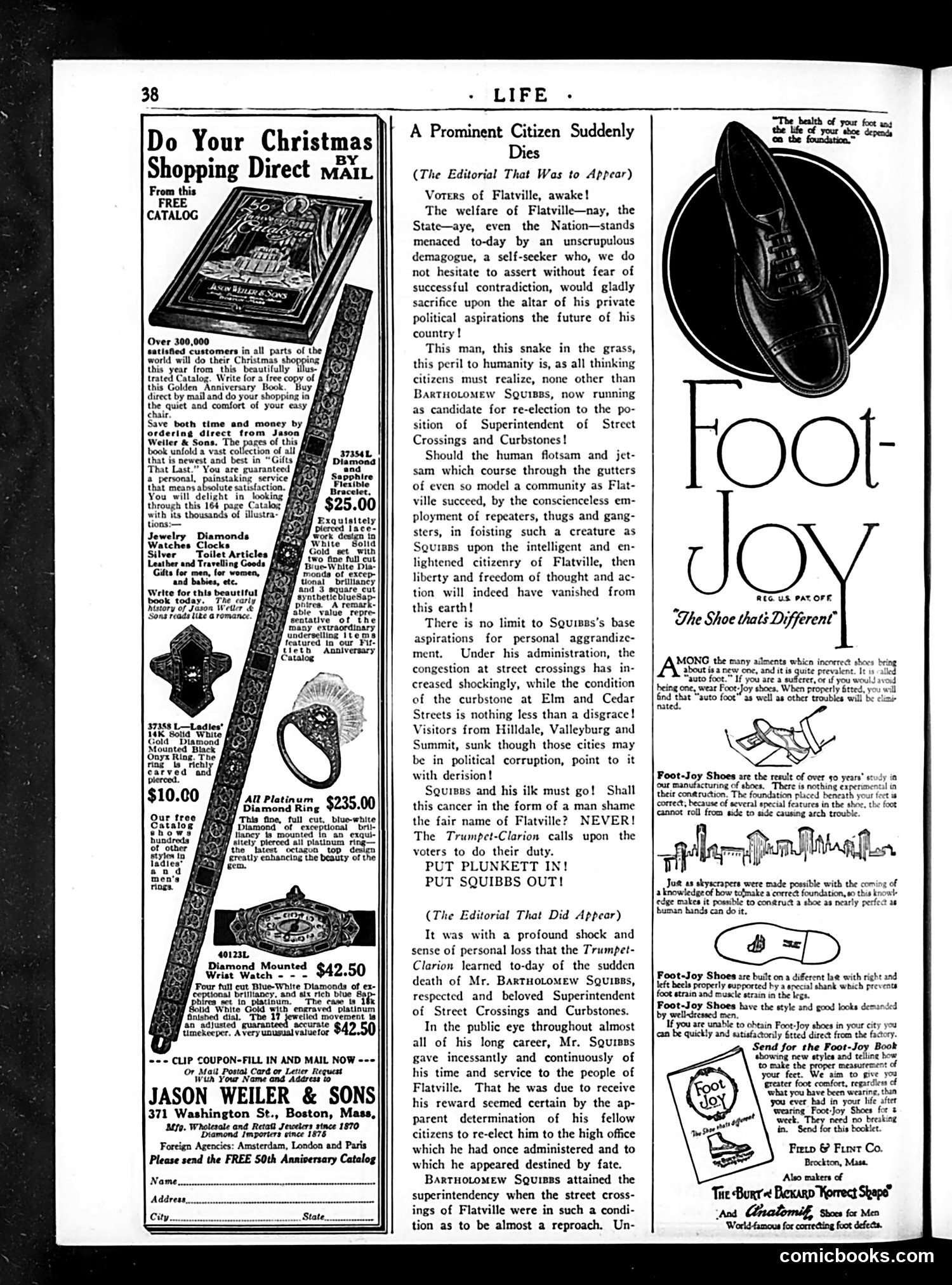
This page satirizes how newspapers abandon principles upon a politician's death. The left column shows an unsigned editorial attacking "Bartholomew Squibbs," candidate for Superintendent of Street Crossings and Curbstones in the fictional town of Flatville. It uses hyperbolic language—calling him a "snake in the grass" and "cancer"—to denounce his administration's failures with street conditions. The right column reveals the joke: the same newspaper's actual editorial, published after Squibbs suddenly died, reverses course entirely, now praising him as "respected and beloved." The satire mocks how publications conveniently abandon critical scrutiny of public figures once they're deceased, replacing honest critique with sanitized eulogies. It's commentary on journalistic cowardice and hypocrisy—the unwillingness to maintain editorial positions when social convention demands respectful silence about the dead.
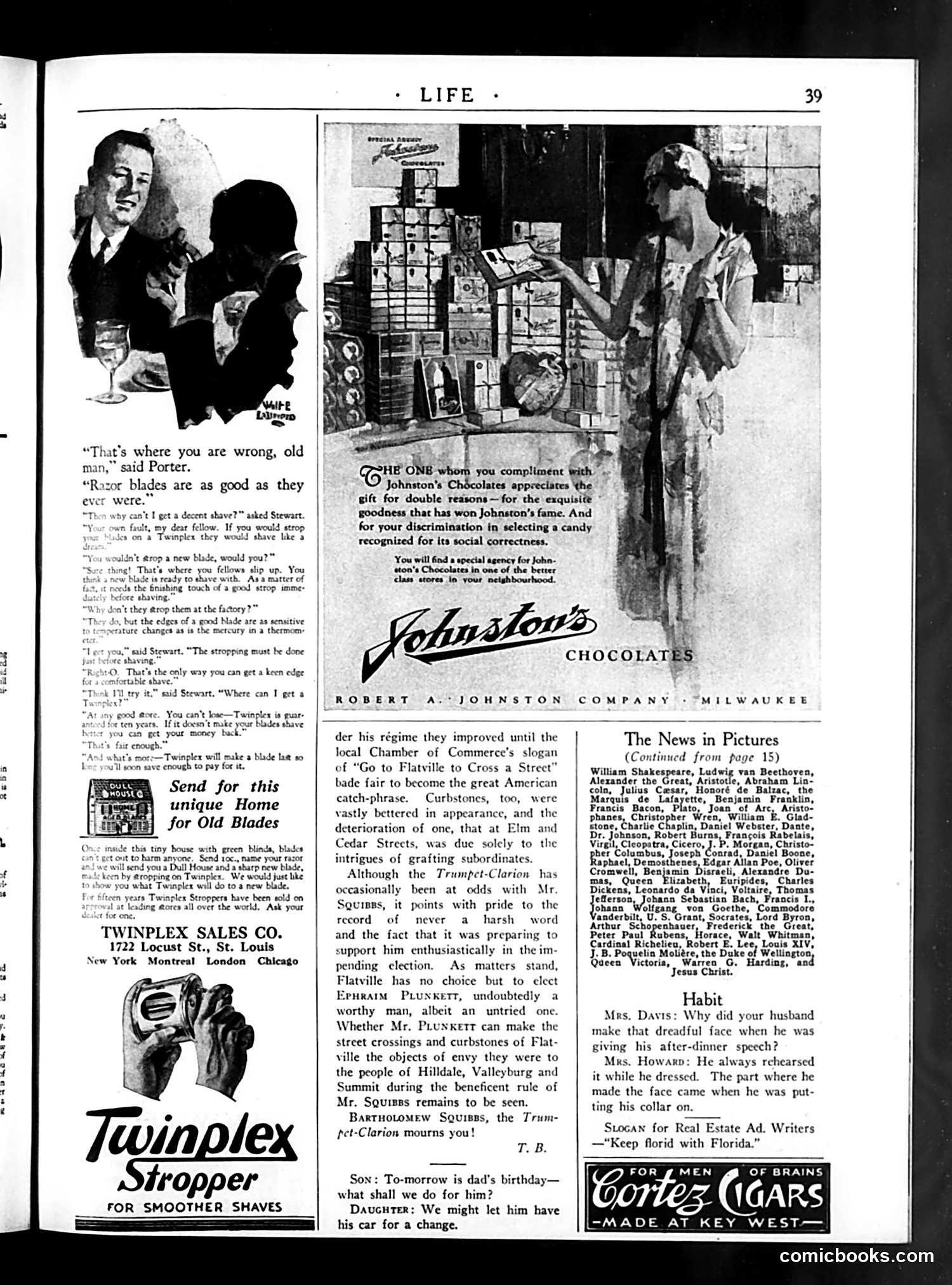
This page contains primarily **advertisements and filler content** rather than political cartoons. The main visual content includes: 1. **Twinplex Stropper ad** (left): A dialogue between two men debating razor blade quality. The joke assumes readers understand that straight razors required stropping (realigning blade edges) before use—a common grooming practice of the era. The ad promotes their stropping device as essential for maintaining blade sharpness. 2. **Johnston's Chocolates ad** (center): Features an elaborate display of chocolate boxes, marketing the product as a gift reflecting the giver's refined social taste and "correctness." 3. **"The News in Pictures"** (right): A lengthy list of historical and contemporary figures, apparently illustrating a photo essay continued from an earlier page. 4. **Cortez Cigars ad** (bottom right): Simple product advertisement. The page is essentially a **commercial publication** with minimal satirical content—typical of Life's mixed advertising and editorial model during this period.
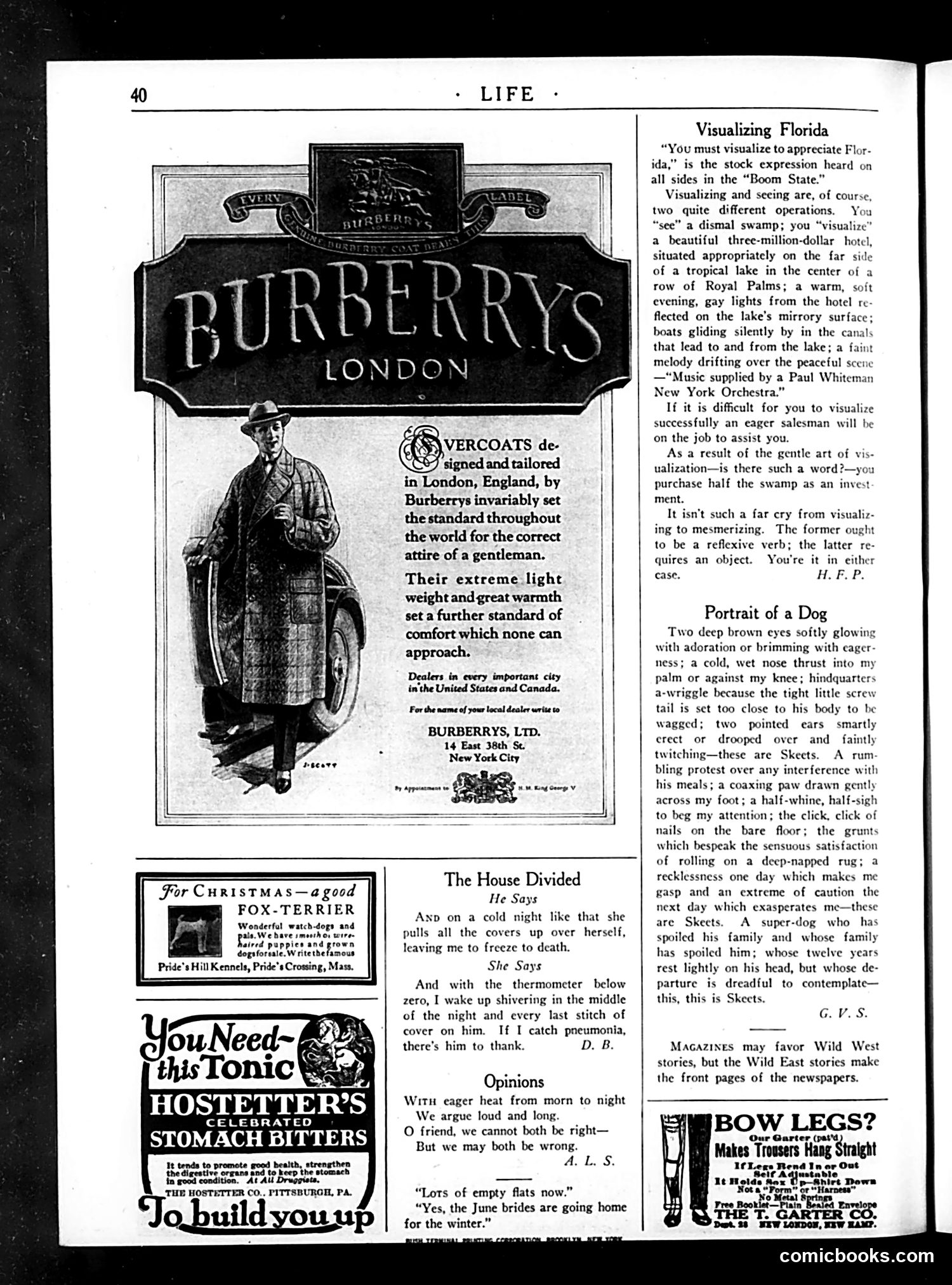
This page is primarily **advertisements and light humor pieces**, not political cartoons. The main content includes: **Advertisements**: Burberrys overcoats (positioned as the gentleman's standard), Fox-terrier puppies, and Hostetter's Stomach Bitters (a patent medicine). **Humor pieces** satirizing contemporary domestic life: - "The House Divided" mocks marital conflict over bedcovers—a relatable complaint where each spouse blames the other for hogging blankets during winter. - "Opinions" presents conflicting viewpoints on an unstated disagreement, suggesting both parties might be wrong. - A brief joke about June brides returning home suggests newlyweds' marriages are already failing. **Social commentary** on Florida's real-estate boom: The "Visualizing Florida" essay sarcastically critiques salesmen who use persuasive language ("visualization") to sell swampland as luxury resort property—exposing the marketing manipulation behind Florida's speculative bubble. Minor content includes a sentimental dog portrait and a quip about newspapers preferring scandal over adventure stories.
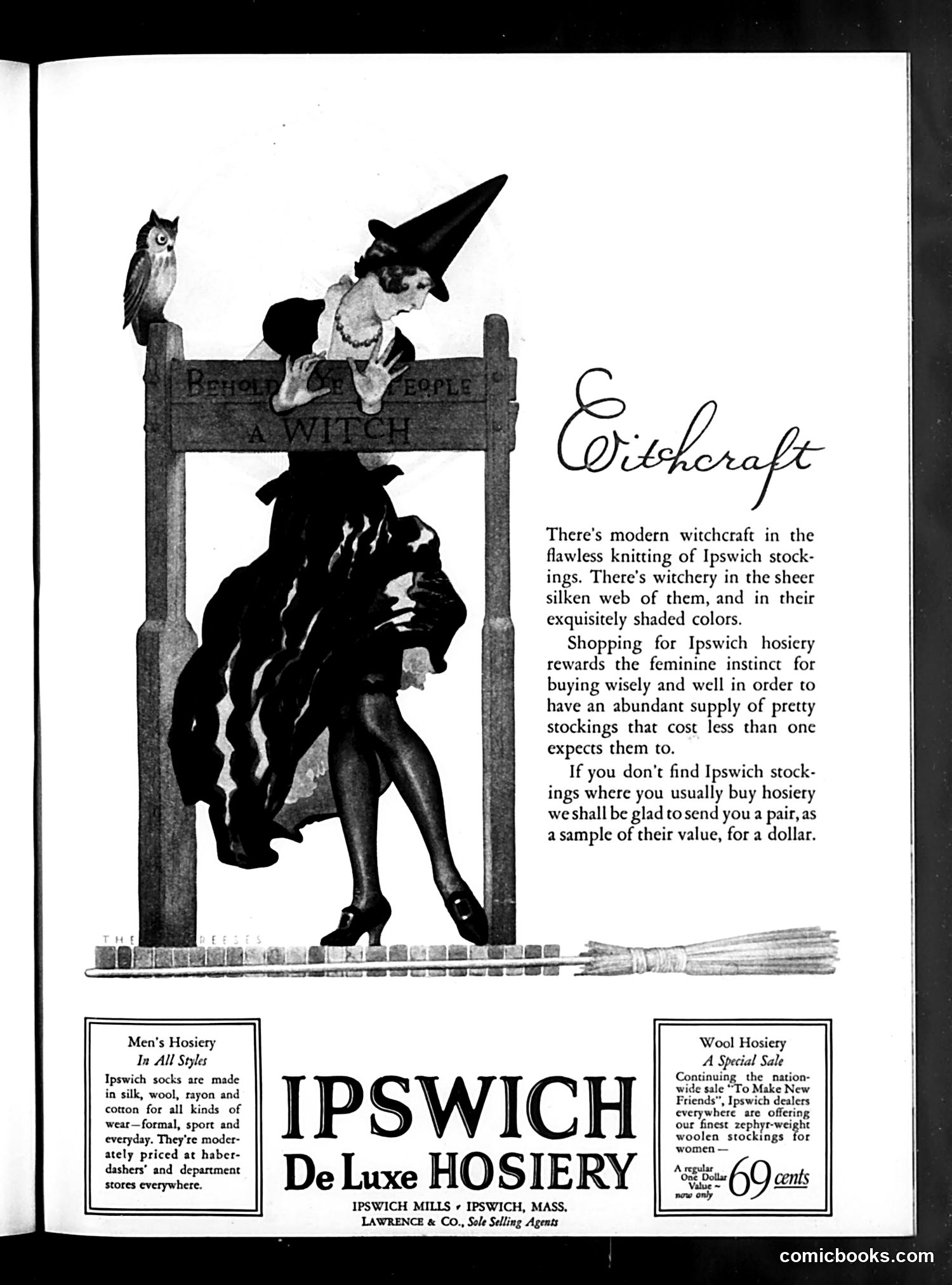
This is primarily a **hosiery advertisement** for Ipswich De Luxe Hosiery, not political satire. The witch imagery is purely commercial wordplay. The illustration depicts a witch in pointed hat with an owl and broomstick, framed within a stocks (pillory) device—a visual pun linking "witchcraft" to "stockings." The ad copy plays on this: "There's modern witchcraft in the flawless knitting" and "witchery in the sheer silken web." For modern readers: the "witch" represents the magical quality of well-made hosiery—how superior craftsmanship seems almost miraculous. The stocks frame reinforces the stocking/stocks wordplay. This was typical 1920s-era advertising humor, using whimsical imagery to suggest that buying Ipswich hosiery was a smart, almost magical bargain for women seeking quality stockings at reasonable prices. The ad emphasizes affordability and offers a dollar-sample program.
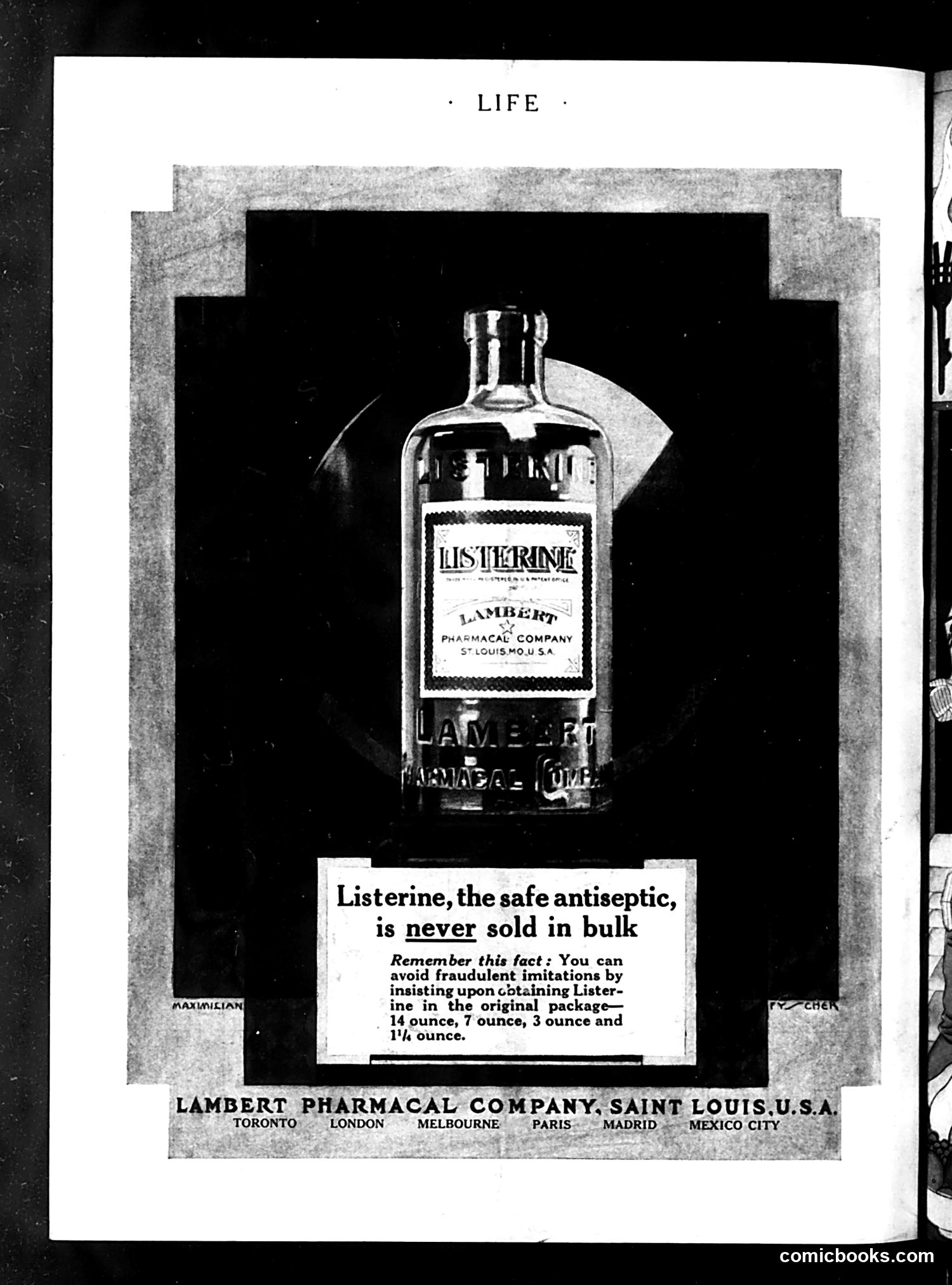
This is **not a cartoon or satire**—it's a product advertisement for Listerine antiseptic mouthwash from the Lambert Pharmacal Company (Saint Louis). The ad emphasizes that genuine Listerine comes only in specific bottle sizes (14 ounce, 7 ounce, 3 ounce, and 1¼ ounce) and warns consumers against counterfeit imitations. The prominent bottle photograph showcases the authentic packaging. This reflects early 20th-century concerns about patent medicines and fraudulent products. The ad reassures customers that buying the original branded packaging protects them from fake competitors. The global company locations listed (Toronto, London, Melbourne, Paris, Madrid, Mexico City) emphasize Listerine's international legitimacy and reach.