
Life, 1925-11-26 · page 24 of 44
Life — November 26, 1925 — page 24: what you’re looking at
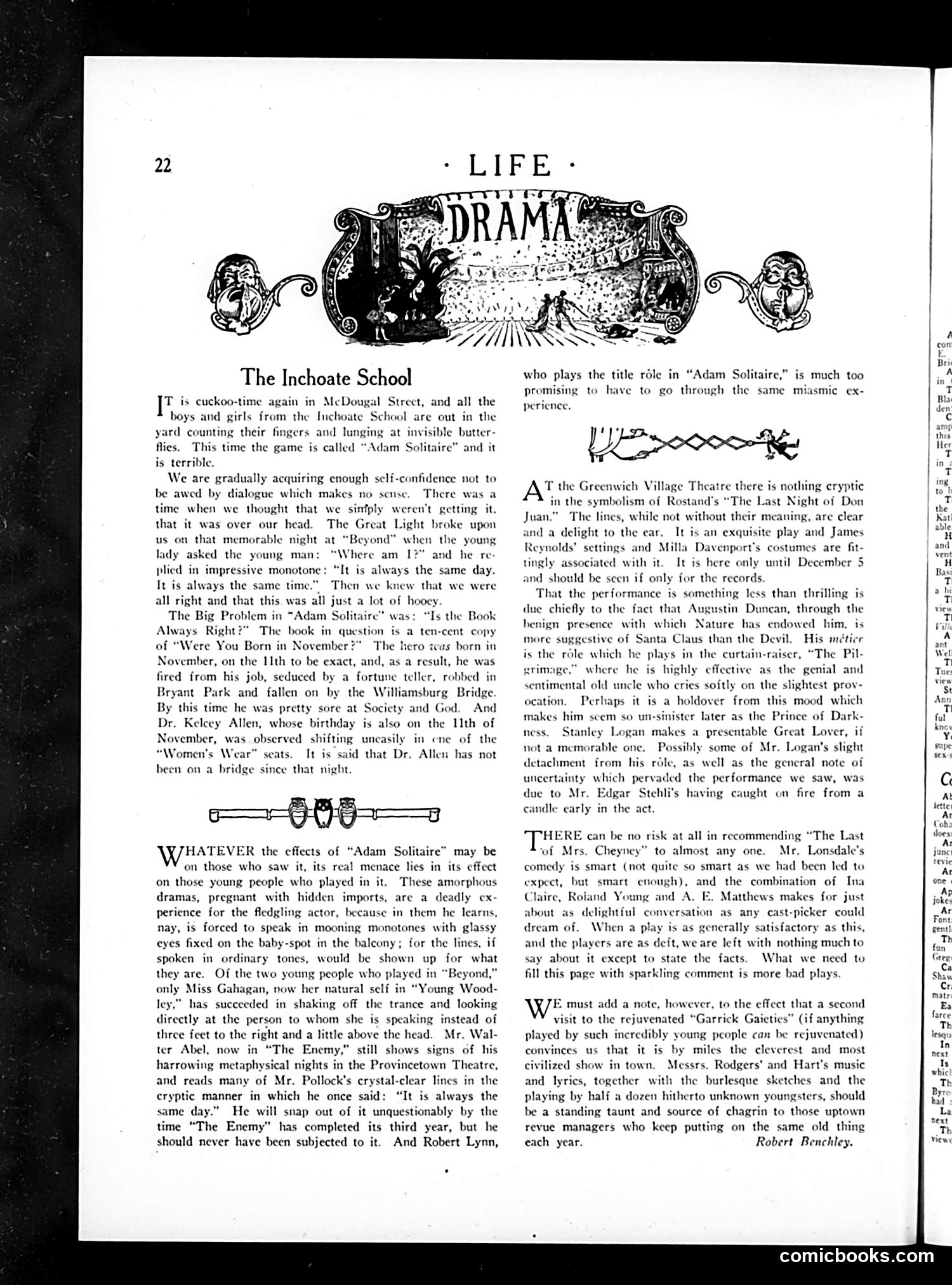
What you’re looking at
This page reviews several experimental/avant-garde theatrical productions. The satire targets the "Inchoate School" of drama—deliberately obscure, nonsensical plays performed in Greenwich Village's Provincetown Theatre. The critic ridicules plays like "Adam Solitaire" and "Beyond" for their pretentious meaninglessness. The joke: audiences initially felt stupid not understanding these works, until realizing the plays themselves were "just a lot of hooey." The review mocks actors forced to deliver meaningless dialogue in affected, monotone styles—staring at nothing, eyes "fixed on the baby-spot in the balcony." Young performers like Helen Gahagan and Walter Abel are pitied for being subjected to this "deadly experience." The contrast comes via Rostand's "The Last Night of Don Juan" at Greenwich Village Theatre—a genuinely sophisticated play with clear meaning and beautiful language—demonstrating that complexity need not mean incomprehensibility. The satire attacks modernist theater's obscurantism while praising genuine artistic merit.
📄 Transcribed text from this page (OCR, searchable)
Machine-transcribed from the original scan — historical spelling and the odd misread are preserved.
The Inchoate School T is cuckoo-time again in McDougal Street, and all the boys and girls from the Inchoate School are out in the yard counting their fingers and lunging at invisible butter- flies. This time the game is called “Adam Solitaire” and it is terrible. We are gradually acquiring enough self-confidence not to be awed by dialogue which makes no sense. There was a time when we thought that we sinfply weren't getting it. that it was over our head. The Great Light broke upon us on that memorable night at “Beyond” when the young lady asked the young man: “Where am 1?" and he re plied in impressive monotone: “It is always the same day. It is always the same tim Then we knew that we were all right and that this. was all just a lot of hooey The Big Problem in “Adam Solitaire” was: “Is the Book Always Righ The book in question is a ten-cent copy of “Were You Born in November November, on the Ith to be exact, and, as a result, he was fired from his job, seduced by a fortune teller, robbed in Bryant Park and fallen on by the Williamsburg Bridge. By this time he was pretty sore at Society and God. And Dr, Kelcey Allen, whose birthday is also on the 11th of November, was observed shifting uneasily in one of the “Women's Wear” seats. It is said that Dr. Allen has not been on a bridge since that night. The hero was born in HATEVER the effects of “Adam Solitaire” may be on those who saw it, its real menace lies in its cffect on those young people who played in it. These amorphous dramas, pregnant with hidden imports, are a deadly ex- perience for the fledgling actor, because in them he learns, nay, is forced to speak in mooning monotones with glassy eyes fixed on the baby-spot in the balcony; for the lines, if spoken in ordinary tones, would be shown up for what they are. Of the two young people who played in “Beyond,” only Miss Gahagan, now her natural self in “Young Wood- ley,” has succeeded in shaking off the trance and looking directly at the person to whom she is speaking instead of three feet to the right and a little above the head. Mr. Wal- ter Abel, now in “The Enemy,” still shows signs of his harrowing metaphysical nights in the Provincetown Theatre, and reads many of Mr. Pollock's crystal-clear lines in the cryptic manner in which he once said: “It is always the same da} He will snap out of it unquestionably by the time “The Enemy” has completed its third year, but he should never have been subjected to it. And Robert Lynn, who plays the title role in “Adam Solitaire,” is much too promising to have to go through the same miasmic ex- [moose T the Greenwich Villa vatre there is nothing eryptic in the symbolism of Rostand’s “The Last Night of Don Juan.” The lines, while not without their meaning, are clear and a delight to the ear, It is an exquisite play and James Reynolds’ settings and Milla Davenport's costumes are fit- tingly associated with it. It is here only until December 5 perience. and should be seen if only for the records. That the performance is something less than thrilling is due chiefly to the fact that Augustin Duncan, through the henign presence with which Nature has endowed him, is more suggestive of Santa Claus than the Devil. His méti is the role which he plays in the curtain-raiser, “The Pil- grimage,” where he is highly effective as the genial and sentimental old uncle who cries softly on the slightest prov- ocation. Perhaps it is a holdover from this mood which makes him scem so un-sinister later as the Prince of Dark- n makes a presentable Great Lover, if anley Loga not a memorable one. Possibly some of Mr. Logan's slight detachment from his rdle, as well as the general note of uncertainty which pervaded the performance we saw, was due to Mr. Edgar Stehli's having caught on fire from a candle early in the act. ness. § HERE can be no risk at all in recommending he Last { Mrs. Cheyney” to almost any one. Mr. Lonsdale’s comedy is smart (not quite so smart as we had been led to expect, but smart enough), and the combination of Ina Claire, Roiand Young and A. E. Matthews makes for just about as delightful conversation as any cast-picker could dream of. When a play is as generally satisfactory as this, and the players are as deft, we are left with nothing much to say about it except to state the facts. What we need to fill this page with sparkling comment is more bad plays W = must add a note, however, to the effect that a second visit to the rejuvenated “Garrick Gaicties” (if anything played by such incredibly young people can be rejuvenated) convinces us that it is by miles the cleverest and most civilized show in town. Messrs. Rodgers’ and Hart's music and lyrics, together with the burlesque sketches and the playing by half a dozen hitherto unknown youngsters, should be a standing taunt and source of chagrin to those uptown revue managers who keep putting on the same old thing each year. Robert Benchley. comicbooks.com