
Life, 1925-11-26 · page 20 of 44
Life — November 26, 1925 — page 20: what you’re looking at
What you’re looking at
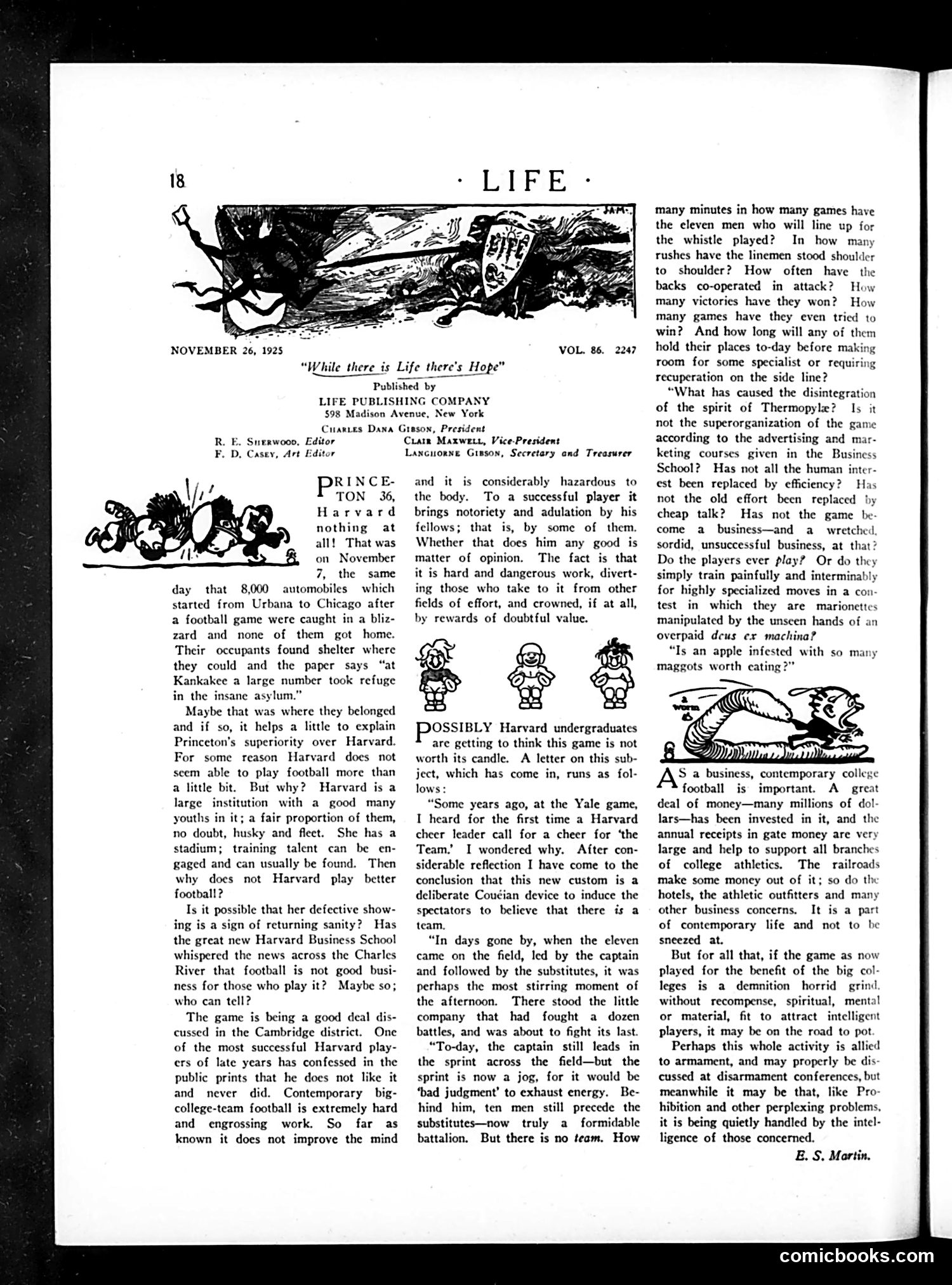
This page critiques Harvard University's poor football performance relative to Princeton. The article mocks Harvard's athletics program, suggesting its weakness may paradoxically indicate "returning sanity"—implying competitive college football is dangerous, time-consuming, and morally questionable. A reader's letter argues that Harvard no longer fields a true "team." It sarcastically notes that cheerleaders now must call for cheers for "the Team" as if willing it into existence—a reference to Émile Coué's popular "autosuggestion" self-help method. The letter laments that modern Harvard football lacks the cohesion and fighting spirit of past years, instead fielding constantly rotating specialists with no genuine unity. The cartoon (top) appears to show Princeton football players in contrast to Harvard's perceived weakness. The satire targets both the corruption of college athletics and Harvard's institutional decline in this competitive arena.
📄 Transcribed text from this page (OCR, searchable)
Machine-transcribed from the original scan — historical spelling and the odd misread are preserved.
a NOVEMBER 26, 1925 VOL. 8&6. 2247 “While there is Life there's Hope” Bes ere Published by LIFE PUBLISHING COMPANY $98 Madison Avenue, New York Cuartes Dana Grason, President R. E. Snerwooo, Editor F. D, Casey, Art Editor RINCE- TON 36, Harvard nothing at all! That was . Ss a ee & oon November 7, the same day that 8,000 automobiles which started from Urbana to Chicago after a football game were caught in a bliz- zard and none of them got home. Their occupants found shelter where they could and the paper says “at Kankakee a large number took refuge in the insane asylum.” Maybe that was where they belonged and if so, it helps a little to explain Princeton's superiority over Harvard. For some reason Harvard does not seem able to play football more than a little bit. But why? Harvard is a large institution with a good many youths in it; a fair proportion of them, no doubt, husky and flect. She has a stadium; training talent can be en- gaged and can usually be found. Then why does not Harvard play better football? Is it possible that her defective show- ing is a sign of returning sanity? Has the great new Harvard Business School whispered the news across the Charles River that football is not good busi- ness for those who play it? Maybe so; who can tell? The game is being a good deal dis- cussed in the Cambridge district. One of the most successful Harvard play- ers of late years has confessed in the public prints that he does not like it and never did. Contemporary big- college-team football is extremely hard and engrossing work. So far as known it does not improve the mind Crate Maxwent, Vice-President Lancuorne Gisson, Secretary and Treasurer and it is considerably hazardous to the body. To a successful player it brings notoriety and adulation by his fellows; that is, by some of them, Whether that does him any good is matter of opinion. The fact is that it is hard and dangerous work, divert- ing those who take to it from other fields of effort, and crowned, if at all, by rewards of doubtful value. & 24 POSSIBLY Harvard undergraduates Pe getting to think this game is not worth its candle. A letter on this sub- ject, which has come in, runs as fol- lows: “Some years ago, at the Yale game, I heard for the first time a Harvard cheer leader call for a cheer for ‘the Team.’ I wondered why. After con- siderable reflection I have come to the conclusion that this new custom is a deliberate Couéian device to induce the spectators to believe that there is a team. “In days gone by, when the eleven came on the field, led by the captain and followed by the substitutes, it was perhaps the most stirring moment of the afternoon. There stood the little company that had fought a dozen battles, and was about to fight its last. “To-day, the captain still leads in the sprint across the field—but the sprint is now a jog, for it would be ‘bad judgment’ to exhaust energy. Be- hind him, ten men still precede the substitutes—now truly a formidable battalion. But there is no team. How many minutes in how many games have the eleven men who will line up for the whistle played? In how many rushes have the linemen stood shoulder to shoulder? How often have the backs co-operated in attack? How many victories have they won? How many games have they even tried to win? And how long will any of them hold their places to-day before making room for some specialist or requiring recuperation on the side line? “What has caused the disintegration of the spirit of Thermopyle? Is it not the superorganization of the game according to the advertising and mar- keting courses given in the Business School? Has not all the human inter- est been replaced by efficiency? Has not the old effort been replaced by cheap talk? Has not the game be come a business—and a wretched, sordid, unsuccessful business, at that? Do the players ever play? Or do they simply train painfully and interminably for highly specialized moves in a con- test in which they are marionettes manipulated by the unscen hands of an overpaid deus ex machina? “Is an apple infested with so many maggots worth cating?” S a business, contemporary college football is important. A great deal of money—many millions of dol- lars—has been invested in it, and the annual receipts in gate money are very large and help to support all branches of college athletics. The railroads make some moncy out of it; so do the hotels, the athletic outfitters and many other business concerns. It is a part of contemporary life and not to be sneezed at. But for all that, if the game as now played for the benefit of the big col- leges is a demnition horrid grind without recompense, spiritual, mental or material, fit to attract intelligent players, it may be on the road to pot Perhaps this whole activity is allied to armament, and may properly be dis- cussed at disarmament conferences, but meanwhile it may be that, like Pro- hibition and other perplexing problems, it is being quietly handled by the intel- ligence of those concerned. E. S. Martin. comicbooks.com