
Life, 1925-11-26 · page 27 of 44
Life — November 26, 1925 — page 27: what you’re looking at
What you’re looking at
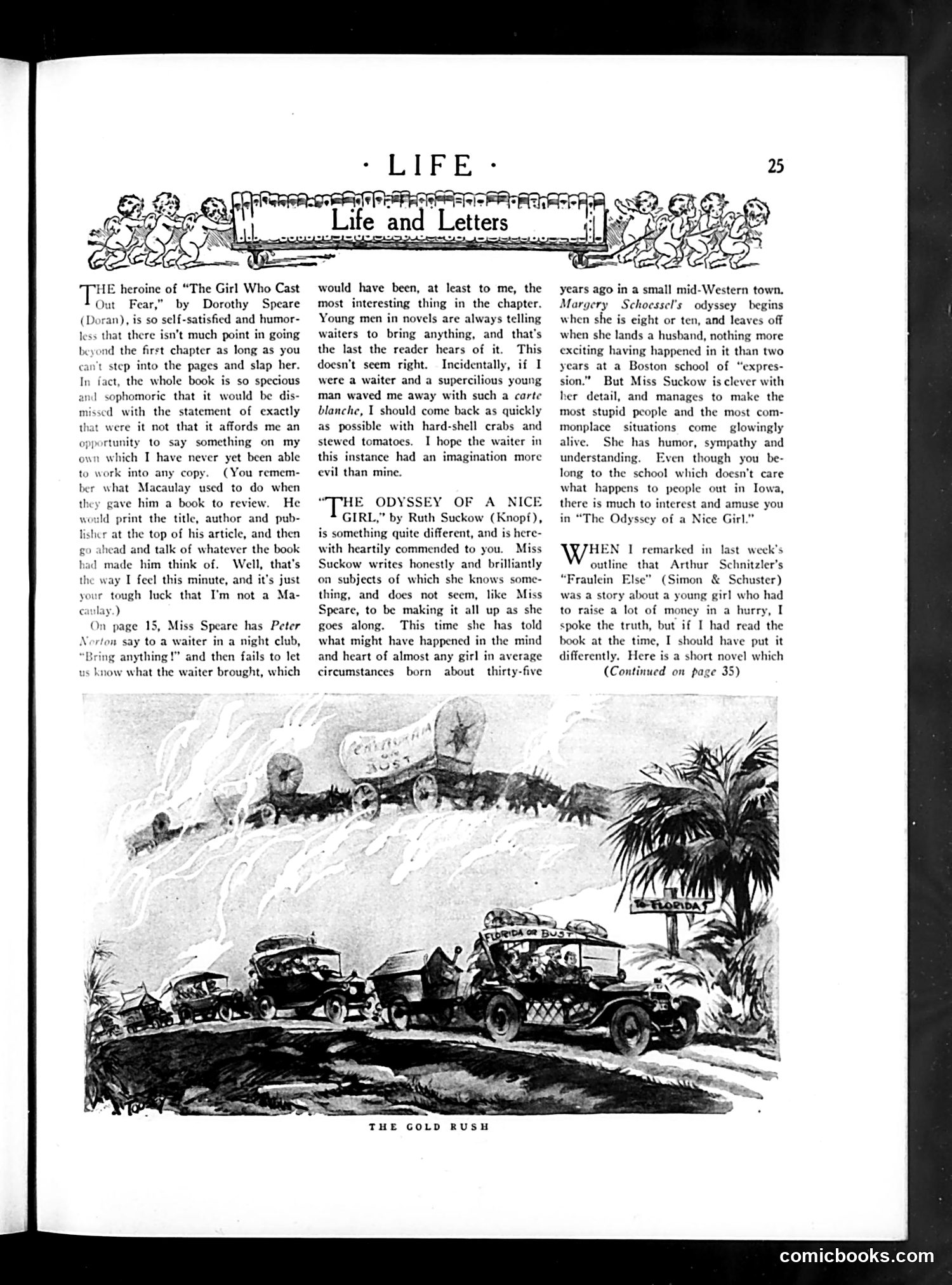
This is a literary criticism page featuring book reviews. The main content is a satirical essay by the columnist (likely Edmund Wilson or similar era critic) reviewing three novels: 1. **"The Girl Who Cast Out Fear"** by Dorothy Speare—dismissed as pretentious and boring, with the critic using it as a springboard to complain about a narrative gap (a waiter never returns with the ordered food). 2. **"The Odyssey of a Nice Girl"** by Ruth Suckow—praised for honest, detailed storytelling about an ordinary Midwestern woman's life from childhood to marriage. 3. **"Fräulein Else"** by Arthur Schnitzler—briefly mentioned as a short novel about a girl needing to raise money quickly. **The illustration** titled "The Gold Rush" depicts vehicles and crowds heading toward Florida (marked on a palm tree), likely satirizing the 1920s Florida land boom speculation craze where Americans rushed to invest in Florida real estate. The column exemplifies Life's blend of literary criticism with humorous social commentary.
📄 Transcribed text from this page (OCR, searchable)
Machine-transcribed from the original scan — historical spelling and the odd misread are preserved.
THE heroine of “The Girl Who Cast Out Fear,” by Dorothy Speare (Doran), is so self-satisfied and humor- less that there isn’t much point in going be 1 the first chapter as long as you € step into the pages and slap her. In fact, the whole book is so specious snd sophomoric that it would be dis- missed with the statement of exactly at were it not that it affords me an opportunity to say something on my own which I have never yet been able to work into any copy. (You remem- ber what Macaulay used to do when they gave him a book to review. He would print the title, author and pub- lisher at the top of his article, and then go ahead and talk of whatever the book had made him think of. Well, that's the way I feel this minute, and it's just * tough luck that I'm not a Ma- ay.) On page 15, Miss Speare has Peter rion say to a waiter in a night club, ng anything!” and then fails to let what the waiter brought, which (7 Life and "Letters would have been, at least to me, the most interesting thing in the chapter. Young men in novels are always telling waiters to bring anything, and that's the last the reader hears of it. This doesn’t seem right. Incidentally, if I were a waiter and a supercilious young man waved me away with such a carte blanche, I should come back as quickly as possible with hard-shell crabs and stewed tomatoes. I hope the waiter in this instance had an imagination more evil than mine. HE ODYSSEY OF A NICE GIRL,” by Ruth Suckow (Knopf), is something quite different, and is here- with heartily commended to you. Miss Suckow writes honestly and brilliantly on subjects of which she knows some- thing, and does not m, like Miss Speare, to be making it all up as she goes along. This time she has told what might have happened in the mind and heart of almost any girl in average circumstances born about thirty-five THE GOLD RUSH a small mid-Western town, Schoesscl’s odyssey begins when she is eight or ten, and leaves off when she lands a husband, nothing more exciting having happened in it than two years at a Boston school of sion.” But Miss Suckow is clever with her detail, and manages to make the most stupid people and the most com- monplace situations come glowingly alive. She has humor, sympathy and understanding. Even though you be- long to the school which doesn't care what happens to people out in Iowa, there is much to interest and amuse you in “The Odyssey of a Nice Girl.” years ago i Margery HEN I remarked in last week's outline that Arthur Schnitzler’s aulein Else” (Simon & Schuster) was a story about a young girl who had to raise a lot of money in a hurry, I spoke the truth, but if I had read the book at the time, I should have put it differently. Here is a short novel which (Continued on page 35) comicbooks.com