
A complete issue · 36 pages · 1925
Life — June 11, 1925
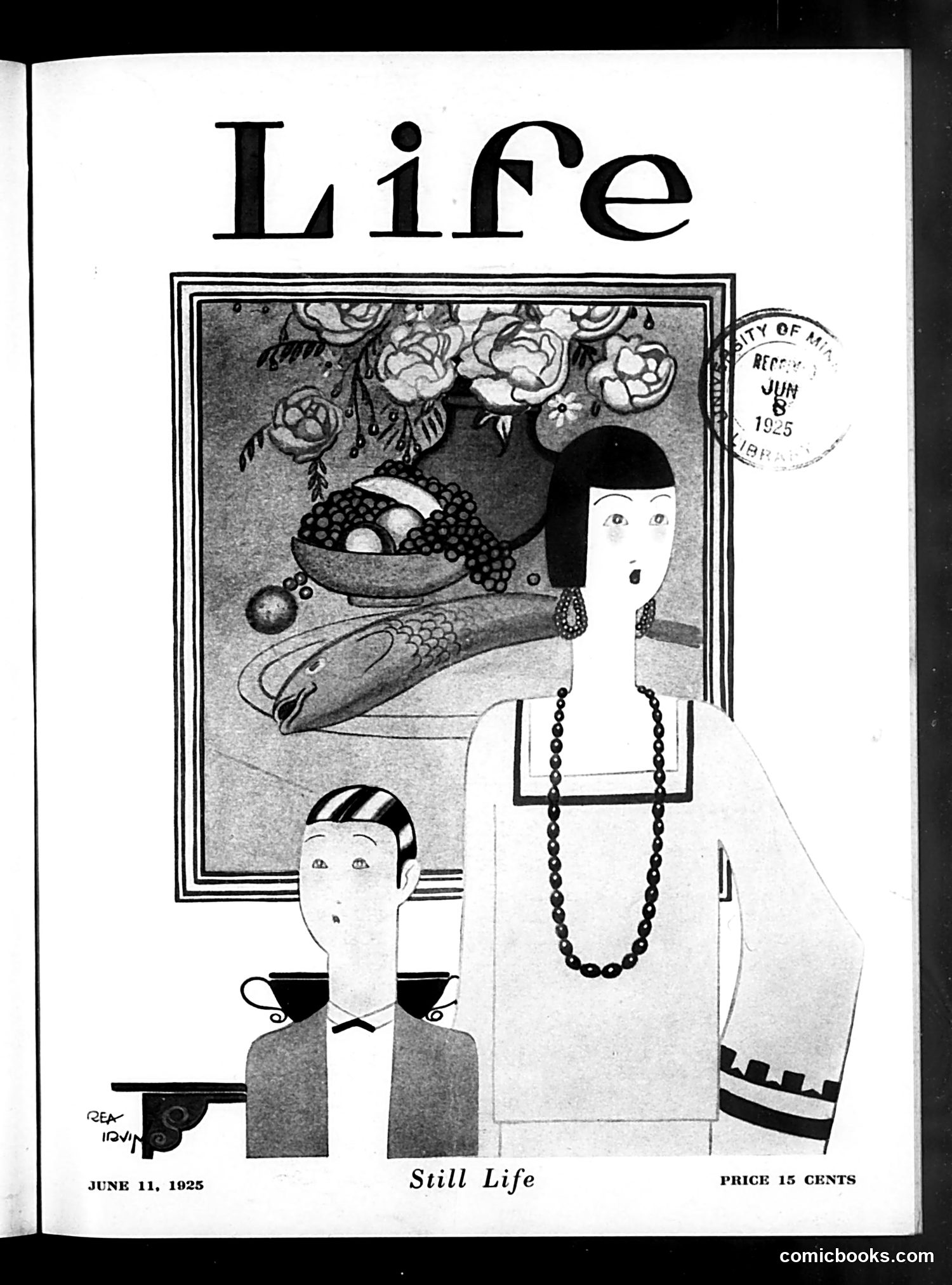
This cover illustrates "Still Life"—a visual pun playing on the art term. The composition depicts a woman and child rendered as stylized, mask-like figures characteristic of 1920s modernist illustration. The artwork references the period's artistic movements, likely Art Deco or Cubism, which emphasized geometric forms and flattened perspective. The "still life" joke operates on multiple levels: traditionally, still life paintings depict inanimate objects (fruit, flowers), yet here human figures are depicted with the flatness and emotional distance of painted objects. The accompanying still life painting in the background—showing fruit and flowers in a decorative arrangement—reinforces this artistic commentary. The satire likely mocks contemporary modernist art movements' tendency to reduce human subjects to abstract, emotionless forms.
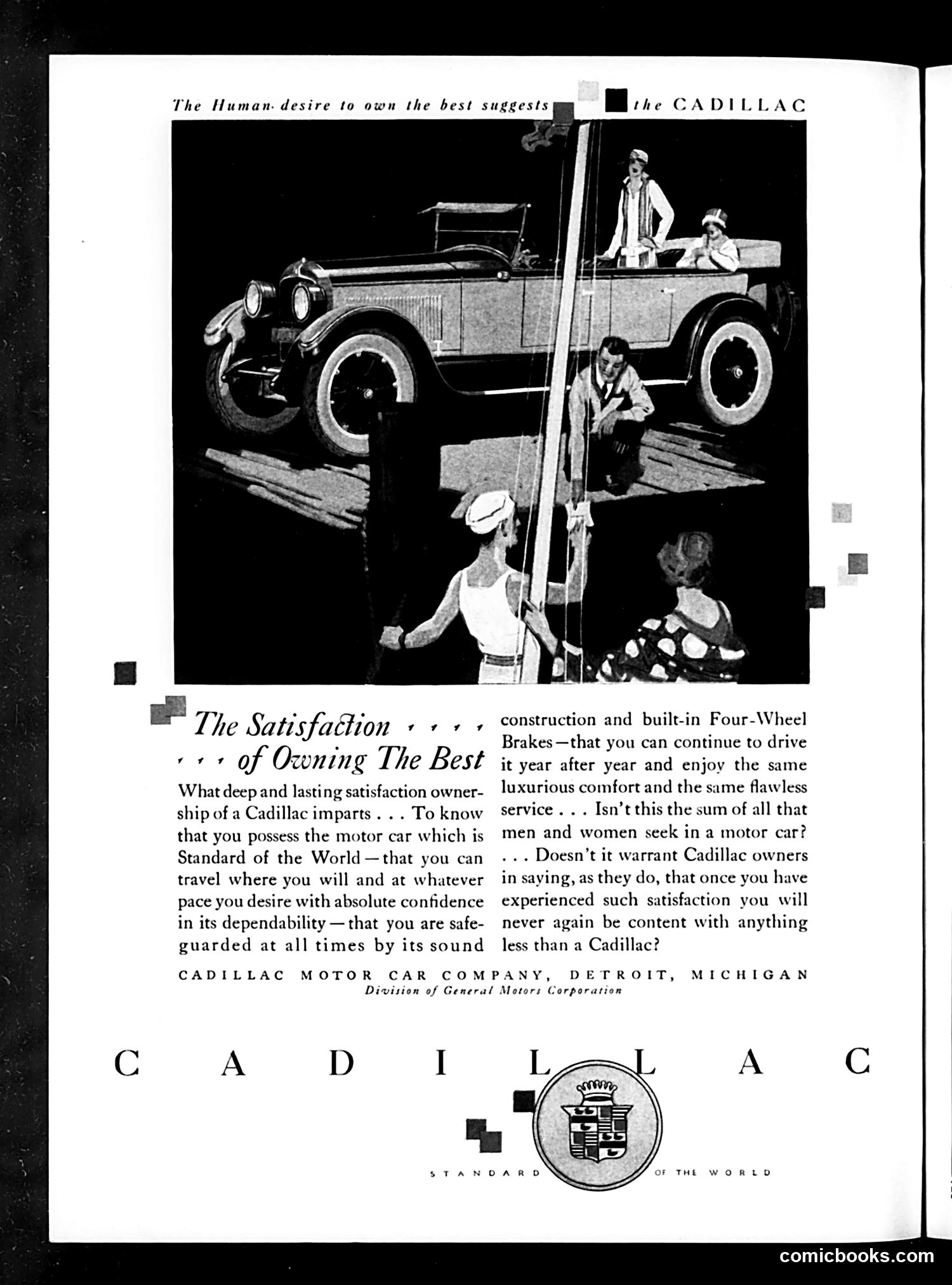
This is **not a political cartoon or satire**—it's a straightforward advertisement for Cadillac automobiles. The page features a showroom scene with well-dressed customers examining a Cadillac truck, accompanied by promotional text emphasizing luxury, reliability, and the car's status as "Standard of the World." The headline "The human desire to own the best suggests the CADILLAC" frames car ownership as aspirational. The ad targets affluent consumers by emphasizing long-term satisfaction, dependability, and the prestige of ownership. This represents early automotive advertising strategy: positioning luxury vehicles as symbols of success and permanence rather than mere transportation. The clothing and styling suggest this dates to approximately the 1920s-early 1930s.
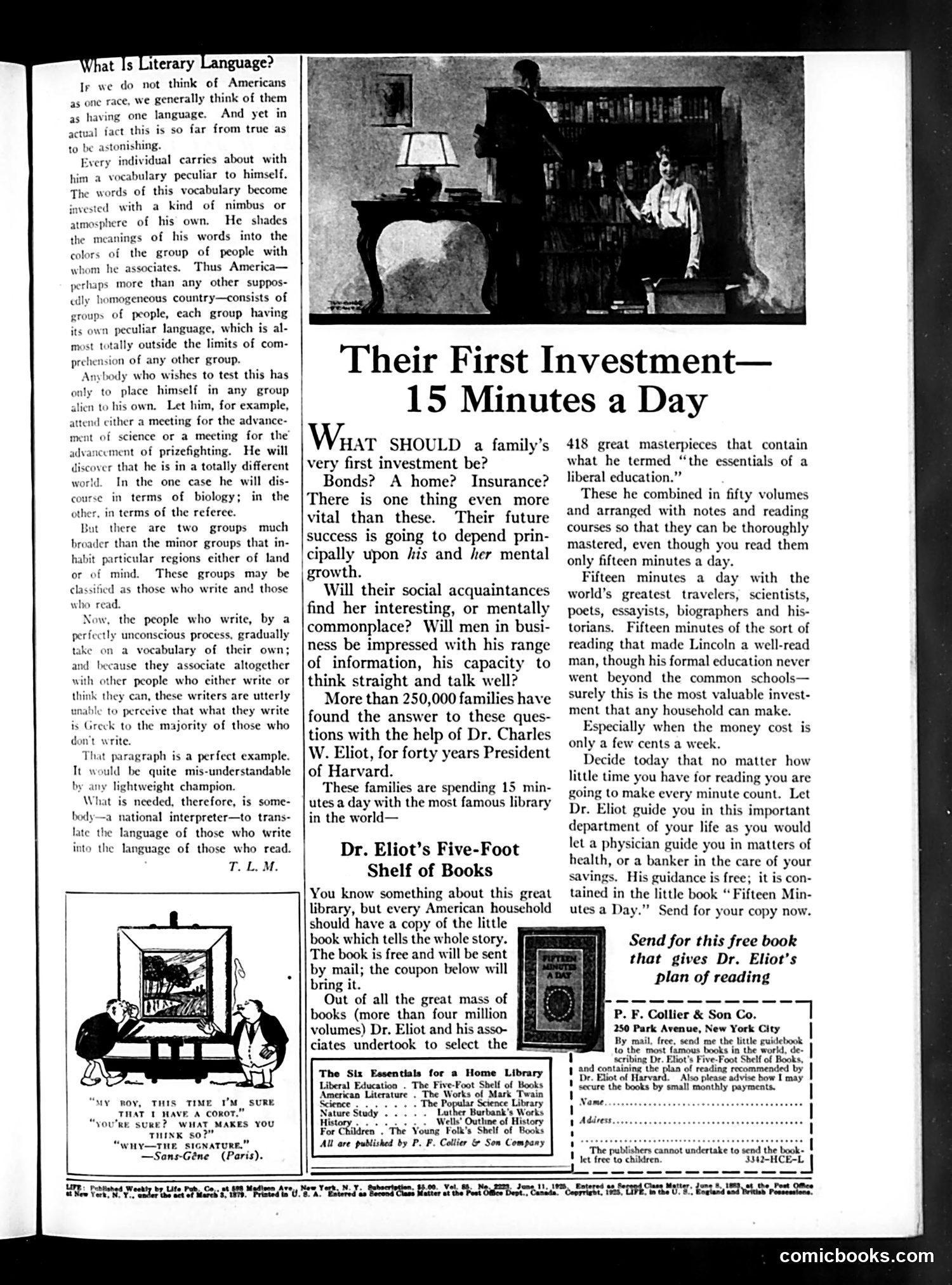
This page combines educational content with advertising rather than political satire. The left side features an essay "What is Literary Language?" discussing how different American groups have distinct vocabularies and speech patterns. Below it is a small cartoon showing two figures examining a bookshelf, with dialogue about having "a book" and "why" — this appears to illustrate the essay's point about language variation. The right side promotes Dr. Charles W. Eliot's (Harvard's president for 40 years) curated five-foot home library. The advertisement claims families reading just 15 minutes daily from these 418 "great masterpieces" can achieve mental growth and refinement. The overall message reflects early 20th-century progressive faith in self-improvement through reading and cultural education. The content targets middle-class Americans seeking intellectual development for themselves and their families.
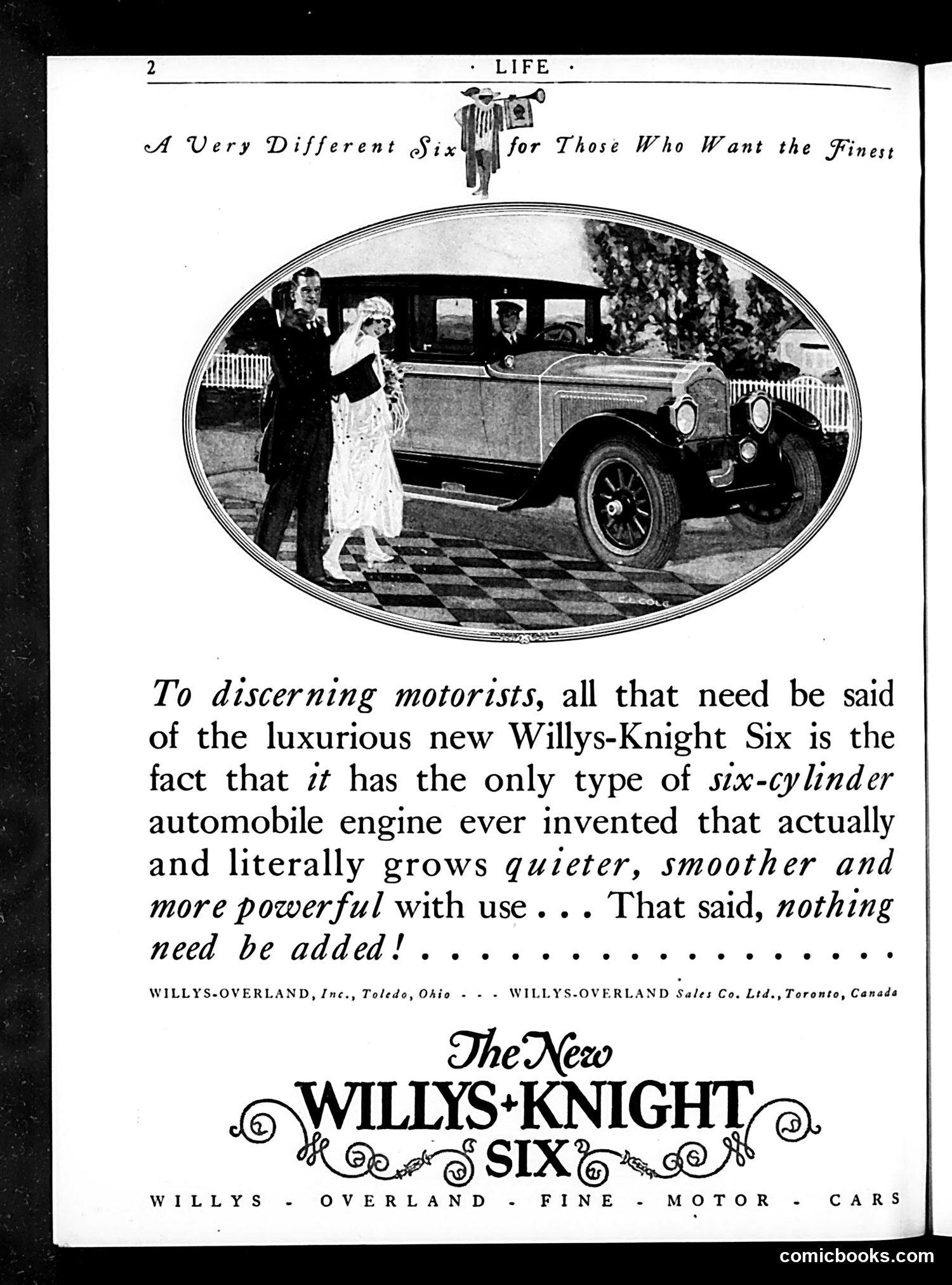
This is **not a political cartoon** but rather a **vintage automobile advertisement** for the Willys-Knight Six, appearing in Life magazine (page 2). The image shows a well-dressed couple admiring a luxury car parked outside an elegant home. The ad's central claim is that this six-cylinder engine uniquely "grows quieter, smoother and more powerful with use"—a technical selling point emphasizing durability and refinement. The phrase "A Very Different Six for Those Who Want the Finest" targets affluent consumers. The domestic scene and formal attire suggest this car appeals to upper-class motorists seeking status and mechanical superiority. This represents early automotive advertising strategy: emphasizing engineering innovation and exclusivity to justify premium pricing during the competitive 1920s automobile market.
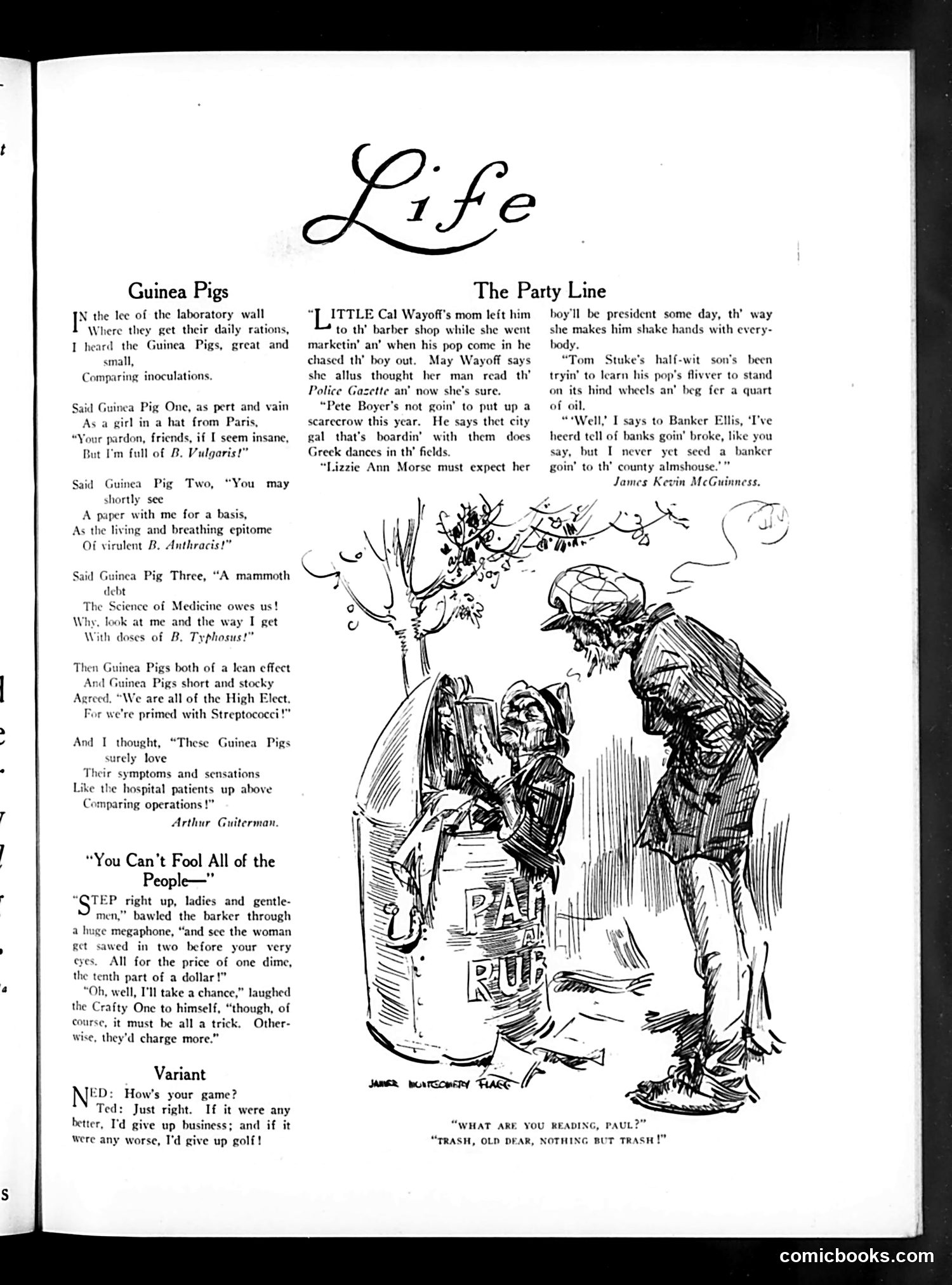
The main cartoon depicts two figures examining what appears to be reading material labeled "TRASH" and "RUB." One character asks "What are you reading, Paul?" with the response "Trash, old dear, nothing but trash!" This satirizes lowbrow or sensationalist publications of the era. The artwork style and composition suggest social commentary on reading habits and popular culture consumption among the working or middle classes. The dismissive tone—calling readable material "trash"—likely critiques both the publications themselves and readers' consumption of them. The page also contains humorous anecdotes about guinea pigs used in laboratory testing, playing on their role in medical research. The overall page mixes social satire with light humor typical of *Life* magazine's satirical approach to contemporary American society and class attitudes.
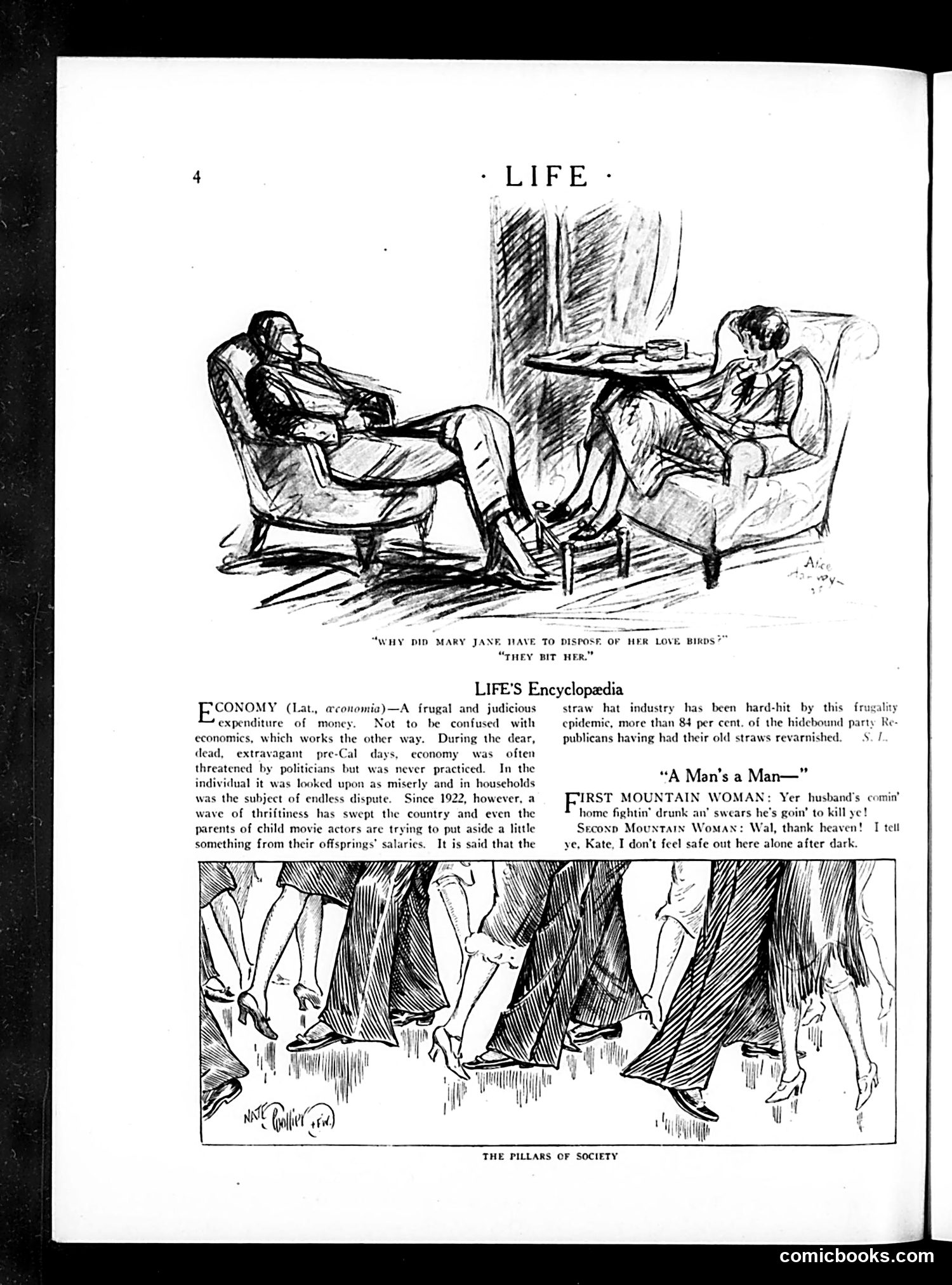
**Top Cartoon:** A man and woman sit in chairs facing each other across a small table. The caption reads "WHY DID MARY JANE HAVE TO DISPOSE OF HER LOVE BIRDS? 'THEY BIT HER.'" This appears to be a simple joke playing on double meaning—the phrase "love birds" (a type of parrot) literally biting the woman, though "love birds" colloquially refers to romantic couples. **"LIFE'S Encyclopedia" Section:** Contains a definition of "ECONOMY" emphasizing frugality, noting that during pre-Prohibition days ("pre-Cal days") economy was often disregarded by politicians but practiced by households. It references post-1922 thriftiness sweeping the country. **"A Man's a Man" Comic Strip:** Shows dialogue between mountain women discussing husbands coming home drunk and fighting. The strip titled "THE PILLARS OF SOCIETY" depicts women's legs/feet, satirizing how women were society's supposed moral foundation.
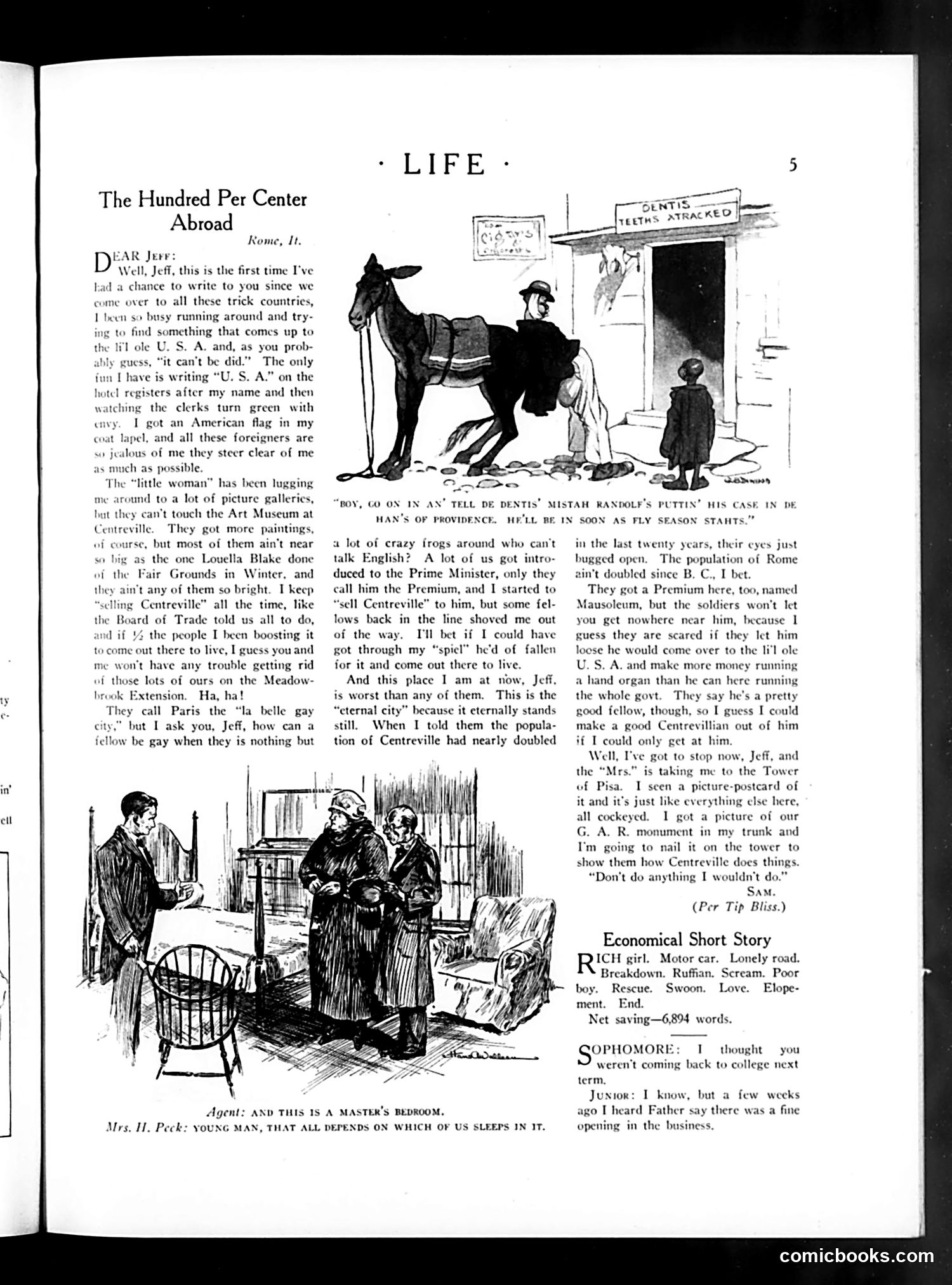
This page contains a humorous letter from Rome titled "The Hundred Per Center Abroad," mocking American tourists abroad who insist on American standards while traveling. The writer complains about encountering other Americans demanding English speakers, calling themselves "Centrevillians," and generally refusing to adapt to local culture. The top illustration depicts an American tourist with a donkey and luggage approaching what appears to be an Italian dental office, satirizing the stereotype of Americans abroad who remain fixated on American conveniences even in foreign lands. The lower illustration shows what's labeled "a Master's bedroom," likely mocking European accommodations that Americans found inadequate. The satire targets American cultural insularity and the expectation that the world should accommodate American preferences rather than travelers adapting to local customs.
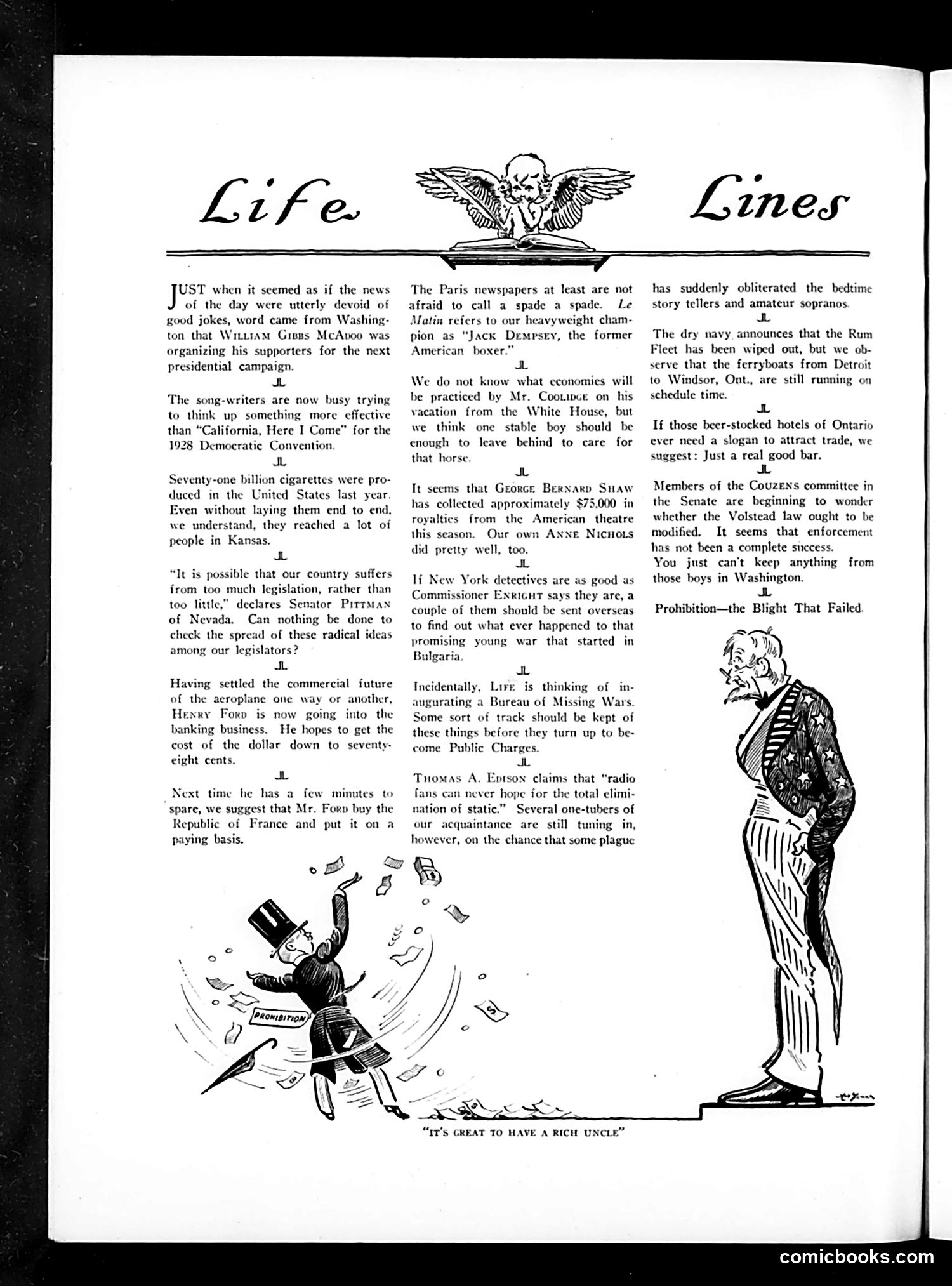
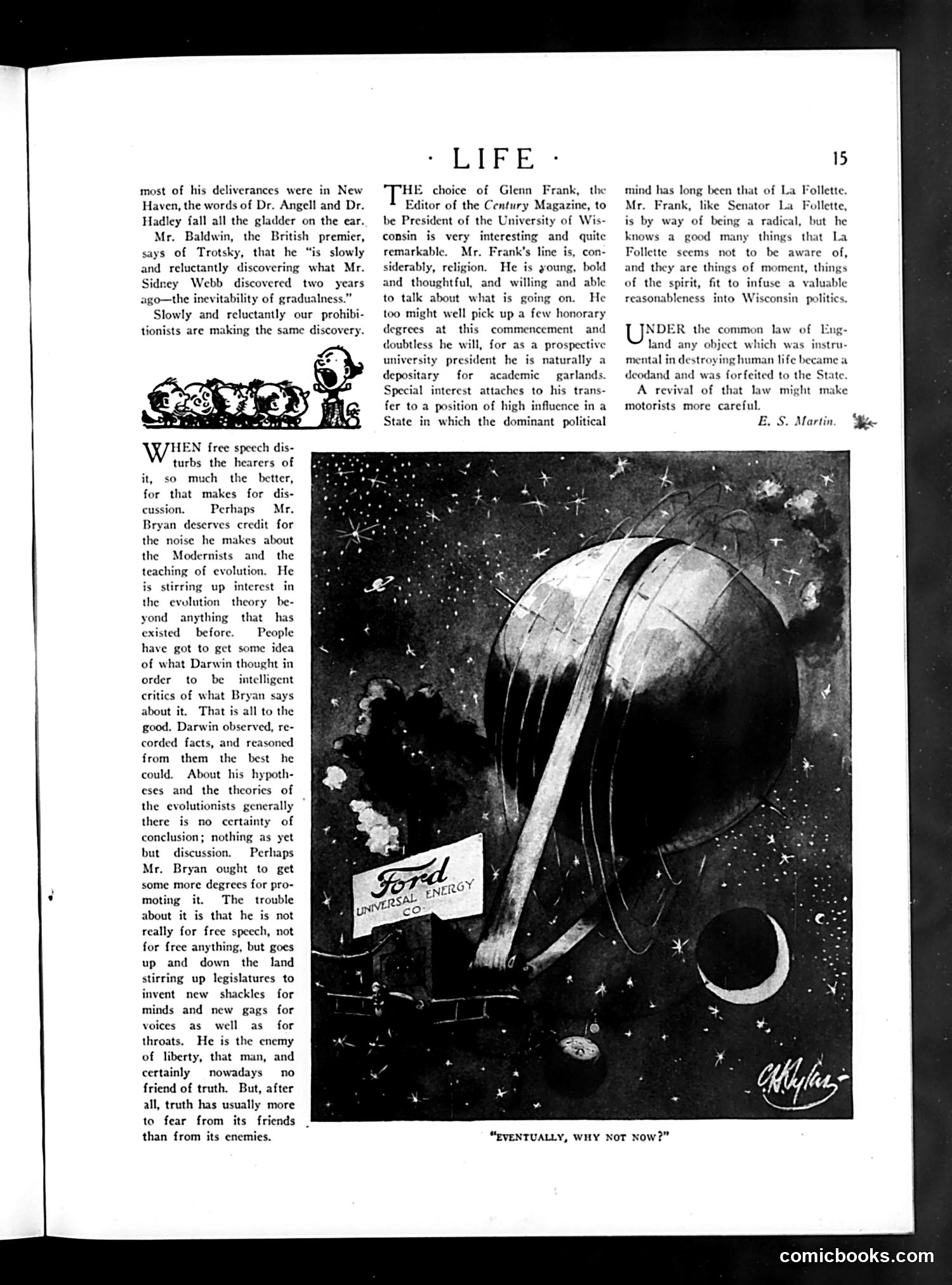
This page contains brief satirical commentary on contemporary political and social topics, typical of *Life* magazine's format. **Main Cartoon:** "It's Great to Have a Rich Uncle" depicts Prohibition as a figure juggling money while a wealthy man observes approvingly. The satire suggests that Prohibition enforcement benefits the wealthy—likely referring to bootleggers, corrupt officials, or wealthy individuals profiting from illegal alcohol sales during the Prohibition era (1920-1933). **Text References:** The page includes jabs at politicians (Senator Pittman of Nevada), Henry Ford's business plans, George Bernard Shaw, and radio technology. The subtitle "Prohibition—the Blight That Failed" indicates the cartoonist's skepticism about Prohibition's effectiveness, a common stance by the late 1920s as the policy's failures became apparent.
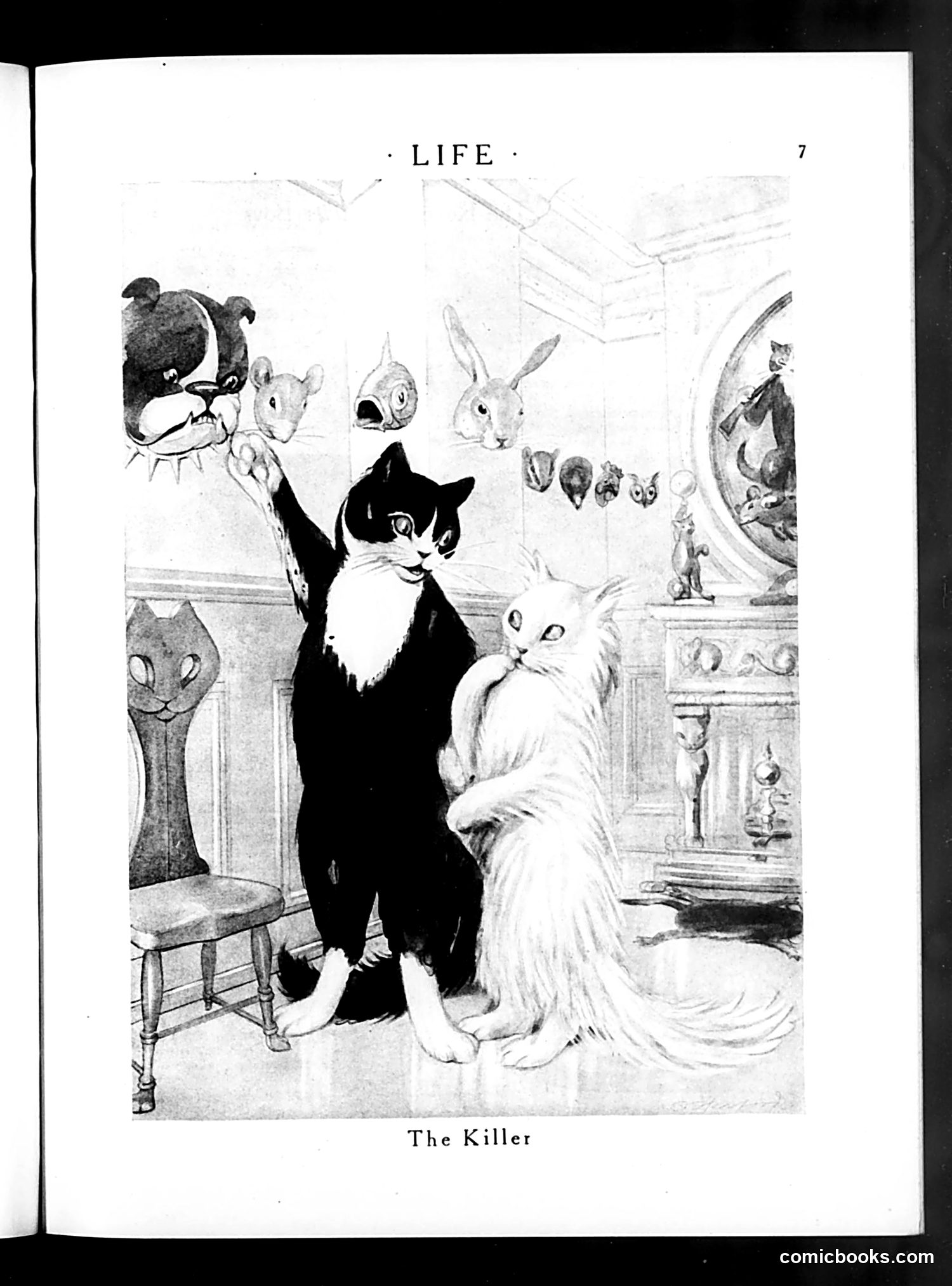
This cartoon depicts two anthropomorphized cats in a domestic interior examining what appears to be taxidermied animal heads and specimens on display. The title "The Killer" likely satirizes the contrast between the cats' nature as predators and their current civilized setting among collected fauna. The cartoon appears to comment on the incongruity of keeping wild animals as trophies or pets while coexisting in polite society. The black and white cat seems to present the specimens to the white cat, suggesting a proud display of hunting prowess now translated into interior decoration. The satire likely targets either the pretensions of trophy-hunting as "civilized" behavior, or perhaps critiques the keeping of animals in captivity for display—a commentary relevant to early 20th-century attitudes toward nature and domesticity.
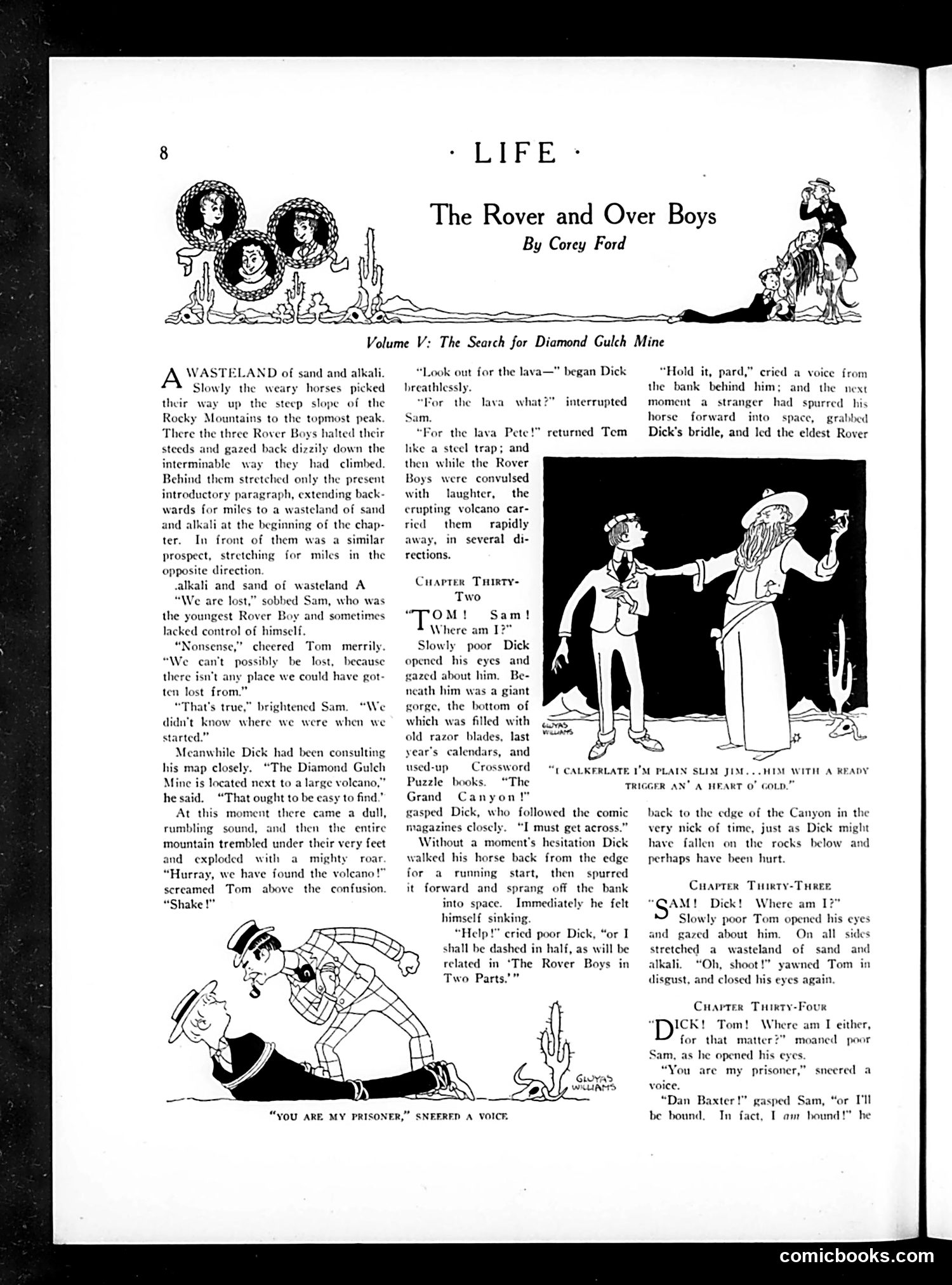
This is a serialized adventure story (Volume V: "The Search for Diamond Gulch Mine"), not political satire. The narrative follows characters named Dick, Tom, and Sam—young "Rover Boys" exploring a desert wasteland near a volcano searching for a diamond mine. The illustrations show slapstick comedy typical of early 20th-century adventure fiction: characters in peril (one appears imprisoned in a giant tortoise shell), encounters with a bearded prospector, and desert hazards. The dialogue emphasizes humor through miscommunication and physical comedy rather than social commentary. This appears to be entertainment fiction, part of Life magazine's broader content beyond its satirical offerings.
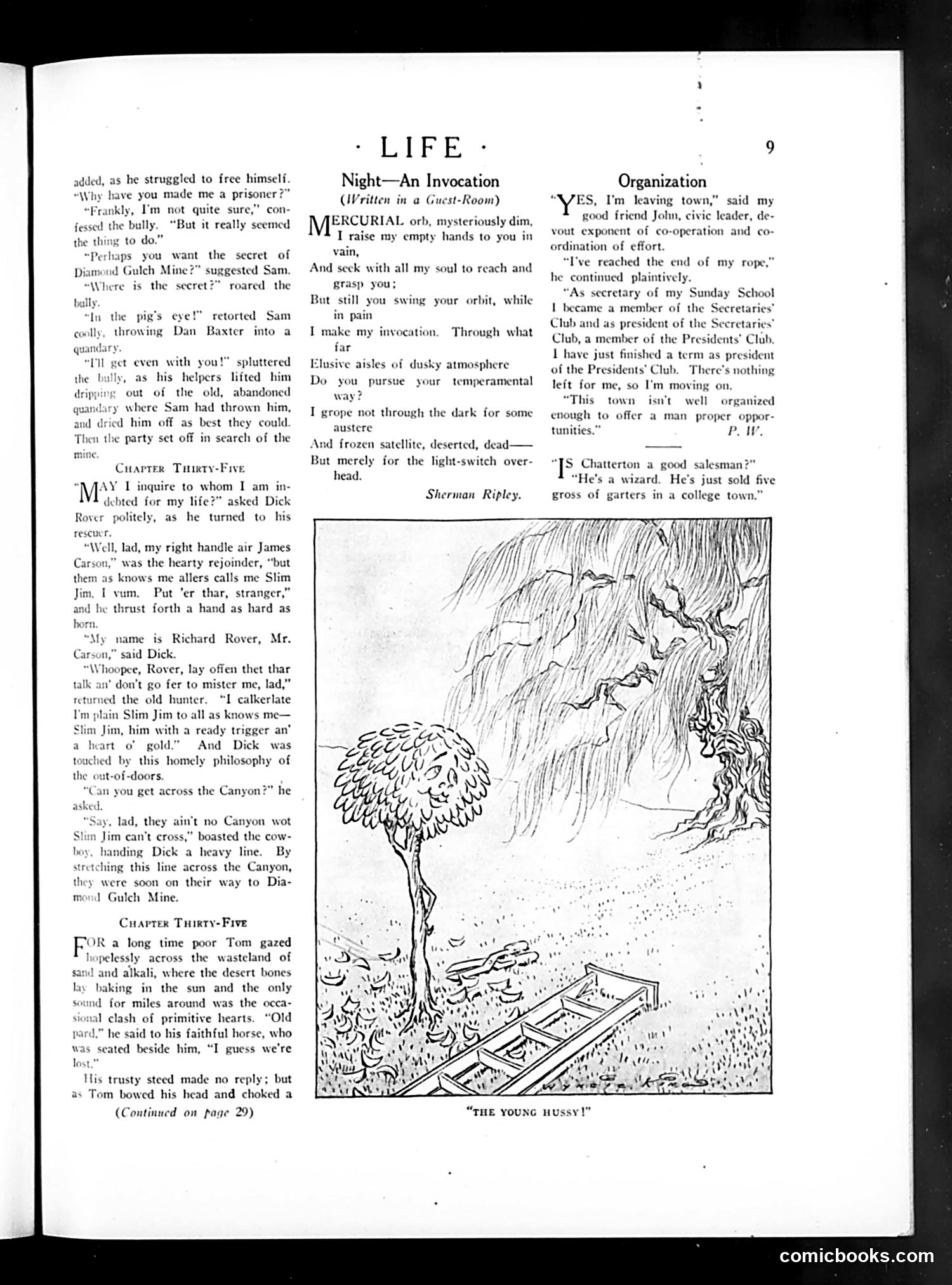
This page combines fiction and social commentary. The main content includes: **Literary sections:** - "Night—An Invocation," a poem by Sherman Ripley about spiritual yearning - Chapter 35 of a serialized story featuring characters Dick Rover and James Carson in a Western setting, discussing crossing a canyon **Social satire ("Organization"):** A brief dialogue mocking civic club culture. A man leaving town complains the city lacks organization to offer "better" opportunities. His friend responds that a local named Chatterton is "a wizard"—a successful salesman who "just sold five gross of garters in a college town." This satirizes how small-town success is measured by mundane commercial achievement rather than genuine organizational accomplishment. **Illustration:** "The Young Hussy" depicts a woman in a tree above a man with a ladder—likely illustrating romantic or comedic tension from the serialized narrative.
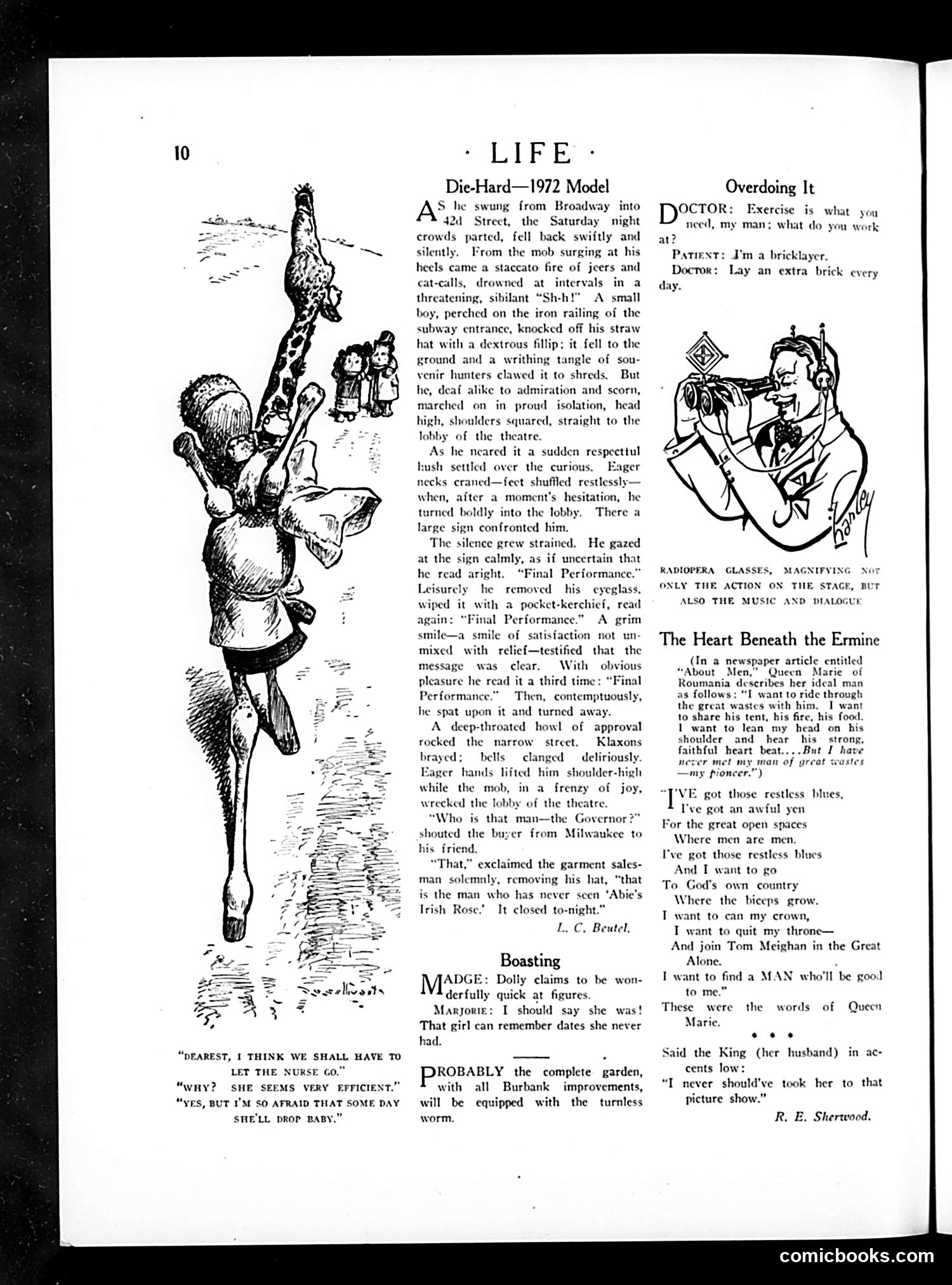
This page contains three satirical pieces: 1. **"Die-Hard—1972 Model"** (left): A sketch mocking an stubborn, old-fashioned man who ignores modern social changes. The narrative describes him defiantly walking through a theater district despite social upheaval around him. 2. **"Overdoing It"** (top right): A brief humorous doctor-patient exchange where a bricklayer claims he lays an extra brick daily for exercise—obviously excessive and impractical. 3. **"The Heart Beneath the Ermine"** and **"Boasting"** (bottom right): Short humorous pieces about Queen Marie (likely historical royalty) and characters named Madge and Marjorie discussing being "quick at figures." The cartoons use exaggeration and irony to satirize stubbornness, excessive behavior, and social pretension typical of 1970s Life Magazine humor.
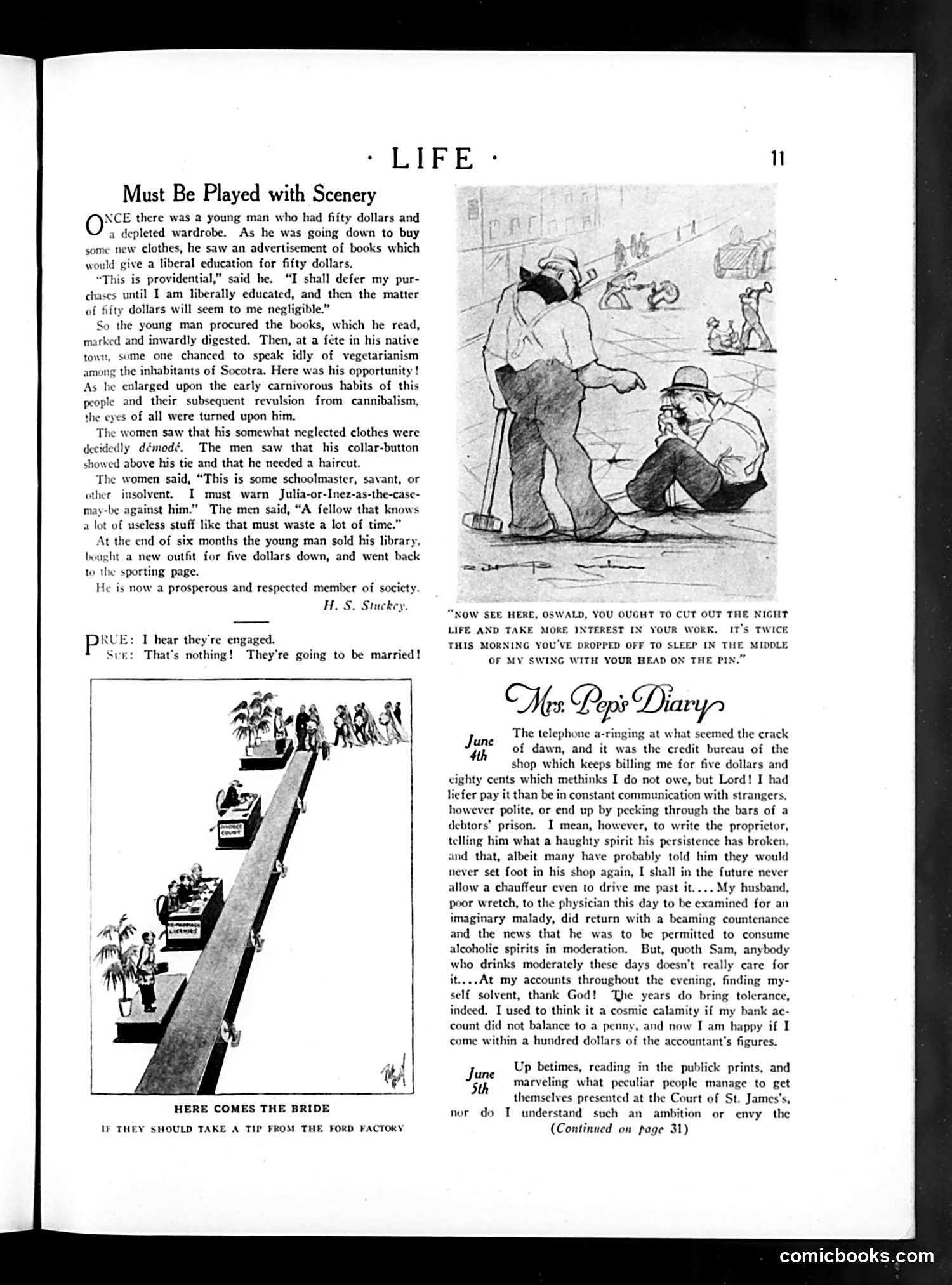
The page contains two distinct satirical pieces: **"Must Be Played with Scenery"** (top): A story by H. S. Stackey mocking a young man who squanders $50 on impractical books about vegetarianism and Eastern philosophy rather than practical education. The satire targets pretentious intellectualism and naive idealism—he sells the library after six months and returns to conventional society. The accompanying cartoon shows working-class ridicule of such affectations. **"Here Comes the Bride"** (bottom): The illustration appears to depict a wedding procession ascending a ramp or escalator-like structure, likely satirizing consumerism or commercialization of marriage, possibly critiquing how weddings have become elaborate, costly spectacles. The caption suggests ironic commentary about treating weddings like factory production. **"Mrs. Pep's Diary"** (right): Opens a domestic humor column about bill collectors and marital conflict.
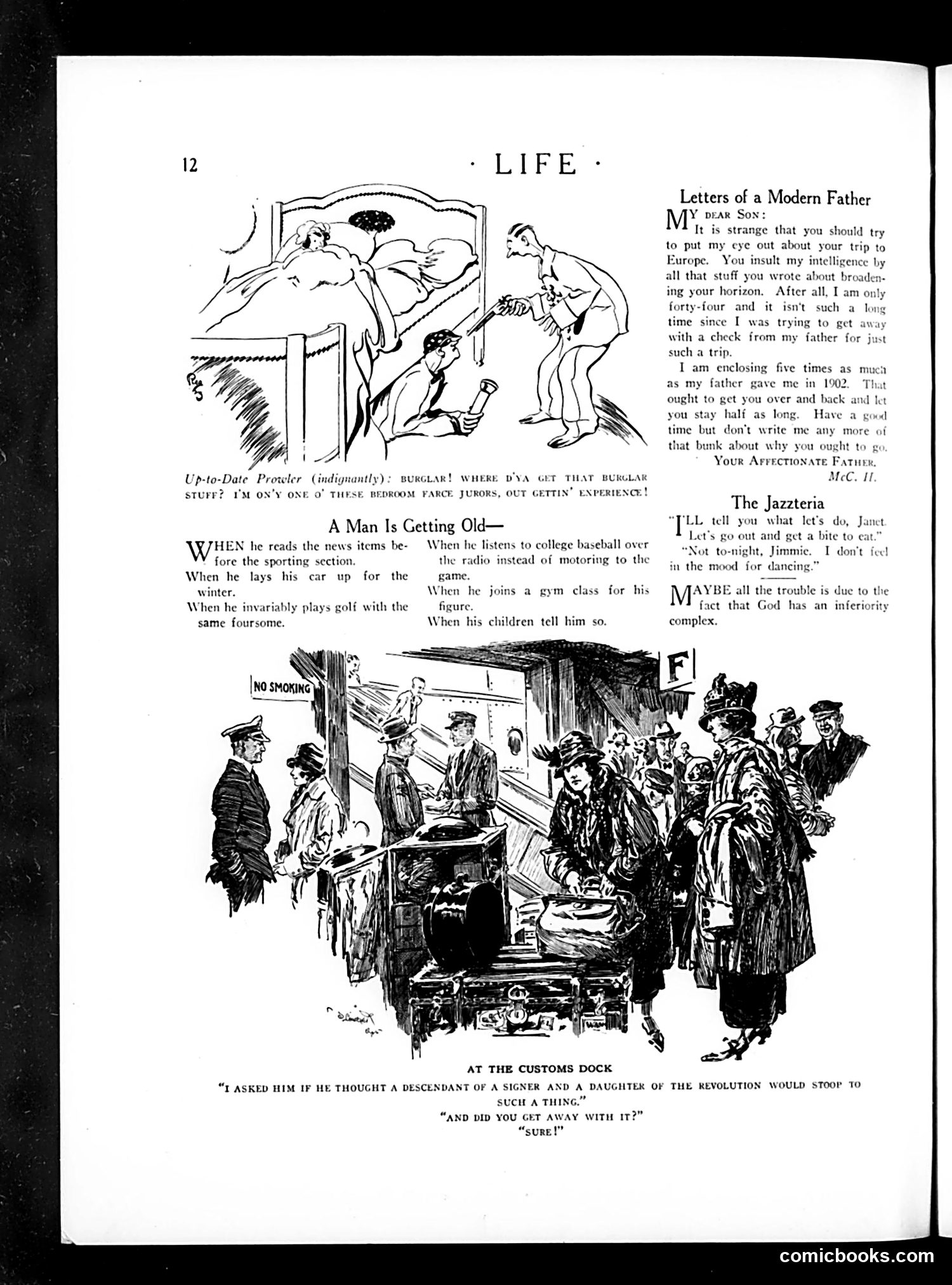
**Top cartoon** depicts a burglar caught in a bedroom. The caption satirizes an "up-to-date prowler" who announces himself before stealing—a humorous inversion of traditional burglary stealth. **"A Man Is Getting Old"** section uses a checklist format to mock aging: playing golf repeatedly, listening to baseball instead of driving, joining gym classes. The humor lies in recognizing these as stereotypical "old man" behaviors. **Bottom cartoon** shows a customs dock scene where officials question an arriving passenger about descended signers of the Declaration of Independence. The man admits smuggling them back into America. This satirizes American reverence for Revolutionary ancestors and perhaps critiques the absurdity of worshipping historical figures as contraband. The page demonstrates early 20th-century satirical humor targeting everyday masculine life and American nationalism.
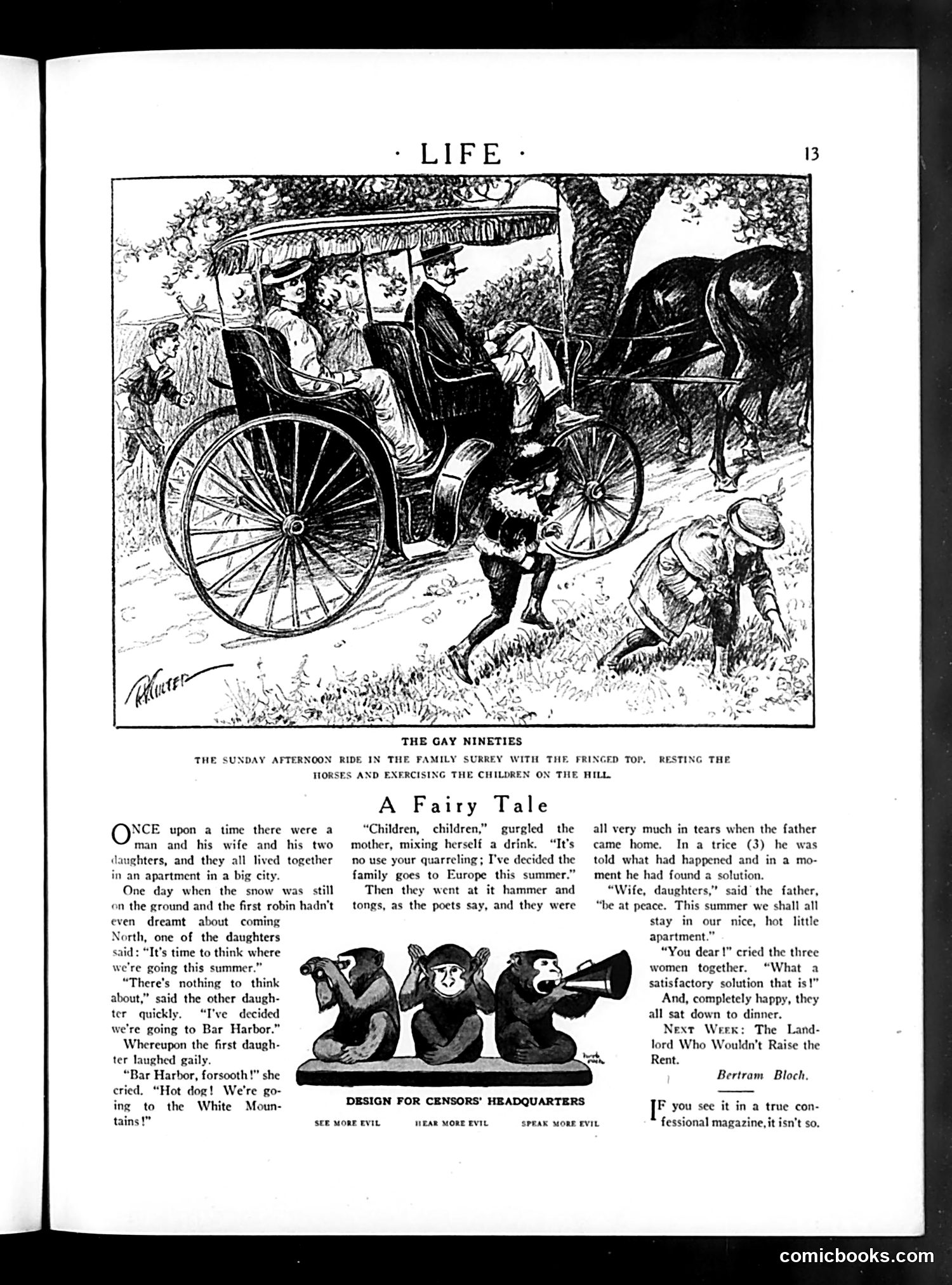
**Top Illustration ("The Gay Nineties"):** A satirical sketch of an idealized Victorian-era family outing in a horse-drawn carriage with a fringed canopy top. Children play beside the road while adults relax. The caption mocks this nostalgic vision of the 1890s as quaint and leisurely. **"A Fairy Tale" Story:** A family living in a cramped city apartment dreams of escape. When the mother announces they'll go to Europe instead of Bar Harbor, the daughters initially despair—but ultimately accept the compromise over their cramped urban life. **Bottom Illustration:** Three monkeys representing "see evil, hear evil, speak no evil"—labeled as "Design for Censors' Headquarters." This satirizes censorship by suggesting censors should embody willful ignorance. The page generally satirizes both class aspirations and social constraints of the era.
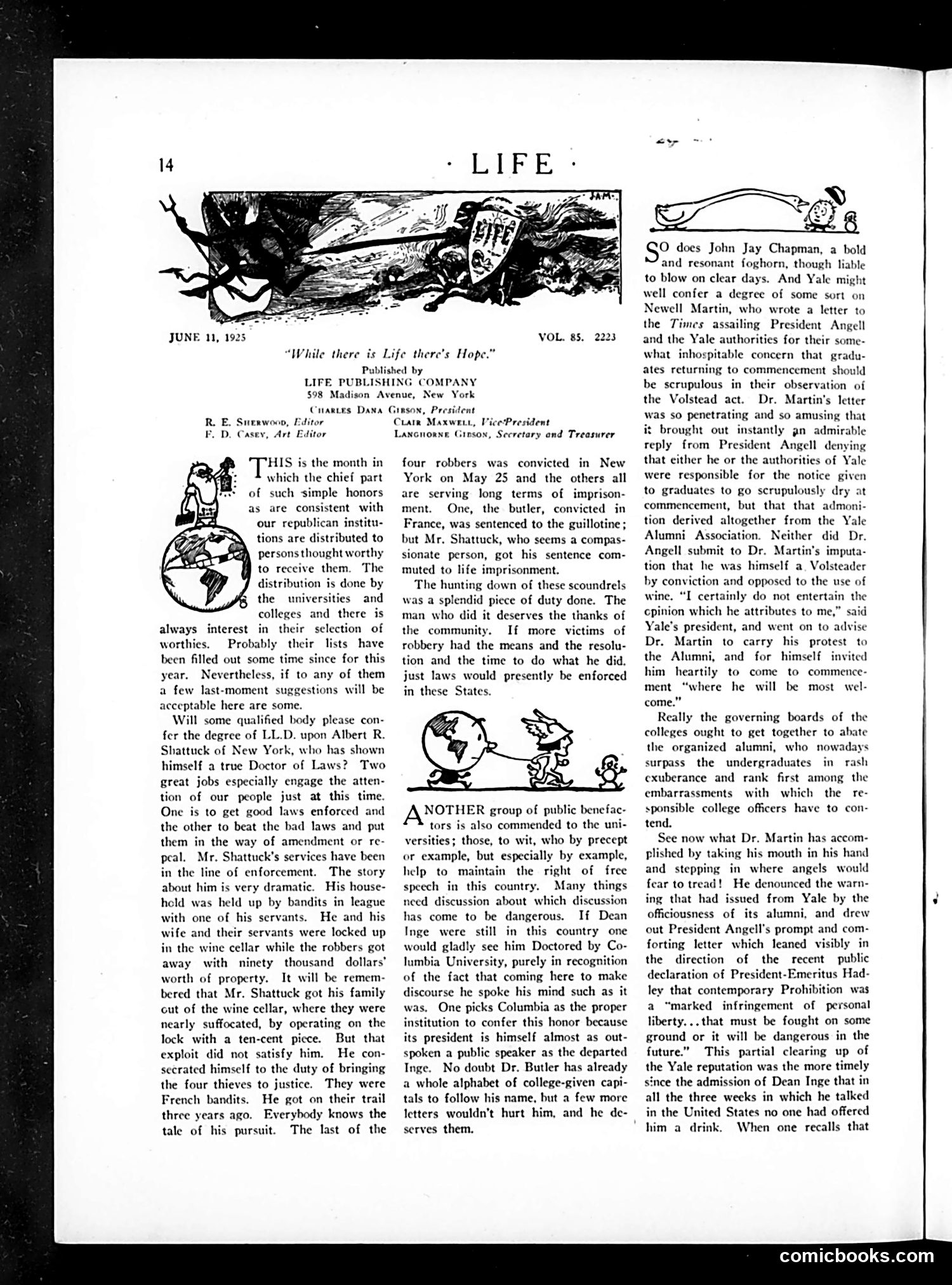
This editorial page discusses college discipline and legal enforcement during Prohibition. The main cartoon (upper left) depicts a figure labeled "LIFE" lying down with what appears to be a wine bottle, illustrating the magazine's satirical stance on enforcement issues. The text criticizes both robbers convicted in New York and argues for better law enforcement generally. It praises Yale's president for taking a stand against Prohibition violations among students, and commends university governing boards for maintaining "free speech" while disciplining alumni who break laws. The cartoons appear to satirize the tensions between college authority, student conduct, and Prohibition enforcement—a major public controversy in 1920s America. The piece advocates for stronger institutional accountability regarding alcohol violations.

This appears to be a landscape photograph rather than a political cartoon or satirical illustration. The black and white image shows a scenic rural valley view framed by tree branches in the foreground, with mountains visible in the distance, a river or stream, and what appear to be farm buildings or houses scattered throughout the landscape. The page contains minimal text—only "LIFE" at the top right, "The Photo" at the bottom right, and a watermark from "comicbooks.com." Without additional context or caption text identifying the location or the photograph's significance, it's unclear what satirical or political point this image is meant to convey. It may simply be a nature or landscape photograph published in the magazine, rather than satirical content.
This appears to be a satirical illustration from Life magazine depicting a figure (likely representing a political or social figure of the era) riding atop a large, hairy beast or monster. The rider carries a long spear or lance, suggesting a "Don Quixote" reference—tilting at windmills or engaging in futile, quixotic pursuits. The landscape in the background is barren and sparse. The satire likely critiques someone's unrealistic ambitions, foolish crusade, or misguided leadership. Without visible text identifying the specific figure or historical moment, the exact political reference remains unclear, but the "quixotic quest" metaphor was commonly used in early 20th-century political cartooning to mock idealistic but impractical initiatives or leaders. The monstrous steed may represent an unwieldy cause or movement being ridden recklessly.
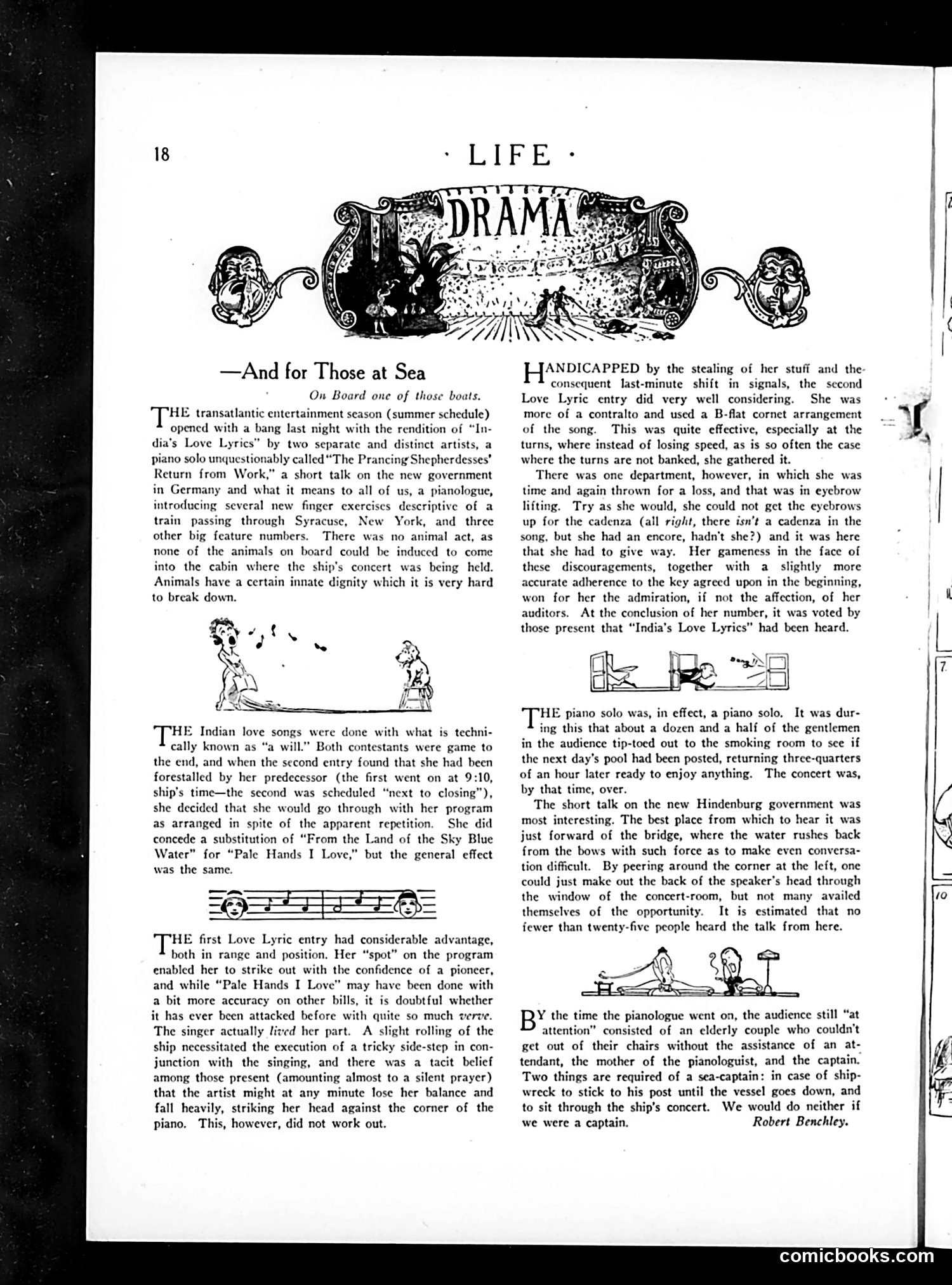
This article humorously reviews an onboard ship's concert during a transatlantic voyage. The satire targets the tedium of shipboard entertainment through deadpan, mock-serious criticism. Two female singers performed "India's Love Lyrics" — apparently competing, with the second performer forced to substitute songs after the first performed the same piece. Life's critic sarcastically praises their "verve" and notes the first singer nearly fell due to ship's motion (which the audience apparently hoped would happen). The second singer, a contralto, struggled with "eyebrow lifting" during cadenzas. A piano solo bored gentlemen so thoroughly they abandoned the concert for the smoking room's betting pool. A talk on Germany's new government (likely Weimar-era, unclear which specific period) played to sparse attendance near the bridge. The satire mocks both amateur performers and the captive, unenthusiastic audience enduring mandatory entertainment at sea — a common complaint about early-20th-century ship life.
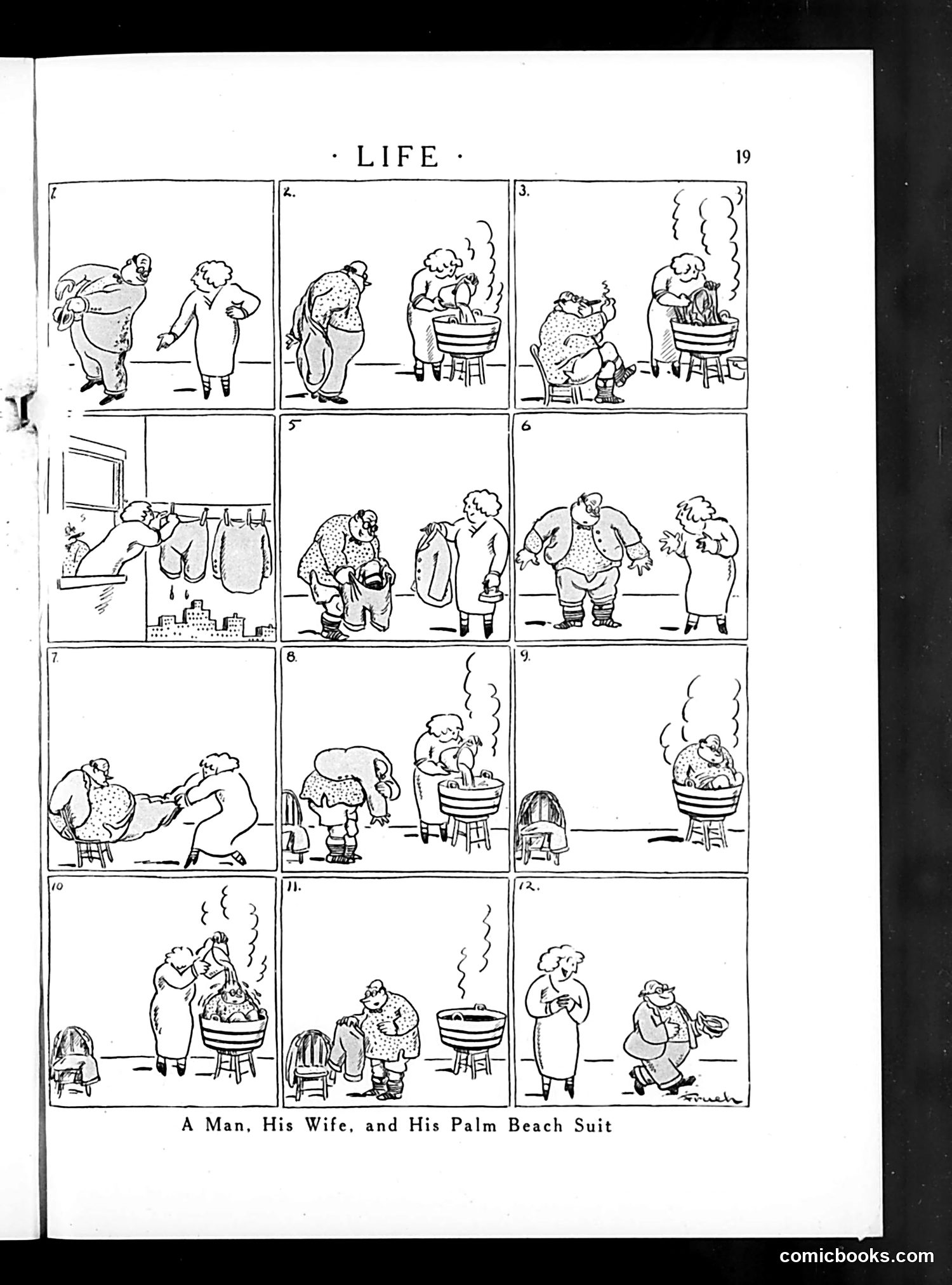
This 12-panel comic strip satirizes the impracticality of fashionable Palm Beach suits—likely lightweight summer wear popular in the 1920s-30s. The narrative follows a man's suit through domestic chaos: a wife dunks laundry in a basin, children play roughly with the garment, it gets wrung out, tangled, and generally mistreated through various household mishaps. The steam-rising basket suggests boiling or washing. The joke targets vanity about fashionable clothing versus domestic reality—a man invests in an expensive, delicate Palm Beach suit only to have it destroyed through normal family life. It's gentle social satire about the gap between aspirational fashion and practical living, mocking both the suit's fragility and perhaps men's concern with appearance.
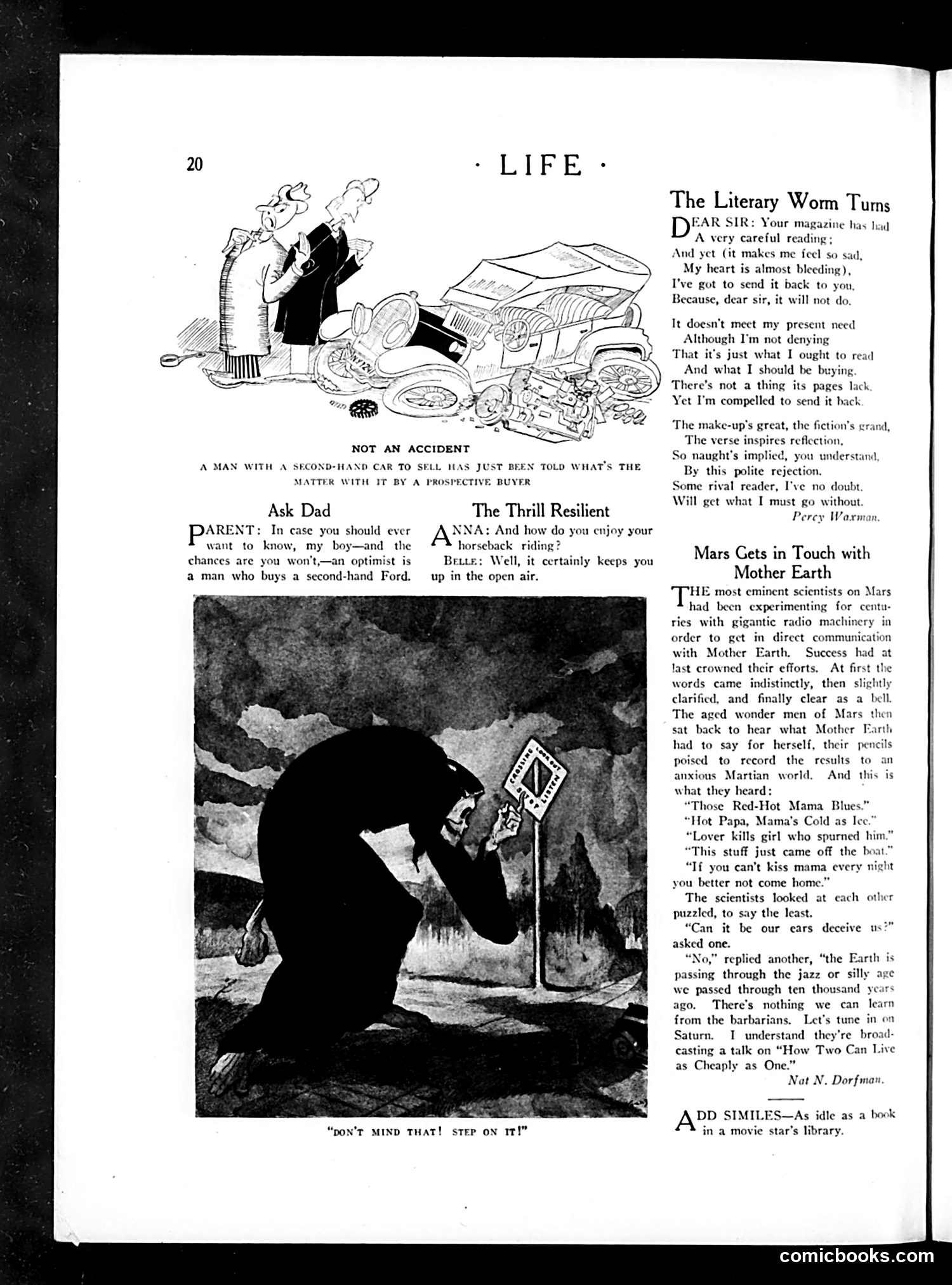
This page contains three separate humorous pieces satirizing 1920s American culture: 1. **"Not an Accident"** (top cartoon): Shows a man with a decrepit second-hand car being told its problems by a buyer. The joke plays on the definition below: an "optimist" is someone foolish enough to buy a used Ford—implying Fords are notoriously unreliable vehicles. 2. **"Ask Dad"**: A father jokes that buying a second-hand Ford requires optimism, reinforcing the running gag about Ford reliability. 3. **"The Thrill Resilient"**: A light exchange about horseback riding's appeal. 4. **"The Literary Worm Turns"**: A humorous letter rejecting Life magazine itself—praising its quality while refusing it for unclear reasons. The irony is the author admits it's excellent but must return it anyway. 5. **"Mars Gets in Touch with Mother Earth"**: Scientists on Mars successfully radio Earth only to receive jazz music, pop songs about romance, and crime headlines. The satire mocks 1920s popular culture as lowbrow "barbarian" entertainment unworthy of alien contact, contrasting with serious scientific aspiration.
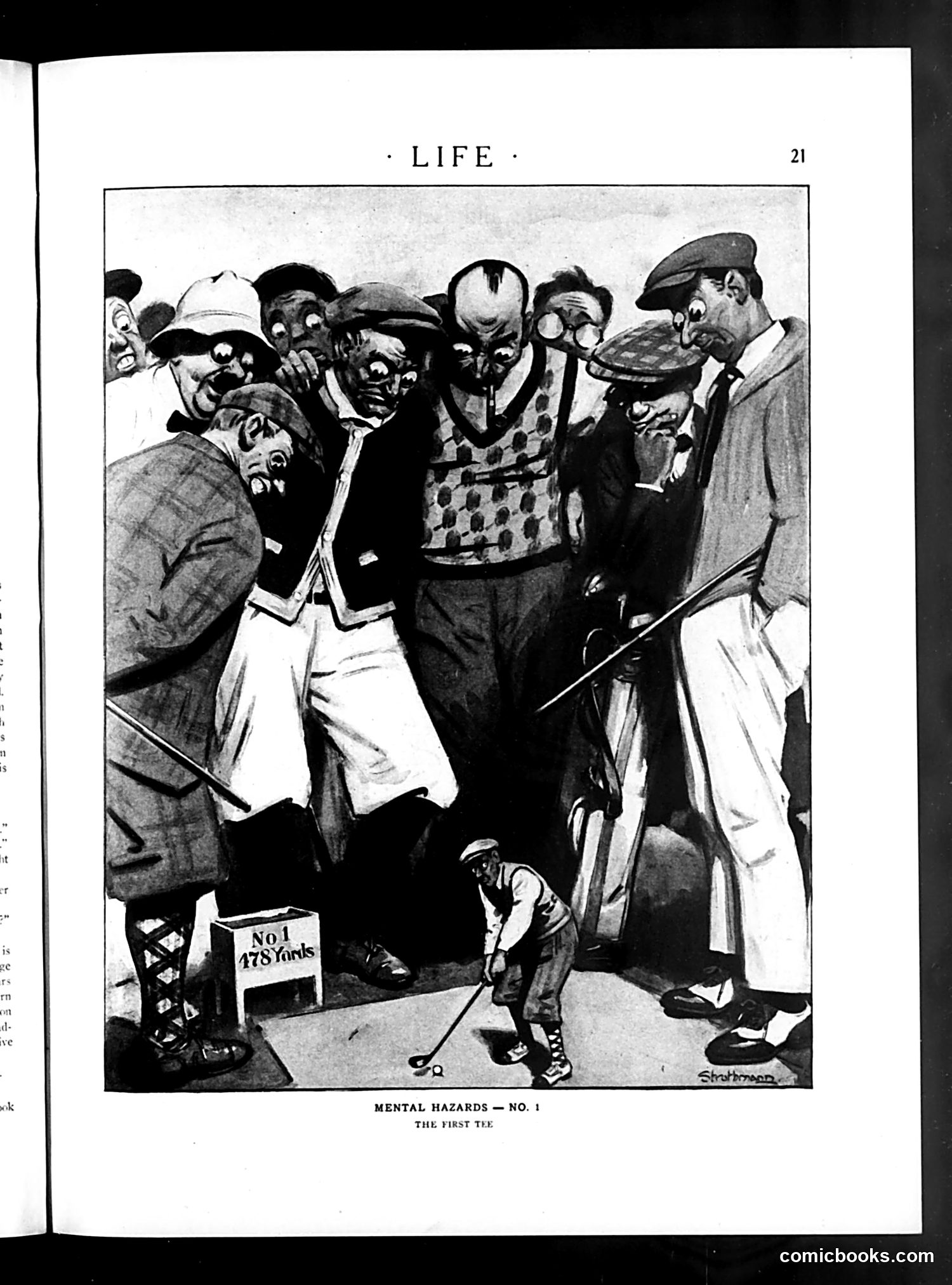
This satirical cartoon depicts golf's psychological pressures. A tiny golfer stands alone at the first tee, marked "No 1 478 Yards," while a crowd of grotesquely caricatured spectators looms behind him—their exaggerated, menacing faces creating visual commentary on performance anxiety. The joke centers on how golfers' nerves intensify under observation, particularly at the opening hole. The contrast between the lone player's small stature and the towering, intimidating crowd emphasizes the mental burden of performing publicly. The "Mental Hazards" title suggests this is part of a series exploring golf's psychological challenges beyond physical obstacles. This reflects early 20th-century Life magazine's humorous treatment of upper-class leisure activities and their unexpected emotional complexities.
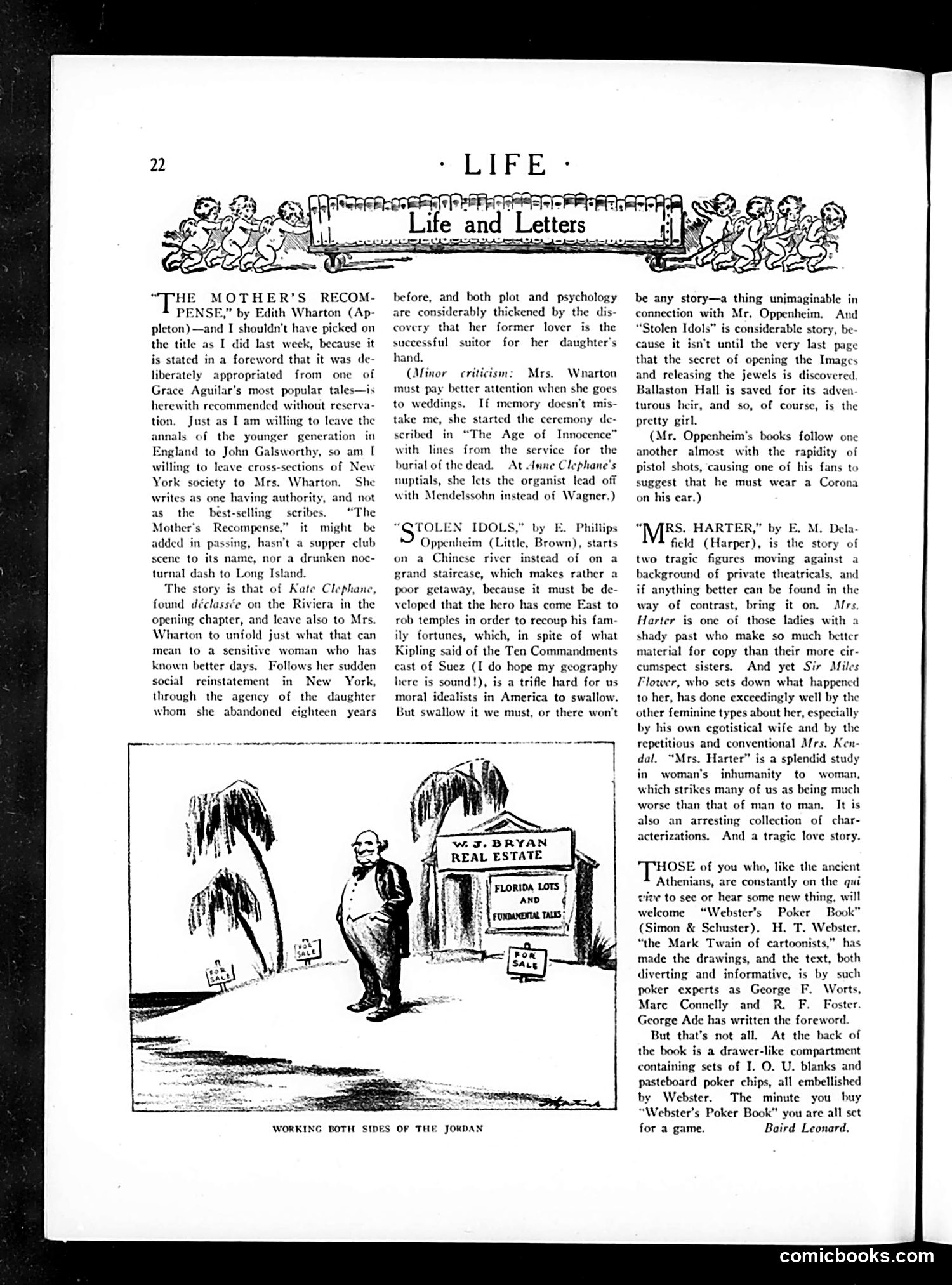
This page from *Life* magazine contains book reviews and a single cartoon titled "Working Both Sides of the Jordan." **The Cartoon:** The image shows a real estate agent (labeled "W.S. Bryan Real Estate") standing between palm trees, advertising "Florida Lots and Fundamental Talks." This is satirizing the Florida land boom of the 1920s—a speculative bubble where developers aggressively marketed swampland and worthless property to investors. The phrase "working both sides of the Jordan" (Biblical reference to crossing into the Promised Land) is a pun suggesting the agent profits from gullible buyers on both sides of the transaction. The cartoon mocks the deceptive sales tactics and false promises that characterized this era of American real estate fraud. **Context:** The cartoon targets the get-rich-quick schemes that duped many Americans before the 1929 stock market crash.
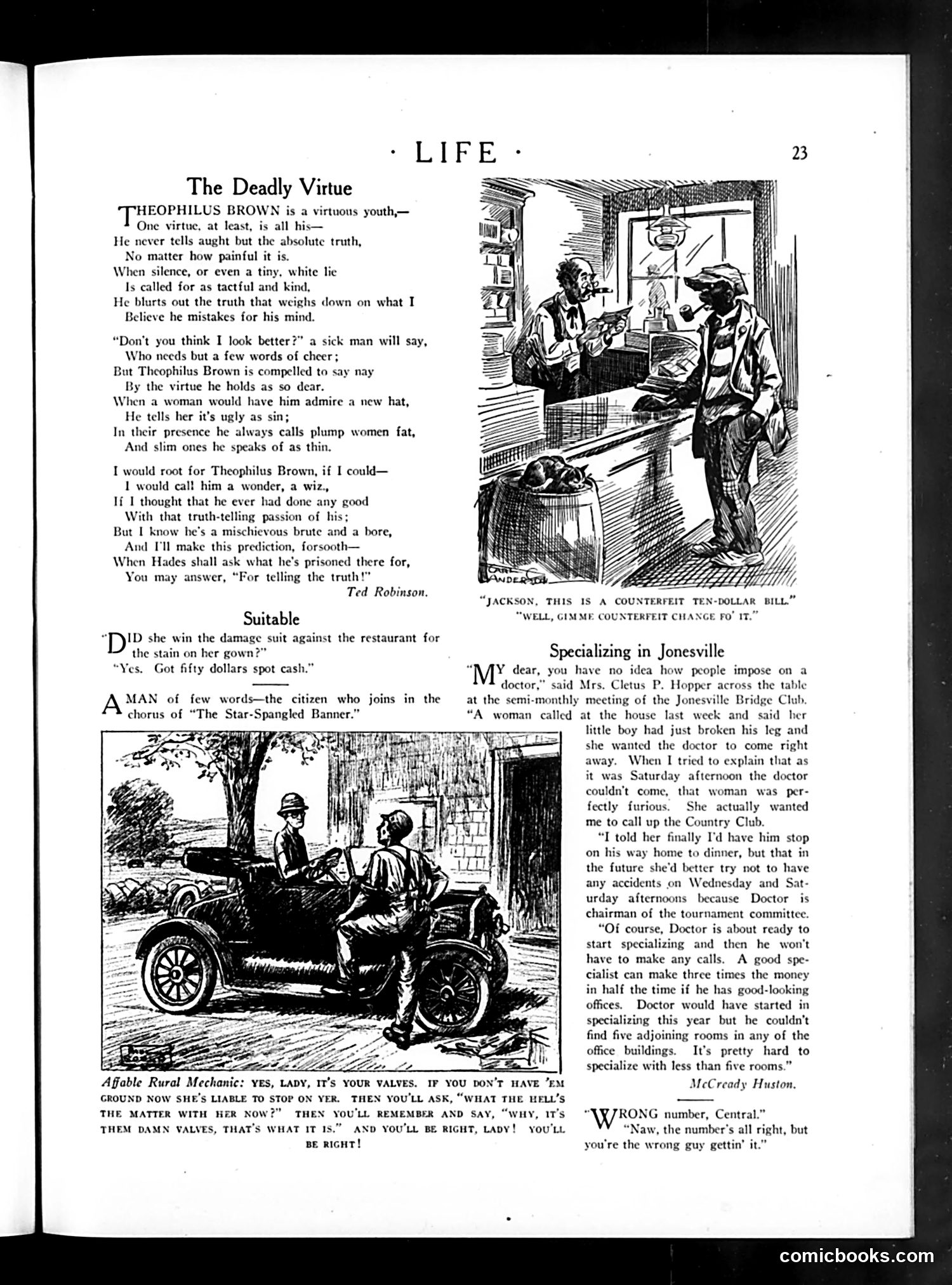
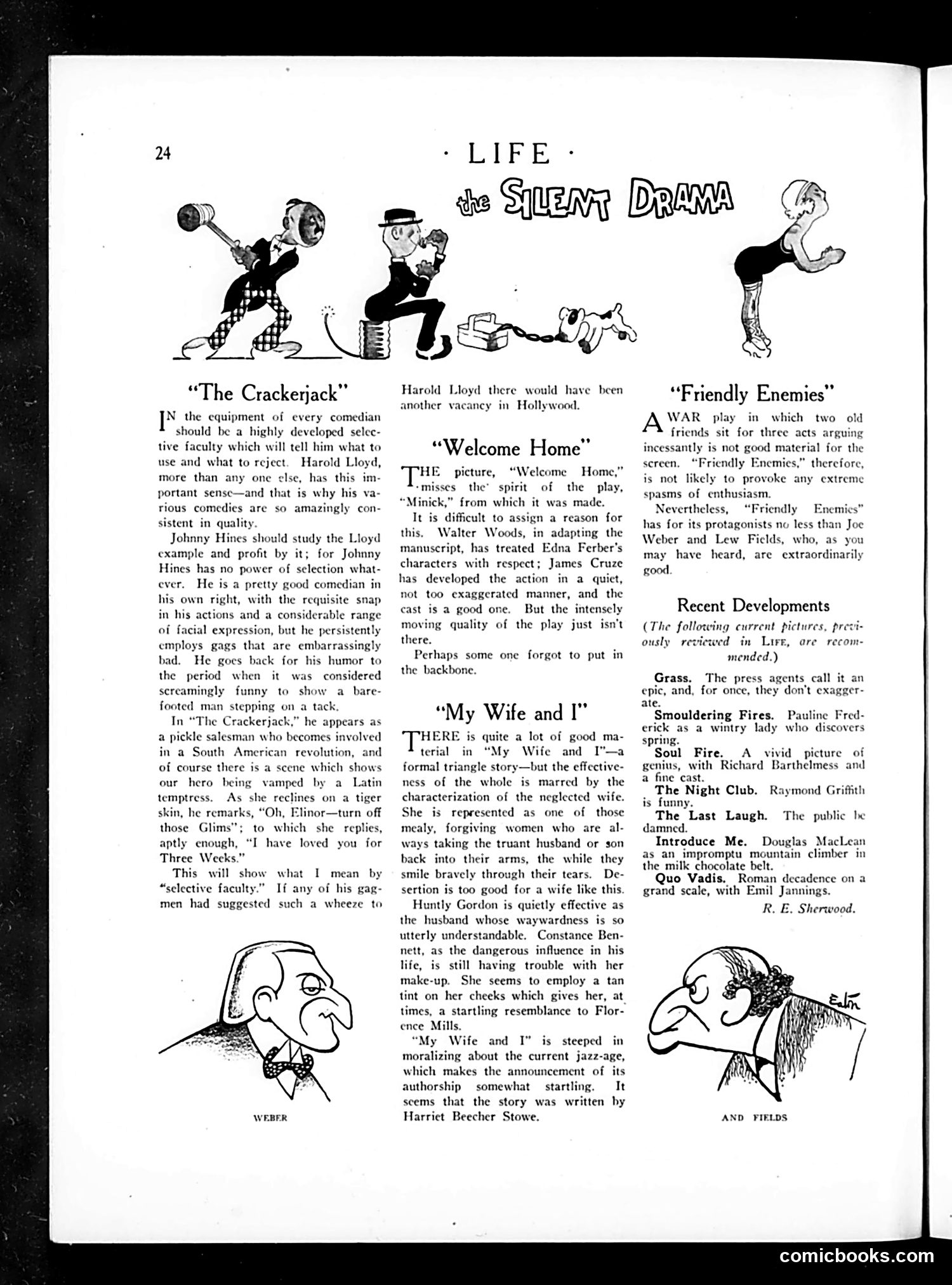
This page reviews several silent films from the early 1920s. The main critiques focus on comedians' selective judgment: Harold Lloyd is praised for knowing which gags to use, while Johnny Hines is criticized for relying on outdated, crude humor (like a barefoot man stepping on a tack). The Weber and Fields caricatures at bottom represent the vaudeville comedy duo appearing in "Friendly Enemies." The reviews reveal period concerns: "My Wife and I" moralizes about "jazz-age" behavior, while "Welcome Home" (adapted from Edna Ferber's play "Minick") loses dramatic impact in translation to screen. The satire about Harriet Beecher Stowe's supposed authorship of "My Wife and I" is clearly a joke—the actual author isn't identified here. The cartoons mock both filmmaking choices and silent-era comedy conventions that seemed dated even then.
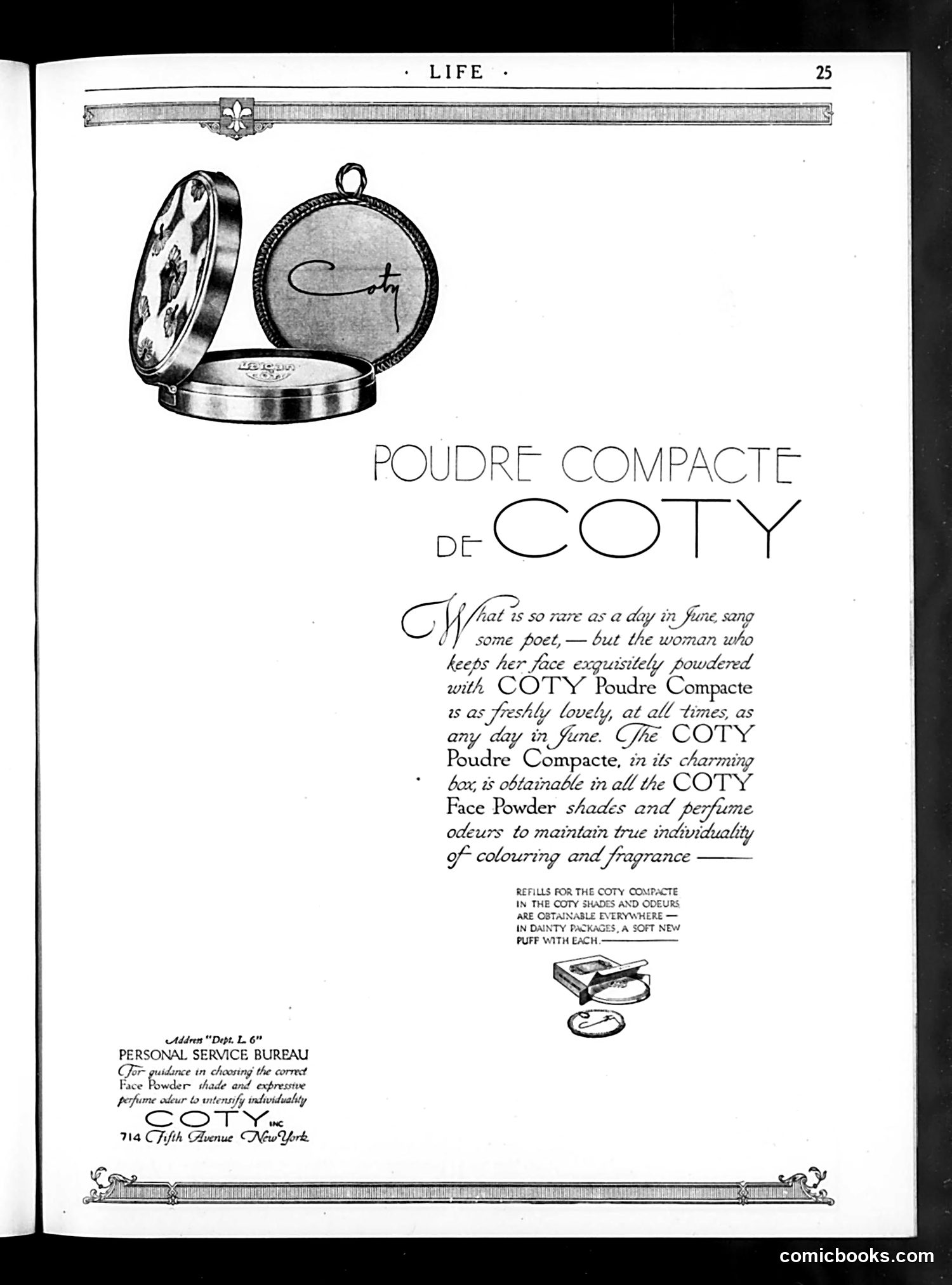
This page is **not a cartoon or satire** — it is a **cosmetics advertisement** for COTY Poudre Compacte (compact face powder), likely from the 1920s. The ad features product images: a decorative compact case with mirror and a spherical pendant version. The text uses romantic, poetic language (quoting about "a day in June") to market the powder as a beauty product that keeps women's faces "exquisitely powdered" and "freshly lovely at all times." The advertisement emphasizes **individuality** through multiple powder shades and perfume options, and includes a "Personal Service Bureau" at COTY's Fifth Avenue, New York location offering guidance on shade selection. There is **no political satire or social commentary** here — this is straightforward period advertising aimed at female consumers, reflecting early 20th-century beauty culture and consumerism. The genteel, flowery language was typical marketing style of the era.
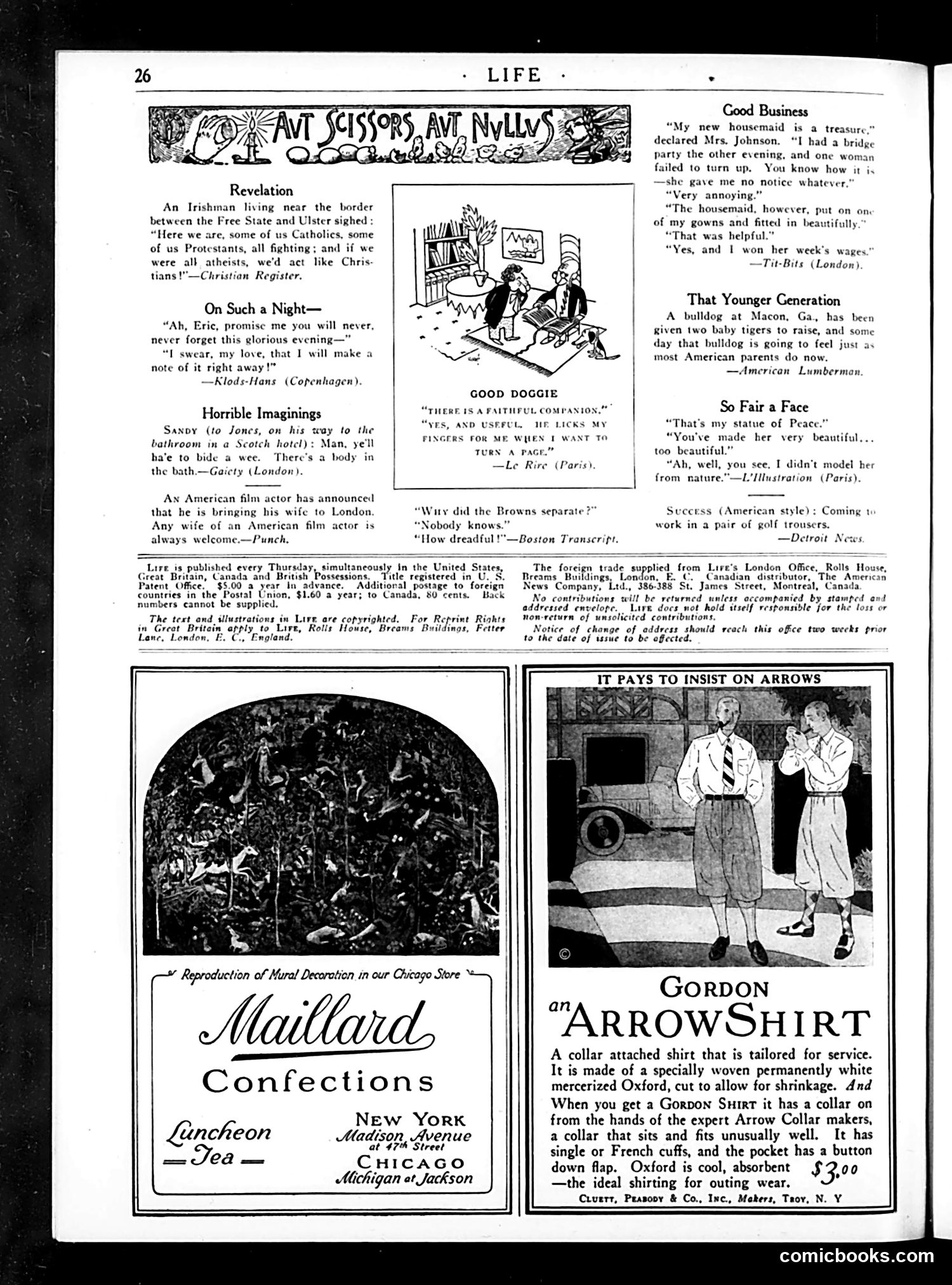
This page collects brief satirical observations and jokes from various sources, representing Life's signature style of social commentary. Key items include: **"Revelation"**: An Irish border resident jokes that Catholics, Protestants, and atheists in Ireland fight constantly—but if they were all atheists, they'd behave like Christians. This mocks religious hypocrisy and the sectarian violence of post-independence Ireland (likely 1920s). **"Good Doggie"**: A cartoon showing a dog turning pages—humor about a faithful pet that literally follows orders. **"Horrible Imaginings"**: Absurdist humor about finding a body in a Scottish hotel bath. **Social commentary items** mock American attitudes (film actors, golf culture), British domesticity, and gender dynamics (a housemaid wearing the mistress's gown). The page is predominantly **satirical filler and advertisements** (Maillard Confections, Gordon Arrow Shirt) rather than substantial political content. The humor assumes readers familiar with Anglo-American social conventions of the era.
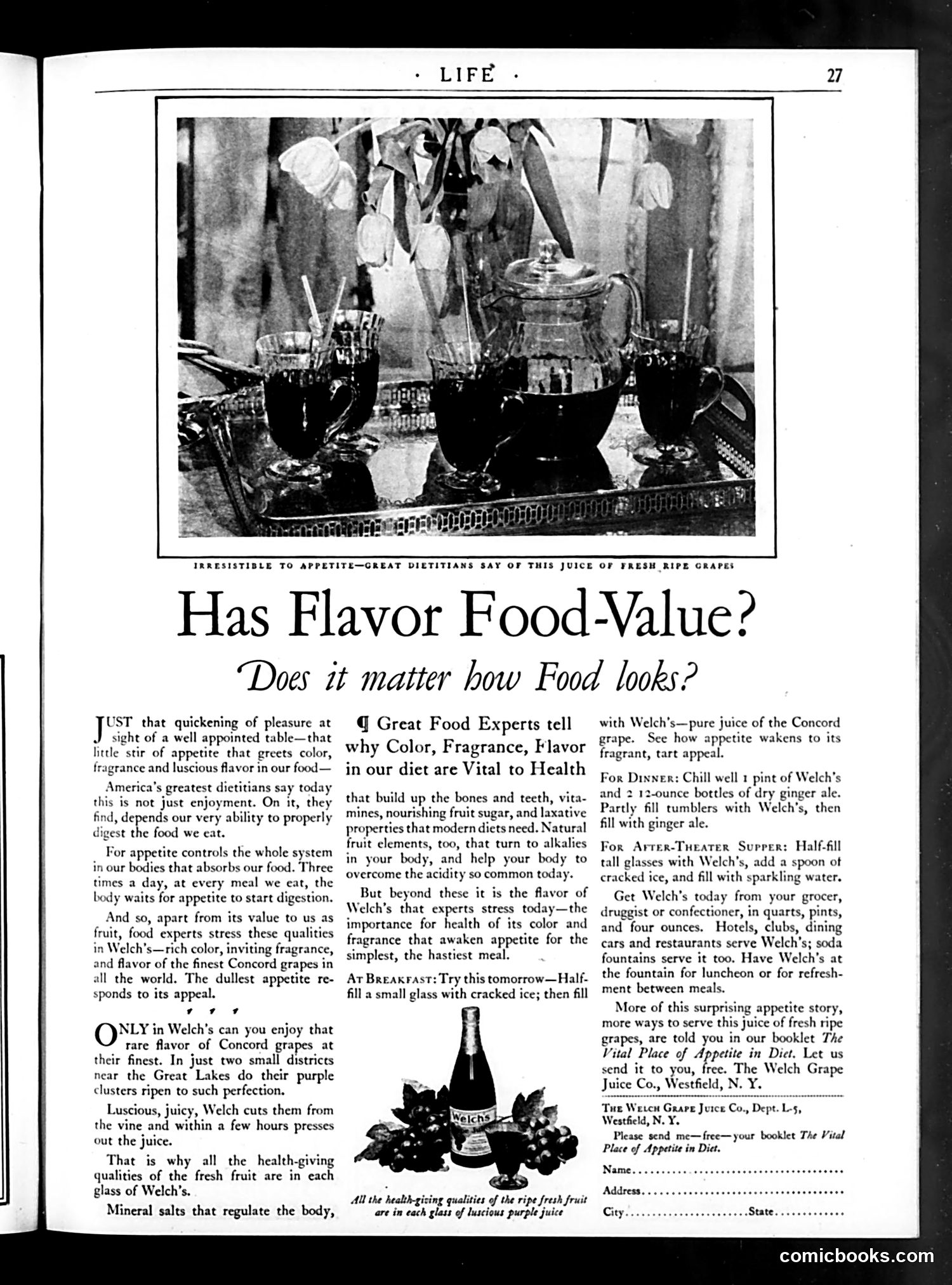
This is a **product advertisement**, not political satire. It promotes Welch's grape juice by appealing to early 20th-century nutritional science and emerging dietary psychology. The ad argues that appetizing food presentation—color, fragrance, flavor—is scientifically essential to digestion itself. Contemporary dietitians allegedly claimed that appetite "controls the whole system" that absorbs nutrients. By this logic, Welch's juice doesn't just taste good; its appealing appearance actually *enables* proper digestion and provides vital minerals, vitamins, and alkaline properties modern diets supposedly lacked. The image shows an elegant table setting with a Welch's bottle surrounded by grapes, reinforcing the product's appeal and natural origins. Suggested serving methods (with ginger ale, cracked ice) position it as sophisticated refreshment for various occasions. This represents pre-FDA regulation marketing that makes broad health claims without modern scientific scrutiny—typical of early 1900s patent medicine-style advertising blending genuine nutritional interest with commercial exaggeration.
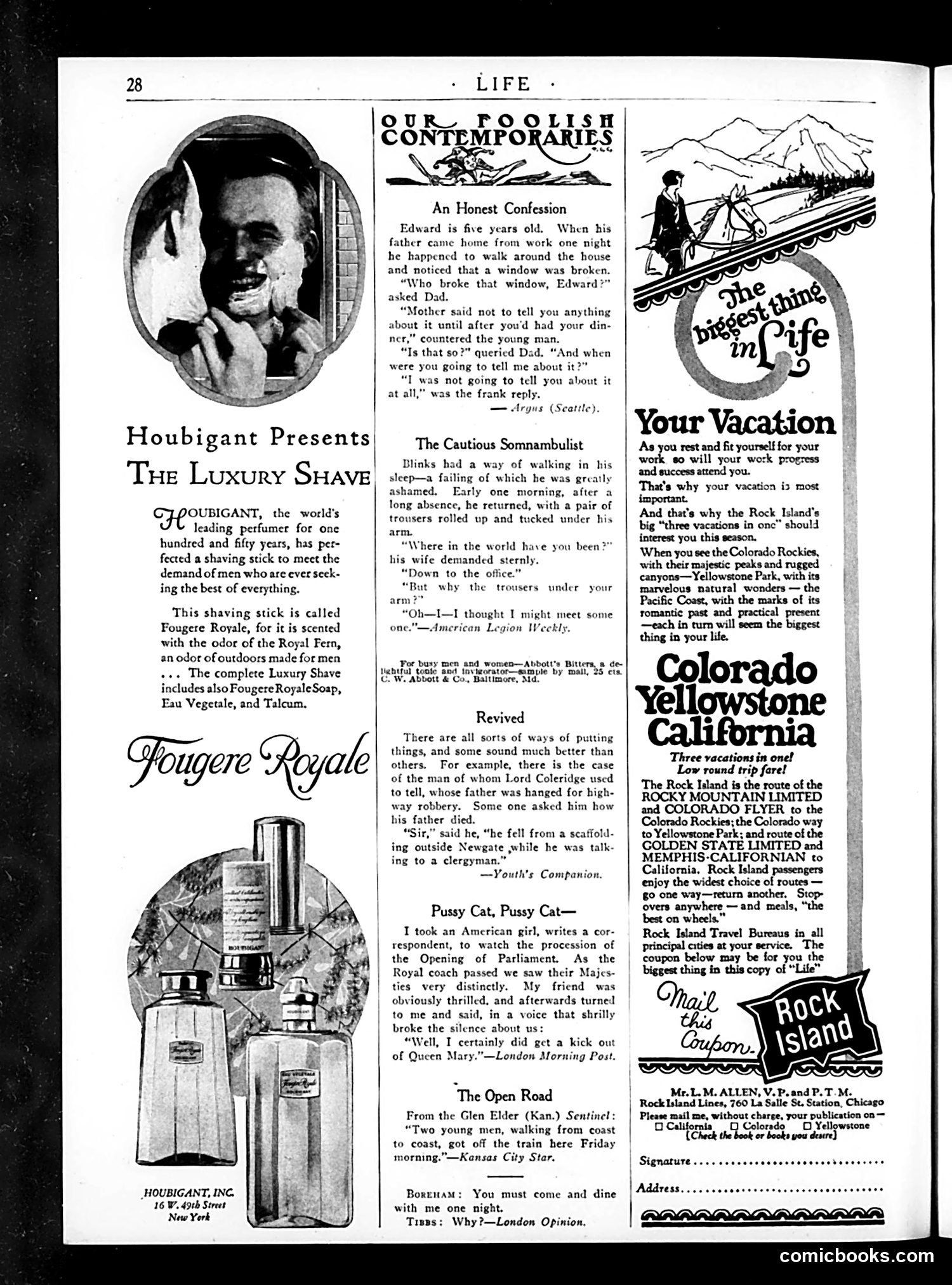
This page primarily contains **advertisements and humorous short anecdotes**, not political cartoons. The "Our Foolish Contemporaries" section collects brief jokes from various publications: - **"An Honest Confession"**: A five-year-old deliberately withholds information from his father about a broken window—satire on children's cunning. - **"The Cautious Somnambulist"**: A man returns from sleepwalking with rolled-up trousers, implying he was prepared for social encounters during his unconscious state—absurdist humor. - **"Pussy Cat, Pussy Cat"**: An American woman, thrilled at seeing Queen Mary during Parliament's opening, exclaims she "got a kick out of Queen Mary"—humor arising from the unintentionally suggestive phrasing. The page also features advertisements for **Houbigant's Fougere Royale shaving products** and **Rock Island travel packages** promoting Colorado, Yellowstone, and California vacations—typical of 1920s-era Life magazine's revenue model. The humor reflects early-20th-century sensibilities: innocent double entendres and observations about human behavior rather than sharp political satire.
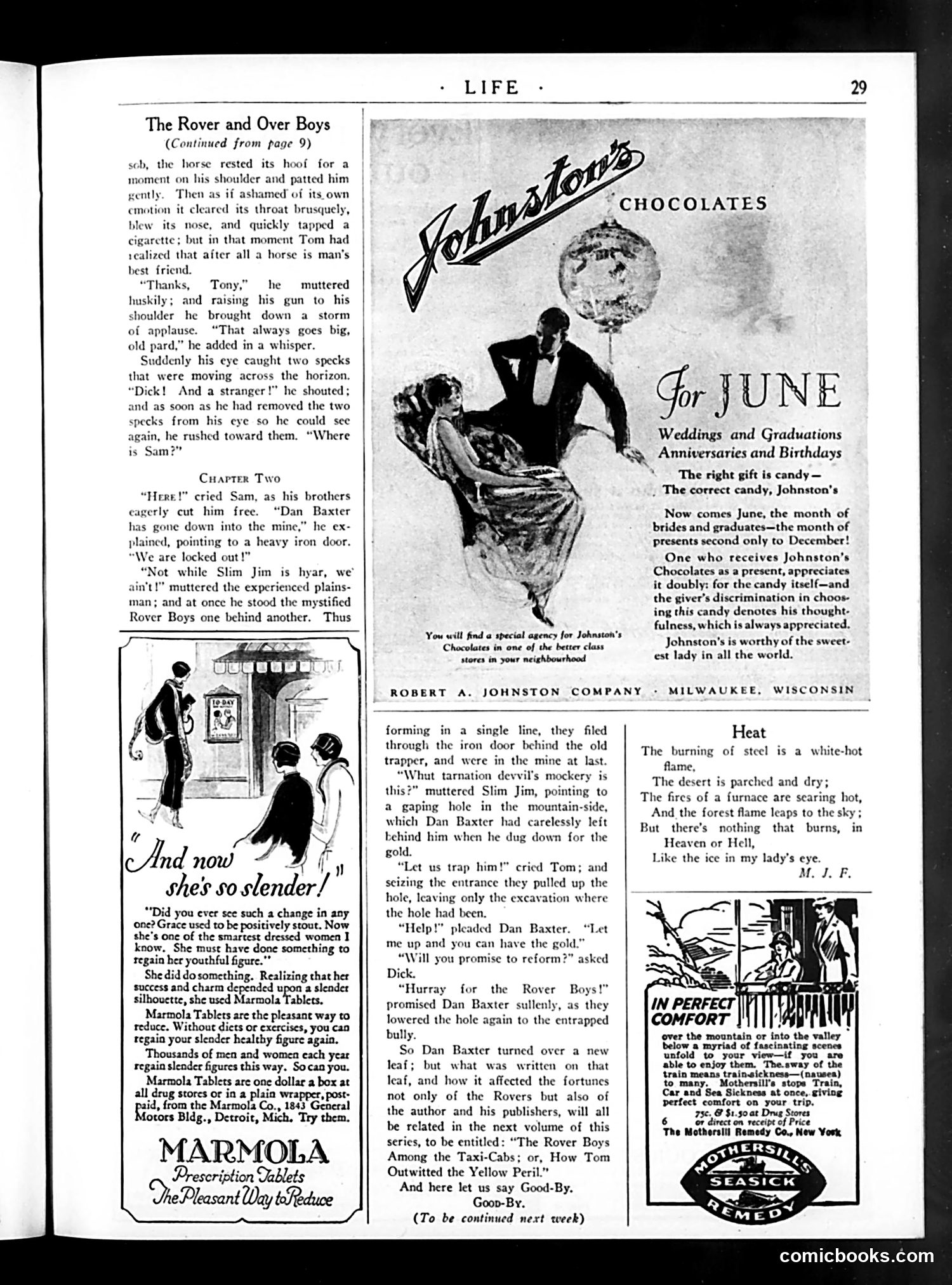
This page continues a serialized adventure story about the "Rover Boys," young protagonists in a popular children's book series. The narrative depicts them rescuing a friend from a mine and trapping a villain named Dan Baxter in an excavation hole until he reforms. The satire appears directed at the **melodramatic conventions** of boys' adventure fiction: a horse that "clears its throat brusquely" and smokes cigarettes, implausibly noble villains who instantly reform when trapped, and absurdly overwrought emotional moments. The title itself—"Rover and **Over** Boys"—suggests the story's excessive repetition of rescue scenarios. The page is primarily **advertising**, featuring Marmola weight-loss tablets (targeting women's body image) and Johnston's chocolates (marketed for June gift-giving). These ads occupy more space than the narrative, reflecting Life's commercial nature.
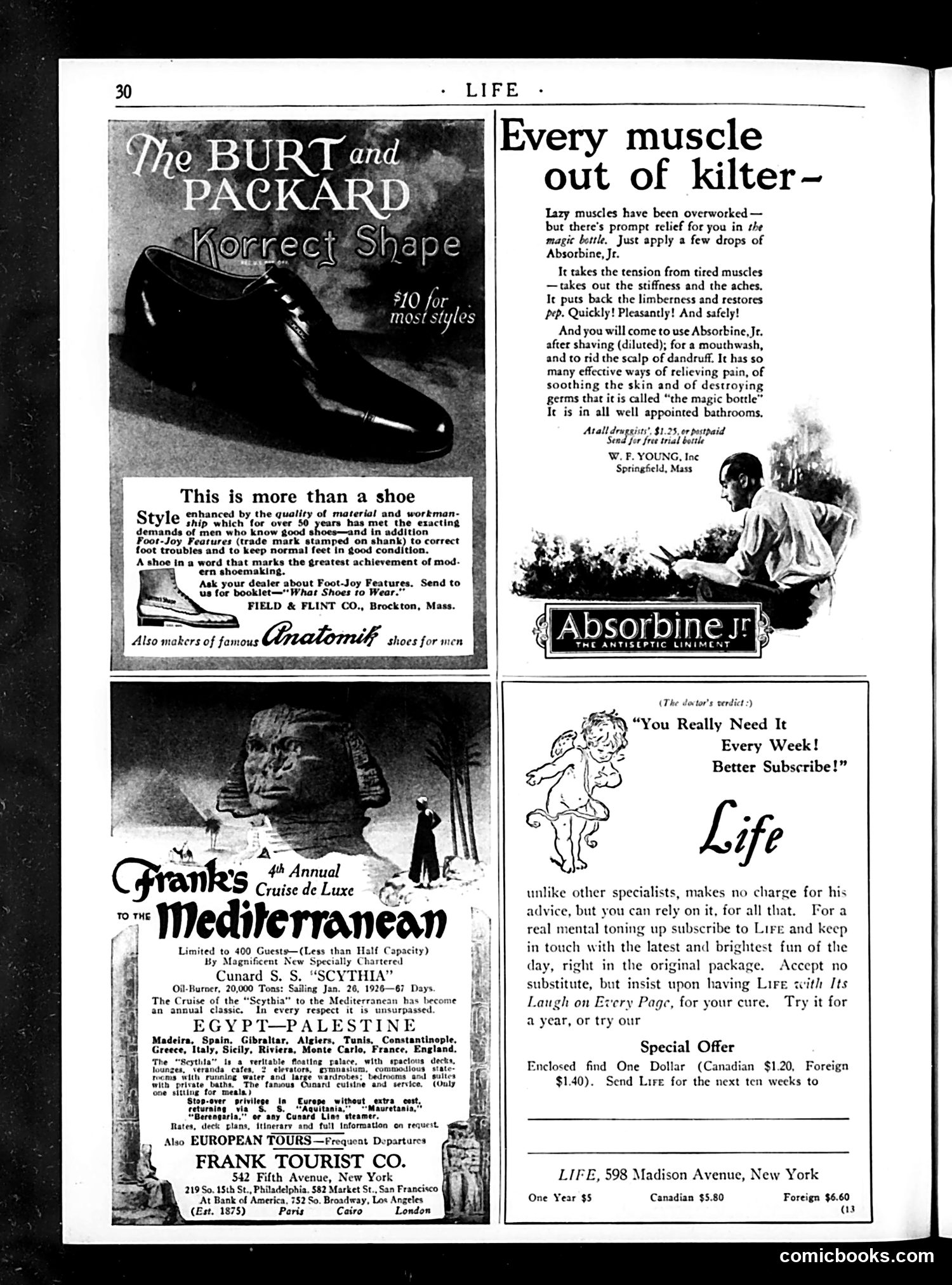
This page is primarily **advertising**, not satirical content. It contains four commercial advertisements typical of 1920s magazines: 1. **Foot-Joy Shoes** (top left): Markets orthopedic footwear with specialized features to correct foot problems, emphasizing 50 years of quality craftsmanship. 2. **Frank Tourist Company** (bottom left): Advertises a Mediterranean luxury cruise aboard the S.S. "Scythia," visiting Egypt, Palestine, and European destinations—a high-end vacation for affluent travelers. 3. **Absorbine Jr.** (right side): Promotes a multi-purpose liniment marketed as a "magic bottle" for sore muscles, post-shaving use, mouthwash, and dandruff treatment—a cure-all product. 4. **Life Magazine Subscription** (bottom right): Uses self-promotional humor ("the doctor's verdict") encouraging weekly subscription for entertainment and "mental toning up." The page reflects 1920s consumer culture: medical products made broad health claims, luxury travel was accessible to the wealthy, and magazines positioned themselves as essential lifestyle products.
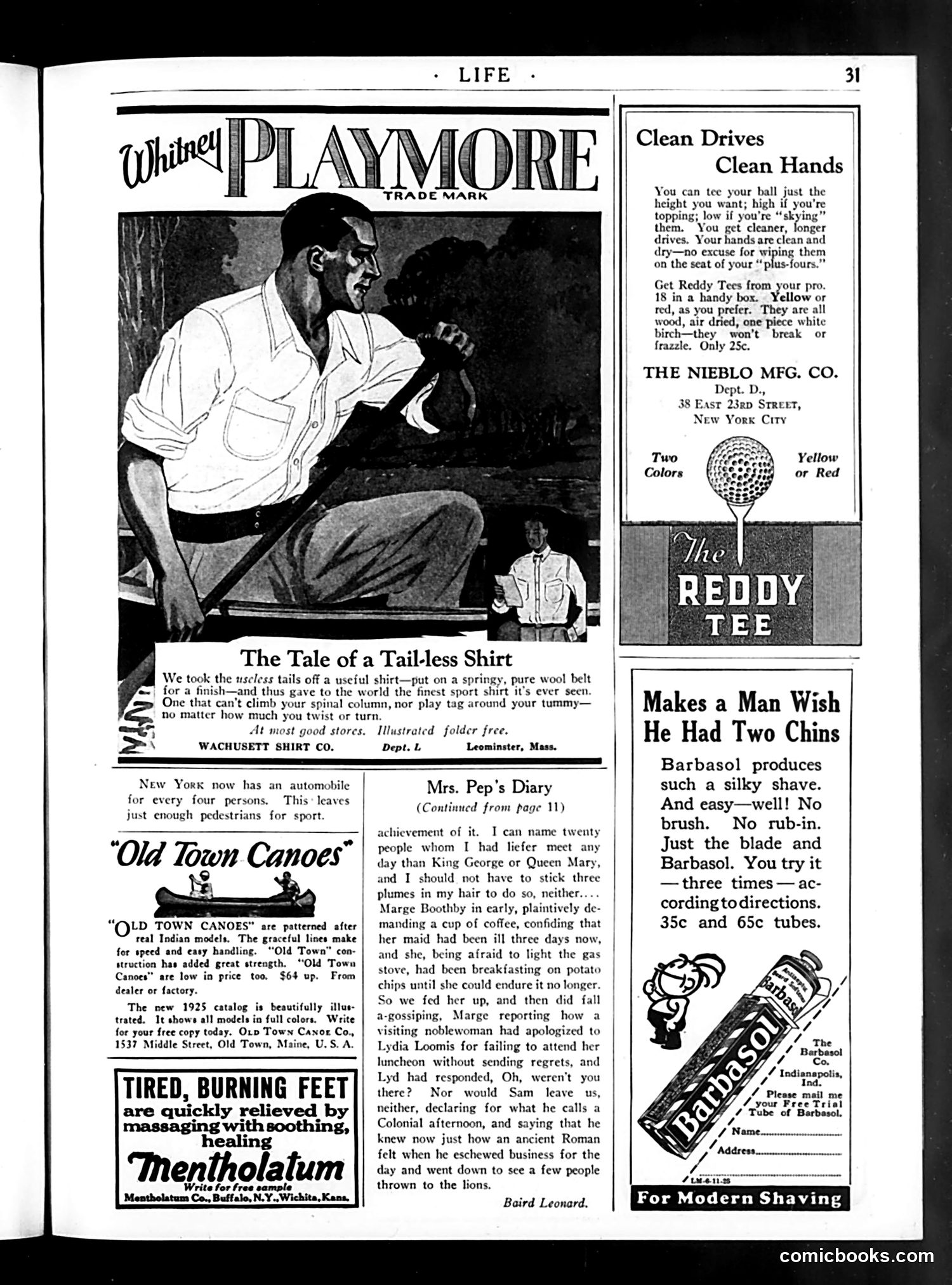
This page is primarily **advertising** with minimal satirical content. The main featured advertisement is for Whitney Playmore's "tail-less shirt"—a sportswear innovation marketed to golfers and active men. The humor lies in the product name itself: the shirt eliminates traditional shirt tails that would ride up during physical activity, solving a genuine practical problem through design. Supporting advertisements include golf tees, canoes, foot cream, and shaving products—all targeting affluent leisure consumers of the 1920s. The only substantial editorial content is "Mrs. Pep's Diary," a gossip column describing social activities among wealthy women, including references to meeting British royalty and attending formal functions. This reflects contemporary upper-class social preoccupations. The page's overall tone reflects 1920s consumer culture and leisure activity marketing rather than political satire. The brief aside about New York automobiles versus pedestrians is mild social commentary rather than serious critique.
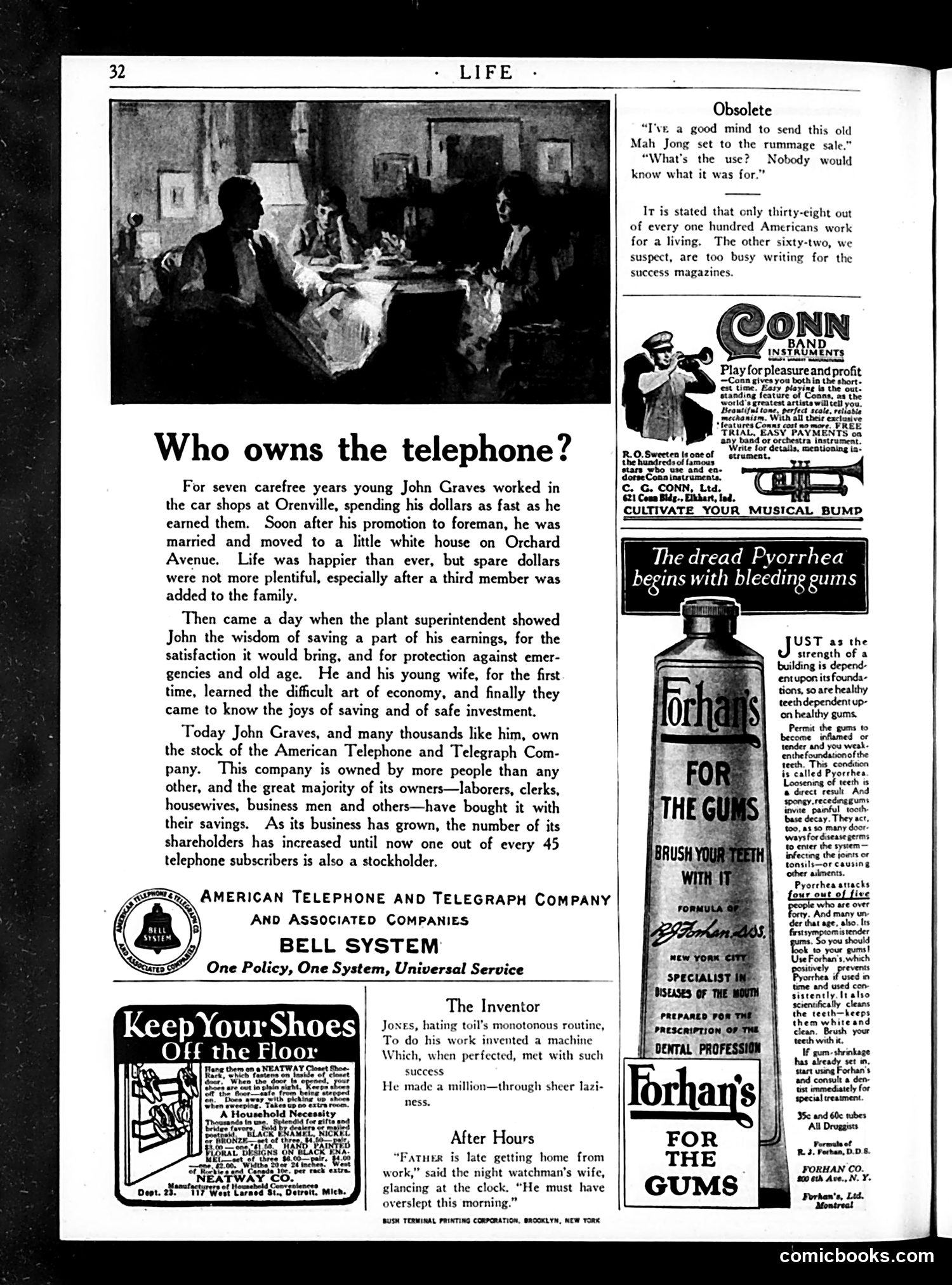
This page from *Life* magazine contains satirical commentary on early 20th-century American society mixed with period advertisements. The main article, "Who owns the telephone?", presents a sanitized success narrative: John Graves rises from factory worker to stockholder in AT&T through prudent savings. The piece promotes widespread stock ownership as democratic capitalism—"one out of every 45 telephone subscribers is also a stockholder." The satirical edge appears in the opening "Obsolete" caption mocking Mah Jong (a faddish parlor game), and especially in the bracketed statistic: only 38 of 100 Americans work for a living; the other 62 are "too busy writing for the success magazines." This jabs at the proliferation of self-help and business literature popular at the time. The advertisements—for musical instruments, dental products, and shoe floor coverings—are typical period marketing using health claims and aspirational messaging common to the era. The page reflects 1920s optimism about consumer capitalism and stock ownership, while *Life*'s humor undercuts both faddish consumer culture and the "success magazine" genre itself.
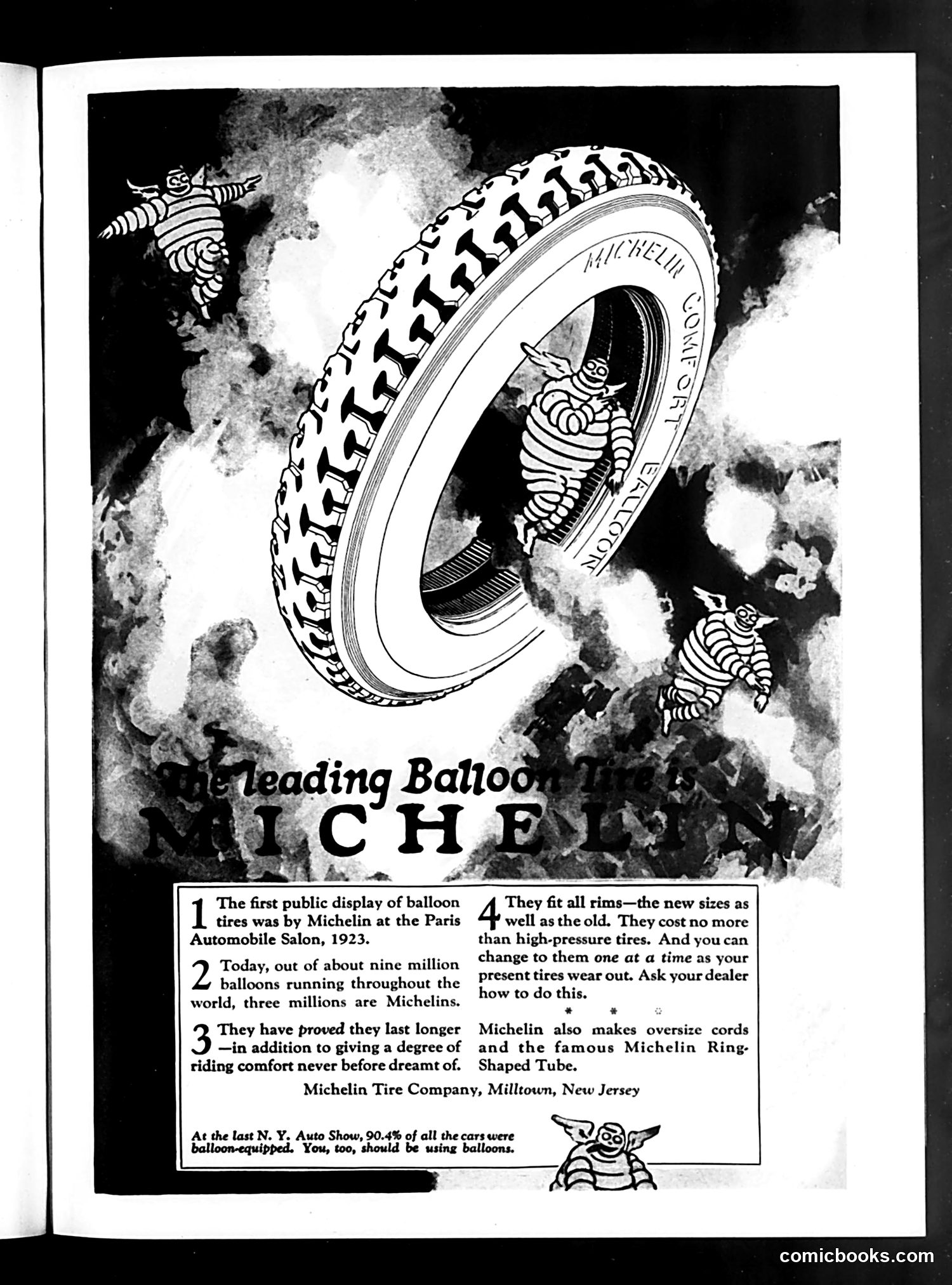
This is a **full-page advertisement**, not satire or editorial content. It promotes Michelin's "balloon tires"—a then-revolutionary automotive innovation featuring lower air pressure and larger volume than conventional high-pressure tires. The imagery shows a Michelin tire with the company's mascot (Bibendum, the Michelin Man) floating among clouds, emphasizing the comfort and cushioning these tires provide. The text makes four key sales points: balloon tires were pioneered by Michelin (Paris, 1923); they dominate the market (3 of 9 million balloons); they last longer and ride more comfortably; and they're affordable and compatible with existing rims. The final statistic—90.4% of cars at the NY Auto Show were balloon-equipped—suggests this technology had already achieved market dominance by publication date, making this advertisement less about introducing a novelty than reinforcing consumer confidence in an established product.
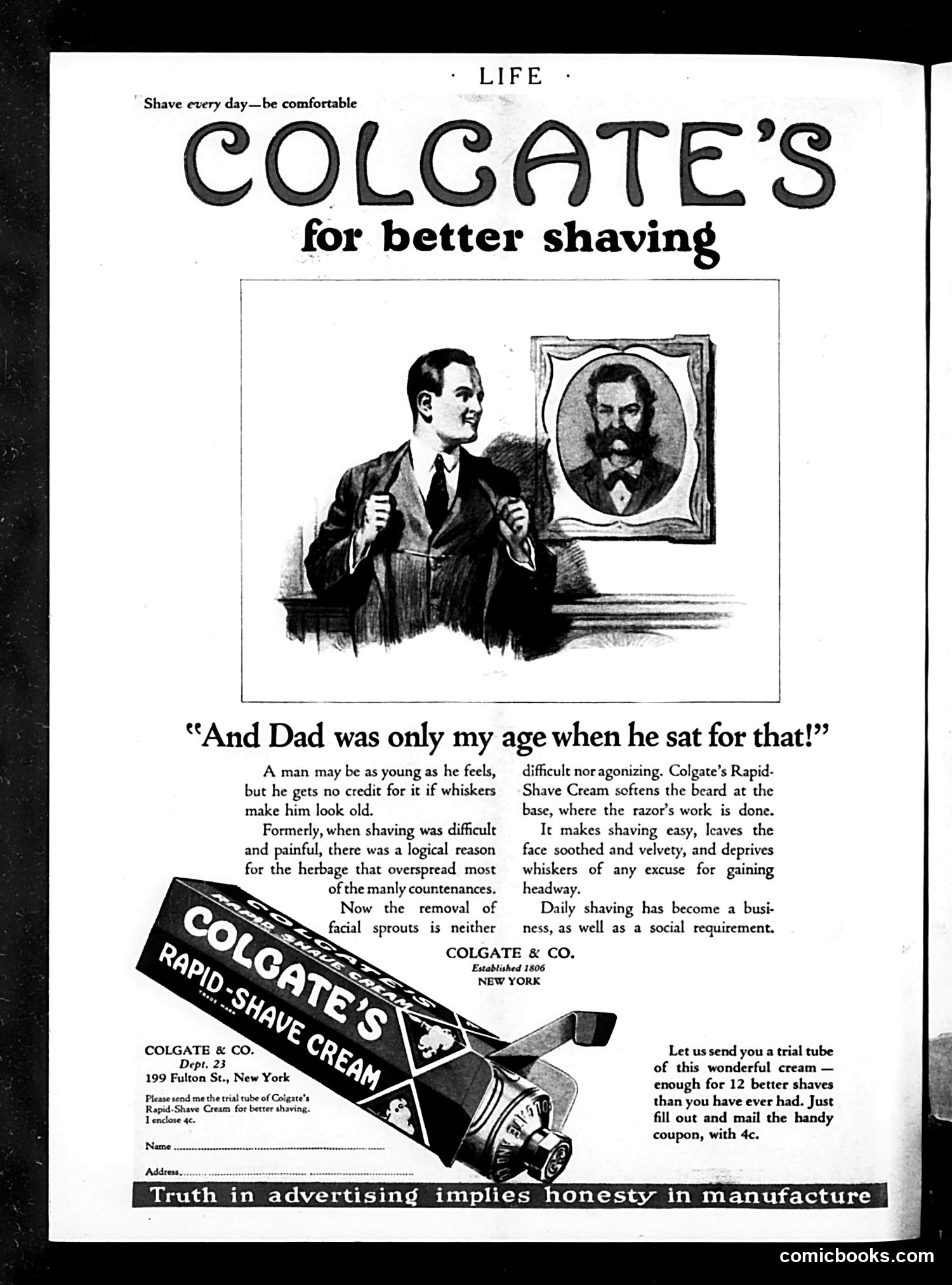
This is primarily a **product advertisement**, not political satire. The joke centers on generational attitudes toward facial hair and grooming standards. **The Setup:** A young man examines a portrait of his bearded father, remarking "And Dad was only my age when he sat for that!" The implication is that his father looked older due to his beard. **The Social Context:** The ad argues that beards were formerly kept because shaving was painful and difficult—a practical excuse for facial hair. However, with modern shaving cream, this excuse no longer applies. The ad frames daily shaving as now both a "business" necessity and "social requirement." **The Satire:** The humor lies in the contrast between old and modern masculinity standards. Keeping a beard once signified manhood; now clean-shaving represents the modern, young, and successful man. The ad leverages generational anxiety about appearing old or outdated to promote daily grooming as a modern social obligation. This reflects early 20th-century shifts toward clean-shaven masculine ideals in American culture.