
Life, 1925-06-11 · page 26 of 36
Life — June 11, 1925 — page 26: what you’re looking at
What you’re looking at
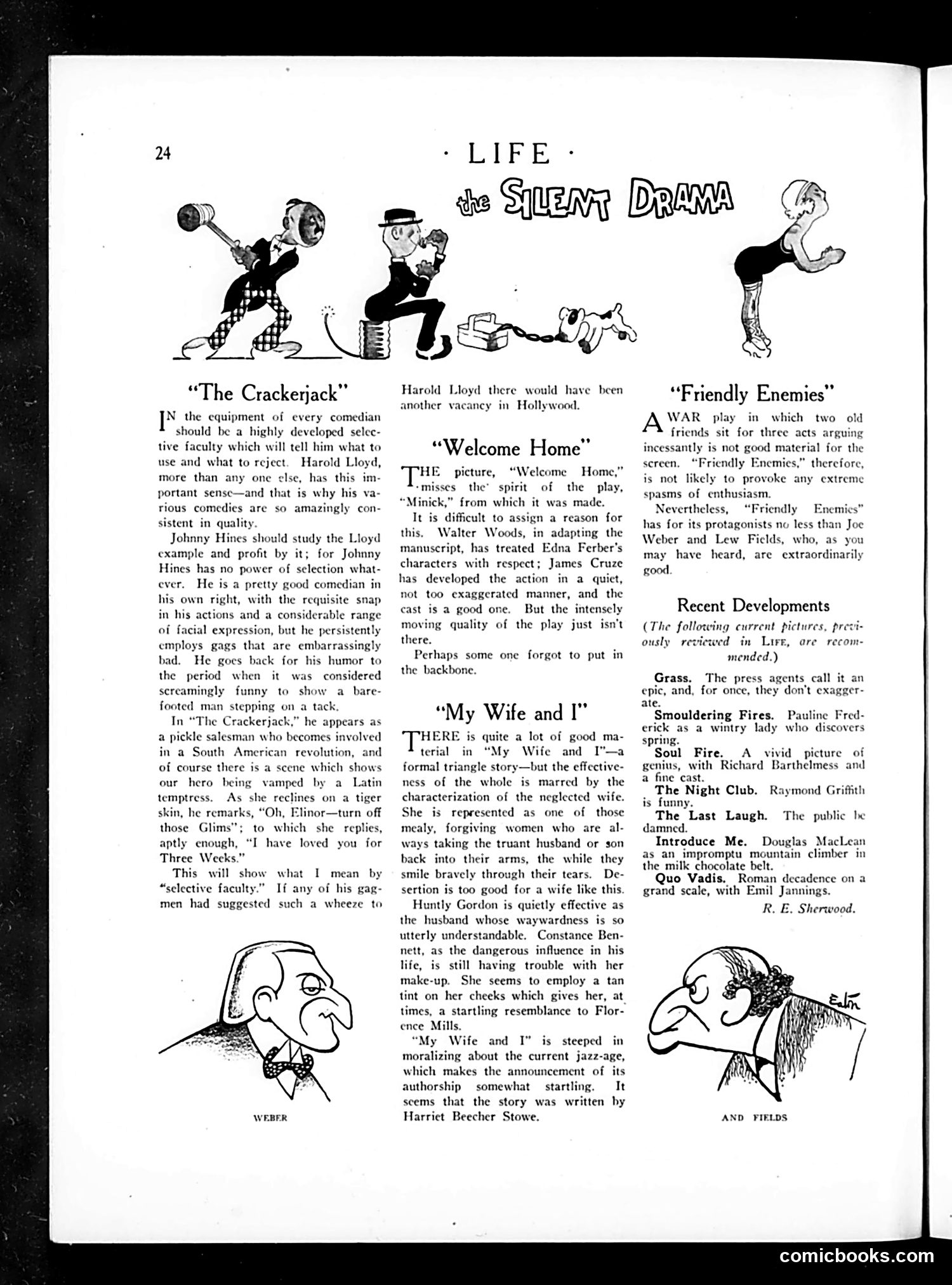
This page reviews several silent films from the early 1920s. The main critiques focus on comedians' selective judgment: Harold Lloyd is praised for knowing which gags to use, while Johnny Hines is criticized for relying on outdated, crude humor (like a barefoot man stepping on a tack). The Weber and Fields caricatures at bottom represent the vaudeville comedy duo appearing in "Friendly Enemies." The reviews reveal period concerns: "My Wife and I" moralizes about "jazz-age" behavior, while "Welcome Home" (adapted from Edna Ferber's play "Minick") loses dramatic impact in translation to screen. The satire about Harriet Beecher Stowe's supposed authorship of "My Wife and I" is clearly a joke—the actual author isn't identified here. The cartoons mock both filmmaking choices and silent-era comedy conventions that seemed dated even then.
📄 Transcribed text from this page (OCR, searchable)
Machine-transcribed from the original scan — historical spelling and the odd misread are preserved.
“The Crackerjack” I8 the equipment of every comedian should be a highly developed selec- tive faculty which will tell him what to use and what to reject. Harold Lloyd, more than any one else, has this im- portant sense—and that is why his va- rious comedies are so amazingly con- sistent in quality. Johnny Hines should study the Lloyd example and profit by it; for Johnny Hines has no power of selection what- ever. He is a pretty good comedian in his own right, with the requisite snap in his actions and a considerable range of facial expression, but he persistently employs gags that are embarrassingly bad. He goes ba for his humor to the period when it considered screamingly funny to show a_bare- footed man stepping on a tack. In “The Crackerjack,” he appears as a pickle salesman who becomes involved in a South American revolution, and of course there is a scene which shows our hero being vamped by a Latin temptress. she reclines on a tiger skin, he remarks, “Oh, Elinor—turn off those Glims”; to which she repl aptly enough, have loved Three Weeks. This will what I mean by “selective facult If any of his gag- men had suggested such a wheeze to was you for show WEBER Harold Lloyd there would have been another vacancy in Hollywood. “Welcome Home” HE picture, “Welcome Home, misses the’ spirit. of the play, Minick,” from which it was made. It is difficult to assign a reason for this, Walter Woods, in adapting the manuscript, has treated Edna Ferber’s characters with respect; James Cruze has developed the action in a quict, not too exaggerated manner, and the cast is a good one. But the intensely moving quality of the play just isn’t there. Perhaps some one forgot to put in the backbone. “My Wife and I” HERE is quite a lot of good ma- terial in “My Wife and I" formal triangle story—but the effect ness of the whole is marred by the characterization of the neglected wife. She is represented as one of those meal ing women who are al- ways taking the truant husband or son back into their arms, the while they smile bravely through their tears. De- sertion is too good for a wife like this. Huntly Gordon is quietly effective as the husband whose waywardness is so utterly understandable. Constance Ben- nett, as the dangerous influence in his life, is still having trouble with her make-up. She seems to employ a tan tint on her cheeks which gives her, at times, a startling resemblance to Flor- ence Mills, “My Wife and I” is steeped in moralizing about the current jazz-age, which makes the announcement of its authorship somewhat _ startling. It seems that the story was written by Harriet Beecher Stowe. “Friendly Enemies” WAR play in which two old friends sit for three acts argu incessantly is not good material for the screen, “Friendly Enemi therefore, is not likely to provoke any extreme spasms of enthusiasm. Nevertheless,“ Enemies” has for its protagonists no less than Joe Weber and Lew Fields, who, as you may have heard, are extraordinarily good. ndly Recent Developments (The following current pictures, previe ously reviewed in Lire, are mended.) Grass. The press agents call it an epic, and, for once, they don't exagger- ate. Smouldering Fires. Pauline Fred- erick as a wintry lady who discovers spring. Soul Fire. A vivid picture of genius, with Richard Barthelmess and a fine cast. The Night Club. Raymond Griffith is funny. The Last Laugh. damned. Introduce Me. Douglas MacLean as an impromptu mountain climber in the milk chocolate belt. Quo Vadis. Roman decadence on a grand scale, with Emil Jannings. . Sherwood. recom- The public he AND FIELDS comicbooks.com