
Life, 1925-06-11 · page 16 of 36
Life — June 11, 1925 — page 16: what you’re looking at
What you’re looking at
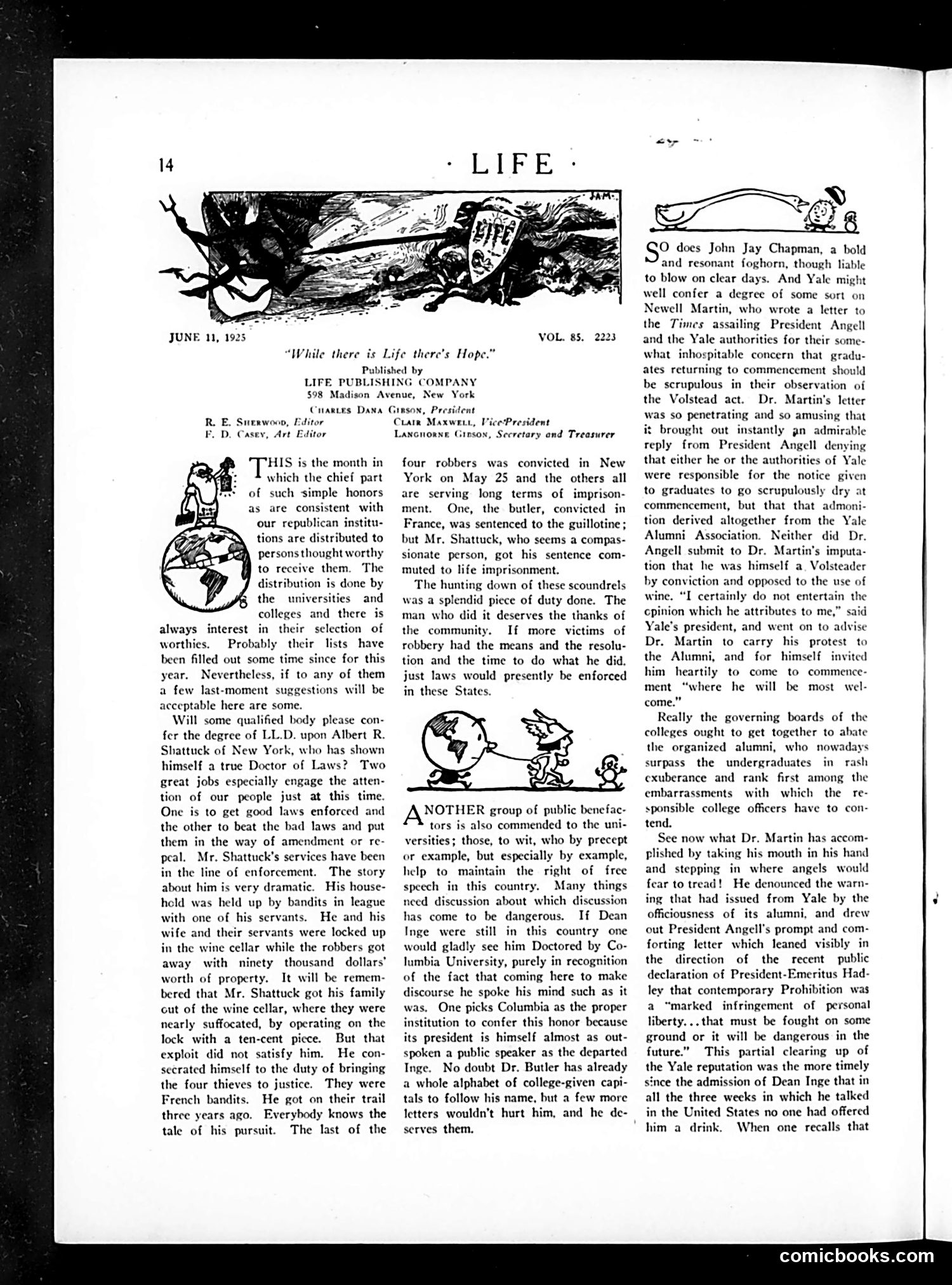
This editorial page discusses college discipline and legal enforcement during Prohibition. The main cartoon (upper left) depicts a figure labeled "LIFE" lying down with what appears to be a wine bottle, illustrating the magazine's satirical stance on enforcement issues. The text criticizes both robbers convicted in New York and argues for better law enforcement generally. It praises Yale's president for taking a stand against Prohibition violations among students, and commends university governing boards for maintaining "free speech" while disciplining alumni who break laws. The cartoons appear to satirize the tensions between college authority, student conduct, and Prohibition enforcement—a major public controversy in 1920s America. The piece advocates for stronger institutional accountability regarding alcohol violations.
📄 Transcribed text from this page (OCR, searchable)
Machine-transcribed from the original scan — historical spelling and the odd misread are preserved.
JUNE 11, 1925 “While there is Life the: VOL. 85. 2223 c's Ho, Published by LIFE PUBLISHING COMPANY $98 Madison Avenue, New York Cuartes Dana Ginson, President R. E. Surrwoop, Editor F, D. Casey, Art Editor HIS is the month in which the chief part of such simple honors as are consistent with our republican institu- tions are distributed to persons thought worthy to receive them. The distribution is done by the universities and colleges and there is always interest in their selection of worthies. Probably their lists have been filled out some time since for this year. Nevertheless, if to any of them a few last-moment suggestions will be acceptable here are some. Will some qualified body please con- fer the degree of LL.D. upon Albert R. Shattuck of New York, who has shown himself a true Doctor of Laws? Two great jobs especially engage the atten- tion of our people just at this time. One is to get good laws enforced and the other to beat the bad laws and put them in the way of amendment or re- peal. Mr. Shattuck’s services have been in the line of enforcement. The story about him is very dramatic. His house- hold was held up by bandits in league with one of his servants. He and his wife and their servants were locked up in the wine cellar while the robbers got away with ninety thousand dollars’ worth of property. It will be remem- bered that Mr. Shattuck got his family out of the wine cellar, where they were nearly suffocated, by operating on the lock with a ten-cent picce. But that exploit did not satisfy him. He con- secrated himself to the duty of bringing the four thieves to justice. They were French bandits. He got on their trail three years ago. Everybody knows the tale of his pursuit. The last of the Crate Maxwant, Vice-President Lancnoane Ginsox, Secretary ond Treasurer four robbers was convicted in New York on May 25 and the others all are serving long terms of imprison- ment. One, the butler, convicted in France, was sentenced to the guillotine ; but Mr. Shattuck, who seems a compas- sionate person, got his sentence com- muted to life imprisonment. The hunting down of these scoundrels was a splendid piece of duty done. The man who did it deserves the thanks of the community. If more victims of robbery had the means and the resolu- tion and the time to do what he did, just laws would presently be enforced in these States. QR NOTHER group of public benefac- tors is also commended to the uni- versities; those, to wit, who by precept or example, but especially by example, help to maintain the right of free speech in this country. Many things need discussion about which discussion has come to be dangerous. If Dean Inge were still in this country one would gladly see him Doctored by Co- lumbia University, purely in recognition of the fact that coming here to make discourse he spoke his mind such as it was, One picks Columbia as the proper institution to confer this honor because its president is himself almost as out- spoken a public speaker as the departed Inge. No doubt Dr. Butler has already a whole alphabet of college-given capi- tals to follow his name, but a few more letters wouldn’t hurt him, and he de- serves them. S° does John Jay Chapman, a bold and resonant foghorn, though liable to blow on clear days. And Yale migh| well confer a degree of some sort on Newell Martin, who wrote a letter to the Times assailing President Angell and the Yale authorities for their some- what inhospitable concern that gradu- ates returning to commencement should be scrupulous in their observation of the Volstead act. Dr. Martin's letter was so penetrating and so amusing that it brought out instantly an admi: reply from President Angell denying that cither he or the authorities of Yale were responsible for the notice given to graduates to go scrupulously dry at commencement, but that that admoni- tion derived altogether from the Yale Alumni Association. Neither did Dr. Angell submit to Dr. Martin's imputa- tion that he was himself a. Volsteader by conviction and opposed to the use of wine. “I certainly do not entertain the cpinion which he attributes to me,” said Yale's president, and went on to advise Dr. Martin to carry his protest to the Alumni, and for himself invited him heartily to come to commence- ment “where he will be most wel- come.” Really the governing boards of the colleges ought to get together to abate the organized alumni, who nowadays surpass the undergraduates in exuberance and rank first among the embarrassments with which the re- sponsible college officers have to con- tend. See now what Dr. Martin has accom- plished by taking his mouth in his hand and stepping in where angels would fear to tread! He denounced the warn- ing that had issued from Yale by the officiousness of its alumni, and drew out President Angell's prompt and com- forting letter which leaned visibly in the direction of the recent public declaration of President-Emeritus Had- ley that contemporary Prohibition was a “marked infringement of personal liberty...that must be fought on some ground or it will be dangerous in the future.” This partial clearing up of the Yale reputation was the more timely since the admission of Dean Inge that in all the three weeks in which he talked in the United States no one had offered him a drink. When one recalls that rash comicbooks.com