
Life, 1925-06-11 · page 20 of 36
Life — June 11, 1925 — page 20: what you’re looking at
What you’re looking at
This article humorously reviews an onboard ship's concert during a transatlantic voyage. The satire targets the tedium of shipboard entertainment through deadpan, mock-serious criticism. Two female singers performed "India's Love Lyrics" — apparently competing, with the second performer forced to substitute songs after the first performed the same piece. Life's critic sarcastically praises their "verve" and notes the first singer nearly fell due to ship's motion (which the audience apparently hoped would happen). The second singer, a contralto, struggled with "eyebrow lifting" during cadenzas. A piano solo bored gentlemen so thoroughly they abandoned the concert for the smoking room's betting pool. A talk on Germany's new government (likely Weimar-era, unclear which specific period) played to sparse attendance near the bridge. The satire mocks both amateur performers and the captive, unenthusiastic audience enduring mandatory entertainment at sea — a common complaint about early-20th-century ship life.
📄 Transcribed text from this page (OCR, searchable)
Machine-transcribed from the original scan — historical spelling and the odd misread are preserved.
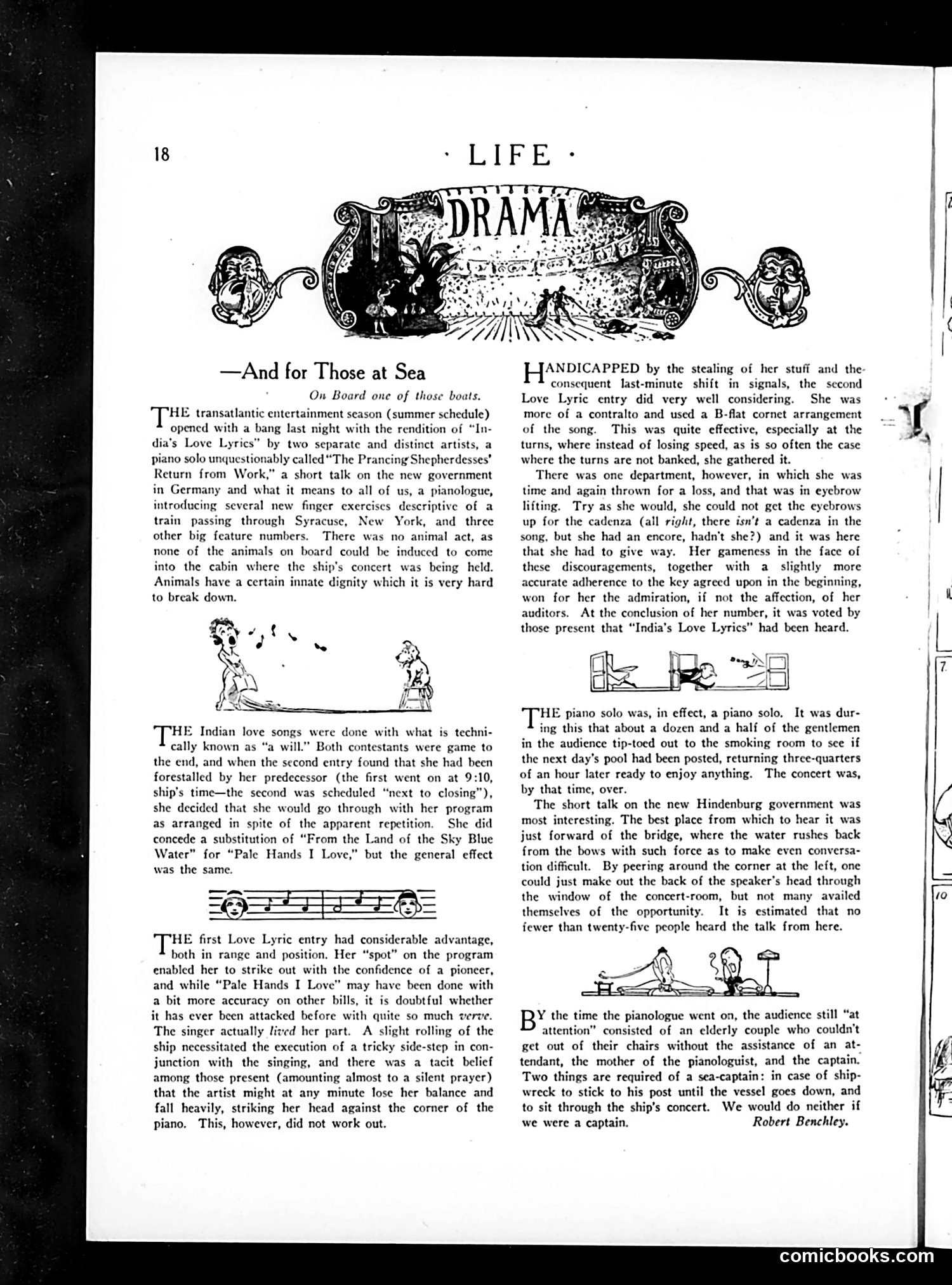
—And for Those at Sea On Board one of those boats. THE transatlantic entertainment season (summer schedule) opened with a bang last night with the rendition of “In- dia’s Love Lyrics” by two separate and distinct artists, a piano solo unquestionably called “The Prancing Shepherdesses’ Return from Work,” a short talk on the new government in Germany and what it means to all of us, a pianologue, introducing several new finger exercises descriptive of a train passing through Syracuse, New York, and three other big feature numbers. There was no animal act, as none of the animals on board could be induced to come into the cabin where the ship's concert was being held. Animals have a certain innate dignity which it is very hard to break down, " bX 'HE Indian love songs were done with what is techni- cally known as “a will.” Both contestants were game to the end, and when the second entry found that she had been forestalled by her predecessor (the first went on at 9:10, ship's time—the second was scheduled “next to closing”), she decided that she would go through with her program as arranged in spite of the apparent repetition. She did concede a substitution of “From the Land of the Sky Blue Water” for “Pale Hands I Love,” but the general effect was the same. 5ST 'HE first Love Lyric entry had considerable advantage, both in range and position. Her “spot” on the program enabled her to strike out with the confidence of a pioneer, and while “Pale Hands I Love” may have been done with a bit more accuracy on other bills, it is doubtful whether it has ever been attacked before with quite so much verve. The singer actually lived her part. A slight rolling of the ship necessitated the execution of a tricky side-step in con- junction with the singing, and there was a tacit belief among those present (amounting almost to a silent prayer) that the artist might at any minute lose her balance and fall heavily, striking her head against the corner of the piano, This, however, did not work out. HANDICAPPED by the stealing of her stuff and the consequent last-minute shift in signals, the second Love Lyric entry did very well considering. She was more of a contralto and used a B-flat cornet arrangement of the song. This was quite effective, especially at the turns, where instead of losing speed, as is so often the case where the turns are not banked, she gathered it. There was one department, however, in which she was time and again thrown for a loss, and that was in eyebrow lifting. Try as she would, she could not get the eyebrows up for the cadenza (all right, there isn’t a cadenza in the song, but she had an encore, hadn't she?) and it was here that she had to give way. Her gameness in the face of these discouragements, together with a slightly more accurate adherence to the key agreed upon in the beginning, won for her the admiration, if not the affection, of her auditors. At the conclusion of her number, it was voted by those present that “India’s Love Lyrics” had been heard. HE piano solo was, in effect, a piano solo, It was dur- ing this that about a dozen and a half of the gentlemen in the audience tip-toed out to the smoking room to sce if the next day’s pool had been posted, returning three-quarters of an hour later ready to enjoy anything. The concert was, by that time, over. The short talk on the new Hindenburg government was most interesting. The best place from which to hear it was just forward of the bridge, where the water rushes back from the bows with such force as to make even conversa- tion difficult. By peering around the corner at the left, one could just make out the back of the speaker's head through the window of the concert-room, but not many availed themselves of the opportunity. It is estimated that no fewer than twenty-five people heard the talk from here. BY the time the pianologue went on, the audience still “at attention” consisted of an elderly couple who couldn't get out of their chairs without the assistance of an at- tendant, the mother of the pianologuist, and the captain. Two things are required of a sea-captain: in case of ship- wreck to stick to his post until the vessel goes down, and to sit through the ship’s concert. We would do neither if we were a captain. Robert Benchley. comicbooks.com