
Life, 1925-06-11 · page 24 of 36
Life — June 11, 1925 — page 24: what you’re looking at
What you’re looking at
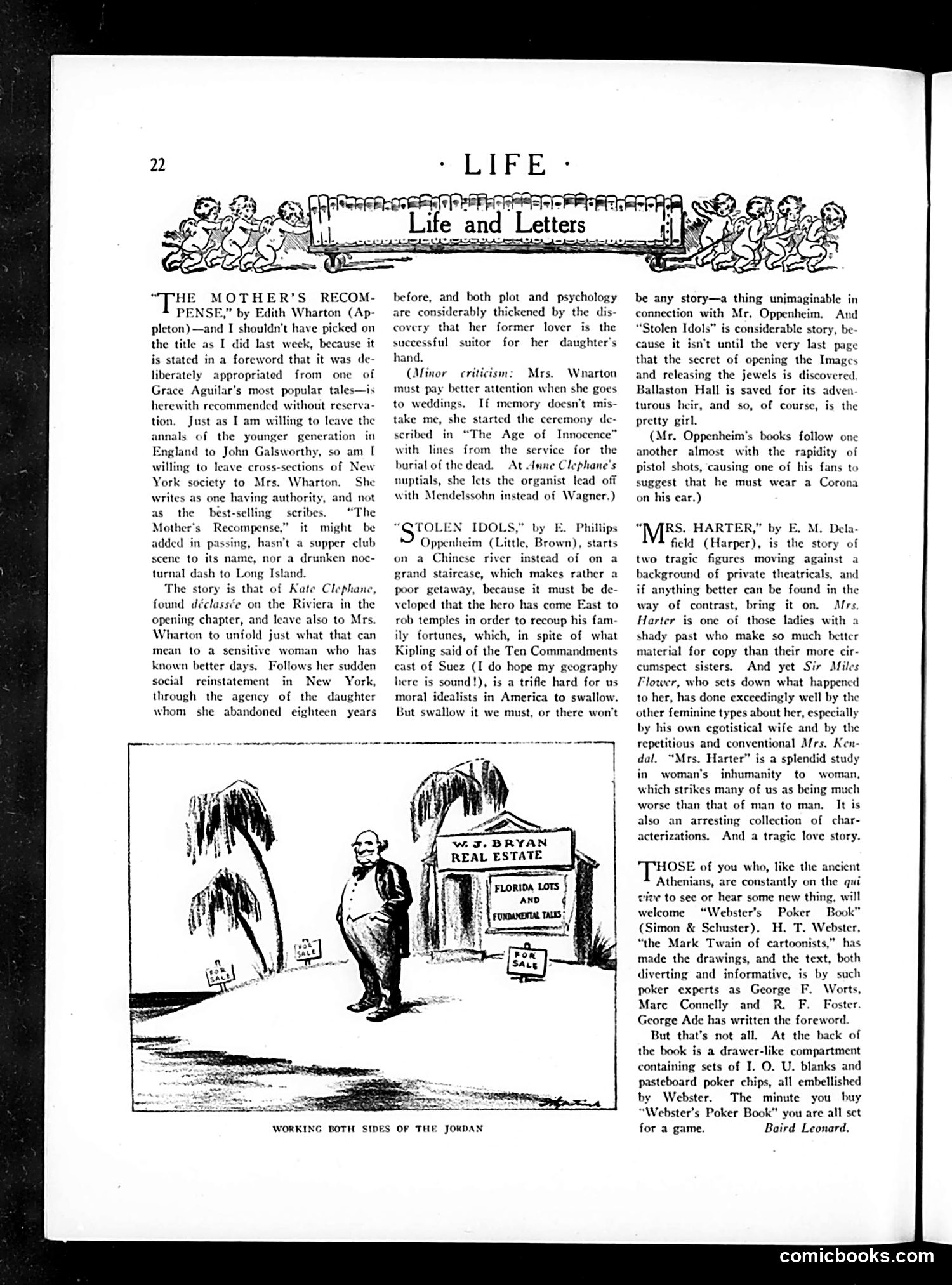
This page from *Life* magazine contains book reviews and a single cartoon titled "Working Both Sides of the Jordan." **The Cartoon:** The image shows a real estate agent (labeled "W.S. Bryan Real Estate") standing between palm trees, advertising "Florida Lots and Fundamental Talks." This is satirizing the Florida land boom of the 1920s—a speculative bubble where developers aggressively marketed swampland and worthless property to investors. The phrase "working both sides of the Jordan" (Biblical reference to crossing into the Promised Land) is a pun suggesting the agent profits from gullible buyers on both sides of the transaction. The cartoon mocks the deceptive sales tactics and false promises that characterized this era of American real estate fraud. **Context:** The cartoon targets the get-rich-quick schemes that duped many Americans before the 1929 stock market crash.
📄 Transcribed text from this page (OCR, searchable)
Machine-transcribed from the original scan — historical spelling and the odd misread are preserved.
MOTHER'S RECOM- E,” by Edith Wharton (Ap- pleton)—and I shouldn't have picked on the title as I did last week, because it is stated in a foreword that it was de- liberately appropriated from one of Grace Aguilar’s most popular tales—is herewith recommended without reserva- tion. Just as I am willing to leave the annals of the younger generation in England to John Galsworthy, so am I willing to leave cross-sections of New York society to Mrs. Wharton. She writes as one having authorit: as the best-selling — scribes. Mother's Recompense,” it might be added in passing, hasn't a supper club scene to its name, nor a drunken noc- turnal dash to Long Island. The story is that of Kate Clephane, found déclassée on the Riviera in the opening chapter, and leave also to Mrs. Wharton to unfold just what that can mean to a sensitive woman who has known better days, Follows her sudden social reinstatement in New York, through the agency of the daughter whom she abandoned eighteen years before, and both plot and psychology are considerably thickened by the dis- that her former lover is the successful suitor for her daughter's hand. (Minor criticism: Mrs. Wharton must pay better attention when she goes to weddings. If memory doesn’t mis- take me, she started the ceremony de- scribed in “The Age of Innocence” with lines from the service for the burial of the dead. At Anne Clephane’s nuptials, she lets the organist lead off with Mendelssohn instead of Wagner.) covery FOLEN IDOL! y E. Phillips Oppenheim (Little, Brown), starts on a Chinese river instead of on a grand staircase, which makes rather a poor getaway, because it must be de- veloped that the hero has come East to rob temples in order to recoup his fam- ily fortunes, which, in spite of what Kipling said of the Ten Commandments cast of Suez (I do hope my geography here is sound!), is a trifle hard for us moral idealists in America to swallow. But swallow it we must, or there won't ws) BRYAN REAL ESTATE WORKING BOTH SIDES OF THE JORDAN be any story—a thing unjmaginable in connection with Mr. Oppenheim. And “Stolen Idols” is considerable story, be- cause it isn't until the very last page that the secret of opening the Images and releasing the jewels is discovered. Ballaston Hall is saved for its adven- turous heir, and so, of course, is the pretty girl. (Mr. Oppenheim's books follow one another almost with the rapidity of pistol shots, causing one of his fans to suggest that he must wear a Corona on his car.) “NARS. HARTER,” by E. M. Dela- field (Harper), is the story of two tragic figures moving against a background of private theatricals, and if anything better can be found in the way of contrast, bring it on. Mrs. Harter is one of those ladies with a shady past who make so much better material for copy than their more cir- cumspect sisters. And yet Sir Miles Flower, who sets down what happened to her, has done exceedingly well by the other feminine types about her, especially by his own egotistical wife and by the repetitious and conventional Mrs. Ken- dal. “Mrs. Harter” is a splendid study in| woman's inhumanity to woman, which strikes many of us as being much worse than that of man to man, It is also an arresting collection of char- acterizations, And a tragic love story. "THOSE of you who, like the ancient Athenians, are constantly on the qui vive to see or hear some new thing, will welcome “Webster’s Poker Boe (Simon & Schuster), H. T. Webster, “the Mark Twain of cartoonists,” has made the drawings, and the text, both diverting and informative, is by such poker experts as George F. Worts, Mare Connelly and R. F. Foster. George Ade has written the foreword. But that’s not all. At the back of the book is a drawer-like compartment containing sets of I. O. U. blanks and pasteboard poker chips, all embellished by Webster. The minute you buy “Webster's Poker Book” you are all set for a game. Baird Leonard. comicbooks.com