
Life, 1925-06-11 · page 8 of 36
Life — June 11, 1925 — page 8: what you’re looking at
What you’re looking at
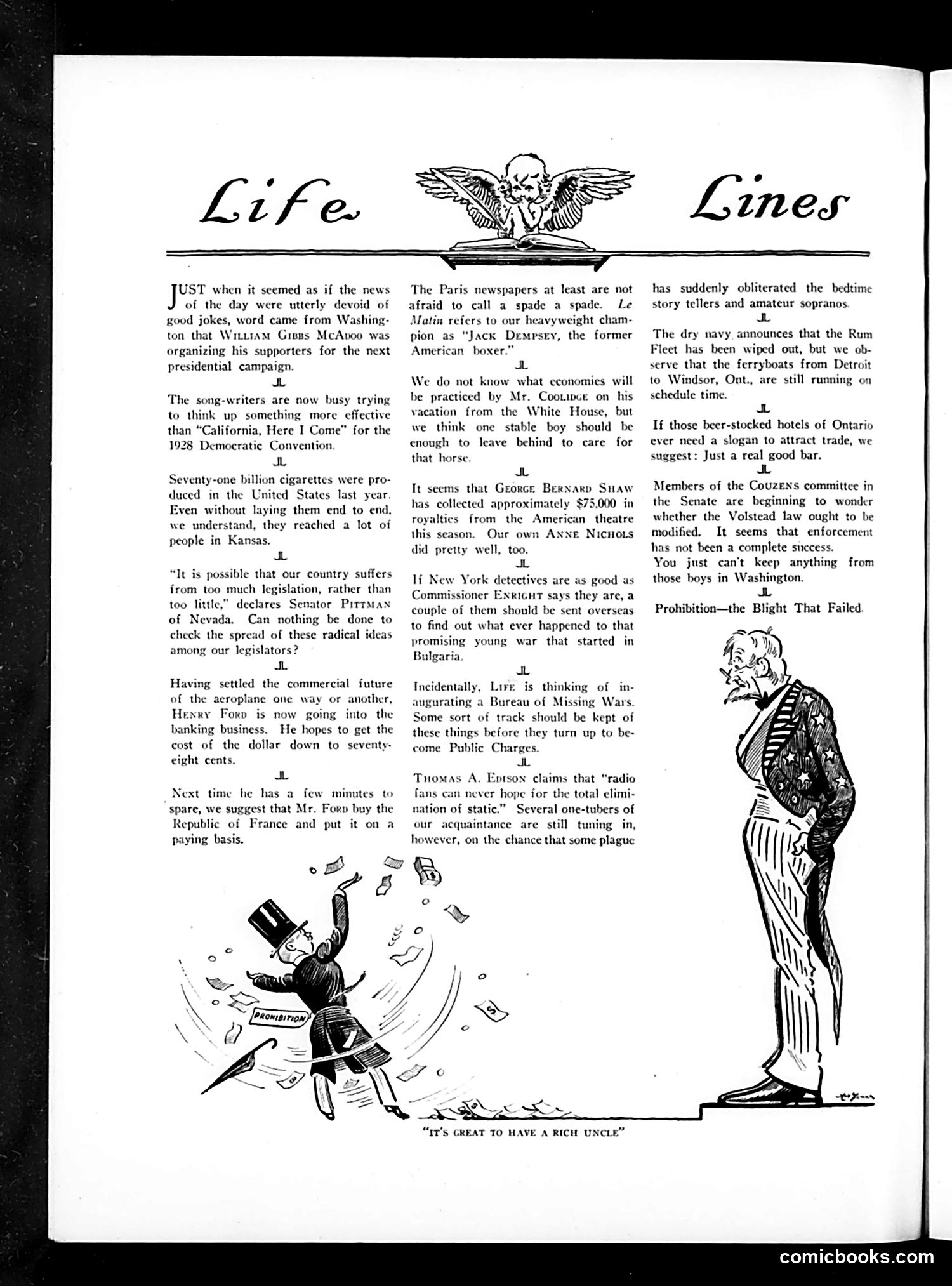
This page contains brief satirical commentary on contemporary political and social topics, typical of *Life* magazine's format. **Main Cartoon:** "It's Great to Have a Rich Uncle" depicts Prohibition as a figure juggling money while a wealthy man observes approvingly. The satire suggests that Prohibition enforcement benefits the wealthy—likely referring to bootleggers, corrupt officials, or wealthy individuals profiting from illegal alcohol sales during the Prohibition era (1920-1933). **Text References:** The page includes jabs at politicians (Senator Pittman of Nevada), Henry Ford's business plans, George Bernard Shaw, and radio technology. The subtitle "Prohibition—the Blight That Failed" indicates the cartoonist's skepticism about Prohibition's effectiveness, a common stance by the late 1920s as the policy's failures became apparent.
📄 Transcribed text from this page (OCR, searchable)
Machine-transcribed from the original scan — historical spelling and the odd misread are preserved.
UST when it seemed as if the news of the day were utterly devoid of good jokes, word came from Washing- ton that Wittiam Ginps McAvoo was organizing his supporters for the next presidential campaign. JL The song-writers are now busy trying to think up something more effective than “California, Here I Come” for the 1928 Democratic Convention. JL Seventy-one billion cigarettes were pro- duced in the United States last year. Even without laying them end to end, we understand, they reached a lot of people in Kansas. aL “It is possible that our country suffers from too much legislation, rather than too little,” declares Senator Pittman of Nevada. Can nothing be done to check the spread of these radi among our legislators? JL Having settled the commercial future of the aeroplane one way or another, Hexry Foxp is now going into the banking business. He hopes to get the cost of the dollar down to seventy: eight cents. ideas aL Next time he has a few minutes to spare, we suggest that Mr. Foro buy the Republic of France and put it on a paying basis. The Paris newspapers at least are not afraid to call a spade a spade. Le Matin refers to our heavyweight cham- pion as eY, the former American boxer.” + We do not know what economies will be practiced by Mr. Coottnce on his vacation from the White House, but we think one stable boy should be enough to leave behind to care for that horse, JL Tt seems that Georce Bexnaky Suaw has collected approximately $75,000 in royalties from the American theatre this on. Our own Anne Nicnots did pretty well, too. JL Ii New York detectives are as good as Commissioner Exricut says they are, a couple of them should be sent overseas to find out what ever happened to that promising young war that started in Bulgaria. aL Incidentally, Lire is thinking of in- augurating a Bureau of Missing Wars. Some sort of track should be kept of these things before they turn up to be- come Public Charges. Jt Tuomas A. Epison claims that “radio fans can never hope for the total elimi- nation of static.” Several one-tubers of our acquaintance are still tuning in, however, on the chance that some plague “t7’s GREAT TO HAVE A RICH UNCLE” has suddenly obliterated the bedtime story tellers and amateur sopranos. aL The dry navy announces that the Rum Fleet has been wiped out, but we ob- serve that the ferryboats from Detroit to Windsor, Ont., are still running on schedule time. LL If those beer-stocked hotels of Ontario ever need a slogan to attract trade, we suggest: Just a real good bar. aL Members of the Couzens committee in the Senate are beginning to wonder whether the Volstead law ought to be modified. It seems that enforcement has not been a complete success. You just can't keep anything from those boys in Washington. Prohibition—the Blight That Failed. comicbooks.com