
A complete issue · 42 pages · 1925
Life — April 30, 1925
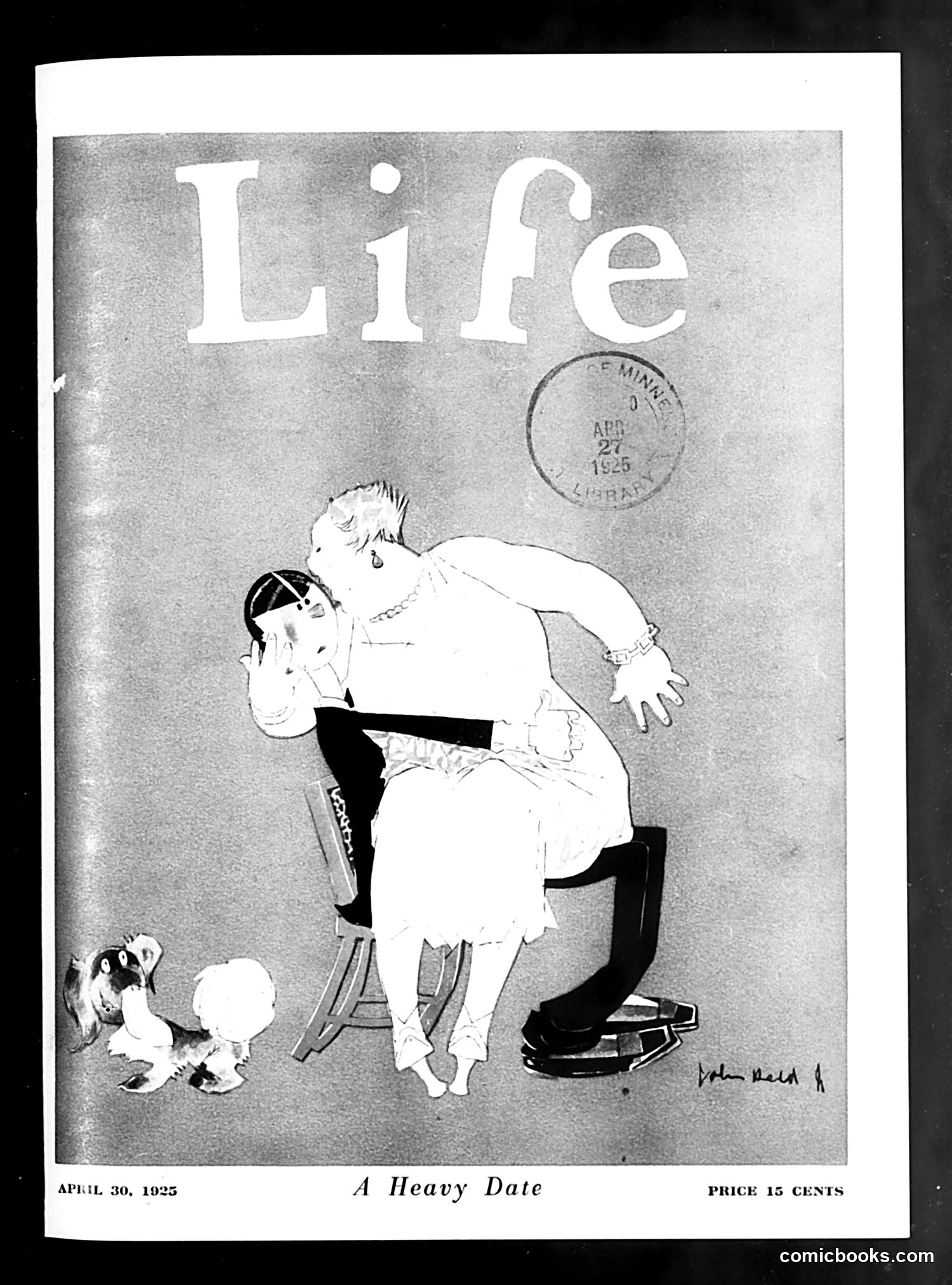
This satirical cartoon depicts a woman sitting on a man's lap in a chair, with a small dog nearby. The title "A Heavy Date" plays on the double meaning of "heavy"—suggesting both a serious romantic encounter and the woman's physical weight. The humor relies on body-shaming satire common in 1920s popular culture. The exaggerated caricature emphasizes the woman's size as the joke's punchline. The man appears uncomfortable or constrained by her weight, reinforcing the satirical premise. The illustration reflects attitudes toward women's bodies and dating customs of the Jazz Age era, though such content would be considered offensive by modern standards. The style and subject matter are typical of Life's humor during this period.
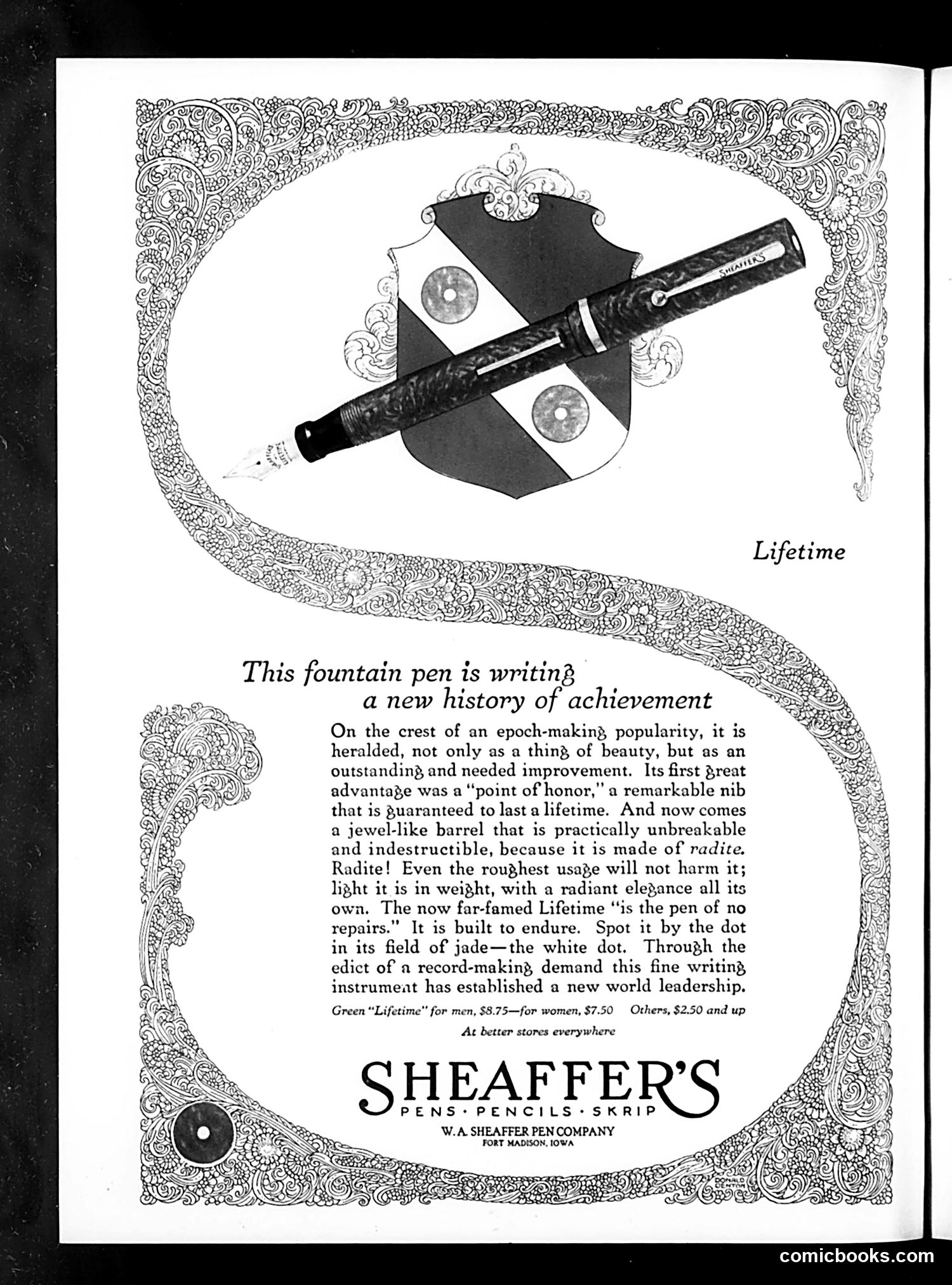
This is a **Sheaffer's fountain pen advertisement**, not political satire. The ornate decorative border frames a product display showing the "Lifetime" model fountain pen positioned across a heraldic shield. The ad promotes the pen's durability and prestige, emphasizing its "point of honor" (a guaranteed lifetime nib) and construction from "radite" (an indestructible material). The text claims it requires "no repairs" and represents "a new world leadership" in writing instruments. The heraldic imagery and language about "epoch-making popularity" and "record-making demand" use grandiose marketing rhetoric typical of early 20th-century luxury goods advertising. For modern readers, this reflects how premium pens were positioned as status symbols and lifetime investments before ballpoint pens became ubiquitous.
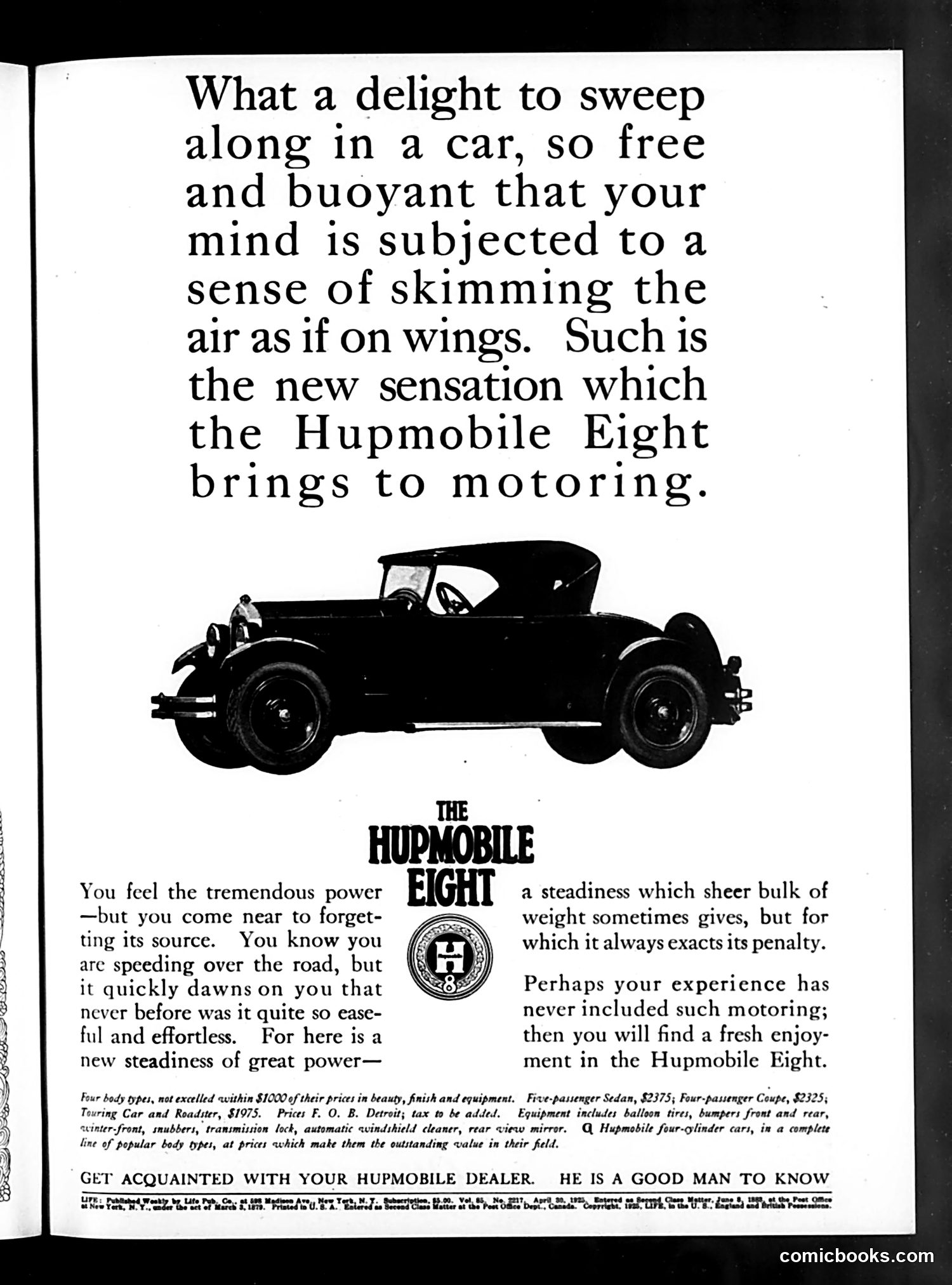
This is primarily **advertising copy**, not satire or political commentary. It's a vintage car advertisement for the Hupmobile Eight automobile. The ad uses flowery, evocative language to describe the driving experience—emphasizing smoothness, power, and the sensation of effortless motion ("skimming the air as if on wings"). The vehicle illustration shows a 1920s-era open-air touring car. The bottom includes pricing information ($2,375-$3,075 depending on body type) and encourages readers to visit Hupmobile dealers. There is **no cartoon, caricature, or political satire** on this page. It's a straightforward product advertisement typical of early-20th-century magazines, using romantic language to market automotive luxury to wealthy consumers.
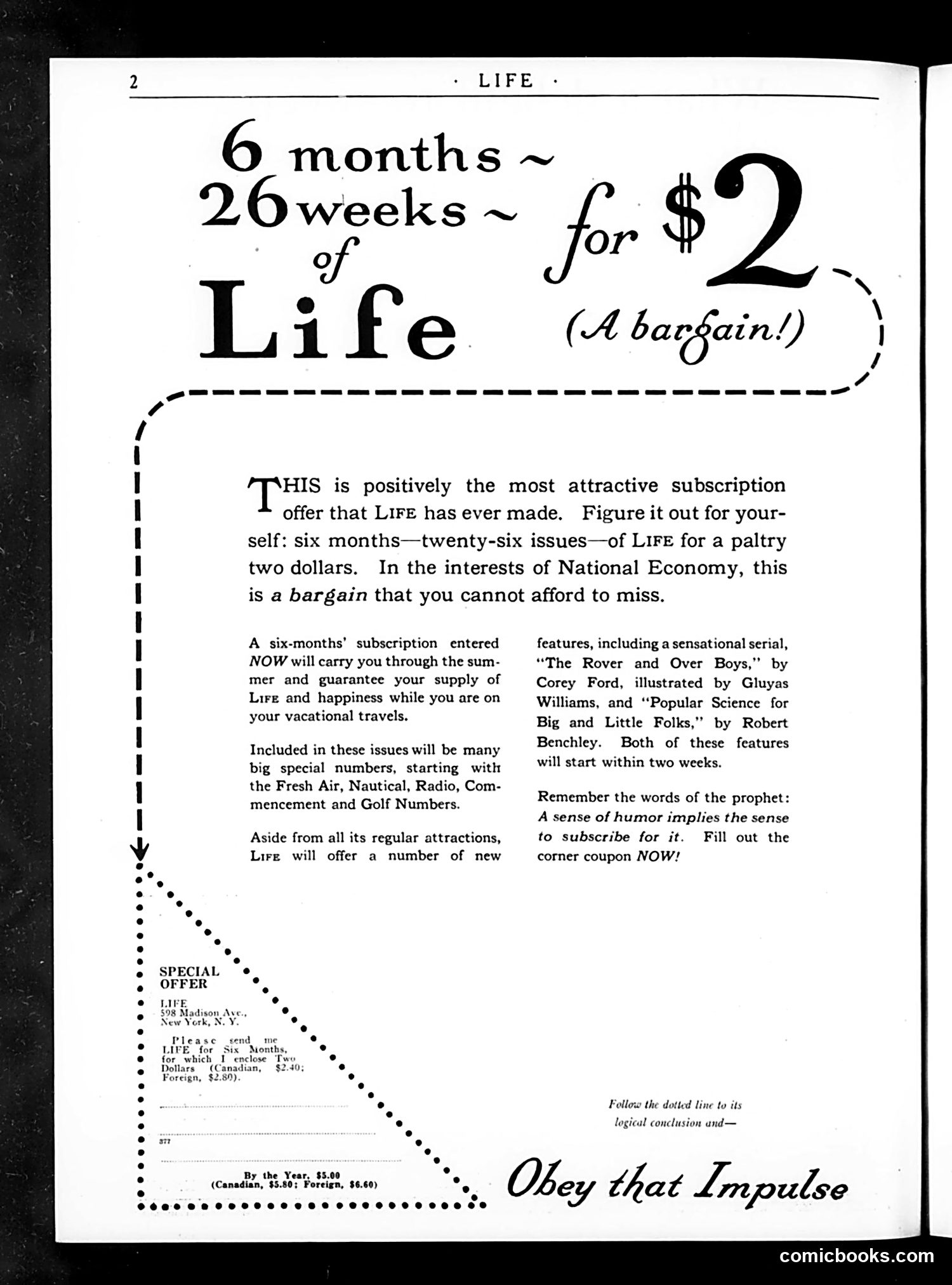
This is primarily a **subscription advertisement**, not a political cartoon. It promotes a six-month Life magazine subscription (26 issues) for $2—presented as an exceptional bargain during what the ad calls "the interests of National Economy." The ad mentions upcoming serial features including "The Rover and Over Boys" by Corey Ford (illustrated by Gluyas Williams) and "Popular Science for Big and Little Folks" by Robert Benchley. These were actual popular Life contributors known for humor and light entertainment. The phrase "Obey that Impulse" at the bottom is a marketing call-to-action typical of Depression-era advertising, appealing to readers' desire for affordable entertainment and information during economically challenging times.
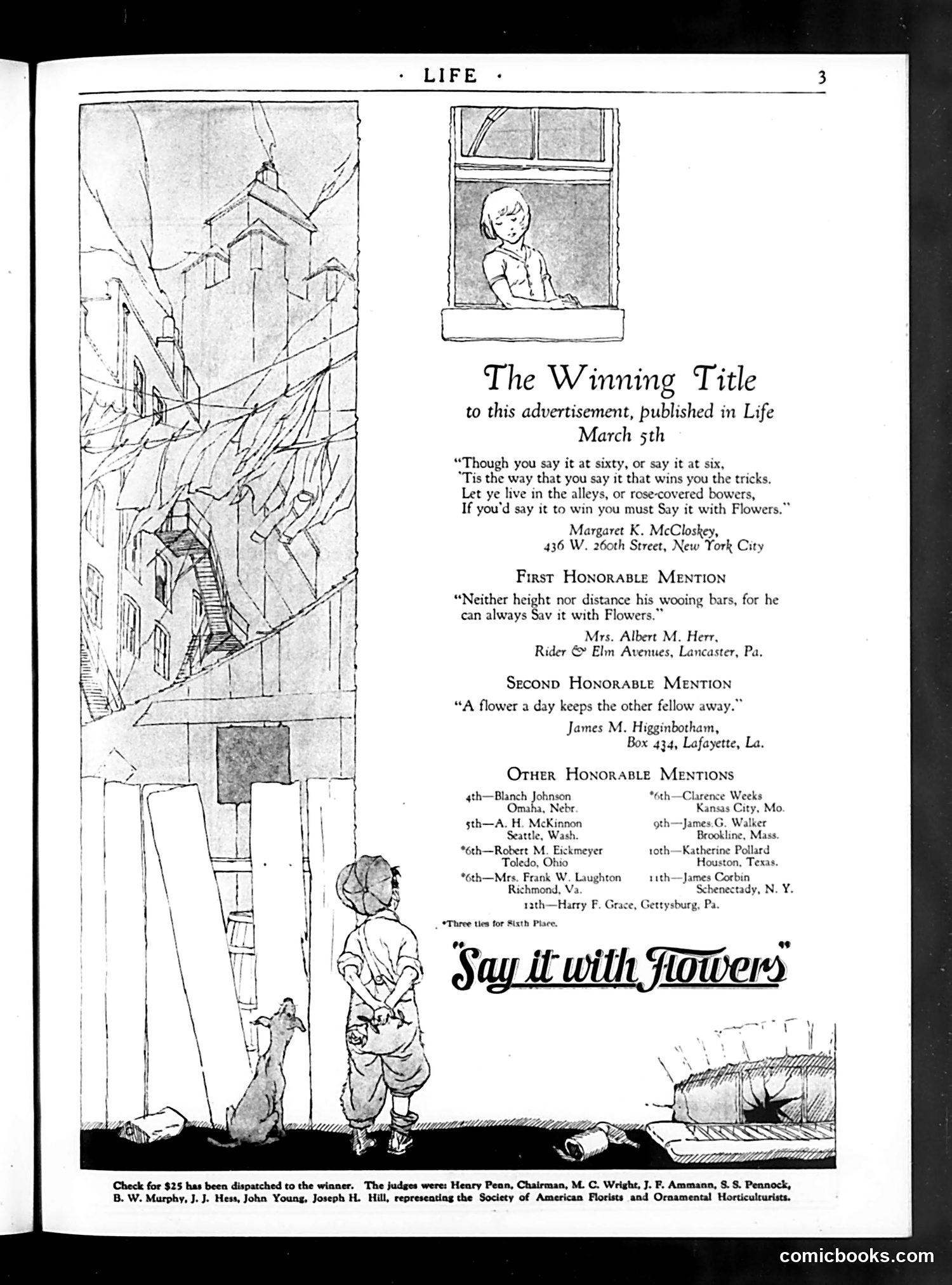
This page showcases winning entries from a Life magazine advertising contest (published March 5th) centered on the phrase "Say it with Flowers"—a popular slogan promoting flowers as gifts. The three illustrated scenes depict domestic scenarios where flowers solve social problems: a child at a window, figures in an alley, and a couple outdoors. Each winning entry offers a humorous aphorism about flowers' persuasive power in romantic or social situations. This reflects early-20th-century advertising culture, where clever taglines and consumer goods (here, flowers) were marketed as solutions to everyday life challenges. The contest itself was a marketing strategy to generate consumer engagement and brand loyalty through participatory humor and creativity.
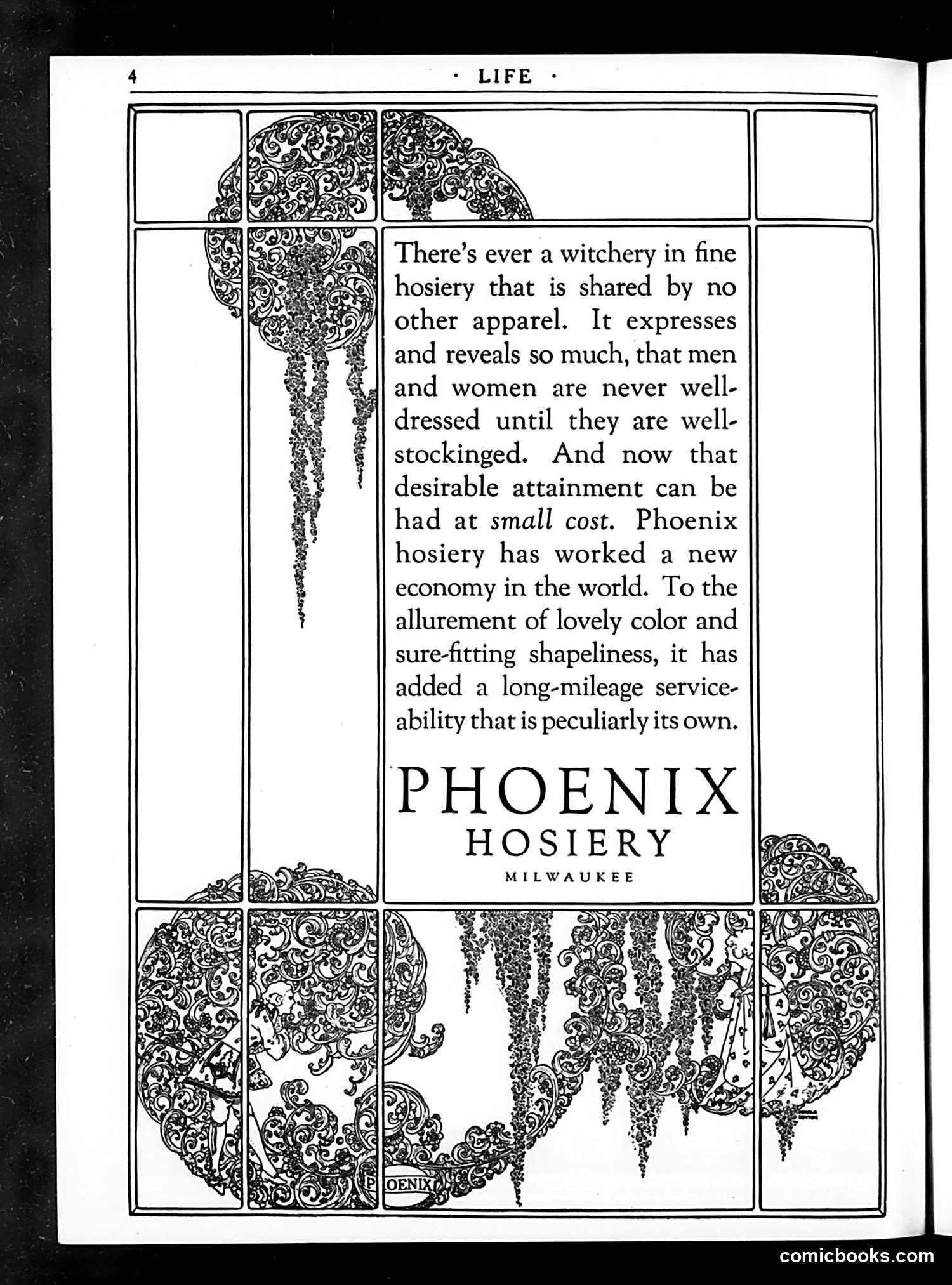
This page is **primarily an advertisement**, not satire or political commentary. Phoenix Hosiery of Milwaukee is promoting women's stockings through an ornate Art Deco or Art Nouveau design featuring decorative floral and scrollwork patterns framing women's legs. The text uses romantic language about hosiery—calling it a "witchery" that expresses elegance—and emphasizes Phoenix's innovation: affordable stockings that combine "lovely color," good fit, and durability. This was a genuine selling point in the early 20th century, when quality hosiery was expensive and fragile. The page reflects contemporary attitudes about women's fashion and legs as a subject for aesthetic presentation, presented without irony as straightforward commercial appeal.
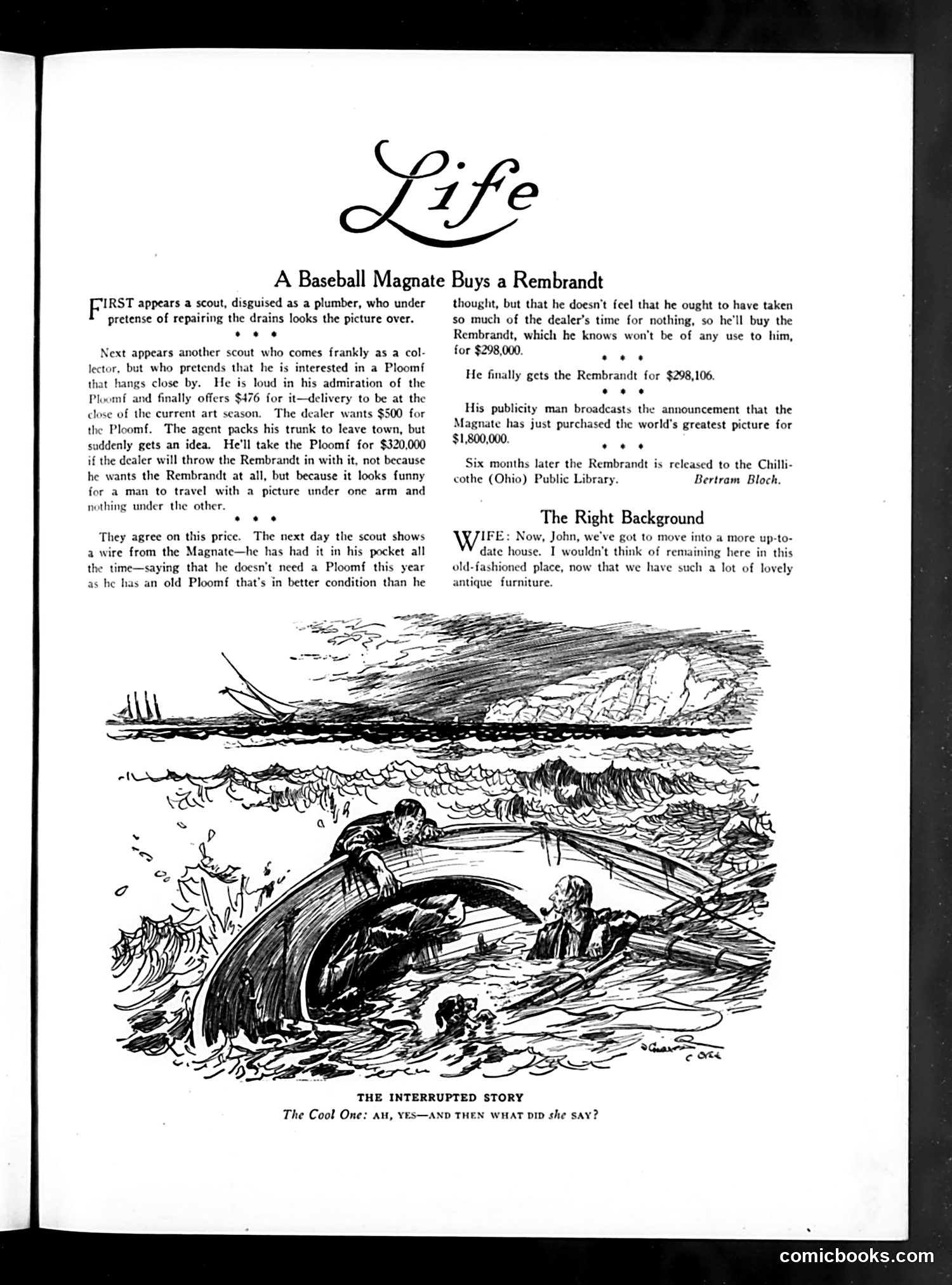
This page from *Life* magazine contains two satirical pieces: **"A Baseball Magnate Buys a Rembrandt"** mocks wealthy sports executives' conspicuous consumption. A baseball team owner is duped by con artists posing as a plumber and art collector into purchasing a fake Rembrandt for $298,106—an astronomical sum (equivalent to roughly $5 million today). The satire targets both the owner's gullibility and the absurd art market prices of the era, suggesting that wealthy industrialists lack taste and are easily separated from their money through flattery and schemes. **"The Right Background"** appears to be the beginning of a narrative piece about a couple's move to a new house, with an illustration captioned "The Interrupted Story: 'Ah, yes—and then what did she say?'" The joke likely plays on marital domestic life or social pretension.
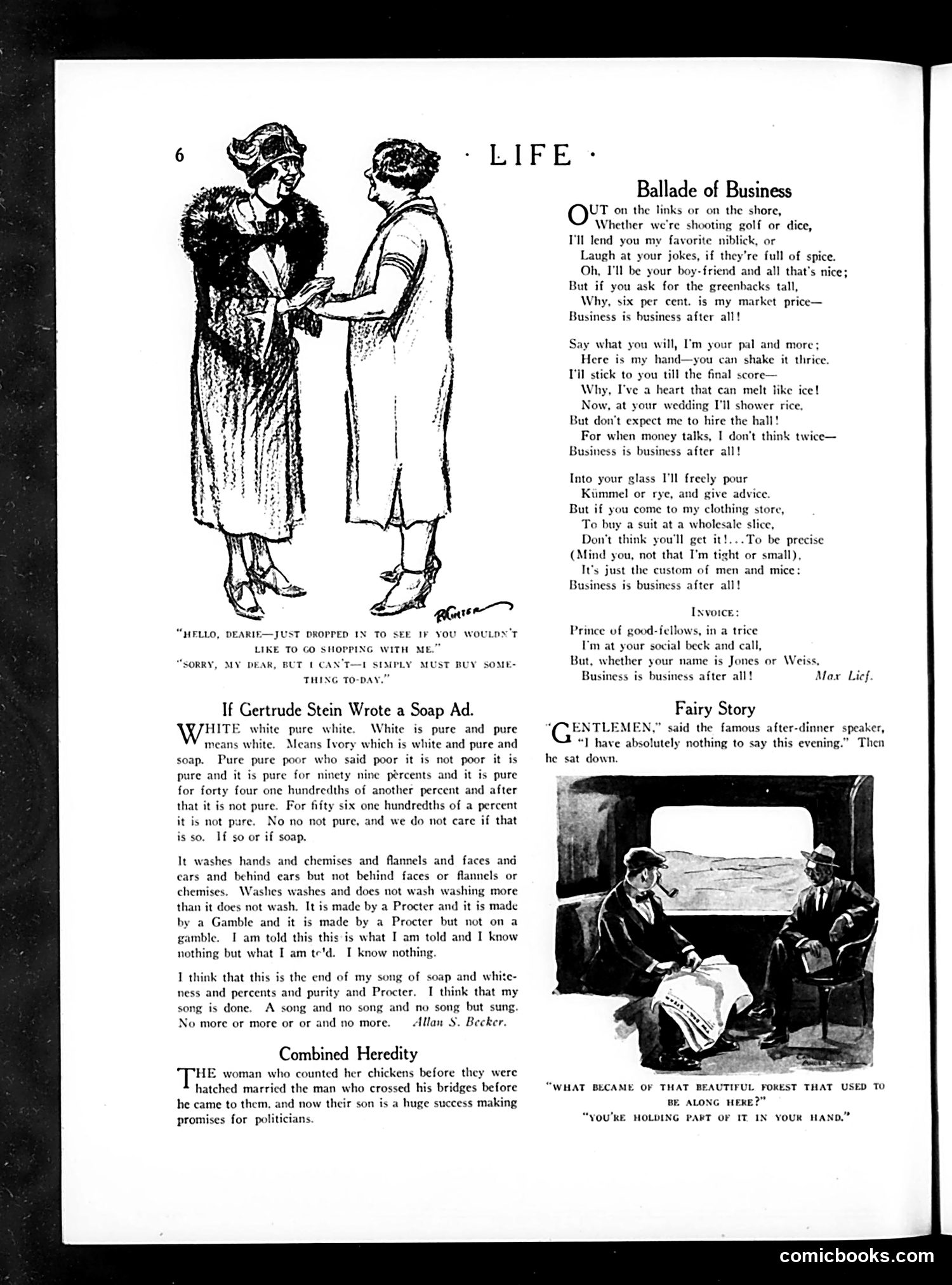
This page contains three satirical pieces: 1. **"Ballade of Business"** — A poem mocking how friendship becomes transactional. The accompanying illustration shows two women meeting, with one claiming she can't afford a shopping trip because "business is business after all"—the refrain emphasizing how financial self-interest overrides personal loyalty. 2. **"If Gertrude Stein Wrote a Soap Ad"** — A parody of modernist writer Gertrude Stein's repetitive, abstract style applied absurdly to soap advertising. It satirizes both Stein's experimental writing and commercial advertising's pretensions to profundity. 3. **"Fairy Story"** — A cartoon showing two men on a train where one holds property deeds, satirizing how wealth and land ownership now define modern narratives instead of traditional fairy-tale virtues. The page targets materialism, commercial culture, and literary pretension.
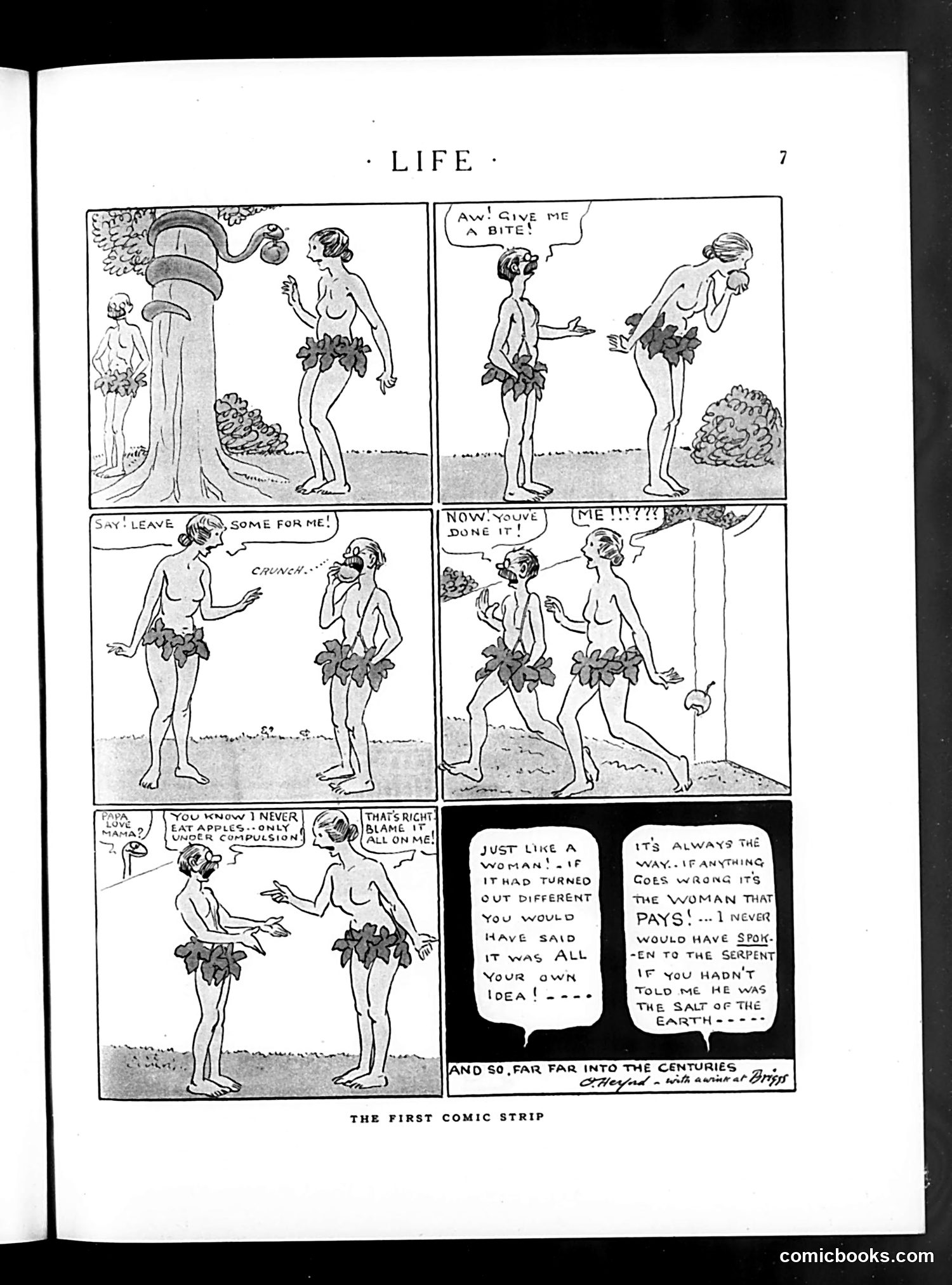
This page presents a comedic retelling of the Adam and Eve story from Genesis, presented as "the first comic strip." The six-panel narrative depicts two nude figures in the Garden of Eden: one character offers an apple to the other, who initially refuses ("Leave some for me!"). After eating, the second figure becomes ill ("Now you've done it!"). The final panels show them blaming each other for the fall of man. The dark final panel delivers the satirical punchline: blaming woman for humanity's downfall, framing it as an eternal consequence—"the woman that pays" for breaking God's rules. The joke targets both biblical literalism and contemporary gender politics, sardonically suggesting women bear responsibility for human suffering itself.
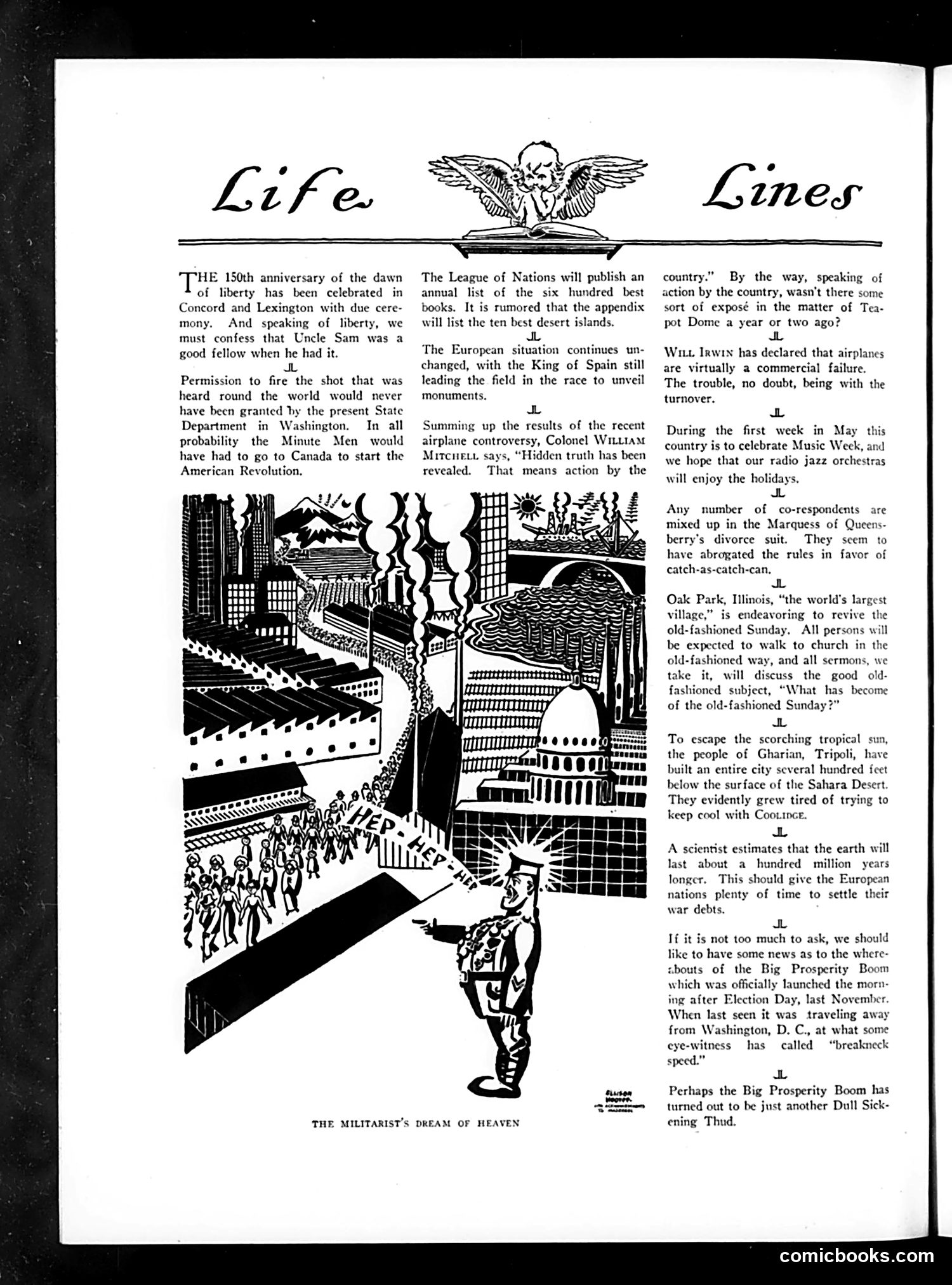
This political cartoon satirizes militarism by depicting a grotesque figure—likely representing a military leader or warmonger—imagining an idealized city of rigid geometric order and regimentation. The stark black-and-white woodcut style emphasizes the dehumanizing nature of military hierarchy. The cartoon critiques how militarists envision society: perfectly ordered, controlled, and uniform—like marching soldiers rather than free citizens. The masses of identical figures suggest loss of individuality under military rule. This reflects 1920s-30s anxieties about rising authoritarianism in Europe and concerns that militarism crushes human freedom and diversity. The "dream" framing suggests this militarist vision is dangerously unrealistic and inhumane, mocking those who romanticize military organization as a societal model.
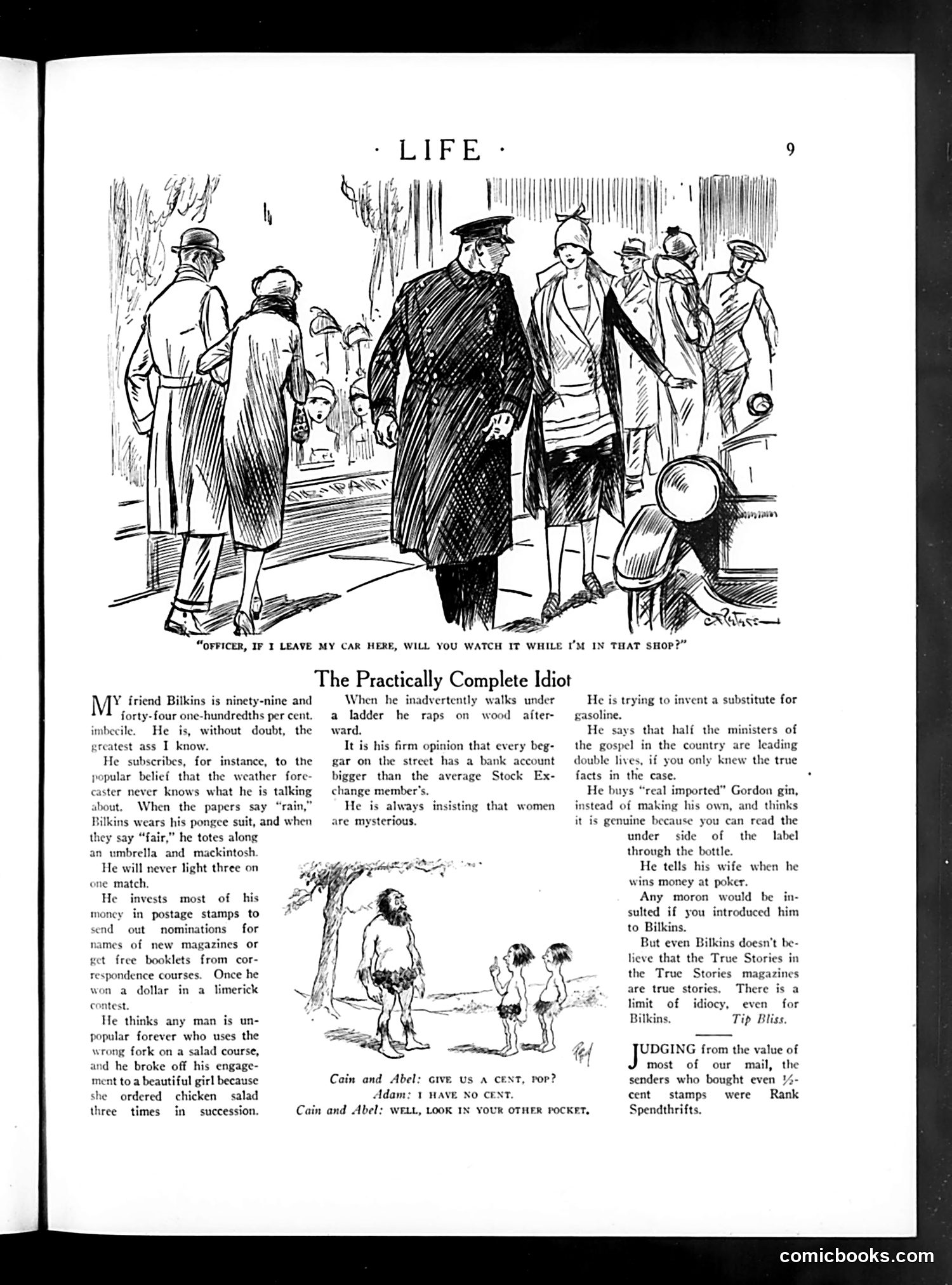
**Top Cartoon:** An officer parks his car on a street and asks a passerby to watch it while he shops. The satire targets urban inconvenience and the absurdity of trusting strangers with valuables—a common early-20th-century concern as automobiles became prevalent in cities. **"The Practically Complete Idiot" Article:** A satirical character sketch of "Bilkins," a stereotypical foolish man who holds contradictory opinions, makes poor investments (postage stamps, limerick contests), believes dubious claims (about gin authenticity and stock market tips), and spreads misinformation. The piece mocks credulous people who believe unlikely stories and lack practical sense. **Bottom Illustration:** Labeled "Cain and Abel," it depicts biblical figures in poverty, humorously asking for money—likely satirizing beggary or economic hardship.
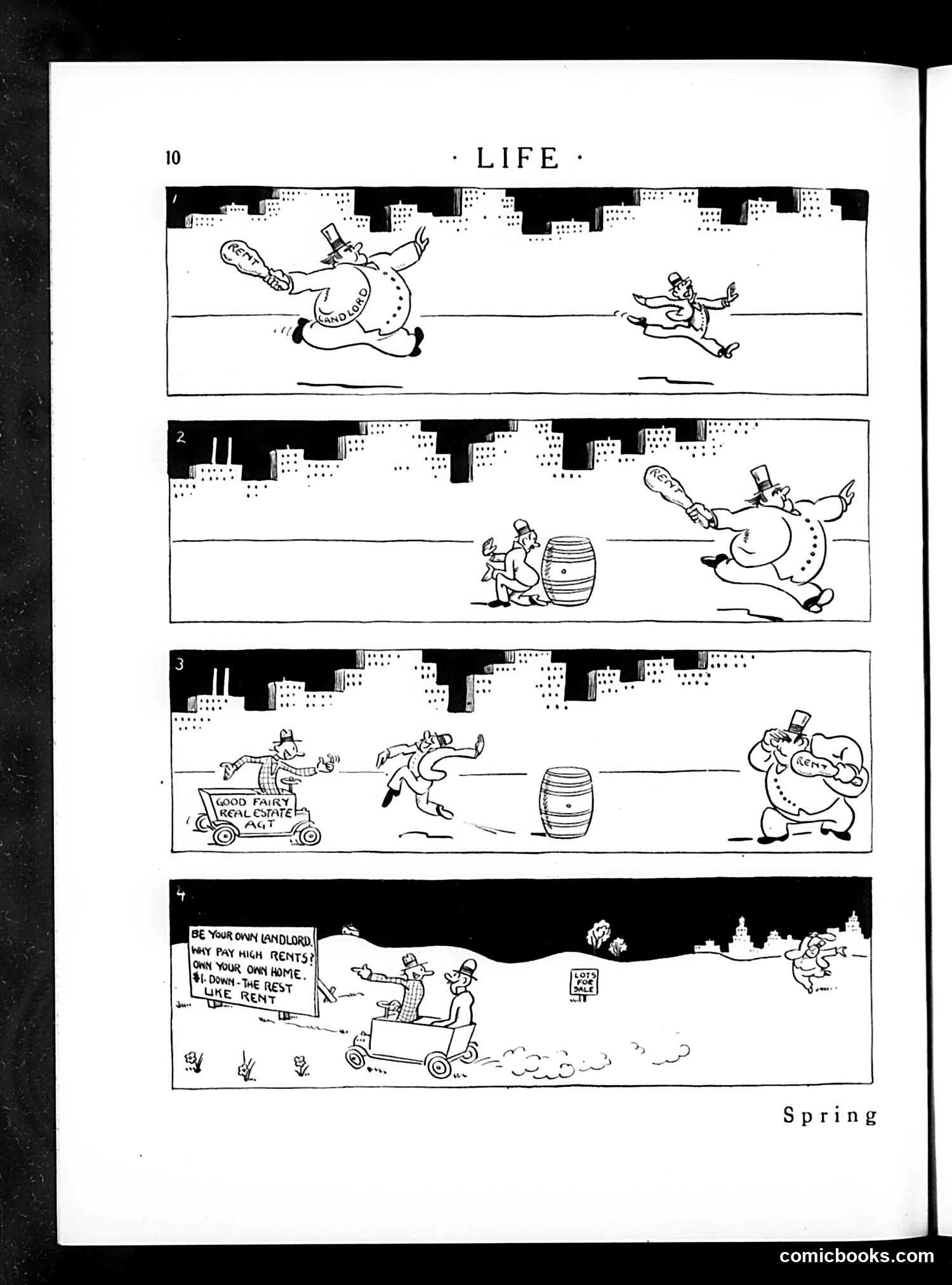
This four-panel satire from *Life* magazine depicts the seasonal return of a wealthy landlord figure (top hat, rotund) pursuing tenants. The narrative arc shows: 1. **Landlord chasing a tenant** across open ground 2. **Tenants hiding near a barrel**, suggesting desperation 3. **A "Good Fairy Real Estate Agent"** attempting to mediate between fleeing tenants and the landlord 4. **A sign reading "BE YOUR OWN LANDLORD"** promoting home ownership as an alternative to paying "high rents" and "full-time rest like rent" The cartoon satirizes the exploitative landlord-tenant relationship of the era, using the spring season (traditionally when rent came due) to mock both landlords' relentless pursuit of payment and the real estate industry's optimistic promises of affordable homeownership as an escape. The "good fairy" imagery mockingly suggests such solutions are pure fantasy.
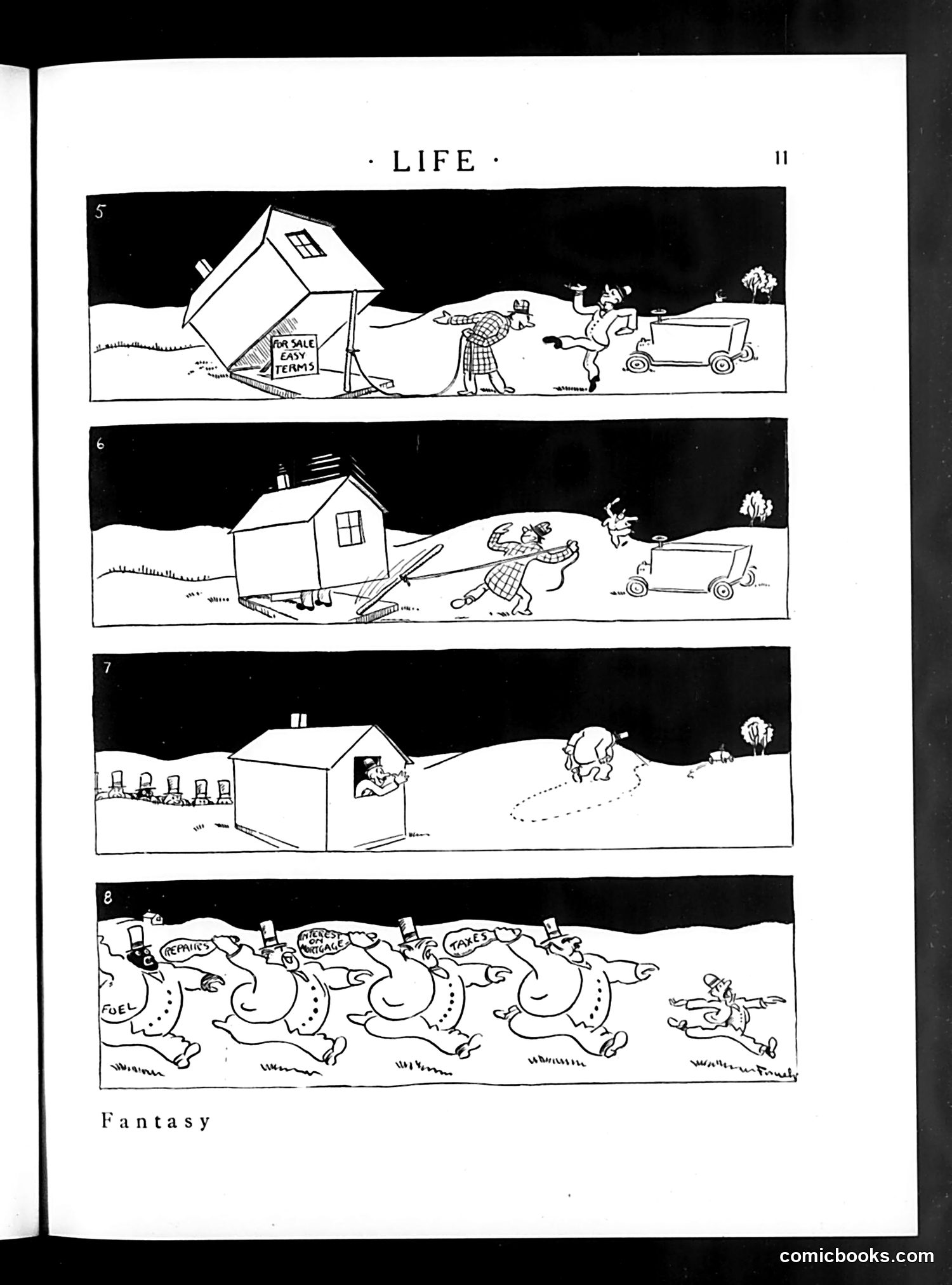
This four-panel comic titled "Fantasy" satirizes American real estate and housing markets, likely from the early-to-mid 20th century. Panel 5 shows a tilted house advertised "For Sale Easy Terms," with a man approaching. Panel 6 depicts him being knocked over by the house falling. Panel 7 shows him now inside the collapsed structure. Panel 8 concludes with a surreal parade of bloated figures labeled with terms like "Fuel," "Repairs," "Taxes," and "Interest," chasing the exhausted man—visualizing the mounting costs of homeownership. The satire critiques how "easy terms" to purchase a house mask the substantial hidden expenses that follow. The fantasy is affordability; the reality is financial burden. This reflects Depression-era anxieties about working-class Americans being trapped by homeownership costs despite low down payments.
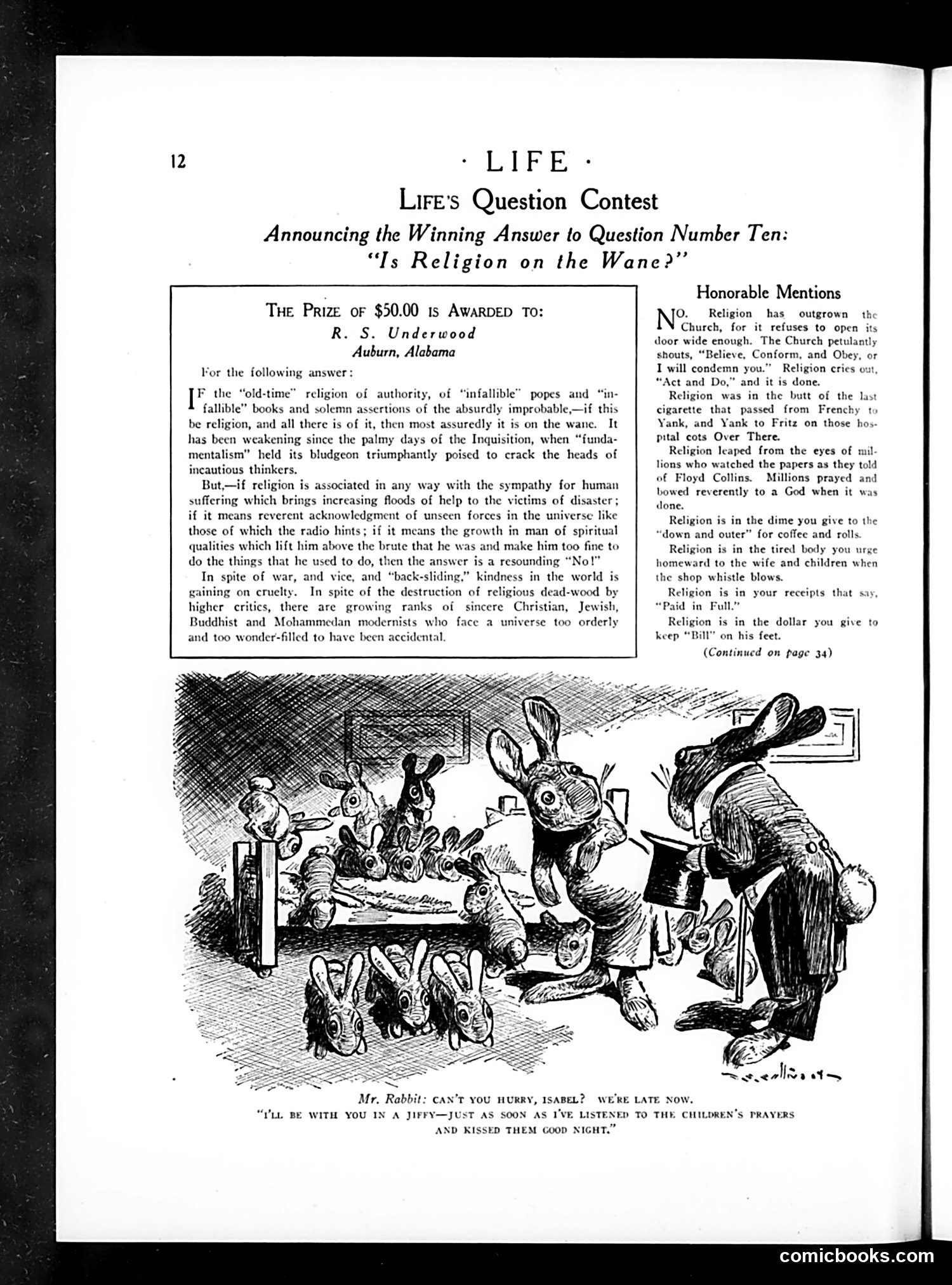
This page announces the winning answer to *Life* magazine's "Question Contest" about whether religion belongs "on the wane." The winning answer by R.S. Underwood (Auburn, Alabama) argues that religion—associated with outdated authority, papal infallibility, and dogmatism—should decline. The answer contrasts "old-time" religious rigidity with modern values like sympathy and spiritual growth, claiming sincere faith is incompatible with religious institutions. The cartoon below depicts a domestic scene: Mr. Rabbit hurrying home, apologizing for lateness to his family while referencing having listened to children's prayers and kissed them goodnight—a gentle satire on how religious observance operates within family life and domestic routines. The humor lies in the mundane, habitual nature of religious practice.
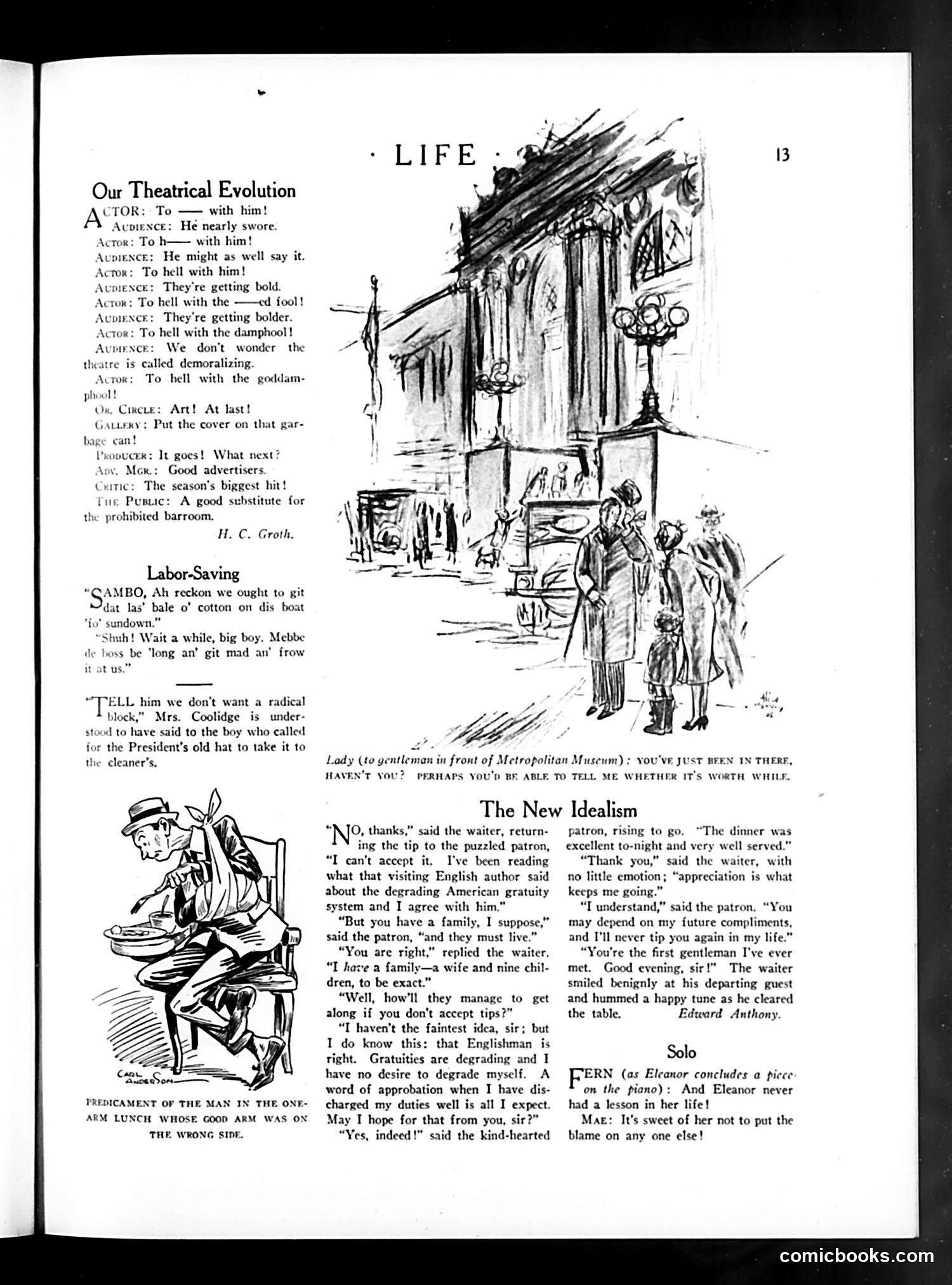
This page contains three satirical pieces about American social attitudes circa early 20th century. **"Our Theatrical Evolution"** mocks how theatrical audiences have become increasingly crude and bold—progressing from "nearly swore" to openly cursing. The satire suggests theater reflects society's moral decline, with the uncle's comment about theater being "demoralizing" capturing conservative disapproval. **"Labor-Saving"** presents a dialogue between working-class characters (Sambo and Mesbe) about avoiding labor, satirizing attitudes toward Black workers and labor-saving excuses. **"The New Idealism"** depicts a waiter declining a tip, claiming gratuities degrade his dignity as an Englishman. The satire targets both affected European pretension and changing American service-industry norms regarding tipping. The sketches collectively satirize evolving American manners and class anxieties.
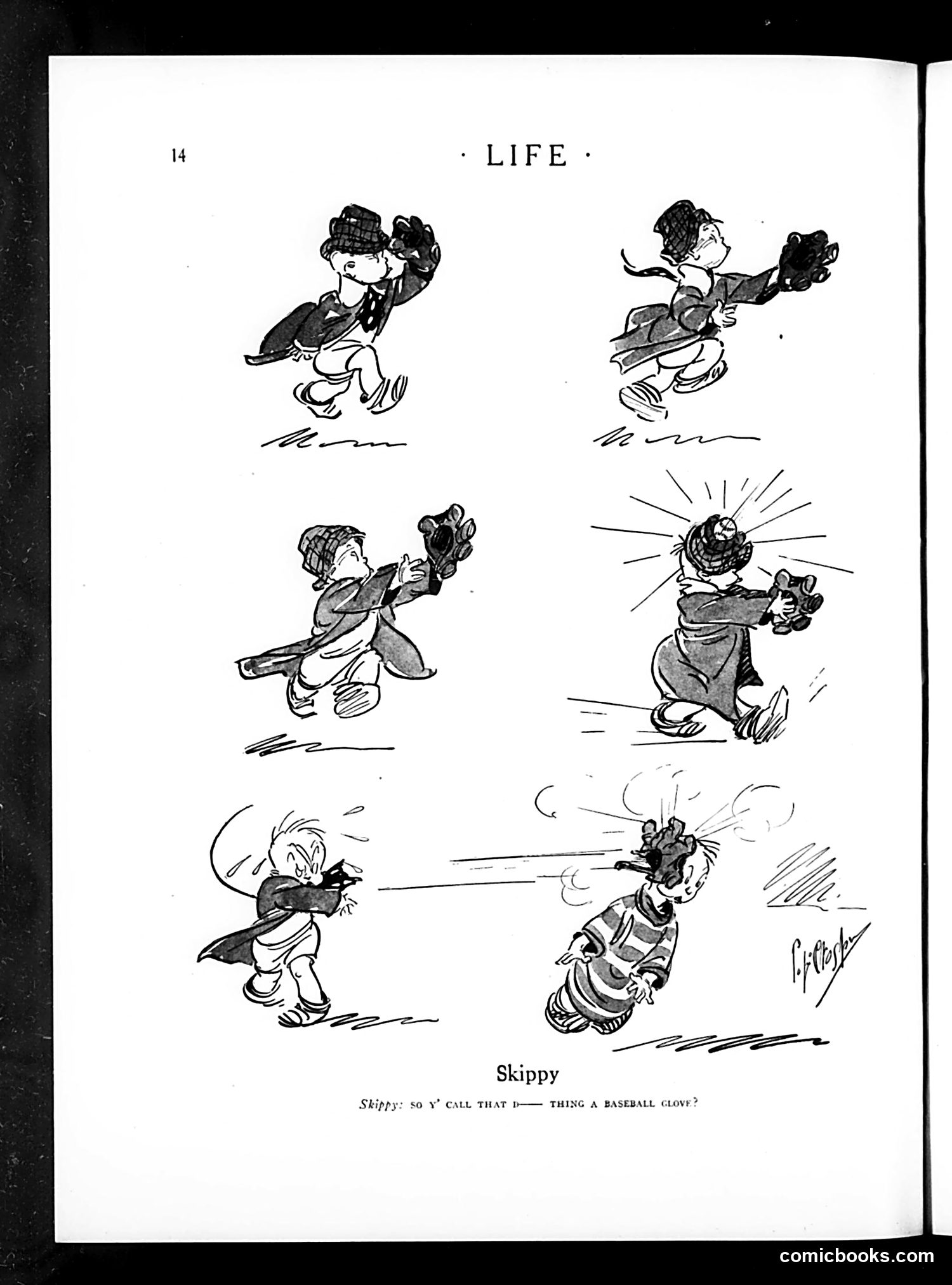
This is a humorous comic strip titled "Skippy" showing a child character in six sequential panels engaging in increasingly energetic play with a baseball glove. The panels progress from calm to frantic, with the final panel showing the child being knocked backward by the force of catching a ball. The joke appears in the caption: "Skippy: so y' call that p—thing a baseball glove?" The humor relies on the child's exaggerated reaction—being violently thrown back by the catch—which humorously questions whether calling the object a "glove" is accurate, since it seems to possess surprising power. It's a sight-gag about the intensity of play and the gap between the mundane name of sporting equipment and its dramatic effects in action.
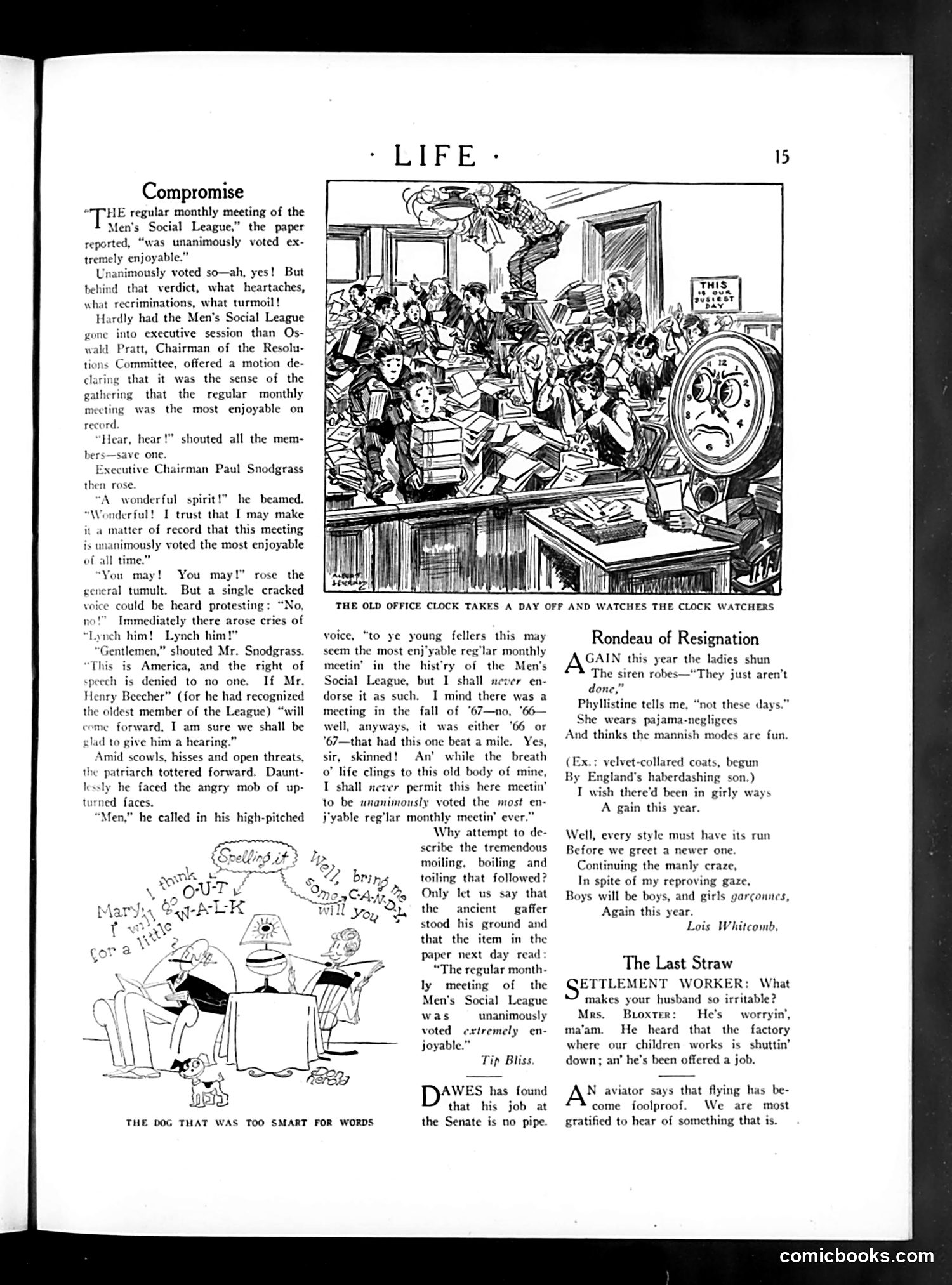
This satirical piece mocks the Men's Social League's monthly meeting, which voted their gatherings "unanimously extremely enjoyable." The text reveals the irony: the meeting actually descended into chaos and conflict, contradicting the official verdict. The large illustration shows the chaotic scene—men arguing, fighting, and generally disrupting the meeting while an old office clock watches from the wall (personified as a disapproving observer). Executive Chairman Paul Snodgrass attempts to restore order and make the discord "a matter of record." The joke satirizes institutional hypocrisy: organizations issuing glowing official statements about their proceedings while actual events reveal discord and compromise between members' true feelings and public pronouncements. The anthropomorphized clock serves as a silent, judgmental witness to the gap between rhetoric and reality.
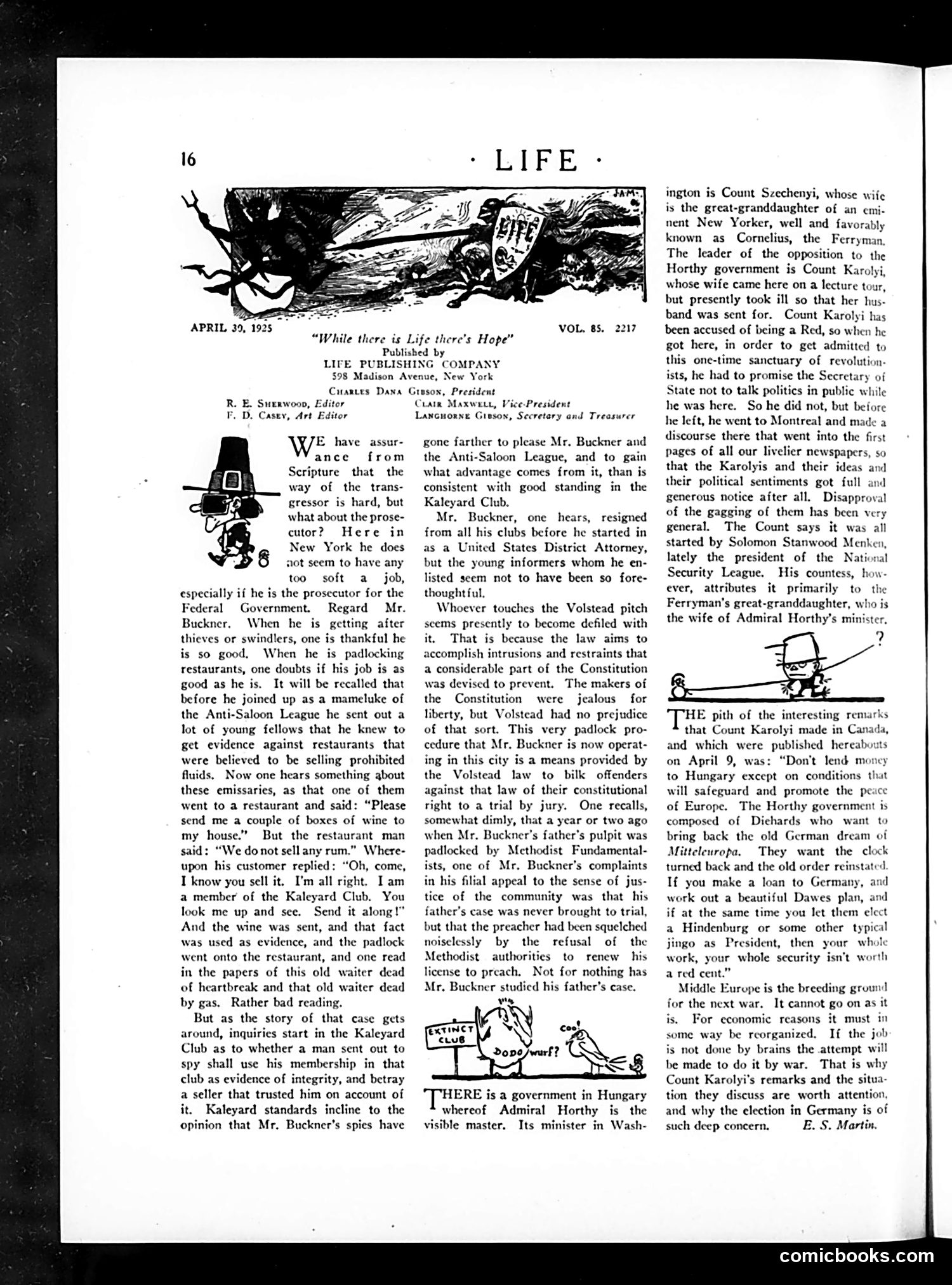
This page satirizes **Henry Buckner**, U.S. District Attorney for New York, who aggressively enforces Prohibition. The article criticizes his undercover agents' tactics—specifically, agents posing as club members to entrap restaurant owners into illegally selling alcohol, then using that membership as "evidence of integrity." The satire's key point: Buckner's methods violate the ethical standards of the Kaleyard Club (a real social organization) by weaponizing trust and membership. The author notes the ironic hypocrisy: Buckner complained years earlier when his *father's* Methodist church was padlocked without trial—yet now uses the Volstead Act to bypass jury trials against alcohol sellers. The piece argues Prohibition enforcement inherently corrupts constitutional protections and civic integrity. A secondary item discusses Hungarian politics and Count Karolyi's opposition to Admiral Horthy's government.
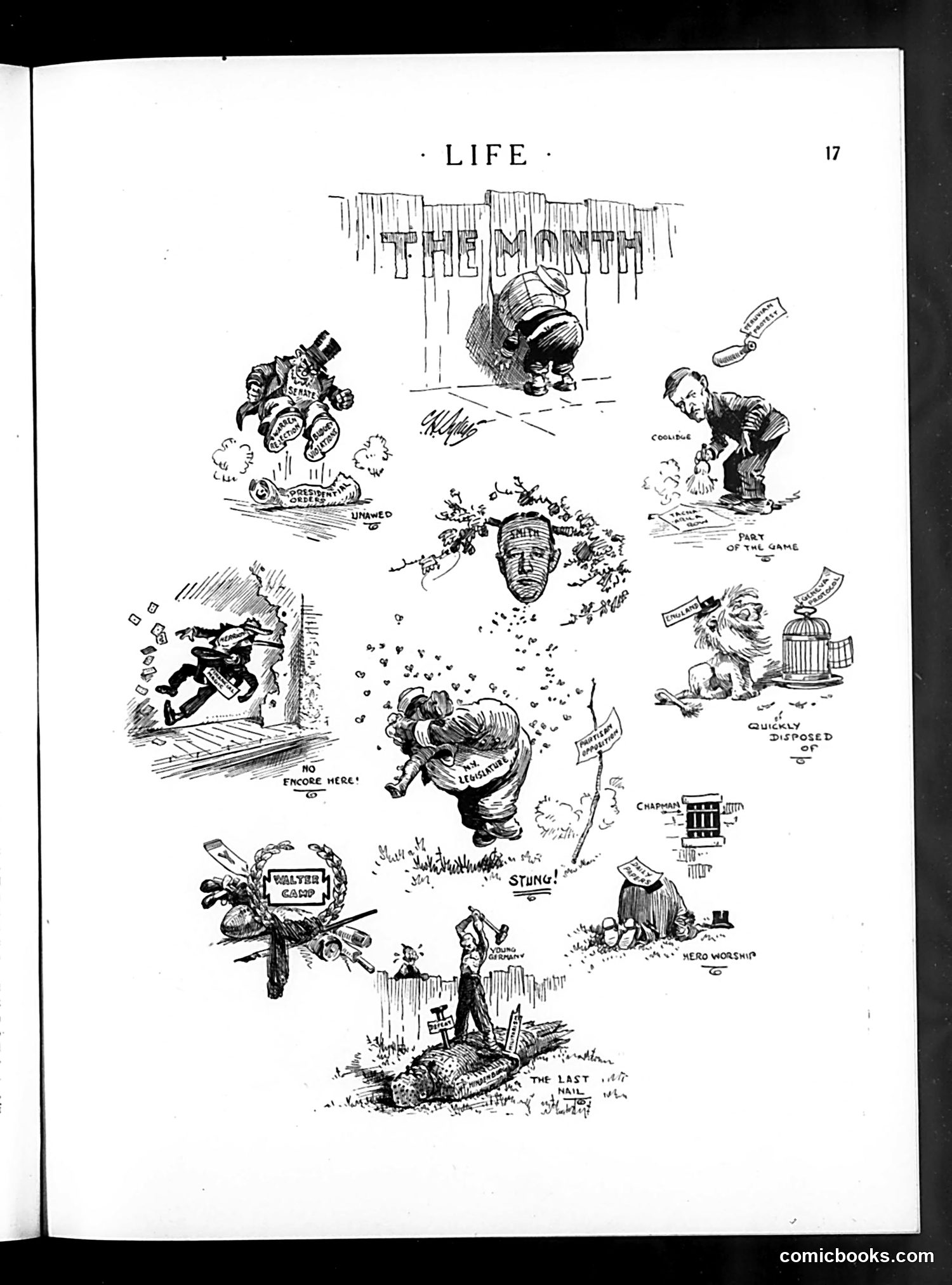
This is a satirical cartoon map of what appears to be Ireland or Britain, with various labeled incidents scattered across the territory. Each vignette depicts social or political troubles: "No Encore Here," "Stung!," "Part of the Game," "Quickly Disposed Of," and "Hero Worship" among others. The central label "The Month" suggests this summarizes major events or controversies during a specific month. The cartoon employs dark humor to comment on political unrest, labor disputes, or social disorder occurring throughout the country. Without the magazine's date visible, the specific events remain unclear, but the scattered chaos imagery implies systemic instability being treated satirically by Life magazine's editors as inevitable or absurdly commonplace.
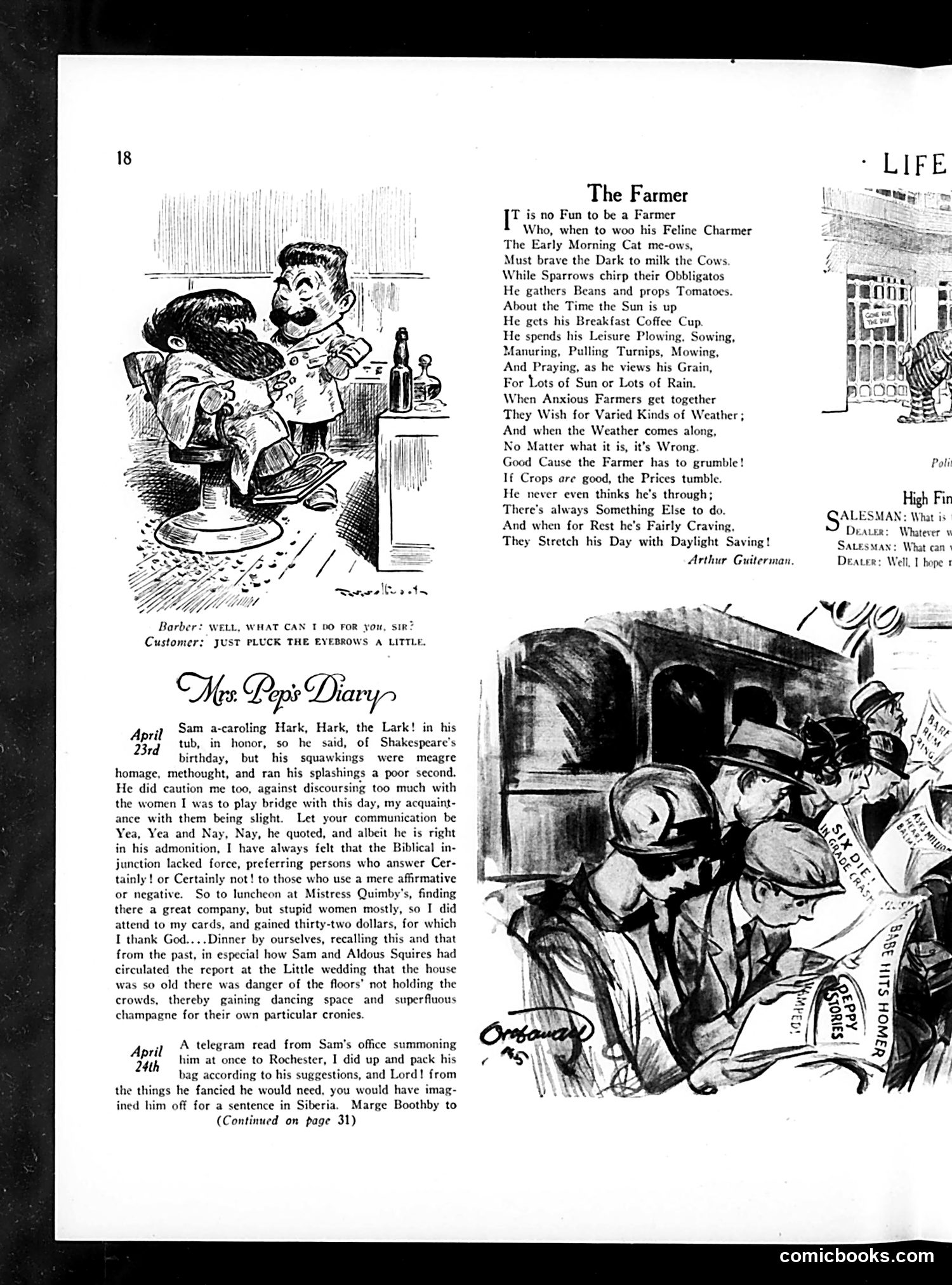
This *Life* magazine page contains three separate pieces of period humor: **"The Farmer" (poem by Arthur Guiterman):** A humorous complaint about agricultural life—the farmer faces constant demands (early milking, crop maintenance, unpredictable weather) yet can never win. If crops succeed, prices fall; if they fail, he still loses. The final joke references "Daylight Saving" (then controversial), which extended his workday artificially. This satirizes farmers' perpetual struggles and the public perception of them as perpetually aggrieved. **Barber cartoon:** A simple visual gag—a customer requesting eyebrow plucking, a beauty treatment then considered somewhat vain or unusual for men, suggesting either affectation or an awkward grooming request. **"Mrs. Peps's Diary":** A society column satirizing upper-class domestic life, featuring trivial social observations (bridge games, dinner parties, wedding gossip) written in affected, verbose language. The humor mocks the pretentiousness and pettiness of this social circle. All three reflect *Life*'s satirical focus on American manners and social class circa the 1910s-20s.
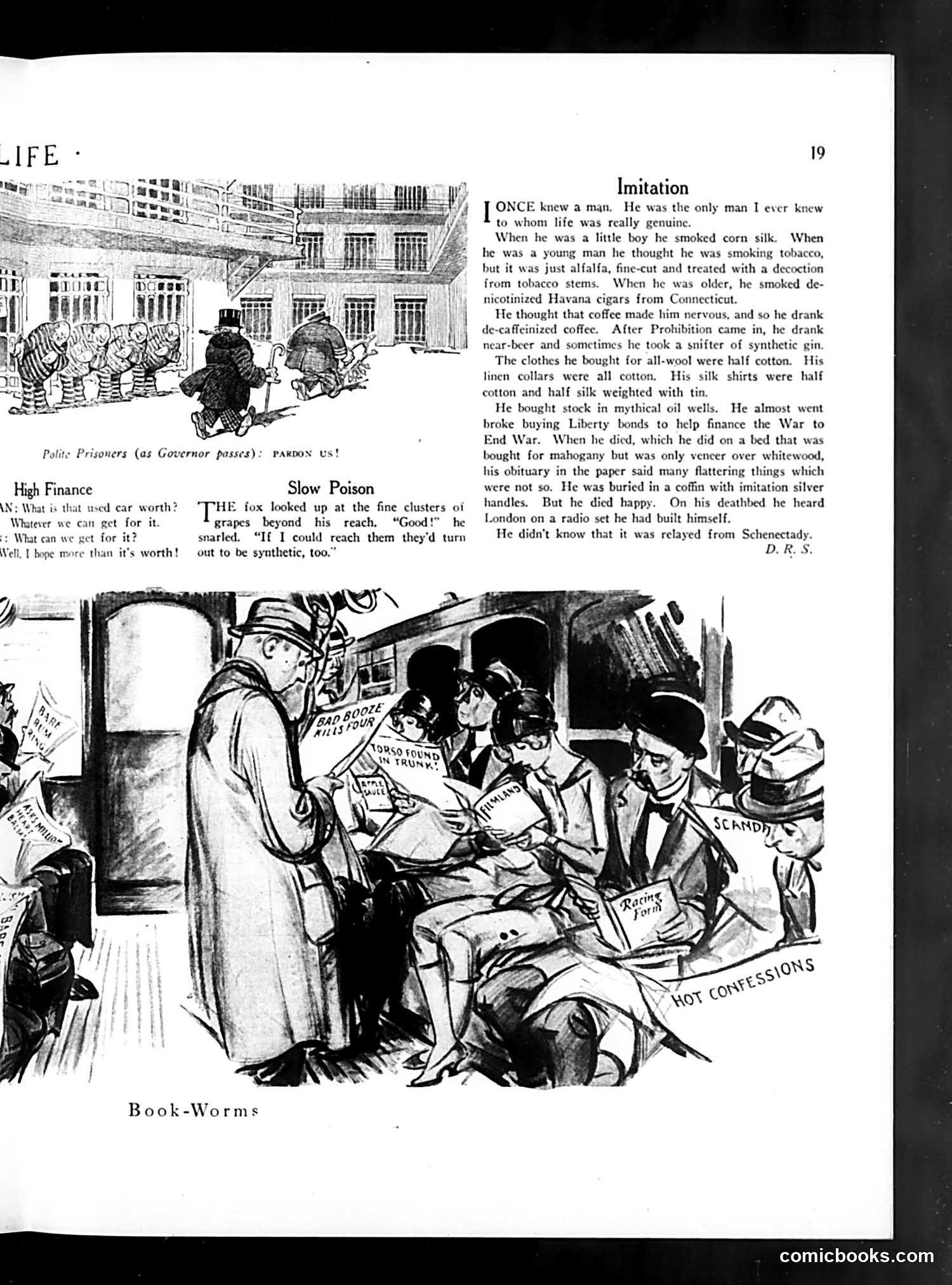
This page contains three separate satirical pieces critiquing 1920s American consumer culture and dishonesty: **"High Finance"**: A joke about used car fraud—dealers inflating worthless vehicles' value, with the punchline that hoped-for profit exceeds actual worth. **"Slow Poison"**: A fox unable to reach grapes dismisses them as synthetic—reversing Aesop's fable. The satire targets consumer skepticism about mass-produced goods. **"Imitation"** (main story): Chronicles a man whose entire life involved fake/adulterated products—synthetic gin, decaffeinated coffee, counterfeit materials, and stock schemes—yet he died "happy." The bitter irony: even his triumphant final moment (hearing London on radio) was relayed from elsewhere without his knowledge. **"Book-Worms"** (cartoon): Prisoners appeal to a passing governor for pardons, labeled with scandal headlines ("Bad Booze," "Graft," "Hot Confessions")—satirizing corruption and the era's crime/scandal obsession. Together, these pieces mock widespread consumer fraud, synthetic substitutes, and societal dishonesty during the post-WWI era.
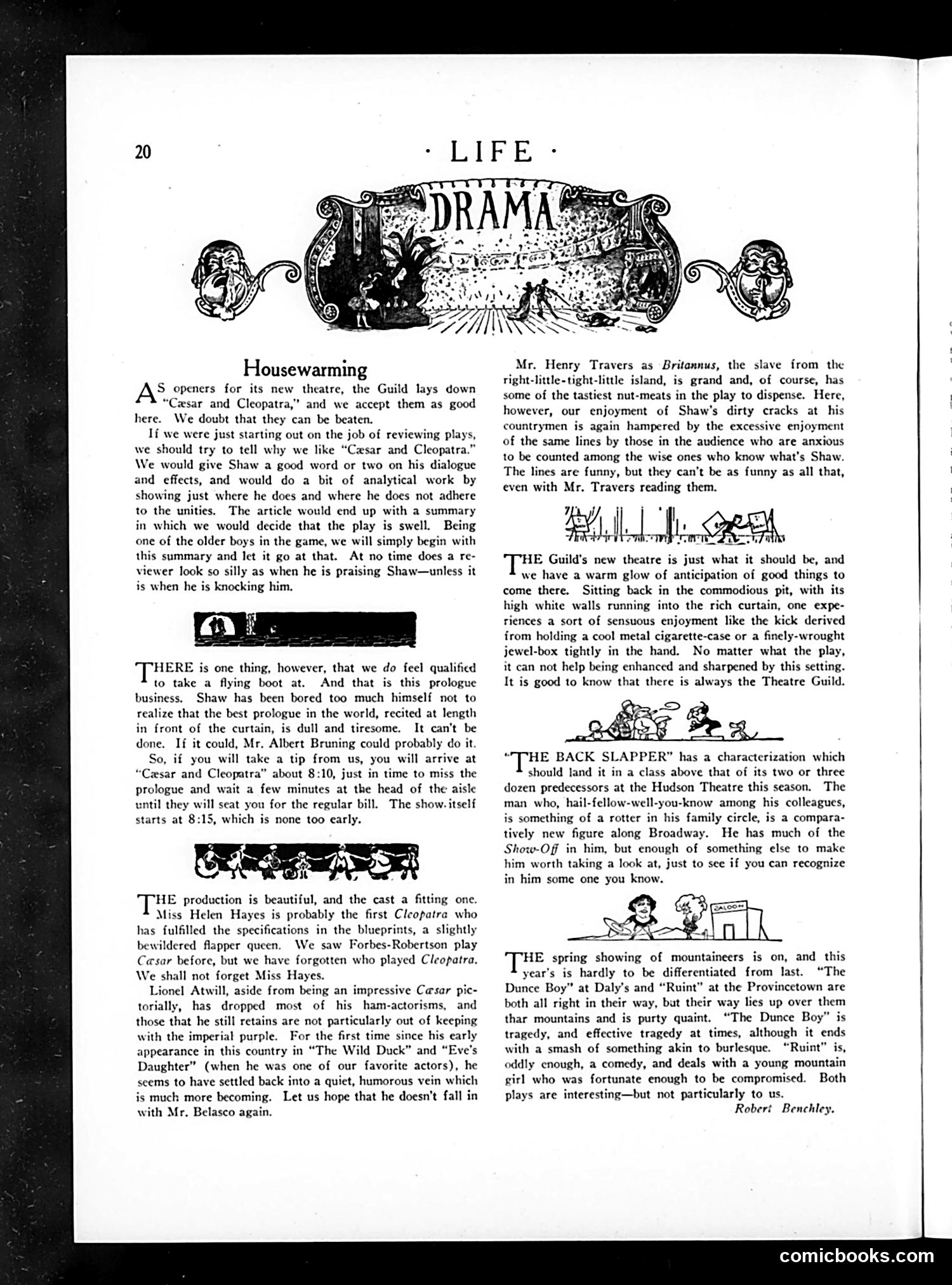
This page reviews the Theatre Guild's production of Shaw's "Caesar and Cleopatra," starring Helen Hayes and Lionel Atwill. The critic praises the play and production design but mocks Shaw's prologue as tediously dull—advising readers to arrive late to skip it. The review offers specific performance assessments: Hayes is praised as the first Cleopatra matching the script's specifications (a "bewildered flapper queen"), while Atwill is commended for restraint in his imperial role. Henry Travers, as the British slave Britannus, delivers Shaw's satirical jabs at the British character—though the critic notes audiences laugh too hard at these jokes, suggesting they're performing their own sophistication. The critic also celebrates the Theatre Guild's new venue itself as an elegant space enhancing any production. A brief mention of "The Back Slapper" at the Hudson Theatre appears at page's end. The overall tone is insider theatrical commentary for an educated readership familiar with contemporary stage productions.
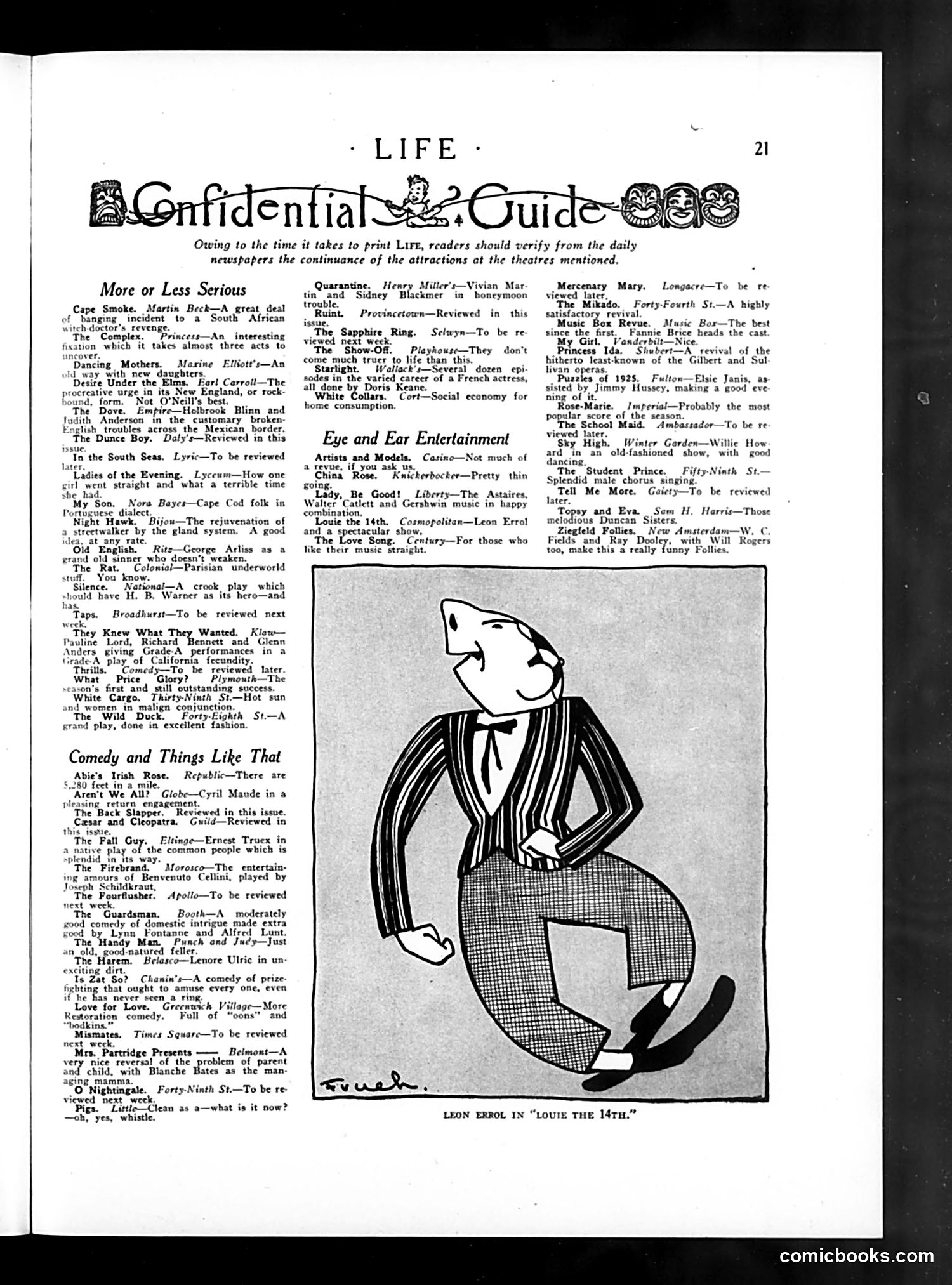
This page from *Life* magazine is a theater review section titled "Confidential Guide," listing Broadway shows of the era (appears to be mid-1920s based on references and style). The cartoon shows **Leon Errol in "Louie the 14th,"** depicted as a rotund, cartoonishly exaggerated figure in period costume. Errol was a popular vaudeville and silent-film comedian known for physical comedy and drunk-act routines. The caricature emphasizes his heavyset build and comedic persona. The reviews themselves use sharp, witty one-liners to describe shows—mixing genuine critique with satirical jabs. For example, "What Price Glory?" is called "the season's first and still outstanding success," while *White Cargo* is dismissed as "Hot sun and women in malign conjunction." The *Life* editors assume readers knew these performers and shows intimately. The humor relies on insider theater knowledge and the magazine's signature irreverent tone toward popular entertainment.
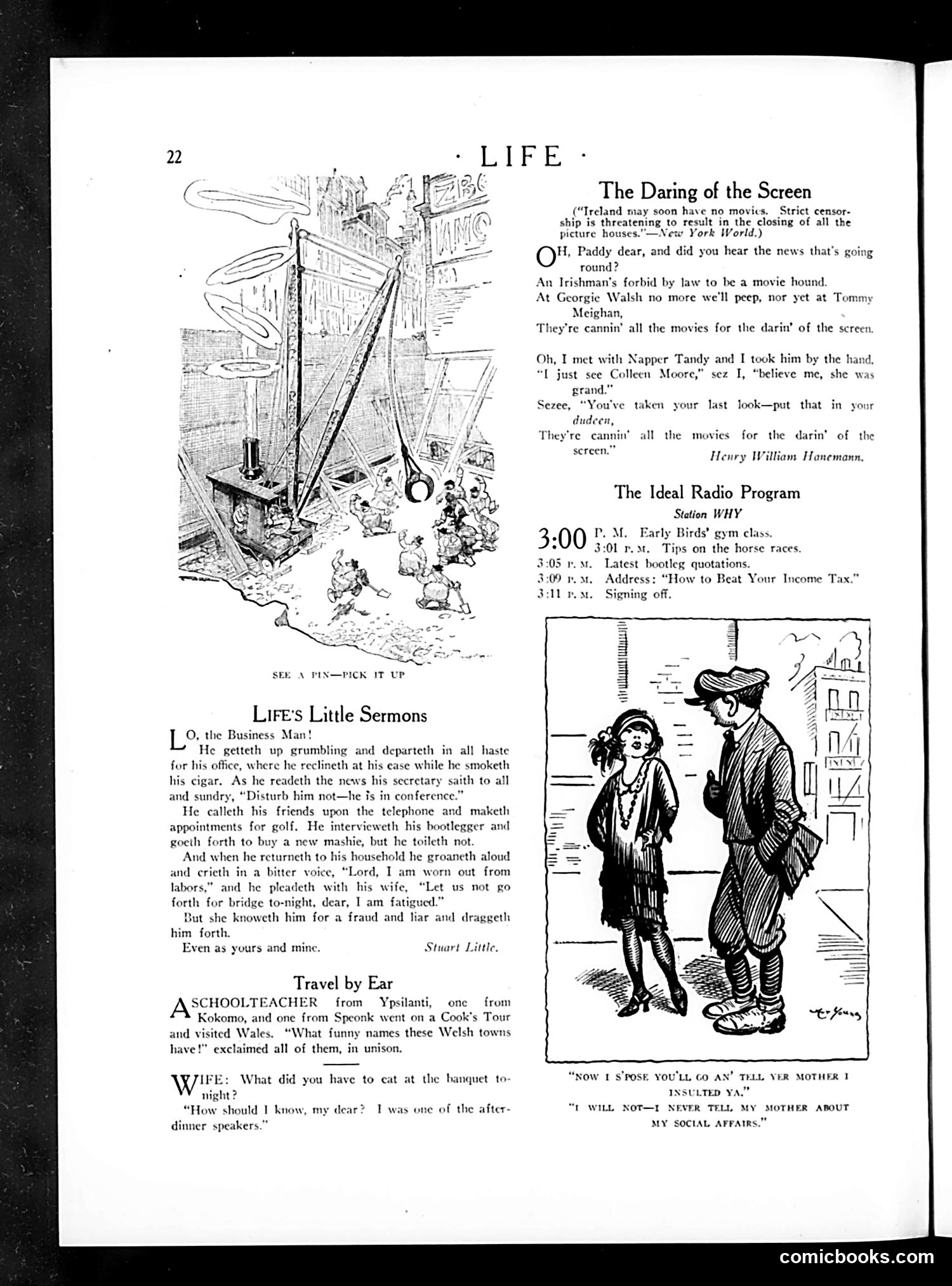
This page satirizes Irish-American concerns about film censorship. The poem parodies Irish folk songs, using dialect humor to depict an Irishman lamenting strict censorship laws that would close movie theaters and ban viewing popular silent film stars like Colleen Moore, George Walsh, and Tommy Meighan. The satire targets both censorship overreach and Irish-American cultural stereotypes. The "Ideal Radio Program" satirizes Prohibition-era corruption, listing a radio station's schedule that openly includes "bootleg quotations" and tax evasion advice—mocking how brazenly illegal activities were conducted during the 1920s. The cartoon below depicts a woman confronting a man about insulting her, with his assurance that she won't tell her mother about their "social affairs"—likely satirizing flapper-era dating and changing courtship norms that alarmed older generations.
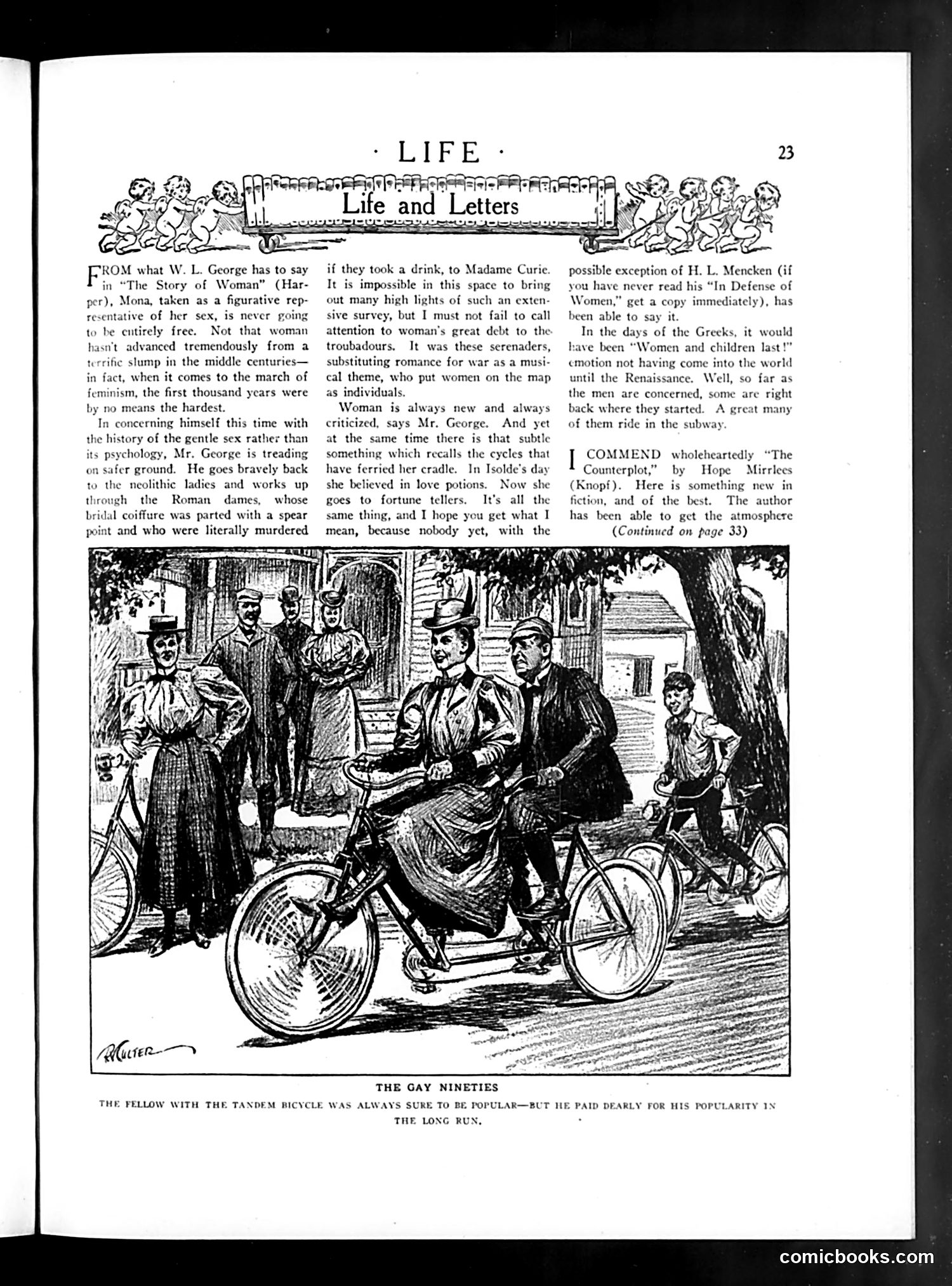
This illustration satirizes 1890s social dynamics through the figure of a man riding a tandem bicycle with a woman. The caption explains the joke: he's "always sure to be popular" because tandem bicycles required close physical proximity and cooperation between riders—making them a socially acceptable way for unmarried couples to interact. However, the satire is that he "paid dearly for his popularity in the long run." The cartoon likely mocks how men of that era traded personal comfort and effort (the physical exertion of pedaling a heavy tandem) for romantic opportunity and social approval. The onlookers suggest this was a notable spectacle. The illustration reflects the "Gay Nineties'" fascination with bicycles as symbols of modernity and courtship, while poking fun at the social performances and physical demands men endured to be desirable partners. The tandem bicycle serves as both literal vehicle and metaphor for romantic compromise.
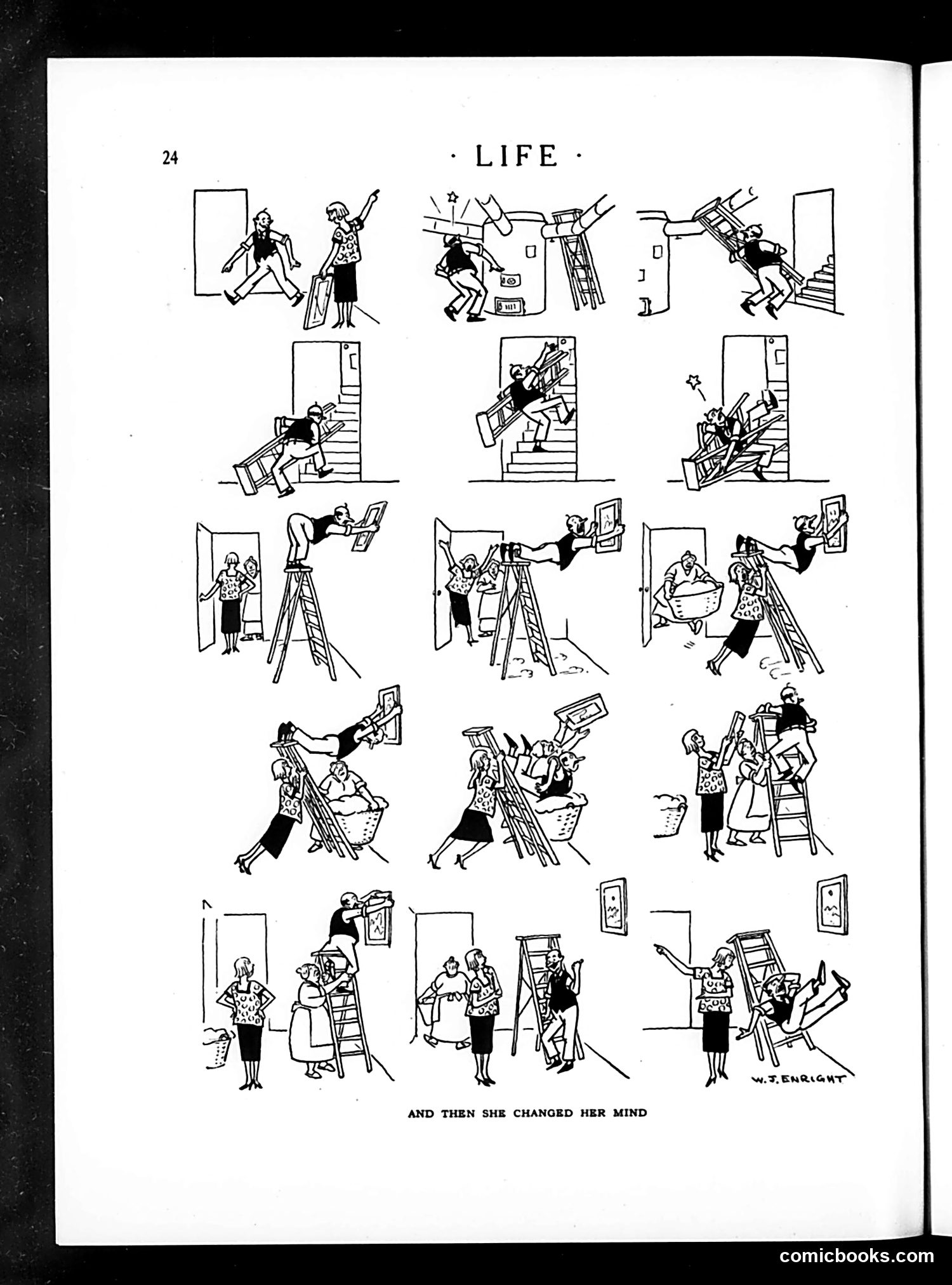
This is a humorous sequential comic strip about home renovation indecision. The panels show a woman directing workers through various painting and decorating projects—positioning ladders, applying paint, hanging pictures, and moving furniture. Each panel depicts a different plan or change in approach. The title's punchline suggests the woman repeatedly changes her mind about how to decorate or renovate her home, causing the workers to constantly adjust their efforts. This satirizes a common domestic stereotype: the indecisive homeowner (typically portrayed as female in this era) who keeps altering renovation plans, frustrating workers trying to complete the job. The cartoon mocks both the woman's changeability and, implicitly, the chaos of home improvement projects. It's signed by W.T. Enright, a Life magazine cartoonist.
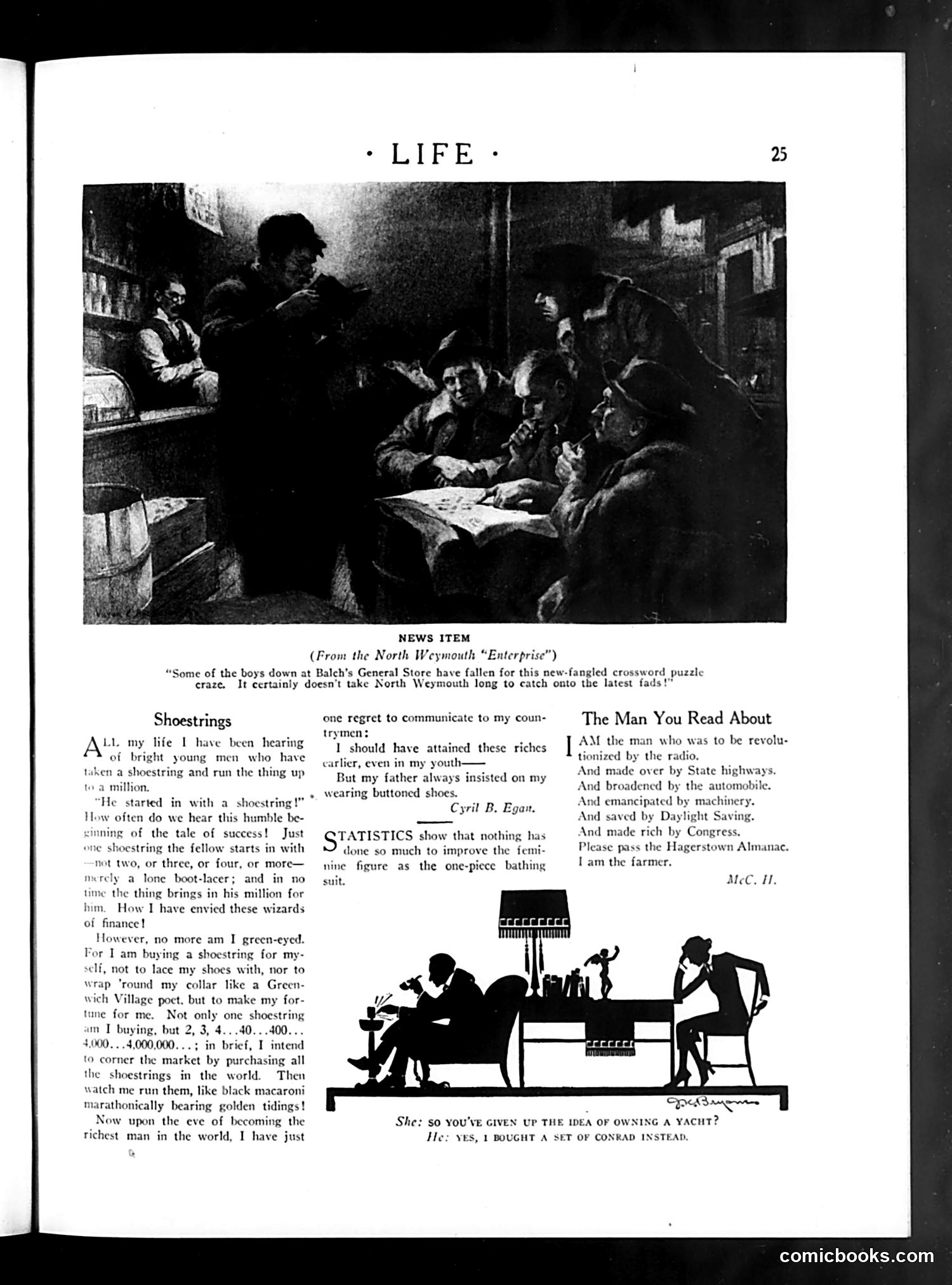
This page contains satirical commentary on American consumer culture and self-improvement crazes circa the 1920s-30s. **"Shoestrings"** mocks the bootstraps mythology—the idea that fortunes are built from nothing. The author sardonically announces he'll corner the global shoestring market, treating a mundane commodity as a get-rich-quick scheme. The joke satirizes both naive get-rich-quick thinking and the absurdity of taking business advice literally. **"The Man You Read About"** parodies Americans who believe technology will transform their lives. The farmer lists supposed modern improvements (radio, highways, automobiles, machinery, daylight saving, government aid) yet asks for an almanac—implying these promises delivered nothing practical. **The cartoon** shows a couple where the man abandons yacht-ownership for Joseph Conrad novels instead. It satirizes middle-class aspiration: unable to afford luxury, he substitutes with intellectual pretension, suggesting that reading about adventure replaces actually living it. All three pieces mock consumer culture, technological utopianism, and false promises of social advancement—common Life magazine themes.
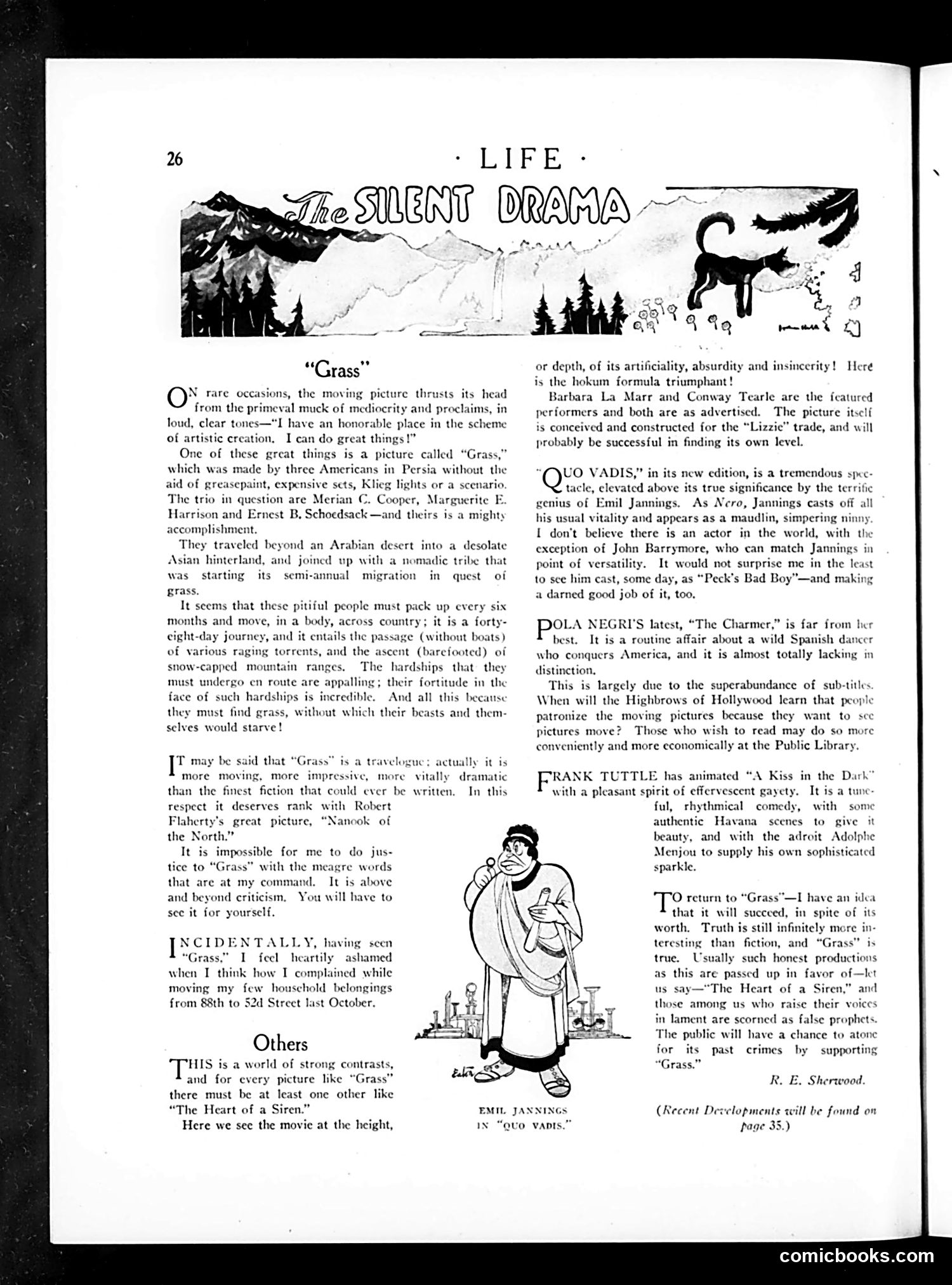
This page reviews several 1920s silent films. The central satire contrasts "Grass"—praised as genuine artistic cinema—against inferior Hollywood productions. **"Grass"** is celebrated as a documentary travelogue following nomadic Persian tribes on a 48-day migration seeking pasture. Reviewers emphasize its authenticity: filmed on location without studio artifice, expensive sets, or scenarios. It's favorably compared to "Nanook of the North." By contrast, the page ridicules formulaic entertainment films like "The Heart of a Siren" and "Quo Vadis," dismissed as hokum designed for working-class audiences (the "Lizzie trade"). Emil Jannings receives backhanded praise for playing Nero as a "simpering ninny" rather than heroically. The satirical point: authentic, documentary-style filmmaking represents cinema's artistic potential, while conventional Hollywood melodrama represents its commercial degradation. The page's tone mocks both the lowbrow audience and producers' cynical calculations, positioning "Grass" as proof that cinema could achieve genuine artistic merit.
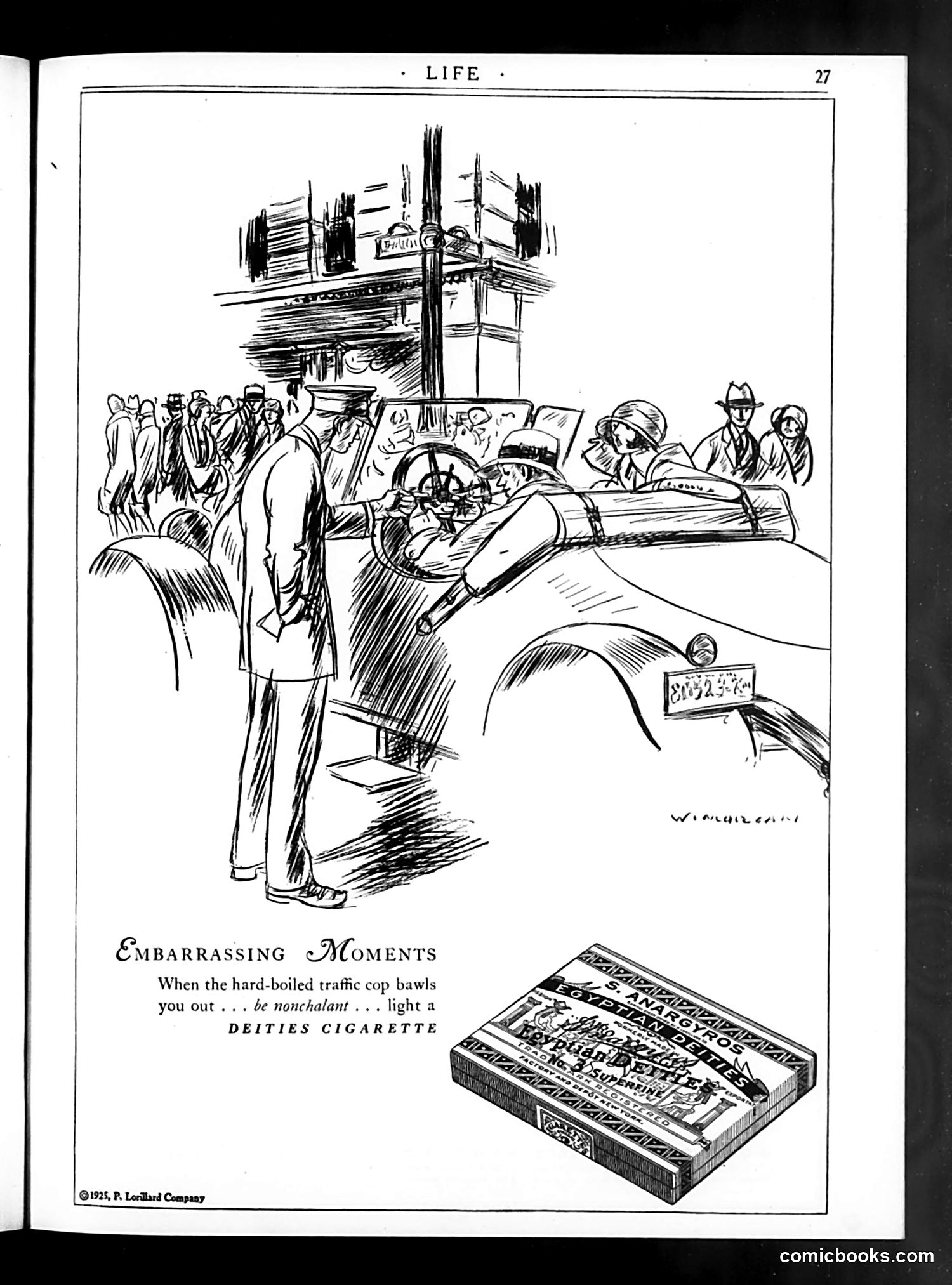
This is a 1925 cigarette advertisement disguised as humorous social commentary. The cartoon depicts a traffic cop scolding a motorist in front of onlookers and a street sign. The advertiser's suggestion: when publicly embarrassed or scolded—maintain composure by smoking a Deities cigarette, projecting nonchalance. The humor targets the specific anxiety of being "bawled out" by an authority figure (a traffic cop) in public view. The advertisement exploits this embarrassment to market cigarettes as a confidence-restoring tool—a way to appear cool and unaffected during social humiliation. This represents vintage advertising that weaponized social anxieties to drive product sales, before modern advertising regulation. The 1925 date places this during Prohibition and the Jazz Age's cultural shifts.
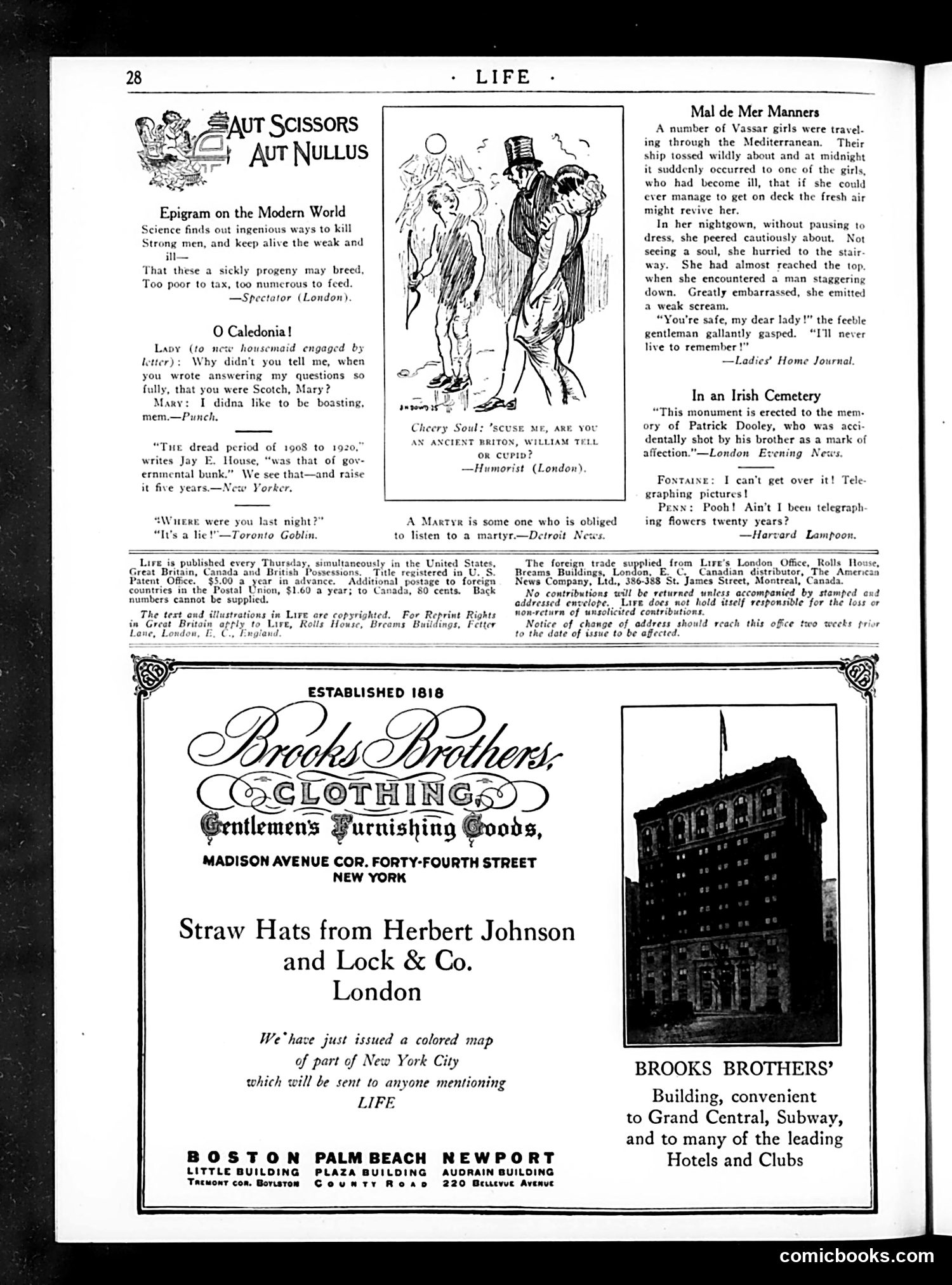
This page contains several brief satirical jokes rather than a single cartoon: **"O Caledonia!"** mocks Scottish frugality: a housemaid, when asked why she didn't mention her nationality in her job application letter, responds she didn't want to seem like she was "boasting"—the joke being that Scots have a reputation for stinginess. **"In an Irish Cemetery"** plays on Irish violence stereotypes, describing a monument to a man "accidentally shot by his brother as a mark of affection"—dark humor implying Irish people casually shoot each other. **"Cheery Soul"** depicts someone asking if another person is "an ancient Briton, William Tell, or Cupid"—unclear reference, possibly visual wordplay about the person's appearance. The page also includes period advertisements for Brooks Brothers clothing and straw hats, plus publication information for Life magazine. The jokes reflect early-20th-century ethnic and national stereotyping common to the era's humor.
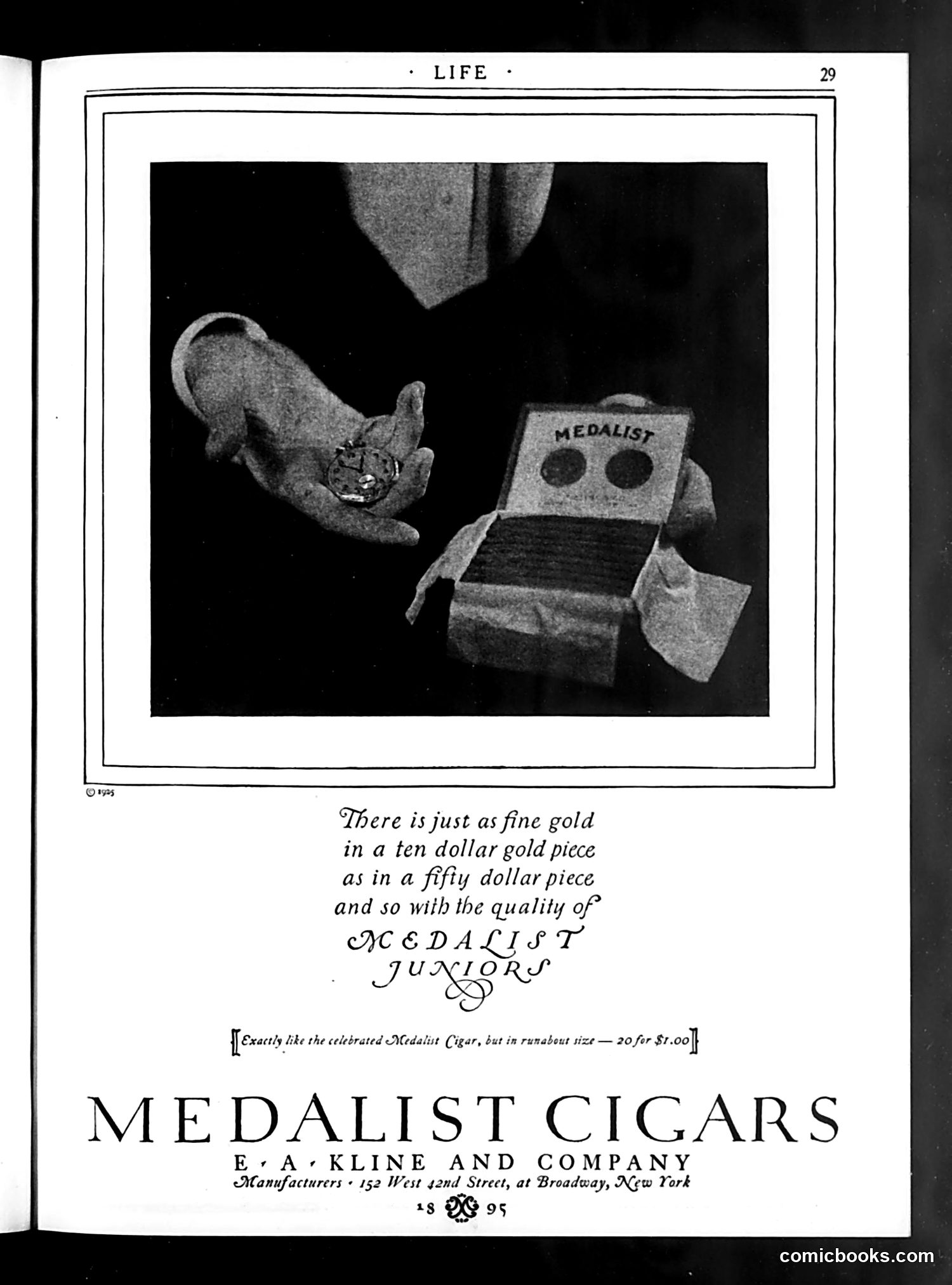
This is primarily a **cigar advertisement**, not political satire. The page shows a hand holding a medal or coin next to an open box labeled "MEDALIST." The copywriting uses an economic argument to appeal to value-conscious consumers: just as a ten-dollar gold coin contains the same fine gold as a fifty-dollar piece, Medalist Junior cigars offer equivalent quality to more expensive varieties, but in smaller ("runabout") size at lower cost (20 for $1.00). The image demonstrates the product's packaging and size relative to actual coins—a visual sales tactic emphasizing affordability without sacrificing quality. The "medalist" branding likely references medal awards, suggesting the cigars had won competitions or recognition. This reflects late-19th-century consumer marketing strategy targeting middle-class buyers seeking luxury goods at accessible prices.
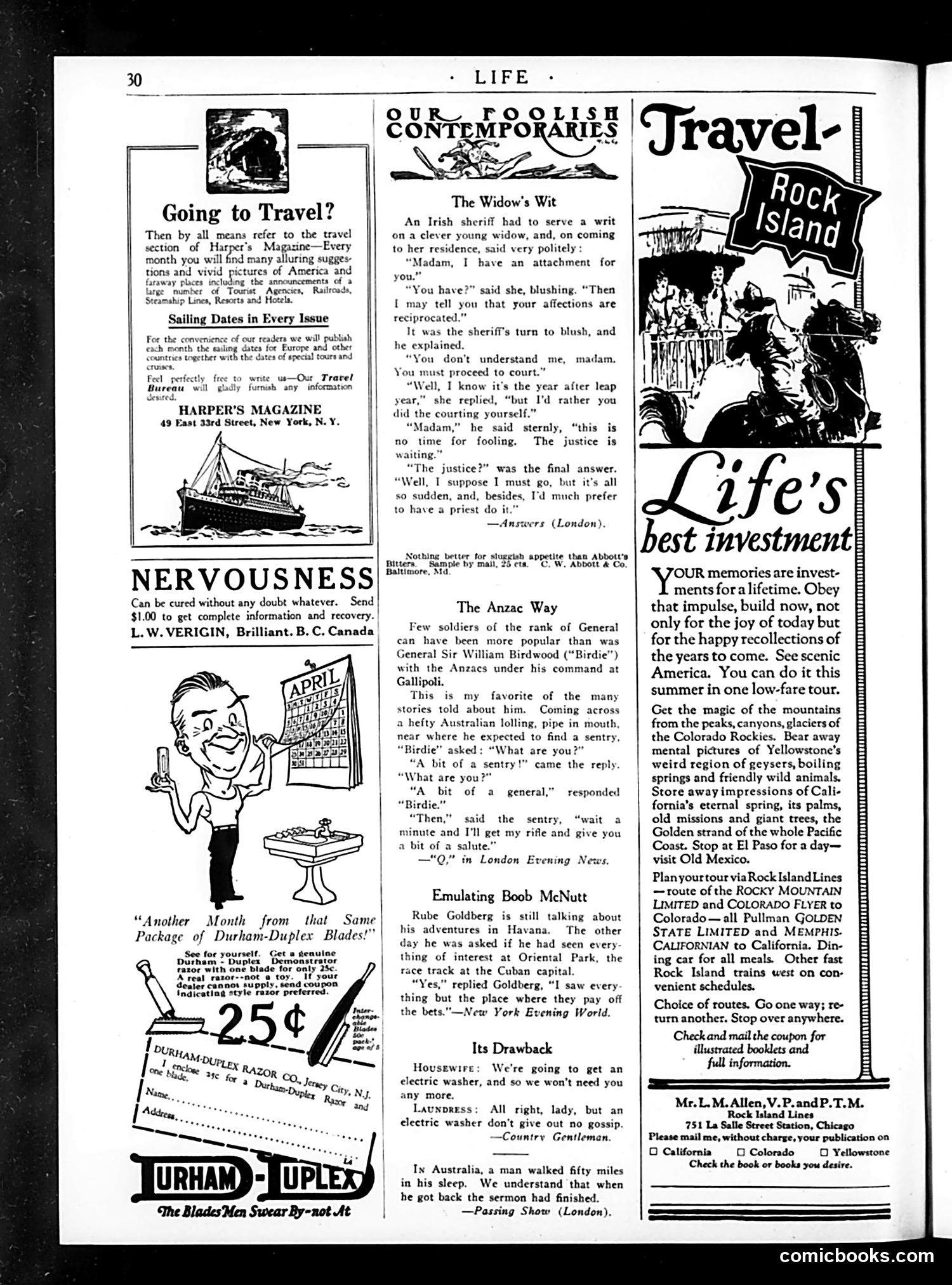
This page from *Life* magazine (undated but appears early 20th century based on style) contains several short humor pieces and advertisements typical of the publication. The main satirical content includes: **"The Widow's Wit"**: A play on words where an Irish widow misinterprets a sheriff's mention of having "an attachment" (legal paperwork) as romantic interest, leading to flirtatious wordplay about courtship and marriage. **"The Anzac Way"**: An anecdote about Australian soldiers under General Birdwood at Gallipoli, poking gentle fun at the soldiers' casual irreverence toward military hierarchy. **Other brief jokes** mock domestic life (a housewife's laundress worried about job loss to electric washers) and make absurdist observations about Australian oddities. The page is primarily **advertising-driven**, featuring travel promotions, Durham-Duplex razors, and Abbott's Bitters alongside the humor content—typical of *Life*'s commercial model.
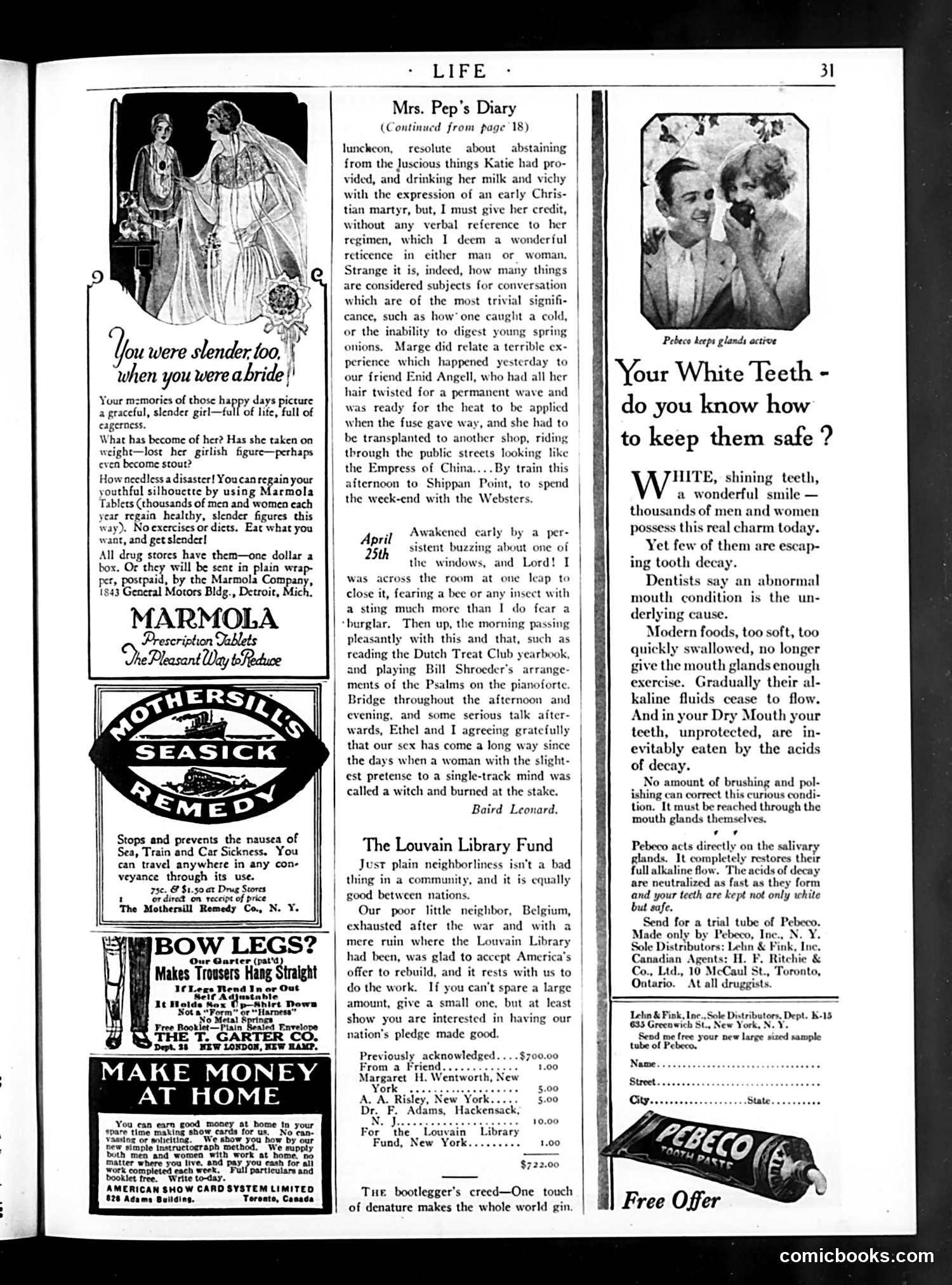
This page is primarily **advertising** with some editorial content. The main satirical element is the **Marmola weight-loss ad** featuring an illustrated couple. The ad's humor (now dated) plays on post-marital anxieties: a bride shown as "slender" and full of life, contrasted with an implied present-day version who has gained weight and lost her appeal. The caption "You were slender, too, when you were a bride" shames women for weight gain after marriage, suggesting their worth depends on maintaining youthful appearance for their husbands. Other ads target body insecurities (bow-legs corrector, seasickness remedy) typical of 1920s marketing. The page also includes Mrs. Pep's Diary (social commentary on women's lives) and a notice about rebuilding Belgium's Louvain Library after WWI destruction—representing American charitable goodwill toward Europe post-war. The overall content reflects 1920s attitudes: consumerism, anxieties about female bodies, and American cultural confidence following the war.
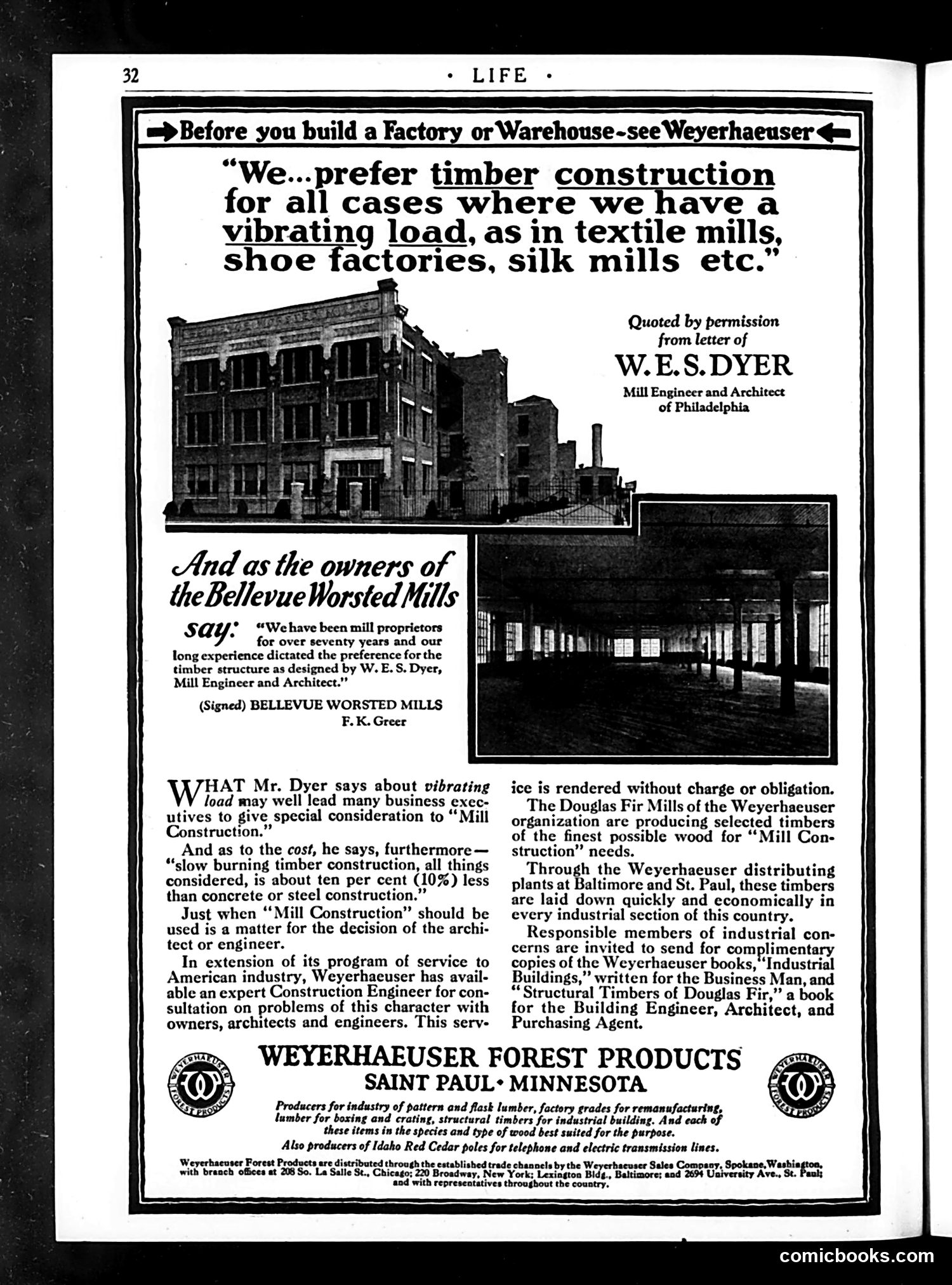
This is **not a cartoon or satire**, but rather a **full-page advertisement** for Weyerhaeuser Forest Products (circa early 20th century). The ad promotes timber construction for industrial buildings by featuring testimonials from respected figures: W.E.S. Dyer, a mill engineer and architect from Philadelphia, and the owners of Bellevue Worsted Mills. They endorse timber (rather than concrete or steel) for factories with "vibrating loads"—textile mills, shoe factories, and silk mills—claiming it costs roughly 10% less and handles mechanical stress better. The images show a substantial mill building and its interior timber-framed structure. Weyerhaeuser offers free expert consultation and their Douglas Fir lumber through regional distribution centers. **For modern readers:** This reflects early industrial-era marketing that emphasized timber's practical and economic advantages for manufacturing facilities before steel frame construction became dominant. The testimonials from industry professionals served as credibility markers, similar to modern celebrity endorsements.
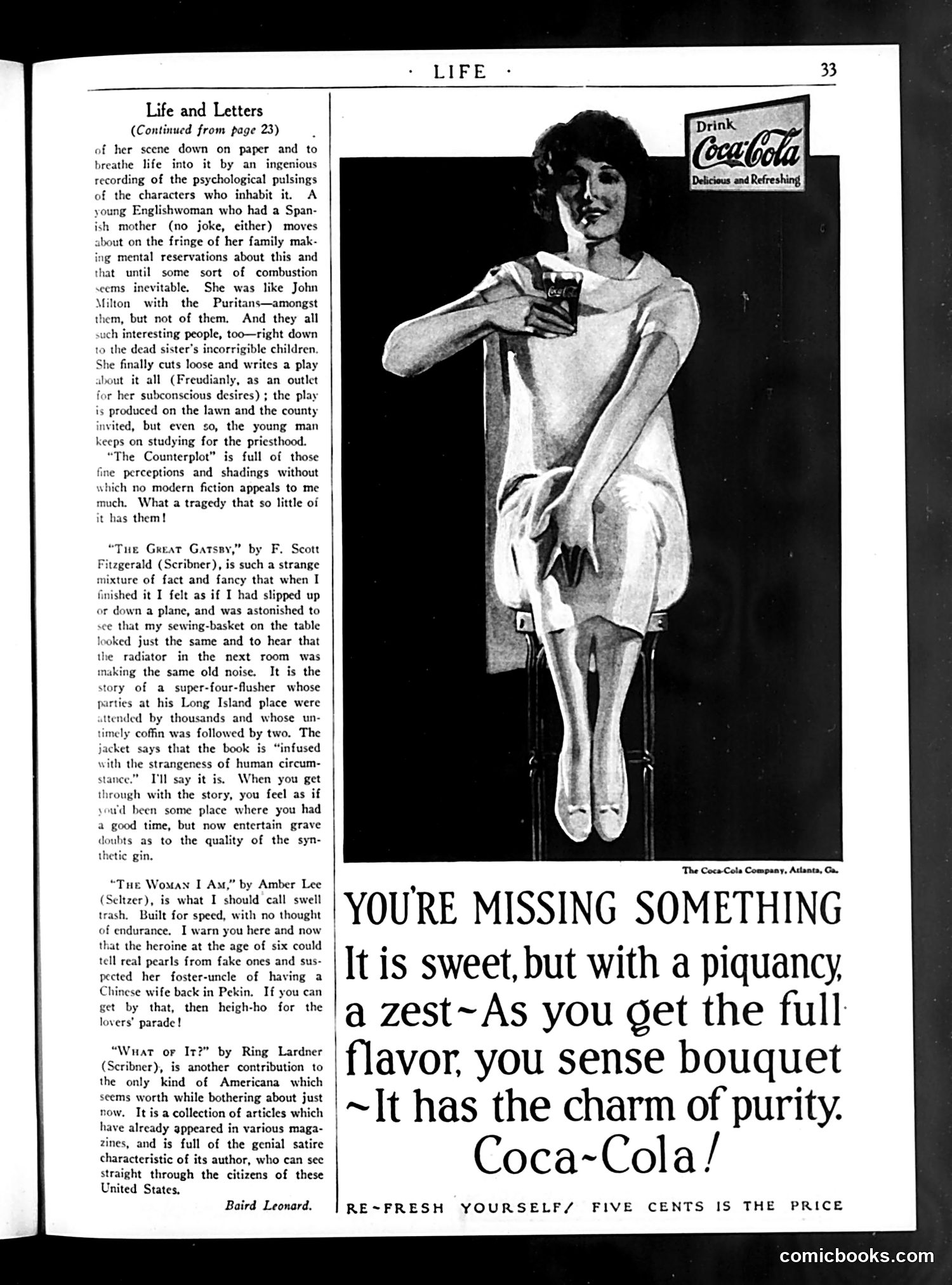
This page combines literary criticism with advertising. The left column reviews contemporary books by F. Scott Fitzgerald (*The Great Gatsby*), Ring Lardner, and others—discussing their literary merit and narrative techniques. The dominant content is a **Coca-Cola advertisement** (not satire or cartoon). It features a woman in a light dress holding a Coca-Cola bottle, with marketing copy emphasizing the drink's qualities: "sweet," "piquancy," "bouquet," and "charm of purity." The ad costs five cents. There is **no political cartoon** on this page. The advertisement's positioning alongside serious literary discussion creates an unintentional juxtaposition—pairing high culture (book reviews) with consumer product messaging. This reflects 1920s magazine practice where ads occupied prominent space regardless of editorial content. The phrase "YOU'RE MISSING SOMETHING" targets readers, suggesting Coca-Cola completion to their experience—a straightforward sales pitch rather than satire.
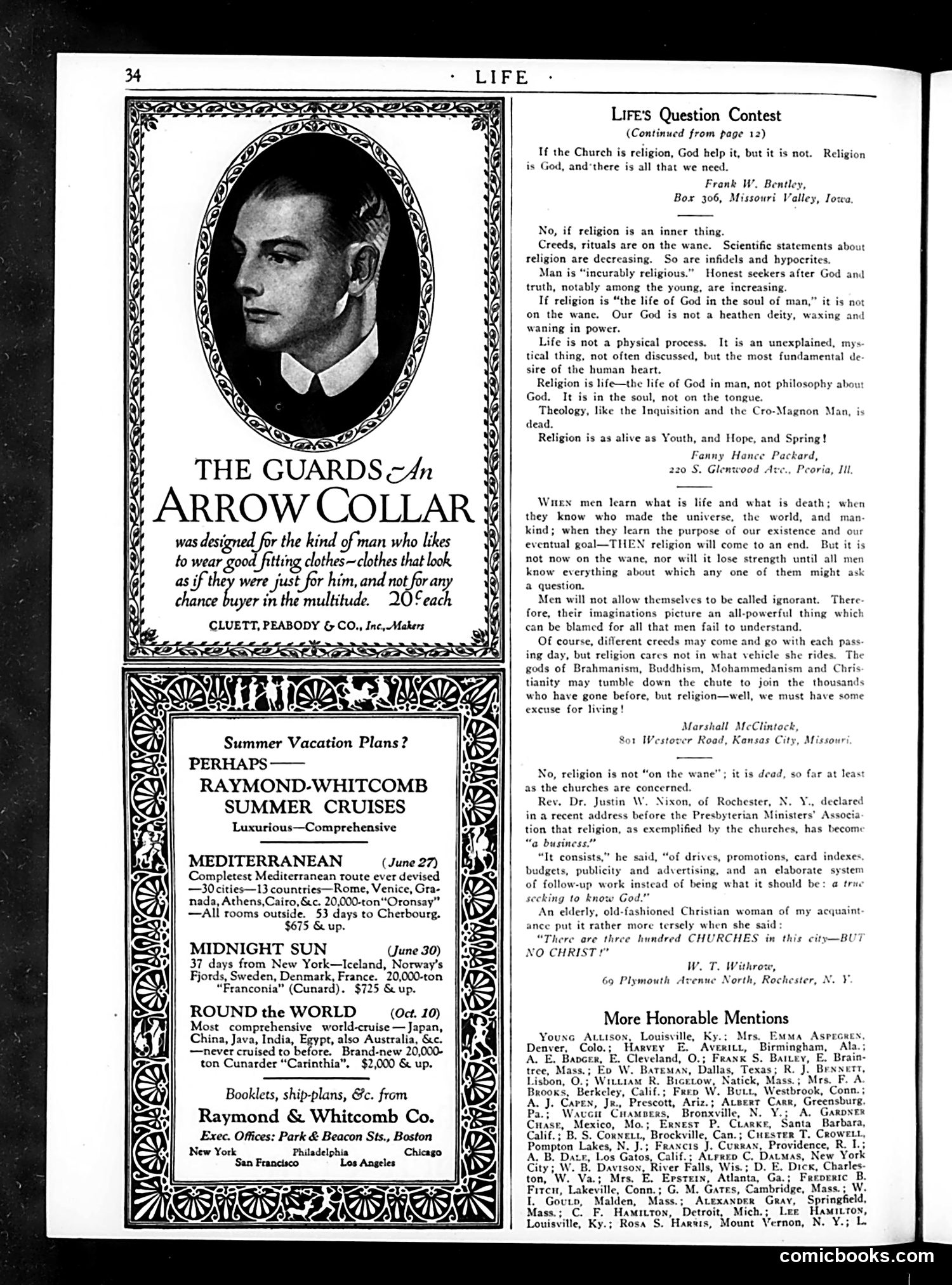
This page combines commercial advertising with editorial content on religion's relevance in modern society. **The Advertisement:** The top features an Arrow Collar ad using an attractive male portrait—typical early 20th-century marketing that associated quality clothing with masculine appeal and social status. **The Editorial Feature:** The bulk of the page presents "Life's Question Contest," a reader-response column debating whether religion is declining. Contributors argue both sides: some claim true religion (as spiritual experience) remains vital despite weakening organized churches; others contend institutional religion has become merely "business"—reduced to "drives, promotions, card indexes, budgets, publicity and advertising" rather than genuine faith. **The Satire/Point:** The contrast itself is satirical: Life juxtaposes consumerist advertising (selling identity through clothes) with philosophical debate about religion's commercialization. The inclusion of a clergyman's admission that churches function as businesses underscores the irony—organized religion mimics commercial promotion, making it indistinguishable from the advertising surrounding it on the page. **Context:** This reflects 1920s-era skepticism about institutional religion amid modernization and the rise of consumer culture.
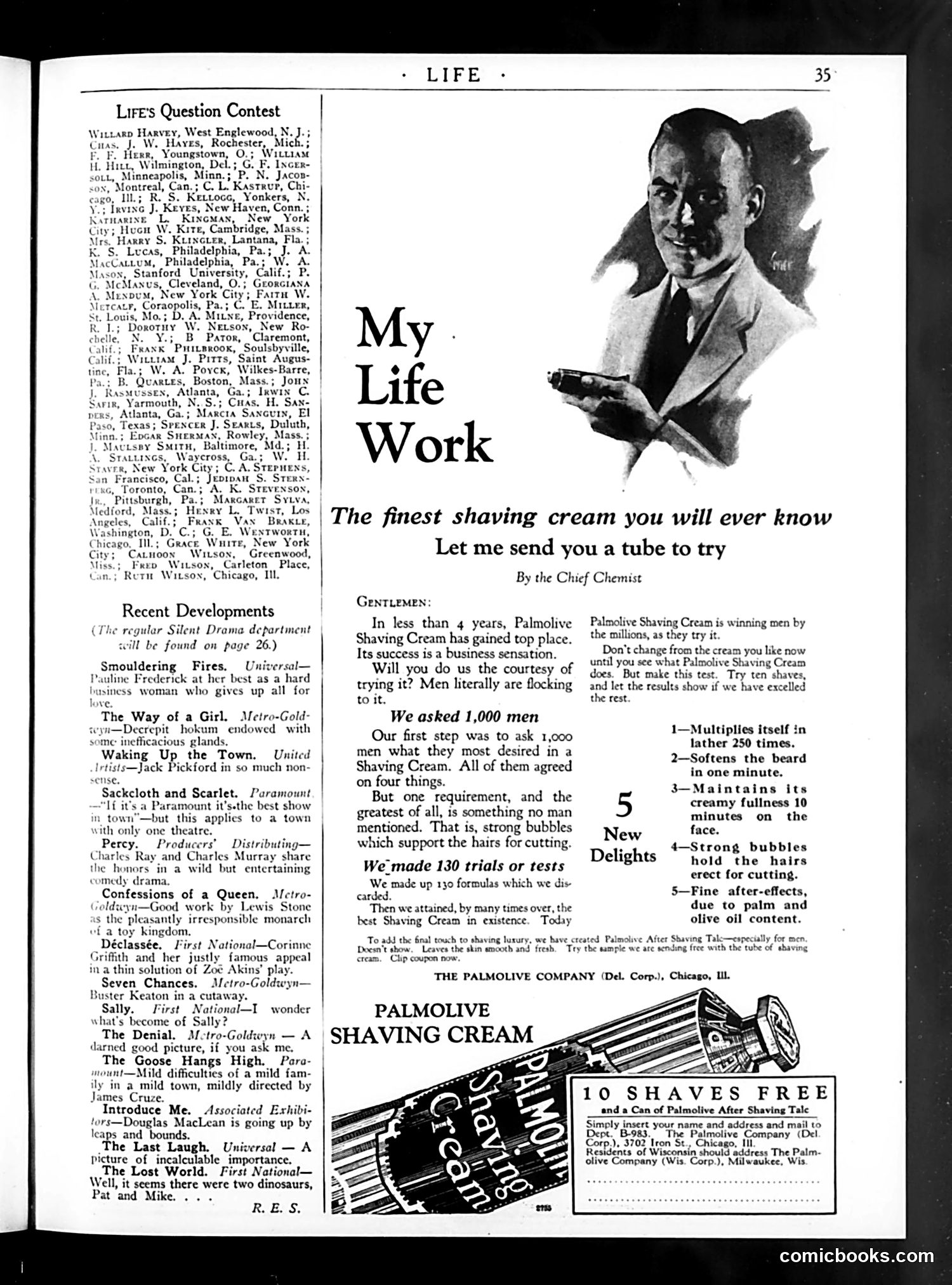
This page is **primarily advertising**, not satire or political commentary. The dominant content is a large Palmolive Shaving Cream advertisement featuring a portrait illustration of a man and promotional text from "the Chief Chemist." The advertisement employs marketing claims common to early 1920s product promotion: it cites market success ("gained top place in less than 4 years"), claims scientific rigor ("130 trials or tests"), and appeals to consumer testimonials ("asking 1,000 men"). The ad emphasizes five specific benefits, with particular stress on producing "strong bubbles" to support hair for cutting. The page also includes a **"Life's Question Contest"** listing winners' names and addresses, plus brief film reviews of silent movies (featuring stars like Buster Keaton and Charles Ray). These reviews are dismissive in tone—typical of Life's satirical style—but are incidental to the page's primary commercial purpose. No political figures or social satire appear on this page.
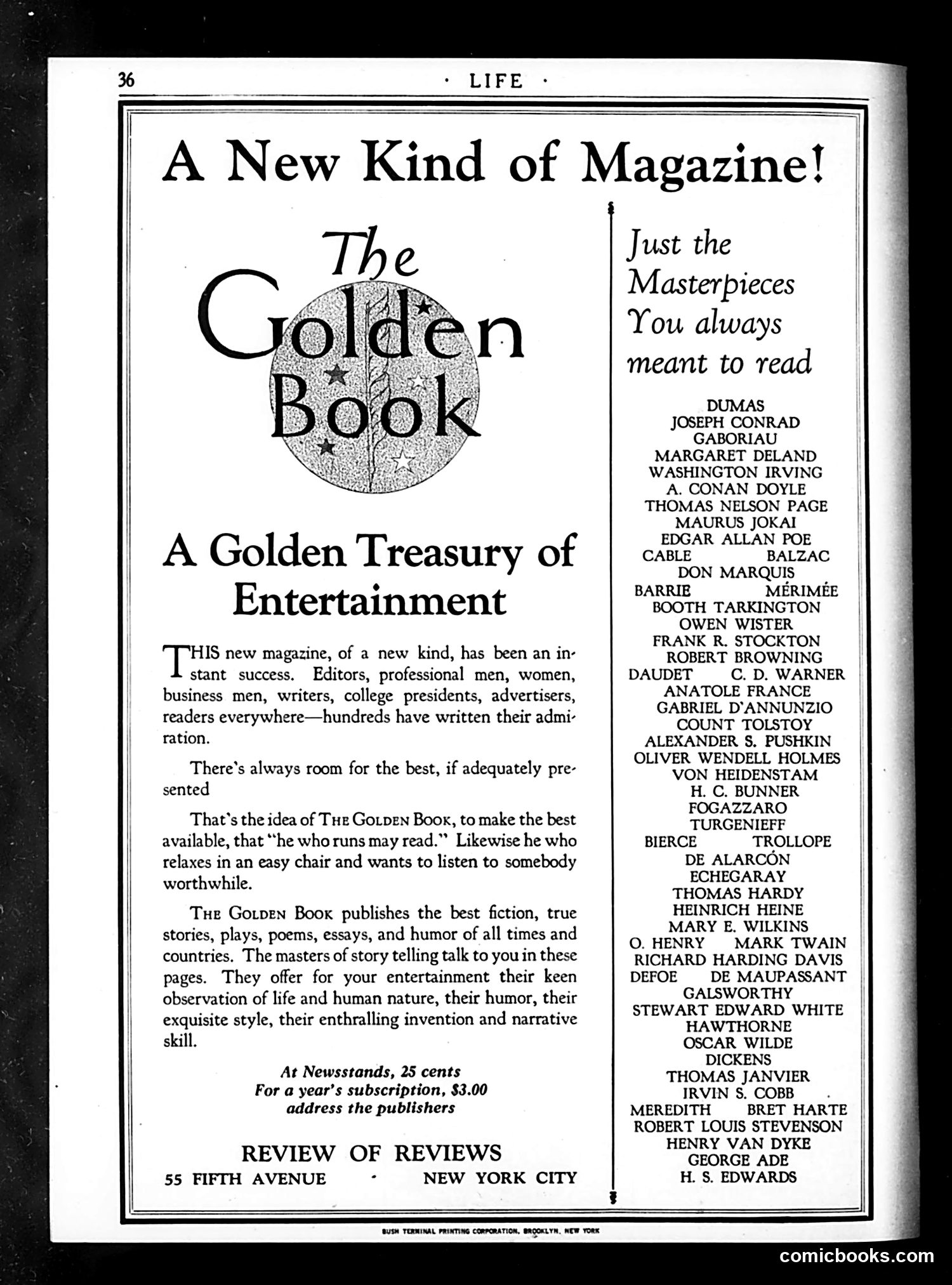
This is a full-page advertisement, not a cartoon. It promotes *The Golden Book*, described as "a new kind of magazine"—a literary digest offering classic fiction, essays, poems, and humor. The pitch appeals to busy, cultured readers: those who "run" and want quality without effort, or those relaxing who want "somebody worthwhile." The magazine promises "masterpieces you always meant to read." The right column lists prestigious authors—Dumas, Doyle, Twain, Hardy, Wilde, Dickens, Tolstoy, etc.—establishing credibility. At 25 cents per issue or $3 annually, it positioned itself as an accessible gateway to canonical literature for middle-class Americans. This reflects early-20th-century optimism about democratizing high culture through affordable magazines.

I can see this is a very dark, low-contrast black and white page from what appears to be a historical publication. While I can make out what seem to be two circular design elements or medallions in the lower portion of the image, and a white vertical strip on the left edge, the image is too dark and degraded for me to reliably identify specific figures, read any text clearly, or determine the content with confidence. To provide an accurate explanation of the satire, political references, or jokes intended for a modern reader, I would need a clearer, higher-contrast version of this page. I cannot responsibly guess at identities or meanings when the source material is this illegible.

I can see this is a mostly black page from Life magazine (as indicated by the "comicbooks.com" credit line), but the image is too dark and lacks sufficient contrast for me to reliably identify any specific cartoon content, text, or satirical elements. While there appear to be some faint shapes or figures visible in the dark areas, I cannot make out details clearly enough to accurately identify who is depicted, what political or social references are intended, or what the satire's point might be. To provide you with accurate historical analysis per your rules, I would need a clearer or higher-contrast version of this page.
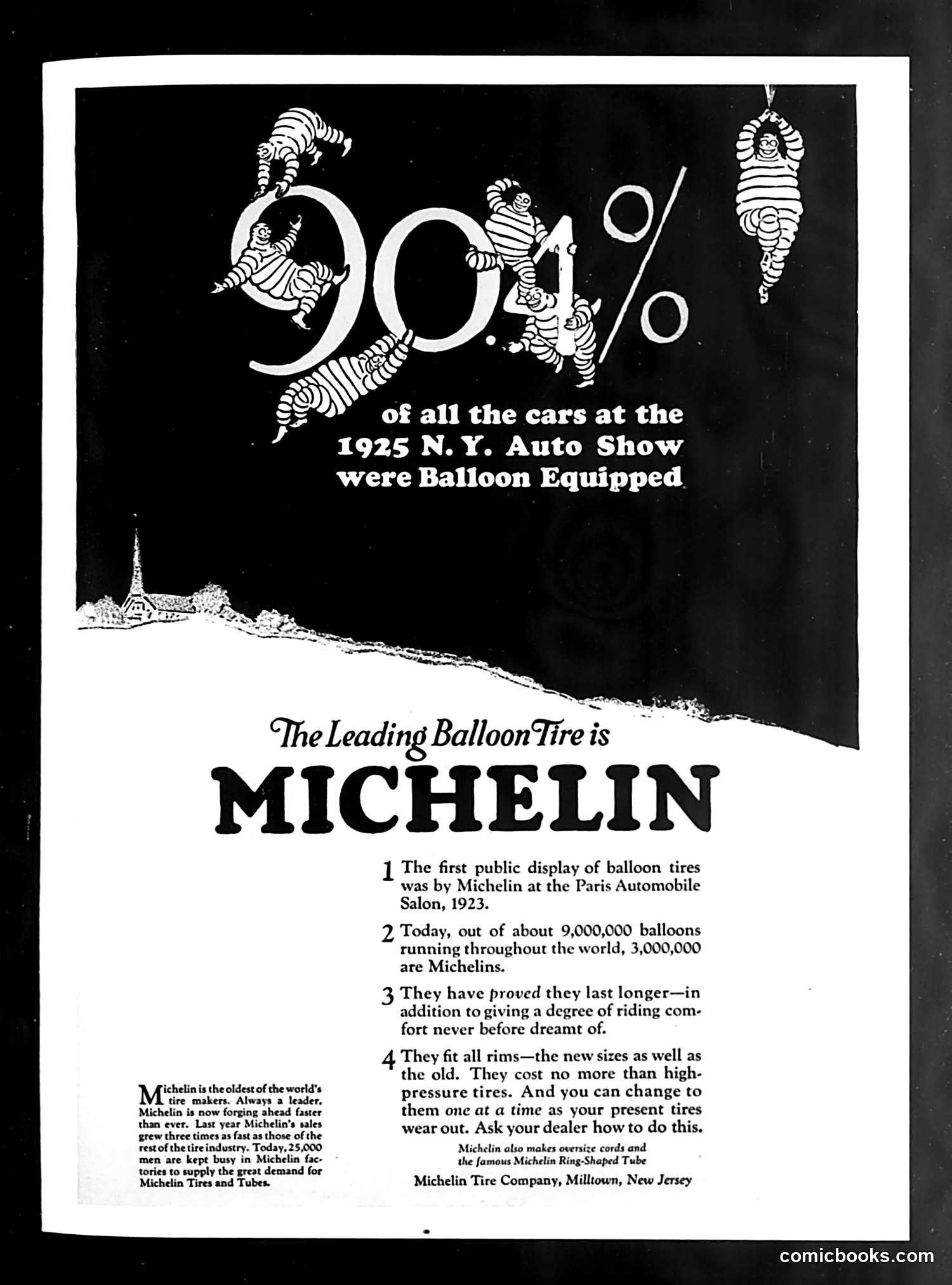
This is a **Michelin tire company advertisement**, not political satire. The illustrated figures are **Michelin's mascot—Bibendum, the rotund tire man**—shown playfully positioned around the statistic "90 1/0" (meaning 90.1%). The ad claims that 90.1% of cars at the 1925 New York Auto Show were equipped with Michelin's new "balloon tires"—a then-revolutionary tire technology featuring lower pressure and improved comfort. The cartoon mummies are meant to be whimsical/eye-catching rather than satirical. The advertisement emphasizes Michelin's market dominance: three million of nine million balloon tires worldwide are Michelins. It highlights product benefits—durability, comfort, compatibility with existing rims—and notes affordability compared to traditional high-pressure tires. This represents early automotive advertising targeting the rapidly expanding 1920s car market.
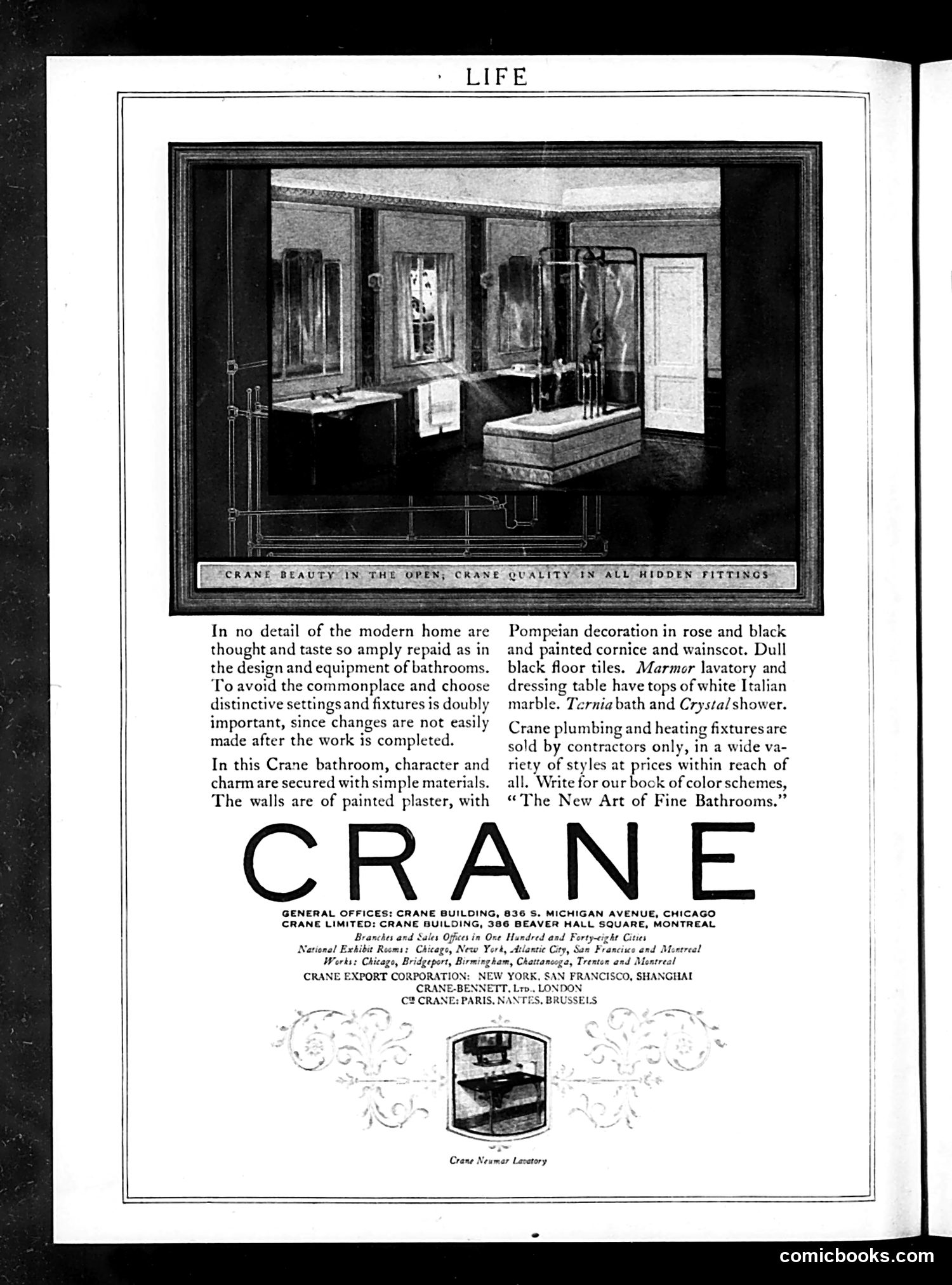
This is **not a cartoon or satire**—it's a full-page advertisement for Crane plumbing fixtures, appearing in *Life* magazine. The image shows a luxurious bathroom display featuring Pompeian-style decoration in rose and black, Italian marble surfaces, and high-end fixtures. The ad emphasizes that bathroom design deserves careful aesthetic consideration, as renovations are costly and permanent. The sales pitch targets affluent homeowners by framing bathroom fixtures as expressions of "character and charm" rather than mere utilities. It promotes Crane's products across multiple showrooms and international locations, offering design consultations through their "New Art of Fine Bathrooms" guidebook. This reflects early 20th-century American consumer culture, where domestic luxury—particularly the modern bathroom—became a status symbol and mark of refined taste.