
Life, 1925-04-30 · page 28 of 42
Life — April 30, 1925 — page 28: what you’re looking at
What you’re looking at
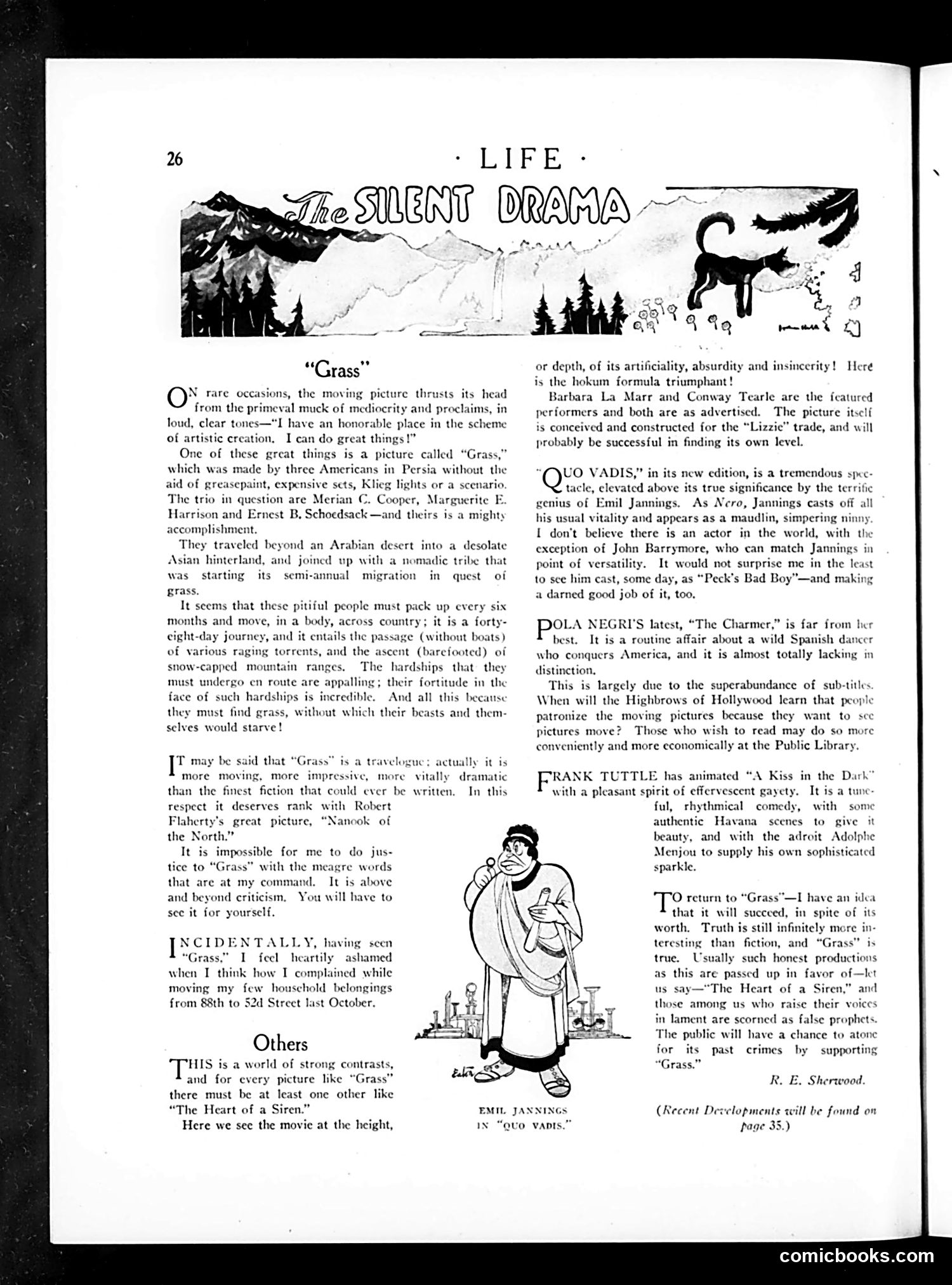
This page reviews several 1920s silent films. The central satire contrasts "Grass"—praised as genuine artistic cinema—against inferior Hollywood productions. **"Grass"** is celebrated as a documentary travelogue following nomadic Persian tribes on a 48-day migration seeking pasture. Reviewers emphasize its authenticity: filmed on location without studio artifice, expensive sets, or scenarios. It's favorably compared to "Nanook of the North." By contrast, the page ridicules formulaic entertainment films like "The Heart of a Siren" and "Quo Vadis," dismissed as hokum designed for working-class audiences (the "Lizzie trade"). Emil Jannings receives backhanded praise for playing Nero as a "simpering ninny" rather than heroically. The satirical point: authentic, documentary-style filmmaking represents cinema's artistic potential, while conventional Hollywood melodrama represents its commercial degradation. The page's tone mocks both the lowbrow audience and producers' cynical calculations, positioning "Grass" as proof that cinema could achieve genuine artistic merit.
📄 Transcribed text from this page (OCR, searchable)
Machine-transcribed from the original scan — historical spelling and the odd misread are preserved.
LIVE, * rare occasions, the moving picture thrusts its head from the primeval muck of mediocrity and proclaims, in loud, clear tones—"I have an honorable place in the scheme of artistic creation, I can do great things!” One of these great things is a picture called “Grass,” which was made by three Americans in Persia without the aid of greasepaint, expensive sets, Klieg lights or a scenario The trio in question are Merian C. Cooper, Marguerite I Harrison and Ernest B, Schoedsack —and theirs is a mighty accomplishment. They traveled beyond an Arabian desert into a desolate Asian hinterland, and joined up with a nomadic tribe that was starting its semi-annual ation in mig quest of grass. It scems that these pi ful people must pack up every six months and move, in a body, across country; it is a forty- eight-day journey, and it entails the passage (without boats) of various raging torrents, and the ascent (barefooted) of snow-capped mountain. The hardships that they must undergo en route are appallir their fortitude in the face of such hardships is incredible. And all this because they must find grass, without which th selves would starve! nges, rt beasts and them- T may be said that “Grass” is a more moving, more impressive, more velogue; actually it is vitally than the finest fiction that could ever be written. respect it deserves rank with Robert laherty’s great picture, “Nanook of the North.” It is impossible for me to do jus- tice to “Grass” with the meagre words that are at my command. It is above and beyond criticism. You will have to sce it for yourself. dramatic In this | as DENTALLY, havi “Grass,” I feel heartily hamed when I think how I complained while moving my few houschold belongings from 88th to 52d Street last October. Others HIS is a world of strong contrasts, and for every picture like “Grass” there must be at least one other like “The Heart of a Siren.” Here we see the movie at the height, EMIL. JANNINGS IN “Quo vapts.” or depth, of its artificiality, absurdity and insincerity! is the hokum formula triumphant! Barbara La Marr and Conway Tearle are the featured performers and both are as advertised. The picture itself is conceived and constructed for the “Lizzie” trade, and will probably be successful in finding its own level. Here “C)YLO VADIS,” in its new edition, is a tremendous spec- tacle, elevated above its true significance by the terrific genius of Emil Jannings. As Nero, Jannings casts off all his usual vitality and appears as a maudlin, simpering ninny I don't believe there is an actor in the world, with the exception of John Barrymore, who can match Jannings in point of versatility. It would not surprise me in the least to sce him cast, some day, as “Peck’s Bad Boy”—and making a darned good job of it, too. OLA N RIS latest, “The Charmer,” is far from her best. It is a routine affair about a wild Spanish dancer who conquers America, and it is almost totally lacking in distinction, This is largely due to the superabundance of sub-titles. When will the Highbrows of Hollywood learn that people patronize the moving pictures because they want to sec pictures move? Those who wish to read may do so more conveniently and more economically at the Public Library, RANK TUTTLE has animated “A Kiss in the Dark” with a pleasant spirit of effervescent gayety. It is a tune ful, rhythmical com with authentic Havana scenes to give it beauty, and with the adroit Adolphe Menjou to supply his own sophisticated sparkle. some 'O return to “Grass"—I have an idea that it will succced, in spite of its worth. Truth is still infinitely more in- teresting than fiction, and true. Usually such honest productions as this are passed up in favor of—let us say—"“The Heart of a Siren,” and those among us who raise their in lament are scorned as false prophet The public will have a chance to ate for its past crimes by “Grass.” ass” is ‘oices supporting R. E. Sherwood. (Recent Developments will be found on page 35.) comicbooks.com