
Life, 1925-04-30 · page 18 of 42
Life — April 30, 1925 — page 18: what you’re looking at
What you’re looking at
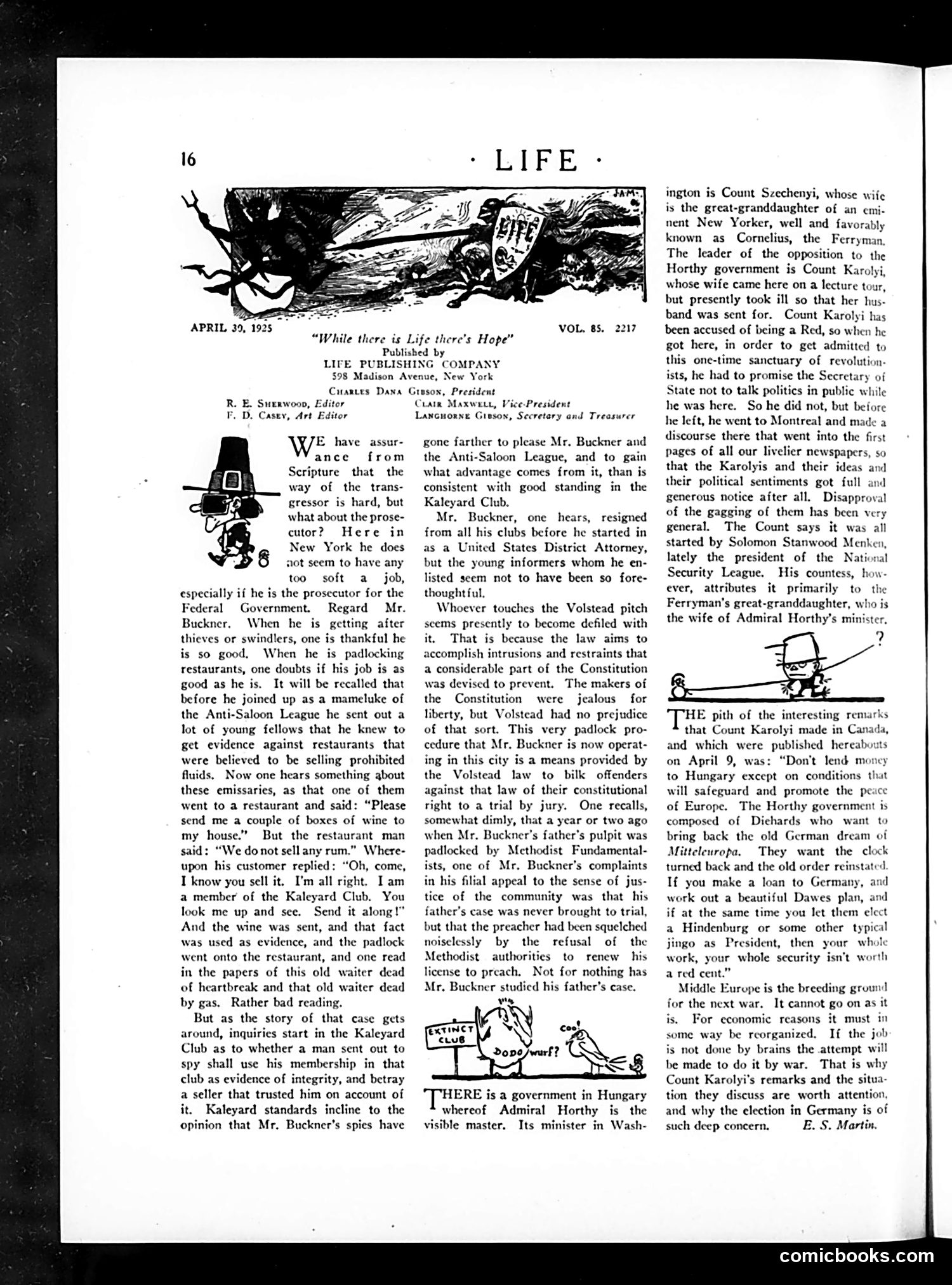
This page satirizes **Henry Buckner**, U.S. District Attorney for New York, who aggressively enforces Prohibition. The article criticizes his undercover agents' tactics—specifically, agents posing as club members to entrap restaurant owners into illegally selling alcohol, then using that membership as "evidence of integrity." The satire's key point: Buckner's methods violate the ethical standards of the Kaleyard Club (a real social organization) by weaponizing trust and membership. The author notes the ironic hypocrisy: Buckner complained years earlier when his *father's* Methodist church was padlocked without trial—yet now uses the Volstead Act to bypass jury trials against alcohol sellers. The piece argues Prohibition enforcement inherently corrupts constitutional protections and civic integrity. A secondary item discusses Hungarian politics and Count Karolyi's opposition to Admiral Horthy's government.
📄 Transcribed text from this page (OCR, searchable)
Machine-transcribed from the original scan — historical spelling and the odd misread are preserved.
APRIL 39, 192 VOL. 85. 2217 “While there is Life there's Hope” Published by LIFE PUBLISHING COMPANY $98 Madison Avenue, New York Cuaates Dana Grasox, President R. E. Surawooo, Editor F. D, Casey, Art Editor E have assur- ance from Scripture that the way of the trans- gressor is hard, but what about the prose- cutor? Here in New York he does ot seem to have any too soft a job, especially if he is the prosecutor for the Federal Government. Regard = Mr. Buckner. When he is getting after thieves or swindlers, one is thankful he is so good, When he is padlocking restaurants, one doubts if his job is as good as he is. It will be recalled that before he joined up as a mameluke of the Anti-Saloon League he sent out a lot of young fellows that he knew to get evidence against restaurants that were believed to be selling prohibited fluids. Now one hears something about these emissaries, as that one of them went to a restaurant and said: “Please send me a couple of boxes of wine to my house.” But the restaurant man said: “We donot sell any rum.” Where- upon his customer replied: “Oh, come, I know you sell it. I'm all right. Iam a member of the Kaleyard Club. You look me up and see. Send it along!” And the wine was sent, and that fact was used as evidence, and the padlock went onto the restaurant, and one read in the papers of this old waiter dead of heartbreak and that old waiter dead by gas. Rather bad reading. But as the story of that case gets around, inquiries start in the Kaleyard Club as to whether a man sent out to spy shall use his membership in that club as evidence of integrity, and betray a seller that trusted him on account of it. Kaleyard standards incline to the opinion that Mr. Buckner's spies have Cian Maxwent, Vice-President Lancuomne Ginson, Secretary and Treasurer gone farther to please Mr. Buckner and the Anti-Saloon League, and to gain what advantage comes from it, than is consistent with good standing in the Kaleyard Club. Mr. Buckner, one hears, resigned from all his clubs before he started in as a United States District Attorney, but the young informers whom he en- listed seem not to have been so fore- thoughtful. Whoever touches the Volstead pitch scems presently to become defiled with it. That is because the law aims to accomplish intrusions and restraints that a considerable part of the Constitution was devised to prevent. The makers of the Constitution were jealous for liberty, but Volstead had no prejudice of that sort. This very padlock pro- cedure that Mr. Buckner is now operat- ing in this city is a means provided by the Volstead law to bilk offenders against that law of their constitutional right to a trial by jury. One recalls, somewhat dimly, that a year or two ago when Mr. Buckner’s father's pulpit was padlocked by Methodist Fundamental- ists, one of Mr. Buckner’s complaints in his filial appeal to the sense of jus- tice of the community was that his father’s case was never brought to trial, but that the preacher had been squelched noiselessly by the refusal of the Methodist authorities to renew his license to preach. Not for nothing has Mr. Buckner studied his father’s case. | HERE is a government in Hungary w vhereof Admiral visible master, Horthy is the Its minister in Wash- ington is Count Szechenyi, whose wife is the great-granddaughter of an emi- nent New Yorker, well and favorably known as Cornelius, the Ferryman, The leader of the opposition to the Horthy government is Count Karolyi, whose wife came here on a lecture tour, but presently took ill so that her hus- band was sent for. Count Karolyi has been accused of being a Red, so when he got here, in order to get admitted to this one-time sanctuary of revolution- ists, he had to promise the Secretary of State not to talk politics in public while he was here. So he did not, but before he left, he went to Montreal and made a discourse there that went into the first pages of all our livelier newspapers, so that the Karolyis and their ideas and their political sentiments got full and generous notice after all, Disapproval of the gagging of them has been very general. The Count says it was all started by Solomon Stanwood Menken, lately the president of the National Security League. His countess, ever, attributes it primarily to 1 Ferryman’s great-granddaughter, who is the wife of Admiral Horthy’s minister, ? THE pith of the interesting remarks that Count Karolyi made in Cana and which were published hereab on April 9, was: “Don't lend money to Hungary except on conditions that will safeguard and promote the peace of Europe. The Horthy government composed of Diehards who want to bring back the old German dream oi Mitteleuropa. They want the clock turned back and the old order reinstated If you make a loan to Germany, and work out a beautiful Dawes plan, and if at the same time you let them elect a Hindenburg or some other typical jingo as President, then your whole work, your whole security isn’t worth a red cent.” Middle Europe is the breeding ground for the next war. It cannot go on as it is, For economic reasons it must in some way be reorganized. If the job is not done by brains the attempt will be made to do it by war. That is why Count Karolyi’s remarks and the situa- tion they discuss are worth attention, and why the election in Germany is of such deep concern. E. S. Martin. comicbooks.com