
Life, 1925-04-30 · page 22 of 42
Life — April 30, 1925 — page 22: what you’re looking at
What you’re looking at
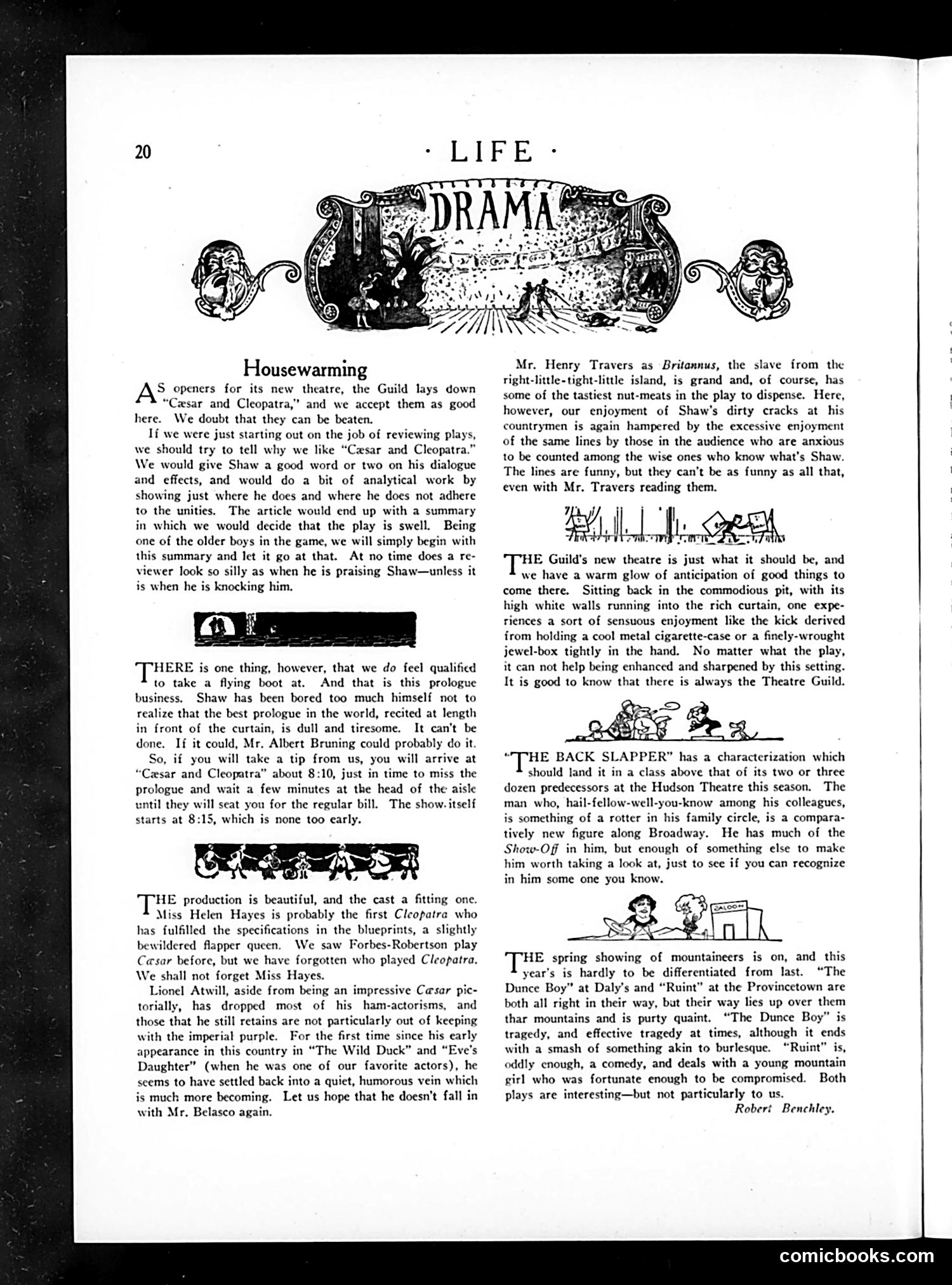
This page reviews the Theatre Guild's production of Shaw's "Caesar and Cleopatra," starring Helen Hayes and Lionel Atwill. The critic praises the play and production design but mocks Shaw's prologue as tediously dull—advising readers to arrive late to skip it. The review offers specific performance assessments: Hayes is praised as the first Cleopatra matching the script's specifications (a "bewildered flapper queen"), while Atwill is commended for restraint in his imperial role. Henry Travers, as the British slave Britannus, delivers Shaw's satirical jabs at the British character—though the critic notes audiences laugh too hard at these jokes, suggesting they're performing their own sophistication. The critic also celebrates the Theatre Guild's new venue itself as an elegant space enhancing any production. A brief mention of "The Back Slapper" at the Hudson Theatre appears at page's end. The overall tone is insider theatrical commentary for an educated readership familiar with contemporary stage productions.
📄 Transcribed text from this page (OCR, searchable)
Machine-transcribed from the original scan — historical spelling and the odd misread are preserved.
Housewarming AS openers for its new theatre, the Guild lays down “Cxsar and Cleopatra,” and we accept them as good here. We doubt that they can be beaten. If we were just starting out on the job of reviewing plays, we should try to tell why we like “Cxsar and Cleopatra.” We would give Shaw a good word or two on his dialogue and effects, and would do a bit of analytical work by showing just where he does and where he does not adhere to the unities. The article would end up with a summary in which we would decide that the play is swell. Being one of the older boys in the game, we will simply begin with this summary and let it go at that. At no time does a re- viewer look so silly as when he is praising Shaw—unless it is when he is knocking him. HERE is one thing, however, that we do feel qualified to take a flying boot at. And that is this prologue business, Shaw has been bored too much himself not to realize that the best prologue in the world, recited at length in front of the curtain, is dull and tiresome. It can’t be done. If it could, Mr. Albert Bruning could probably do it So, if you will take a tip from us, you will arrive at “Cxsar and Cleopatra” about 8:10, just in time to miss the prologue and wait a few minutes at the head of the aisle until they will seat you for the regular bill. The show. itself starts at 8:15, which is none too early. ry LN, THe production is beautiful, and the cast a fitting one. Miss Helen Hayes is probably the first Cleopatra who has fulfilled the specifications in the blueprints, a slightly bewildered flapper queen. We saw Forbes-Robertson play Cesar before, but we have forgotten who played Cleopatra. We shall not forget Miss Hayes. Lionel Atwill, aside from being an impressive C@sar pic- torially, has dropped most of his ham-actorisms, and those that he still retains are not particularly out of keeping with the imperial purple. For the first time since his early appearance in this country in “The Wild Duck” and “Eve's Daughter” (when he was one of our favorite actors), he seems to have settled back into a quiet, humorous vein which is much more becoming. Let us hope that he doesn’t fall in with Mr. Belasco again. Mr. Henry Travers as Britannus, the slave from the right-little-tight-little island, is grand and, of course, has some of the tastiest nut-meats in the play to dispense. Here, however, our enjoyment of Shaw's dirty cracks at his countrymen is again hampered by the excessive enjoyment of the same lines by those in the audience who are anxious to be counted among the wise ones who know what's Shaw. The lines are funny, but they can't be as funny as all that, even with Mr. Travers reading them. THE Guild’s new theatre is just what it should be, and we have a warm glow of anticipation of good things to come there. Sitting back in the commodious pit, with its high white walls running into the rich curtain, one expe- riences a sort of sensuous enjoyment like the kick derived from holding a cool metal cigarette-case or a finely-wrought jewel-box tightly in the hand. No matter what the play, it can not help being enhanced and sharpened by this setting. It is good to know that there is always the Theatre Guild. 2G Pen “"THE BACK SLAPPER” has a characterization which should land it in a class above that of its two or three dozen predecessors at the Hudson Theatre this season. The man who, hail-fellow-well-you-know among his colleagues, is something of a rotter in his family circle, is a compara- tively new figure along Broadway. He has much of the Show-Off in him, but enough of something else to make him worth taking a look at, just to see if you can recognize in him some one you know. PR spring showing of mountaineers is on, and this year’s is hardly to be differentiated from last. “The Dunce Boy” at Daly’s and “Ruint” at the Provincetown are both all right in their way, but their way lies up over them thar mountains and is purty quaint. “The Dunce Boy” is tragedy, and effective tragedy at times, although it ends with a smash of something akin to burlesque. “Ruint” is, oddly enough, a comedy, and deals with a young mountain girl who was fortunate enough to be compromised. Both plays are interesting—but not particularly to us. Robert Benchley. comicbooks.com