
Life, 1925-04-30 · page 21 of 42
Life — April 30, 1925 — page 21: what you’re looking at
What you’re looking at
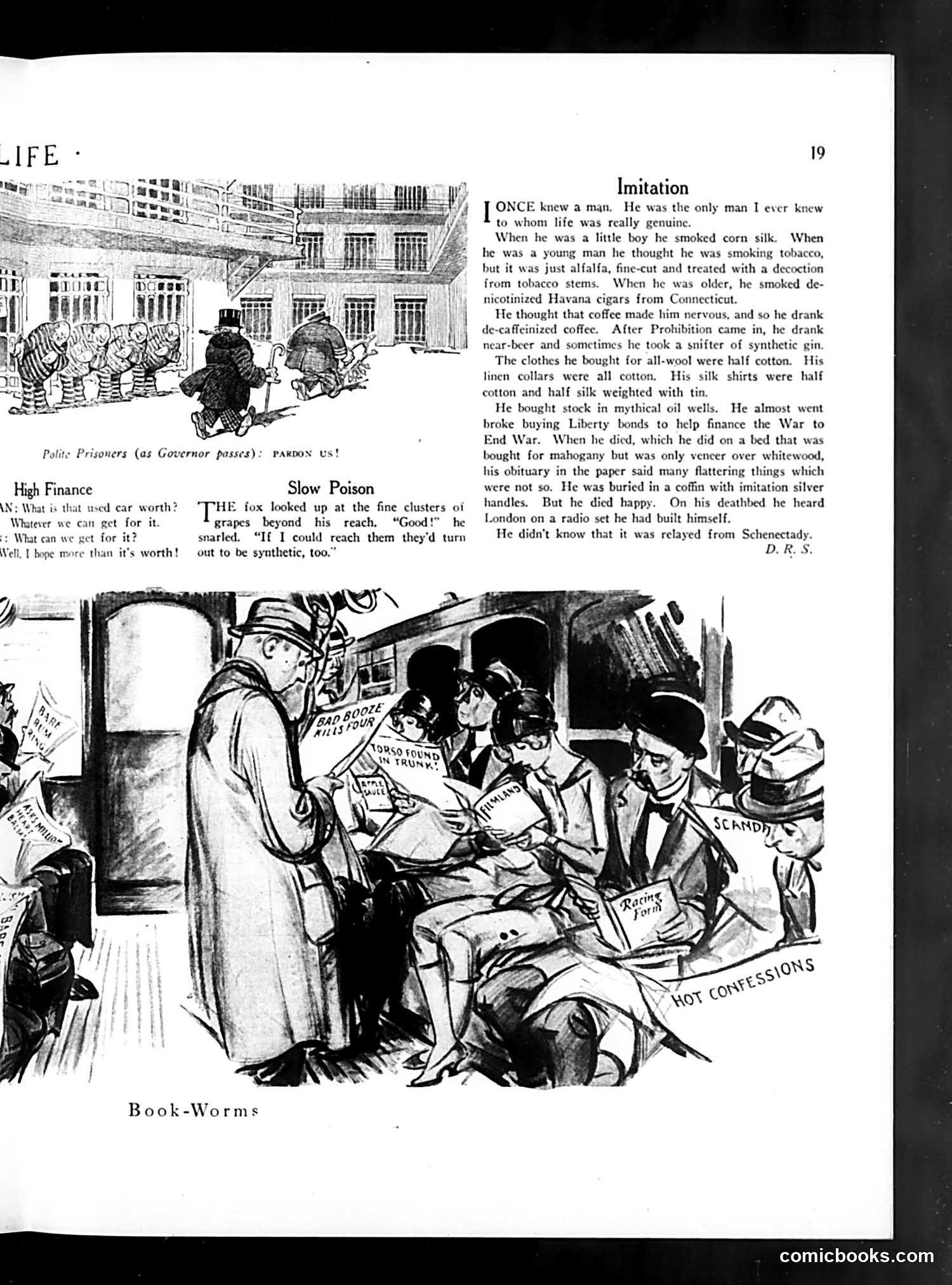
This page contains three separate satirical pieces critiquing 1920s American consumer culture and dishonesty: **"High Finance"**: A joke about used car fraud—dealers inflating worthless vehicles' value, with the punchline that hoped-for profit exceeds actual worth. **"Slow Poison"**: A fox unable to reach grapes dismisses them as synthetic—reversing Aesop's fable. The satire targets consumer skepticism about mass-produced goods. **"Imitation"** (main story): Chronicles a man whose entire life involved fake/adulterated products—synthetic gin, decaffeinated coffee, counterfeit materials, and stock schemes—yet he died "happy." The bitter irony: even his triumphant final moment (hearing London on radio) was relayed from elsewhere without his knowledge. **"Book-Worms"** (cartoon): Prisoners appeal to a passing governor for pardons, labeled with scandal headlines ("Bad Booze," "Graft," "Hot Confessions")—satirizing corruption and the era's crime/scandal obsession. Together, these pieces mock widespread consumer fraud, synthetic substitutes, and societal dishonesty during the post-WWI era.
📄 Transcribed text from this page (OCR, searchable)
Machine-transcribed from the original scan — historical spelling and the odd misread are preserved.
ES Prisoners (as Governor passes): PARDON Us! High Finance \N: What is that used car worth? Whatever we can get for it +: What can we get for it? Vell, | bope more than it's worth! Slow Poison 'HE fox looked up at the fine clusters oi grapes beyond his reach, “Good!” he snarled. “If I could reach them they'd turn out to be synthetic, too.” Book-Worms 19 Imitation ONCE knew a man. He was the only man I ever knew to whom life was really genuine. When he was a little boy he smoked corn silk. When he was a young man he thought he was smoking tobacco, but it was just alfalfa, fine-cut and treated with a decoction from tobacco stems. When he was older, he smoked de- nicotinized Havana cigars from Connecticut. He thought that coffee made him nervous, and so he drank de-caffeinized coffee. After Prohibition came in, he drank near-beer and sometimes he took a snifter of synthetic gin. The clothes he bought for all-wool were half cotton. His linen collars were all cotton. His silk shirts were half cotton and half silk weighted with tin. He bought stock in mythical oil wells. He almost went broke buying Liberty bonds to help finance the War to End War. When he died, which he did on a bed that was bought for mahogany but was only vencer over whitewood, his obituary in the paper said many flattering things which were not so. He was buried in a coffin with imitation silver handles. But he diced happy. On his deathbed he heard London on a radio set he had built himself. He didn’t know that it was relayed from Schenectady. DR. S. comicbooks.com