
A complete issue · 40 pages · 1925
Life — March 12, 1925
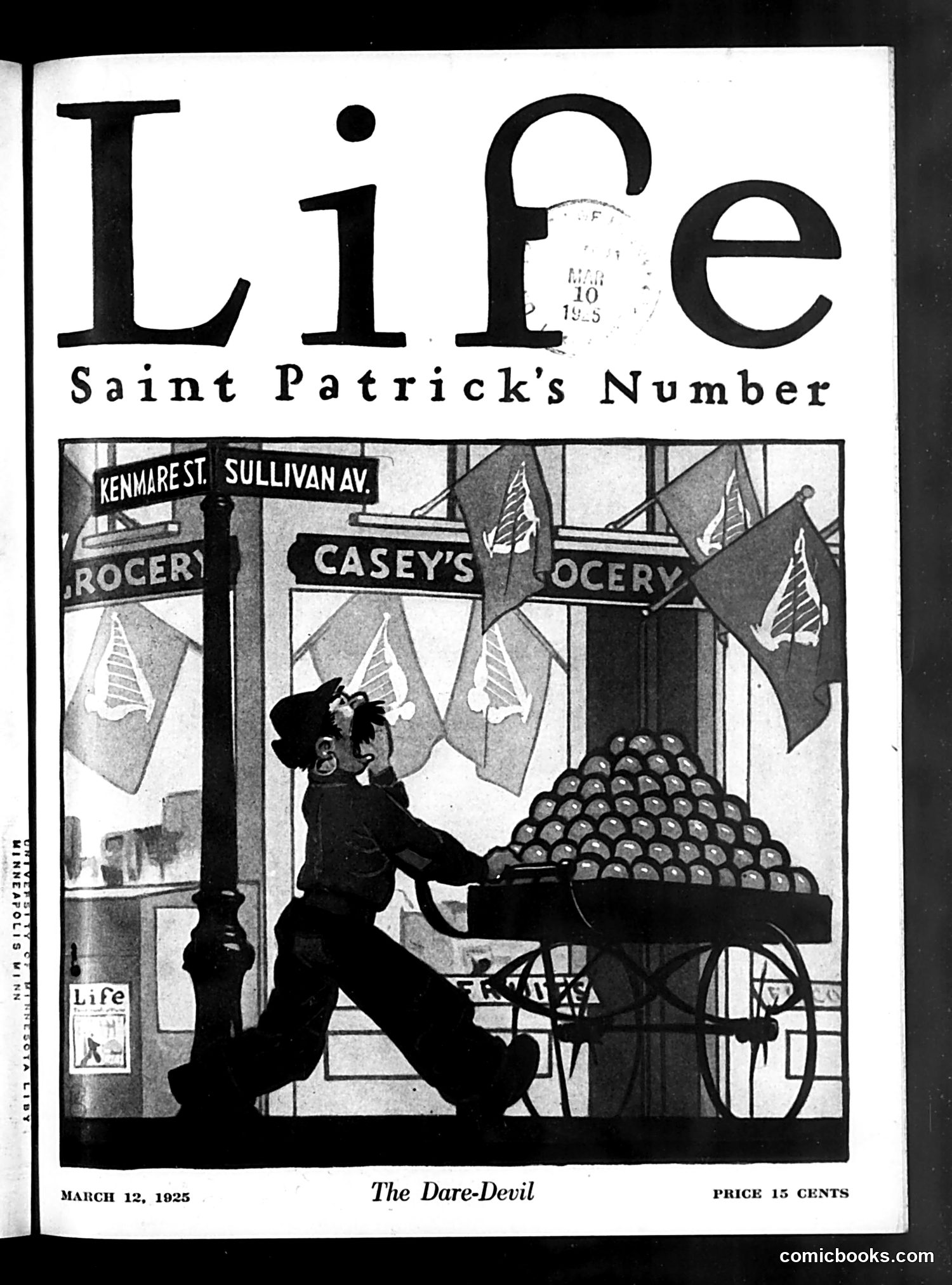
This is the cover illustration for Life's Saint Patrick's Day issue. The image shows a leprechaun-type figure selling oranges from a street cart outside Casey's Grocery on the corner of Kenmare Street and Sullivan Avenue (both historically Irish-American neighborhoods in New York City). The storefront displays Irish flags. The satire likely plays on Irish-American stereotypes common to 1920s humor—depicting Irish immigrants or their descendants as street vendors and fruit sellers in urban ethnic enclaves. The "Dare-Devil" subtitle suggests the figure's precarious economic circumstances or the humorous danger of street commerce. This reflects how Life magazine typically caricatured immigrant communities during this era.
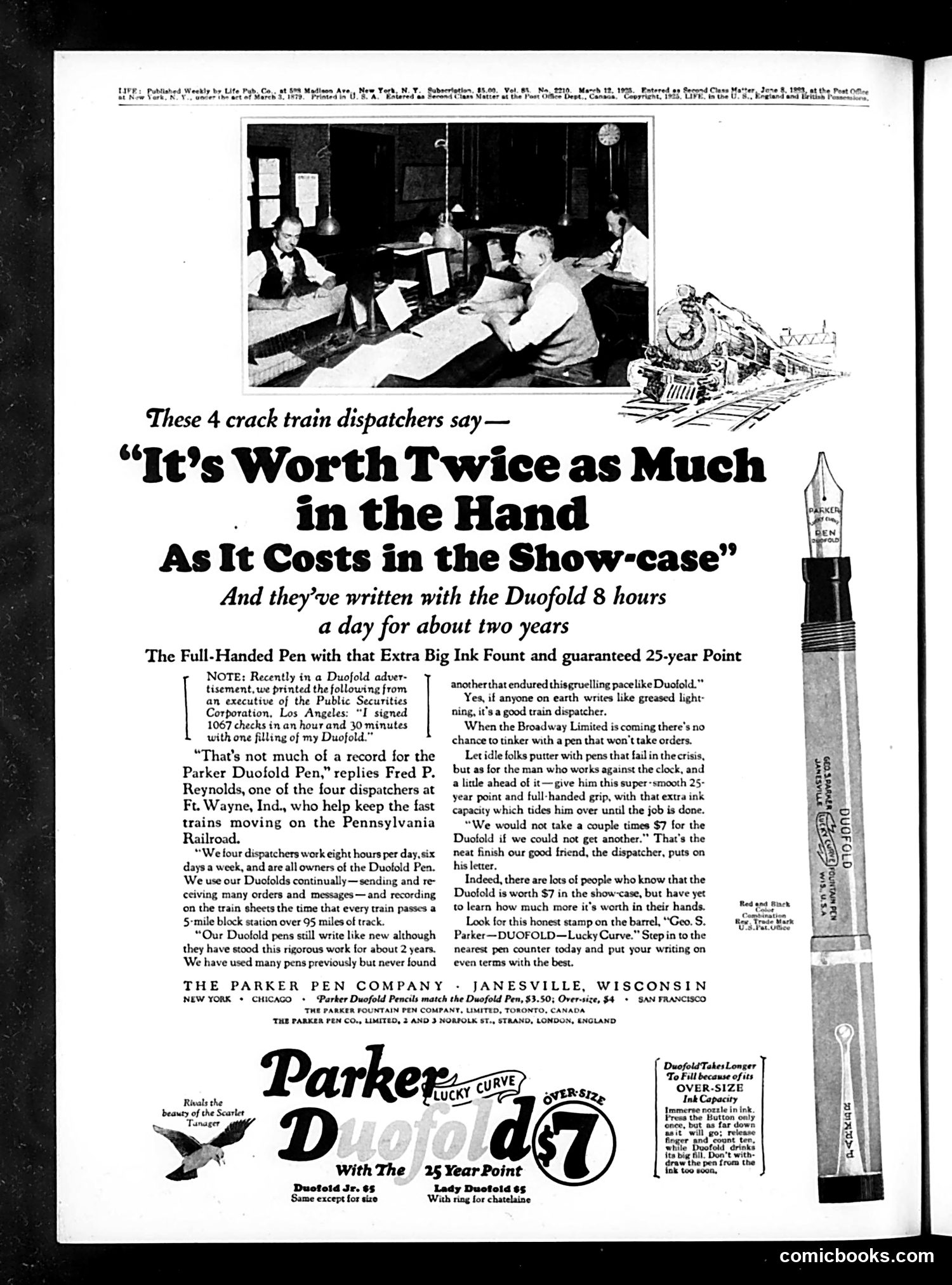
This page is primarily **advertisement, not satire or political commentary**. It features a Parker Duofold pen advertisement testimonial format. The image shows four railroad train dispatchers at their work station, and the ad quotes them endorsing the pen's durability and value—claiming "It's Worth Twice as Much in the Hand As It Costs in the Show-case." The appeal targets professional workers (dispatchers on the Pennsylvania Railroad) who need reliable writing instruments for demanding daily use. The testimonial format was a common advertising strategy of this era, lending credibility through worker endorsement. The only potentially satirical element is the implicit contrast between the pen's modest price ($7) and its claimed superior value to competitors—but this is straightforward advertising copy rather than political satire.
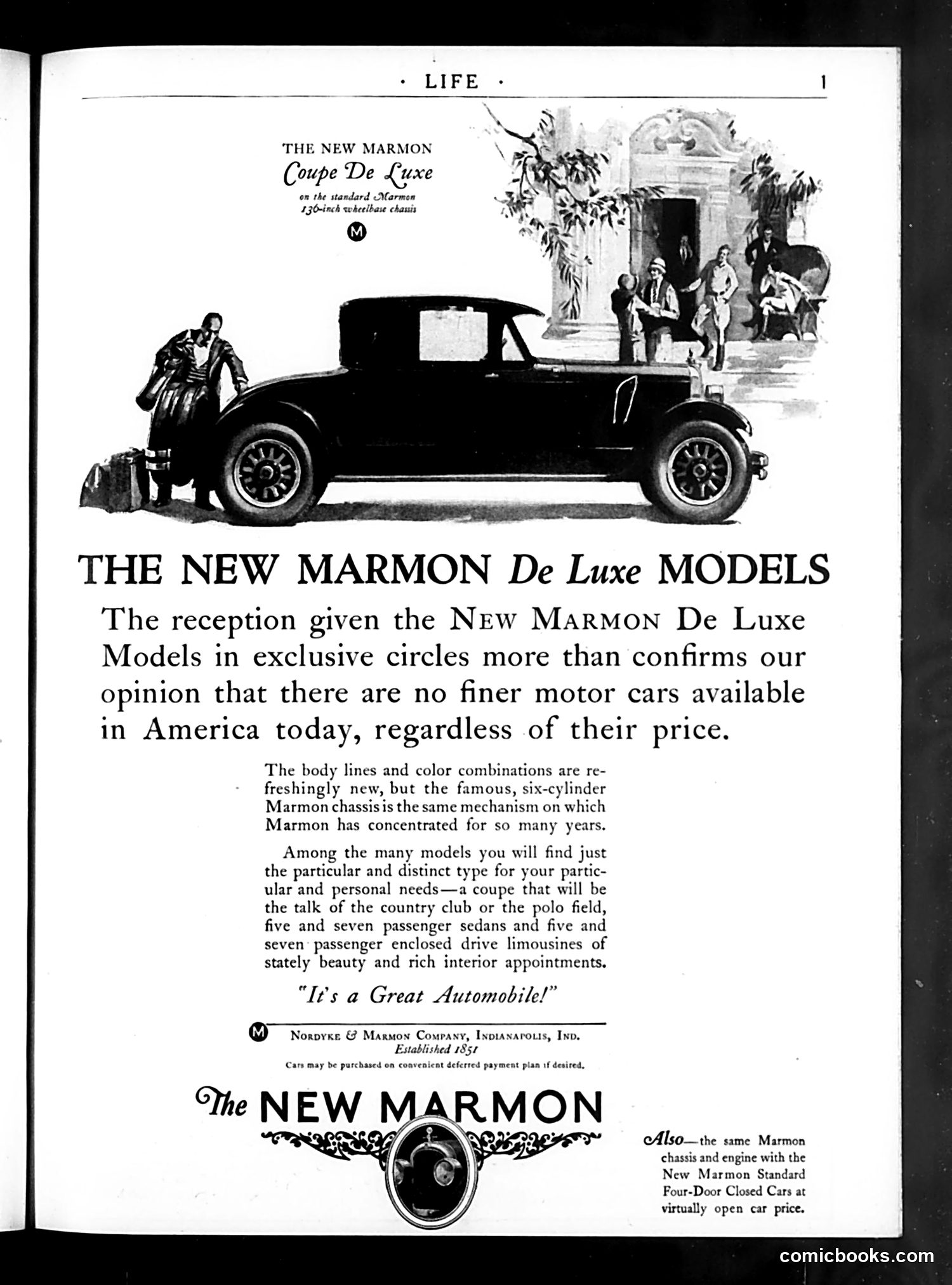
This page is primarily **advertising, not satire**. It's a full-page advertisement for the Marmon automobile company promoting their new "De Luxe" models. The ad features an illustration of a luxury car alongside a scene of well-dressed people at what appears to be an exclusive social venue (country club or similar establishment). The tagline "It's a Great Automobile!" emphasizes quality and prestige. The text claims the Marmon De Luxe offers superior design and mechanical excellence compared to competitors, regardless of price. It highlights various body styles available—coupes, sedans, and limousines—positioned as status symbols for affluent buyers. The Marmon company, based in Indianapolis, uses the advertisement to associate their product with wealth, exclusivity, and refined taste—standard luxury car marketing appeals of the era.
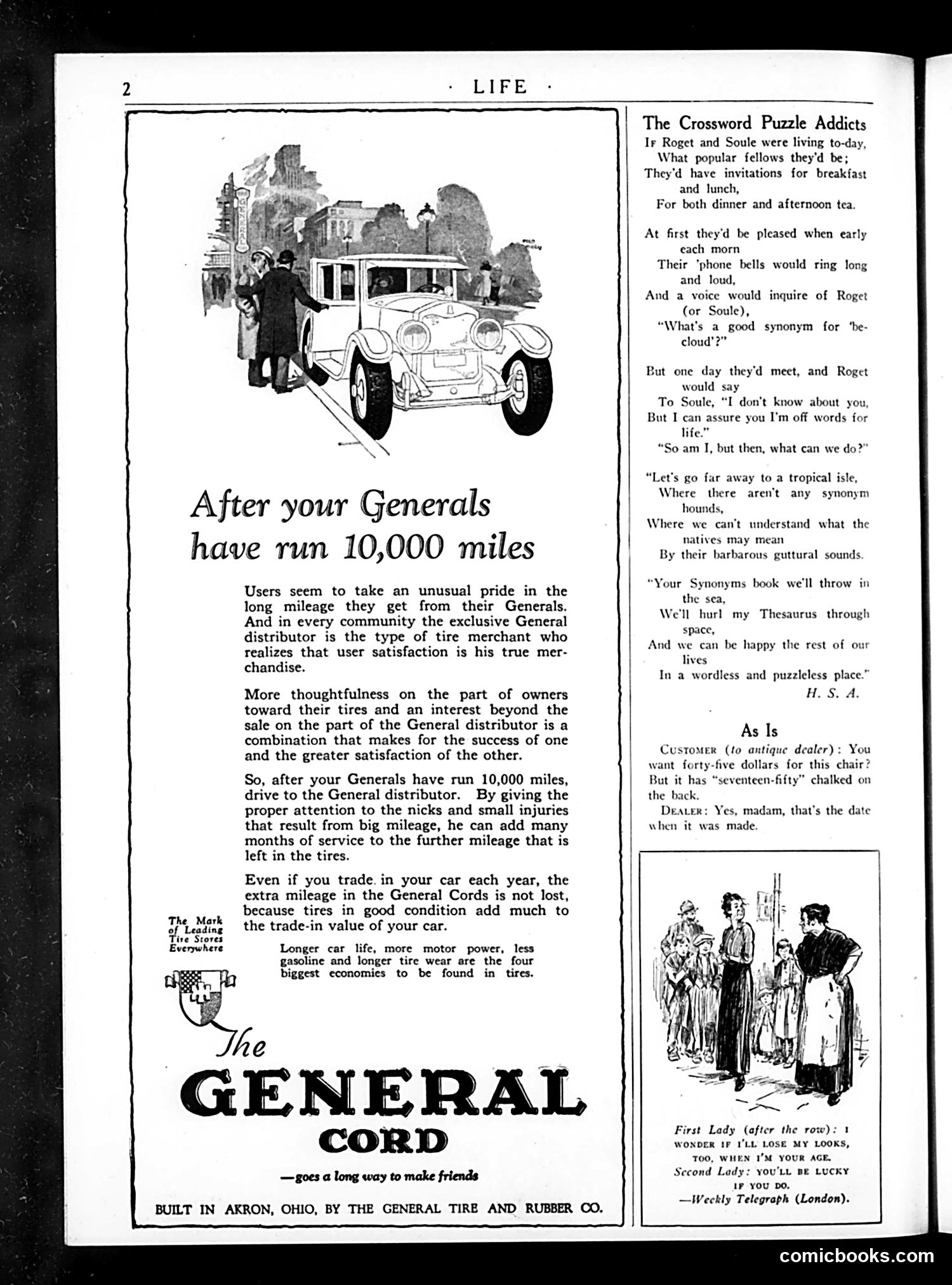
This page contains **primarily advertising** rather than editorial satire. The dominant left-hand content is a General Cord tire advertisement targeting car owners at the 10,000-mile mark, emphasizing tire durability and resale value. The tagline "goes a long way to make friends" is a marketing pitch. The right side features two distinct items: a humorous poem titled "The Crossword Puzzle Addicts" satirizing the contemporary craze for crossword puzzles (popular in the 1920s-30s), and a brief comic sketch labeled "As Is" depicting a furniture dealer's deception about a chair's age—a gentle jab at retail dishonesty. The page reflects period concerns: automobile maintenance, puzzle obsession, and consumer skepticism.
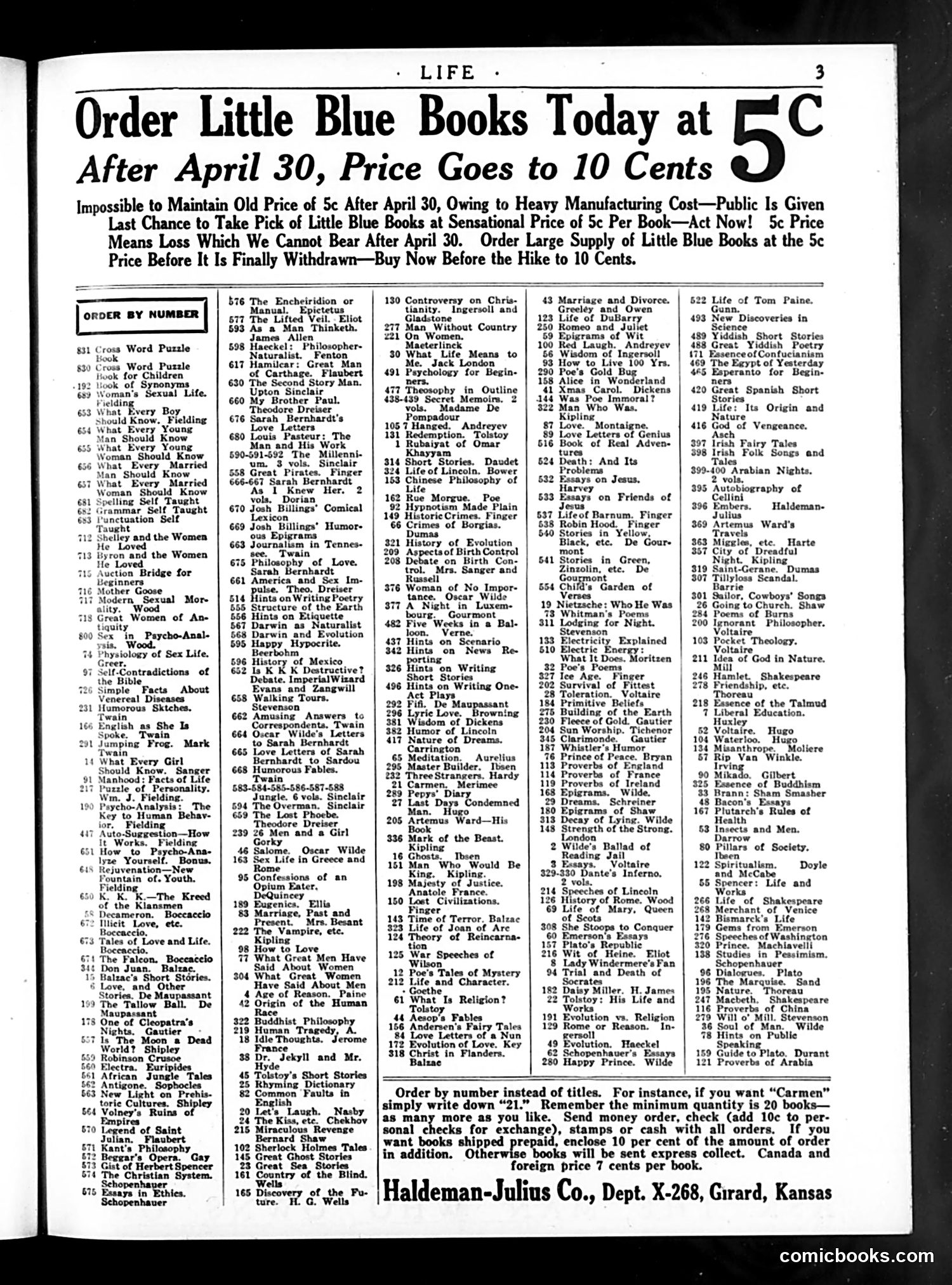
This page is **entirely advertising**, not a cartoon or satirical content. It's a mail-order catalog advertisement for "Little Blue Books"—inexpensive paperback editions published by Haldeman-Julius Co. of Girard, Kansas. The ad announces that books currently priced at 5 cents will increase to 10 cents after April 30, 1922, due to manufacturing costs. It urges customers to order immediately at the lower price. The bulk of the page lists hundreds of available titles—ranging from classics like Shakespeare and Poe to practical guides and philosophical works—organized by number for easy ordering. This reflects early 20th-century mass-market publishing, where Little Blue Books made literature and knowledge affordable for ordinary Americans.
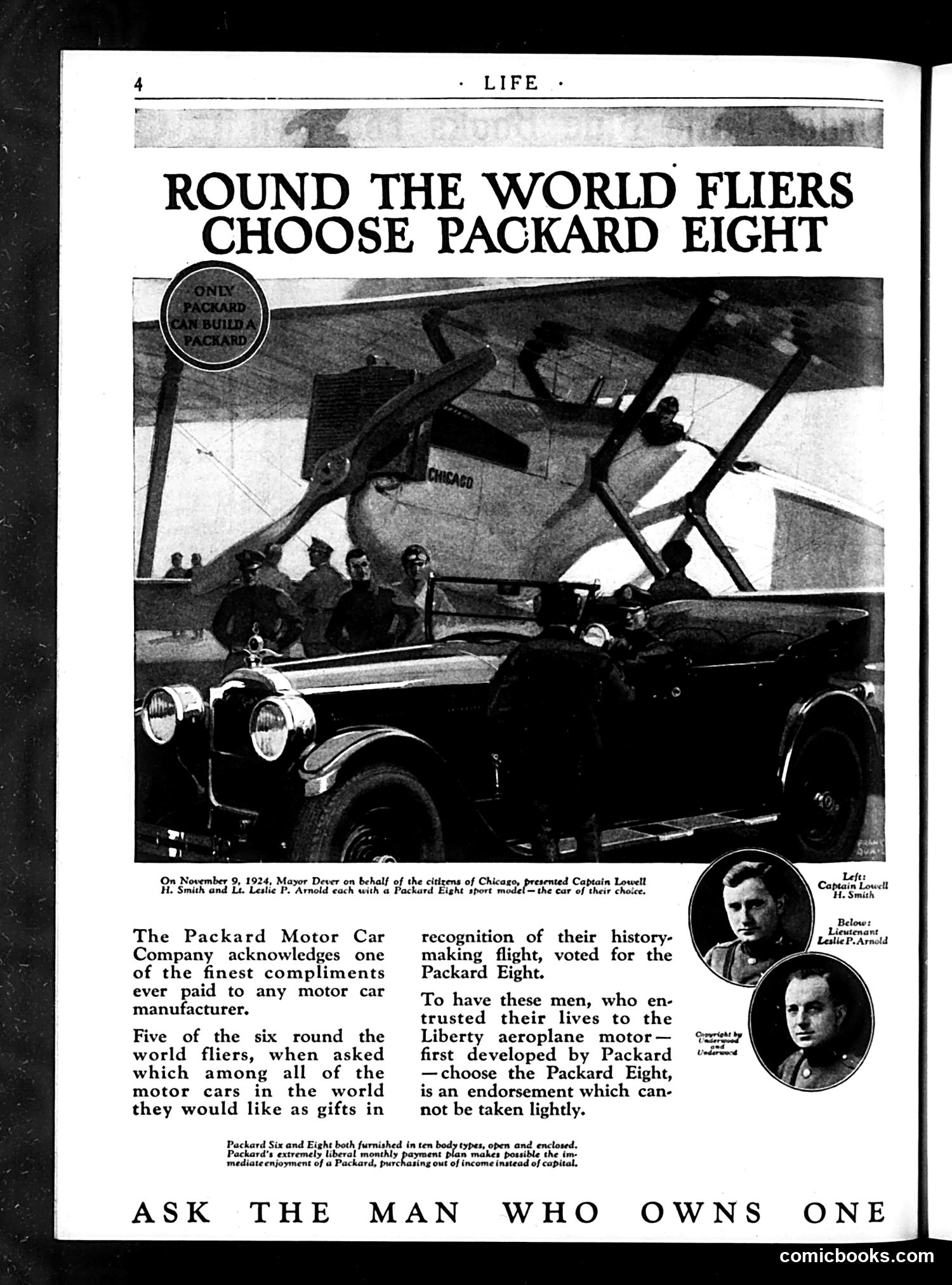
This is primarily a **Packard automobile advertisement**, not satire or political commentary. The page reports that five of six round-the-world aviators, when asked which motor car they'd want as a gift, chose the Packard Eight. The advertisement celebrates this as validation from pioneering aviators who "entrusted their lives to the Liberty aeroplane motor—first developed by Packard." The image shows the presentation of Packard Eight sport models to Captain Lowell H. Smith and Lieutenant Leslie P. Arnold on November 2, 1924, with a large aircraft visible behind them. This leverages the prestige of early aviation—then thrilling and dangerous—to market luxury automobiles. The logic: if brave aviators trust Packard engines in planes, consumers should trust Packard cars on roads. It's aspirational advertising rather than satire.
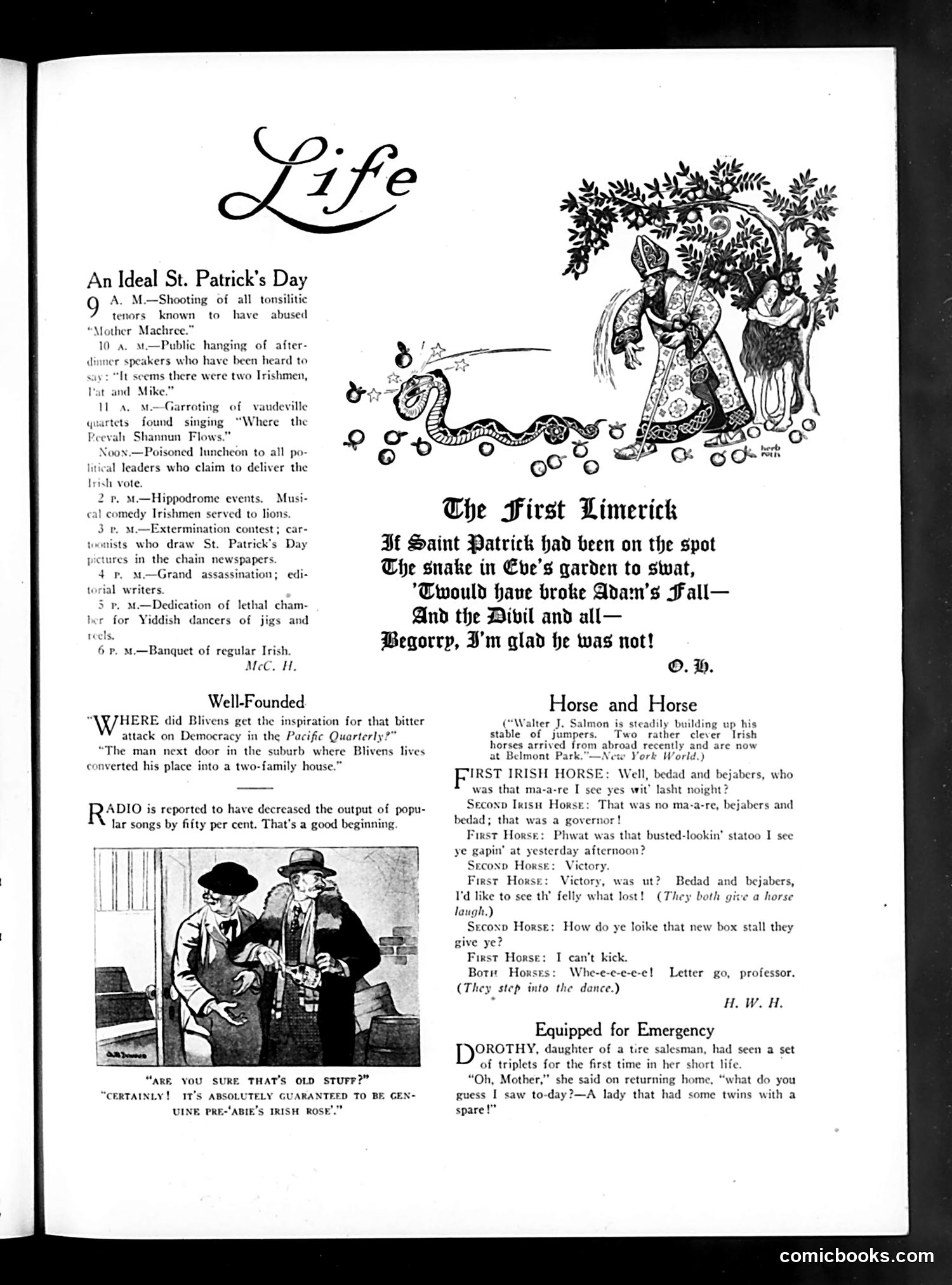
This page is a St. Patrick's Day themed humor section featuring Irish-American stereotypes and satire typical of early 20th-century Life magazine. **"An Ideal St. Patrick's Day"** mocks Irish-American political engagement, listing exaggerated activities from morning (shooting "Mother Machree" singers) through evening (poisoned lunches for political leaders). The humor relies on stereotypes about Irish immigrants, drinking, and vocal sentimentality. **"The First Limerick"** is a clever religious joke: if St. Patrick had killed the serpent in Eden, humanity wouldn't have fallen—but he didn't, so we're stuck with original sin. **"Horse and Horse"** is a vaudeville-style dialogue between two Irish horses with thick accents, playing on dialect humor and working-class Irish stereotypes. The cartoon bottom-left shows two men discussing "pre-Abe's Irish rose"—likely a reference to contemporary popular culture about Irish identity.
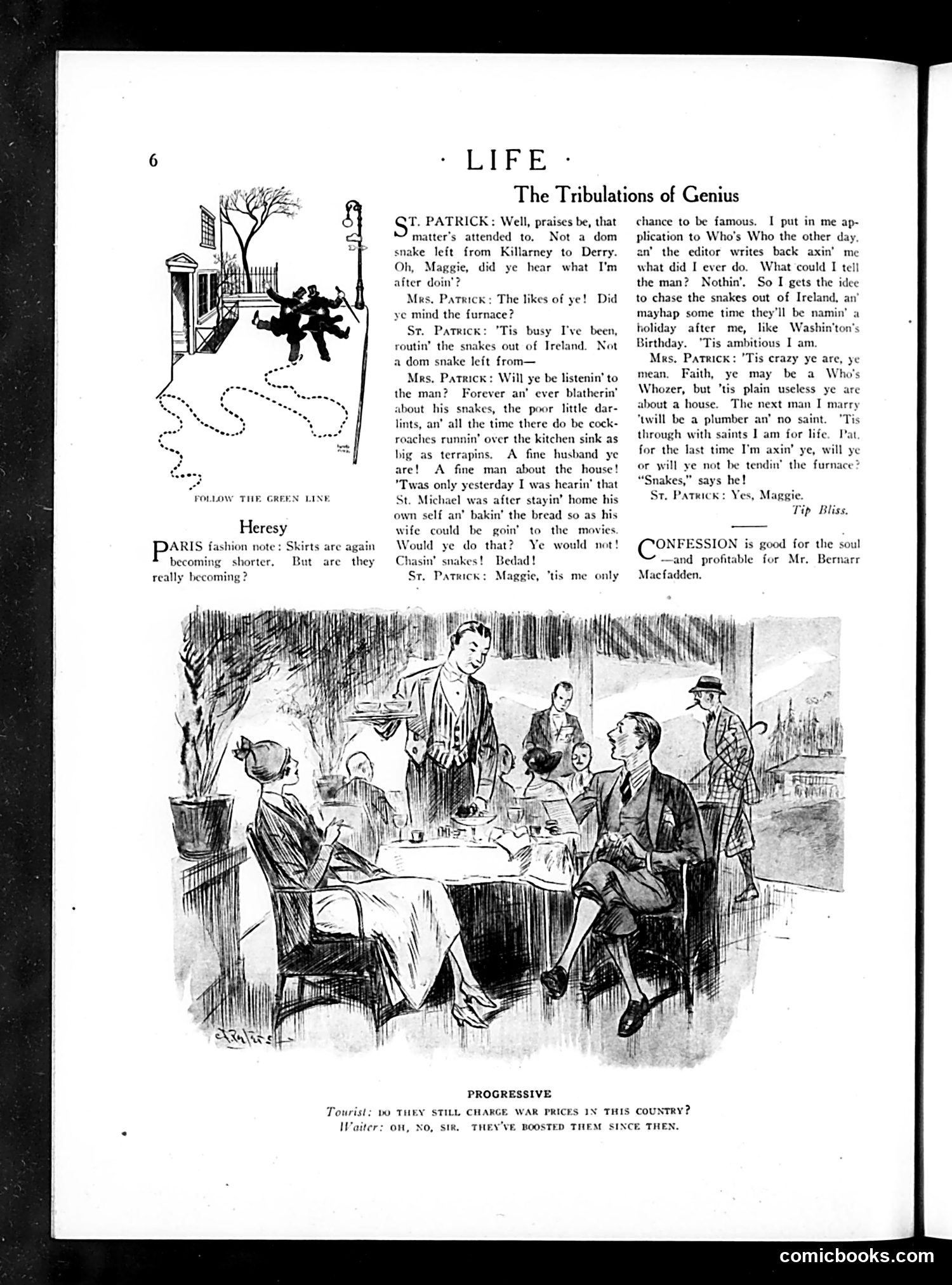
This page contains three distinct satirical pieces: 1. **"The Tribulations of Genius"** — A dialogue between St. Patrick and Mrs. Patrick about their son's ambitions. St. Patrick complains about removing snakes from Ireland only to have his son want to become a famous writer/editor. The satire mocks aspiring writers' impracticality compared to honest work. 2. **"Heresy"** — A brief note suggesting Paris fashion skirts are becoming shorter, questioning whether this is truly fashionable or represents declining hemlines. 3. **"Progressive"** — A restaurant scene where a waiter informs a customer that war prices have increased despite post-war economy. The satire critiques inflation and false promises of economic improvement after WWI. All three pieces employ light humor targeting social pretensions and economic hardships of the post-war period.
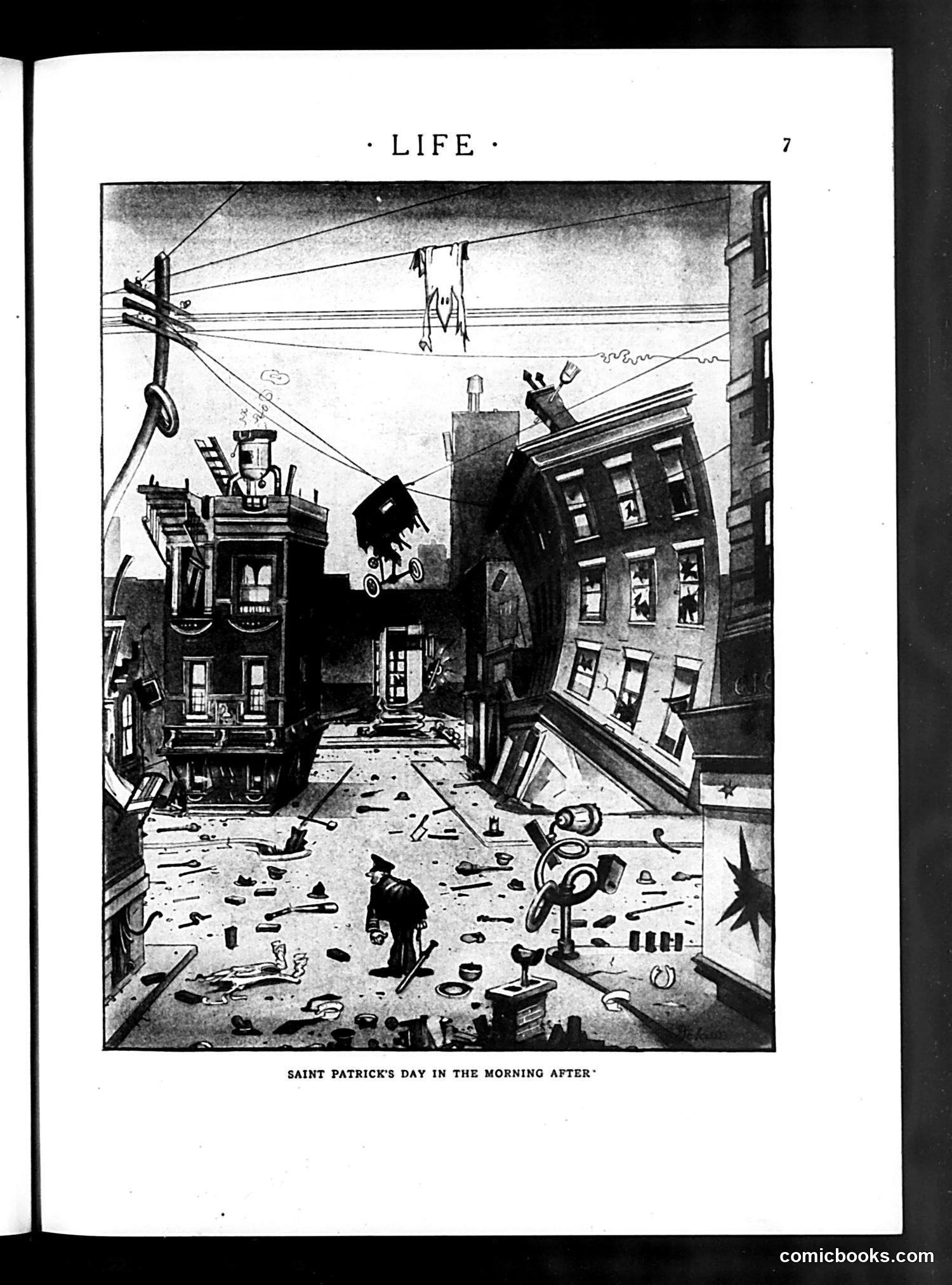
This is a satirical illustration depicting the aftermath of Saint Patrick's Day celebrations in an urban neighborhood. The cartoon shows a tenement courtyard strewn with debris—overturned furniture, broken items, and scattered refuse—suggesting rowdy, destructive revelry. A lone figure stands amid the chaos, likely representing either a resident surveying the damage or a personification of the neighborhood itself. A clothesline hangs overhead with laundry, and children's toys (including what appears to be a baby carriage) are visible, emphasizing that this destruction occurred in a residential area. The satire critiques the stereotype of Irish-American Saint Patrick's Day celebrations as drunken and disorderly, reflecting period attitudes toward Irish immigrants and their communities.
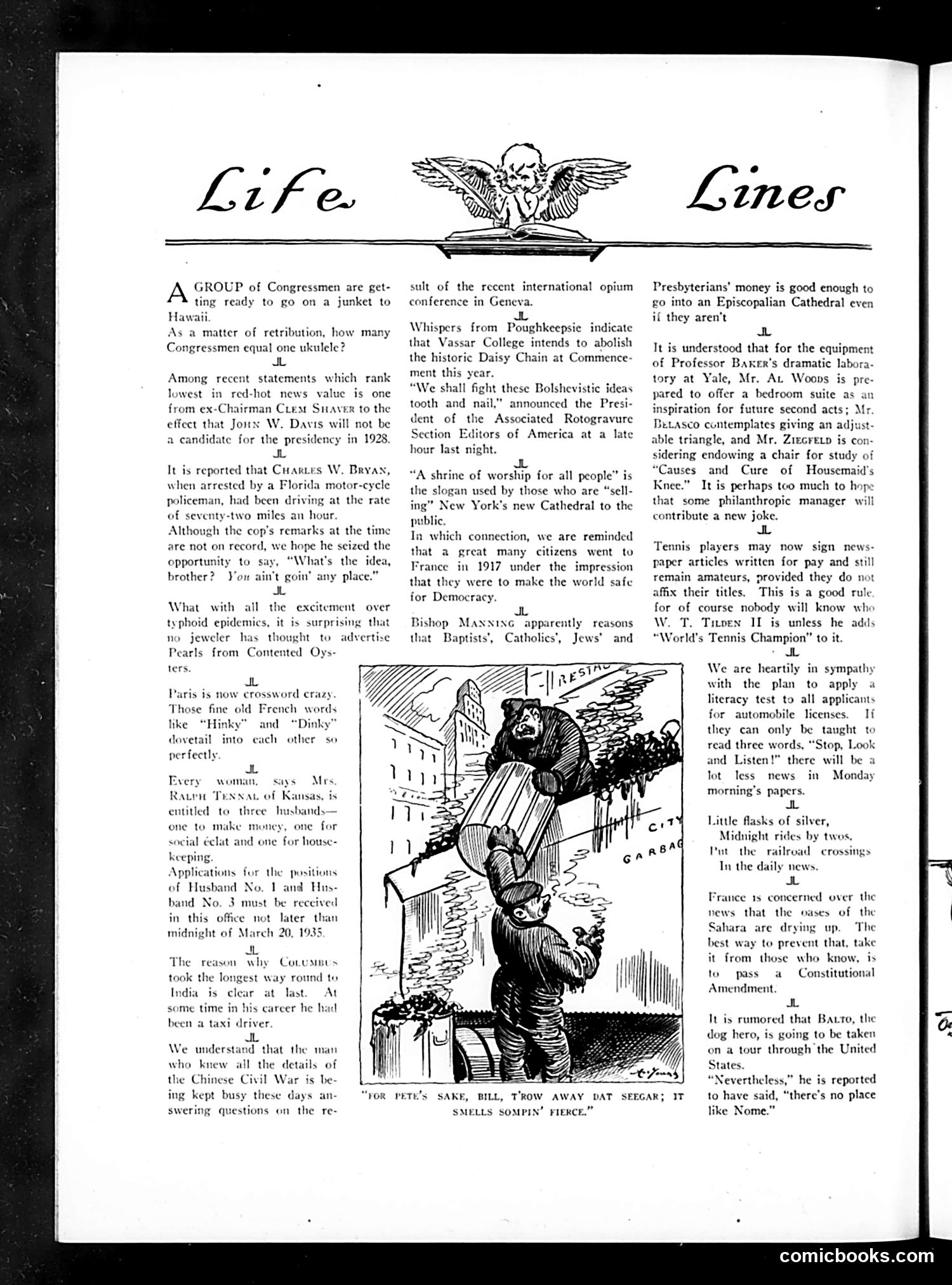
This is a humor column featuring brief satirical observations about contemporary events and figures. The central cartoon depicts a figure dumping garbage, with the caption "FOR PETE'S SAKE, BILL, T'ROW AWAY DAT SEWAGE; IT SMELLS SOMPIN' FIERCE." The cartoon appears to be political satire, likely criticizing government or civic corruption—using garbage/sewage as a metaphor for political refuse or scandal that needs removing. The surrounding text includes quips about: Congressmen visiting Hawaii, a Florida motorist's speeding ticket, the new Episcopal Cathedral, crossword puzzles, and a dog named Balto touring America. The items are typical of 1930s social commentary—mixing lighthearted observations with subtle jabs at contemporary politics and culture. The overall tone is irreverent middle-class American humor.
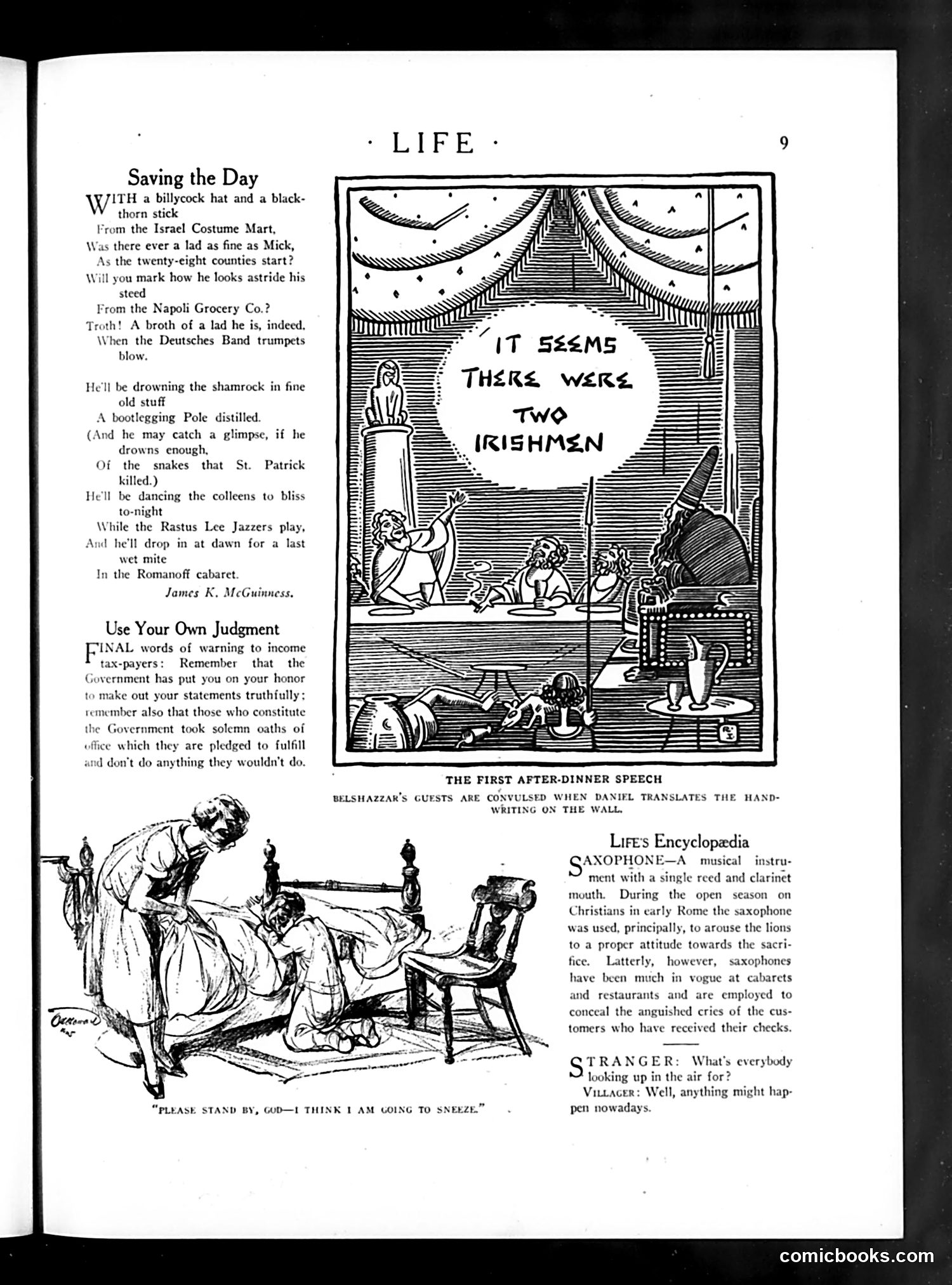
This page contains three distinct pieces: 1. **"Saving the Day"** (poem by James K. McGuinness): A humorous verse about an Irish immigrant's assimilation, referencing contemporary ethnic shops (Israel Costume Mart, Napoli Grocery) and entertainment (Rastus Lee Jazzers—a racist minstrel reference). It satirizes the cosmopolitan urban experience circa 1920s. 2. **"It Seems There Were Two Irishmen"** (cartoon): A captioned illustration showing an after-dinner speech scenario where a character named Daniel translates mysterious wall handwriting, apparently revealing an Irish joke's punchline. The humor relies on ethnic stereotyping common to the period. 3. **"Life's Encyclopedia" (Saxophone entry)**: A brief informational piece, with an unrelated cartoon showing a woman preparing to sneeze, captioned "Please stand by, God—I think I am going to sneeze." The page exemplifies Life's satirical humor targeting immigrant communities and ethnic groups.
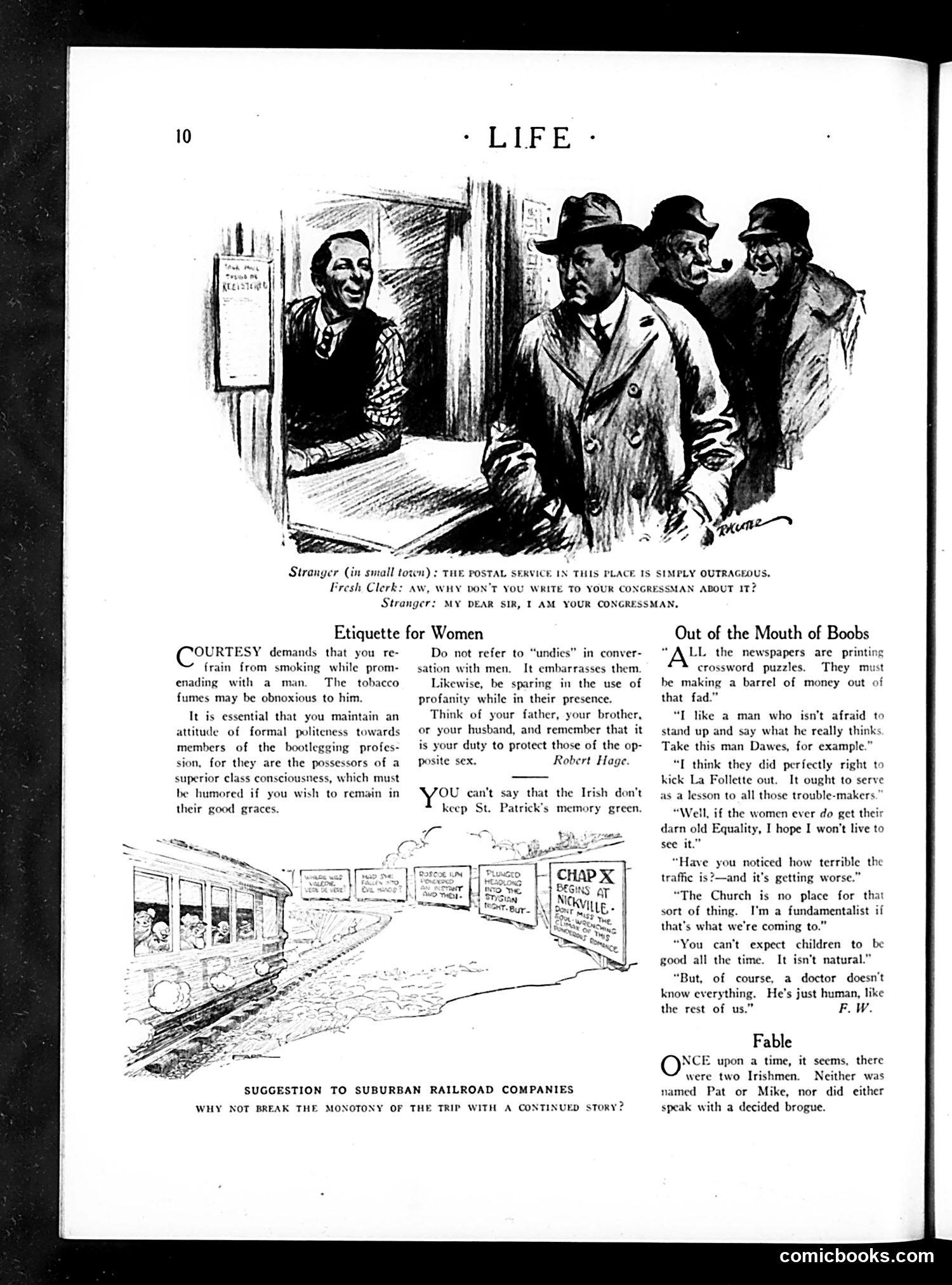
**Top Cartoon:** A postal clerk cheerfully serves a customer while three men wait outside. The "Stranger" complains that postal service is "simply outrageous," prompting the clerk to suggest he write his congressman. The stranger replies he *is* the congressman. This satirizes congressional complaints about government services—politicians criticizing institutions they themselves oversee, or the ineffectiveness of writing to representatives who themselves find services inadequate. **Railroad Cartoon:** Suggests suburban railroad companies break up monotonous trips with "continued story" serialization, showing a train with sequential story panels on its side. This mocks both railroad boredom and the era's serial fiction format. The remaining content includes etiquette advice, a brief fable, and editorial commentary on contemporary social issues.
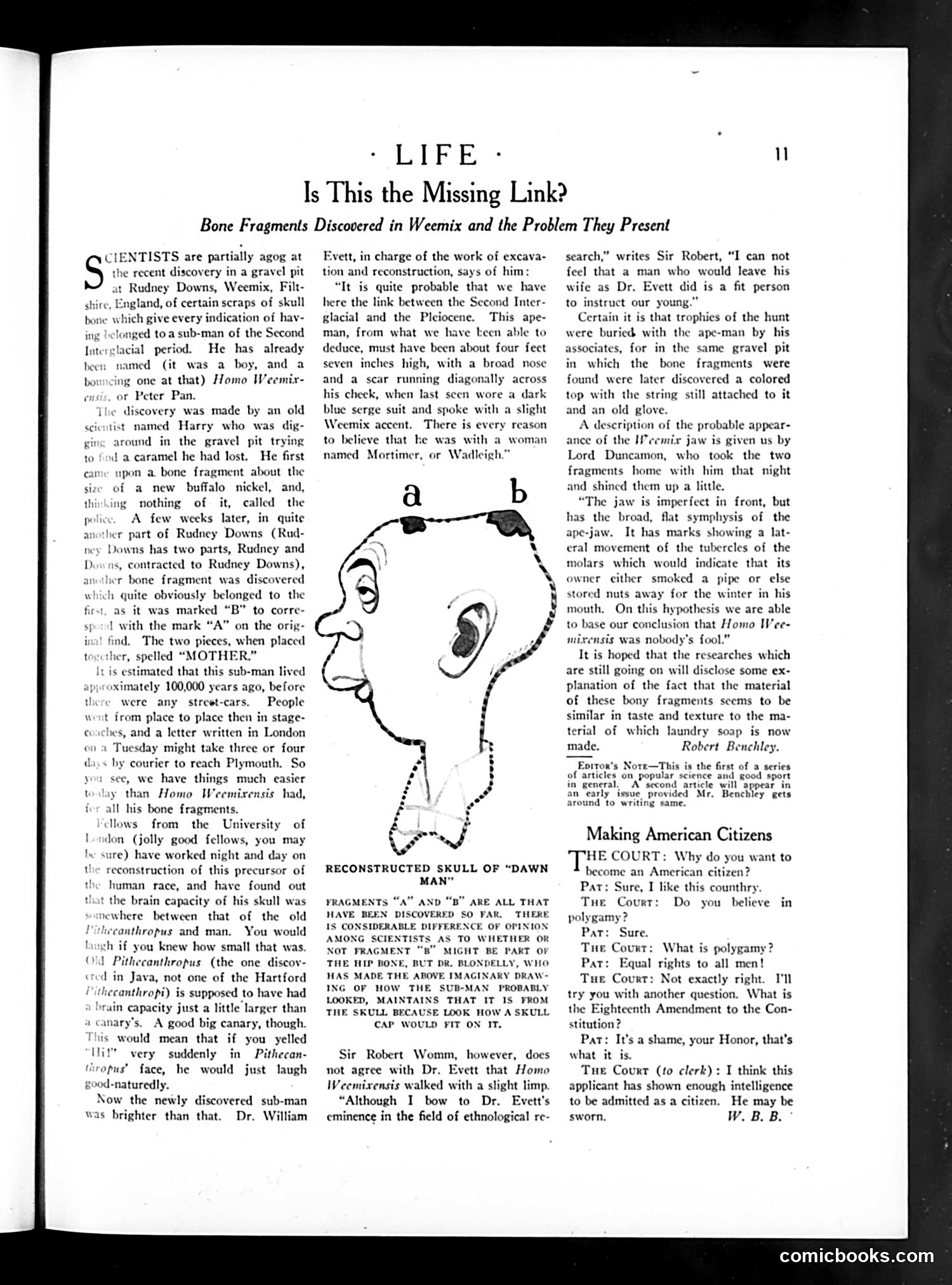
This page discusses the discovery of bone fragments at Rudney Downs, Weemix, in England—purportedly evidence of a "missing link" between apes and humans. The cartoon shows a reconstructed skull labeled "Dawn Man" with two skull fragments (labeled A and B) that scientists debated whether to include. The satire mocks scientific disagreement: scientists disagreed on whether these bones proved *Homo wremensis* walked upright or had ape-like characteristics. The page humorously presents this debate between Dr. Evett and Sir Robert Womm as a serious dispute about human evolution. The accompanying courtroom dialogue satirizes the absurdity of determining evolutionary evidence through quasi-legal argument rather than rigorous science—poking fun at both scientific speculation and bureaucratic procedures.
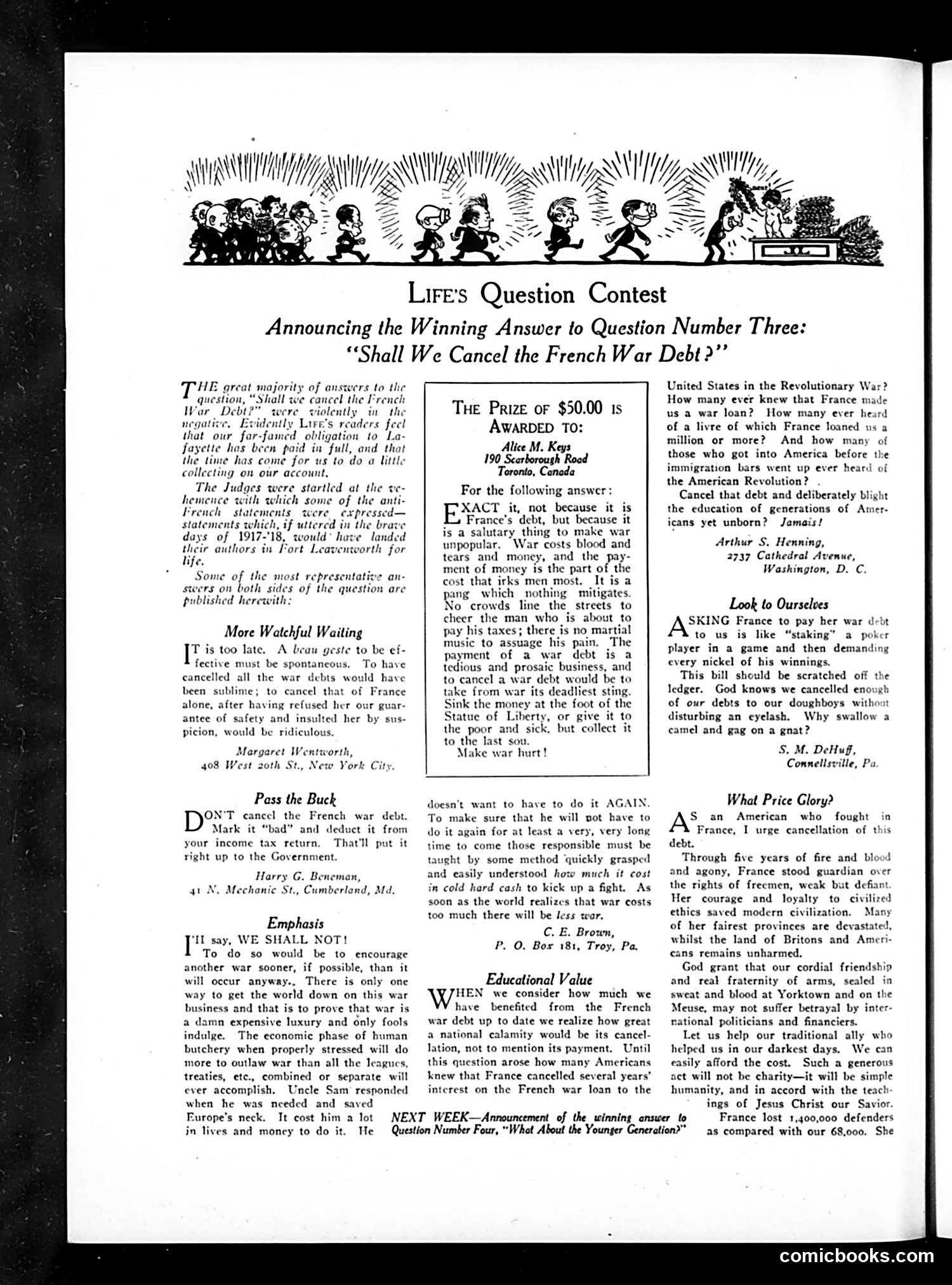
This page announces the winning answer to a Life magazine contest question: "Shall We Cancel the French War Debt?" The winner, Alice M. Kerr, received $50 for arguing that France's debt shouldn't be cancelled—not because it's France's obligation, but because war itself is immoral and expensive. Her logic: cancelling debts won't stop future wars; instead, making war economically painful deters conflict. The other published responses debate whether America should forgive France's WWI loan. Some argue forgiveness encourages future wars; others contend that France suffered greatly and deserves mercy. The satirical premise: readers proposing clever solutions to an intractable post-WWI diplomatic problem—France's inability to repay American loans amid European economic devastation.
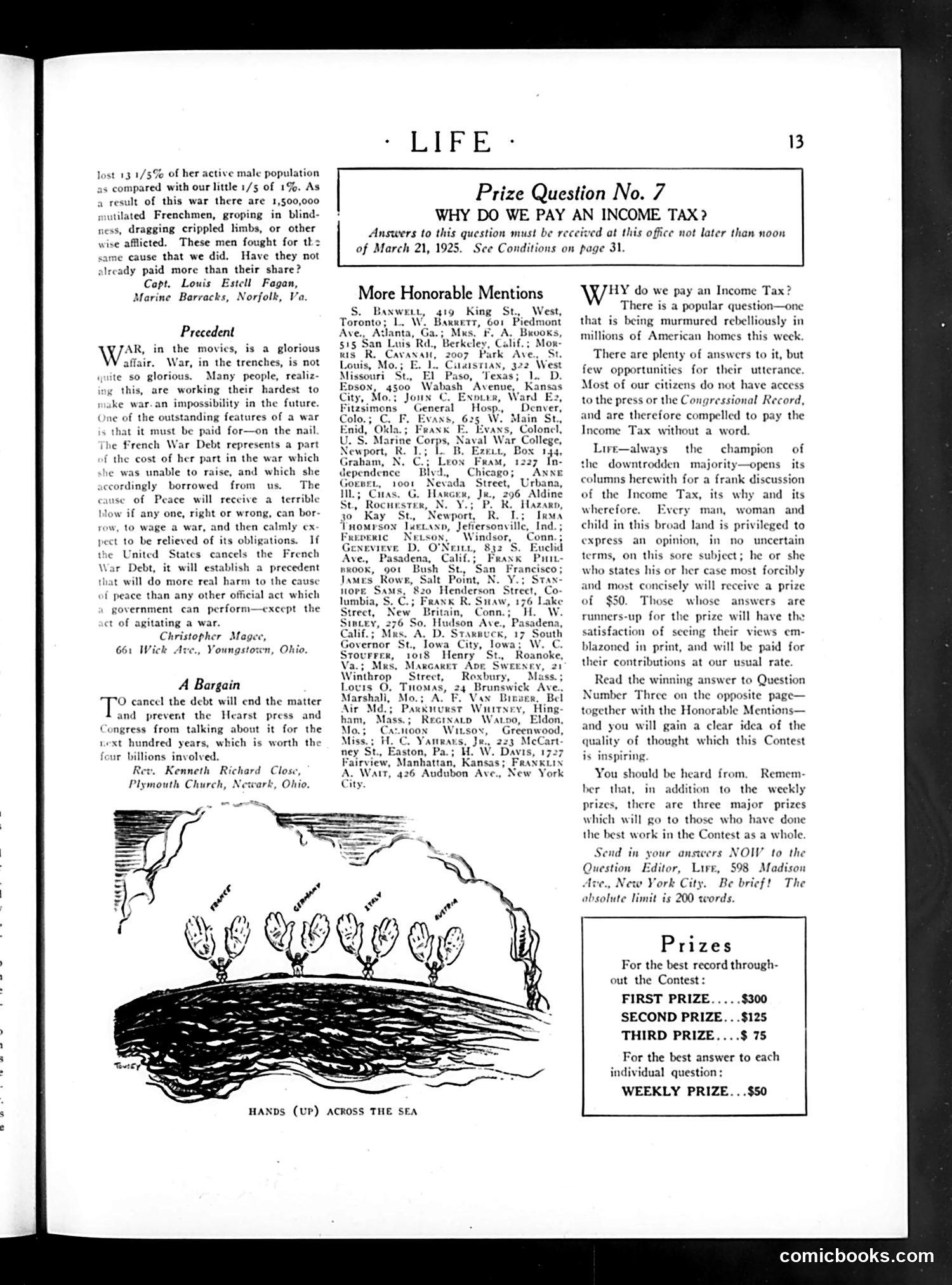
This page contains three elements: **Prize Question No. 7** asks "Why Do We Pay an Income Tax?" — soliciting reader responses for publication and prizes (first prize $300). **"More Honorable Mentions"** lists readers' names whose previous contest answers were published. **"A Bargain"** is a brief satirical piece mocking the national debt, suggesting canceling it would solve financial problems—likely commentary on post-WWI debt concerns. The cartoon **"Hands (Up) Across the Sea"** depicts hands emerging from water reaching upward, symbolizing international cooperation or possibly appeals for aid across the Atlantic—a reference to post-war transatlantic relations. The overall page reflects 1925 concerns: war debt, taxation, and international relations during the interwar period.
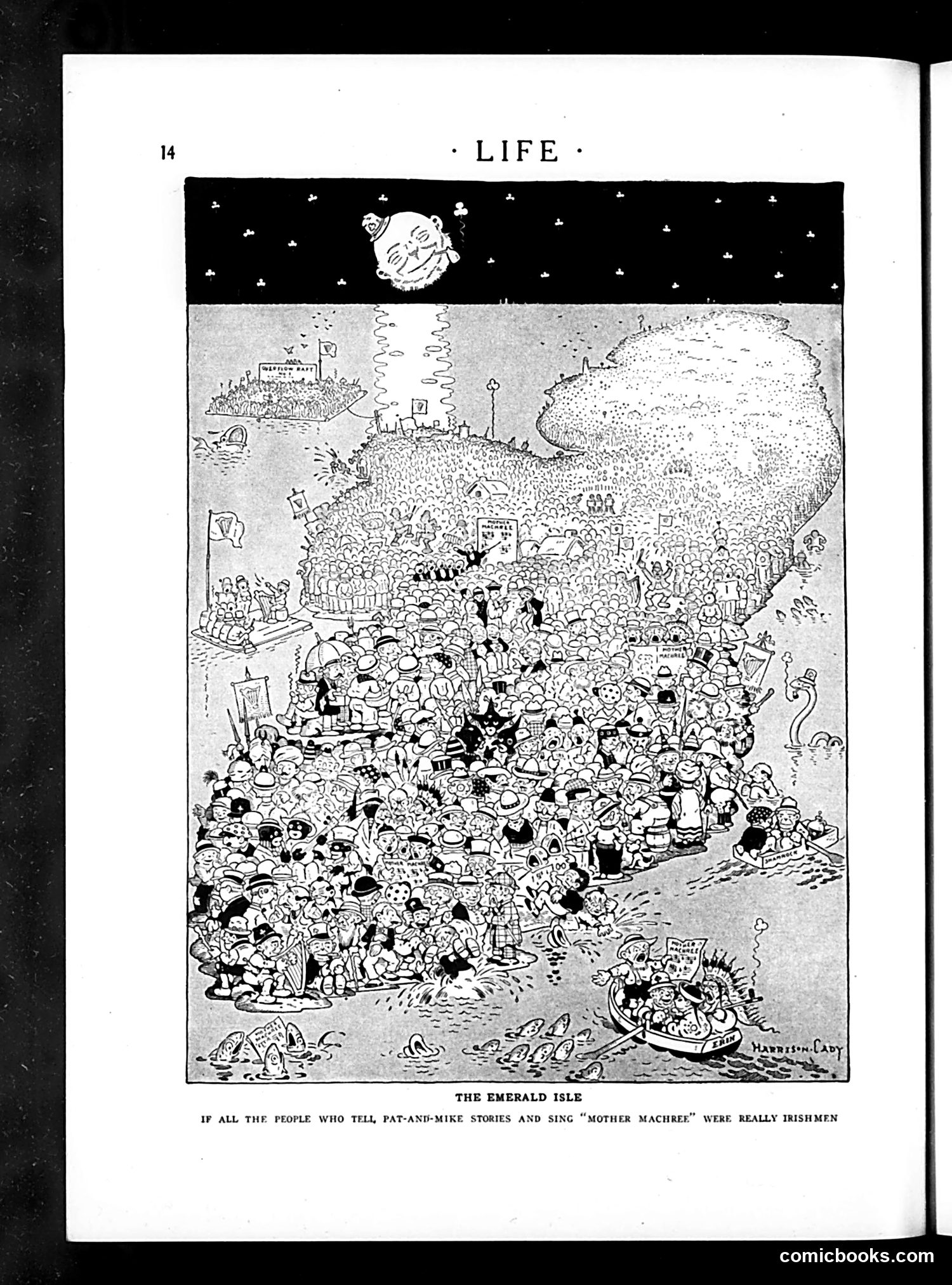
This satirical cartoon depicts a densely crowded island labeled "The Emerald Isle" (Ireland). The caption reads: "If all the people who tell Pat-and-Mike stories and sing 'Mother Machree' were really Irishmen." The cartoon mocks American stereotyping of Irish identity. It suggests that Irish-American culture—particularly the popularized "Pat-and-Mike" dialect humor stories and sentimental songs like "Mother Machree"—was so pervasive in American popular culture that if all Americans who performed these caricatures were actually Irish, Ireland would be impossibly overcrowded. The joke critiques how thoroughly Irish stereotypes had saturated American entertainment and society, while implying these stereotypes didn't authentically represent Irish people. The artist is Harrison Cady, visible in the bottom right signature.
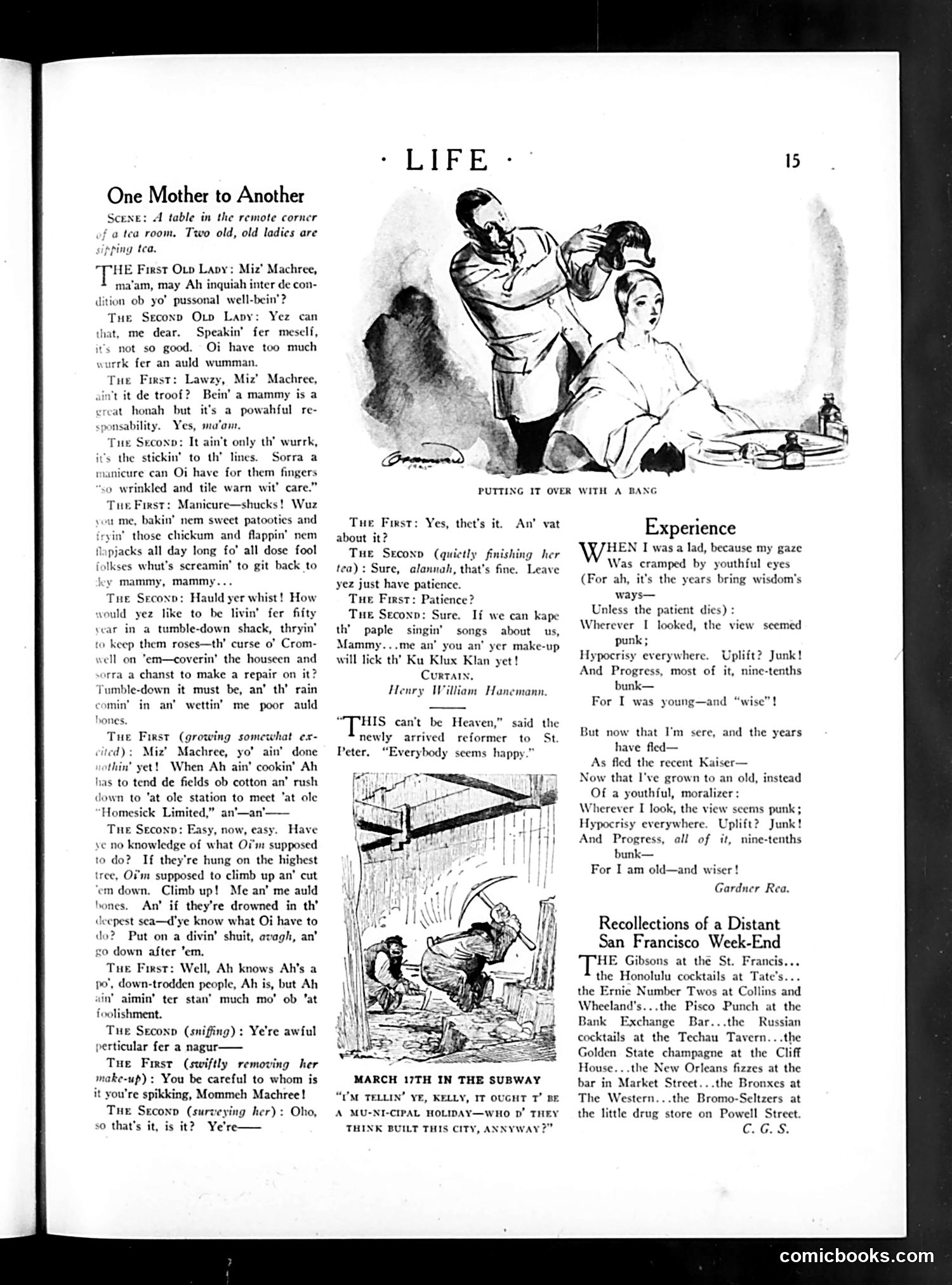
This page contains theatrical sketches and humorous commentary rather than political cartoons. The top sketch, "One Mother to Another," depicts two elderly women gossiping over tea, discussing motherhood's burdens—particularly managing adult children and domestic responsibilities. The humor derives from working-class dialect and relatable domestic complaints. The middle illustration, "Putting It Over with a Bang," shows a man applying cosmetics to a woman, satirizing the cosmetics industry and beauty standards. Below, "March 17th in the Subway" appears to mock St. Patrick's Day celebrations and subway crowding. The text pieces—"Experience" and "Recollections of a Distant San Francisco Week-End"—are reflective essays on aging and nostalgia, not political satire. The content targets social customs and personal memory rather than current events.
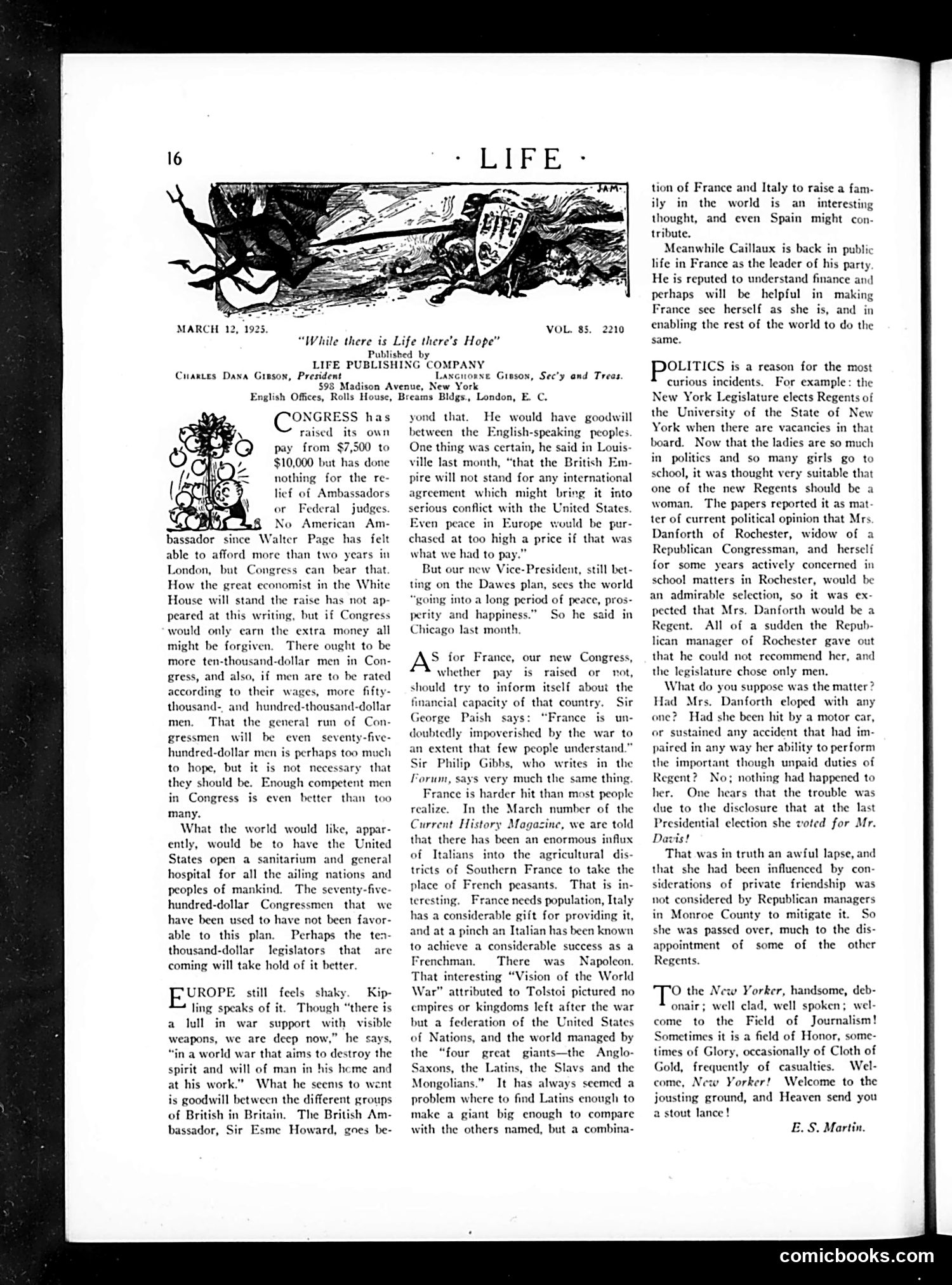
The page features editorial commentary rather than cartoons. The masthead cartoon shows a figure labeled "LIFE" emerging from rubble—likely representing the magazine's satirical mission to comment on contemporary chaos. The main editorials critique Congress's self-interested pay raise ($7,500 to $10,000) while neglecting ambassadors and federal judges. The author sarcastically suggests this may improve legislative quality, but doubts it. A second section discusses post-WWI European instability. It references Vice President Dawes's optimism about peace and prosperity, contrasts British and French financial hardship, and notes Italian immigration into depleted southern France. The final passage references Tolstoy's vision of post-war world governance organized around four "great giants"—Anglo-Saxons, Latins, Slavs, and Mongolians—humorously questioning whether sufficient Latin populations exist. The overall tone is skeptical of American government competence and post-war international reconstruction efforts.
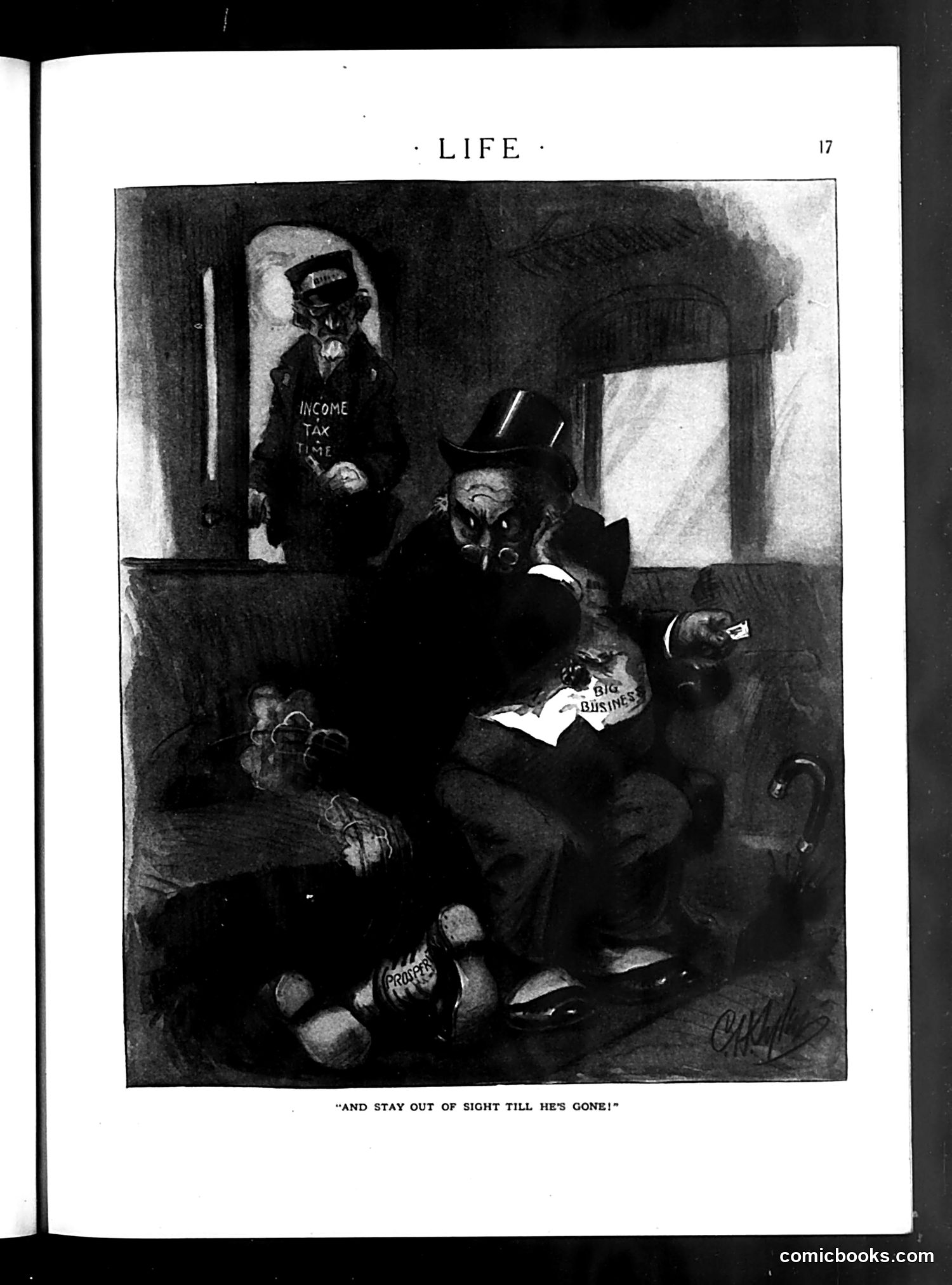
This satirical cartoon depicts personified figures representing "Income Tax" and what appears to be "Big Business" hiding from an approaching authority figure. The skeleton-like character labeled "INCOME TAX" lurks in a doorway while another figure crouches below, clutching papers marked "BIG BUSINESS." The caption—"And stay out of sight till he's gone!"—suggests tax evasion or avoidance. The cartoon satirizes the relationship between wealthy business interests and tax authorities, implying that big business and income tax obligations are in collusion to hide from governmental oversight or inspection. The dark, shadowy style emphasizes the secretive, illicit nature of the activity being mocked. This reflects early-to-mid 20th-century American anxieties about corporate tax avoidance and regulatory capture.
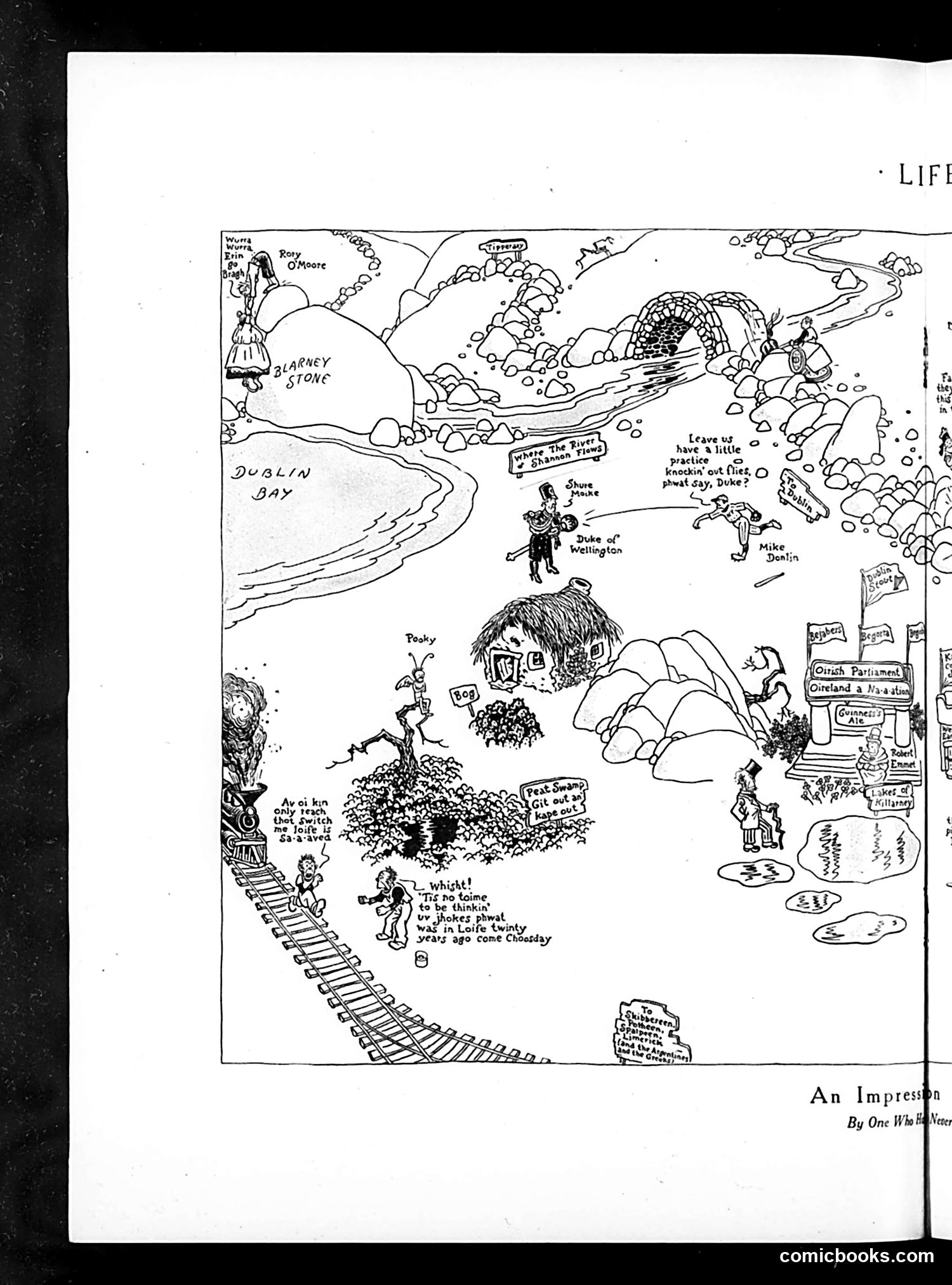
This appears to be a satirical map or landscape illustration titled "An Impression By One Who Had Never" (text cuts off). The cartoon depicts various Irish stereotypes and references, including characters with Irish dialect ("phwat," "Loife," "Choosday"). Labeled locations include "Blarney Stone," "Dualin Bay," and references to Irish landmarks and figures like the "Duke of Wellington." There's a small train or railway element at the bottom. The humor relies on exaggerated Irish brogue spelling and what appears to be mockery of Irish cultural tropes—typical of early-to-mid 20th century American satire that often caricatured Irish immigrants and Irish identity. The crude dialects and stereotypical imagery reflect attitudes common in that era's popular media, though such depictions would be considered offensive today.
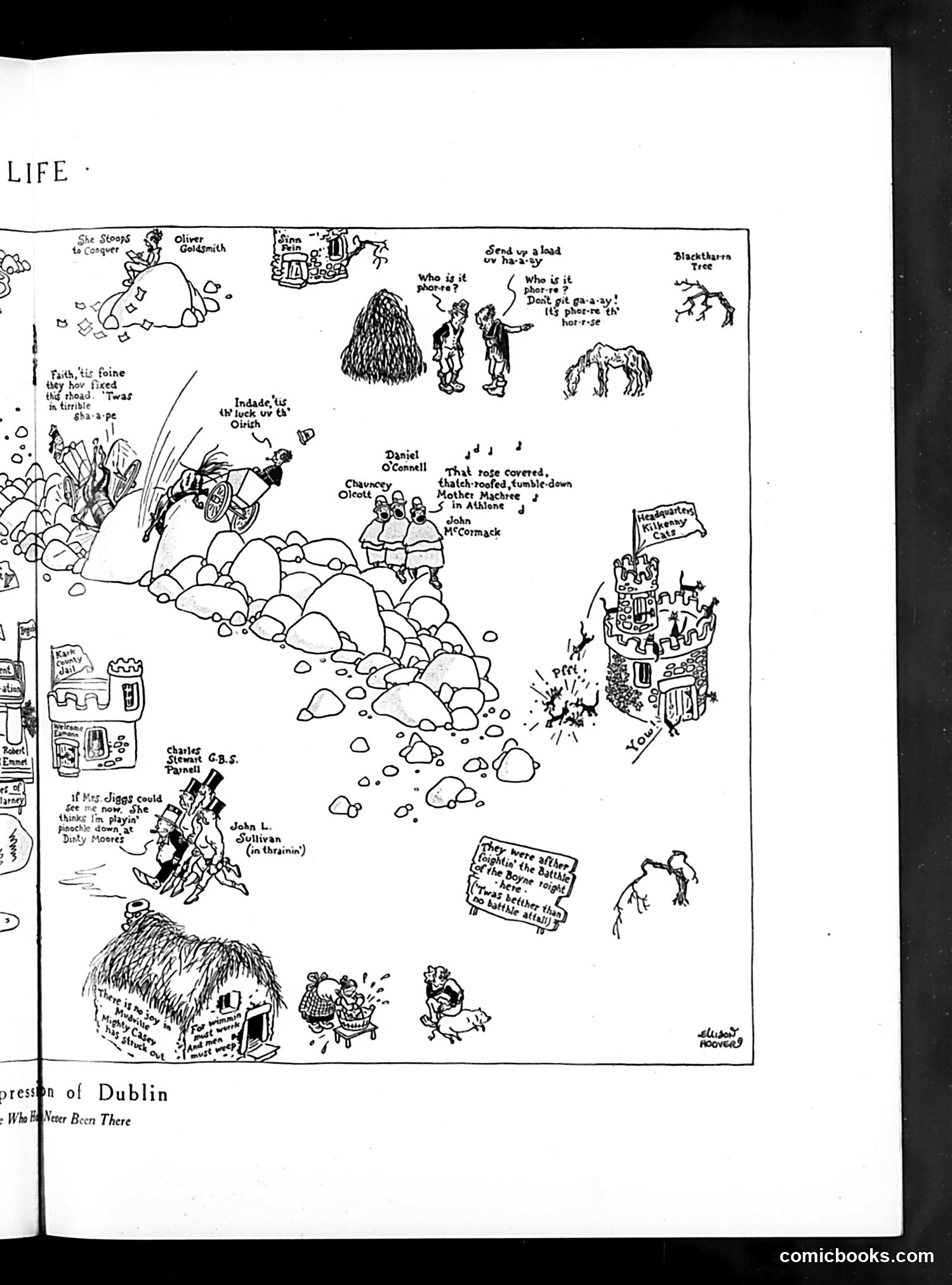
This appears to be a satirical map/illustration of Dublin life, likely from the early 20th century, depicting Irish cultural stereotypes and literary references popular in American humor of that era. The cartoons reference Irish literature and cultural figures: "She Stoops to Conquer" (Oliver Goldsmith play), Daniel O'Connell (Irish nationalist leader), and "Mother Machree" (sentimental Irish song). Characters like "Dinty Moore" suggest working-class Irish stereotypes. The scattered vignettes—featuring thatched cottages, rural scenes, and phonetically-rendered Irish dialect—mock Irish "stage Irishness" as understood by American audiences. The humor relies on exaggerated Irish-ness: pastoral simplicity, superstition (blackthorn tree), and quaint poverty presented as charming. This reflects how Life magazine satirized ethnic groups through caricature, treating Irish identity as exotic and comedic for middle-class American readers unfamiliar with actual Irish life.
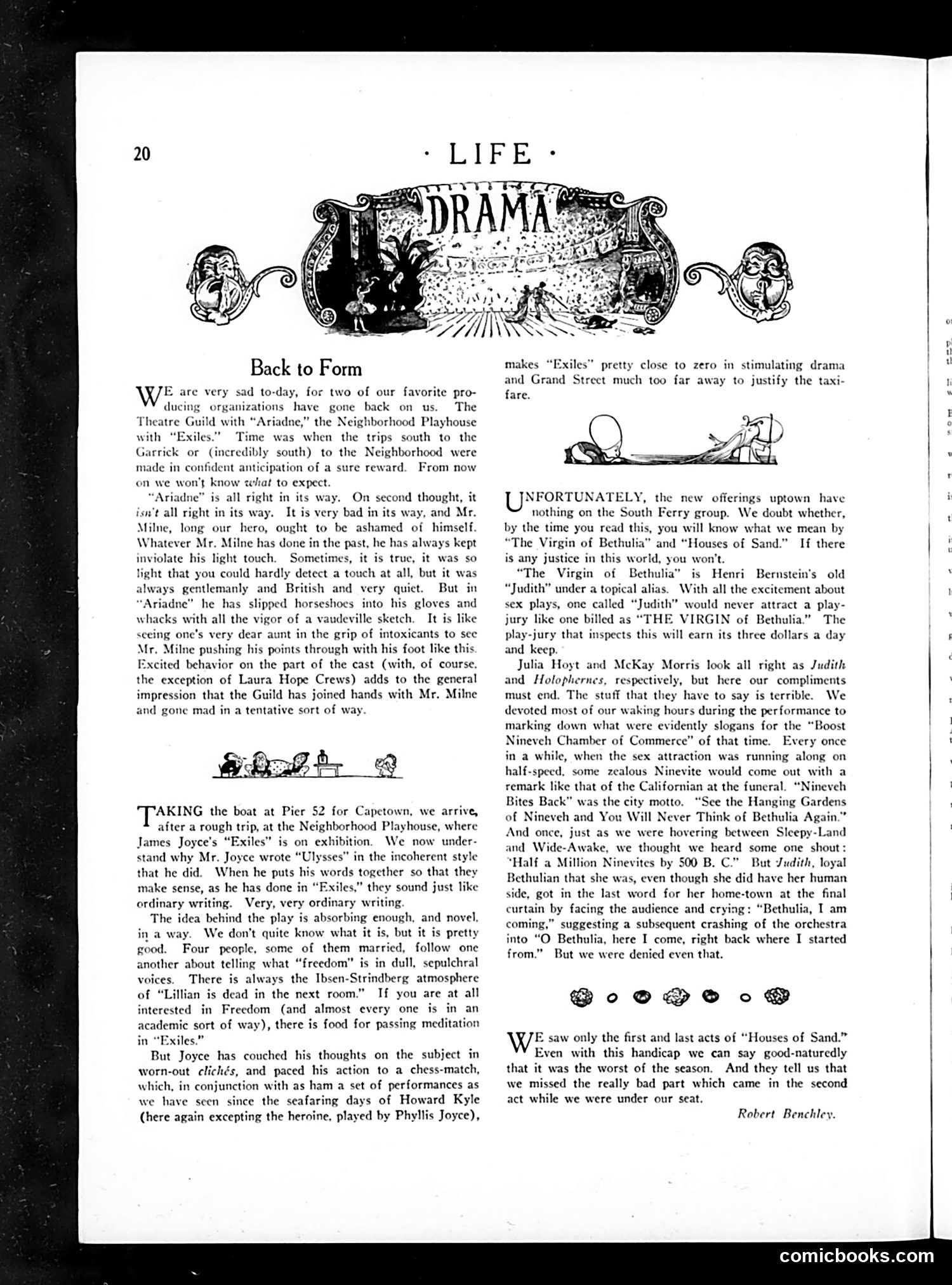
This is a theater review column critiquing three Broadway productions. The critic laments that prestigious theaters—the Theatre Guild and Neighborhood Playhouse—have disappointed audiences. **Key references:** - **"Ariadne"** by A.A. Milne: The reviewer criticizes Milne for abandoning his signature "light touch" comedy style, comparing his clumsy dramatic efforts to "horseshoes in gloves" - **"Exiles"** by James Joyce: The critic mocks the play as dull despite ambitious themes about freedom, suggesting Joyce should have stuck to his deliberately obscure writing style (like *Ulysses*) - **"The Virgin of Bethulia"**: A retitled Bernstein play that cynically substitutes the biblical "Judith" with a sexually suggestive title to attract audiences The satire targets artistic pretension and commercial dishonesty—established artists abandoning their strengths, and producers repackaging old material with sensational marketing. The tone is witty but dismissive of all three productions.
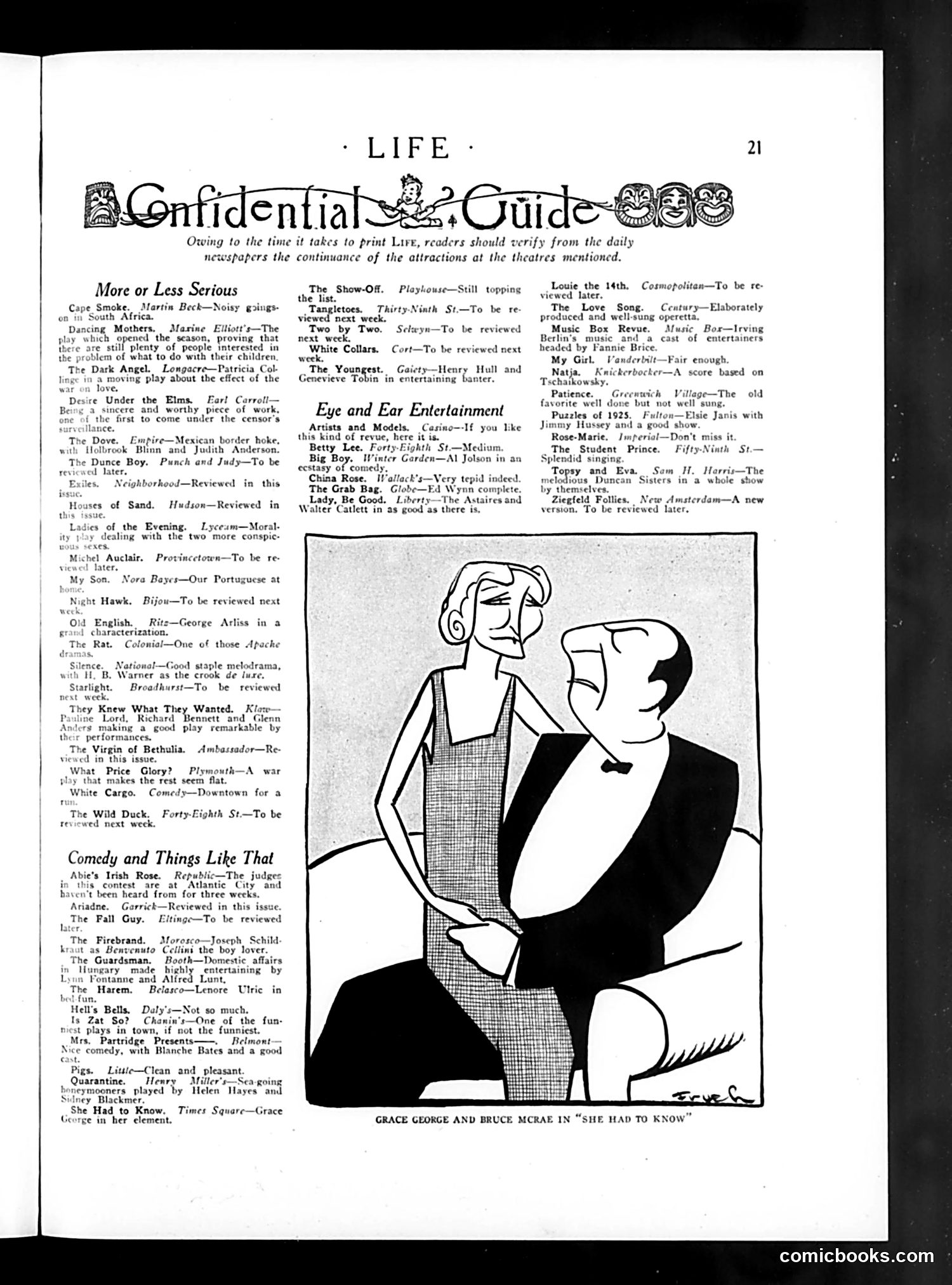
This page is a **theatre review guide** from Life magazine, listing Broadway and other stage productions currently running, with brief critical notes and performance details. The **cartoon** at the bottom depicts a scene from "She Had to Know," showing Grace George and Bruce McRae in what appears to be a comedic romantic or domestic moment—she looks surprised or amused while he gazes at her intently. The illustration is typical 1920s theatrical promotion art. The context: This is from the **Jazz Age era** (likely early-to-mid 1920s based on shows listed). Life functioned partly as an entertainment guide. Notably, many plays address serious post-WWI themes ("The Dark Angel" about war's effect on love, "What Price Glory?" a war play), alongside comedies and musicals. The prevalence of revues ("Artists and Models," "Music Box Revue") and Al Jolson references reflect popular entertainment of the period. This page isn't satirical—it's straightforward theatrical coverage for urban audiences planning their entertainment.
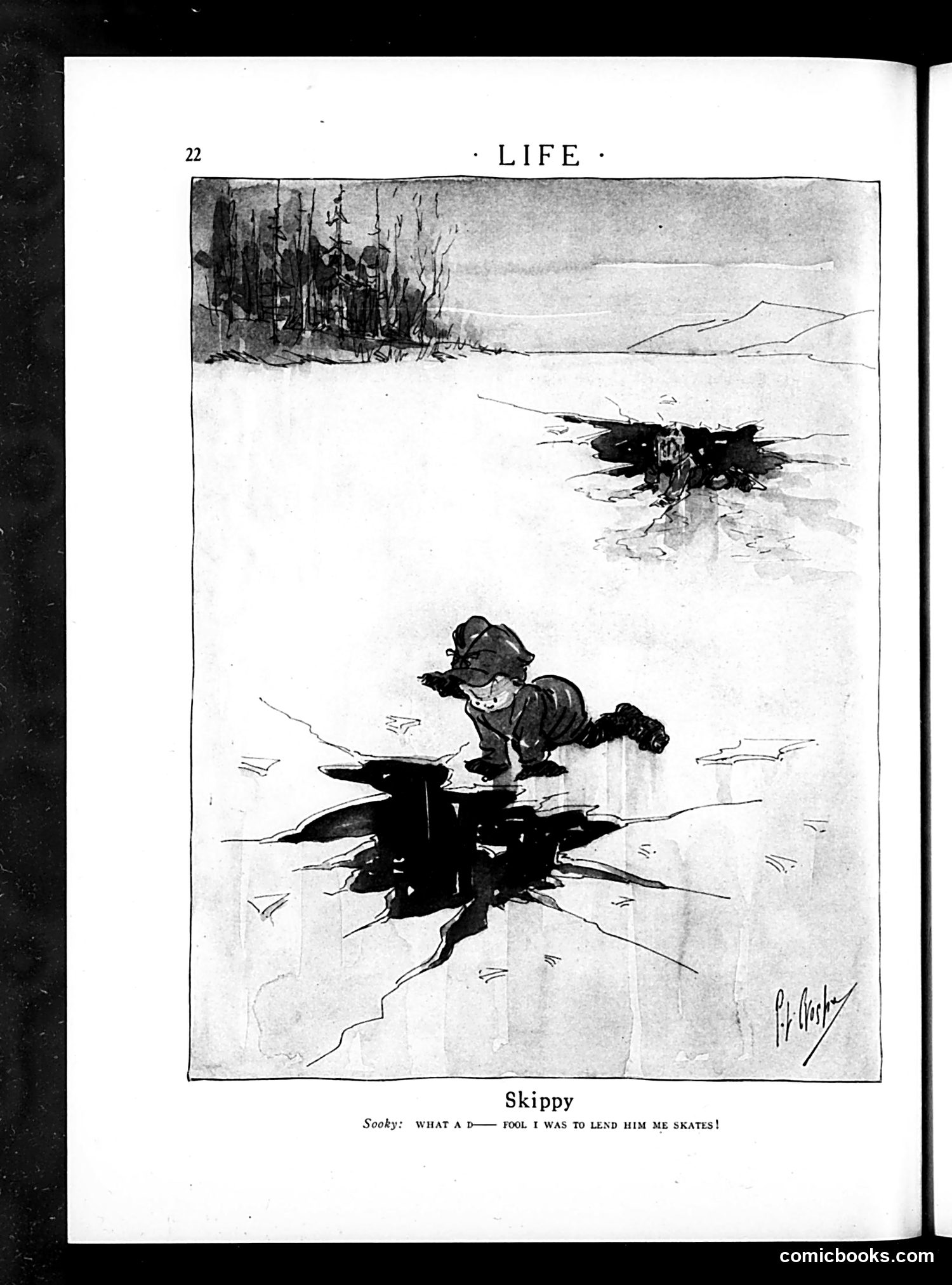
This is a cartoon from *Life* magazine featuring "Skippy," a popular comic strip character of the early 20th century. The scene depicts a winter mishap: a child has fallen through ice while wearing borrowed skates, creating a dramatic splash. Another character (Sooky) expresses regret at having lent the skates, using period slang ("D—— fool"). The humor is straightforward slapstick—a cautionary tale about lending possessions to careless children. The artistic style, with its sketchy ink work and snow-covered landscape, emphasizes the comedic disaster. There's no apparent political satire here; rather, it's gentle domestic humor about childhood misadventures and the consequences of poor judgment, typical of *Life*'s lighter entertainment content.
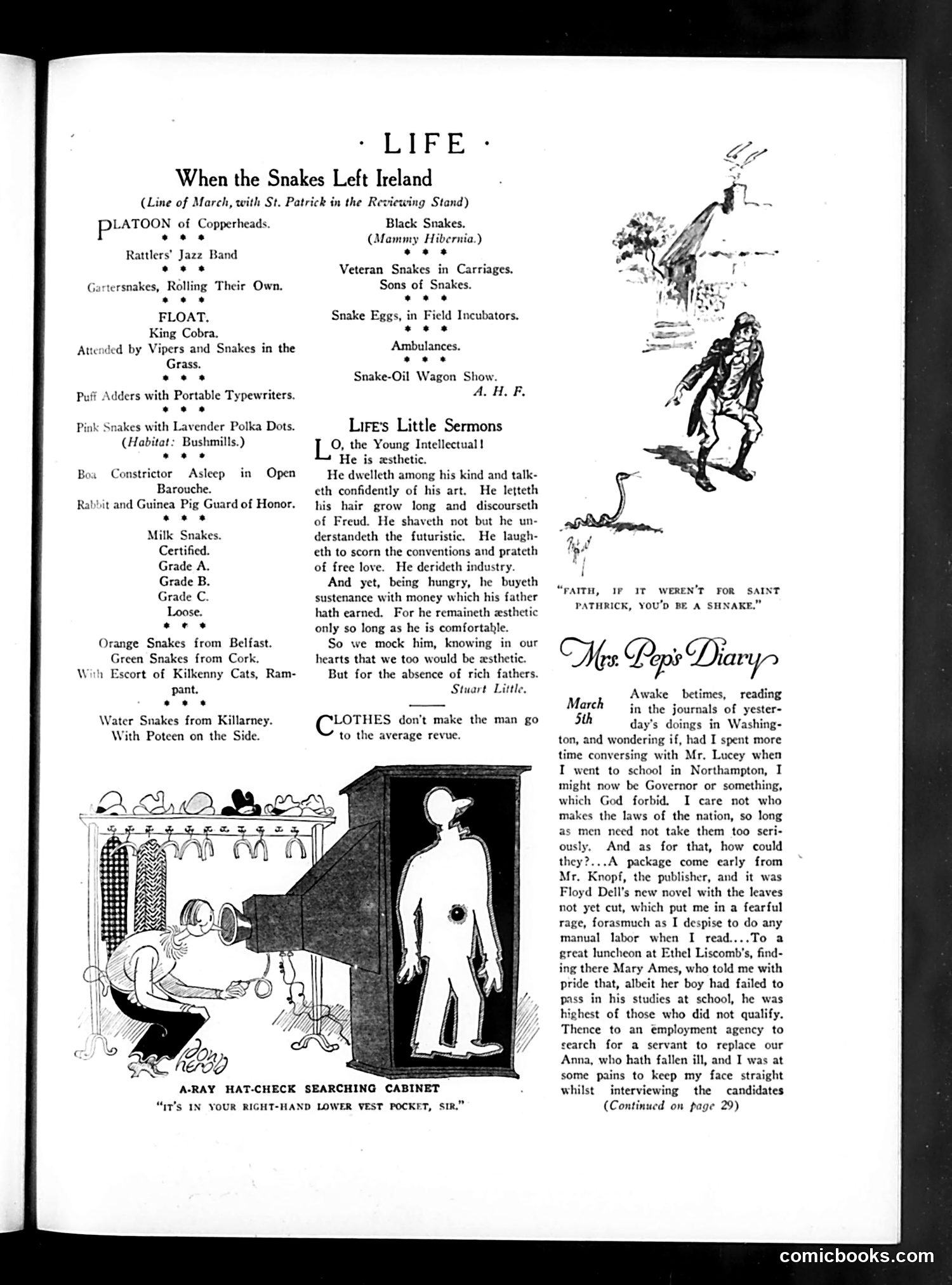
This satirical piece uses snakes as a metaphor for Irish people and Irish-American stereotypes, referencing St. Patrick's legendary expulsion of snakes from Ireland. The parade listing mocks various Irish ethnic and regional identities: "Copperheads," snakes from Belfast and Cork with "Kilkenny Cats," references to Irish whiskey ("Poteen"), and "Mammy Hibernia" (a stereotype of Irish motherhood). The humor targets Irish-American stereotypes—including criminality ("vipers," "snakes in the grass"), labor ("garter snakes rolling their own" cigarettes), and bootlegging ("Snake-Oil Wagon Show"). The piece suggests Irish immigrants as undesirable, using the biblical parallel of expulsion. This reflects early 20th-century anti-Irish prejudice common in American popular media, where Life published such content aimed at educated, presumably non-Irish audiences.
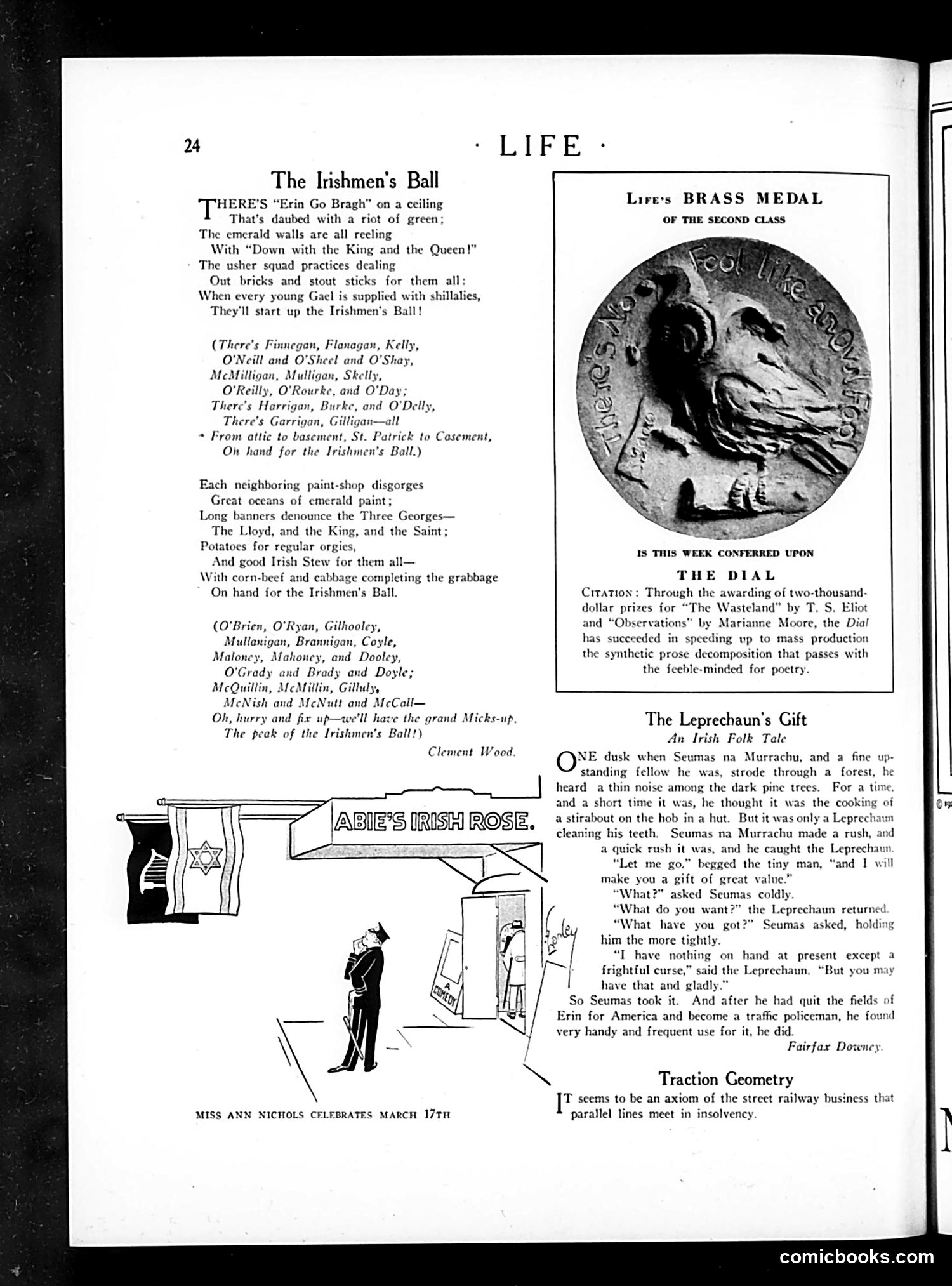
This poem by Clement Wood satirizes Irish-American St. Patrick's Day celebrations (March 17th, referenced in the illustration's caption). The satire operates on multiple levels: **The Stereotype:** The poem catalogs exclusively Irish surnames and stereotypical Irish cultural markers—emerald green, shillelagies (fighting sticks), corned beef and cabbage, potatoes—suggesting Life magazine viewed Irish-American identity as one-dimensional and performative. **Political Edge:** References to "Down with the King and the Queen" and banners denouncing "the Three Georges" and "Casement" (likely Roger Casement, Irish nationalist executed by Britain) imply Irish-Americans were seen as harboring anti-British republican sentiment, a concern during this era. **Class Mockery:** The emphasis on drinking, fighting, and crude celebration positions Irish-Americans as rowdy, working-class troublemakers unsuitable for refined American society. The illustration shows "Abie's Irish Rose," likely referencing the popular 1922 play about interfaith marriage, suggesting tensions around Irish-American assimilation.
This is primarily a **cigar advertisement**, not a political cartoon. The page features a photograph showing someone examining what appears to be gold coins or medallions with a magnifying glass. The ad's logic is a straightforward commercial comparison: just as a ten-dollar gold piece contains the same quality gold as a fifty-dollar piece (regardless of face value), Medalist Junior cigars offer equivalent quality to their larger "celebrated Medalist Cigar" counterpart, but in smaller "runabout size" at a lower price point (20 for $1.00). The visual demonstrates the concept of comparing items of different sizes/values to establish quality equivalence. There is no political satire here—this is simply an early-20th-century marketing strategy comparing a budget product favorably to premium offerings.
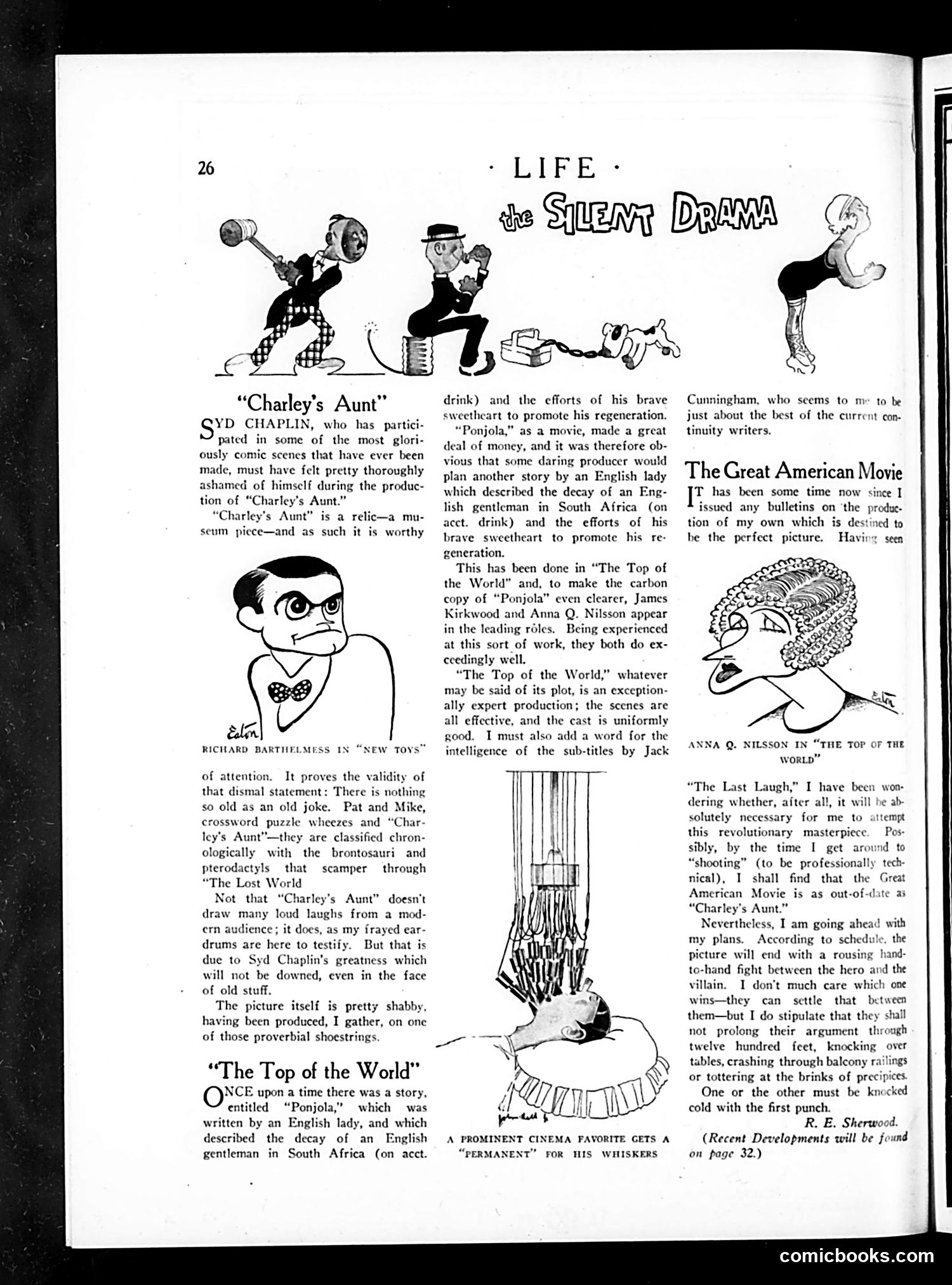
This 1920s *Life* magazine page reviews silent films, critiquing their artistic merit and originality. **"Charley's Aunt"** is mocked as an ancient, worn-out theatrical property—the reviewer suggests it's as outdated as dinosaurs. However, Syd Chaplin's acting talent salvages the production despite its shabby, low-budget filmmaking. **"The Top of the World"** is criticized as a shameless carbon copy of an earlier successful film called "Ponjola"—both stories about an English gentleman's moral decay in South Africa and his sweetheart's redemptive efforts. The reviewer acknowledges the film is expertly made and well-acted (by James Kirkwood and Anna Q. Nilsson), but condemns its lack of originality. The cartoons illustrate Chaplin's physical comedy and show an actress receiving a permanent wave treatment. The final section is the author's tongue-in-cheek promise to create "The Great American Movie," humorously suggesting even his revolutionary masterpiece may become dated by the time he finishes it.
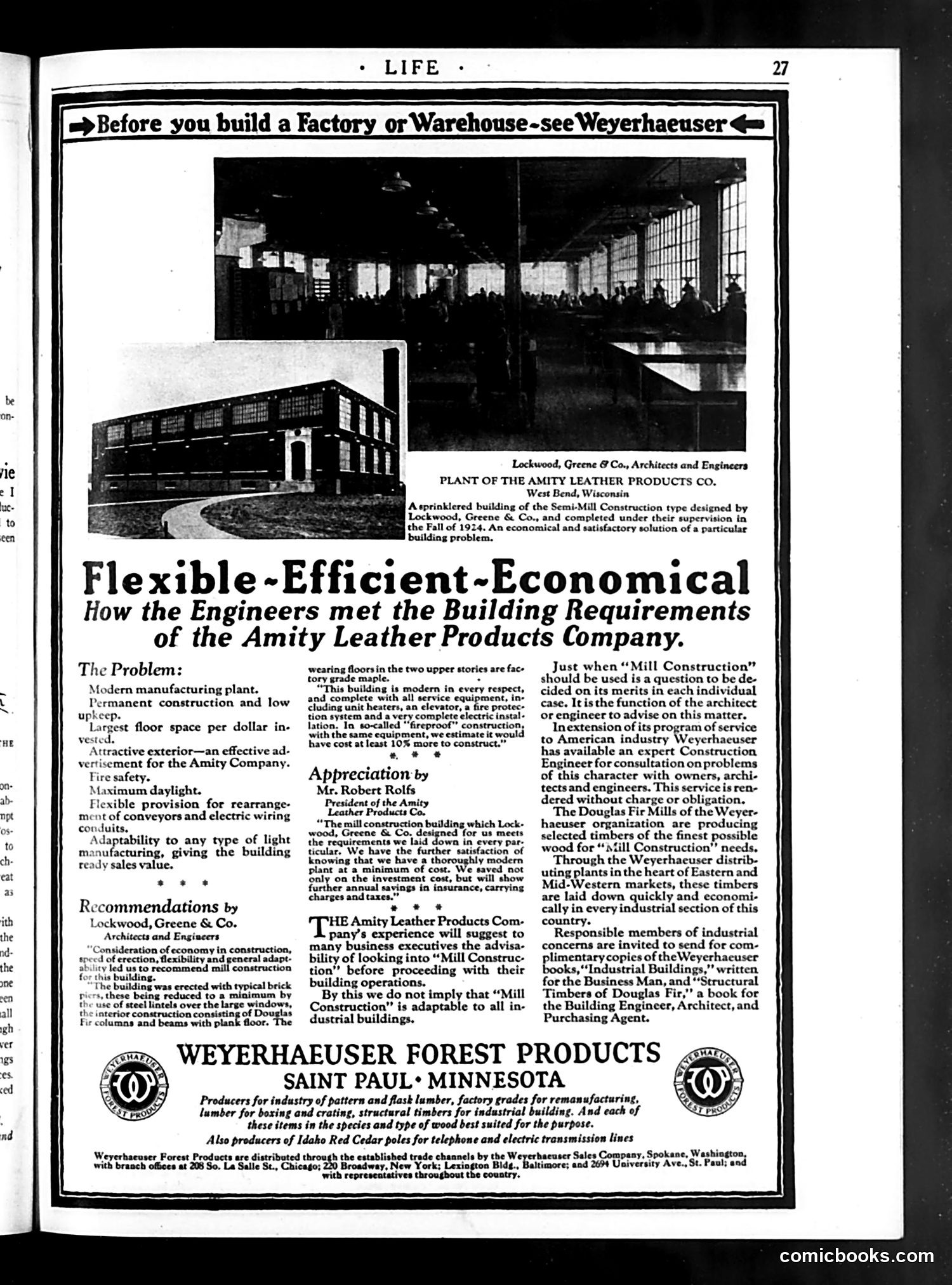
This is a full-page advertisement for Weyerhaeuser Forest Products, not a political cartoon. It presents a business case study of how the architecture firm Lockwood, Greene & Co. designed an economical factory for the Amity Leather Products Company in West Bend, Wisconsin using "mill construction"—a building method emphasizing wood beams and columns (particularly Douglas Fir) over expensive fireproof steel and masonry. The page showcases the problem-solving approach: meeting manufacturing needs (flexible space, safety, daylight, low costs) while reducing construction expenses by approximately 10% compared to fireproof construction. President Robert Rolfs's testimonial endorses the solution's practical and financial benefits. Weyerhaeuser uses this case study to promote their timber products and complimentary consulting engineer services to American industrial companies considering similar construction methods. The advertorial format blends editorial credibility with promotional messaging.
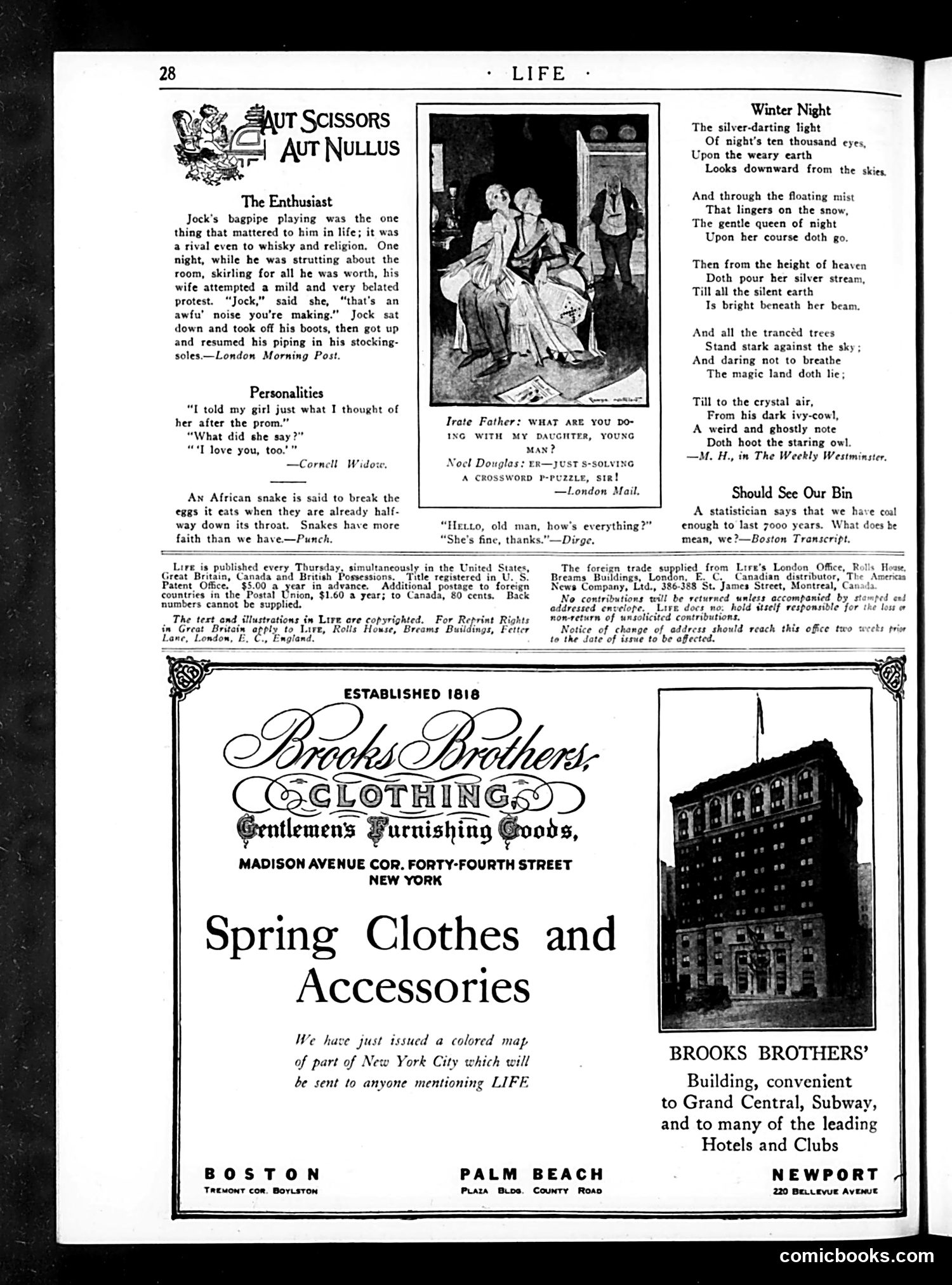
This page from *Life* magazine contains several brief humorous pieces typical of the publication's satirical style: **"The Enthusiast"** depicts a Scottish man (Jock) so obsessed with bagpipe playing that when his wife complains about the noise, he simply removes his boots and continues playing in his socks—prioritizing his hobby over domestic peace. The joke mocks single-minded enthusiasm. **"Personalities"** offers three short, witty anecdotes: a man telling his girlfriend his honest thoughts after a dance (she responds with unexpected affection); an irate father confronting a young man courting his daughter; and a statistician's quip about coal reserves lasting 7,000 years, with someone sardonically asking "what does he mean, we?"—suggesting cynicism about humanity's future. The page also includes a romantic poem, "Winter Night," and concludes with advertisements for Brooks Brothers clothing and a crossword puzzle reference. The humor relies on gentle social observation and wordplay rather than sharp political commentary.
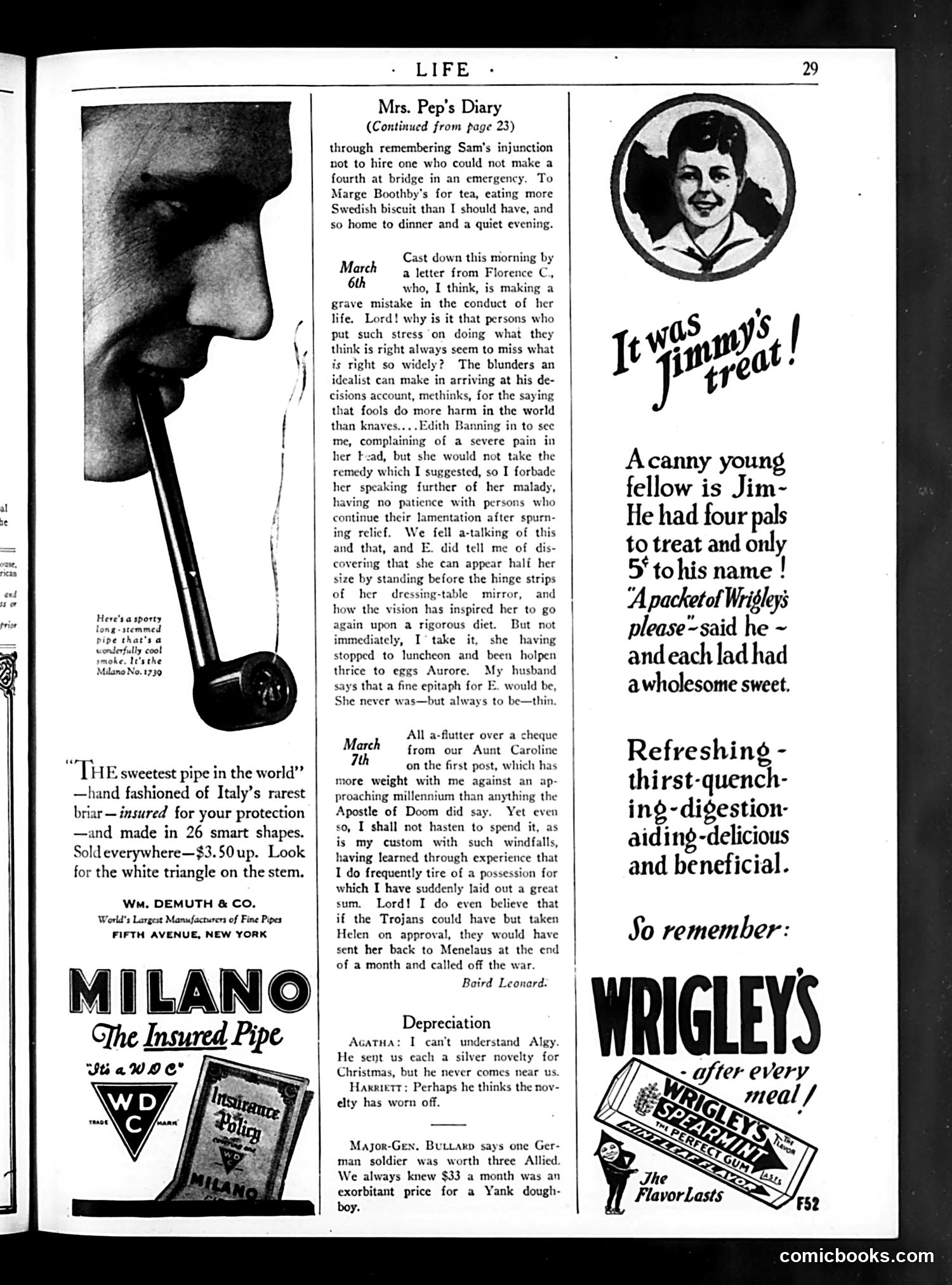
This page mixes editorial content with advertisements typical of Life's format. **Mrs. Pep's Diary** is a recurring satirical column mocking upper-class women's concerns: obsessing over bridge-playing qualifications for social emergencies, consuming Swedish biscuits while dieting, and judging a friend "Florence C." for being overly principled. The humor targets wealthy women's perceived shallow priorities and hypocritical behavior (notably the jab at "E." who claims to diet while eating three helpings of eggs). **"Depreciation"** contains three brief social commentary jokes, likely post-WWI. The final quip—equating German soldiers' claimed superiority to American soldiers' monthly $33 wage as "exorbitant"—sarcastically critiques either military pay scales or the war's cost. **Advertisements** for Milano pipes and Wrigley's gum occupy the remaining space, using period marketing language ("insured," "wholesome"). The page reflects 1920s Life's focus: satirizing American class pretensions while selling consumer goods.
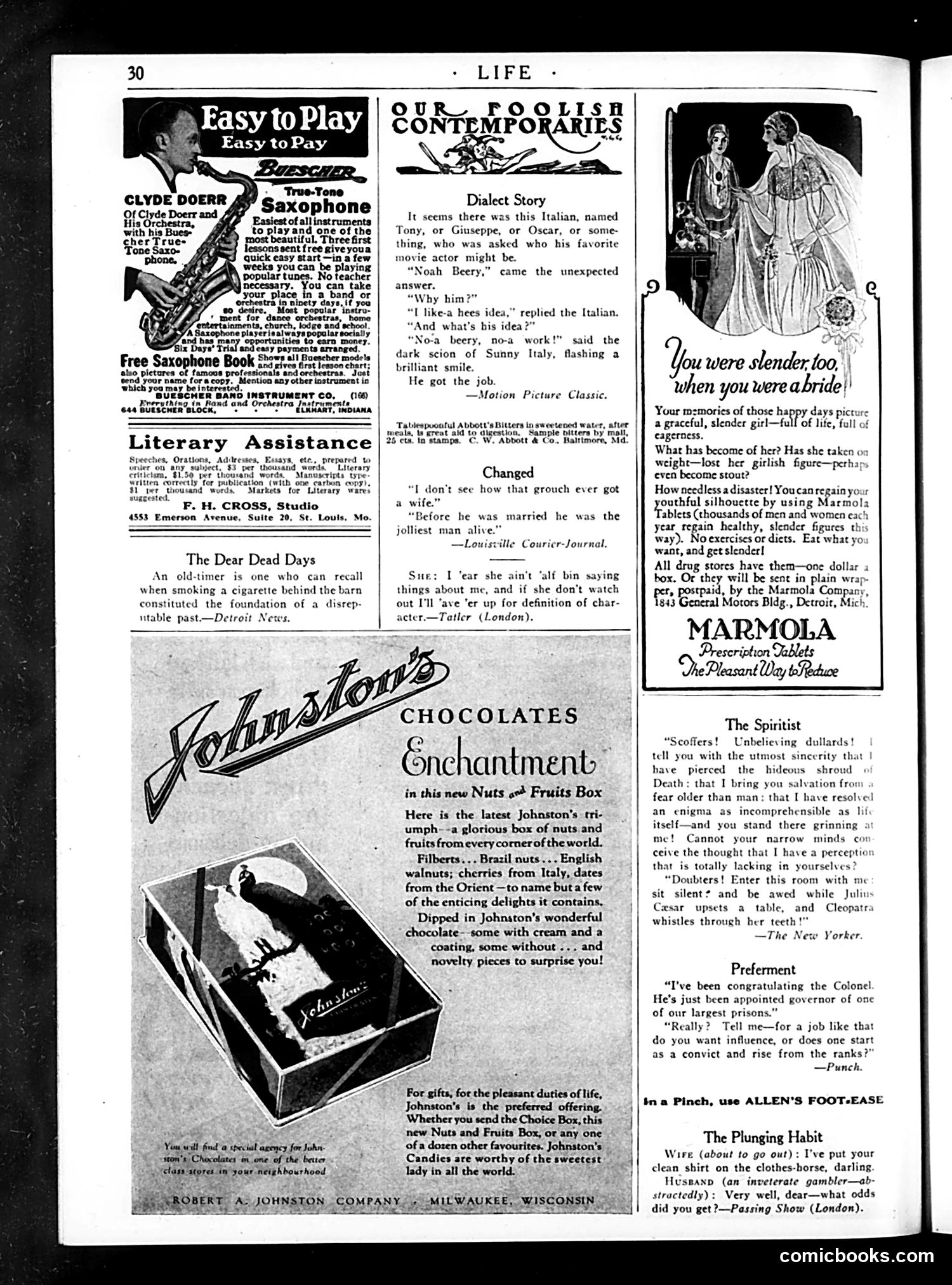
This is primarily an **advertising page** from Life magazine, with brief humorous anecdotes interspersed. The main content includes: **Advertisements:** - Buescher saxophone (musical instrument) - Johnston's chocolates (luxury candy) - Marmola tablets (weight-loss product) - Literary assistance services **Humor sections** feature short dialect jokes and observations: - An Italian immigrant's pun on actor "Noah Beery" (no beer, no work) - A married man's personality change - Observations about cigarette smoking "behind the barn" **Social context:** The Marmola ad reveals period anxieties about women's appearance post-marriage, addressing wives who've "lost their girlish figure." The Italian dialect story reflects early 20th-century entertainment using exaggerated immigrant accents as comedy. These are light, forgettable filler items—typical of Life's satirical-magazine format mixing advertisements with brief comic observations about contemporary life.
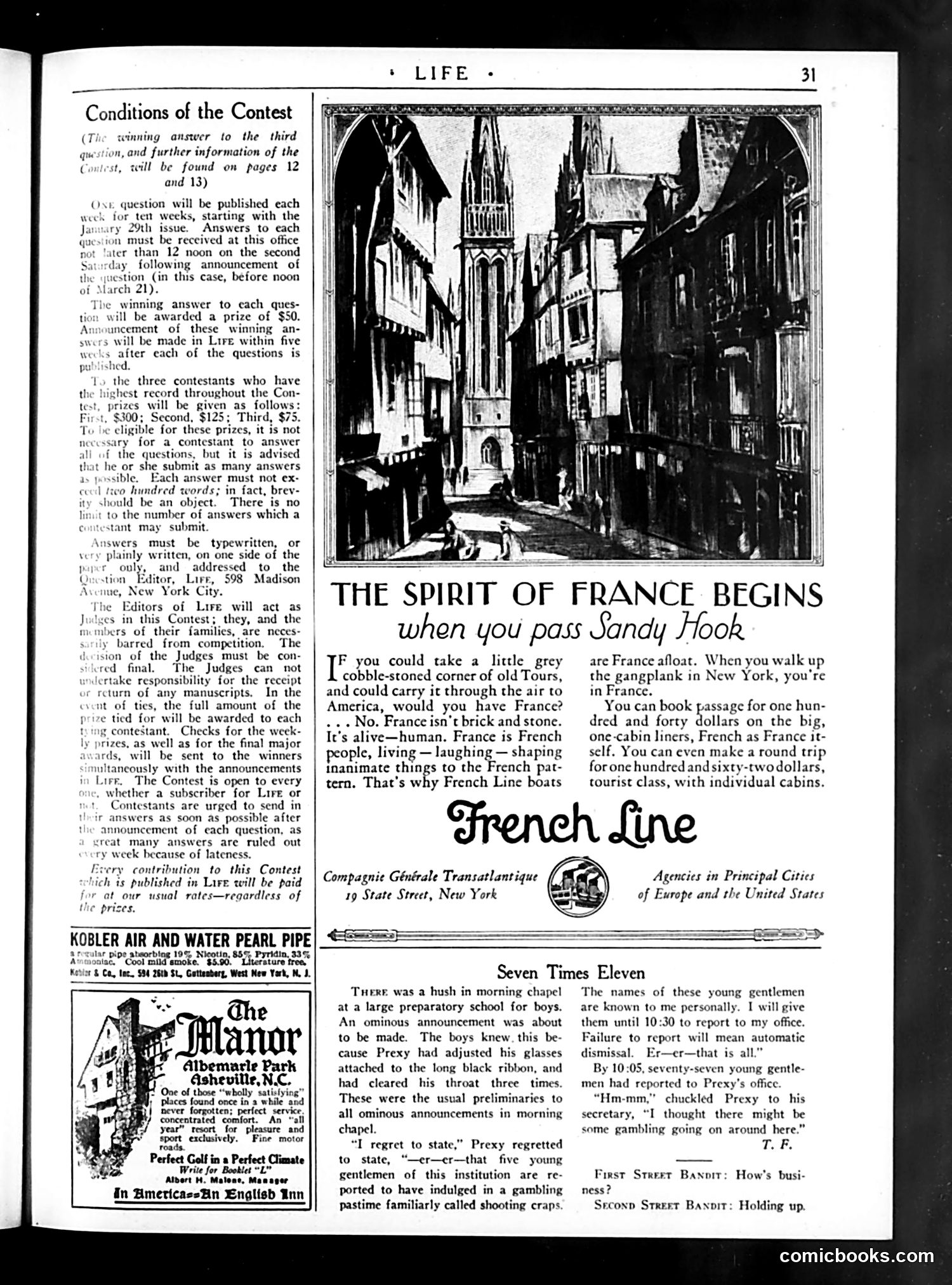
This page primarily contains **contest rules** and **advertisements** rather than political cartoons. The main content announces Life's ten-week trivia contest (beginning January 29th) offering weekly $50 prizes and major awards up to $300 for top performers. Answers must be typewritten, under 200 words, and submitted by strict deadlines. Below are product advertisements for pipe tobacco and a golf resort, typical of the era. The significant advertisement is for **French Line steamships**, which uses nationalist sentiment to market transatlantic travel. The copy argues that France's essence isn't architecture but its *people*—and that traveling on French ships provides an authentic French experience. Passage costs $140-$162, positioning it as accessible luxury. At page bottom, a brief story titled "Seven Times Eleven" begins, apparently involving a school announcement—likely satirical content, though cut off here. The page reflects 1920s American consumer culture and nascent tourism marketing.
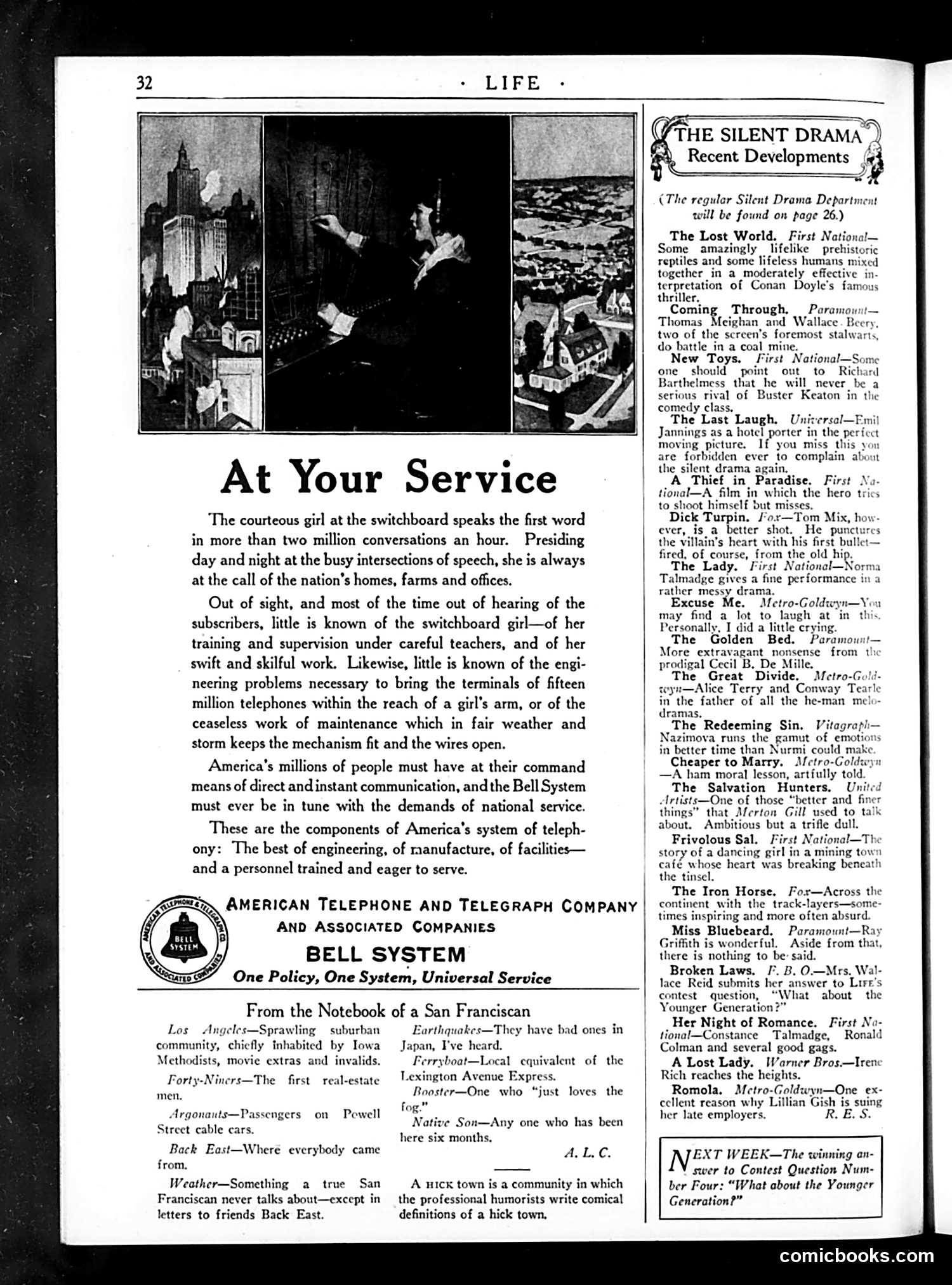
This page is primarily a **Bell System (AT&T) advertisement**, not a political cartoon. The main image shows three scenes of telephone switchboard operators at work—a young woman at a switchboard, operators in an office, and an aerial city view—illustrating the infrastructure behind telephone service. The ad's message praises the "courteous girl at the switchboard" as essential to American communication, emphasizing the hidden engineering and labor that enables "two million conversations an hour." It presents the telephone operator as a skilled, supervised professional crucial to national service. The accompanying text mocks San Francisco's pretensions with humorous local definitions (Los Angeles as a sprawl of "Iowa Methodists," the cable car as the "Ferryboat"), and the right column reviews silent films from major studios. This reflects early 1920s corporate messaging: celebrating female labor while emphasizing corporate infrastructure and American technological superiority.
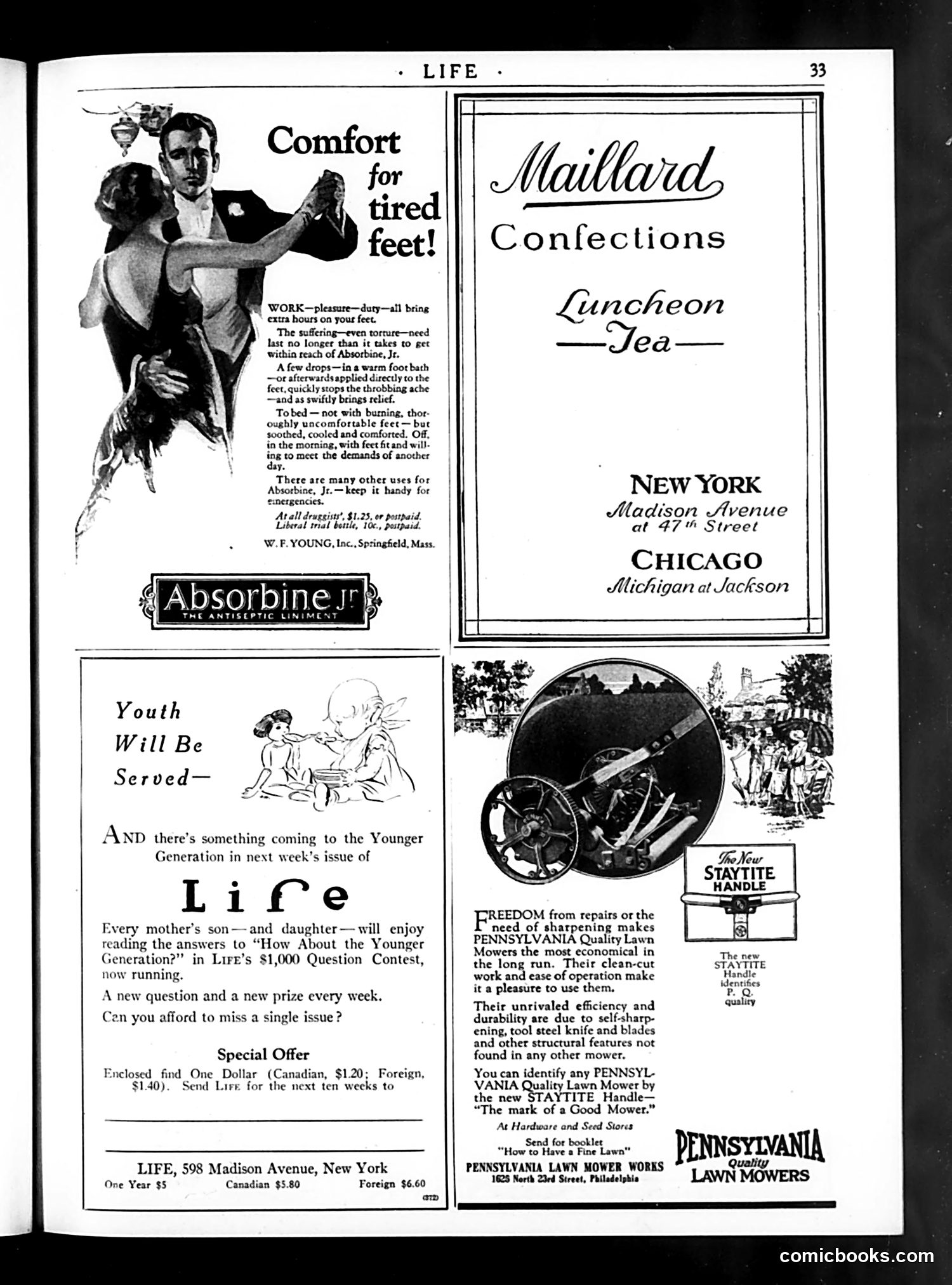
This page is primarily **advertising**, not satire or political commentary. It contains four commercial advertisements typical of early 20th-century American magazines: 1. **Absorbine Jr.** (top left): Promotes a liniment for foot pain relief, targeting working people experiencing fatigue from long hours standing. 2. **Maillard Confections** (top right): A simple directory ad for a candy/chocolate company with locations in New York and Chicago. 3. **Life Magazine itself** (bottom left): Promotes the magazine's "$1,000 Question Contest" aimed at "the Younger Generation," inviting readers to subscribe for ten weeks at one dollar. 4. **Pennsylvania Quality Lawn Mowers** (bottom right): Advertises lawn mowers with the "Staytite Handle," emphasizing durability and low maintenance. The only modest editorial content is Life's self-promotion promising entertaining questions and prizes to appeal to younger readers. There is no political cartoon or satire present on this page.
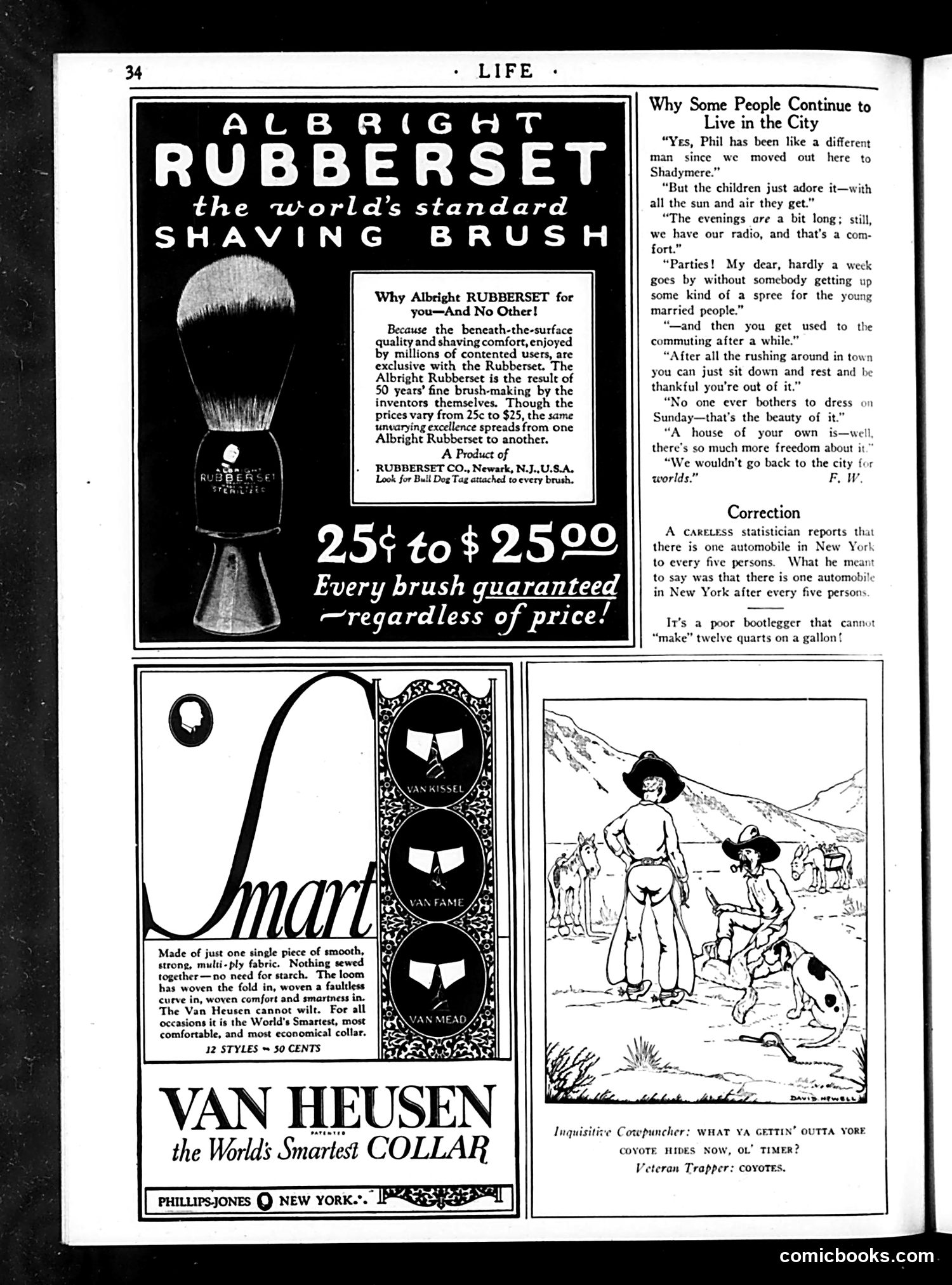
This page combines advertising with social commentary. The main editorial content is "Why Some People Continue to Live in the City," a satirical dialogue contrasting urban and suburban life. The speakers acknowledge suburban benefits (fresh air, children's happiness, privacy, freedom from social obligation) while admitting city life's appeal (entertainment, social activity, radio comfort). The satire gently mocks both lifestyles—suburban residents' defensive justifications suggest they're rationalizing a compromise, not fully convinced they've made the right choice. The cartoons below depict a western scene titled "Inquisitive Cowpuncher," showing children asking an old trapper about coyotes. This appears to be humorous Americana, likely from a regular comic feature. The page is primarily **advertising-driven**, featuring products: Albright Rubberset shaving brushes, Van Heusen collars, and Omari fabric. A "Correction" note addresses a statistical error about New York automobiles, typical of the magazine's self-aware humor.
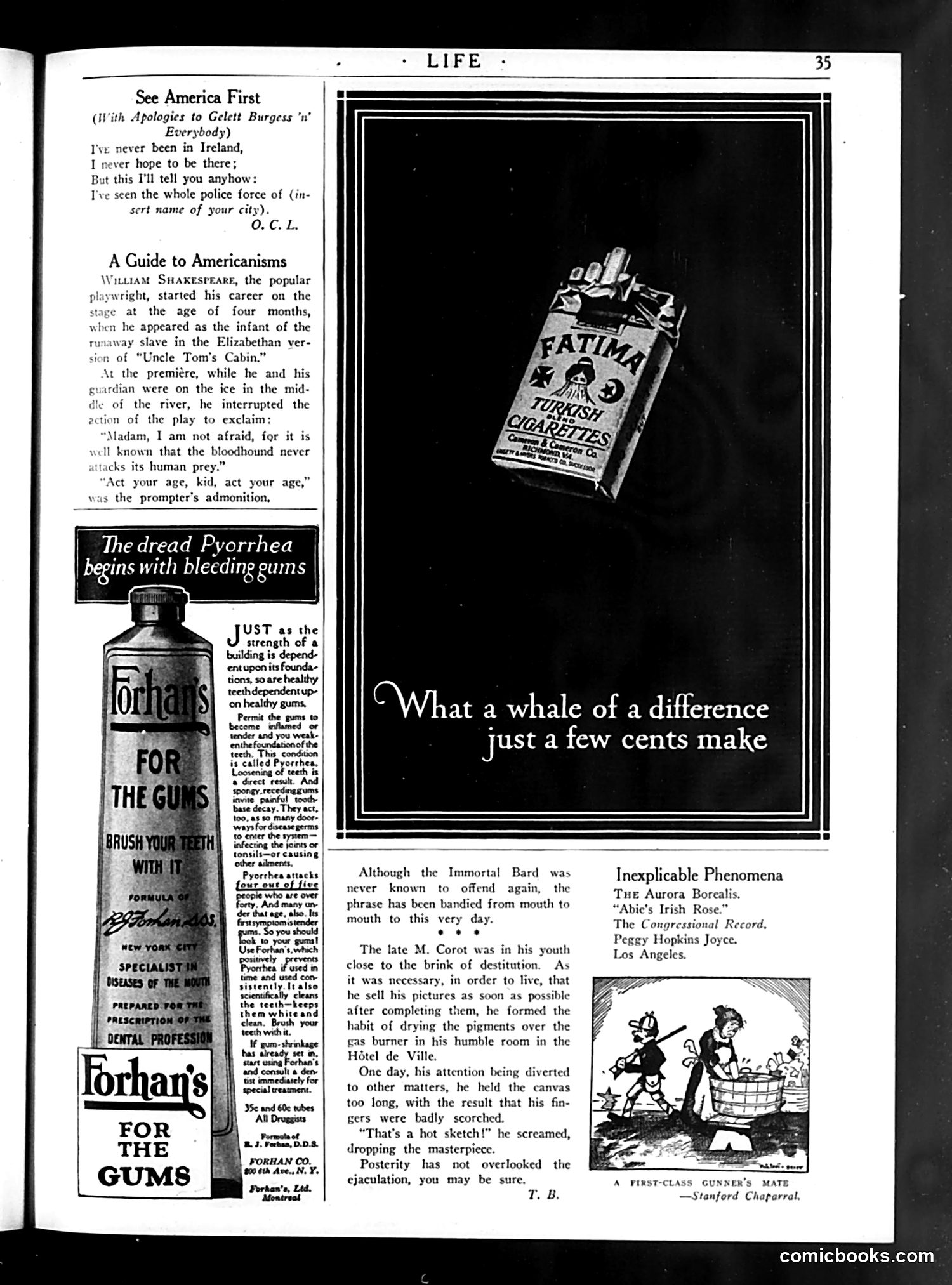
This page from Life magazine contains satirical pieces mocking American cultural phenomena and absurdities: **"See America First"** is a parody of travel poetry, humorously claiming the author has never visited Ireland but has somehow "seen the whole police force" of various American cities—a jab at widespread police corruption or incompetence in early 20th-century urban America. **"A Guide to Americanisms"** satirizes misattributions to Shakespeare, fabricating an absurd story about a four-month-old "William Shakespeare" performing in a stage adaptation of Uncle Tom's Cabin. This mocks Americans' tendency to misquote or misattribute famous figures. **"Inexplicable Phenomena"** lists items as mysterious oddities: Aurora Borealis, an Irish Rose (likely referencing a popular song), the Congressional Record, and **Peggy Hopkins Joyce**—a famous actress/socialite of the era known for multiple marriages and scandals, implying her existence was as mysterious or inexplicable as natural phenomena. The M. Corot anecdote plays on the phrase "hot sketch" as a pun about accidentally burning artwork. The page is largely satirical humor rather than political commentary.
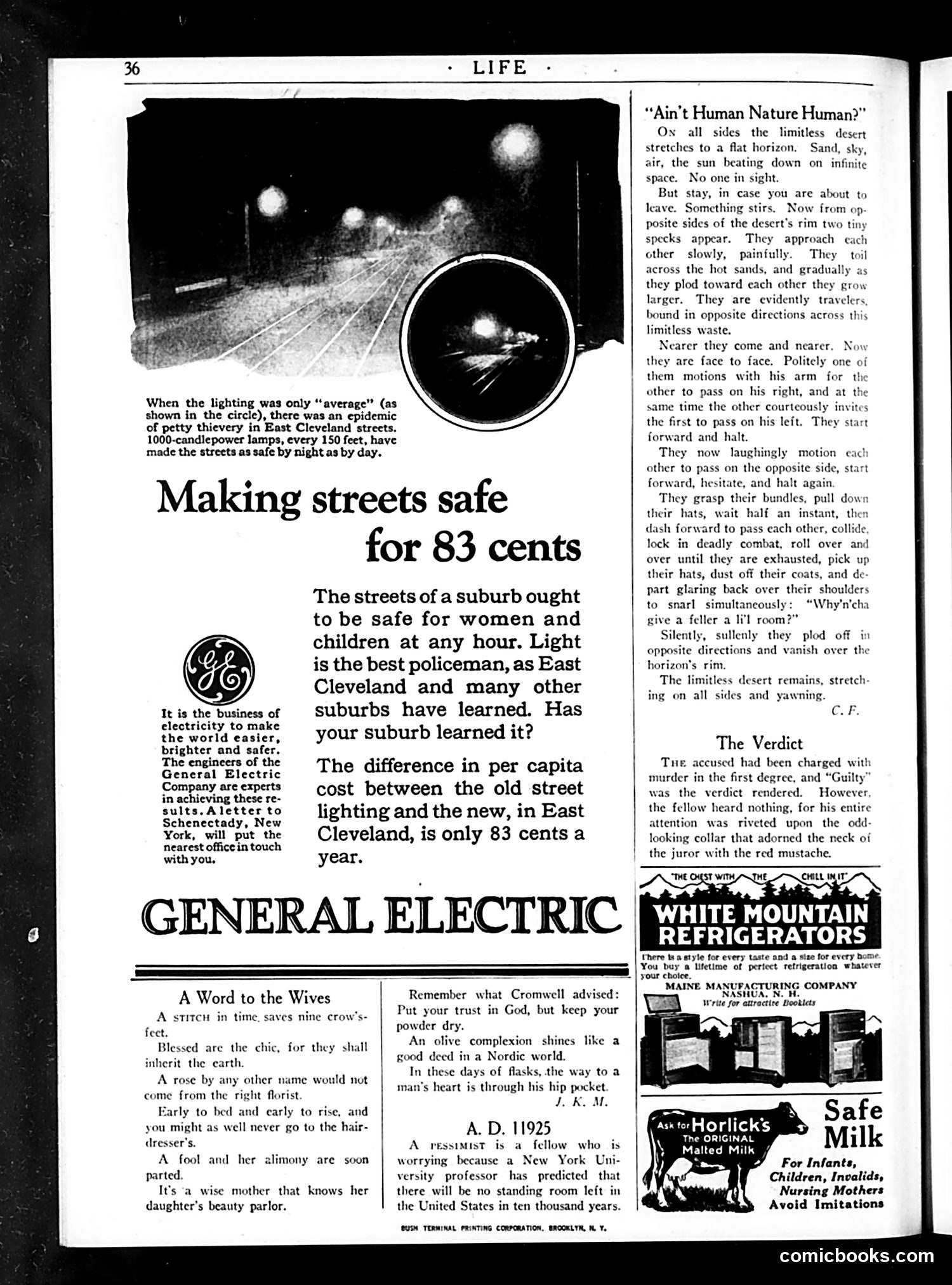
This page contains a General Electric advertisement promoting street lighting, plus several short satirical pieces typical of *Life* magazine's humor. **Main Advertisement**: GE argues that installing bright streetlights (1,000-candlepower lamps every 150 feet) in East Cleveland reduced theft by making streets safe at night. The cost increase was minimal—only 83 cents per capita annually. The implicit message: better lighting deters crime. **Satirical Content**: - "A Word to the Wives" offers tongue-in-cheek advice about beauty, marriage, and aging (e.g., "Early to bed and early to rise, and you might as well never go to the hairdresser's"). - "Ain't Human Nature Human?" is a short story about two desert travelers who meet and—despite polite gestures—end up fighting over right-of-way, then angrily part ways. It satirizes human nature: we're instinctively combative despite social pretense. - "The Verdict" is a brief joke: a jury member with a distinctive red mustache and odd collar distracted the defendant during his murder trial. The page is primarily advertising wrapped in period humor.
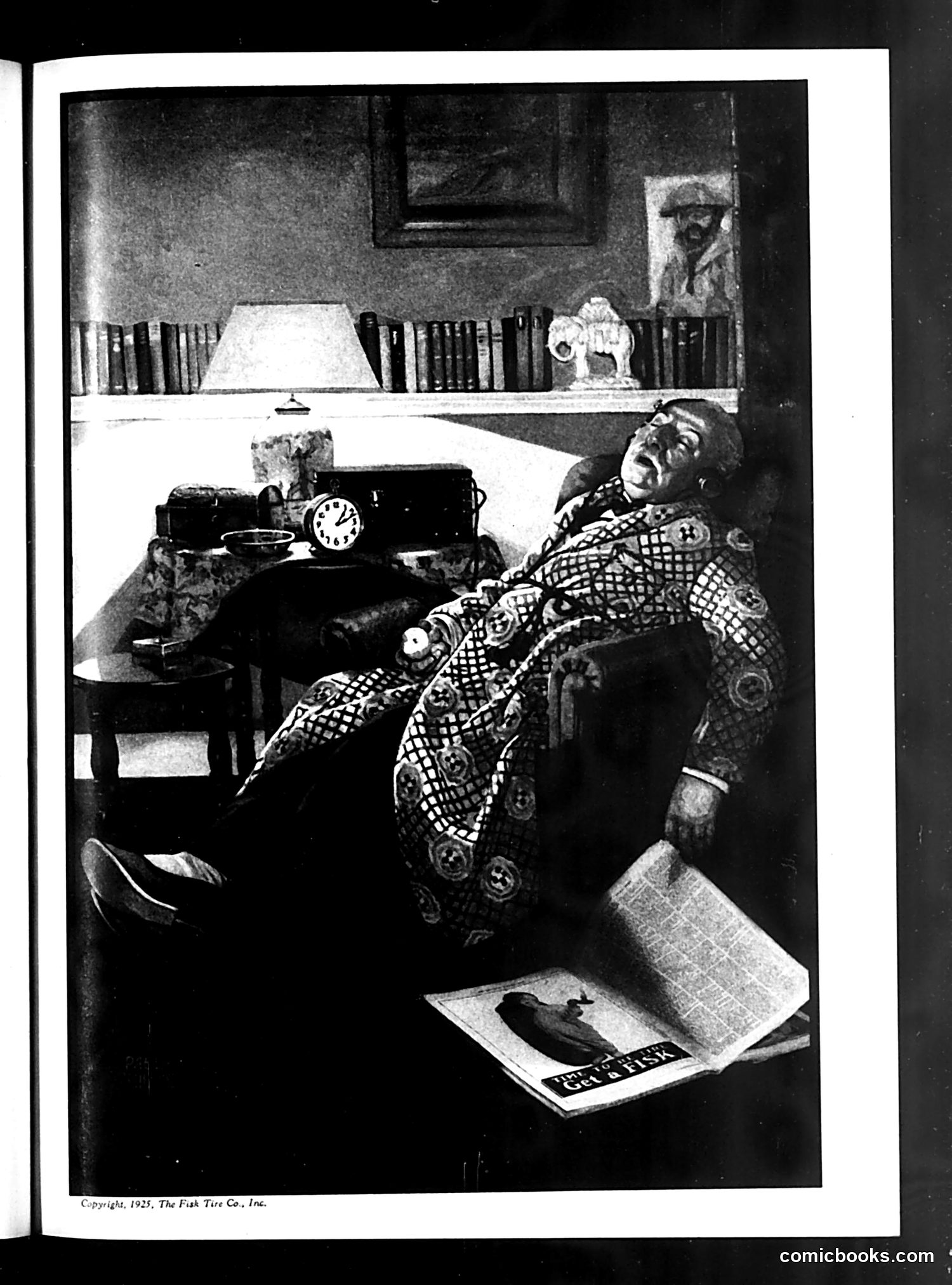
This is a 1925 advertisement for Fisk Tires, not political satire. The image shows a man relaxing in a chair at home, dressed in patterned loungewear, with his feet up on a small table. A clock and various household items surround him. A newspaper or magazine lies open on the floor. The ad appears to promote tire quality and reliability by suggesting that Fisk tires allow owners leisure time and peace of mind—they can relax at home knowing their vehicle is equipped with dependable tires. This reflects 1920s advertising strategies that linked consumer products to comfort, modernity, and domestic contentment. The exaggerated posture and satisfied expression emphasize relaxation and confidence in the product.
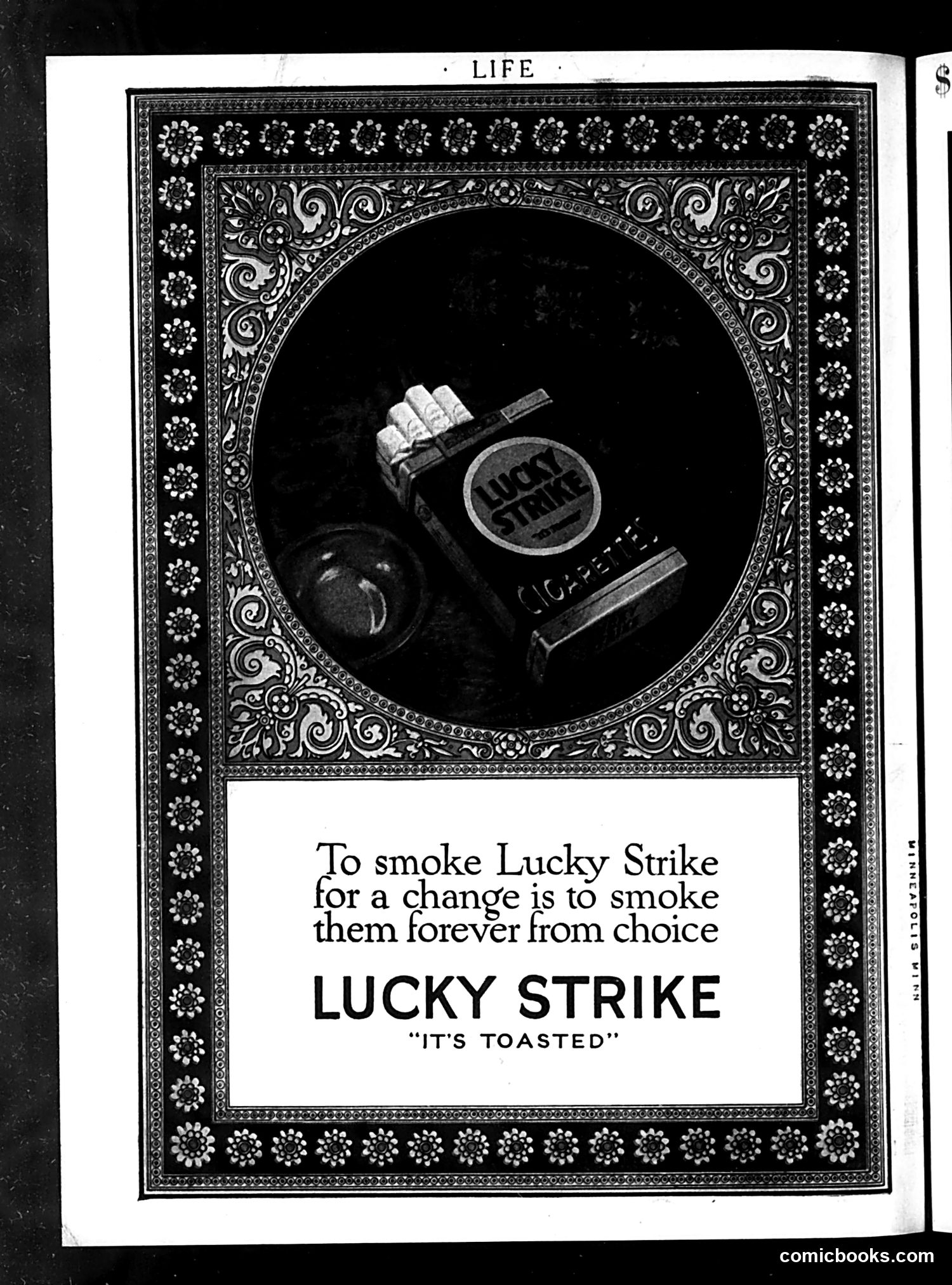
This is a **cigarette advertisement**, not political satire. It promotes Lucky Strike cigarettes with the slogan "It's Toasted" and features an ornate decorative border typical of early 20th-century magazine design. The ad's tagline — "To smoke Lucky Strike for a change is to smoke them forever from choice" — suggests that switching to this brand will convert smokers into loyal, permanent customers. The image shows cigarettes and what appears to be a smoking pipe or lighter against a dark background. This represents the era when tobacco companies advertised freely in mainstream magazines without health warnings. The appeal relies on claims of preference and quality rather than any health benefits, reflecting advertising standards before mid-20th-century regulations restricted cigarette marketing.