
Life, 1925-03-12 · page 18 of 40
Life — March 12, 1925 — page 18: what you’re looking at
What you’re looking at
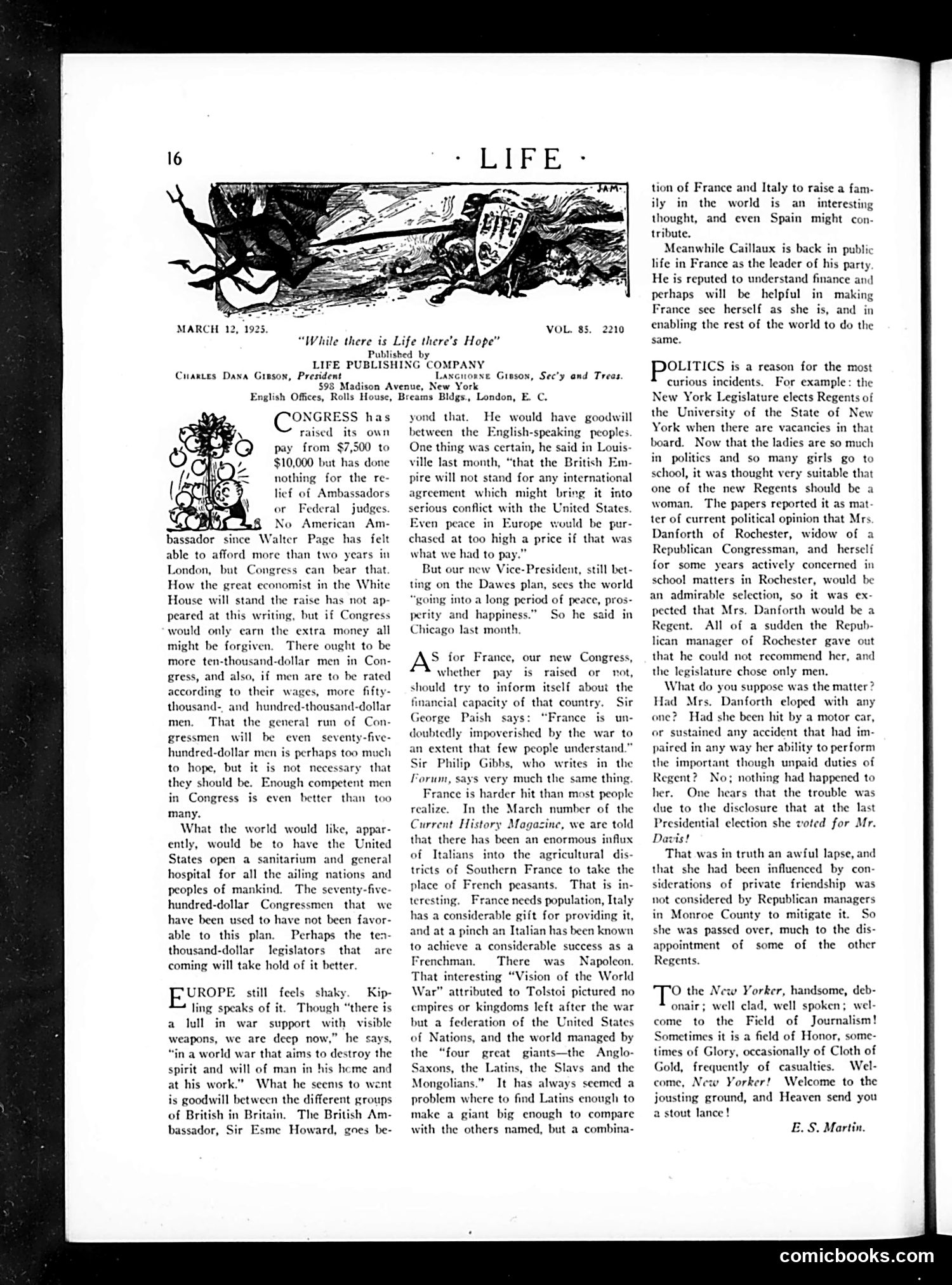
The page features editorial commentary rather than cartoons. The masthead cartoon shows a figure labeled "LIFE" emerging from rubble—likely representing the magazine's satirical mission to comment on contemporary chaos. The main editorials critique Congress's self-interested pay raise ($7,500 to $10,000) while neglecting ambassadors and federal judges. The author sarcastically suggests this may improve legislative quality, but doubts it. A second section discusses post-WWI European instability. It references Vice President Dawes's optimism about peace and prosperity, contrasts British and French financial hardship, and notes Italian immigration into depleted southern France. The final passage references Tolstoy's vision of post-war world governance organized around four "great giants"—Anglo-Saxons, Latins, Slavs, and Mongolians—humorously questioning whether sufficient Latin populations exist. The overall tone is skeptical of American government competence and post-war international reconstruction efforts.
📄 Transcribed text from this page (OCR, searchable)
Machine-transcribed from the original scan — historical spelling and the odd misread are preserved.
Sey” a “While there is Life there’s Hope” Published by LIFE PUBLISHIN Cuantes Dana Gisson, President “OMPANY Laxcuorxe Gresox, Sec’y and $98 Madison Avenue, New York English Offices, Rolls House, Breams Bldgs., London, E. C. ONGRESS has raised its own pay from $7,500 to $10,000 but has done nothing for the re- lief of Ambassadors feral judges. American Am- bassador since Walter Page has felt able to afford more than two years in London, but Congress can bear that. How the great economist in the White House will stand the raise has not ap- peared at this writing, but if Congress would only earn the extra money all might be forgiven. There ought to be more ten-thousand-dollar men in Con- gress, and also, if men are to be rated according to their wages, more fifty- thousand-. and hundred-thousand-dollar men, That the general run of Con- gressmen will be hundred-dollar men is perhaps too much to hope, but it is not necessary that they should be. Enough competent men in Congress is even better than too many. What the world would like, appar- ently, would be to have the United States open a sanitarium and general hospital for all the ailing nations and peoples of mankind. The seventy-five- hundred-dollar Congressmen that we have been used to have not been favor- able to this plan. Perhaps the te: thousand-dollar legislators that are coming will take hold of it better. even seventy-five- UROPE still feels shaky. Kip- ling speaks of it. Though “there is a lull in war support with visible weapons, we are decp now,” he says, “in a world war that aims to destroy the spirit and will of man in his heme and at his work.” What he seems to went is goodwill between the different groups of British in Britain. The British Am- bassador, Sir Esme Howard, goes be- yond that. He would have goodwill between the English-speaking peoples. One thing was certain, he said in Louis- ville last month, “that the British Em- pire will not stand for any international agreement which might bring it into serious conflict with the United States. Even peace in Europe would be pur- chased at too high a price if that was what we had to pay But our new Vice-President, still bet- ting on the Dawes plan, sees the world ing into a long period of peace, pros- perity and happines: So he said in Chicago last month. S for France, our new Congress, whether pay is raised or not, should try to inform itself about the financial capacity of that country. Sir Paish says: “France is un- doubtedly impoverished by the war to an extent that few people understand.” Sir Philip Gibbs, who writes in’ the George Forum, says very much the same thing, France is harder hit than most people realize. In the March number of the Current History Magazine, we are told that there has been an enormous influx of Italians into the agricultural dis- tricts of Southern France to take the place of French peasants. That is in- teresting. France needs population, Ita has a considerable gift for providing it, and at a pinch an Italian has been known to achieve a considerable success as a Frenchman. There Napoleon. That interesting “Vision of the World War” attributed to Tolstoi pictured no empires or kingdoms left after the war but a federation of the United States of Nations, and the world managed by the “four great giants—the Anglo- Saxons, the Latins, the Slavs and the Mongolians.” It has always seemed a problem where to find Latins enough to make a giant big enough to compare with the others named, but a combina- was tion of France and Italy to raise a fam- ily in the world is an_ interesting thought, and even Spain might con- tribute. Meanwhile Caillaux is back in public life in France as the leader of his party He is reputed to understand finance and perhaps will be helpful in making France see herself as she is, and in enabling the rest of the world to do the same. OLITICS is a reason for the most curious incidents. For example: the New York Legislature elects Regents of the University of the State of New York when there are vacancies in that board. Now that the ladies are so much in politics and so many girls go to school, it was thought very suitable that one of the new Regents should be a woman. The papers reported it as mat ter of current political opinion that Mrs. Danforth of Rochester, widow of a Republican Congressman, and_ herself for some years actively concerned in school matters in Rochester, would be an admirable selection, so it was ex- pected that Mrs. Danforth would be a Regent. All of a sudden the Repub- lican manager of Rochester gave out that he could not recommend her, and the legislature chose only men. What do you suppose was the matter? Had Mrs. Danforth eloped with any Had she been hit by a motor car, or sustained any accident that had im- paired in any way her ability to perform the important though unpaid duties of Regent? No; nothing had happened to her. One hears that the trouble was due to the disclosure that at the last Presidential election she voted for Mr. Davis! That was in truth an awful lapse, and that she had been influenced by con- siderations of private friendship was not considered by Republican managers in Monroe County to mitigate it. So she was passed over, much to the dis- appointment of some of the other Regents. one? 'O the New Yorker, handsome, deb- onair; well clad, well spoken; wel- come to the Field of Journalism! Sometimes it is a field of Honor, some- times of Glory, occasionally of Cloth of Gold, frequently of casualties. Wel- come, New Yorker! Welcome to the jousting ground, and Heaven send you a stout lance! E. S. Martin. comicbooks.com