
Life, 1925-03-12 · page 22 of 40
Life — March 12, 1925 — page 22: what you’re looking at
What you’re looking at
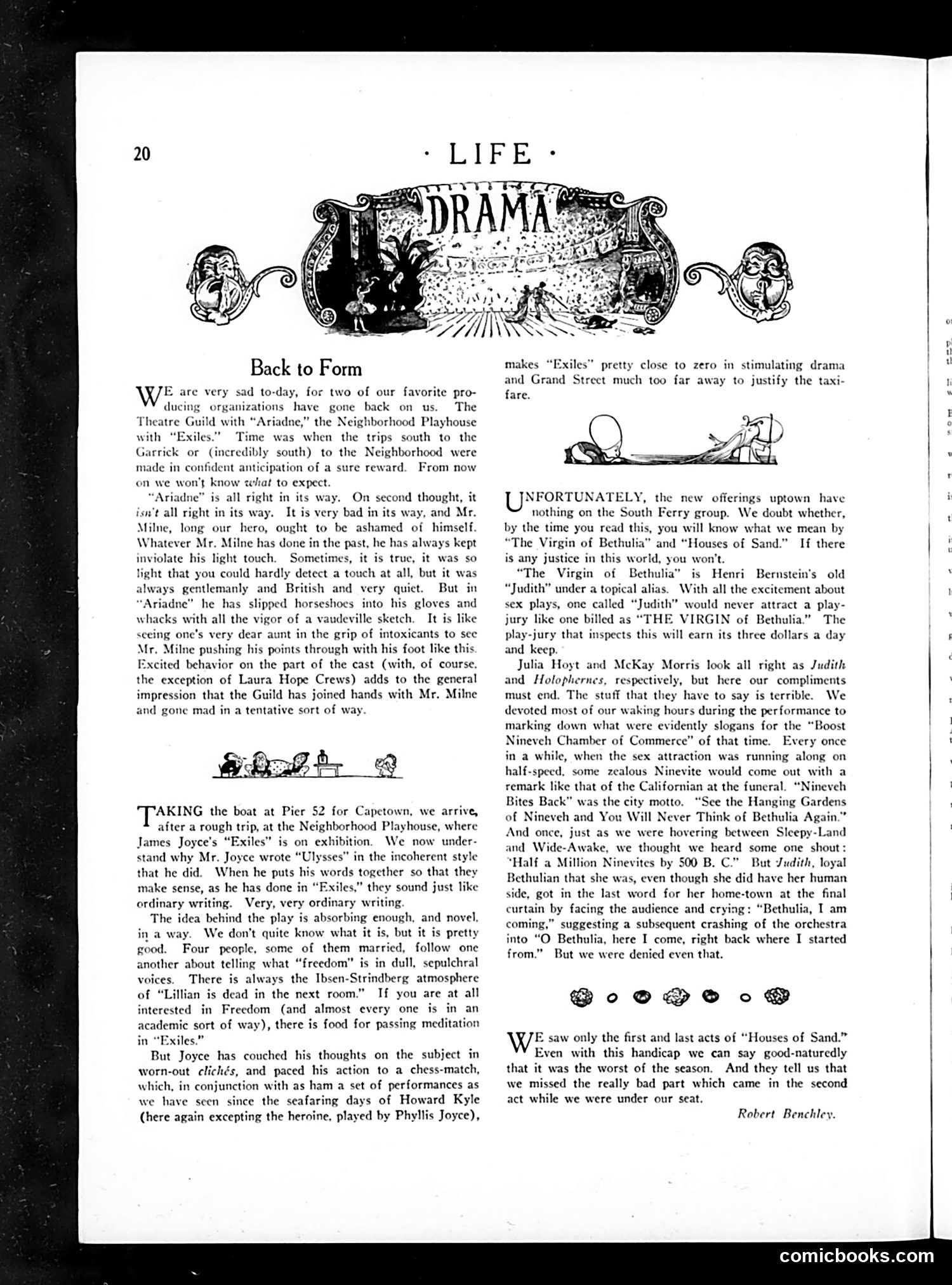
This is a theater review column critiquing three Broadway productions. The critic laments that prestigious theaters—the Theatre Guild and Neighborhood Playhouse—have disappointed audiences. **Key references:** - **"Ariadne"** by A.A. Milne: The reviewer criticizes Milne for abandoning his signature "light touch" comedy style, comparing his clumsy dramatic efforts to "horseshoes in gloves" - **"Exiles"** by James Joyce: The critic mocks the play as dull despite ambitious themes about freedom, suggesting Joyce should have stuck to his deliberately obscure writing style (like *Ulysses*) - **"The Virgin of Bethulia"**: A retitled Bernstein play that cynically substitutes the biblical "Judith" with a sexually suggestive title to attract audiences The satire targets artistic pretension and commercial dishonesty—established artists abandoning their strengths, and producers repackaging old material with sensational marketing. The tone is witty but dismissive of all three productions.
📄 Transcribed text from this page (OCR, searchable)
Machine-transcribed from the original scan — historical spelling and the odd misread are preserved.
Back to Form W © very sad to-day, for two of our favorite pro- ducing organizations have gone back on us. The Theatre Guild with “Ariadne,” the Neighborhood Playhouse with “Exiles.” Time was when the trips south to the Garrick or (incredibly south) to the Neighborhood were made in confident anticipation of a sure reward. From now on we won't know what to expect. “Ariadne” is all right in its way. On second thought, it isn’t all right in its way. It is very bad in its way, and Mr Milne, long our hero, ought to be ashamed of himsel Whatever Mr. Milne has done in the past, he has always kept inviolate his light touch. Sometimes, it is true, it was so light that you could hardly detect a touch at all, but it always gentlemanly and British and very quict. But in “Ariadne” he has slipped horseshoes into his gloves and whacks with all the vigor of a vaudeville sketch. It is like seeing one’s very dear aunt in the grip of intoxicants to see Mr. Milne pushing his points through with his foot like this Excited behavior on the part of the cast (with, of course, the exception of Laura Hope Crews) adds to the general impression that the Guild has joined hands with Mr. Milne and gone mad in a tentative sort of way. ‘as 'AKING the boat at Pier 52 for Capetown, we arrive, after a rough trip, at the Neighborhood Playhouse, where James Joyce's “Exiles” is on exhibition. We now under- stand why Mr. Joyce wrote “Ulysses” in the incoherent style that he did. When he puts his words together so that they make sense, as he has done in “Exiles,” they sound just like ordinary writing. Very, very ordinary writing. The idea behind the play is absorbing enough, and novel, in a way. We don't quite know what it is, but it is pretty good. Four people, some of them married, follow one another about telling what “freedom” is in dull, sepulchral voices. There is always the Ibsen-Strindberg atmosphere of “Lillian is dead in the next room.” If you are at all interested in Freedom (and almost every one is in an academic sort of way), there is food for passing meditation in “Exiles.” But Joyce has couched his thoughts on the subject in worn-out clichés, and paced his action to a chess-match, which, in conjunction with as ham a set of performances as we have scen since the seafaring days of Howard Kyle (here again excepting the heroine, played by Phyllis Joyce), makes xiles” pretty close to zero in stimulating drama and Grand Strect much too far away to justify the taxi- fare. NFORTUNATELY, the new offerings uptown have nothing on the South Ferry group. We doubt whether, by the time you read this, you will know what we mean by “The Virgin of Bethulia” and “Houses of Sand.” If there is any justice in this world, you won't. “The Virgin of Bethulia” is Henri Bernstein's old “Judith” under a topical alias. With all the excitement about sex plays, one called “Judith” would never attract a play- jury like one billed as “THE VIRGIN of Bethulia.” The play-jury that inspects this will earn its three dollars a day and keep. Julia Hoyt and McKay Morris look all right as Judith and Holophernes, respectively, but here our compliments must end, The stuff that they have to say is terrible. We devoted most of our waking hours during the performance to marking down what were evidently slogans for the “Boost Nineveh Chamber of Commerce” of that time. Every once in a while, when the sex attraction was running along on half-specd, some zealous Ninevite would come out with a remark like that of the Californian at the funeral. ineveh Bites Back” was the city motto, “See the Hanging Gardens of Nineveh and You Will Never Think of Bethulia Again.” And once, just as we were hovering between Sleepy-Land and Wide-Awake, we thought we heard some one shout: “Half a Million Ninevites by 500 B.C." But Judith, loyal Bethulian that she was, even though she did have her human side, got in the last word for her home-town at the final curtain by facing the audience and crying: “Bethulia, I am coming,” suggesting a subsequent crashing of the orchestra into “O Bethulia, here I come, right back where I started from.” But we were denied even that. QBrSMeo o @ WE saw only the first and last acts of “Houses of Sand.” en with this handicap we can say good-naturedly that it was the worst of the season. And they tell us that we missed the really bad part which came in the second act while we were under our seat. Robert Benchley. comicbooks.com t