
Life, 1925-03-12 · page 26 of 40
Life — March 12, 1925 — page 26: what you’re looking at
What you’re looking at
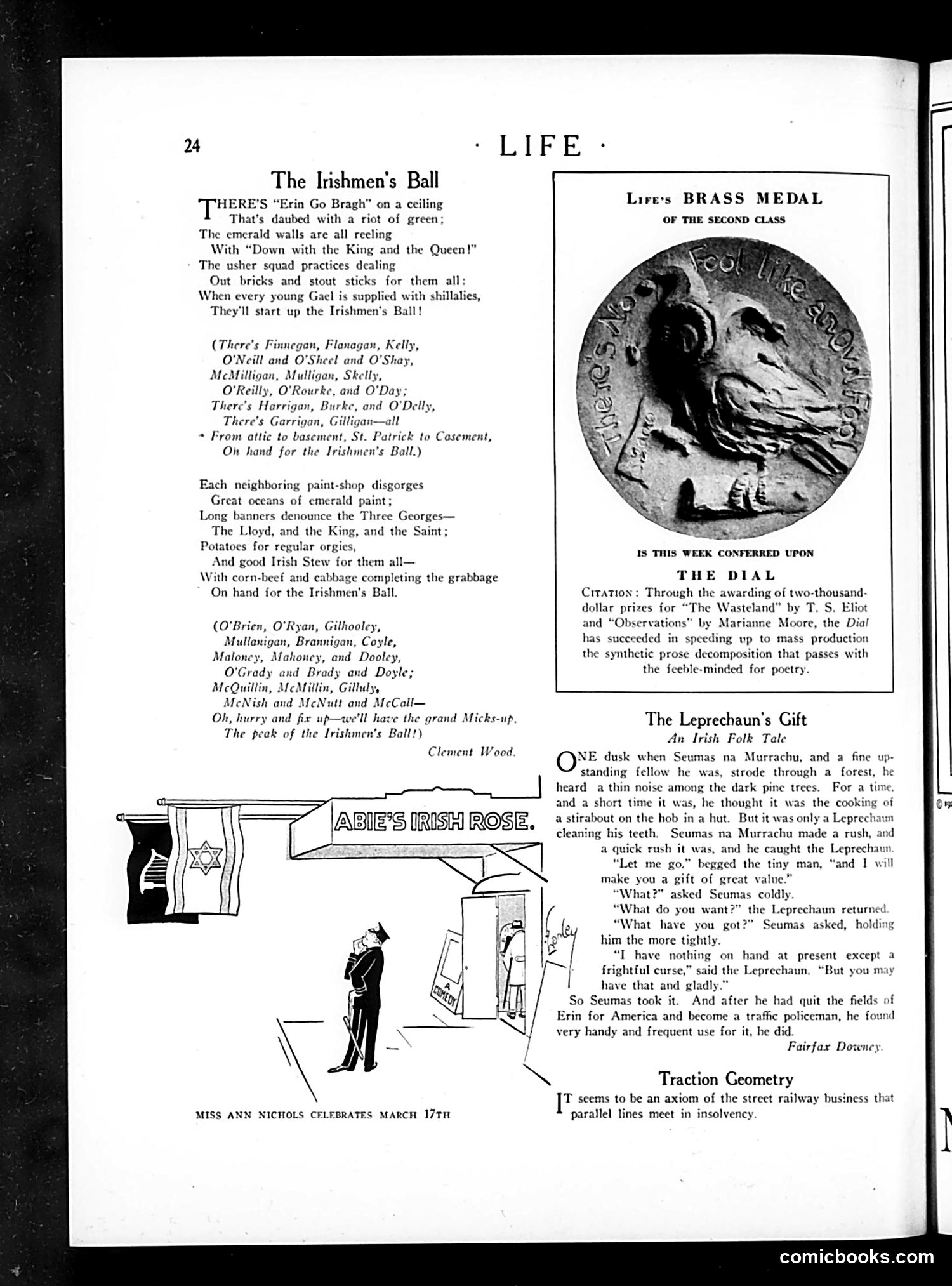
This poem by Clement Wood satirizes Irish-American St. Patrick's Day celebrations (March 17th, referenced in the illustration's caption). The satire operates on multiple levels: **The Stereotype:** The poem catalogs exclusively Irish surnames and stereotypical Irish cultural markers—emerald green, shillelagies (fighting sticks), corned beef and cabbage, potatoes—suggesting Life magazine viewed Irish-American identity as one-dimensional and performative. **Political Edge:** References to "Down with the King and the Queen" and banners denouncing "the Three Georges" and "Casement" (likely Roger Casement, Irish nationalist executed by Britain) imply Irish-Americans were seen as harboring anti-British republican sentiment, a concern during this era. **Class Mockery:** The emphasis on drinking, fighting, and crude celebration positions Irish-Americans as rowdy, working-class troublemakers unsuitable for refined American society. The illustration shows "Abie's Irish Rose," likely referencing the popular 1922 play about interfaith marriage, suggesting tensions around Irish-American assimilation.
📄 Transcribed text from this page (OCR, searchable)
Machine-transcribed from the original scan — historical spelling and the odd misread are preserved.
The Irishmen’s Ball HERE'S “Erin Go Bragh” on a ceiling That's daubed with a riot of green; The emerald walls are all reeling With “Down with the King and the Queen!” The usher squad practices dealing Out bricks and stout sticks for them all: When every young Gael is supplied with shillalies, They'll start up the Irishmen’s Ball! (There's Finnegan, Flanagan, Kelly, O'Neill and O'Sheel and O'Shay, McMilligan, Mulligan, Skelly, O'Reilly, O'Rourke, and O'Day; There’s Harrigan, Burke, and O'Delly, There's Garrigan, Gilligan—all + From attic to basement, St. Patrick to Casement, On hand for the Irishmen’s Ball.) Each neighboring paint-shop disgorges Great oceans of emerald paint; Long banners denounce the Three Georges— The Lloyd, and the King, and the Saint; Potatoes for regular orgies, And good Irish Stew for them all— With corn-beef and cabbage completing the grabbage On hand for the Irishmen’s Ball. (O'Brien, O’Ryan, Gilhooley, Mullanigan, Brannigan, Coyle, Maloney, Mahoney, and Doole O'Grady and Brady and Doyle; McQuillin, McMillin, Gilluly, McNish and McNutt and McCall— Oh, hurry and fix up—twe'll have the grand Micks-up, The peak of the Irishmen's Ball!) Clement Wood. MISS ANN NICHOLS CFLEBRATES MARCH 17TH Liress BRASS MEDAL OF THE SECOND CLASS 18 THIS WEEK CONFERRED UPON THE DIAL Citation: Through the awarding of two-thousand- dollar prizes for “The Wasteland” by T. S. Eliot and “Observations” by Marianne Moore, the Dial has succeeded in speeding vp to mass production the synthetic prose decomposition that passes with the feeble-minded for poetry. The Leprechaun's Gift An Irish Folk Tale NE dusk when Seumas na Murrachu, and a fine up- standing fellow he was, strode through a forest, he heard a thin noise among the dark pine trees. For a time and a short time it was, he thought it was the cooking of a stirabout on the hob in a hut. But it was only a Leprechaun cleaning his teeth. Seumas na Murrachu made a rush, and a quick rush it was, and he caught the Leprechaun. “Let me go.” begged the tiny man, “and I will make you a gift of great value.” “What?” asked Seumas coldly. ( “What do you want?” the Leprechaun returned “What have you go Seumas asked, holding oe him the more tightly. v “I have nothing on hand at present except a | frightful curse,” said the Leprechaun, “But you may have that and gladly.” So Seumas took it. And after he had quit the fields of Erin for America and become a traffic policeman, he found very handy and frequent use for it, he did Fairfax Downey Traction Geometry T seems to be an axiom of the street railway business that parallel lines meet in insolvency. comicbooks.com