
Life, 1925-03-12 · page 34 of 40
Life — March 12, 1925 — page 34: what you’re looking at
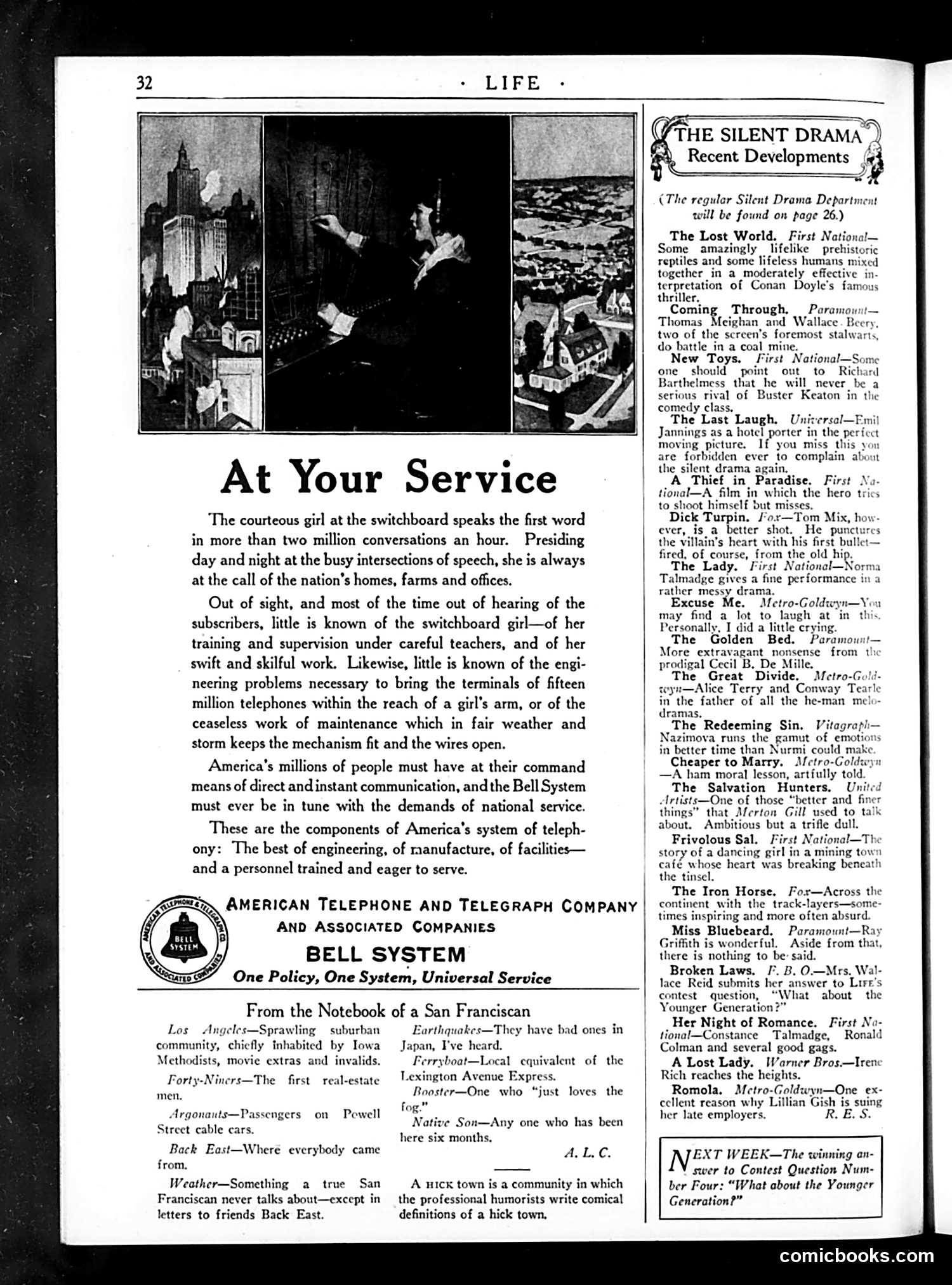
What you’re looking at
This page is primarily a **Bell System (AT&T) advertisement**, not a political cartoon. The main image shows three scenes of telephone switchboard operators at work—a young woman at a switchboard, operators in an office, and an aerial city view—illustrating the infrastructure behind telephone service. The ad's message praises the "courteous girl at the switchboard" as essential to American communication, emphasizing the hidden engineering and labor that enables "two million conversations an hour." It presents the telephone operator as a skilled, supervised professional crucial to national service. The accompanying text mocks San Francisco's pretensions with humorous local definitions (Los Angeles as a sprawl of "Iowa Methodists," the cable car as the "Ferryboat"), and the right column reviews silent films from major studios. This reflects early 1920s corporate messaging: celebrating female labor while emphasizing corporate infrastructure and American technological superiority.
📄 Transcribed text from this page (OCR, searchable)
Machine-transcribed from the original scan — historical spelling and the odd misread are preserved.
At Your Service The courteous girl at the switchboard speaks the first word in more than two million conversations an hour. Presiding day and night at the busy intersections of speech, she is always at the call of the nation’s homes, farms and offices. Out of sight, and most of the time out of hearing of the subscribers, little is known of the switchboard girl—of her training and supervision under careful teachers, and of her swift and skilful work. Likewise, little is known of the engi- neering problems necessary to bring the terminals of fifteen million telephones within the reach of a girl's arm, or of the ceaseless work of maintenance which in fair weather and storm keeps the mechanism fit and the wires open. America’s millions of people must have at their command means of direct and instant communication, and the Bell System must ever be in tune with the demands of national service. These are the components of America’s system of teleph- ony: The best of engineering, of raanufacture, of facilities— and a personnel trained and eager to serve. AMERICAN TELEPHONE AND TELEGRAPH COMPANY AND ASSOCIATED COMPANIES BELL SYSTEM One Policy, One System, Universal Service From the Notebook of a San Franciscan Los Angeles—Sprawling — suburban community, chic inhabited by Iowa Methodists, movie extras and invalids. Forty-Niners—The first men, real-estate Argonauts—Passengers on Powell Street cable cars, Back East—Where everybody came from, Weather—Something a true San Franciscan never talks about—except in letters to friends Back East. Earthquakes—They have bad ones in Japan, I've heard. ryboat—Local equivalent of the Lexington Avenue Express. Rooster—One who “just loves the Native Son—Any one who has been here six months, ALL. C. A HICK town is a community in which the professional humorists write comical definitions of a hick town, THE SILENT DRAMA) Recent Developments 4 q (The regular Silent Drama Department will be found on page 26.) The Lost World. First National— Some amazingly lifelike prehistoric reptiles and some lifeless humans mixed together in a moderately effective in- terpretation of Conan Doyle's famous thriller, Coming Through, Paramount— Thomas Meighan and Wallace. Beery, two of the screen’s foremost stalwarts do battle_in a coal mine. New Toys. First National. one should point out to Richard Barthelmess that he will) never be a serious rival of Buster Keaton in the comedy class. The Last Laugh. Universal—Emil Jannings as a hotel porter in the perfect moving picture. If you miss this you are forbidden ever to complain about the silent drama again, Thief in Paradise. First tional—A film in which the hero trics to shoot himself but misses. Dick Turpin. /°o..—Tom Mix, how- ever, is a better shot. He punc' the villain'’s heart with his first bullet— fired, of course, from the old hi The Lady. First National— Talmadge gives a fine performance rather messy drama. Excuse Me. Metro-Goldwyn—Y. may find a lot to laugh at in this. Personally, I did a little crying. The Golden Bed. Paramowi!— More extravagant_nonsense from t) prodigal Cecil B. De Mille. The Great Divide. Metro-Gold- Alice Terry and Conway Tear! ne father of all the he-man me dramas, The Redeeming Sin. Nazimova_ runs the in better time than N Cheaper to Marry. Metro-Golc —A ham moral lesson, artfully tol The Salvation Hunters. U -Irtists—One of those “better and things” that Merton Gill used to talk about. Ambitious but a trifle dull. Frivolous Sal. First National—Tt story of a dancing girl in a mining café whose heart was breaking ben the tinsel. The Iron Horse. Fox—Across the continent with the track-layers—some- times inspiring and more often absurd. Miss Bluebeard, Paramount—Ray Griffith is wonderful. Aside from that, there is nothing to be: said. Broken Laws. /°. B, O.—Mrs. Wal- lace Reid submits her answer to Lire’s contest question, “What about the Younger Generation? Her Night of Romance. First Na- tional—Constance Talmadge, Ronald Colman and several good gags. A Lost Lady. Warner Bros.—Irenc Rich reaches the heights. Romola. Metro-Goldwyn—One ex- cellent reason why Lillian Gish is suing her late employers, RE. Vitagra EXT WEEK—The winning an- swer to Contest Question Num- ber Four: “What about the Younger Generation?” comicbooks.com