
Life, 1925-03-12 · page 13 of 40
Life — March 12, 1925 — page 13: what you’re looking at
What you’re looking at
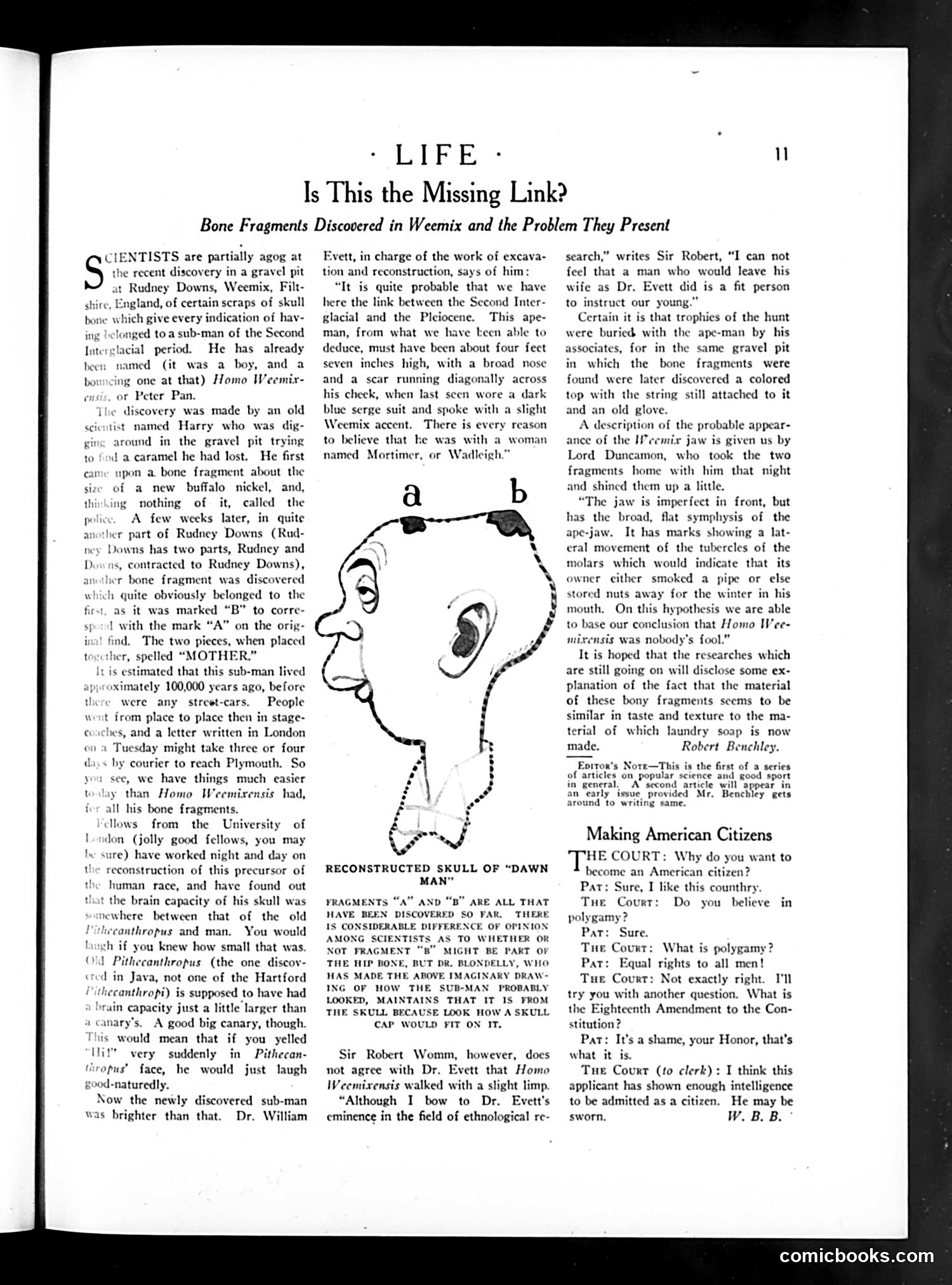
This page discusses the discovery of bone fragments at Rudney Downs, Weemix, in England—purportedly evidence of a "missing link" between apes and humans. The cartoon shows a reconstructed skull labeled "Dawn Man" with two skull fragments (labeled A and B) that scientists debated whether to include. The satire mocks scientific disagreement: scientists disagreed on whether these bones proved *Homo wremensis* walked upright or had ape-like characteristics. The page humorously presents this debate between Dr. Evett and Sir Robert Womm as a serious dispute about human evolution. The accompanying courtroom dialogue satirizes the absurdity of determining evolutionary evidence through quasi-legal argument rather than rigorous science—poking fun at both scientific speculation and bureaucratic procedures.
📄 Transcribed text from this page (OCR, searchable)
Machine-transcribed from the original scan — historical spelling and the odd misread are preserved.
LIFE - Is This the Missing Link? Bone Fragments Discovered in Weemix and the Problem They Present CIENTISTS are partially agog at S the recent discovery in a gravel pit at Rudney Downs, Weemix, Filt- c, England, of certain scraps of skull bone which give every indication of hav- ing belonged toa sub-man of the Second Interglacial period. He has already been med (it was a boy, and a bouncing one at that) Homo Weemix- cnsis, or Peter Pan, lhe discovery was made by an old scientist named Harry who was dig- gine around in the gravel pit trying to {nd a caramel he had lost. He first came upon a bone fragment about the a new buffalo nickel, and, nothing of it, called the A few weeks later, in quite another part of Rudney Downs (Rud- ney Downs has two parts, Rudney and Downs, contracted to Rudney Downs), another bone fragment was discovered h quite obviously belonged to the as it was marked “B" to corre- 1 with the mark “A” on the orig- find. The two pieces, when placed ther, spelled “MOTHER.” t is estimated that this sub-man lived oximately 100,000 years ago, before were any street-cars. People t from place to place then in stage- iches, and a letter written in London on a Tuesday might take three or four s by courier to reach Plymouth, So : see, we have things much easier lay than Homo Weemixensis had, all his bone fragments. cllows from the University of don (jolly good fellows, you ma ~ sure) have worked night and day on reconstruction of this precursor of human race, and have found out t the brain capacity of his skull was where between that of the old canthropus and man. You would ch if you knew how small that was. ‘d Pithecanthropus (the one discov- din Java, not one of the Hartford thecanthropi) is supposed to have had ain capacity just a little larger than a canary’s. A good big canary, though. is would mean that if you yelled Mil" very suddenly in Pithecan- thropus’ face, he would just laugh good-naturedly. Now the newly discovered sub-man was brighter than that. Dr. William size of thinking Evett, in charge of the work of excava- tion and reconstruction, says of him: “It is quite probable that we have here the link between the Second Inter- glacial and the Pleiocene. This ape- man, from what we have keen able to deduce, must have been about four feet seven inches high, with a broad nose and a scar running diagonally across his cheek, when last seen wore a dark blue serge suit and spoke with a slight Weemix accent. There is every reason to believe that ke was with a woman named Mortimer, or Wadleigh.” b RECONSTRUCTED SKULL OF “DAWN MAN” AMONG SCIENT S_AS TO WHETHER OR NOT FRAGMENT “B” MIGHT BE PART OF THE HIP BONE, BUT DR. BLONDELLY, WHO HAS MADE THE ABOVE IMAGINARY DRAW- NG OF HOW THE S§S MAN PROBABLY LOOKED, MAINTA! THAT IT IS FROM THE SKULL BECAUSE LOOK HOW A SKULL CAP WOULD FIT ON IT, Sir Robert Womm, however, does not agree with Dr. Evett that Homo IWeemixensis walked with a slight limp. “Although I bow to Dr. Evett’s eminence in the field of ethnological re- search,” writes Sir Robert, “I can not feel that a man who would leave his wife as Dr. Evett did is a fit person to instruct our young.” Certain it is that trophies of the hunt were buried with the ape-man by his associates, for in the same gravel pit in which the bone fragments were found were later discovered a colored top with the string still attached to it and an old glove. A description of the probable appear- ance of the Hcemix jaw is given us by Lord Duncamon, who took the two fragments home with him that night and shined them up a little. “The jaw is imperfect in front, but has the broad, flat symphysis of the ape-jaw. It has marks showing a lat- eral movement of the tubercles of the molars which would indicate that its owner cither smoked a pipe or else stored nuts away for the winter in his mouth. On this hypothesis we are able to base our conclusion that Homo Wee- mixensis was nobody's fool.” It is hoped that the researches which are still going on will disclose some ex- planation of the fact that the material of these bony fragments seems to be similar in taste and texture to the ma- terial of which laundry soap is now made, Robert Benchley. Epitor’s Nore—This is the first of a series of articles on popular science and good sport in general. A second article will appear in an early issue provided Mr. Benchley gets around to writing same, Making American Citizens THE COURT: Why do you want to become an American citizen? Pat: Sure, I like this counthry. Tue Court: Do polygamy? Pat: Sure. Tue Court: What is polygamy? Pat: Equal rights to all men! Tue Court: Not exactly right. I'll try you with another question. What is the Eighteenth Amendment to the Con- stitution ? Pat: It's a shame, your Honor, that’s what it is. Tue Court (to clerk): I think this applicant has shown enough intelligence to be admitted as a citizen. He may be sworn, W. B. B. you believe in comicbooks.com