
A complete issue · 37 pages · 1924
Life — December 25, 1924
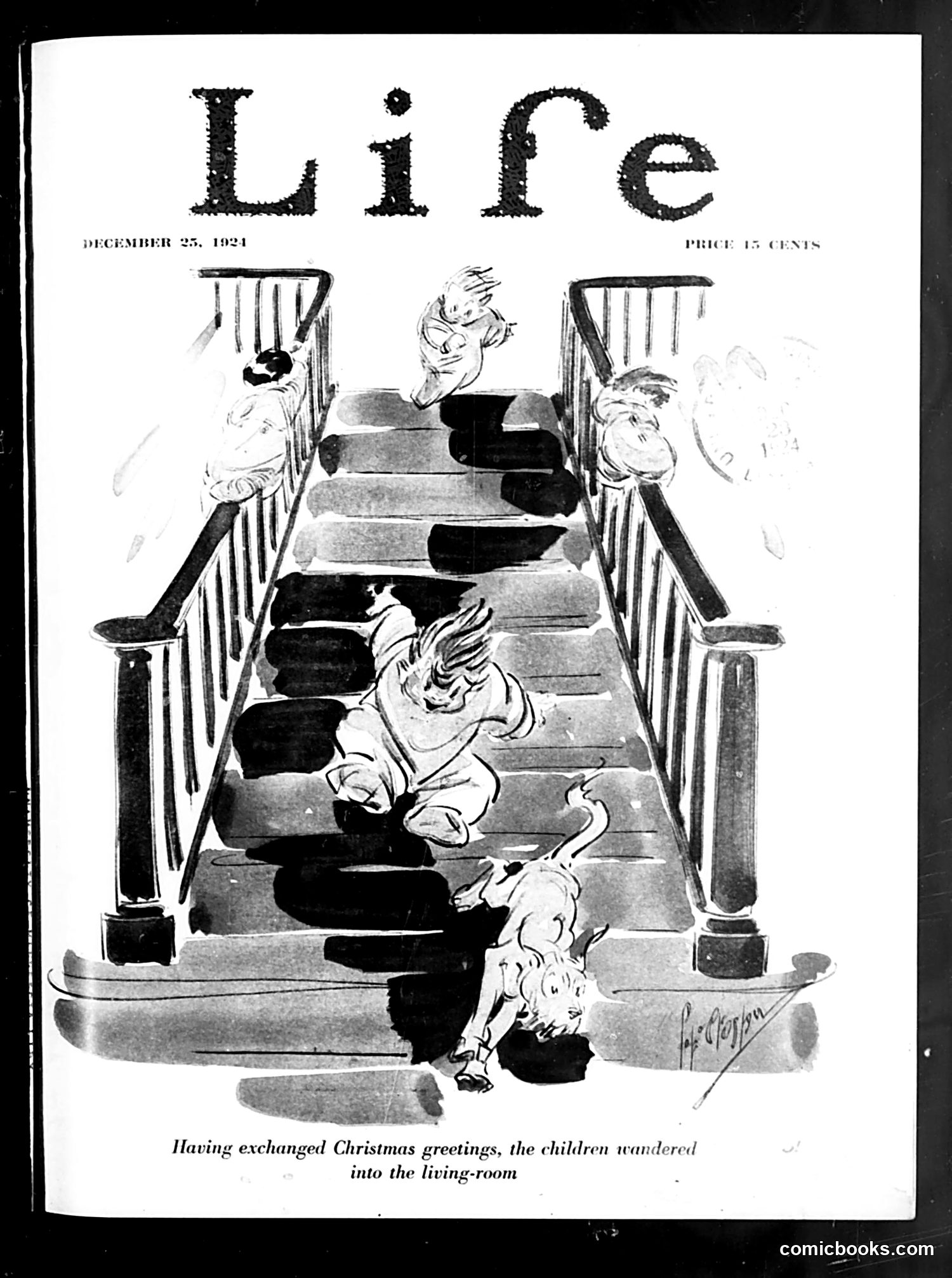
This is a humorous Christmas illustration rather than political commentary. The caption reads: "Having exchanged Christmas greetings, the children wandered into the living-room." The cartoon depicts multiple children of varying ages descending a staircase in single file, each carrying what appears to be a dark object (likely toys or gifts). The humor derives from the orderly, almost military-like procession—children are arranged like soldiers marching downstairs, suggesting the chaos and abundance of Christmas morning when multiple children eagerly rush to see presents and the living room. The satire gently mocks the controlled domesticity parents attempt versus the reality of excited children. The illustration captures a familiar domestic scene from 1920s family life during the holiday season, using exaggeration for comic effect.
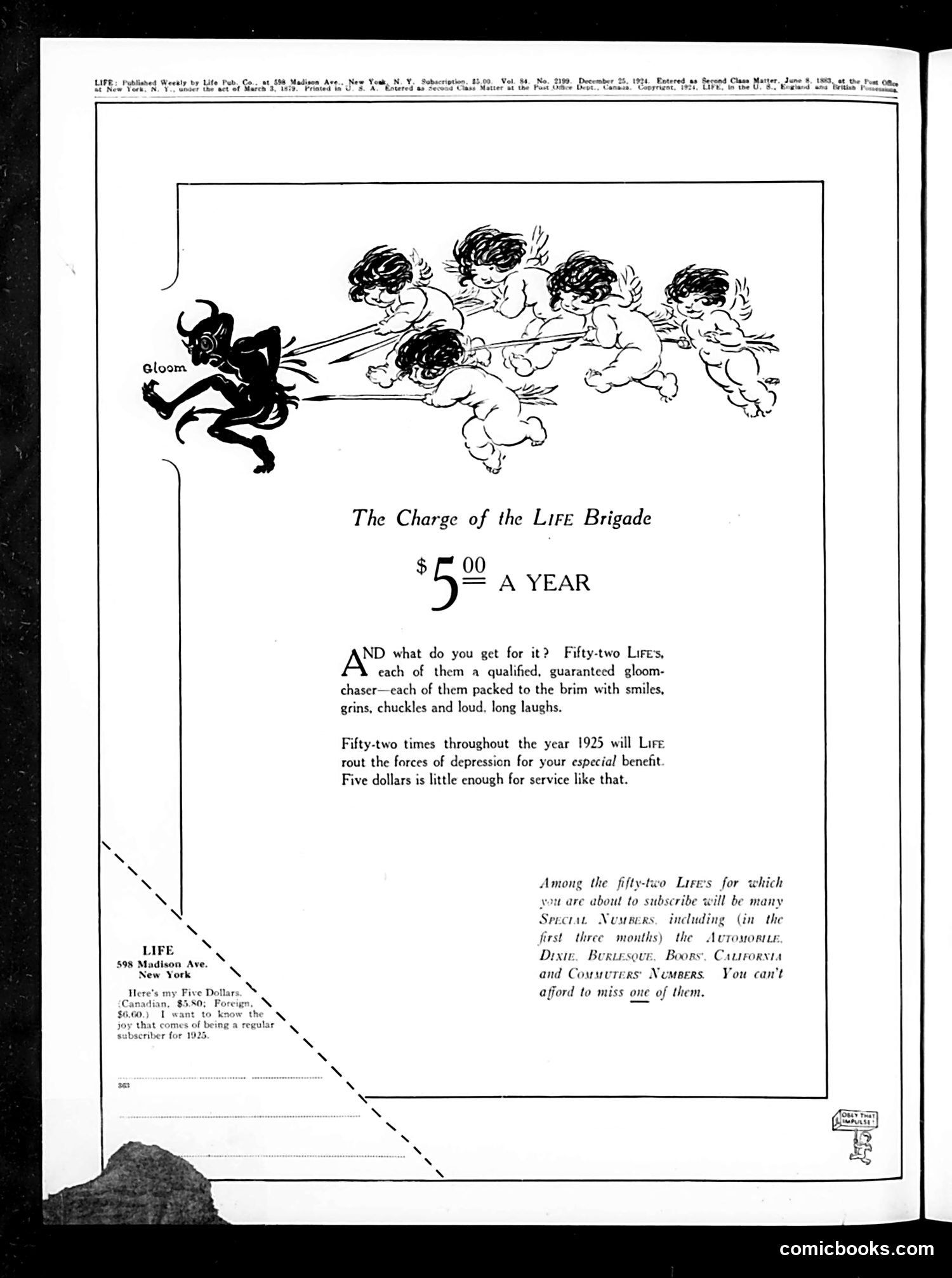
This is a subscription advertisement for *Life* magazine, priced at $5.00 annually for 1925. The cartoon depicts a demonic figure labeled "Gloom" being attacked by a brigade of cherubs—representing *Life*'s comedic content. The satire promises that the magazine will "rout the forces of depression" fifty-two times yearly through humor: "smiles, grins, chuckles and loud, long laughs." The phrase "Charge of the LIFE Brigade" puns on the famous poem "Charge of the Light Brigade," suggesting *Life*'s cheerful assault on melancholy. The advertisement emphasizes that for five dollars, subscribers receive guaranteed entertainment—positioning humor as a valuable service against contemporary gloom, likely referencing post-WWI cultural concerns or economic uncertainty in 1920s America.
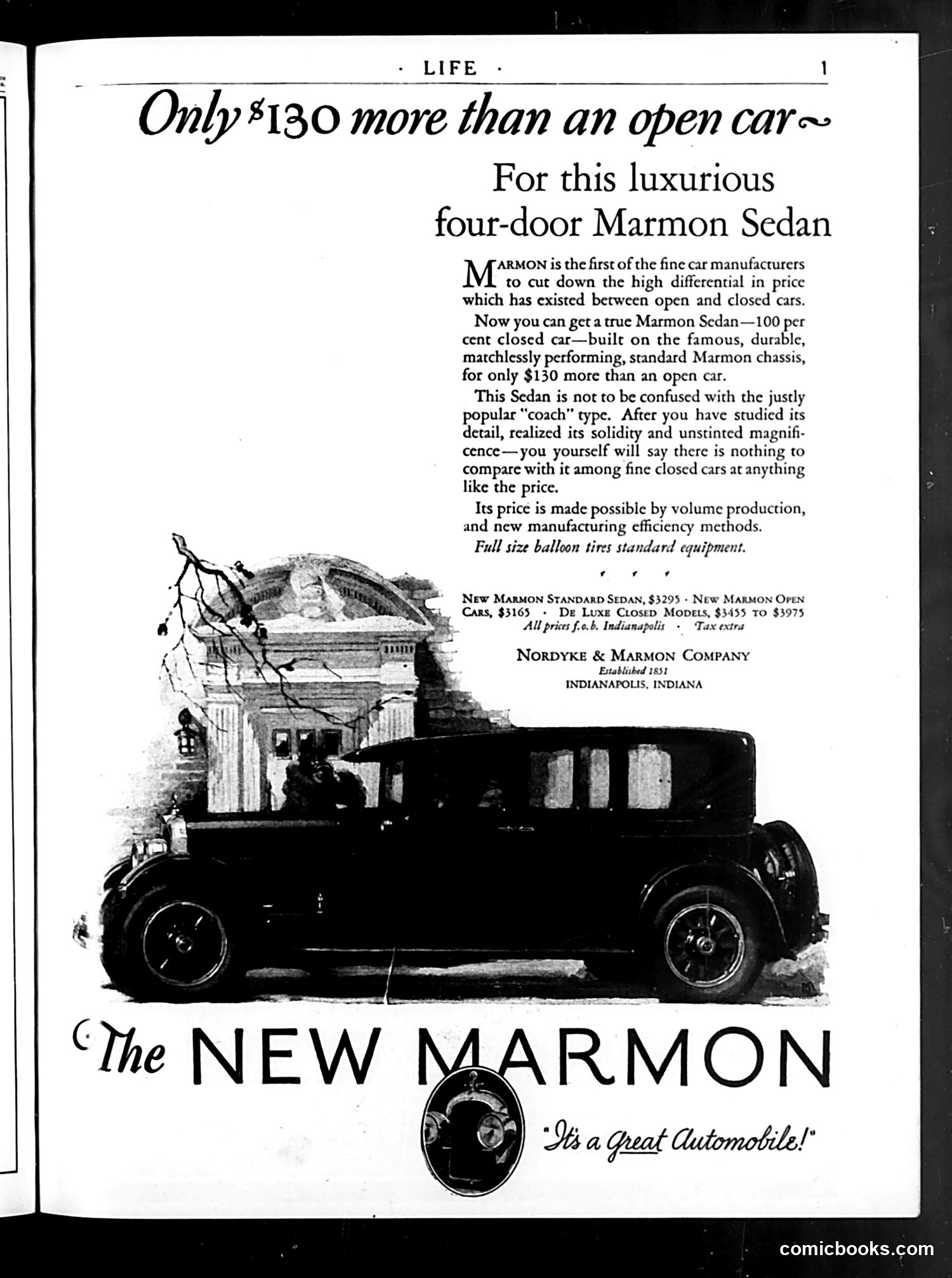
This is primarily a **car advertisement**, not political satire. The Nordyke & Marmon Company (Indianapolis) advertises their new four-door Marmon Sedan, priced at $3,295—only $130 more than an open car model ($3,165). The ad's humor plays on the emerging market shift: closed cars were becoming standard, yet still commanded premium prices. Marmon claims to be "the first of the fine car manufacturers" to reduce this price differential through volume production and manufacturing efficiency. The classical building imagery in the background appears decorative, suggesting luxury and prestige rather than carrying specific satirical meaning. The tagline—"It's a Great Automobile!"—is straightforward marketing. This reflects 1920s automotive industry competition as closed vehicles displaced open-air models.
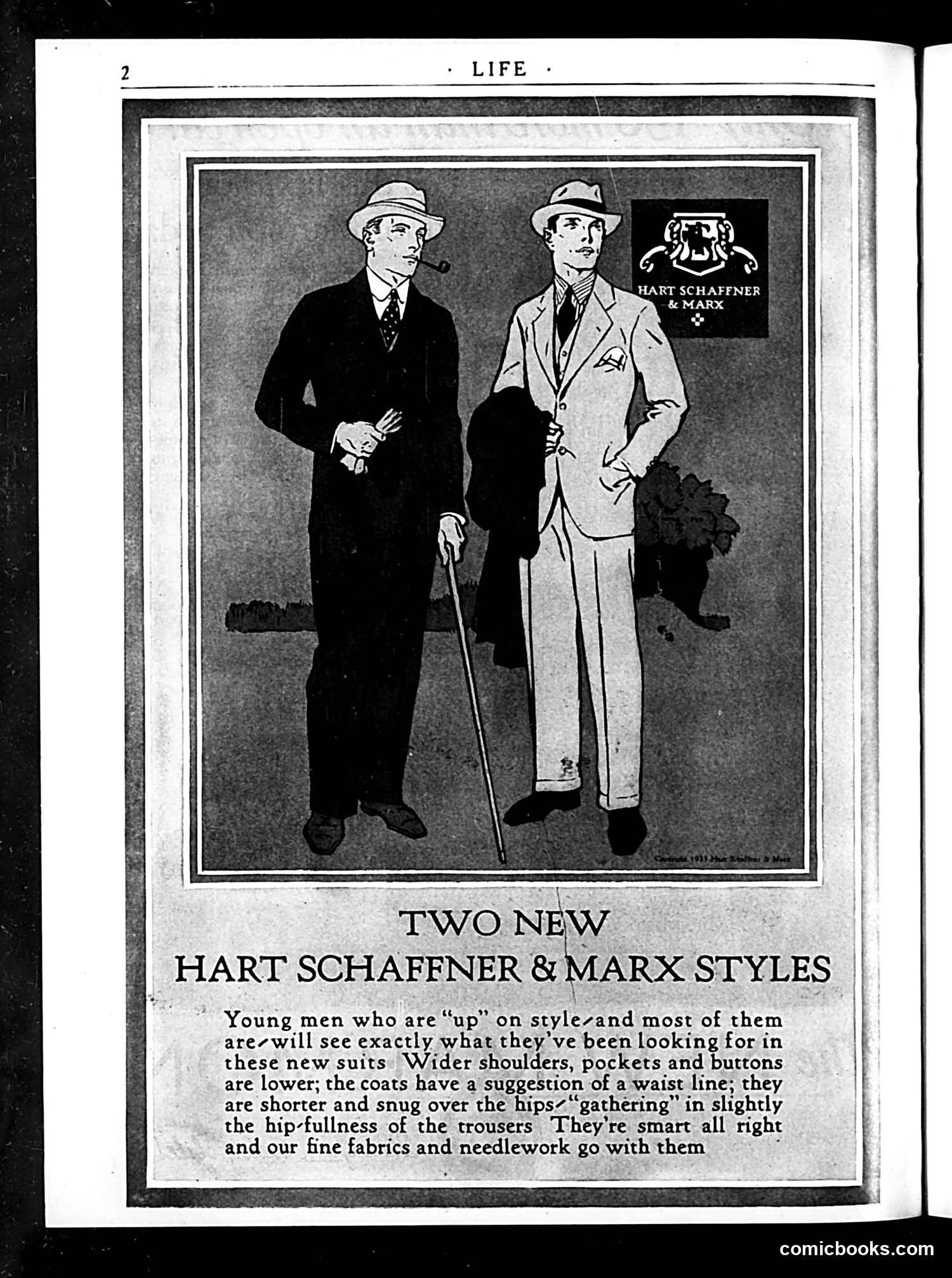
This is a **clothing advertisement**, not political satire. Hart Schaffner & Marx, a men's clothing manufacturer, showcases two new suit styles for young men interested in contemporary fashion. The ad emphasizes modern style features: wider shoulders, lower pockets and buttons, shorter coats with defined waistlines, and trousers with increased hip fullness. The text appeals to fashion-conscious "young men who are 'up' on style," positioning these designs as the latest trend. The illustration depicts two well-dressed men in fedoras modeling the suits side-by-side for comparison. The Hart Schaffner & Marx logo appears in the upper right. This represents straightforward early 20th-century menswear marketing rather than editorial cartoon content.
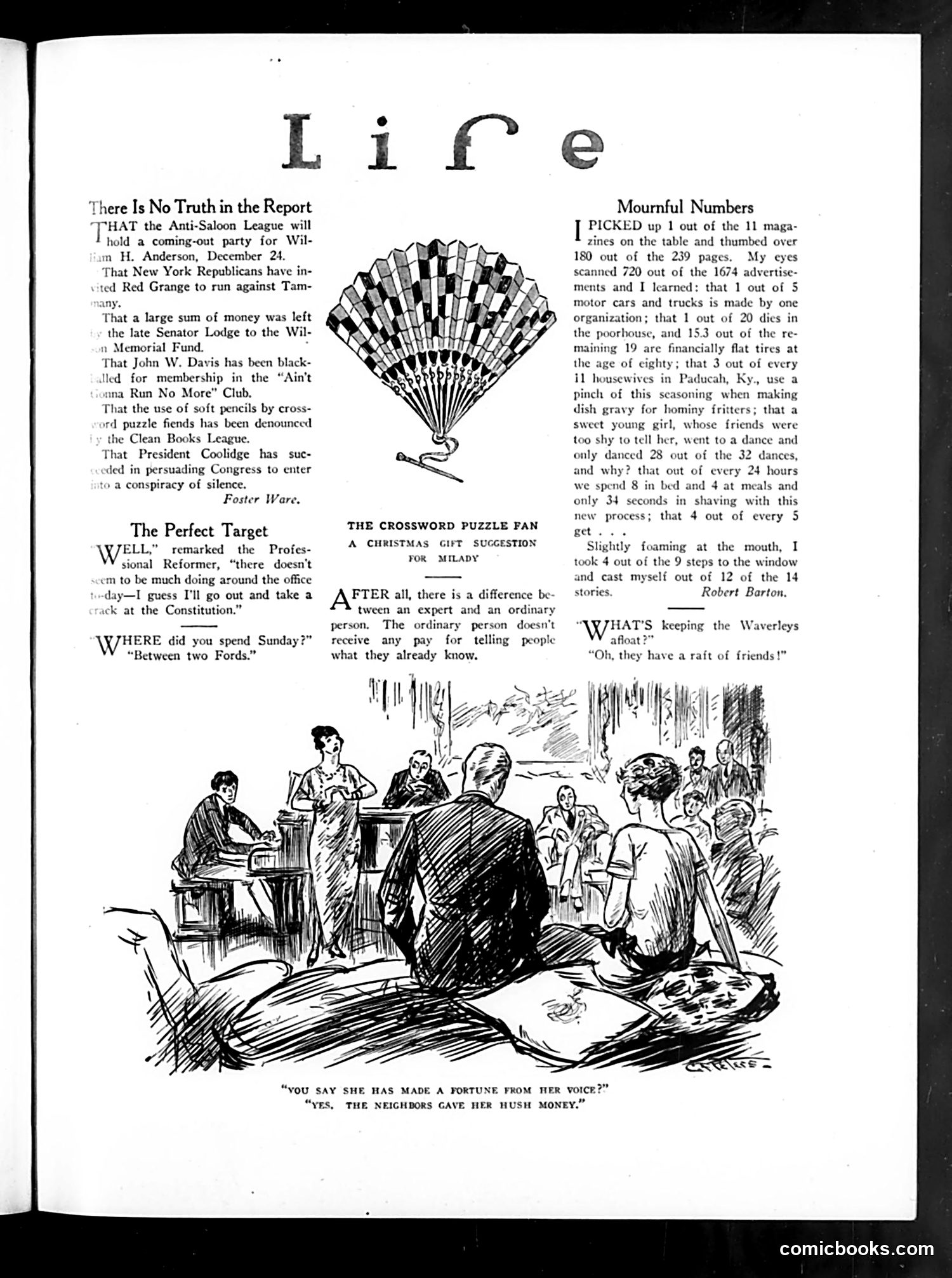
This page contains satirical commentary and humor pieces typical of early 20th-century Life magazine. **"There Is No Truth in the Report"** attacks the Anti-Saloon League with false rumors about its leadership, suggesting hypocrisy around prohibition politics. **"The Perfect Target"** quotes a professional reformer dismissing ordinary citizens' knowledge—satirizing sanctimonious reform movements. **"The Crossword Puzzle Fan"** presents a fan illustration with commentary about obsessive puzzle-solving, a 1920s fad. **"Mournful Numbers"** by Robert Barton catalogues mundane statistics about household life (1 in 5 motor cars, 1 in 20 dies poor) to mock how people anxiously quantify existence. **The main cartoon** depicts a social gathering where neighbors gossiped that a woman "made a fortune from her voice" through "hush money"—satirizing scandal-mongering and assumptions about women's earnings.
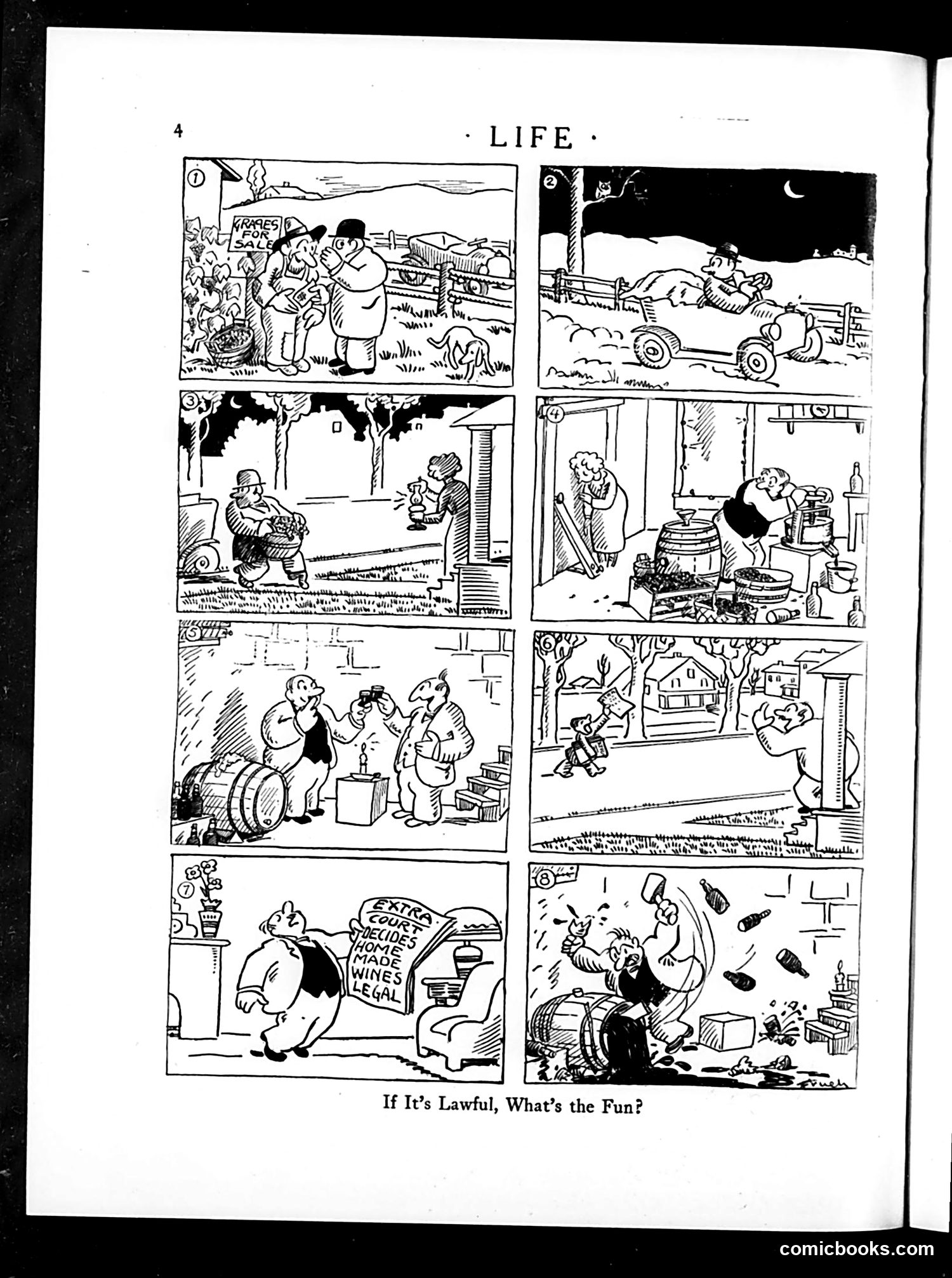
This eight-panel comic satirizes Prohibition-era hypocrisy. The title's ironic question suggests that Americans found illegal activities more appealing than legal alternatives. The narrative appears to follow bootleggers or moonshiners engaging in increasingly brazen illegal alcohol production and distribution. Panel 7 shows a newspaper headline reading "EXTRA SPEAKEASIES MADE WHILE MADE LEGAL" (the text is partially unclear), suggesting Prohibition laws were being circumvented almost immediately upon passage. The final panel depicts chaos—bottles flying, damage everywhere—emphasizing the disorder and violence that characterized Prohibition's enforcement. The satire targets the disconnect between what the law permitted and what Americans actually wanted, mocking both the naivety of Prohibition advocates and the public's eager embrace of lawbreaking.
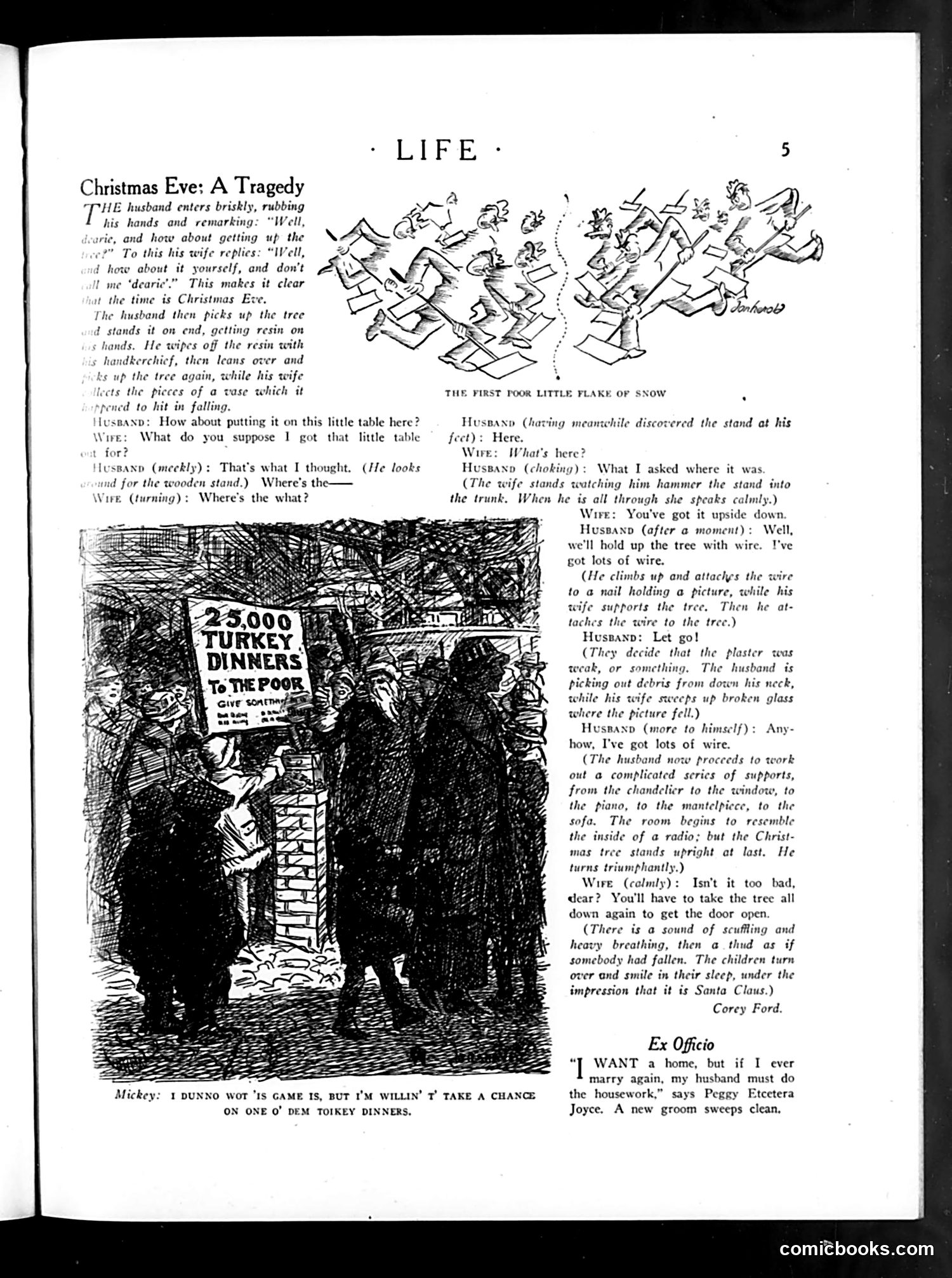
This satirical piece mocks the chaos of assembling a Christmas tree on Christmas Eve. The husband struggles comically to set up a small tree while his wife watches. The cartoon shows two figures outside a building with a sign advertising "23,000 Turkey Dinners to the Poor," establishing a Depression-era setting where charitable giving contrasts with domestic struggles. The humor derives from the mundane disaster: the tree stand doesn't work, wire must substitute for a proper base, and the couple must dismantle the tree to open the door. The title "Tragedy" exaggerates this minor domestic frustration into mock-epic terms. The accompanying cartoon of Mickey Mouse references popular culture. The piece satirizes both working-class Christmas difficulties and the contrast between public charity and private domestic chaos during economically hard times.
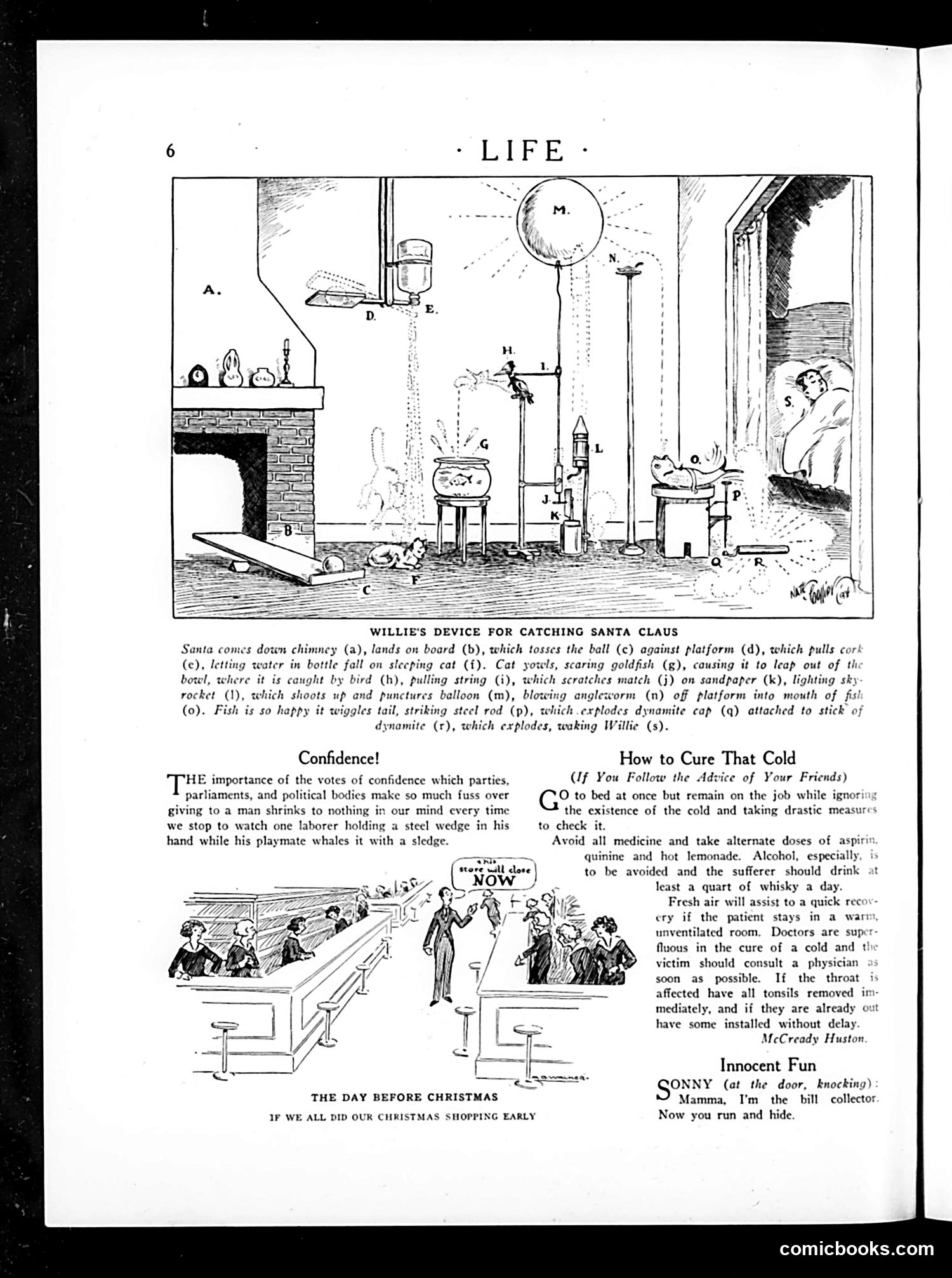
This page contains three distinct pieces: 1. **"Willie's Device for Catching Santa Claus"** — An elaborate Rube Goldberg-style contraption depicting a child's imaginative trap involving dominoes, pulleys, balloons, and explosive devices. It satirizes childhood fantasy and over-engineering. 2. **"The Day Before Christmas"** — A cartoon showing crowded Christmas shopping, with the caption "If We All Did Our Christmas Shopping Early." This social commentary critiques last-minute holiday shopping chaos and consumer behavior. 3. **"How to Cure That Cold"** and **"Innocent Fun"** — Practical advice and a brief humorous dialogue. The cold-remedy section offers period-appropriate medical suggestions (aspirin, quinine, whisky, fresh air). The page exemplifies early 20th-century American humor focusing on everyday domestic life, holiday customs, and gentle satire of social conventions.
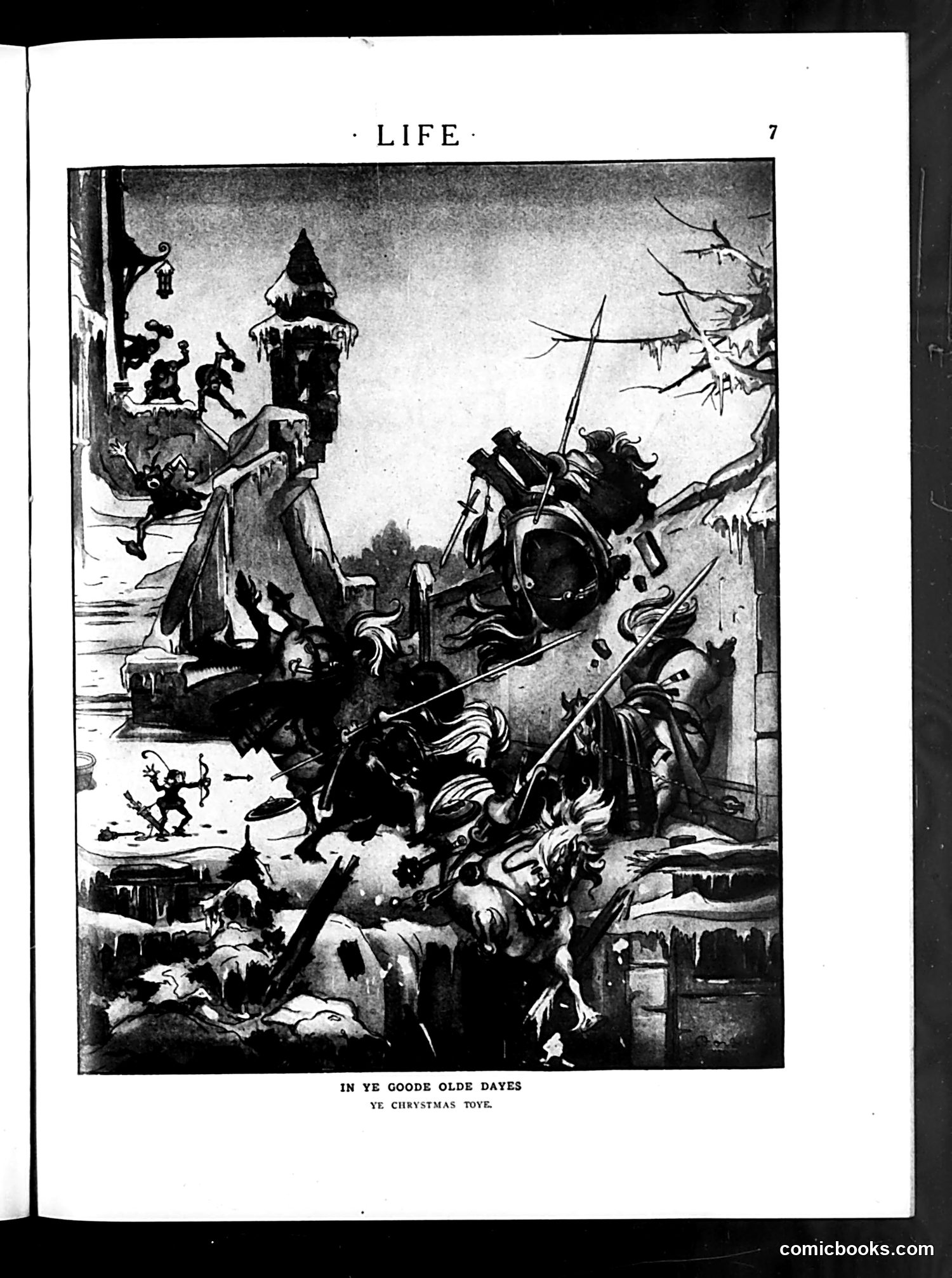
This satirical illustration depicts a chaotic medieval or fairy-tale scene labeled as an "old-fashioned Christmas toy." The image shows armed figures engaged in violent conflict—including what appear to be soldiers or knights with weapons, cannons, and destroyed fortifications in the background. The satire appears to critique the romanticization of historical violence. By framing brutal warfare as a "goodie olde dayes" Christmas plaything, the cartoonist mocks nostalgia for the past and perhaps contemporary toy marketing that glorifies conflict. The contrast between "Chrystmas" (typically associated with peace and innocence) and the graphic violence serves as sharp commentary on how society packages and normalizes warfare, even for children's entertainment.
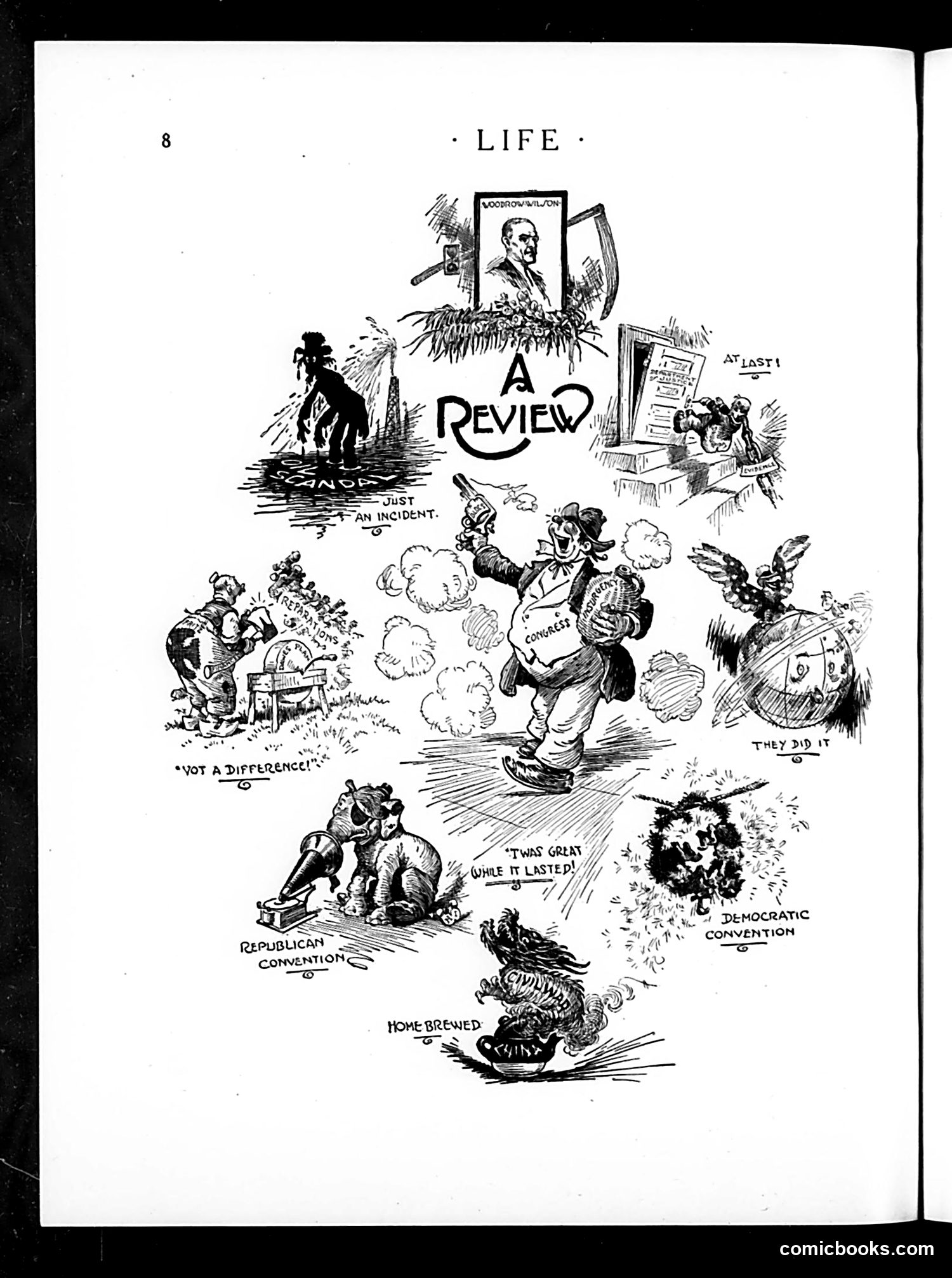
This satirical page from *Life* magazine presents six political vignettes arranged around a central title. Each sketch comments on contemporary political events: **"An Incident"** (top left) and **"Not a Difference"** (left) mock Republican and Democratic conventions as indistinguishable spectacles of chaos and bombast. **"At Last!"** (top right) shows figures celebrating, likely referencing a concluded political moment. The central figure labeled "Congress" appears disheveled, surrounded by smoke and confusion—suggesting legislative dysfunction or gridlock. **"They Did It"** (right) and **"'Twas Great While It Lasted"** (center-bottom) offer sardonic commentary on political accomplishments or their brevity. **"Home Brewed"** (bottom) depicts what appears to be a volatile or self-destructive political creation. The overall message critiques American political theater as chaotic, ineffective, and indistinguishable between parties.
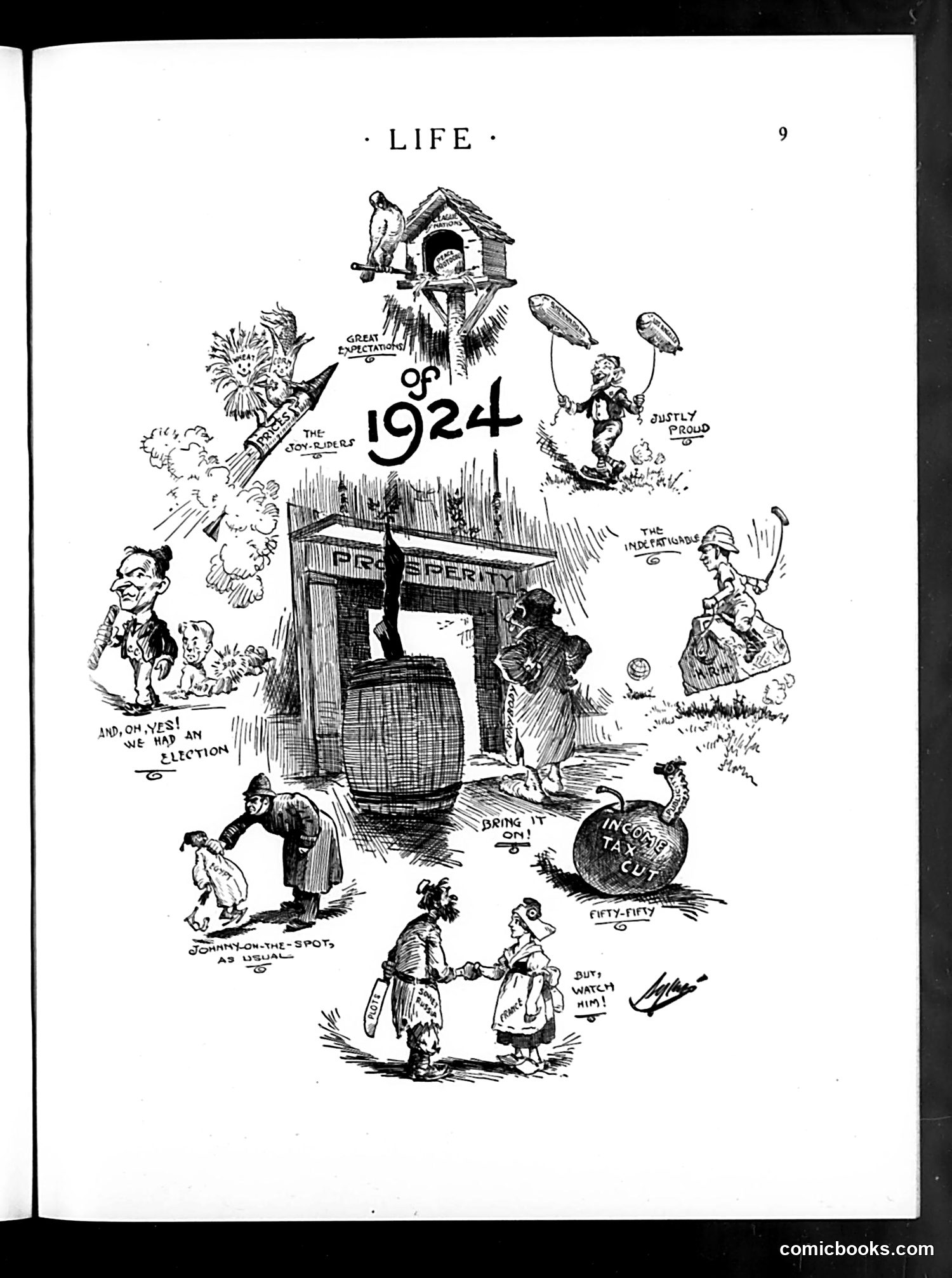
This political cartoon satirizes the 1924 U.S. election year through various vignettes surrounding a large barrel labeled "Prosperity." The central imagery suggests competing political forces attempting to control or benefit from the nation's economic situation. The surrounding scenes include references to "Great Expectations," "Election," "Income Tax Cut," and other topical issues of the era. Figures appear to represent politicians and interest groups—including what seems to be candidates and political operatives—each pursuing their own agenda regarding the barrel of "Prosperity." The cartoon's core message critiques how different political players exploit prosperity rhetoric during election season, each claiming credit or demanding benefits. The style is typical of Life's satirical approach to contemporary American politics and economics during the 1920s.
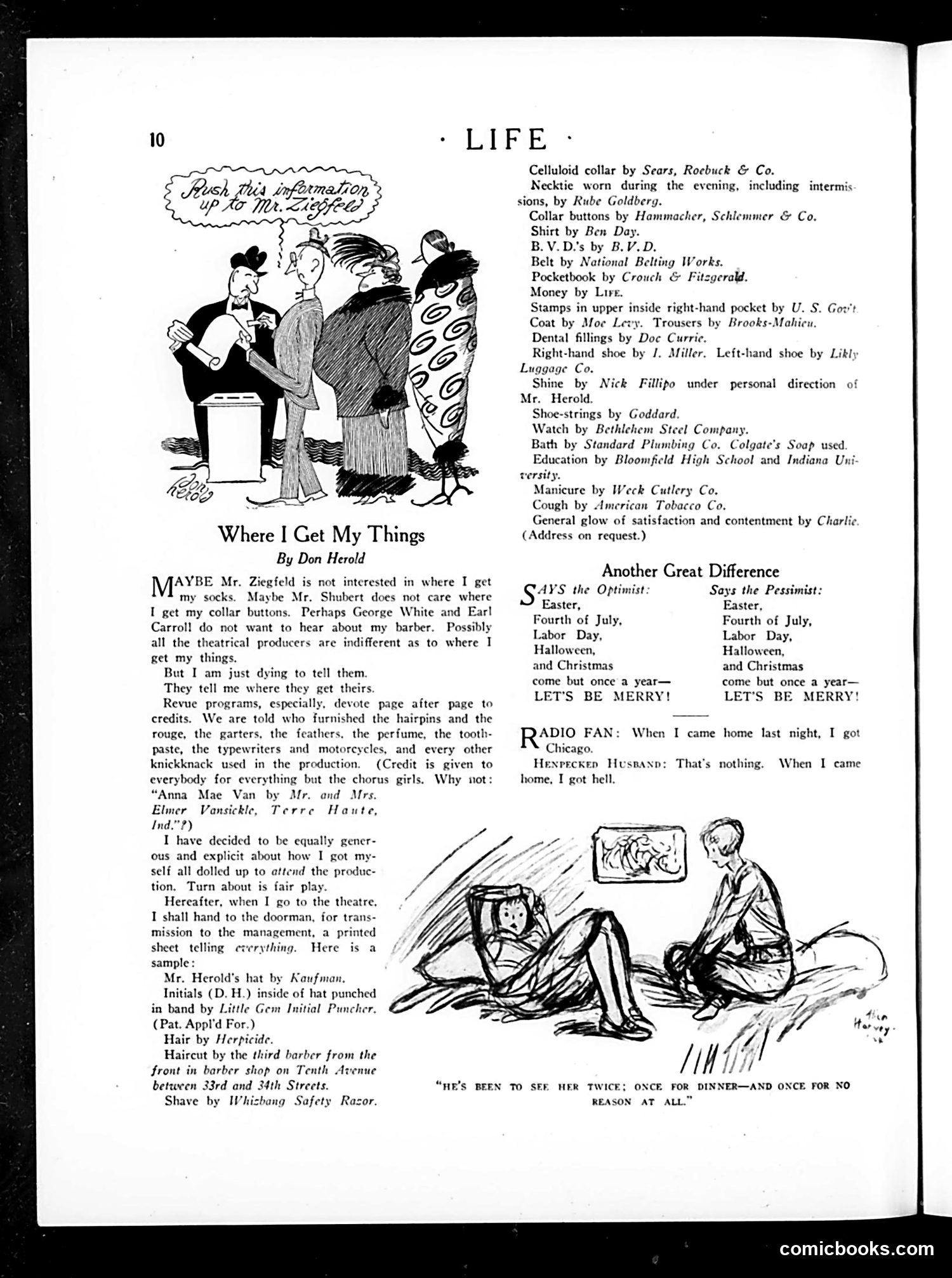
This page contains satirical articles and advertisements rather than political cartoons. **"Where I Get My Things"** by Don Herald humorously catalogs theatrical production credits—arguing that theater programs obsessively credit every supplier (socks, collar buttons, shoes, dental work) while overlooking the actual creative contributors. The joke mocks overdetailed program acknowledgments while omitting essential artists like the chorus girls. **"Another Great Difference"** presents a simple optimist-vs-pessimist comparison about holidays, both concluding "LET'S BE MERRY!"—suggesting life's meaning depends on one's outlook rather than circumstances. **"Radio Fan" and "Henpecked Husband"** exchange jokes comparing domestic complaints. The bottom cartoon depicts a man lounging while a woman stands—captioned "He's been to see her twice: once for dinner—and once for no reason at all," satirizing courtship or infidelity.
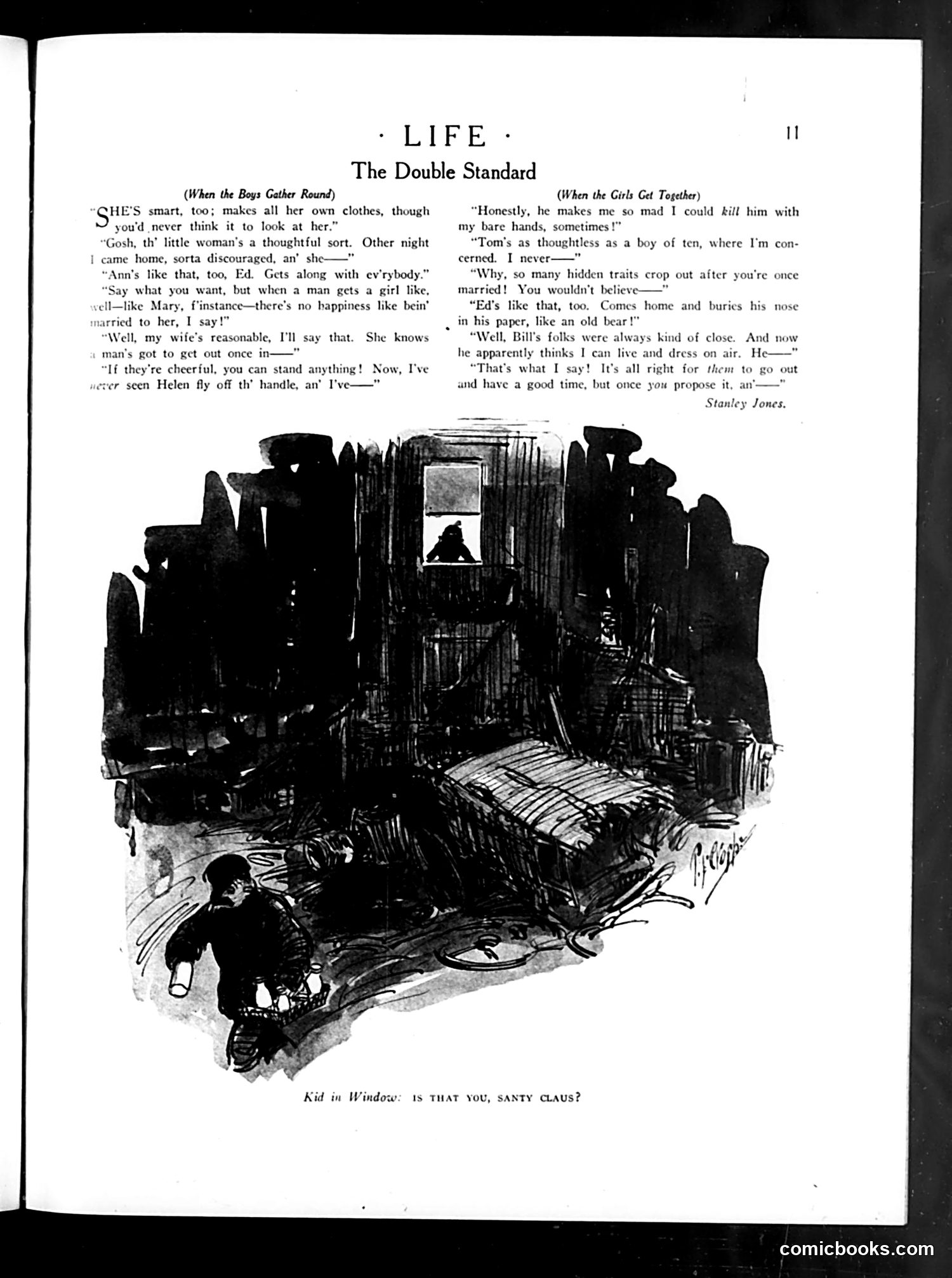
This page presents two contrasting dialogues satirizing marital hypocrisy. "When the Boys Gather Round" shows a husband bragging about his wife's intelligence and domestic skills, claiming she's "reasonable" and "cheerful." "When the Girls Get Together" reveals the same wife's private frustration—her husband is thoughtless, comes home discouraged, and buries himself in the newspaper. The illustration depicts a bedroom scene with a child looking out a window asking "IS THAT YOU, SANTY CLAUS?" The satire exposes the performative nature of gender roles and marriage in this era: husbands present one image publicly while wives privately endure different realities. The piece critiques how women's actual experiences diverge sharply from the idealized domestic narratives men promote.
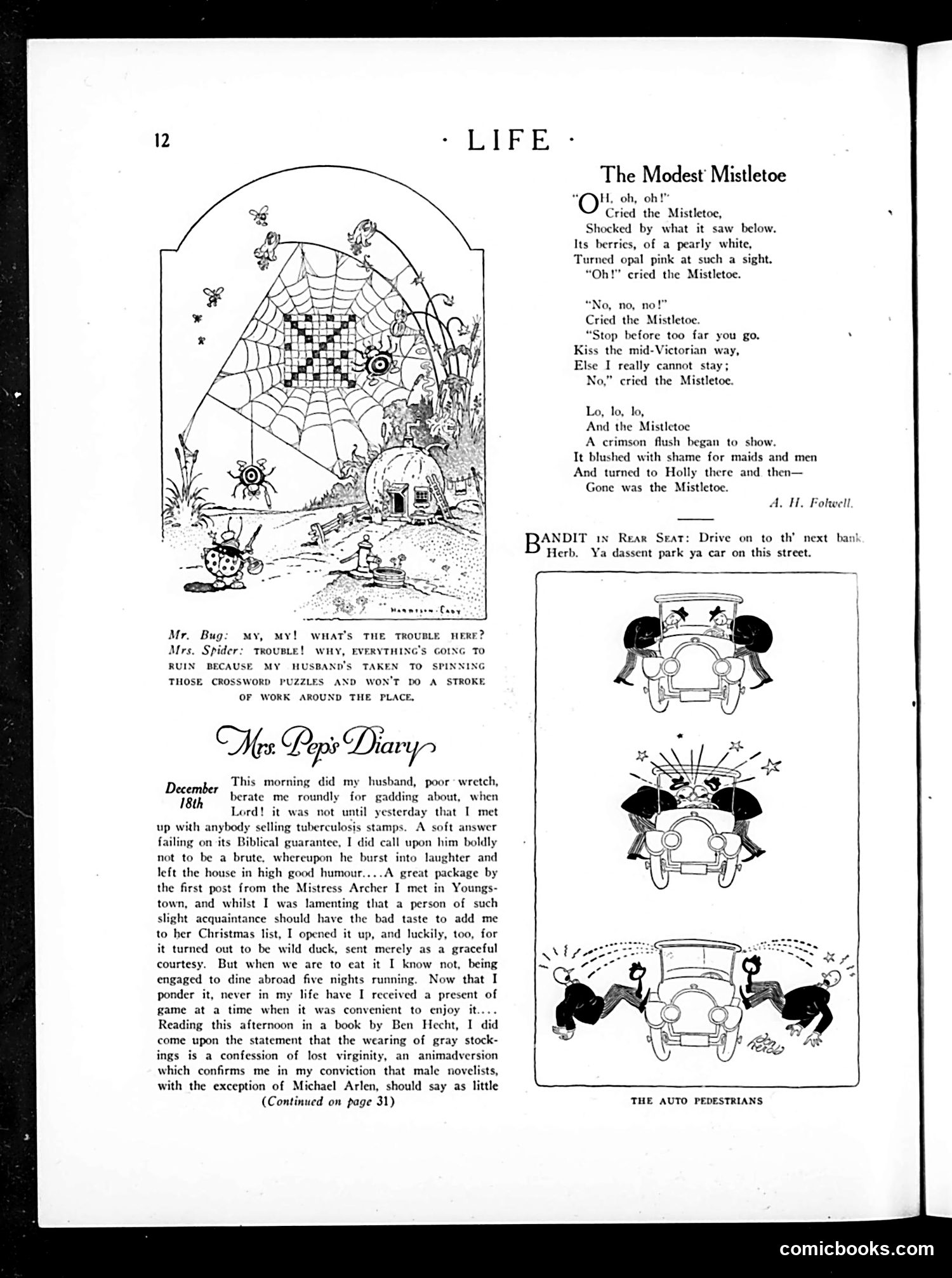
This page contains three distinct pieces: **"The Modest Mistletoe"** — A poem by A.H. Fotherell about a mistletoe character who blushes and flees upon witnessing improper behavior below (likely kissing or romantic conduct). The accompanying illustration shows spiders and insects in a web, suggesting voyeuristic observation. **"Mrs. Pep's Diary"** — A humorous domestic diary entry from December 1918 describing the author's husband's restless behavior and a Christmas gift of game stamps. The satirical commentary critiques male novelists' claims about lost virginity. **"The Auto Pedestrians"** — Three cartoon panels showing automobiles with pedestrians clinging to or being struck by them, captioned with instructions like "Drive on to th' next bank." This satirizes reckless driving and pedestrian danger in early automobile culture. The humor targets Victorian propriety, gender stereotypes, and modern traffic hazards.
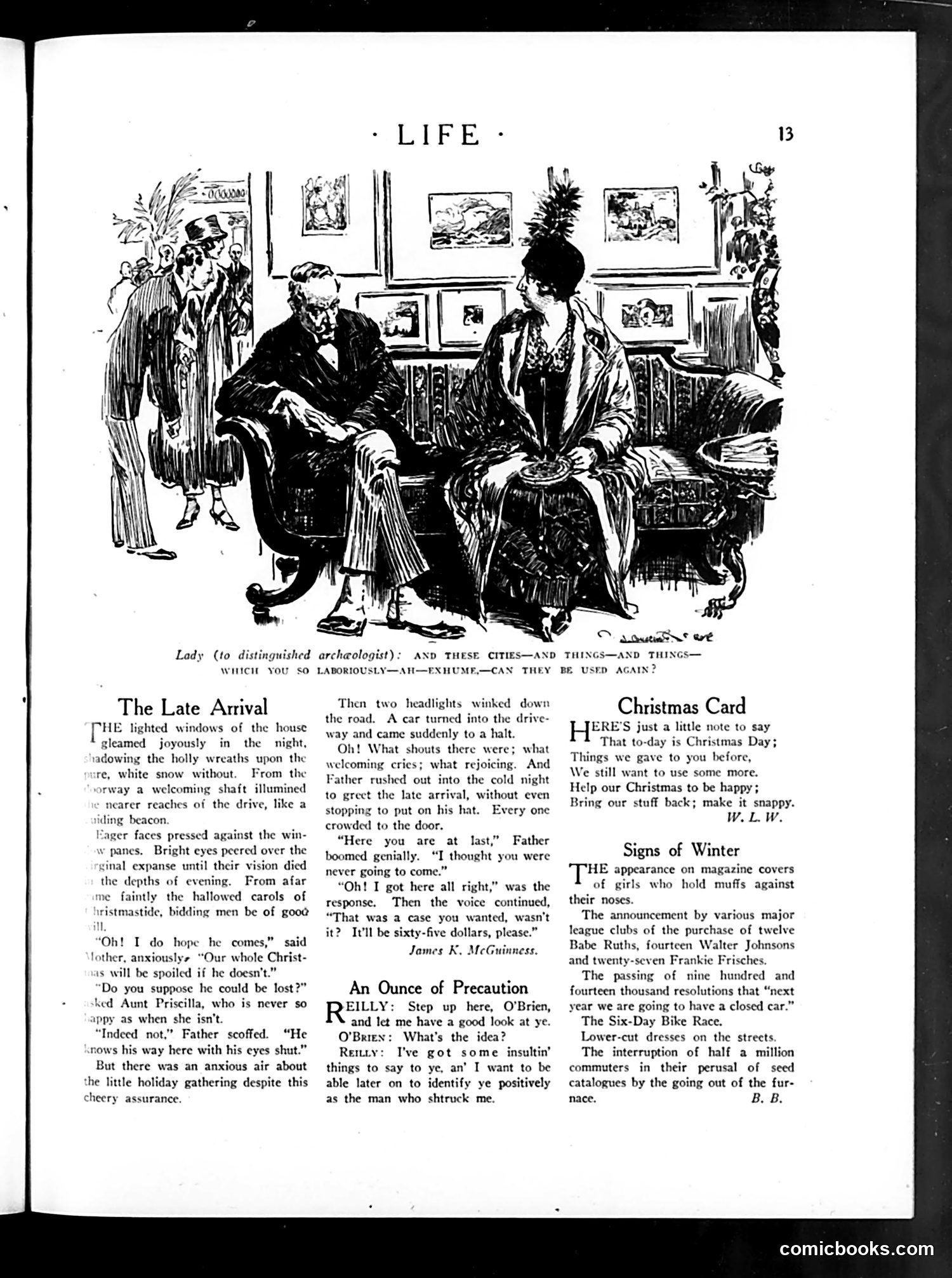
The main cartoon depicts a society gathering where a distinguished archaeologist shows an upper-class couple artifacts and asks whether excavated ancient cities and objects "can they be used again?" This satirizes the wealthy class's materialism and superficiality—suggesting they view even historical artifacts primarily through the lens of practical utility or fashionable reuse rather than genuine scholarly or cultural interest. The page also contains three short humorous pieces: "The Late Arrival" (about a tardy Christmas guest), "Christmas Card" (seasonal greetings), and "An Ounce of Precaution" (dialogue between characters discussing identification). These appear to be typical satirical vignettes mocking middle and upper-class social conventions of the era.
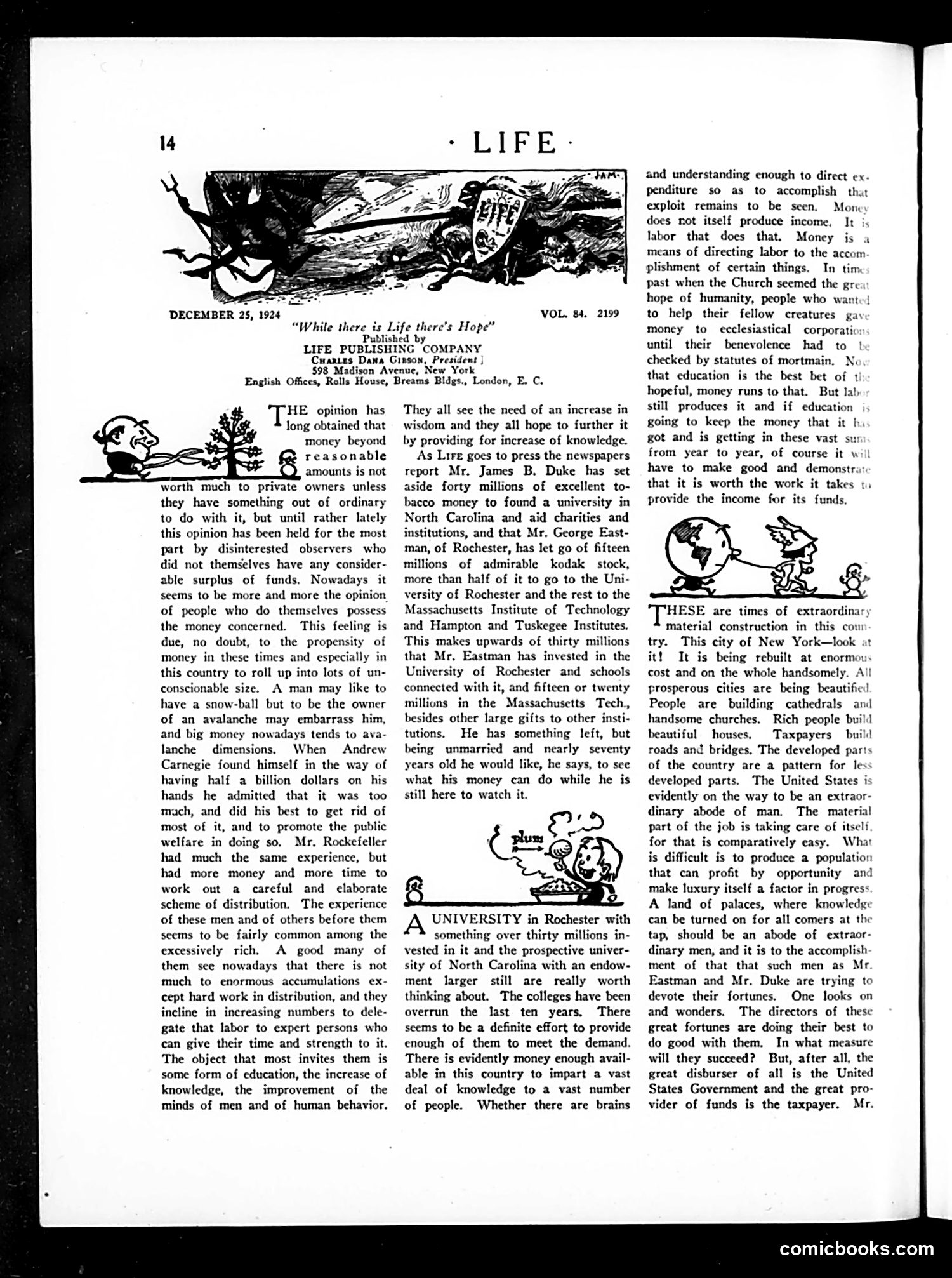
This editorial page discusses wealthy philanthropists and university funding. The text references **James B. Duke** (tobacco magnate) donating $40 million to found Duke University in North Carolina, and **George Eastman** (Kodak founder) giving $15 million to the University of Rochester. The small decorative cartoons appear to be generic illustrations rather than specific political satire—they show figures with money/wealth symbols, likely emphasizing the page's theme about wealthy industrialists and their charitable giving. The editorial's point: while these massive donations are admirable, they represent an insufficient approach to education and social welfare. The author argues money alone doesn't solve systemic problems and questions whether private charity should substitute for broader public investment in education and infrastructure.
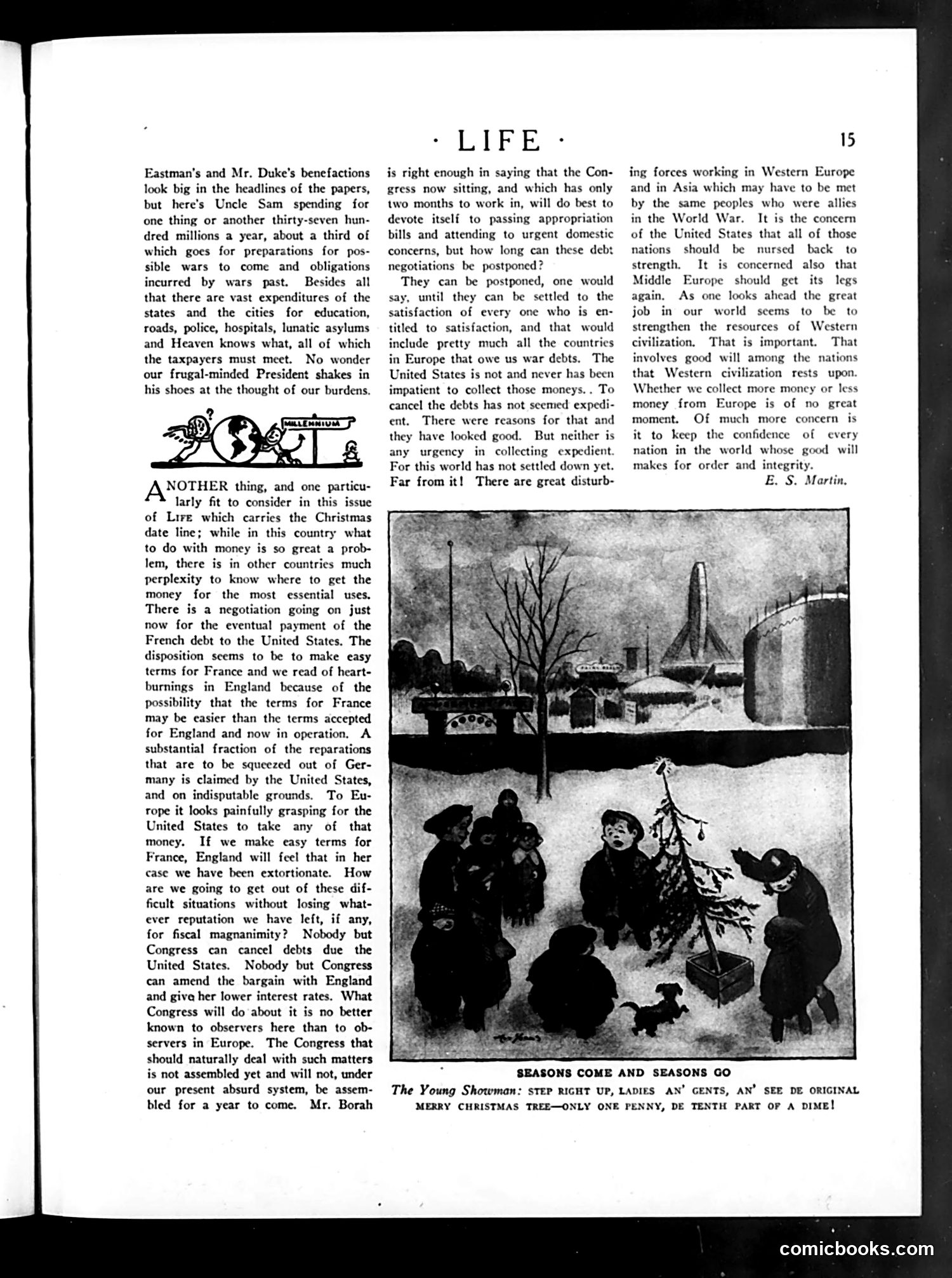
This cartoon depicts young street children in winter, gathered around a sparse, bare tree branch decorated as a Christmas tree. The caption reads: "The Young Showman: step right up, ladies an' gents, an' see de original merry christmas tree—only one penny, de tenth part of a dime!" **The satire:** A street child is entrepreneurially "selling" a view of this pathetic makeshift tree to other poor children—charging admission (one penny) to see what purports to be a "real" Christmas tree. This mocks both the desperation of poverty and the exploitation of the poor by those slightly less poor. It's a dark commentary on class economics and the degradation Christmas spirit undergoes in impoverished conditions. The irony is presenting this meager branch as an "original" attraction worthy of paid admission.
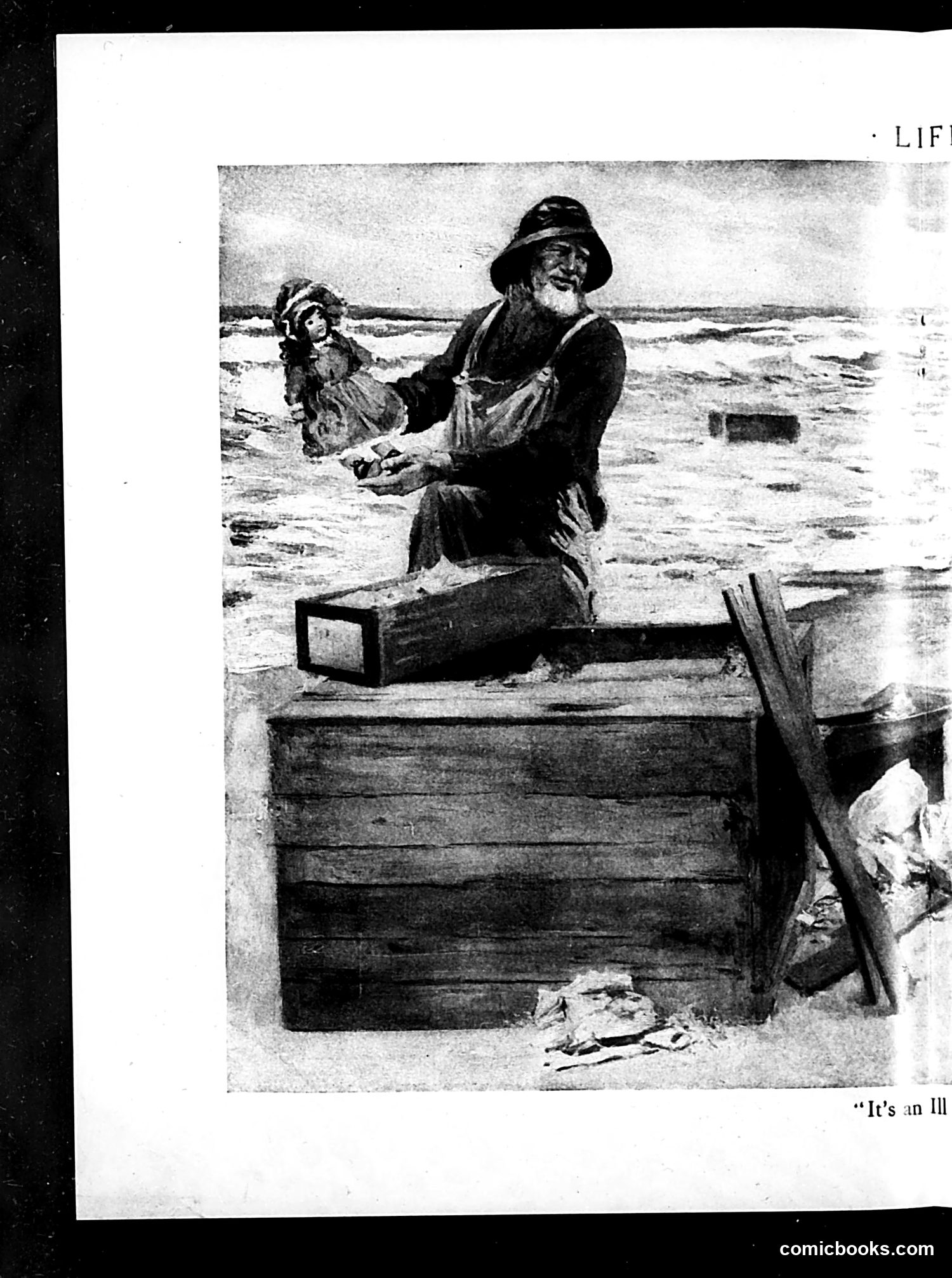
This appears to be a satirical illustration from *Life* magazine showing an elderly bearded man in working clothes standing at a wooden box or container on a beach. He's holding up what looks like a small monkey or ape. The ocean and beach setting are visible in the background. The partial caption reads "It's an Ill..." (incomplete on this page). Without the full caption and context, the specific satire is unclear. However, the image likely comments on either a scientific discovery, evolution debates (popular in early-to-mid 20th century), or possibly a deceptive hoax or con. The elderly working-class figure and his apparent "prize" suggest mockery of either credulous belief or fraudulent claims. The complete caption would clarify the intended satirical target.
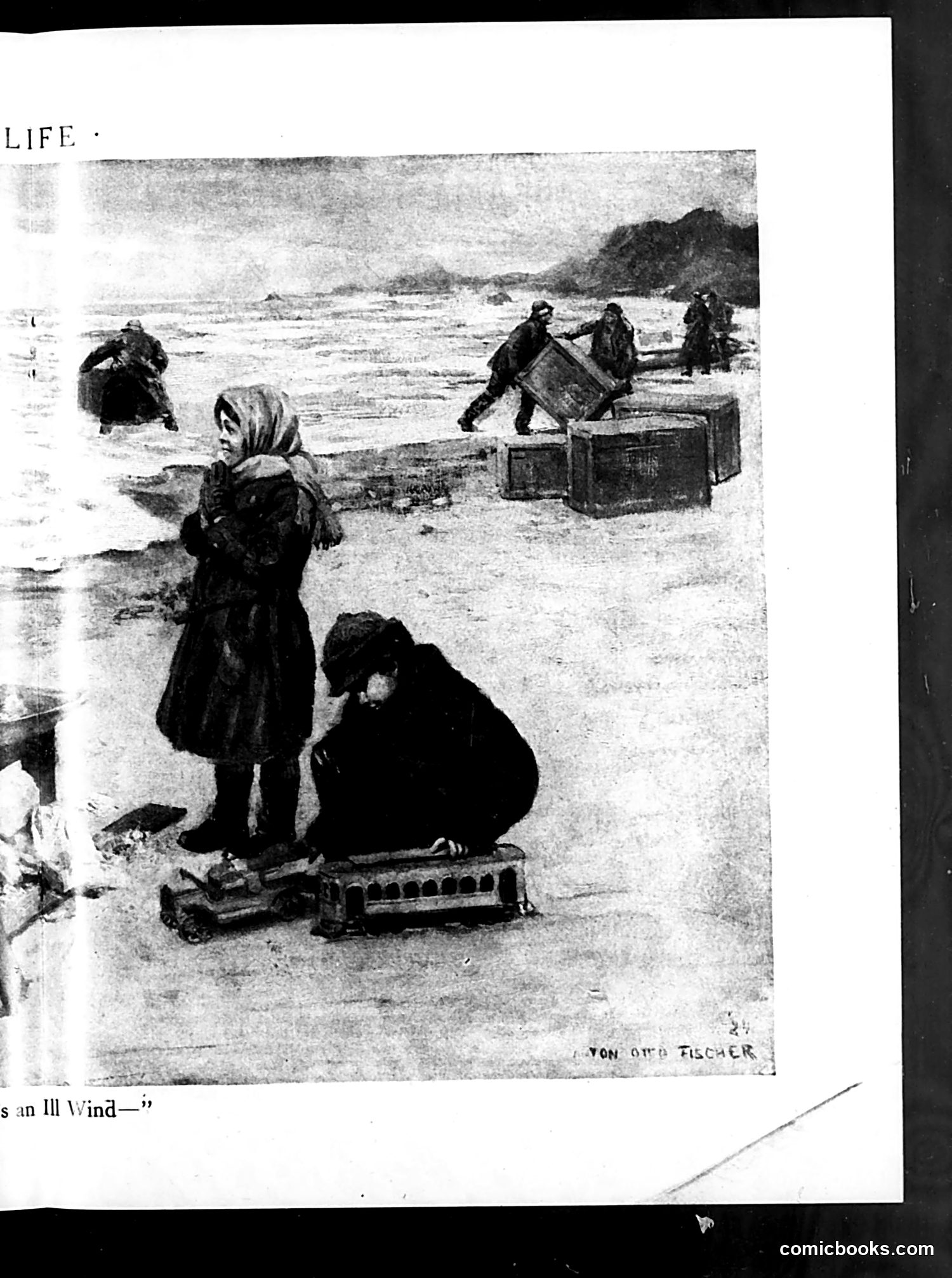
This appears to be a political cartoon titled "An Ill Wind" by Von Ord Fischer (visible signature). The image shows a beach scene with figures engaged in what looks like salvage or scavenging operations—people are handling boxes and cargo on a shoreline, with a hillside visible in the background. The partial OCR text and fragmented title suggest this satirizes some form of disaster, shipwreck, or economic hardship where people are forced to retrieve or salvage goods. Without the complete caption or date, the specific historical event isn't entirely clear, but the visual language of salvage and hardship suggests commentary on economic distress or a maritime catastrophe affecting ordinary people. The "ill wind" idiom typically references misfortune or bad circumstances, supporting a critical social commentary.
This page reviews three Broadway plays with characteristic satirical bite. The critic mocks "The Harem" as utterly predictable—a tired plot about a wife seducing her husband through disguise and Swedish accents, filled with obviously labeled "double entendres" that audiences inexplicably laugh at. The reviewer suggests one could dictate the entire script beforehand. However, two performances redeem mediocre material: Miss Ulric's compelling acting in "The Harem," and Gregory Kelly's "smooth gentility" in "Badges" (a crime drama). The critic suggests Kelly is transitioning from the "Willie Baxter" comedic type toward the more sophisticated "Willie Collier" style. "The Man in Evening Clothes," a French translation starring Henry Miller, offers an interesting premise but drowns under excessive dialogue. The overall tone suggests Broadway's creative bankruptcy—formulaic plots recycled endlessly, with only exceptional performances making attendance worthwhile.
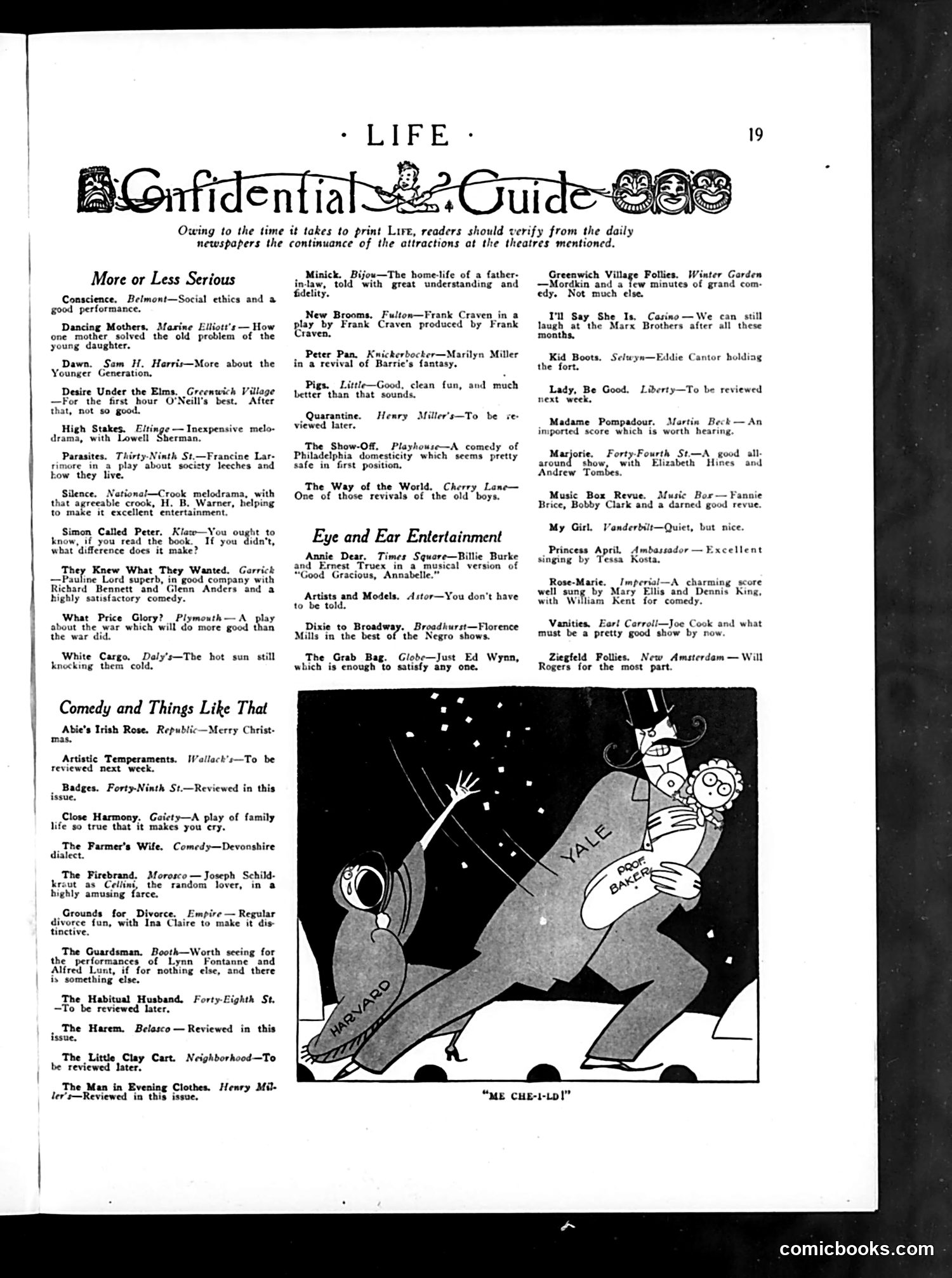
This page from *Life* magazine is primarily a theater guide reviewing Broadway shows and entertainment. The cartoon at bottom—titled "ME CHE-I-LD!"—appears to be satirical commentary on parenting or family dynamics. The image shows a figure (likely representing a parent or authority figure) being struck or knocked backward by what appears to be a child or younger person, with stars indicating impact. The exaggerated "CHE-I-LD" spelling suggests mocking pronunciation, possibly lampooning how parents speak about or to children, or satirizing generational conflict. Given the page's review of plays like *Dancing Mothers* and *Close Harmony* (described as "a play of family life so true that it makes you cry"), this cartoon likely comments on contemporary anxieties about youth rebellion and parent-child relationships—a recurring theme in 1920s entertainment and social commentary. The exact satirical point remains somewhat unclear without additional context.
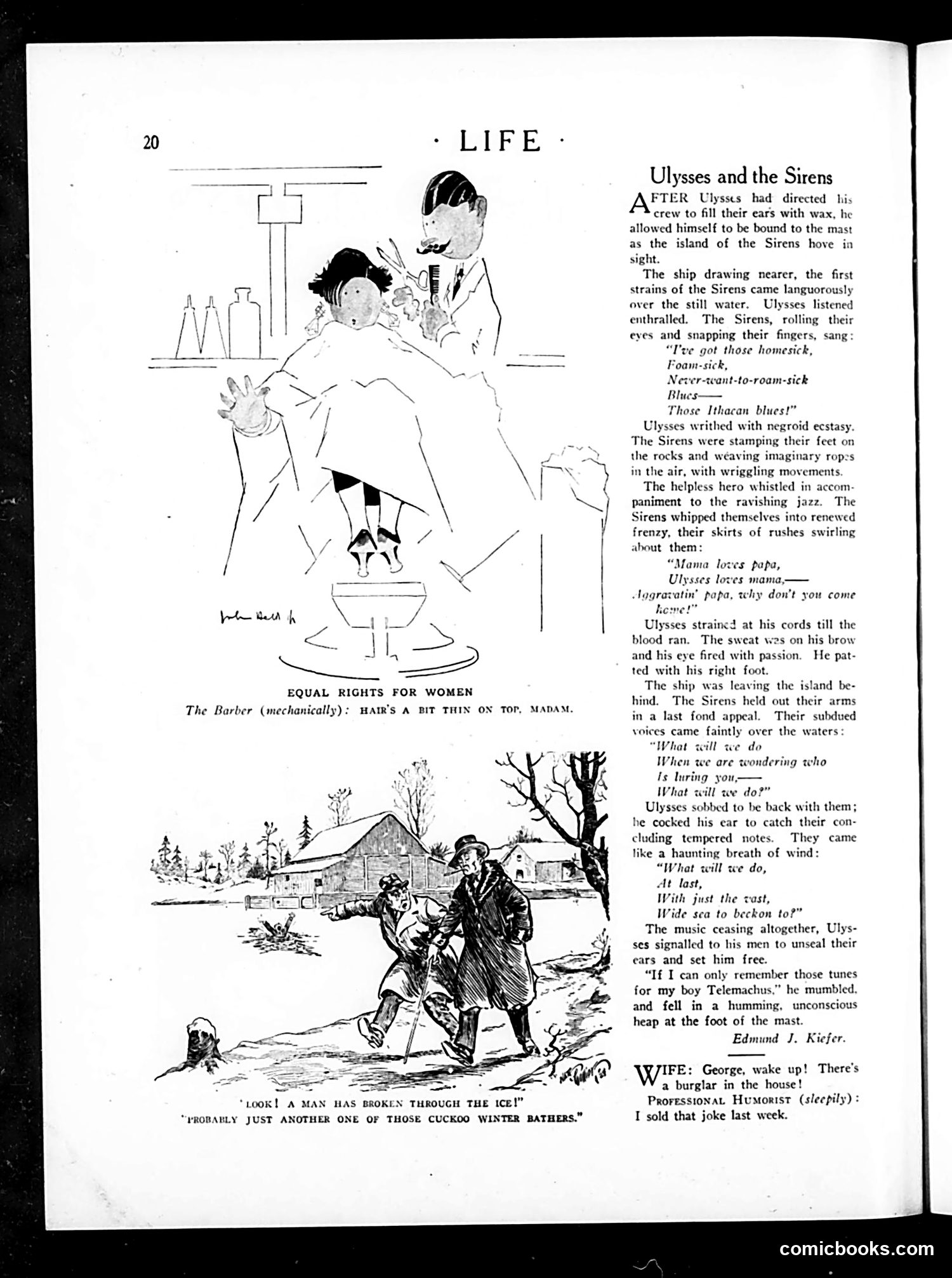
This page contains two satirical pieces: **"Ulysses and the Sirens"** (main story with illustration): A classical mythology retelling updated with 1920s jazz culture. The Sirens sing blues numbers with lyrics about homesickness and romance ("Mama loves papa"). Ulysses, described with dated racial language as experiencing "negroid ecstasy," is overcome by jazz music rather than mythological enchantment. The satire appears to mock both the romanticization of classical literature and perhaps contemporary attitudes toward jazz as seductive/dangerous. **"Equal Rights for Women"** (top cartoon): A barber tells a female customer her hair is "a bit thin on top"—the joke's caption reads "Hair's a bit thin on top, madam," satirizing the mechanical politeness of professional service roles, with possible gendered implications about appearance standards. **"Look! A Man Has Broken Through the Ice!"** (bottom): A joke about clichéd humor—a "professional humorist" mentions he already sold this joke last week, mocking recycled comedy material.
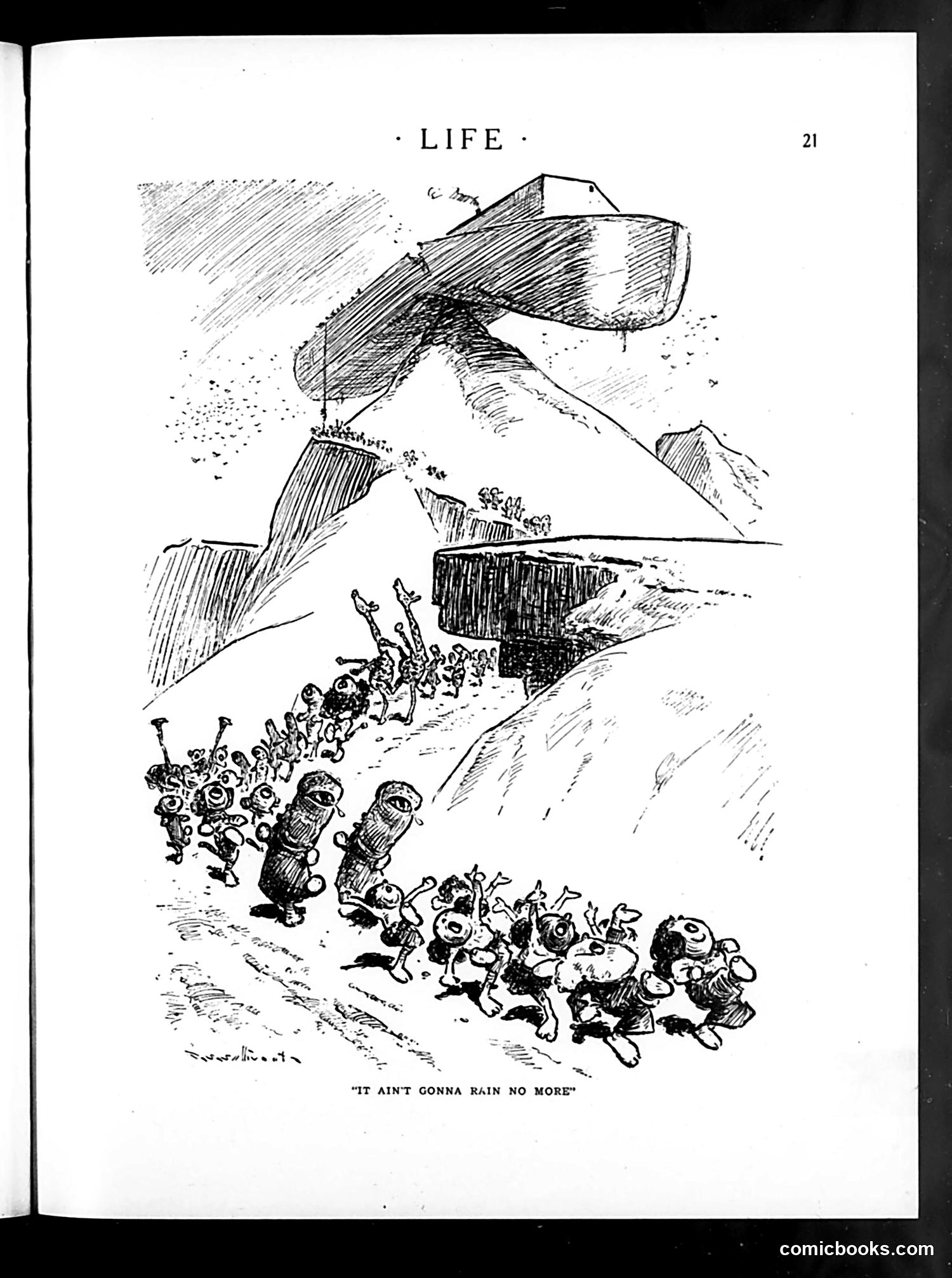
This cartoon depicts a giant hand pouring water from a bucket onto a crowd of small, caricatured figures below. The caption references a popular 1923 song titled "It Ain't Gonna Rain No More." The satire appears to comment on **broken promises or false assurances**—the irony being that despite someone's claim that rain won't come, it plainly is raining down on the crowd. The tiny figures likely represent ordinary people or a specific group, while the massive hand suggests an authority figure or powerful force. Without the publication date visible, the exact historical reference remains unclear, but the cartoon satirizes a gap between confident public statements and harsh reality experienced by ordinary citizens.
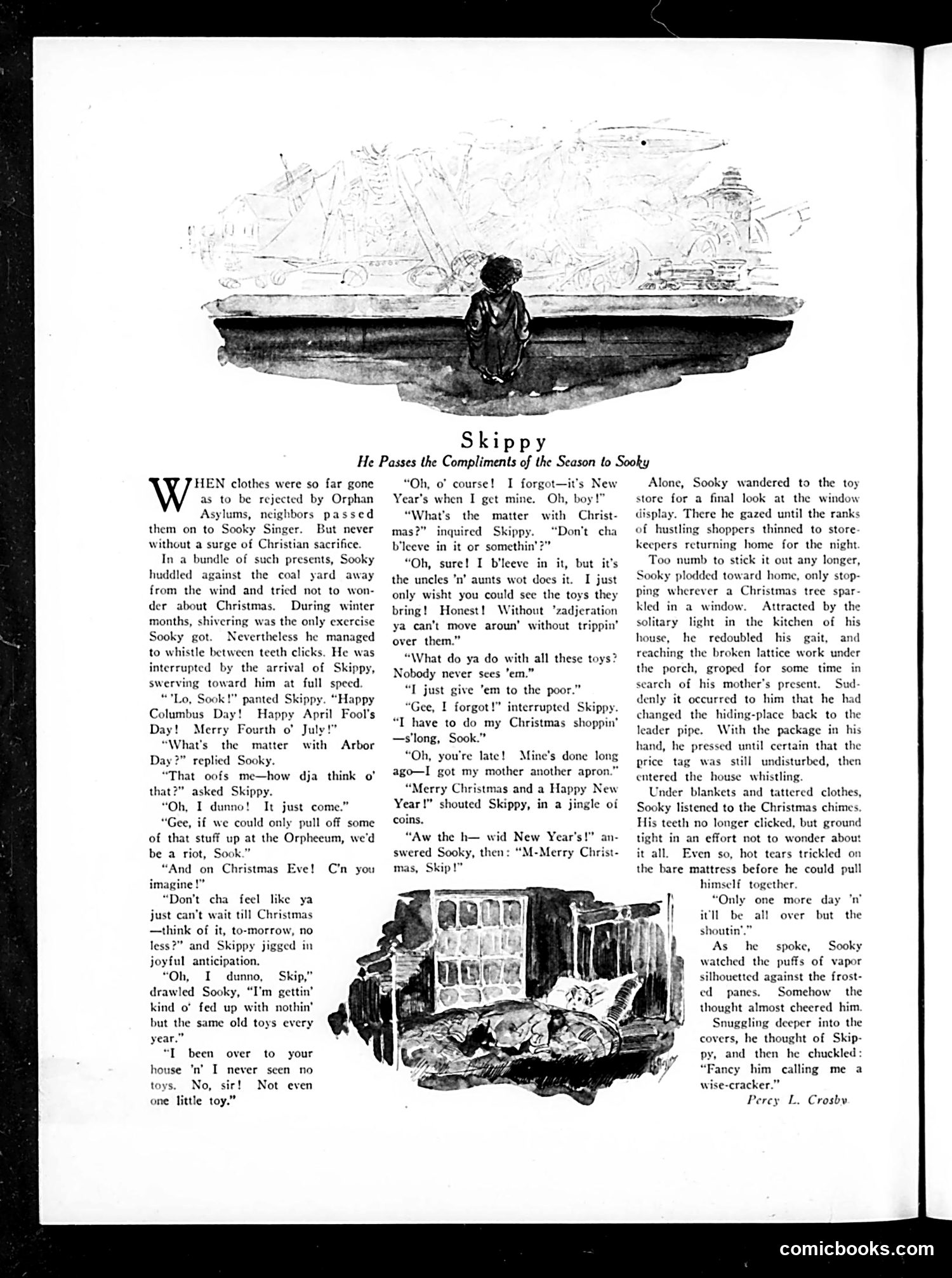
This is a sentimental Christmas story by Percy L. Crosby contrasting childhood innocence with urban poverty. **Skippy** is a cheerful, well-off boy who encounters **Sooky Singer**, a poor orphan living in a coal yard who receives cast-off clothes from charity-minded neighbors. The narrative reveals Sooky's dignified poverty: he pretends to receive toys from uncles but actually gives them to poorer children; his Christmas shopping consists of buying his mother an apron. When Skippy enthusiastically celebrates multiple holidays with coins jingling in his pockets, Sooky maintains quiet dignity rather than admit his deprivation. The satire targets not Sooky but middle-class hypocrisy—those who pass rejected orphanage clothes as Christian "sacrifice" while children like Sooky endure winter shivering as their only "exercise." The story's conclusion shows Sooky alone, emotionally overwhelmed by his circumstances yet finding small comfort in friendship and his mother's love. It's social commentary wrapped in a touching narrative about economic inequality during the Depression era.
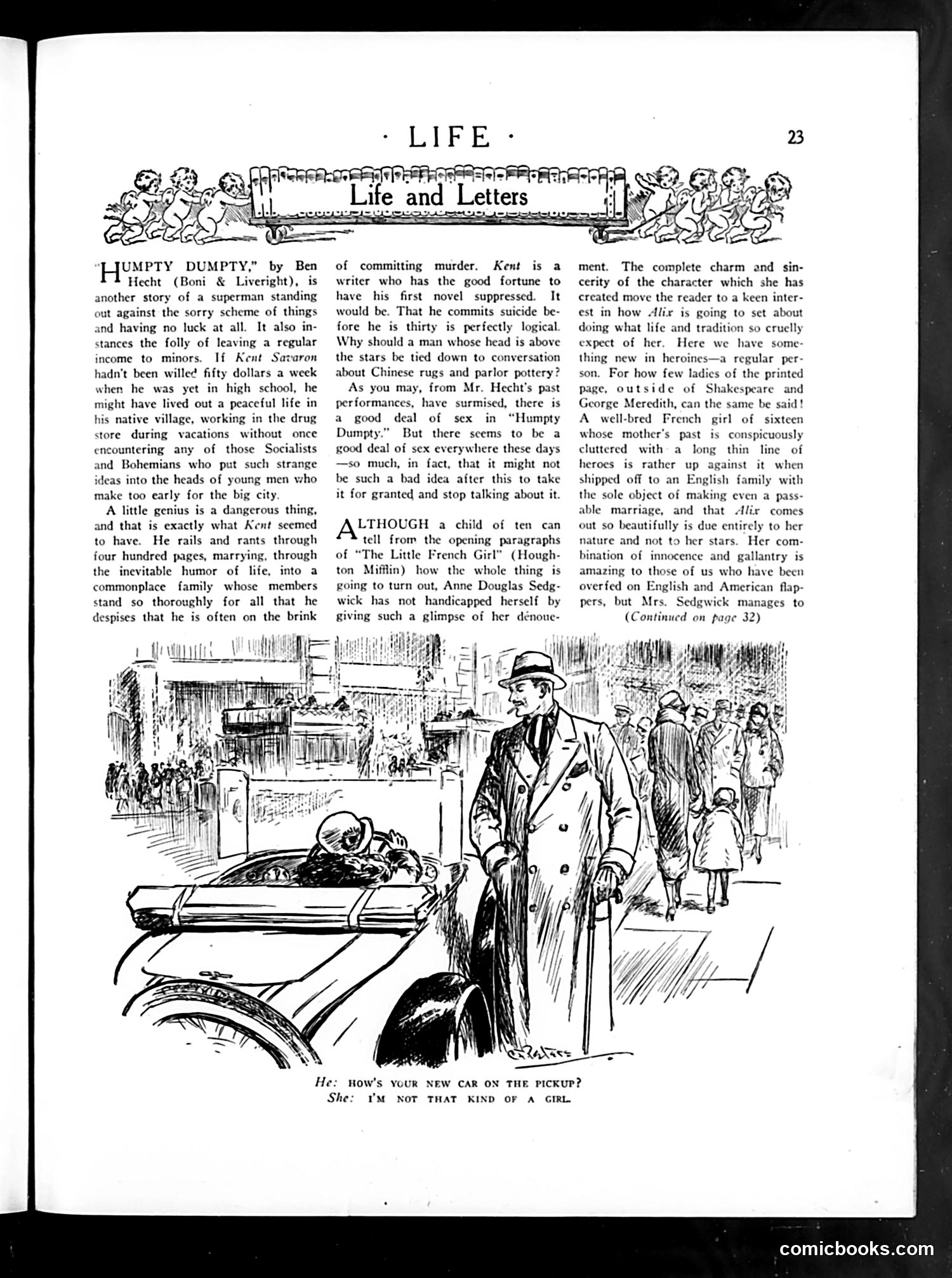
This page from *Life* magazine reviews two novels while featuring a cartoon joke about modern dating culture. The book reviews discuss Ben Hecht's "Humpty Dumpty" (criticized for its protagonist's angst and sexual content) and Anne Douglas Sedgwick's "The Little French Girl" (praised for its authentic female character). The cartoon below depicts a street scene where a man asks a woman admiring his new car how she likes it on the "pickup" (slang for a casual romantic outing). Her response—"I'm not that kind of a girl"—is the joke's punchline, playing on 1920s dating anxieties. The satire mocks both the male assumption that a new automobile automatically impresses women into romantic compliance, and the female's defensive morality claim. This reflects Jazz Age concerns about changing social mores and automobile culture's role in courtship rituals.
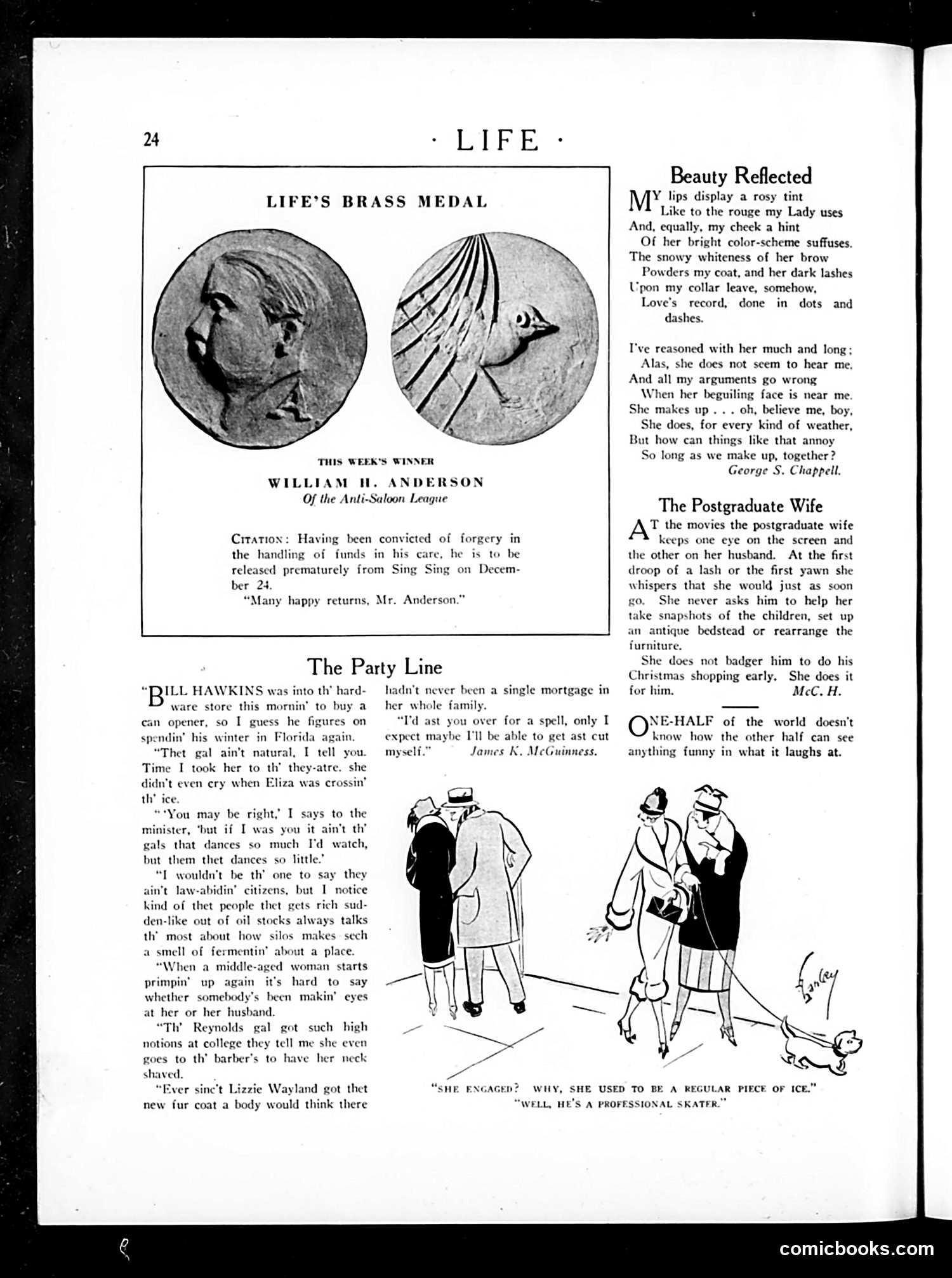
This page contains satirical humor typical of early 20th-century Life magazine: **"Life's Brass Medal"**: Awards William H. Anderson of the Anti-Saloon League for being convicted of forgery while handling funds in his care, then released early from Sing Sing prison. This is ironic mockery—the "brass medal" implies he's a hypocrite, given the Anti-Saloon League's moral crusading stance. **"The Party Line"**: Rural gossip columns poking fun at small-town social pretensions—people buying expensive goods they can't afford, college-educated women getting unnecessary grooming, new fur coats suggesting hidden mortgages. **The cartoon**: Shows two men discussing a woman's engagement. The joke: she was "a regular piece of ice" (frigid/unfriendly) until she met a "professional skater"—a pun suggesting skating ability metaphorically "thawed" her romantic interest. **Poems**: Lighthearted verses about cosmetics, romance, and wives' behavior—gentle domestic satire. The page reflects 1920s anxieties about social mobility, pretension, and changing gender roles.
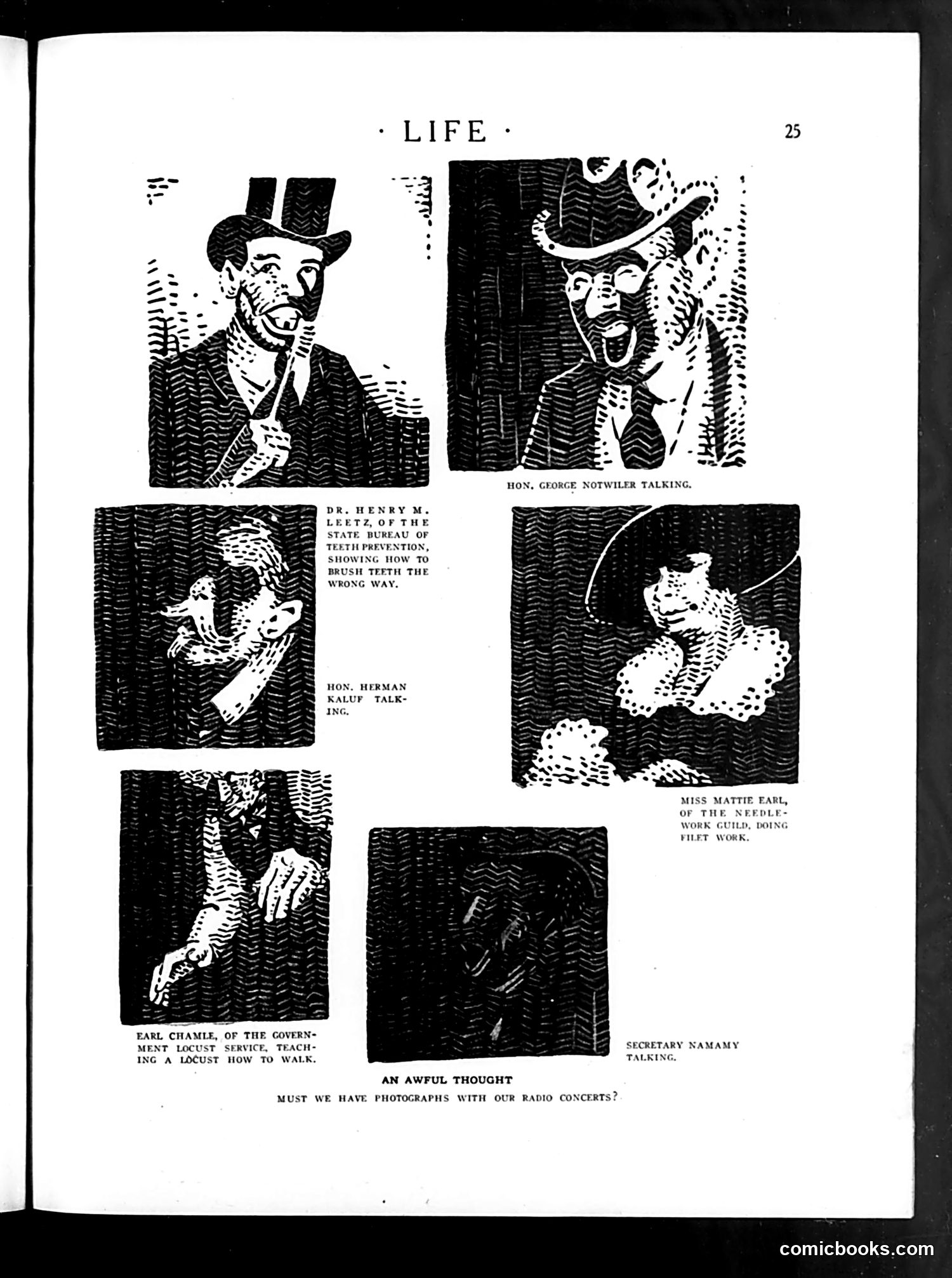
This page satirizes radio broadcasts by depicting various public figures and experts demonstrating their specialized knowledge through exaggerated physical gestures and expressions. The caricatures include: - **Dr. Henry M. Leetz** (teeth prevention expert) demonstrating incorrect tooth-brushing technique - **Hon. George Notwiler** (speaking animatedly) - **Hon. Herman Kalup** (talking) - **Miss Mattie Earl** (needlework guild, doing filet work) - **Earl Chamle** (government locust service, teaching how to walk) - **Secretary Namamy** (talking) The bottom caption poses the satirical question: "MUST WE HAVE PHOTOGRAPHS WITH OUR RADIO CONCERTS?" The joke critiques radio broadcasting's emerging trend of pairing audio broadcasts with still photographs—suggesting these expert demonstrations lose their instructional value when reduced to static images rather than dynamic demonstration.
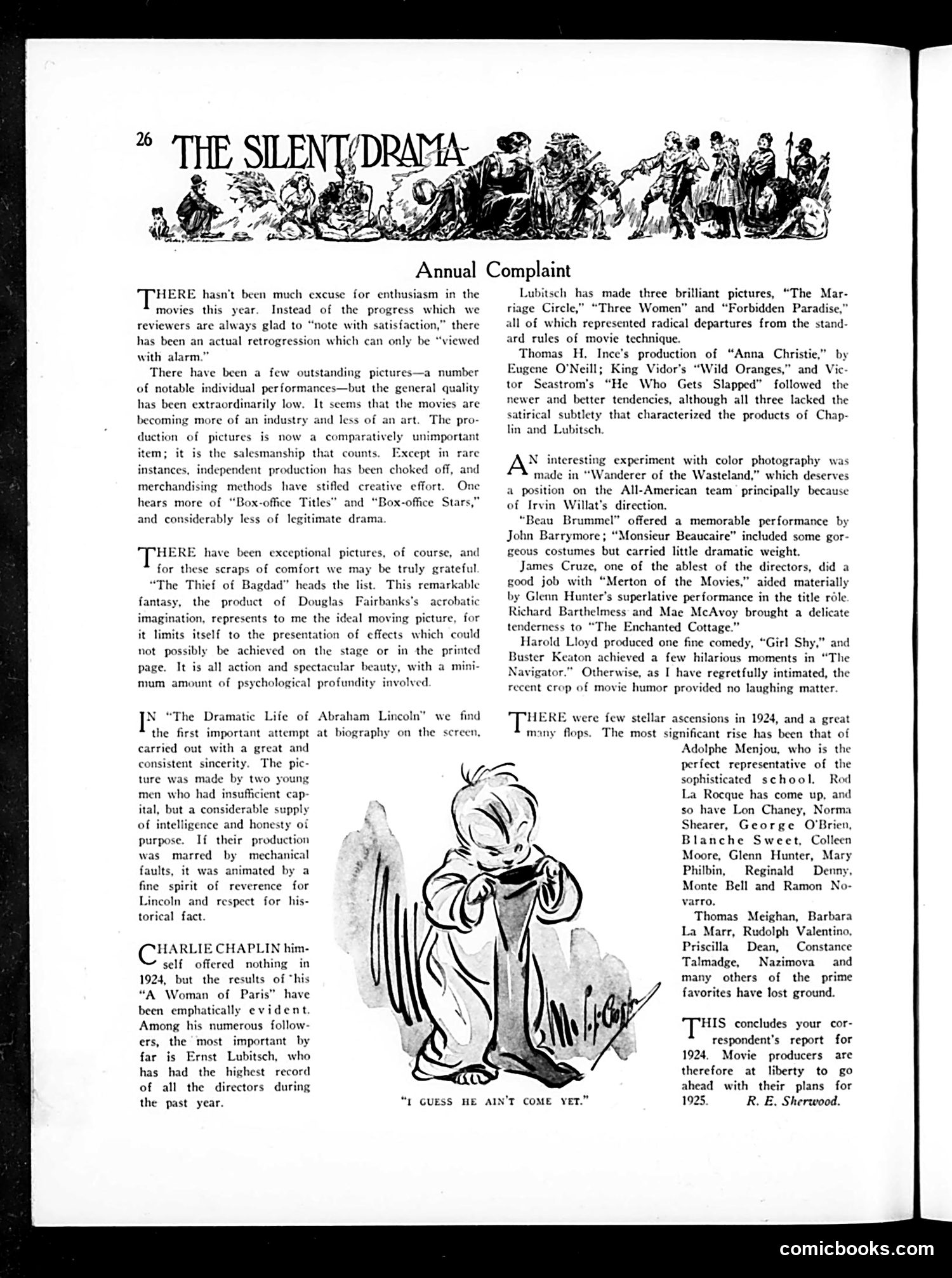
This is a film criticism essay lamenting 1924's poor movie output. The author argues that cinema has shifted from art to commercial industry, with "salesmanship" and "box-office" concerns replacing creative merit. The piece praises exceptions like Douglas Fairbanks's *The Thief of Bagdad* and a Lincoln biography made by underfunded but sincere filmmakers. It credits director Ernst Lubitsch and Charlie Chaplin's influence as bright spots, while noting even talented directors like King Vidor produced inconsistent work. The cartoon shows a cherubic baby or cupid figure with the caption "I GUESS HE AIN'T COME YET"—likely satirizing anticipated arrivals of quality films that never materialized. The essay concludes that 1924 saw few breakout stars and many failures, with only Adolphe Menjou showing significant rise among new talent.
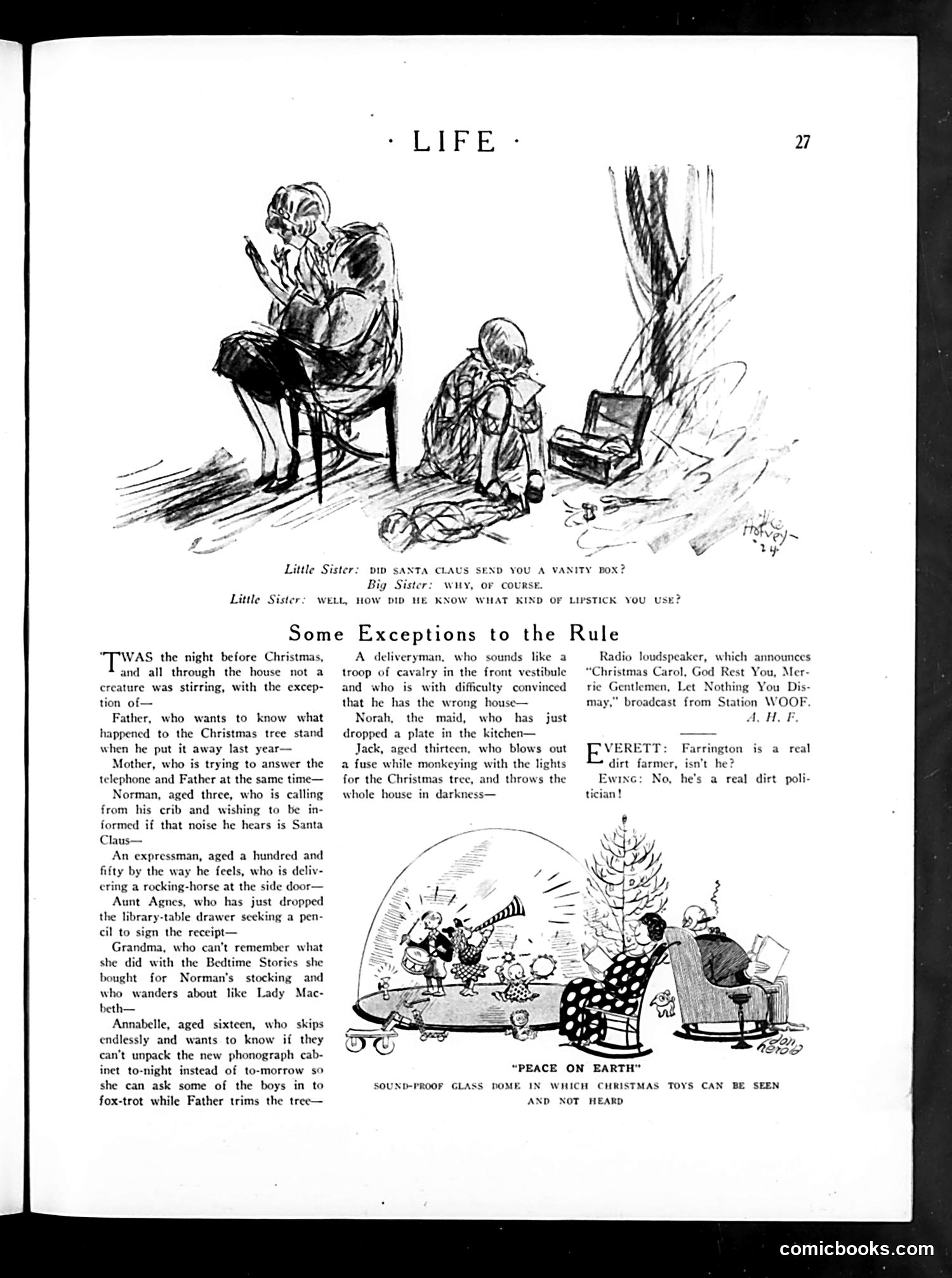
This page contains two separate pieces of Christmas humor: **Top cartoon**: A joke about materialism and vanity. A younger sister asks an older sister if Santa sent her a vanity box (cosmetics). The older sister cynically replies that of course he did—but then asks how Santa knew what brand of lipstick to buy, implying the sister must have told him (defeating Santa's magic) or that she's so predictably vain it was obvious. **"Some Exceptions to the Rule"**: A humorous list of all the people and things *not* at peace on Christmas Eve—contradicting the "peace on earth" sentiment. It catalogs domestic chaos: demanding children, clumsy servants, forgetful relatives, teenagers wanting to party, delivery disasters, and electrical failures. **"Peace on Earth" illustration**: A glass soundproof dome enclosing noisy Christmas toys, satirizing the impossibility of peaceful holidays when surrounded by loud, chaotic activity and demanding family members. The satire targets the gap between Christmas ideals and messy reality.
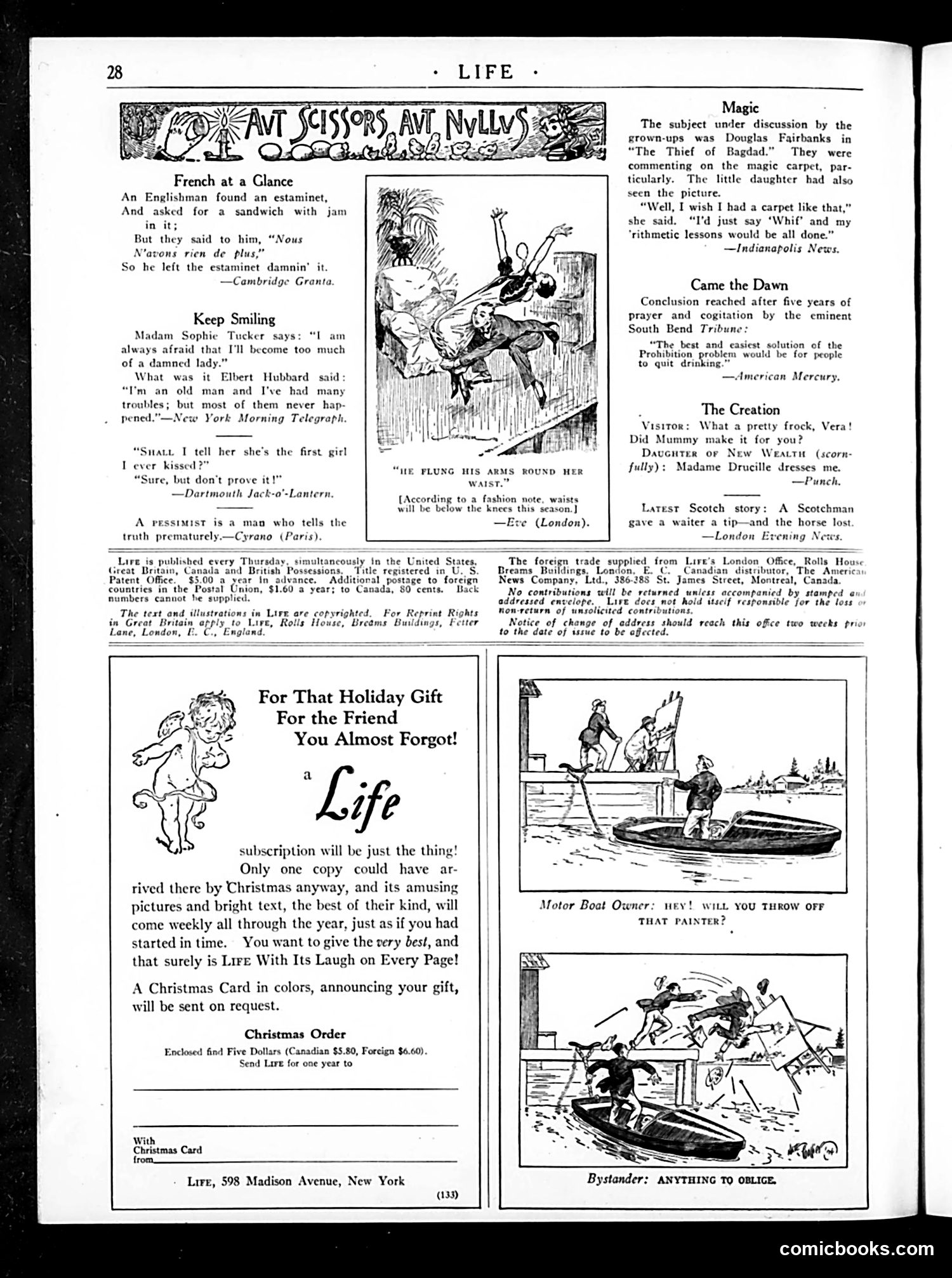
This page combines short satirical verses, humorous anecdotes, and cartoon advertisements typical of *Life* magazine's format. The humor relies on wordplay and social observation rather than political commentary. The cartoons mock everyday situations: a motorboat owner's confused request to "throw off that painter" (a rope) is misunderstood as an insult to an artist; fashion industry absurdities are noted (waists dropping below knees); and Douglas Fairbanks' *Thief of Bagdad* is referenced as cultural touchstone—a child naively wishes for the film's magic carpet to skip arithmetic homework. The anecdotes satirize human nature: Sophie Tucker's fear of becoming "too much of a damned lady," Elbert Hubbard's observation that imagined troubles outnumber real ones, and the observation that "pessimists tell the truth prematurely." The page advertises *Life* subscriptions as holiday gifts, emphasizing weekly entertainment and humor. Overall, this reflects early 20th-century middlebrow American humor—gentle, domestic, and focused on amusing social observation rather than sharp political critique.
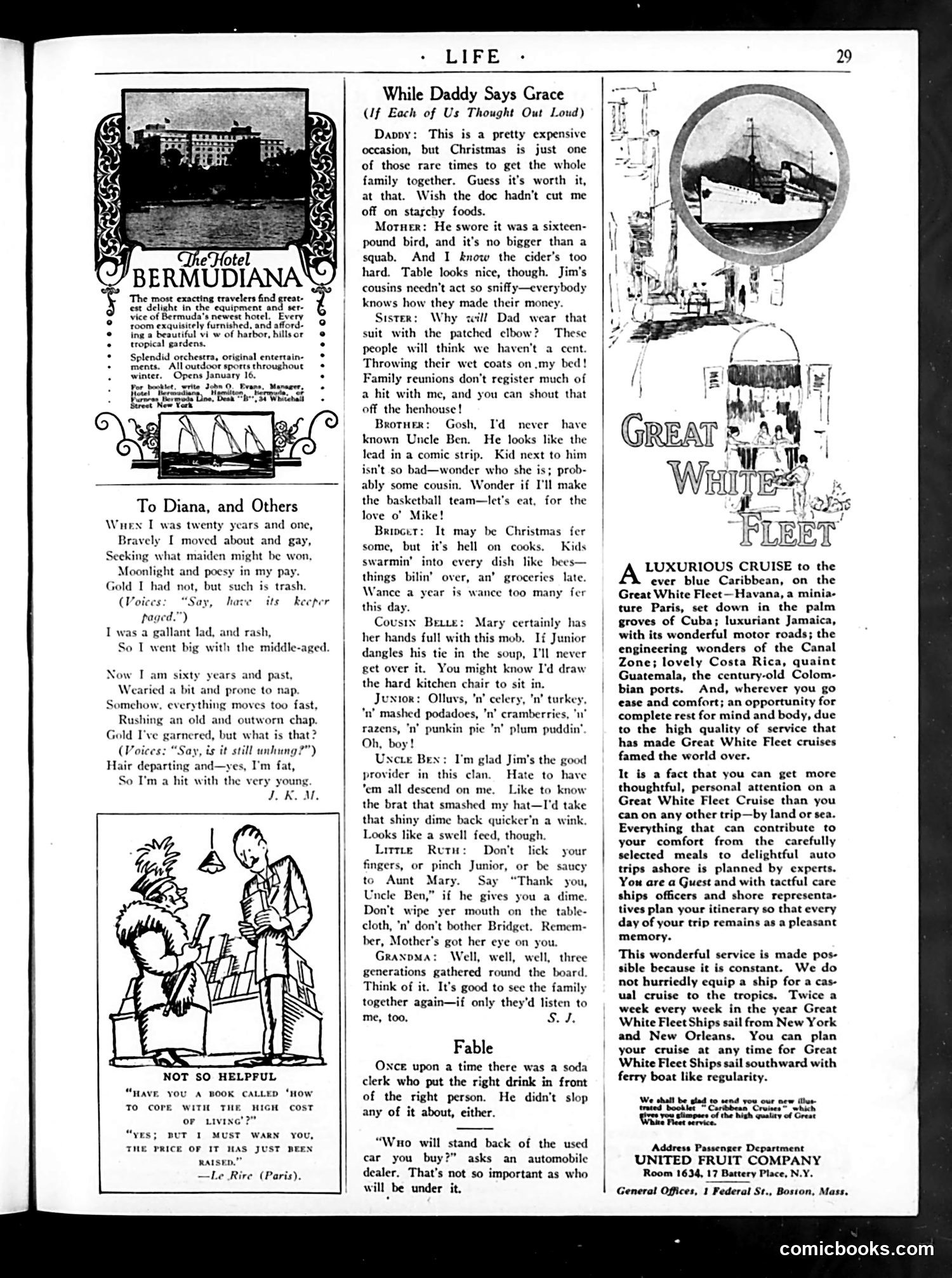
This cartoon satirizes the gap between public propriety and private thoughts at a formal Christmas dinner. Rather than showing reverent silence during grace, the caption reveals each family member's actual preoccupations: **The joke:** Each person thinks selfish or critical thoughts—the father worries about his diet restrictions, the mother resents the turkey's small size, the sister snobs about the guests' appearance, the uncle begrudges hosting relatives, servants complain about chaos, and children fixate on food. **The satire targets:** Middle-class hypocrisy and the phoniness of "family values" gatherings. The cartoon mocks how people perform gratitude and togetherness while internally nursing resentments, financial anxieties, and petty annoyances. **Historical context:** Published during the economically anxious 1920s-30s, this reflects era concerns about class pretension, domestic strain, and the gap between genteel appearances and economic reality. The "fable" below reinforces themes of things not being what they seem.
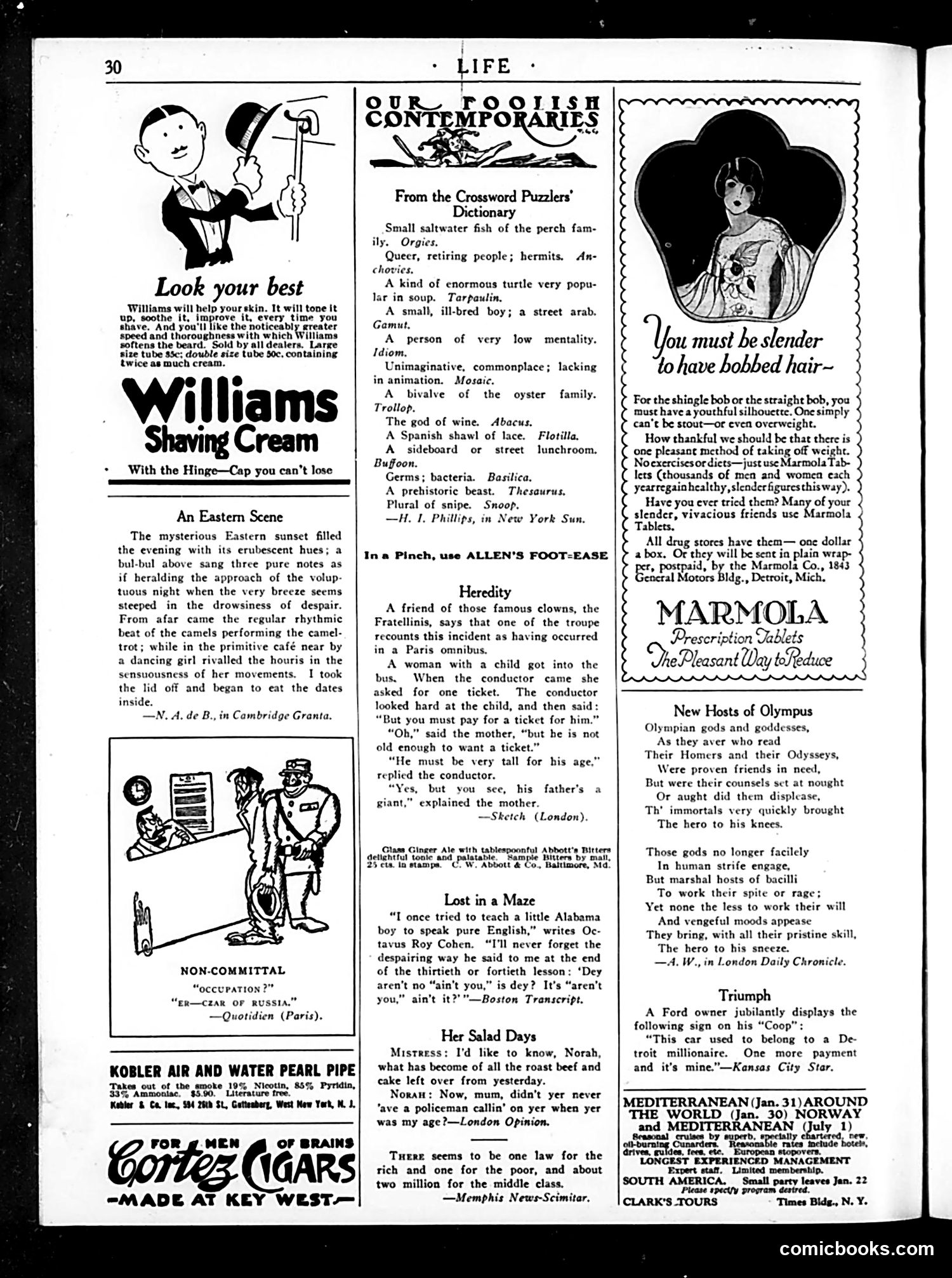
This page from *Life* magazine contains primarily **humor columns and advertisements** rather than political cartoons. The main satirical content includes: **"Our Foolish Contemporaries"** — a recurring *Life* feature mocking crossword puzzle definitions that deliberately misdefine words (e.g., "small saltwater fish" = "Orgies," "person of low mentality" = "Idiom"). This ridicules both pretentious word puzzles and the absurdity of mismatched definitions. **Anecdotes and jokes** about: - An Eastern tourist's overwrought romantic narrative undercut by mundane reality (eating dates) - A Paris bus conductor's confusion about a child's height based on paternity - A teacher's frustration teaching proper English to a Southern dialect speaker - A servant's evasive answer about missing roast beef These sketch-style humor pieces satirize social pretension, class differences, and linguistic/cultural confusion — typical of *Life*'s sophisticated, urbane comedy targeting educated readers. **The advertisements** (Williams Shaving Cream, Marmola weight-loss tablets) occupy significant space, reflecting 1920s consumer culture.
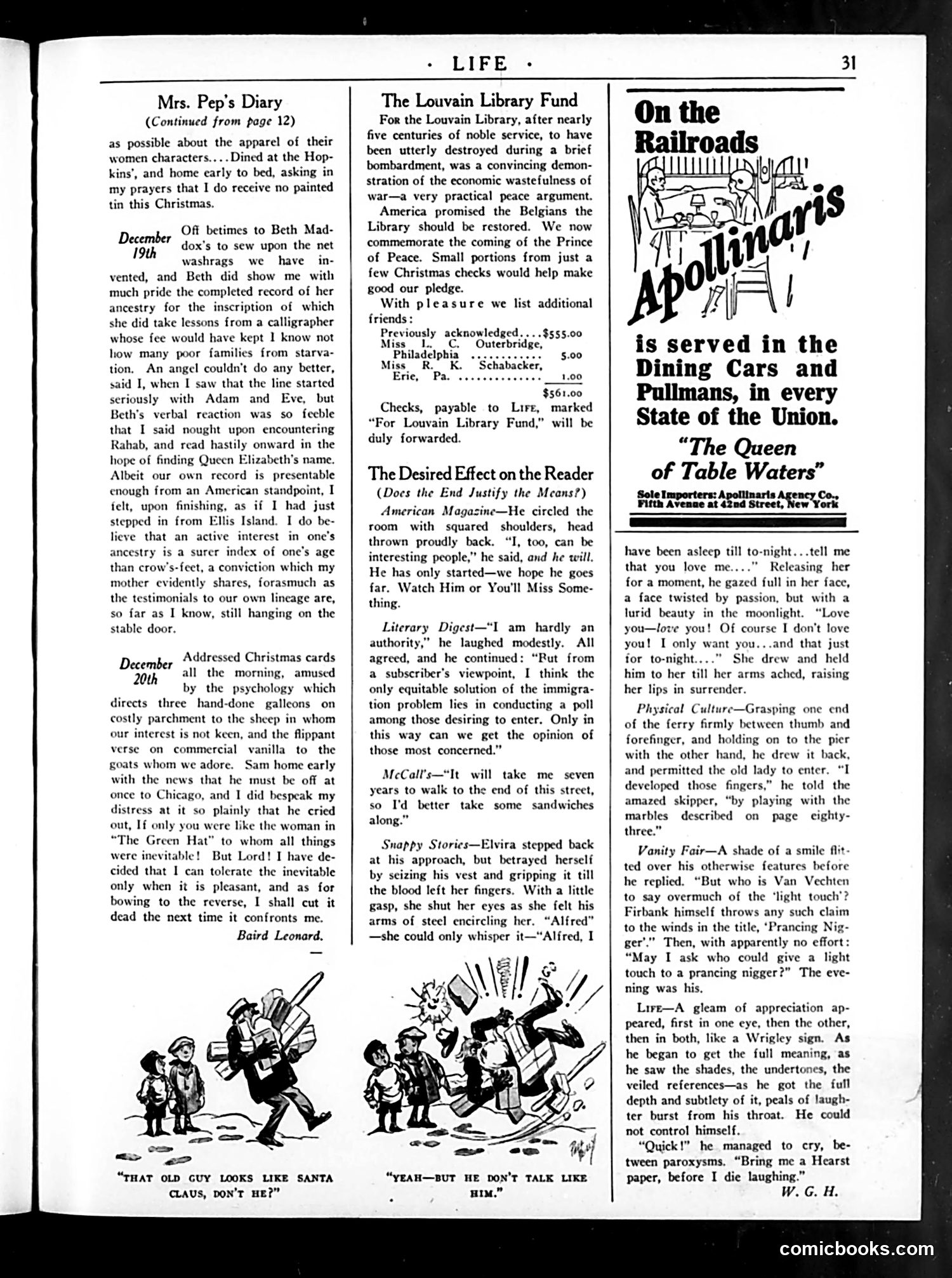
This page contains three distinct sections satirizing American media and social pretension circa the 1920s. **Mrs. Pep's Diary** mocks upper-class affectation through a society woman's observations about ancestry obsession and Christmas card hypocrisy. The reference to "The Green Hat" (a contemporary scandal novel) adds topical humor. **The Louvain Library Fund** is a serious fundraising appeal for the Belgian library destroyed in WWI—framed as a practical peace argument and Christmas charity. **"The Desired Effect on the Reader"** satirizes how different magazines manipulate their readers' self-perception. Each publication excerpt shows someone adopting exaggerated personas (confidence, false modesty, affected concern) that the magazines implicitly encourage. The satire suggests magazines don't report reality but shape how readers wish to present themselves. The two cartoons below (partially visible) appear unrelated genre humor about mistaken identity.
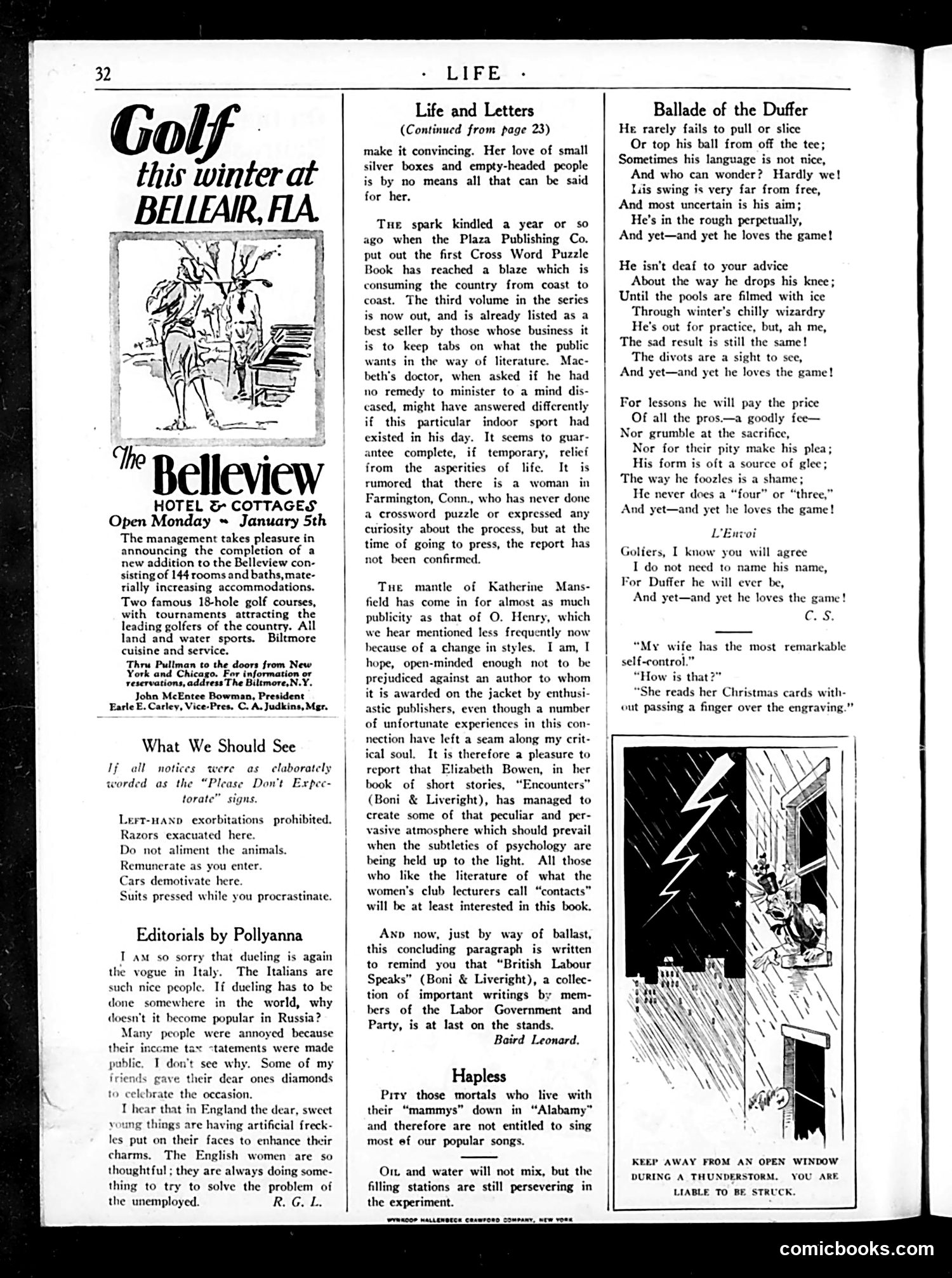
This page combines advertising, satirical commentary, and literary discussion typical of Life's format. **The Advertisements:** The Belleview Hotel promotes Florida winter golf—a luxury destination for wealthy Americans during the 1920s leisure boom. **"What We Should See":** A humorous piece mocking bureaucratic language by deliberately over-complicating simple signs ("Razors exacuated here" instead of "Get a shave"). The satire targets governmental and institutional jargon. **"Editorials by Pollyanna":** Faux-naive commentary where the author (R.G.L.) ironically praises misfortunes—suggesting dueling should spread to Russia, praising income tax transparency, and praising English women for their "unemployed" problem-solving through cosmetic practices. The tone is obviously sarcastic. **The Literary Section:** Discusses the crossword puzzle craze consuming America, and book reviews including Katherine Mansfield's legacy and Elizabeth Bowen's work—reflecting intellectual magazine content of the era.
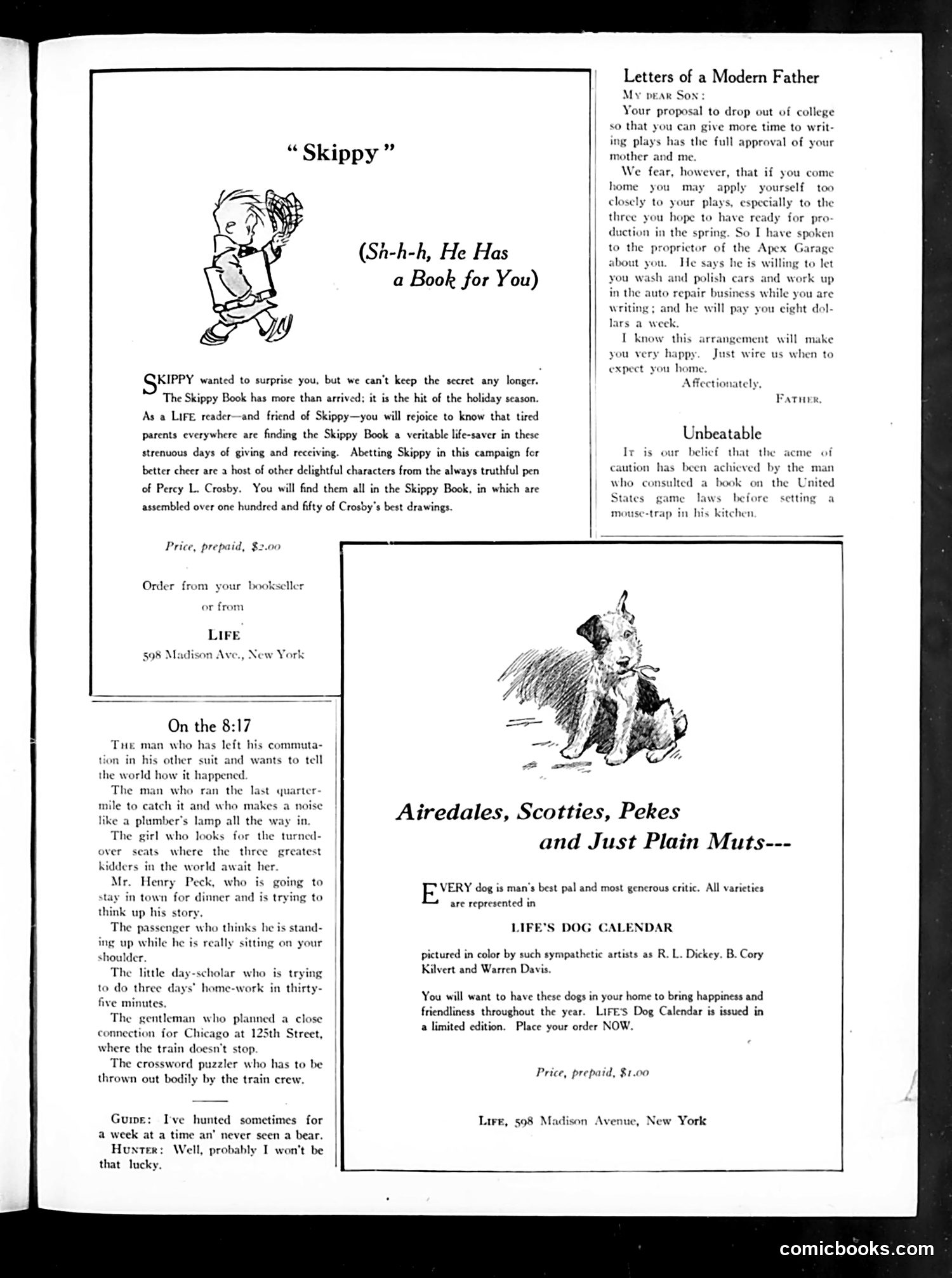
This page contains three distinct pieces of content: ## "Letters of a Modern Father" A satirical letter from a father to his son who wants to drop out of college to write plays. The joke: the father approves but arranges for the son to work at an auto repair shop while writing, paying only eight dollars weekly. The satire mocks both parental skepticism toward artistic pursuits and the economic reality of pursuing writing—the father's "support" is patronizing and financially inadequate, reflecting early 20th-century attitudes that creative work wasn't a viable career. ## "Skippy" Book Advertisement Advertises Percy L. Crosby's cartoon collection as holiday gift merchandise for parents exhausted by gift-giving season—positioning the book as a "life-saver." ## "Life's Dog Calendar" Advertises a calendar featuring dog illustrations by recognized artists, marketed as bringing "happiness and friendliness" throughout the year. The page is primarily **advertising content** using humor and satire to sell products to Life's middle-class readership.
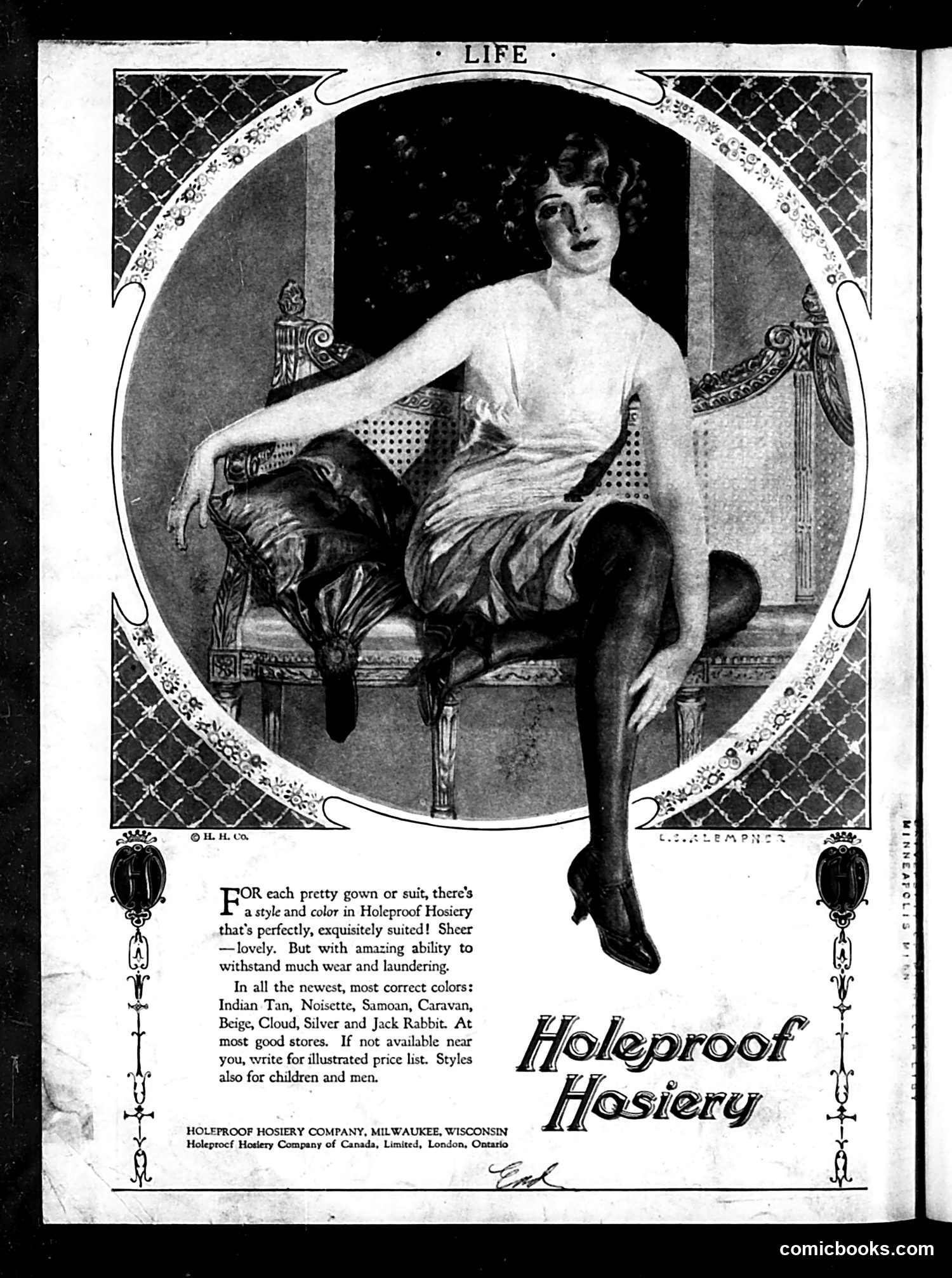
This is a **Holeproof Hosiery advertisement**, not political satire. The page features a glamorous illustration of a woman in 1920s-style dress seated on an ornate chair, displaying her legs and stockings. The ad copy emphasizes that Holeproof hosiery combines elegance ("sheer—lovely") with durability ("withstand much wear and laundering"). It lists fashionable color names of the era: Indian Tan, Noisette, Samoan, Caravan, Beige, Cloud, Silver, and Jack Rabbit. **For modern readers:** This reflects early 20th-century advertising conventions—using glamorous female imagery to sell practical goods. The color names reveal period attitudes (e.g., "Samoan" reflecting exoticist marketing). The emphasis on durability alongside fashion addresses practical consumer concerns about hosiery quality and cost. There is **no political cartoon or satire present**—this is straightforward commercial advertising from *Life* magazine's advertising section.

I can see this is a blank or nearly blank page from what appears to be a Life magazine, with only publication marks and a "comicbooks.com" watermark visible at the bottom. The page contains no discernible cartoon, illustration, text content, or satirical material that I can analyze. Without visible cartoon panels, caricatures, political commentary, or readable text on the actual page image, I cannot identify figures, explain historical references, or interpret satire. This appears to be either a blank filler page, a page that failed to scan properly, or a cover/title page without substantive content. To provide meaningful analysis, I would need a page with actual visible cartoons or text.