
Life, 1924-12-25 · page 28 of 37
Life — December 25, 1924 — page 28: what you’re looking at
What you’re looking at
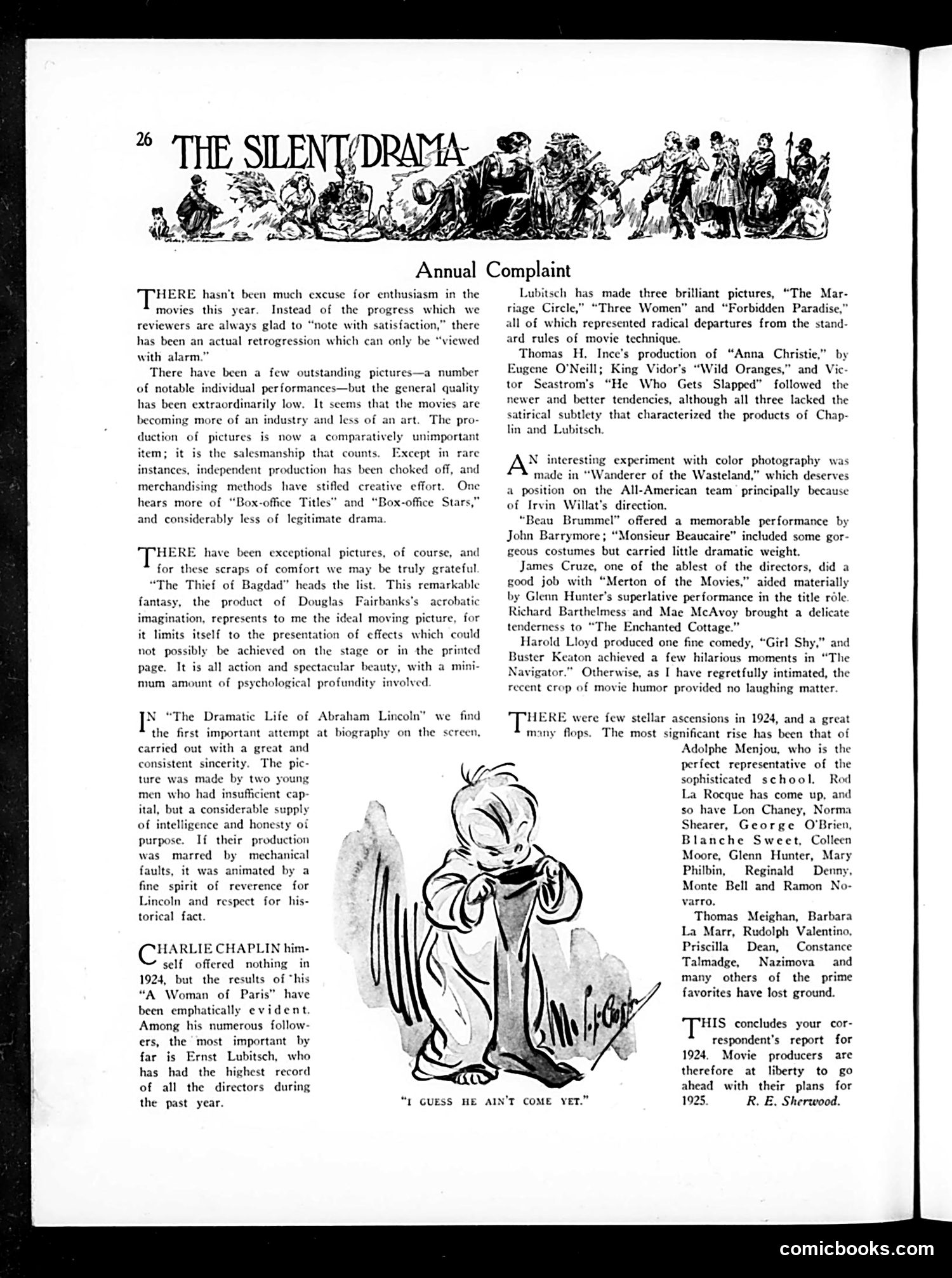
This is a film criticism essay lamenting 1924's poor movie output. The author argues that cinema has shifted from art to commercial industry, with "salesmanship" and "box-office" concerns replacing creative merit. The piece praises exceptions like Douglas Fairbanks's *The Thief of Bagdad* and a Lincoln biography made by underfunded but sincere filmmakers. It credits director Ernst Lubitsch and Charlie Chaplin's influence as bright spots, while noting even talented directors like King Vidor produced inconsistent work. The cartoon shows a cherubic baby or cupid figure with the caption "I GUESS HE AIN'T COME YET"—likely satirizing anticipated arrivals of quality films that never materialized. The essay concludes that 1924 saw few breakout stars and many failures, with only Adolphe Menjou showing significant rise among new talent.
📄 Transcribed text from this page (OCR, searchable)
Machine-transcribed from the original scan — historical spelling and the odd misread are preserved.
Y 26 3 DRAMA: by! Annual Complaint HERE hasn't been much excuse for enthusiasm in the movies this year. Instead of the progress which we reviewers are always glad to “note with satisfaction,” there has been an actual retrogression which can only be “viewed with alarm.” There have been a few outstanding pictures—a number of notable individual performances—but the general quality has been extraordinarily low. It seems that the movies are becoming more of an industry and less of an art. The pro- duction of pictures is now a comparatively unimportant item; it is the salesmanship that counts. instances, independent production has been choked off, and merchandising methods have stifled creative effort. One hears more of “Box-office Titles” and “Box-office Star and considerably less of legitimate drama Except in rare HERE have been exceptional pictures, of course, and or these scraps of comfort we may be truly grateful “The Thief of Bagdad” heads the list. This remarkable fantasy, the product of Douglas Fairbanks’s acrobatic imagination, represents to me the ideal moving picture, for it limits itself to the presentation of effects which could not possibly be achieved on the stage or in the printed page. It is all action and spectacular beauty, with a mini- mum amount of psychological profundity involved. IX “The Dramatic Life of Abraham Lincoln” we find the first important attempt at biography on the screen, carried out with a great and consistent sincerity. The pic- ture was made by two young men who had insufficient cap- ital, but a considerable supply of intelligence and honesty oi purpose. If their production was marred by mechanical faults, it was animated by a fine spirit of reverence for Lincoln and respect for his- torical fact. HARLIE CHAPLIN him- self offered nothing in 1924, but the results of “his “A Woman of Paris” have been emphatically evident. Among his numerous follow- ers, the most important by far is Ernst Lubitsch, who has had the highest record of all the directors during the past year. GUESS HE AIN'T COME YET.” 1925. Lubitsch has made three brilliant pictures, “The Mar- riage Circle,” “Three Women” and “Forbidden Paradise,” all of which represented radical departures from the stand- ard rules of movie technique. Thomas H. Ince’s production of “Anna Christie,” by Eugene O'Neill; King Vidor’s “Wild Oranges,” and Vic- tor Seastrom’s “He Who Gets Slapped” followed the newer and better tendencies, although all three lacked the satirical subtlety that characterized the products of Chap- lin and Lubitsch, N interesting experiment with color photography was made in “Wanderer of the Wasteland,” which deserves a position on the All-American team principally because of Irvin Willat’s direction. “Beau Brummel” offered a memorable performance by John Barrymore; “Monsieur Beaucaire” included some gor- geous costumes but carried little dramatic weight. James Cruze, one of the ablest of the directors, did a good job with “Merton of the Movies,” aided materially by Glenn Hunter's superlative performance in the title réle. Richard Barthelmess and Mae McAvoy brought a delicate tenderness to “The Enchanted Cottage.” Harold Lloyd produced one fine comedy, “Girl Shy,” Buster Keaton achieved a few hilarious moments in “The Navigator.” Otherwise, as I have regretfully intimated, the recent crop of movie humor provided no laughing matter. "THERE were few stellar ascensions in 1924, and a great many flops. The most significant rise has been that of Adolphe Menjou, who is the perfect representative of the sophisticated school. Rod La Rocque has come up, and so have Lon Chaney, Norma Shearer, George O'Brien, Blanche Sweet, Colleen Moore, Glenn Hunter, Mary Philbin, Reginald Dem Monte Bell and Ramon No- varro. Thomas Meighan, Barbara La Marr, Rudolph Valentino, Priscilla Dean, Constance Talmadge, Nazimova and many others of the prime favorites have lost ground. apHs concludes your cor- respondent's report for 1924. Movie producers are therefore at liberty to go ahead with their plans for R. E. Sherwood. comicbooks.com