
Life, 1924-12-25 · page 25 of 37
Life — December 25, 1924 — page 25: what you’re looking at
What you’re looking at
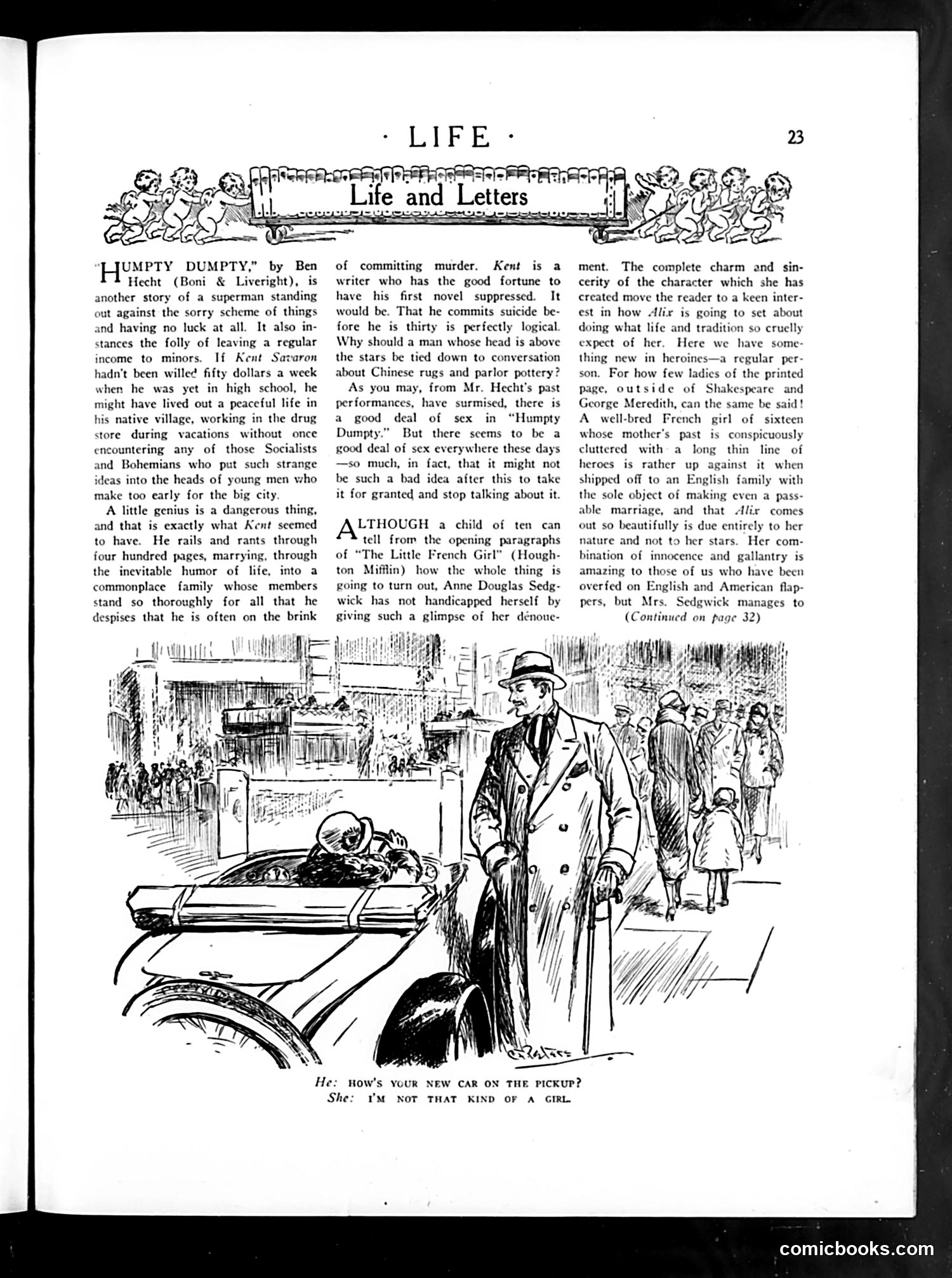
This page from *Life* magazine reviews two novels while featuring a cartoon joke about modern dating culture. The book reviews discuss Ben Hecht's "Humpty Dumpty" (criticized for its protagonist's angst and sexual content) and Anne Douglas Sedgwick's "The Little French Girl" (praised for its authentic female character). The cartoon below depicts a street scene where a man asks a woman admiring his new car how she likes it on the "pickup" (slang for a casual romantic outing). Her response—"I'm not that kind of a girl"—is the joke's punchline, playing on 1920s dating anxieties. The satire mocks both the male assumption that a new automobile automatically impresses women into romantic compliance, and the female's defensive morality claim. This reflects Jazz Age concerns about changing social mores and automobile culture's role in courtship rituals.
📄 Transcribed text from this page (OCR, searchable)
Machine-transcribed from the original scan — historical spelling and the odd misread are preserved.
APTY,” by Ben Hecht (Boni & Liveright), is another story of a superman standing out against the sorry scheme of things and having no luck at all. It also in- stances the folly of leaving a regular income to minors. If Kent Savaron hadn't been willed fifty dollars a week when he was yet in high school, he might have lived out a peaceful life in his native village, working in the drug store during vacations without once encountering any of those Socialists and Bohemians who put such strange ideas into the heads of young men who make too early for the big city. A little genius is a dangerous thing, and that is exactly what Kent seemed to have. He rails and rants through four hundred pages, marrying, through the inevitable humor of life, into a commonplace family whose members stand so thoroughly for all that he despises that he is often on the brink of committing murder. Kent is a writer who has the good fortune to have his first novel suppressed. It would be. That he commits suicide be- fore he is thirty is perfectly logical. Why should a man whose head is above the stars be tied down to conversation about Chinese rugs and parlor pottery? As you may, from Mr. Hecht’s past performances, have surmised, there is a good deal of sex in “Humpty Dumpty.” But there scems to be a good deal of sex everywhere these days —so much, in fact, that it might not be such a bad idea after this to take it for granted and stop talking about it. LTHOUGH a child of ten can tell from the opening paragraphs of “The Little French Girl” (Hough- ton Mifflin) how the whole thing is going to turn out, Anne Douglas Sedg- wick has not handicapped herself by giving such a glimpse of her dénoue- ment. The complete charm and _ sin- cerity of the character which she has created move the reader to a keen inter- est in how Alix is going to set about doing what life and tradition so cruelly expect of her. Here we have some thing new in heroines—a regular per- son. For how few ladies of the printed page, Shakespeare and George Meredith, can the same be said! A well-bred French girl of sixteen whose mother’s past is conspicuously cluttered with a long thin line of heroes is rather up against it when shipped off to an English family with the sole object of making even a pass- able marriage, and that Alix comes out so beautifully is due entirely to her nature and not to her stars. Her com- bination of innocence and gallantry is amazing to those of us who have been overfed on English and American flap- pers, but Mrs. Sedgwick manages to (Continued on page 32) outside of He: wow's YouR NEW CAR ON THE PICKUP? She: YM NoT THAT KIND OF A GIRL. comicbooks.com