
Life, 1924-12-25 · page 20 of 37
Life — December 25, 1924 — page 20: what you’re looking at
What you’re looking at
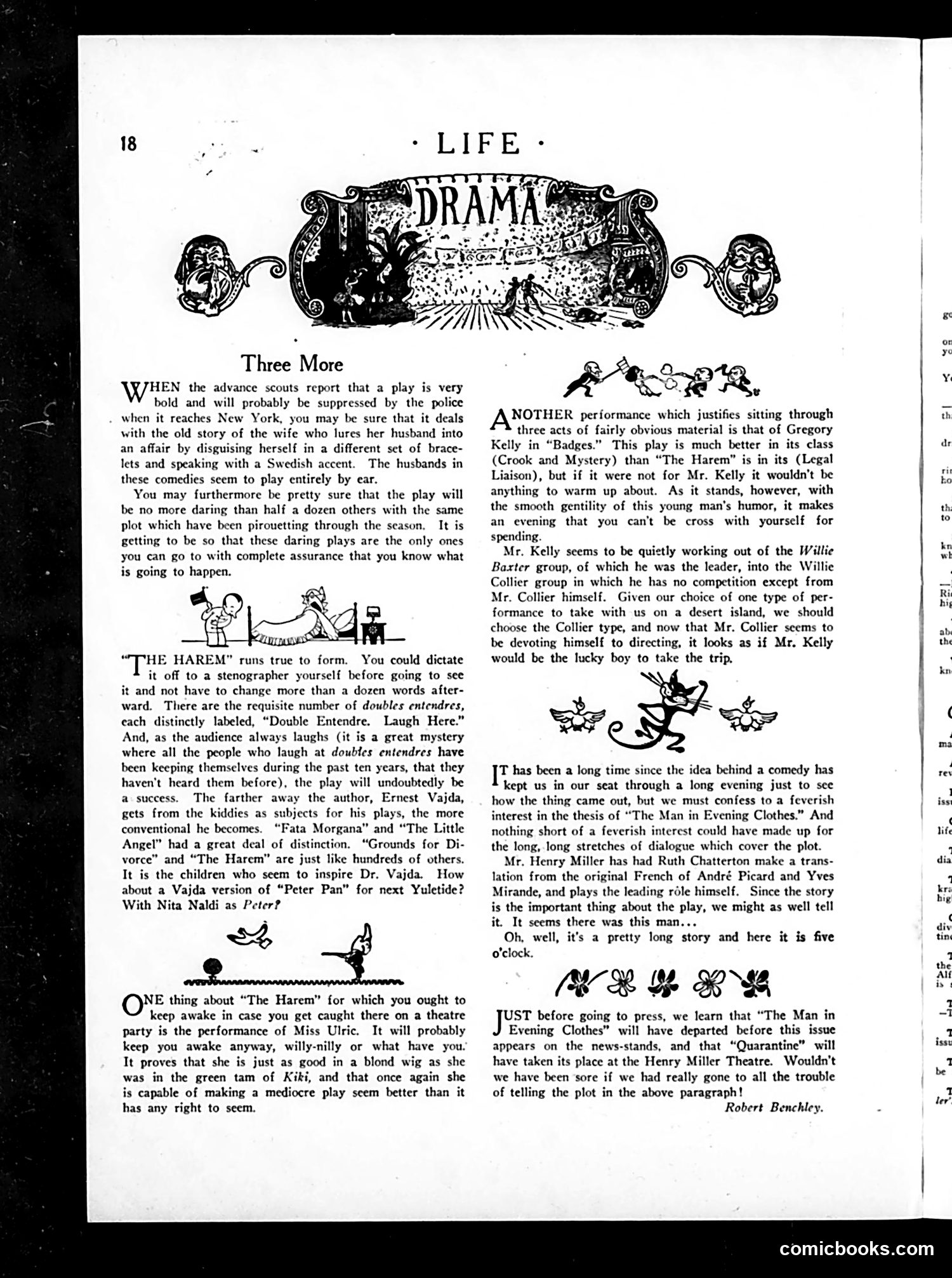
This page reviews three Broadway plays with characteristic satirical bite. The critic mocks "The Harem" as utterly predictable—a tired plot about a wife seducing her husband through disguise and Swedish accents, filled with obviously labeled "double entendres" that audiences inexplicably laugh at. The reviewer suggests one could dictate the entire script beforehand. However, two performances redeem mediocre material: Miss Ulric's compelling acting in "The Harem," and Gregory Kelly's "smooth gentility" in "Badges" (a crime drama). The critic suggests Kelly is transitioning from the "Willie Baxter" comedic type toward the more sophisticated "Willie Collier" style. "The Man in Evening Clothes," a French translation starring Henry Miller, offers an interesting premise but drowns under excessive dialogue. The overall tone suggests Broadway's creative bankruptcy—formulaic plots recycled endlessly, with only exceptional performances making attendance worthwhile.
📄 Transcribed text from this page (OCR, searchable)
Machine-transcribed from the original scan — historical spelling and the odd misread are preserved.
Three More HEN the advance scouts report that a play is very bold and will probably be suppressed by the police when it reaches New York, you may be sure that it deals with the old story of the wife who lures her husband into an affair by disguising herself in a different set of brace- lets and speaking with a Swedish accent. The husbands in these comedies seem to play entirely by ear. You may furthermore be pretty sure that the play will be no more daring than half a dozen others with the same plot which have been pirouetting through the season, It is getting to be so that these daring plays are the only ones you can go to with complete assurance that you know what is going to happen. ““THE HAREM” runs true to form. You could dictate it off to a stenographer yourself before going to see it and not have to change more than a dozen words after- ward. There are the requisite number of doubles entendres, each distinctly labeled, “Double Entendre. Laugh Here.” And, as the audience always laughs (it is a great mystery where all the people who laugh at doubtes entendres have been keeping themselves during the past ten years, that they haven't heard them before), the play will undoubtedly be a success. The farther away the author, Ernest Vajda, gets from the kiddies as subjects for his plays, the more conventional he becomes. “Fata Morgana” and “The Little Angel” had a great deal of distinction. “Grounds for Di- vorce” and “The Harem” are just like hundreds of others. It is the children who seem to inspire Dr. Vajda. How about a Vajda version of “Peter Pan” for next Yuletide? With Nita Naldi as Peter? 3% ONE thing about “The Harem” for which you ought to keep awake in case you get caught there on a theatre party is the performance of Miss Ulric. It will probably keep you awake anyway, willy-nilly or what have you. It proves that she is just as good in a blond wig as she was in the green tam of Kiki, and that once again she is capable of making a mediocre play scem better than it has any right to seem. A°RBR, ANOTHER performance which justifies sitting through three acts of fairly obvious material is that of Gregory Kelly in “Badges.” This play is much better in its class (Crook and Mystery) than “The Harem” is in its (Legal Liaison), but if it were not for Mr. Kelly it wouldn't be anything to warm up about. As it stands, however, with the smooth gentility of this young man's humor, it makes an evening that you can't be cross with yourself for spending. Mr. Kelly seems to be quietly working out of the Willie Baxter group, of which he was the leader, into the Willie Collier group in which he has no competition except from Mr. Collier himself. Given our choice of one type of per- formance to take with us on a desert island, we should choose the Collier type, and now that Mr. Collier seems to be devoting himself to directing, it looks as if Mr. Kelly would be the lucky boy to take the trip. Bre ie Iz has been a long time since the idea behind a comedy has kept us in our seat through a long evening just to see how the thing came out, but we must confess to a feverish interest in the thesis of “The Man in Evening Clothes.” And nothing short of a feverish interest could have made up for the long, long stretches of dialogue which cover the plot. Mr. Henry Miller has had Ruth Chatterton make a trans- lation from the original French of André Picard and Yves Mirande, and plays the leading réle himself. Since the story is the important thing about the play, we might as well tell it. It seems there was this man... Oh, well, it's a pretty long story and here it is five A ME OB UST before going to press, we learn that “The Man in Evening Clothes” will have departed before this issue appears on the news-stands, and that “Quarantine” will have taken its place at the Henry Miller Theatre. Wouldn't we have been ‘sore if we had really gone to all the trouble of telling the plot in the above paragraph! Robert Benchley. comicbooks.com