
Life, 1924-12-25 · page 21 of 37
Life — December 25, 1924 — page 21: what you’re looking at
What you’re looking at
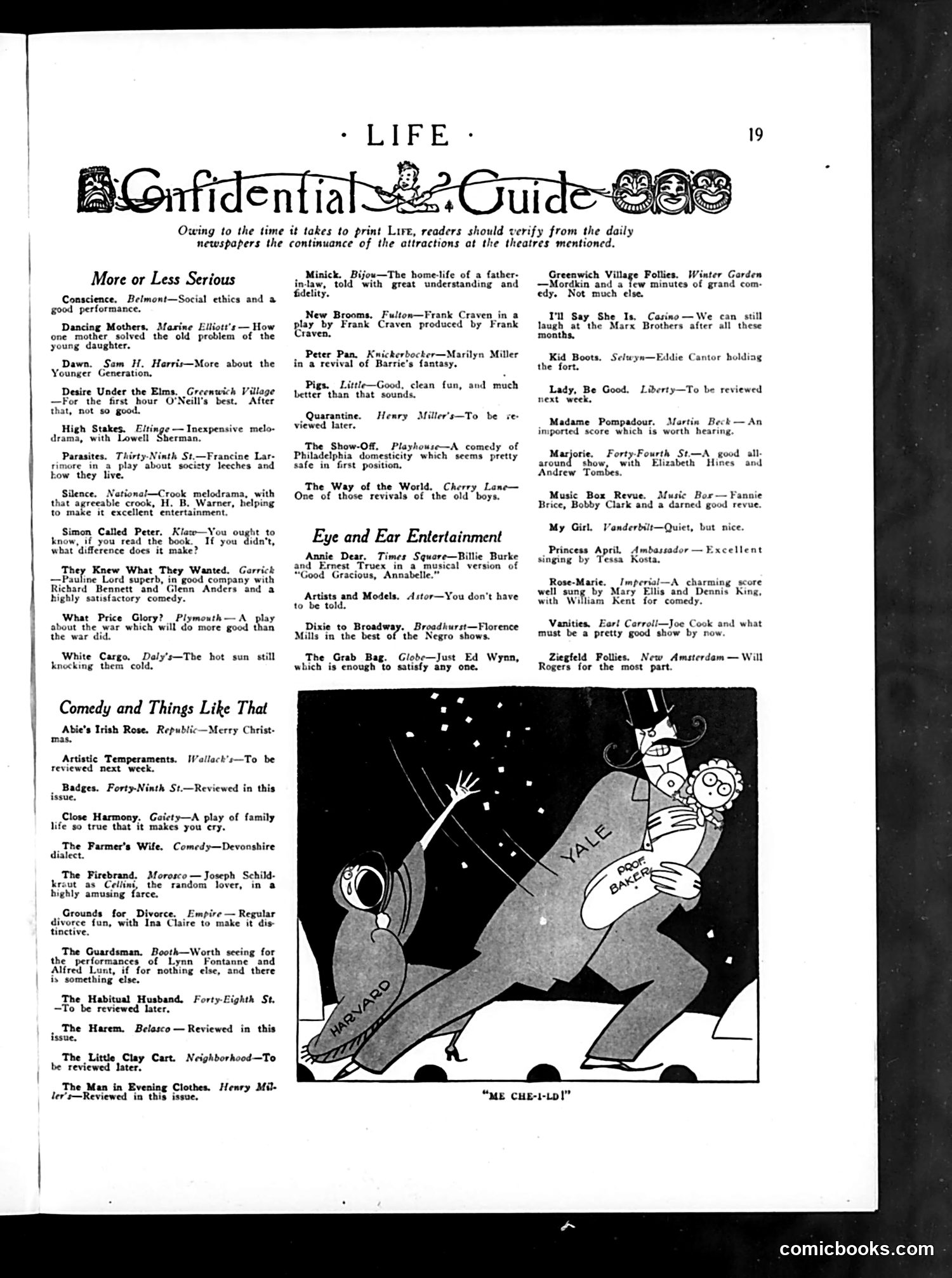
This page from *Life* magazine is primarily a theater guide reviewing Broadway shows and entertainment. The cartoon at bottom—titled "ME CHE-I-LD!"—appears to be satirical commentary on parenting or family dynamics. The image shows a figure (likely representing a parent or authority figure) being struck or knocked backward by what appears to be a child or younger person, with stars indicating impact. The exaggerated "CHE-I-LD" spelling suggests mocking pronunciation, possibly lampooning how parents speak about or to children, or satirizing generational conflict. Given the page's review of plays like *Dancing Mothers* and *Close Harmony* (described as "a play of family life so true that it makes you cry"), this cartoon likely comments on contemporary anxieties about youth rebellion and parent-child relationships—a recurring theme in 1920s entertainment and social commentary. The exact satirical point remains somewhat unclear without additional context.
📄 Transcribed text from this page (OCR, searchable)
Machine-transcribed from the original scan — historical spelling and the odd misread are preserved.
19 Owing to the time it takes to print Lire, readers should verify from the daily newspapers the continuance of the attractions at the theatres mentioned. More or Less Serious Conscience, good performance. Dancing Mothers, Marine Elliott's — How one mother solved the old problem of the young daughter. Dawn. Sam H. Herris—More about the Younger Generation, Desire Under the Elms. —For the first hour O'Neill's best. that, not so good. Greenwich Village After High Stakes. Eltinge — Inexpensive melo- drama, with Lowell Sherman, Thirty-Ninth St—Francine Lar- rimore in a play about socisty leeches and how they live. Silence. National—Crook melodrama, with that agreeable crook, H. B. Warner, helping to make it excellent entertainment, Simon Called Peter. Klaw—You ought to know, if you read the book. If you didn’t, what difference does it make? Parasites. They Knew What They Wanted. Gorrict —Pauline Lord superb, in good company with Richard Bennett and’Glenn Anders and a highly satisfactory comedy. ‘What Price Glory? Plymouth—A play about the war which will do more good than the war did. White Cargo, Daly's—The hot sun still knocking them cold, Comedy and Things Like That Abie's Irish Rose. Republic—Merry Christ- mas, Artistic Temperaments. reviewed next week. Wallack's—To be , Badges. Forty-Ninth St.—Reviewed in this issue. Close Harmony. Gaicty—A play of family life so true that it makes you ery. _ The Farmer's Wife. Comedy—Devonshire dialect. The Firebrand. Morosco— Joseph Schild- kraut as Cellini, the random lover, in a highly amusing farce. Grounds for Divorce. divorce fun, with Ina C1: tinctive, Empire — Regular aire to make it dis- The Guardsman. Booth—Worth seeing for the performances of Lynn Fontanne and Alfred Lunt, if for nothing else, and there is something’ else. The Habitual Husband. Forty. hth St. —To be reviewed later. The Harem. Belasco— Reviewed in this issue. The Little Clay Cart. Neighborhood—To be reviewed later. The Man in Evening Clothes. Henry Mil- ler’s—Reviewed in this issue. Belmont—Social ethics and a Minick. Bijou—The home-life of a father- inlaw, told with great understanding and fidelity. New Brooms. Fulton—Frank Craven in a play by Frank Craven produced by Frank Craven. Peter Pan. Knickerbocker Marilyn Miller in a revival of Barrie’s fanta: Pigs. Littl—Good, clean fun, and much better than that sounds. Quarantine. Henry viewed later. Miller’s—To be see The Show-Of, Playhouse—A comedy of Philadelphia domesticity which seems pretty safe in first position, The Way of the World. Cherry Lane— One of those revivals of the old boys. Eye and Ear Entertainment Annie Dear, Times Squore—Billie Burke and Ernest Truex in a musical version of “Good Gracious, Annabelle.” Artists and Models. Astor—You don't have to be told. Dixie to Broadway. Mills in the best o: Broadhurst—Florence the Negro shows. The Grab Bag. Globe—Just Ed Wynn, which is enough to satisfy any one. Greenwich Village Follies. Winter Garden —Mordkin and a few minutes of grand com- edy. Not much else. I'll Say She Is, Casino —We can still laugh at the Marx Brothers after all these months, Kid Boots. Selwyn—Eddie Cantor holding the fort. Lady, Be Good. next week, Liberty—To be reviewed Madame Pompadour. Martin Beck — An imported score which is worth hearing. Marjorie. Forty-Fourth St—A_ good around show, with Elizabeth Hines an Andrew Tombes. Music Box Revue. Music Bor — Fannie Brice, Bobby Clark and a darned good revue. My Girl. Vanderbilt—Quiet, but nice. Princess April. Ambassador — Excellent singing by Tessa Kosta. Rose-Marie. Imperisl—A charming score well sung by Mary Ellis and Dennis King, with William Kent for comedy. Vanities, Ear! Carroli—Joe Cook and what must be a pretty good show by now Ziegfeld Follies. Rogers for the most Yew Amsterdam — Will part. “ME CHE-I-LD!” comicbooks.com