
Life, 1924-12-25 · page 16 of 37
Life — December 25, 1924 — page 16: what you’re looking at
What you’re looking at
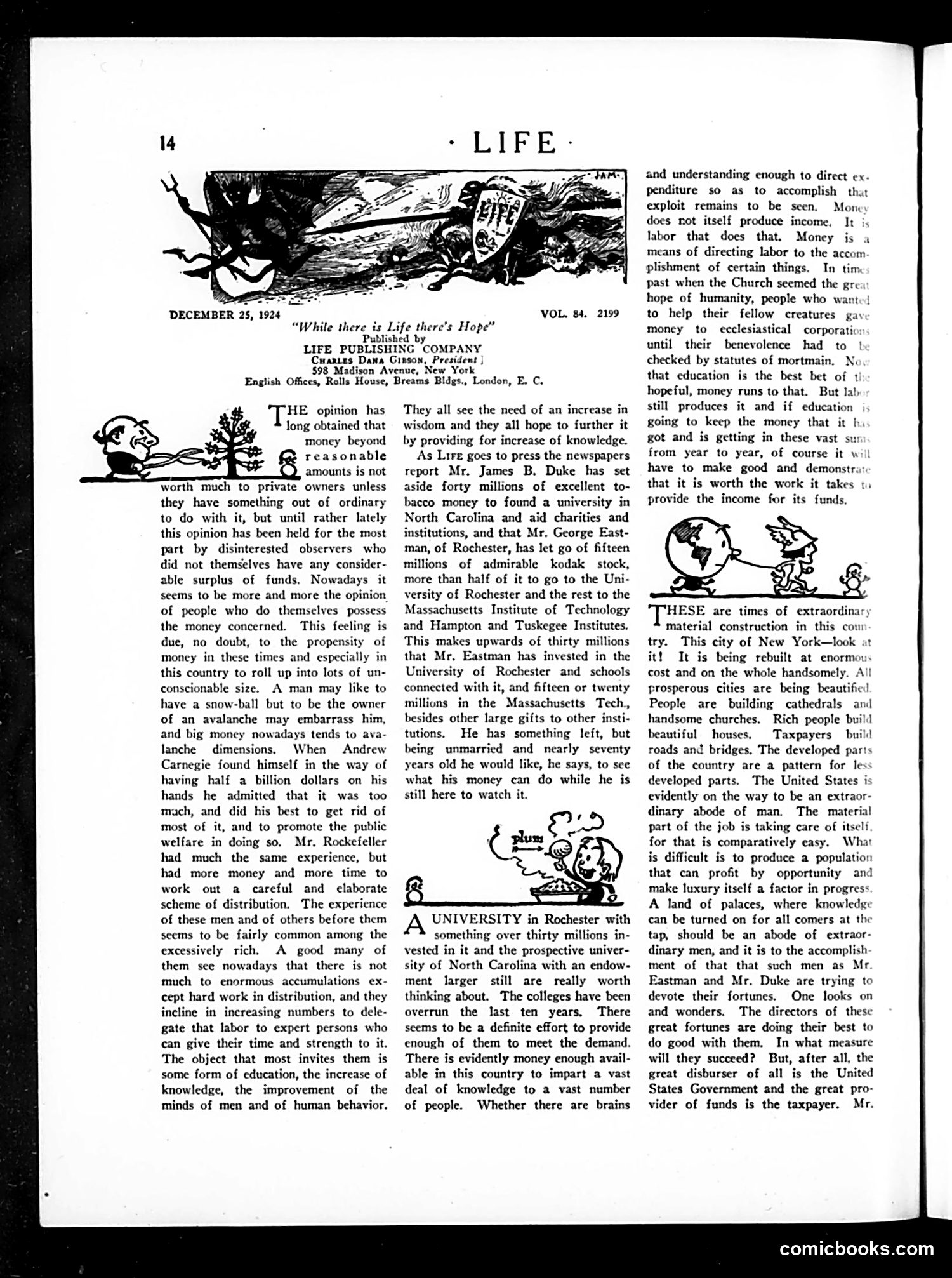
This editorial page discusses wealthy philanthropists and university funding. The text references **James B. Duke** (tobacco magnate) donating $40 million to found Duke University in North Carolina, and **George Eastman** (Kodak founder) giving $15 million to the University of Rochester. The small decorative cartoons appear to be generic illustrations rather than specific political satire—they show figures with money/wealth symbols, likely emphasizing the page's theme about wealthy industrialists and their charitable giving. The editorial's point: while these massive donations are admirable, they represent an insufficient approach to education and social welfare. The author argues money alone doesn't solve systemic problems and questions whether private charity should substitute for broader public investment in education and infrastructure.
📄 Transcribed text from this page (OCR, searchable)
Machine-transcribed from the original scan — historical spelling and the odd misread are preserved.
DECEMBER 25, 1924 VOL. 84. 2199 “While there is Life there's Hope” rublished by LIFE PUBLISHING COMPANY Cuanizs Dana Ginson, President | $98 Madison Avenue, New York English Offices, Rolls House, Breams Bldgs., London, E. C. THE opinion has long obtained that money beyond oe reasonable C2, amounts is not worth much to private owners unless they have something out of ordinary to do with it, but until rather lately this opinion has been held for the most part by disinterested observers who did not themselves have any consider- able surplus of funds. Nowadays it seems to be more and more the opinion, of people who do themselves possess the money concerned. This feeling is due, no doubt, to the propensity of money in these times and especially in this country to roll up into lots of un- conscionable size. A man may like to have a snow-ball but to be the owner of an avalanche may embarrass him, and big money nowadays tends to ava- lanche dimensions. When Andrew Carnegie found himself in the way of having half a billion dollars on his hands he admitted that it was too much, and did his best to get rid of most of it, and to promote the public welfare in doing so. Mr. Rockefeller had much the same experience, but had more money and more time to work out a careful and elaborate scheme of distribution. The experience of these men and of others before them seems to be fairly common among the excessively rich. A good many of them sce nowadays that there is not much to enormous accumulations ex- cept hard work in distribution, and they incline in increasing numbers to dele- gate that labor to expert persons who can give their time and strength to it. The object that most invites them is some form of education, the increase of knowledge, the improvement of the minds of men and of human behavior. They all see the need of an increase in wisdom and they all hope to further it by providing for increase of knowledge. As Lire goes to press the newspapers report Mr. James B. Duke has set aside forty millions of excellent to- bacco money to found a university in North Carolina and aid charities and institutions, and that Mr. George East- man, of Rochester, has let go of fifteen millions of admirable kodak stock, more than half of it to go to the Uni- versity of Rochester and the rest to the Massachusetts Institute of Technology and Hampton and Tuskegee Institutes. This makes upwards of thirty millions that Mr. Eastman has invested in the University of Rochester and schools connected with it, and fifteen or twenty millions in the Massachusetts Tech., besides other large gifts to other insti- tutions. He has something left, but being unmarried and nearly seventy years old he would like, he says, to see what his money can do while he is still here to watch it. fos & UNIVERSITY in Rochester with something over thirty millions in- vested in it and the prospective univer- sity of North Carolina with an endow- ment larger still are really worth thinking about. The colleges have been overrun the last ten years. There seems to be a definite effort to provide enough of them to meet the demand. There is evidently money enough avail- able in this country to impart a vast deal of knowledge to a vast number of people. Whether there are brains and understanding enough to direct ex- penditure so as to accomplish that exploit remains to be seen. Mon does not itself produce income. It is labor that does that. Money is 4 means of directing labor to the ac plishment of certain things. In tim past when the Church seemed the gre: hope of humanity, people who wante! to help their fellow creatures gay money to ecclesiastical corporatic until their benevolence had to | checked by statutes of mortmain. Nx that education is the best bet of 1 hopeful, money runs to that. But lal) still produces it and if education going to keep the money that it } got and is getting in these vast sur from year to year, of course it will have to make good and demonstra: that it is worth the work it takes provide the income for its funds. R HESE are times of extraordinary material construction in this cour try. This city of New York—look at it! It is being rebuilt at enorm cost and on the whole handsomely. Al! Prosperous cities are being beautified People are building cathedrals ani handsome churches. Rich people build beautiful houses. Taxpayers buili! roads and bridges. The developed parts of the country are a pattern for less developed parts. The United States is evidently on the way to be an extraor- dinary abode of man. The material part of the job is taking care of itself for that is comparatively easy. What is difficult is to produce a population that can profit by opportunity and make luxury itself a factor in progress A land of palaces, where knowledge can be turned on for all comers at the tap, should be an abode of extraor- dinary men, and it is to the accomplish ment of that that such men as Mr. Eastman and Mr. Duke are trying to devote their fortunes. One looks on and wonders. The directors of these great fortunes are doing their best to do good with them. In what measure will they succeed? But, after all, the great disburser of all is the United States Government and the great pro- vider of funds is the taxpayer. Mr. comicbooks.com