
Life, 1924-12-25 · page 33 of 37
Life — December 25, 1924 — page 33: what you’re looking at
What you’re looking at
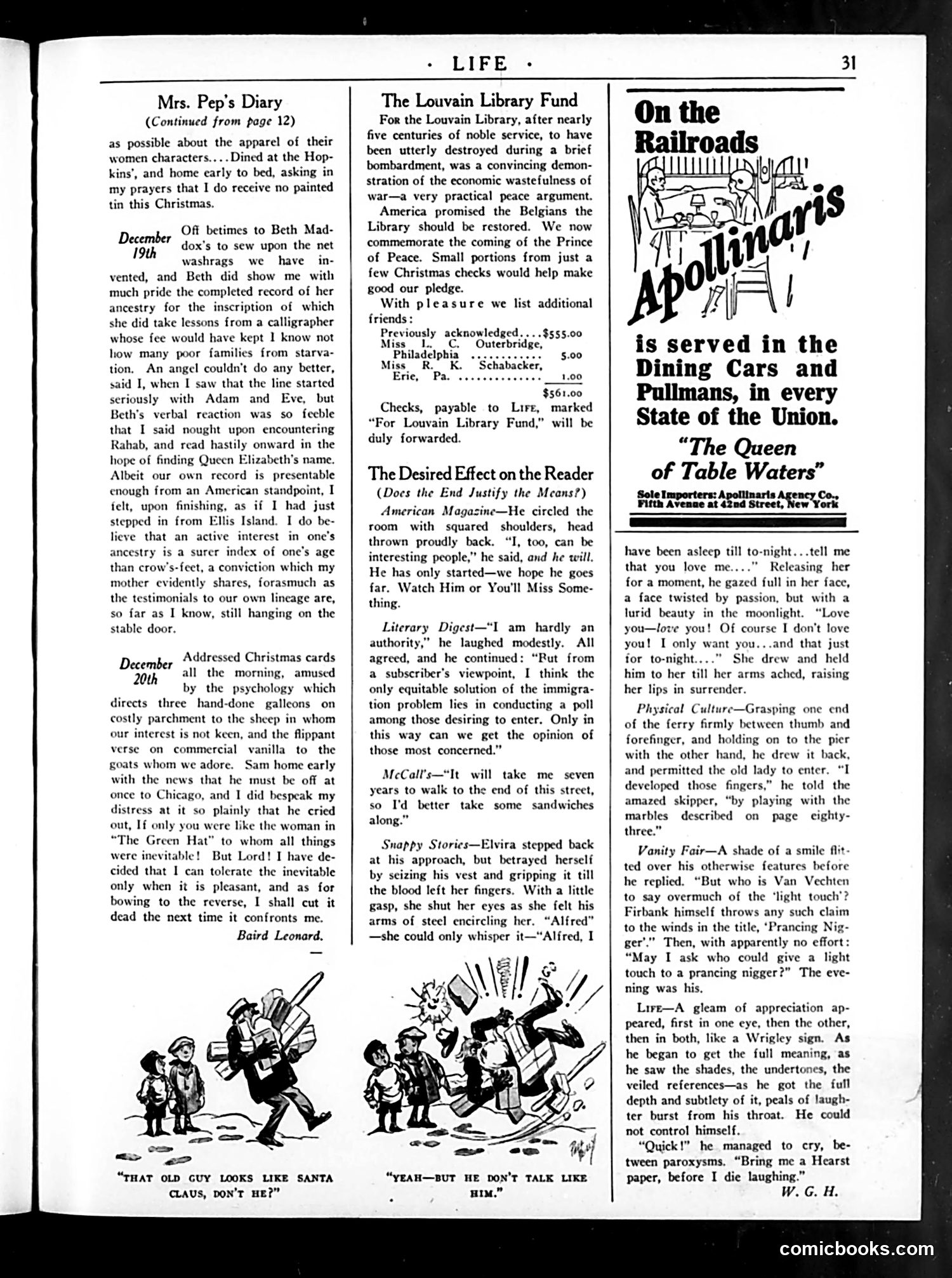
This page contains three distinct sections satirizing American media and social pretension circa the 1920s. **Mrs. Pep's Diary** mocks upper-class affectation through a society woman's observations about ancestry obsession and Christmas card hypocrisy. The reference to "The Green Hat" (a contemporary scandal novel) adds topical humor. **The Louvain Library Fund** is a serious fundraising appeal for the Belgian library destroyed in WWI—framed as a practical peace argument and Christmas charity. **"The Desired Effect on the Reader"** satirizes how different magazines manipulate their readers' self-perception. Each publication excerpt shows someone adopting exaggerated personas (confidence, false modesty, affected concern) that the magazines implicitly encourage. The satire suggests magazines don't report reality but shape how readers wish to present themselves. The two cartoons below (partially visible) appear unrelated genre humor about mistaken identity.
📄 Transcribed text from this page (OCR, searchable)
Machine-transcribed from the original scan — historical spelling and the odd misread are preserved.
Mrs. Pep’s Diary (Continued from page 12) as possible about the apparel of their women characters....Dined at the Hop- kins’, and home early to bed, asking in my prayers that I do receive no painted tin this Christmas. December OF bens to Beth Mad- 19th lox’s to sew upon the net washrags we have in- vented, and Beth did show me with much pride the completed record of her ancestry for the inscription of which she did take lessons from a calligrapher whose fee would have kept 1 know not how many poor families from starva- tion. An angel couldn't do any better, said I, when I saw that the line started seriously with Adam and Eve, but Beth's verbal reaction was so feeble that I said nought upon encountering Rahab, and read hastily onward in the hope of finding Queen Elizabeth's name. Albeit our own record is presentable enough from an American standpoint, I felt, upon finishing, as if I had just stepped in from Ellis Island. I do be- lieve that an active interest in one's ancestry is a surer index of one's age than crow’s-feet, a conviction which my mother evidently shares, forasmuch as the testimonials to our own lineage are, so far as I know, still hanging on the stable door, December Addressed Christmas cards 20th all the morning, amused by the psychology which directs three hand-done galleons on costly parchment to the sheep in whom our interest is not keen, and the flippant verse on commercial vanilla to the goats whom we adore. Sam home early with the news that he must be off at once to Chicago, and I did bespeak my distress at it so plainly that he cried out, If only you were like the woman in “The Green Hat” to whom all things were inevitable! But Lord! I have de- cided that I can tolerate the inevitable only when it is pleasant, and as for bowing to the reverse, I shall cut it dead the next time it confronts me. Baird Leonard. “THAT OLD GUY LOOKS LIKE SANTA CLAUS, DON’T HE?” + LIFE - The Louvain Library Fund For the Louvain Library, after nearly five centuries of noble service, to have been utterly destroyed during a brief bombardment, was a convincing demon- stration of the economic wastefulness of war—a very practical peace argument. America promised the Belgians the Library should be restored. We now commemorate the coming of the Prince of Peace. Small portions from just a few Christmas checks would help make good our pledge. With pleasure we list additional friends: Previously acknowledged... .$555.00 Miss L. C. Outerbridge, Philadelphia ..........-. §.00 M R. K. Schabacker, Erie, Pa. ..cssccsessees 1,00 $561.00 Checks, payable to Lire, marked “For Louvain Library Fund,” will be duly forwarded. The Desired Effect on the Reader (Does the End Justify the Means?) American Magazine—He circled the room with squared shoulders, head thrown proudly back. “I, too, can be interesting people,” he said, and he will. He has only started—we hope he goes far. Watch Him or You'll Miss Some- thing. Literary Digest—“I am hardly an authority,” he laughed modestly. All agreed, and he continued: “But from a subscriber's viewpoint, I think the only equitable solution of the immigra- tion problem lies in conducting a poll among those desiring to enter. Only in this way can we get the opinion of those most concerned.” McCall’s—“It_ will take me seven years to walk to the end of this street, so I'd better take some sandwiches along.” Snappy Stories—Elvira stepped back at his approach, but betrayed herself by seizing his vest and gripping it till the blood left her fingers. With a little gasp, she shut her eyes as she felt his arms of steel encircling her. “Alfred” —she could only whisper it—Alfred, 1 “YEAH—BUT HE DON’T TALK LIKE HIM.” is served in the Dining Cars and Pullmans, in every State of the Union. “The Queen of Table Waters” Firth Avene ai ebnd Street New York have been asleep till to-night. ..tell me that you love me....” Releasing her for a moment, he gazed full in her face, a face twisted by passion, but with a lurid beauty in the moonlight. “Love you—love you! Of course I don't love you! I only want you...and that just for to-night...." She drew and held him to her till her arms ached, raising her lips in surrender. Physical Culture—Grasping one end of the ferry firmly between thumb and forefinger, and holding on to the pier with the other hand, he drew it back, and permitted the old lady to enter. “I developed those fingers,” he told the amazed skipper, “by playing with the marbles described on page cighty- three.” Vanity Fair—A shade of a smile flit- ted over his otherwise features before he replied. “But who is Van Vechten to say overmuch of the ‘light touch’? Firbank himself throws any such claim to the winds in the title, ‘Prancing Nig- ger’.” Then, with apparently no effort: “May I ask who could give a light touch to a prancing nigger?” The eve- ning was his, Lire—A gleam of appreciation ap- peared, first in one eye, then the other, then in both, like a Wrigley sign. As he began to get the full meaning, as he saw the shades, the undertones, the veiled references—as he got the full depth and subtlety of it, peals of laugh- ter burst from his throat. He could not control himself. “Quick!” he managed to cry, be- tween paroxysms. “Bring me a Hearst paper, before I die laughing.” W.G. H. comicbooks.com