
A complete issue · 36 pages · 1924
Life — October 16, 1924
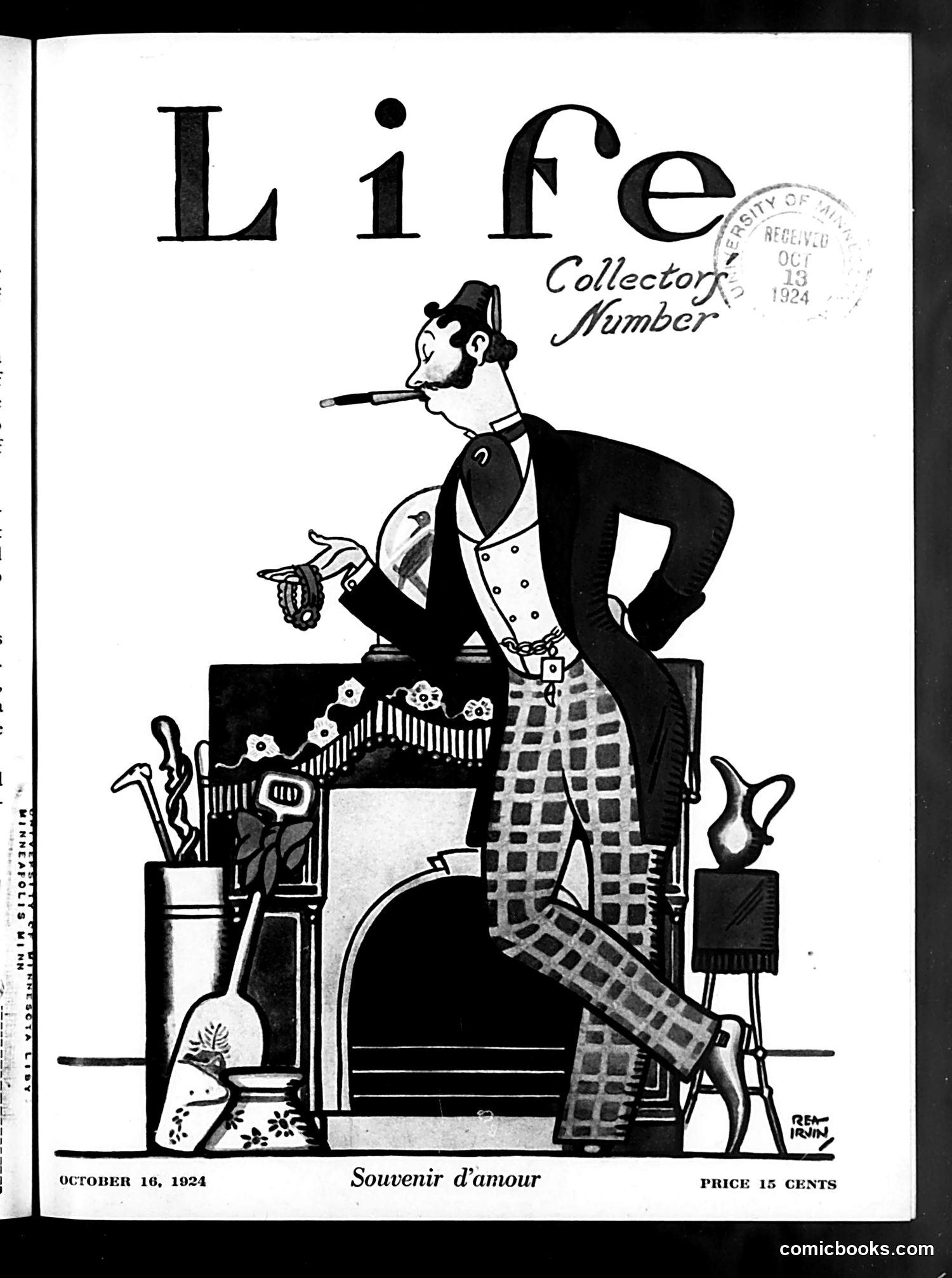
This is a cover illustration titled "Souvenir d'amour" (Souvenir of Love), priced at 15 cents. The artwork depicts an exaggerated dandy or fashionable gentleman in 1920s attire—checkered pants, monocle, and formal wear—striking a theatrical pose while smoking. He's perched among decorative potted plants and ornamental objects in what appears to be an elaborate interior setting. The satire targets contemporary male fashion excess and affectation of the Jazz Age era. The figure's absurdly pompous posture, combined with the overwrought decorative surroundings, mocks the pretentiousness of fashionable urban society and exaggerated masculinity. The French subtitle suggests mockery of European refinement affectations popular among wealthy Americans of the period. This represents typical Life magazine satirical commentary on contemporary social vanity.
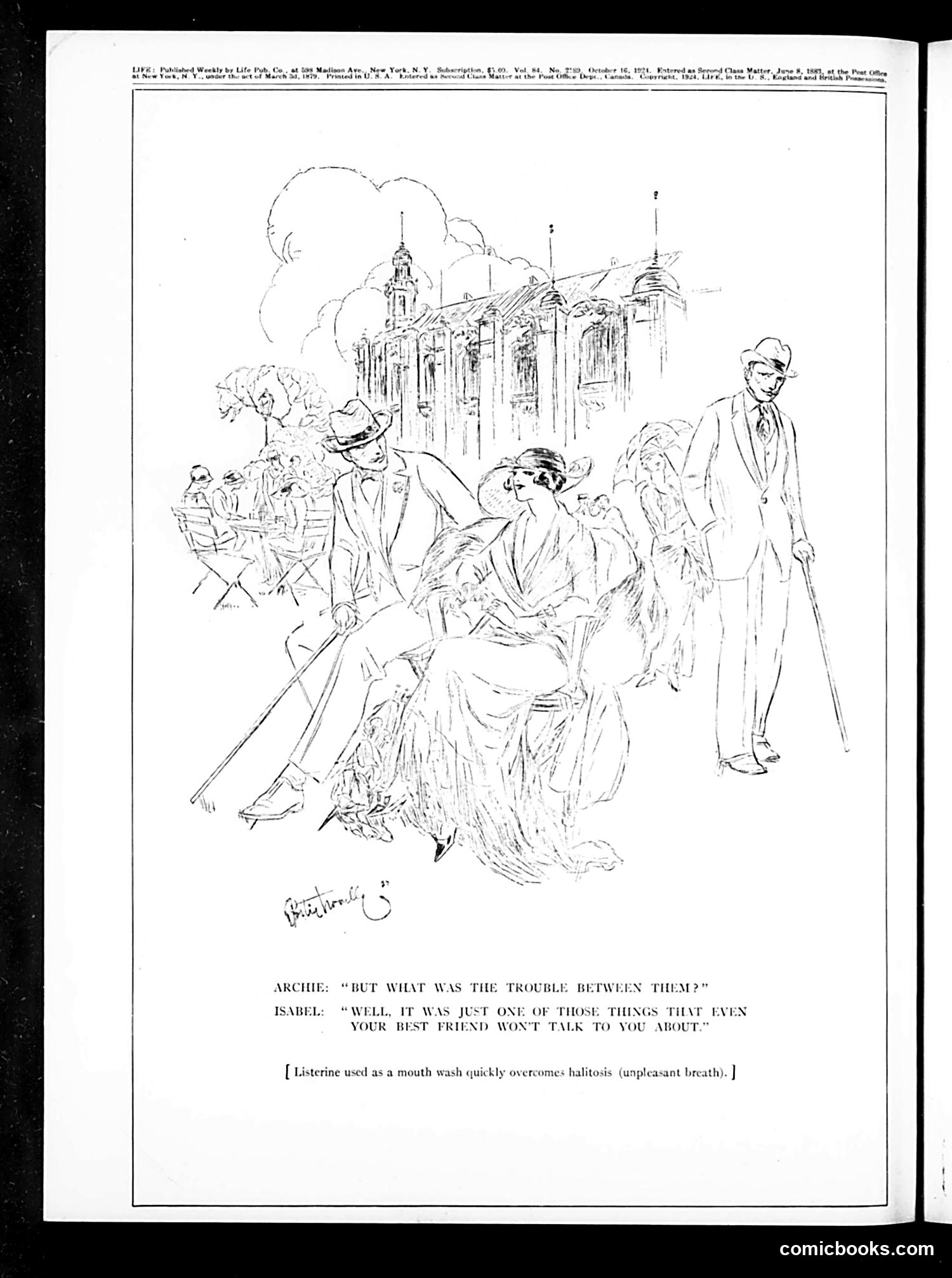
This is a satirical cartoon from *Life* magazine depicting a social scene outside a church. The dialogue between characters named "Archie" and "Isabel" concerns a rift between friends—Isabel reveals that the trouble between them involves "one of those things that even your best friend won't talk to you about." The caption below references Listerine mouthwash, suggesting halitosis (bad breath) as the unspoken problem. This is advertising disguised as editorial content, a common *Life* format. The cartoon satirizes social awkwardness and the euphemistic discomfort surrounding personal hygiene issues in early 20th-century society. The elegant clothing and church setting emphasize how even among the well-to-do, such matters remained taboo topics, making them prime targets for gentle satire and product advertising.
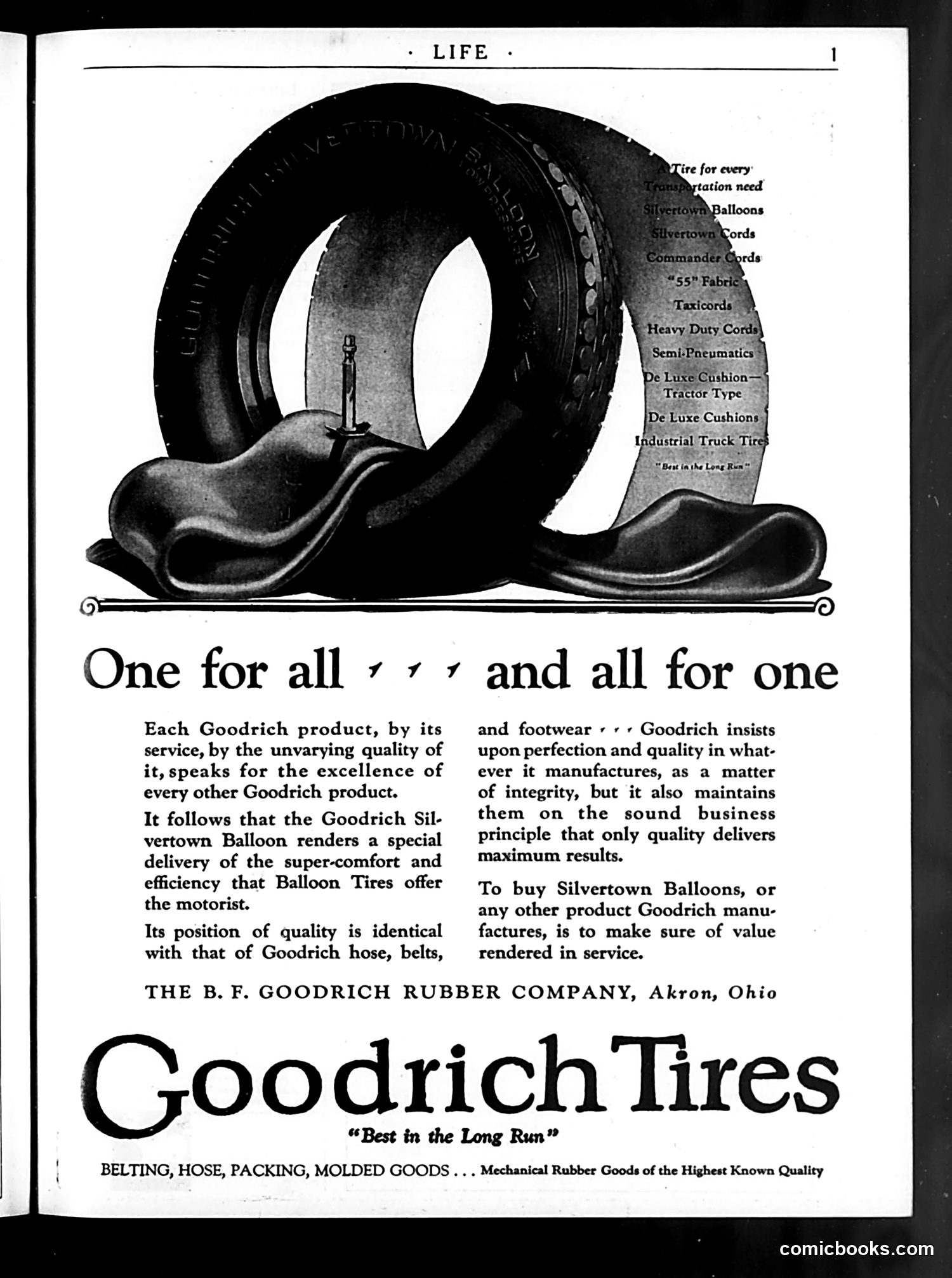
This page is **primarily an advertisement**, not satire or political content. It's a full-page ad for Goodrich Tires from The B.F. Goodrich Rubber Company (Akron, Ohio), published in *Life* magazine. The visual shows a stylized tire and inner tube arranged as a decorative composition. The headline "One for all... and all for one" uses the famous Dumas quote to create a metaphor: just as each musketeer represents collective excellence, each Goodrich product (listed on the right: Silvertown Balloons, cords, fabrics, etc.) reflects the quality of the entire company line. The marketing message emphasizes brand integrity—buying any Goodrich product guarantees value because the company maintains uniform quality standards across all manufacturing. This is straightforward commercial messaging, not satirical commentary.
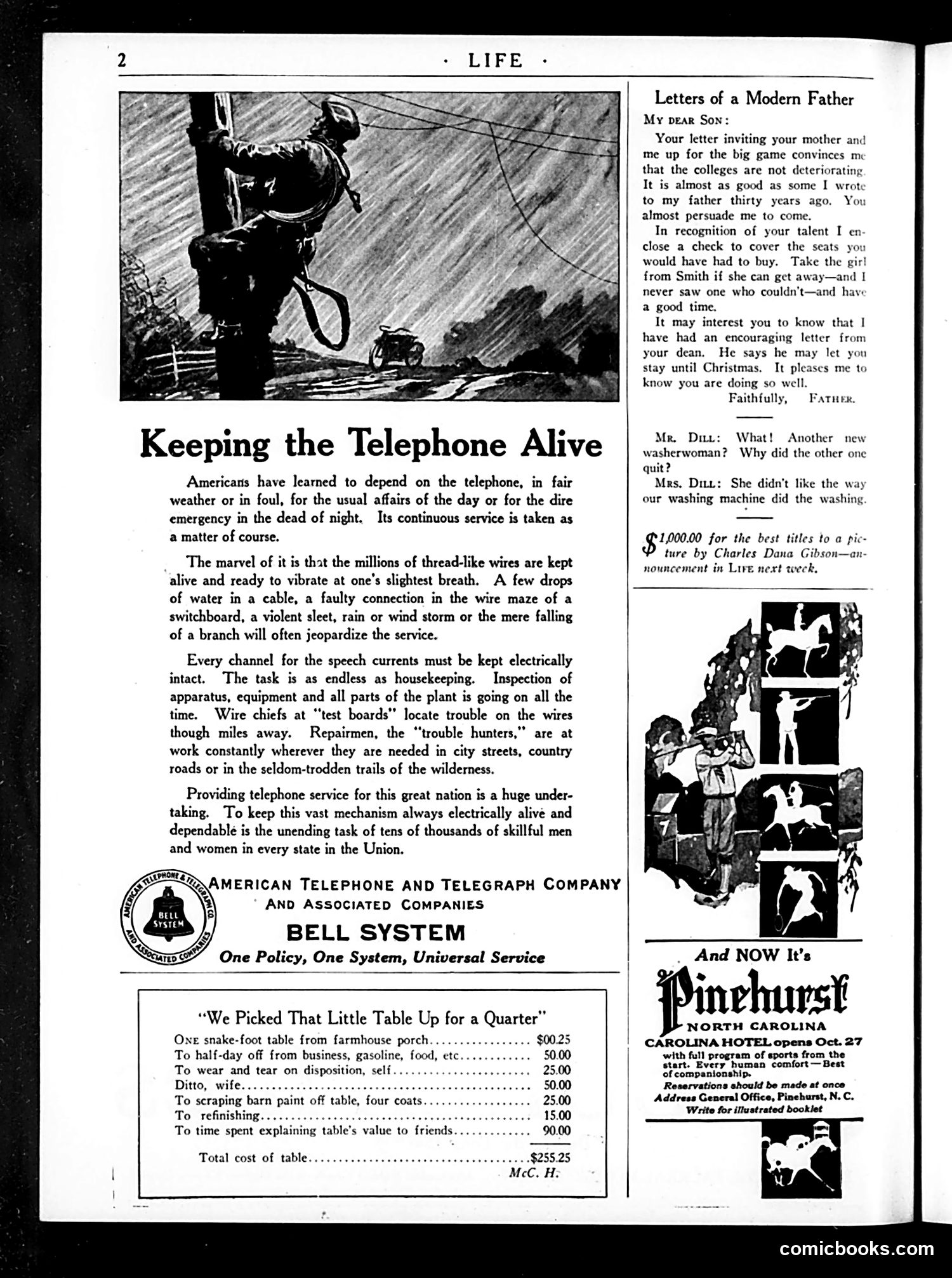
This page is primarily **advertising and editorial content** rather than political satire. The main elements are: 1. **"Letters of a Modern Father"** — A humorous column where a father responds to his son's invitation to a college football game, enclosing money for tickets and advice about taking a girl from "Smith" (likely Smith College). 2. **"Keeping the Telephone Alive"** — A Bell System advertisement celebrating telephone infrastructure maintenance, describing workers who keep lines functional in all weather conditions. 3. **"We Picked That Little Table Up for a Quarter"** — A humorous cost-accounting piece itemizing the expenses of restoring an old farmhouse table (total: $255.25). 4. **"Pinehurst" hotel advertisement** for North Carolina. The page reflects **1920s-30s American life**: college dating culture, technological infrastructure pride, and DIY restoration humor. No significant political satire is present.
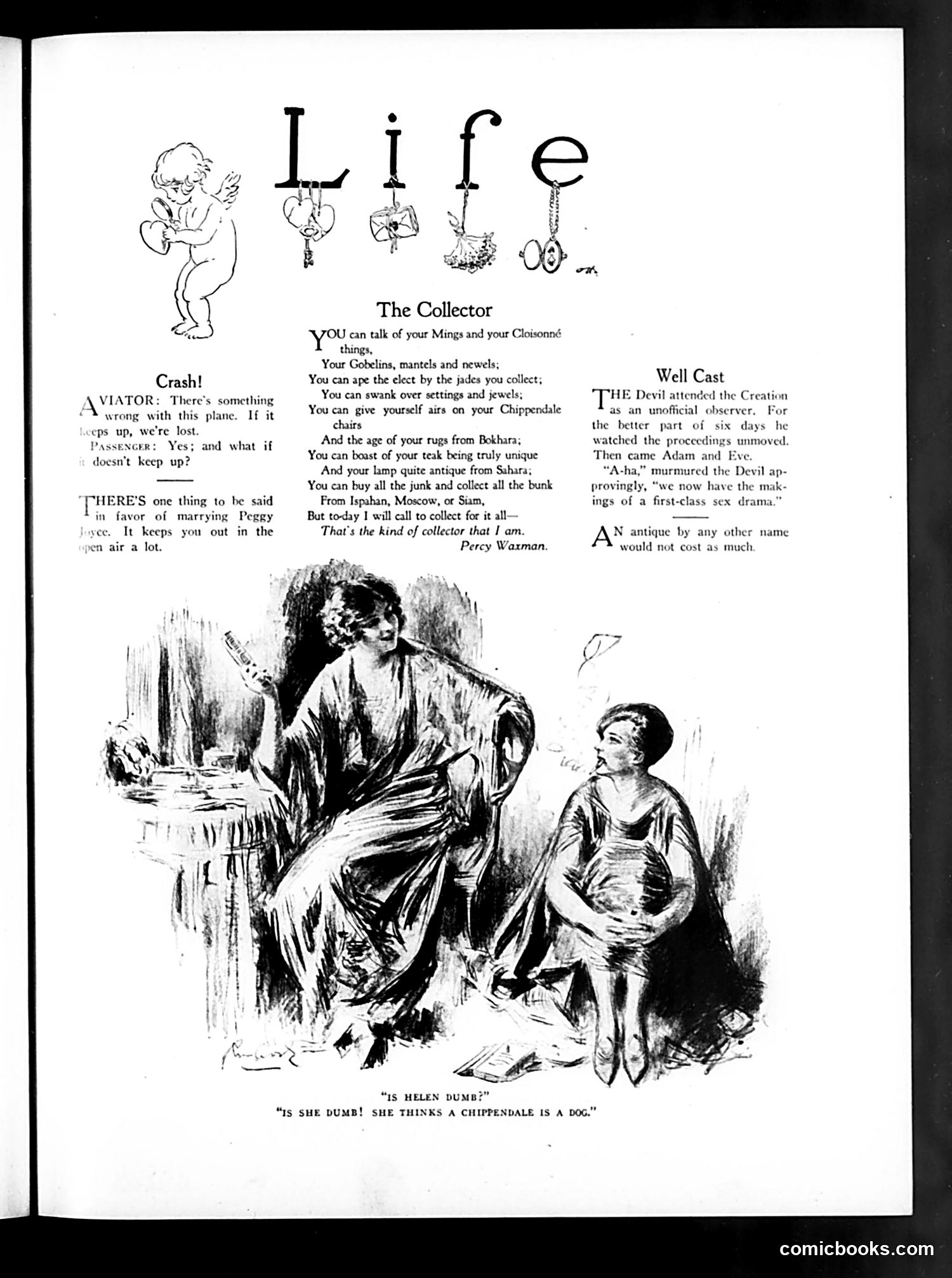
This page contains three separate satirical pieces from early 20th-century *Life* magazine: 1. **"Crash!"** – A brief dialogue mocking aviation pioneers, suggesting flying is dangerously impractical. 2. **"The Collector"** – Percy Waxman's poem satirizes wealthy collectors who obsessively accumulate exotic goods (rugs, teak, jewelry) from colonial locations like India and Burma, treating acquisition as a status symbol. The humor lies in the absurdity of collecting "all the junk" while calling oneself a refined collector. 3. **"Well Cast"** – This mocks theatrical pretension, suggesting the Devil observing the "Creation" play found the Adam-and-Eve scene unconvincingly performed, implying contemporary actors are mediocre. The bottom illustration depicts a dismissive exchange about a woman's pet, likely a Chippendale breed dog mistaken for something else—a joke about social pretension or class confusion.
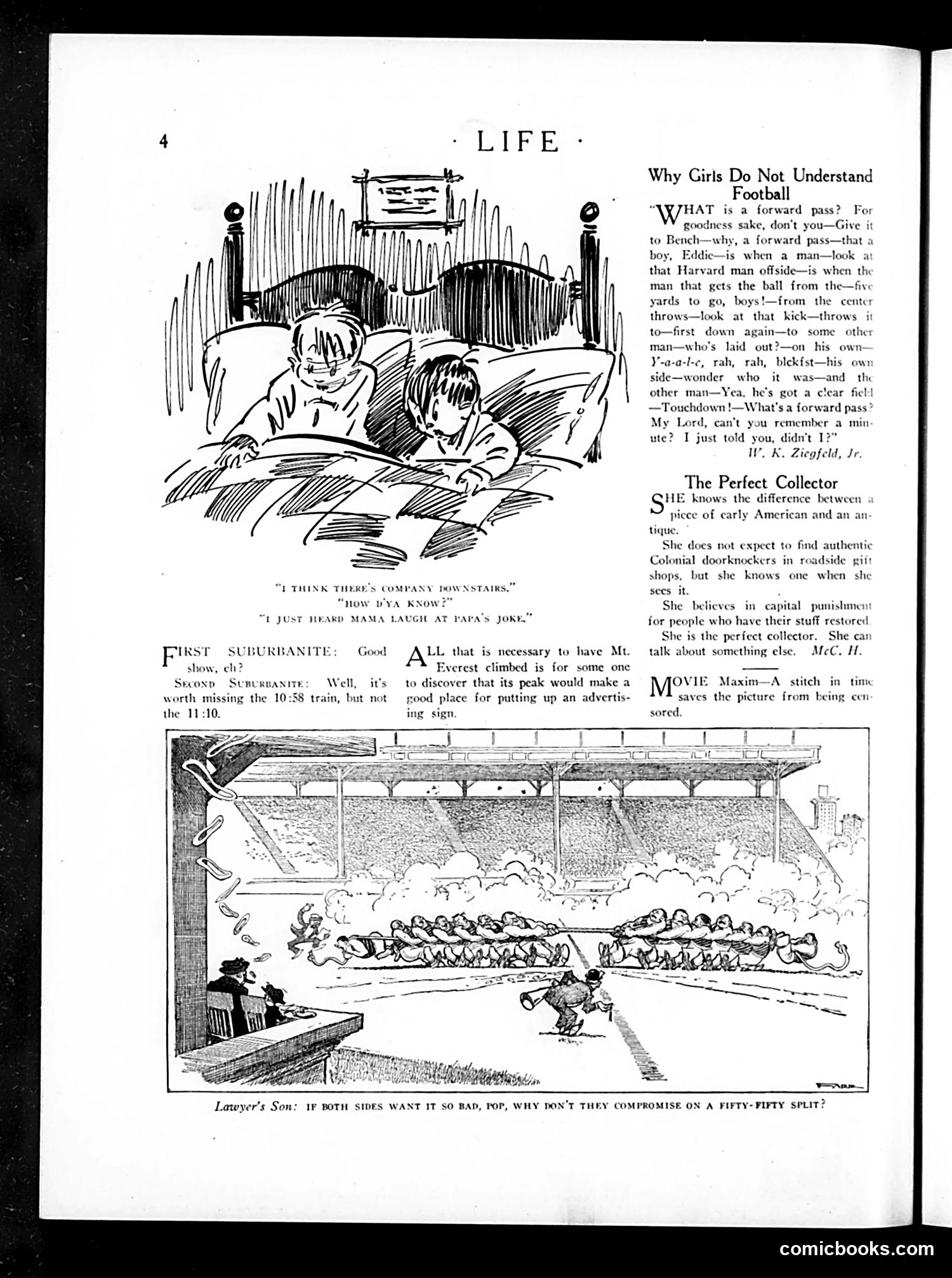
This page contains three separate humorous pieces targeting early 20th-century social conventions: 1. **Top cartoon**: Two children in bed overhear parents discussing a Harvard man offside in football, mishearing "offside" as "off-side" and imagining parental intimacy. 2. **Middle section**: A dialogue between suburbanites about missing trains, satirizing commuter culture and suburban life. 3. **Bottom cartoon ("Lawyer's Son")**: Depicts a football stadium packed with spectators while two teams appear tiny on the field. The caption jokes that if both sides want a "bad" game so badly, why not compromise with a "fifty-fifty split"—likely satirizing mediocrity in sports or society's tendency toward compromise solutions. The page reflects early 1900s anxieties about sports fandom, suburban commuting, and legal/professional pretension.
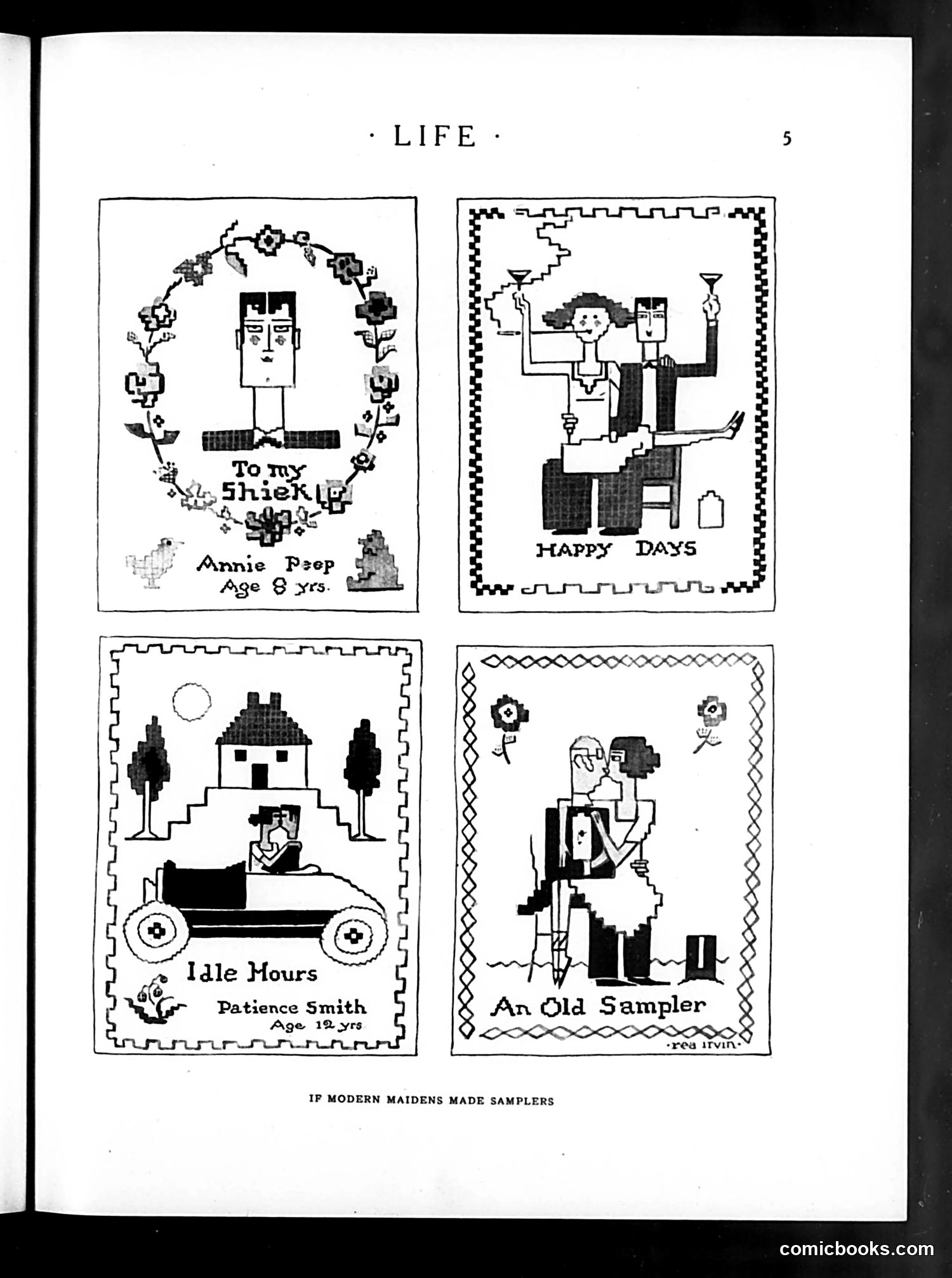
This page features four child-created samplers—embroidered or drawn designs—presented as satirical commentary on modern life versus traditional needlework. The caption "If Modern Maidens Made Samplers" suggests the humor: contrasting what children actually think about with what traditional sampler-makers once stitched (usually moral maxims and domestic scenes). The samplers show: - "To my Shield" (Annie Psep, age 6): flowers and domestic imagery - "Happy Days": a couple in modern domestic life - "Idle Hours" (Patience Smith, age 12): a woman in a car—suggesting leisure and automobiles represent modern priorities - "An Old Sampler": a couple with children flying overhead The satire mocks how modern youth's interests (cars, romance, entertainment) have replaced traditional virtuous or domestic themes that Victorian-era samplers celebrated.
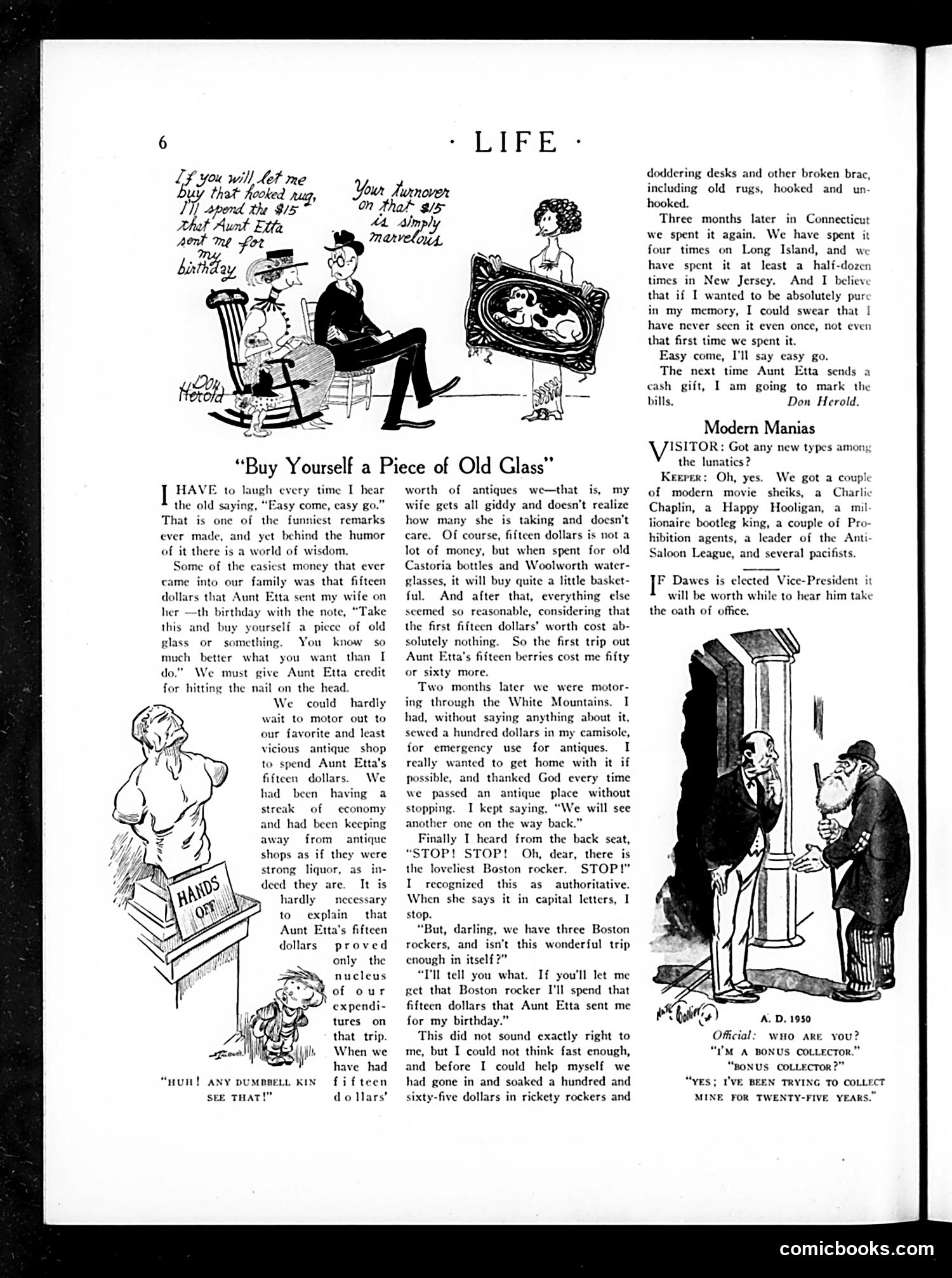
This page satirizes the American antique-collecting craze of the 1920s-30s. The main article humorously documents how Aunt Etta gifted the narrator fifteen dollars for their birthday, intending it for practical use. Instead, the narrator spent it on antiques while vacationing—specifically Boston rockers and glassware. The piece gently mocks how antique-hunting becomes an obsessive hobby that derails vacation plans and finances. The accompanying cartoons reinforce this theme: one shows a woman labeled "Hands Off" protecting her antique collection; another depicts two men discussing collecting habits, with one claiming twenty-five years of collecting. The satire targets middle-class consumerism and how leisure activities (antique shopping) can become frivolous expenditures that contradict practical gift-giving intentions.
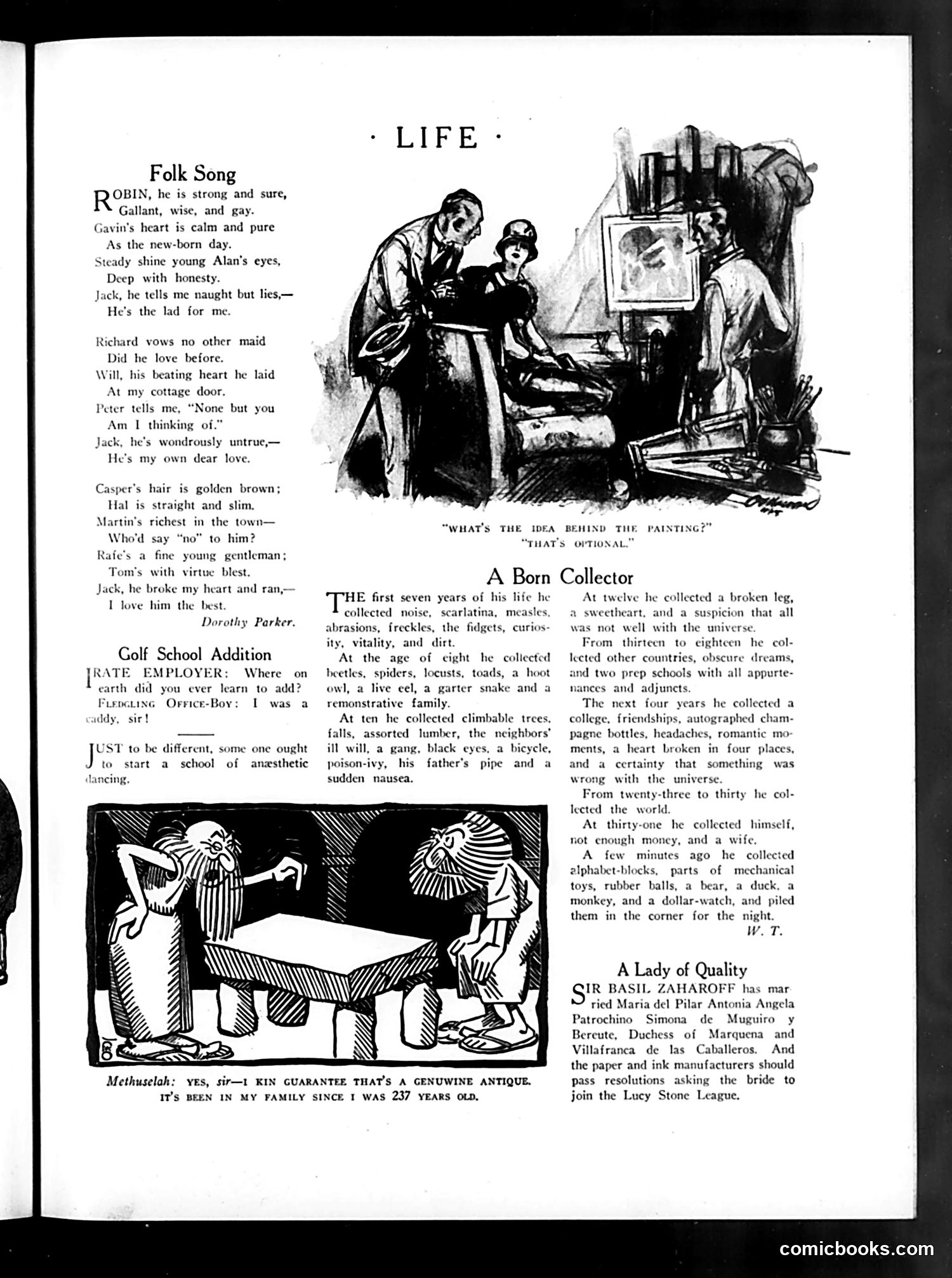
This page contains three distinct pieces: 1. **"Folk Song"** by Dorothy Parker: A poem listing men named Robin, Gavin, Jack, Richard, Peter, Casper, Martin, Tom, and Jack—apparently suitors or romantic interests. The satire lies in cataloging these generic male names and archetypes. 2. **"A Born Collector"**: A humorous short story about a man who obsessively collects objects throughout his life, from childhood (bugs, rocks) through adulthood (the world itself). The joke satirizes collecting as an compulsive behavior. 3. **"Golf School Addition"** and **"Methuselah"**: Brief humorous anecdotes. The lower cartoon depicts two figures debating an antique's authenticity, with one claiming 237-year-old family ownership—likely mocking antiquing pretensions. The page combines literary satire with visual humor targeting collecting habits and social pretension.
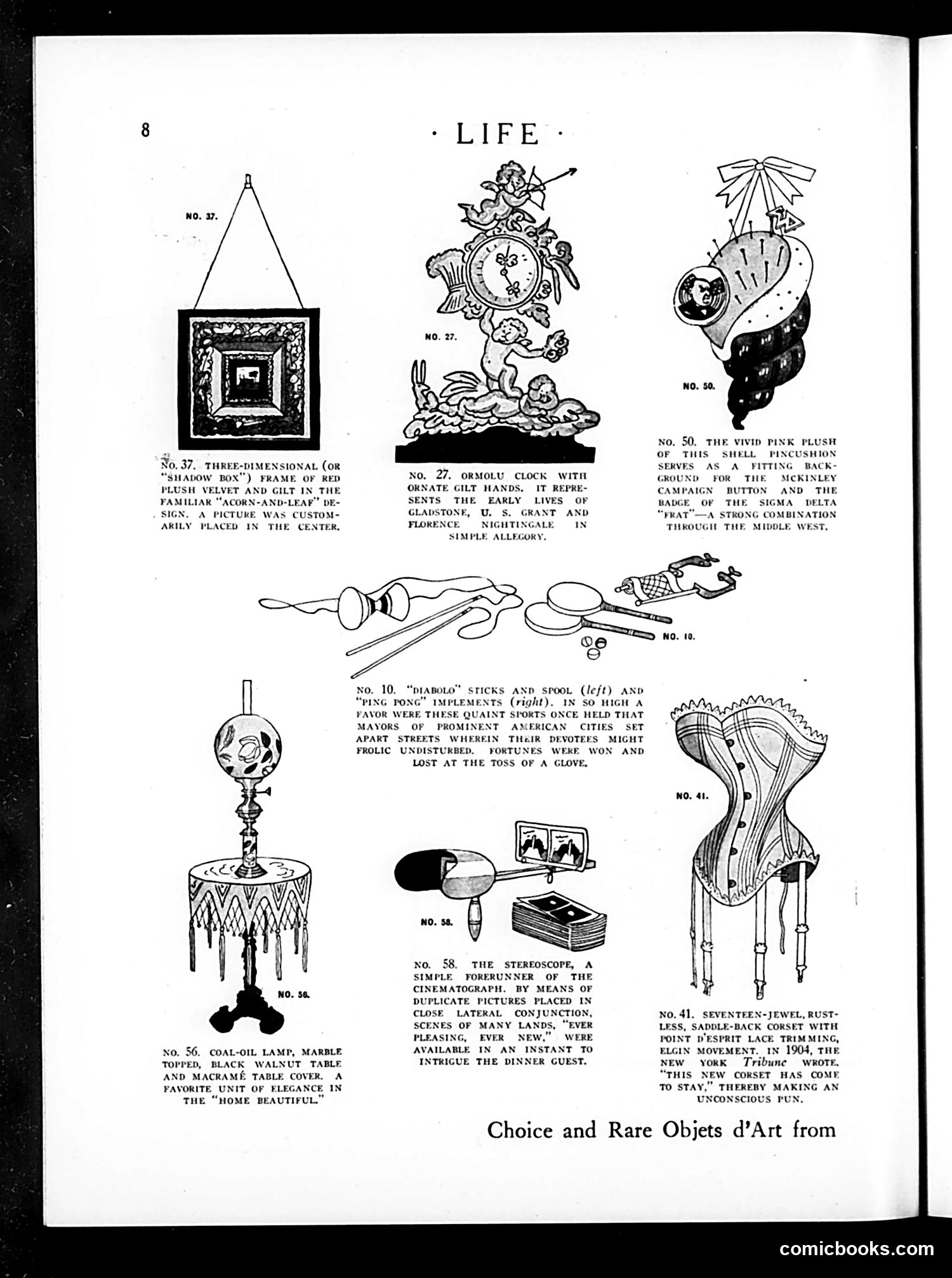
This page is **not a political cartoon**—it's a catalog of decorative objects and novelties from the early 1900s. The heading "Choice and Rare Objects d'Art" indicates this is a consumer goods feature. The items shown include: - A three-dimensional "shadow box" frame (No. 37) - An ornolu clock with cherubs (No. 27)—described as representing U.S. Grant and Florence Nightingale - A shell-based pincushion (No. 50) - Sporting implements like diabolo sticks and ping pong equipment (No. 10) - A coal-oil lamp with marble top (No. 56) - A stereoscope viewer (No. 58) - A decorative corset (No. 41) The text provides humorous descriptions of these fashionable household items and entertainment devices popular with wealthy consumers. This is essentially satirical product placement mocking Victorian consumer culture and elaborate decoration.
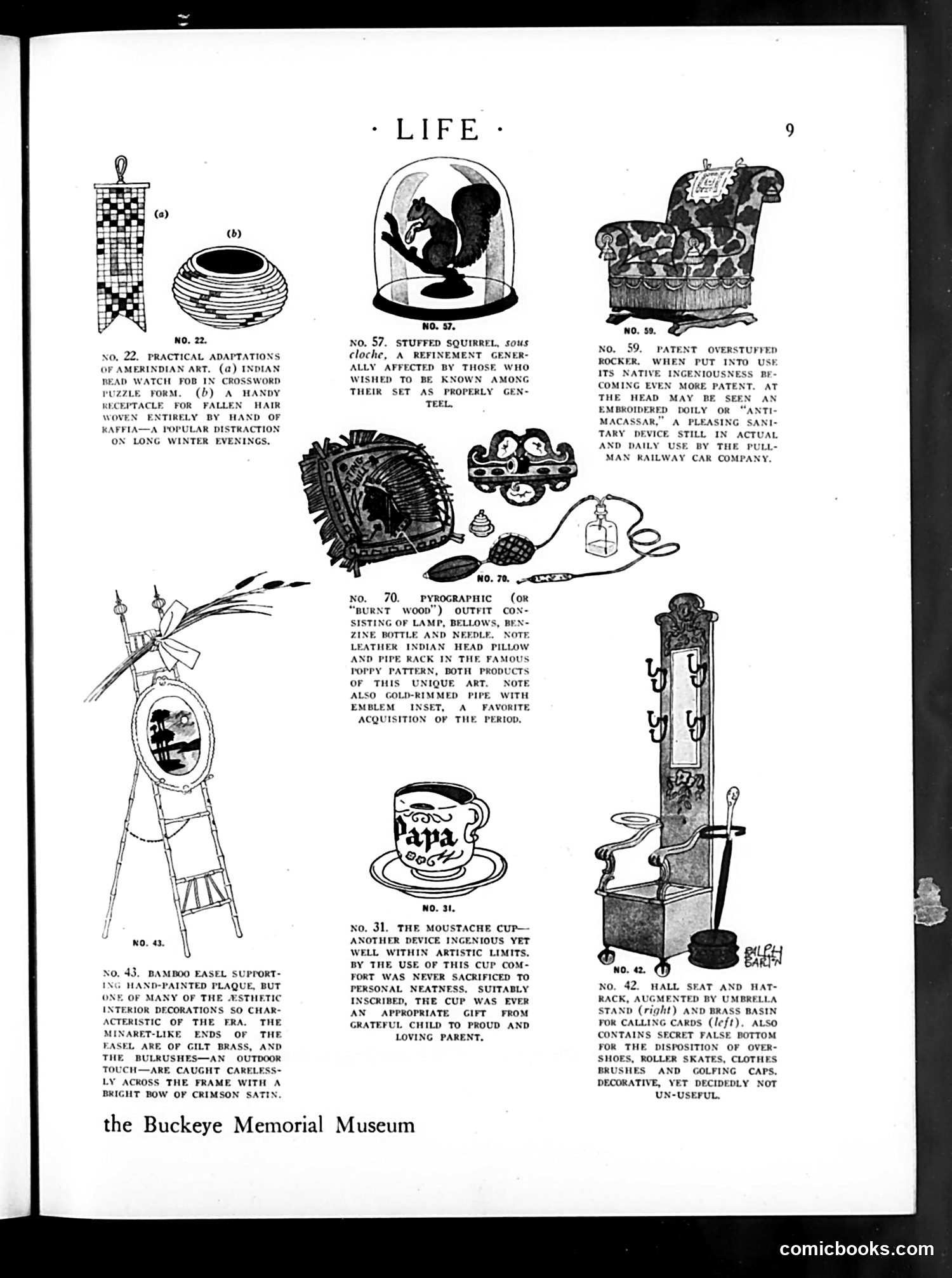
This page is primarily a **product catalog**, not political satire. It displays Victorian-era novelty items and decorative objects numbered 22-59, with detailed descriptions. Items include: - Practical puzzles and games (crossword adaptations, handy receptacle) - Decorative objects (stuffed squirrel under glass, ornate box) - Utilitarian items (pyrographic outfit for woodburning, hall seat with umbrella stand) - A novelty "moustache cup" for personal grooming Each entry includes whimsical, tongue-in-cheek descriptions typical of Life's humorous advertising approach. The moustache cup description, for instance, sarcastically notes it encourages "personal neatness." This represents **early 20th-century consumer culture**—showcasing gifts and novelties marketed toward middle and upper-class households as both practical and amusing acquisitions.
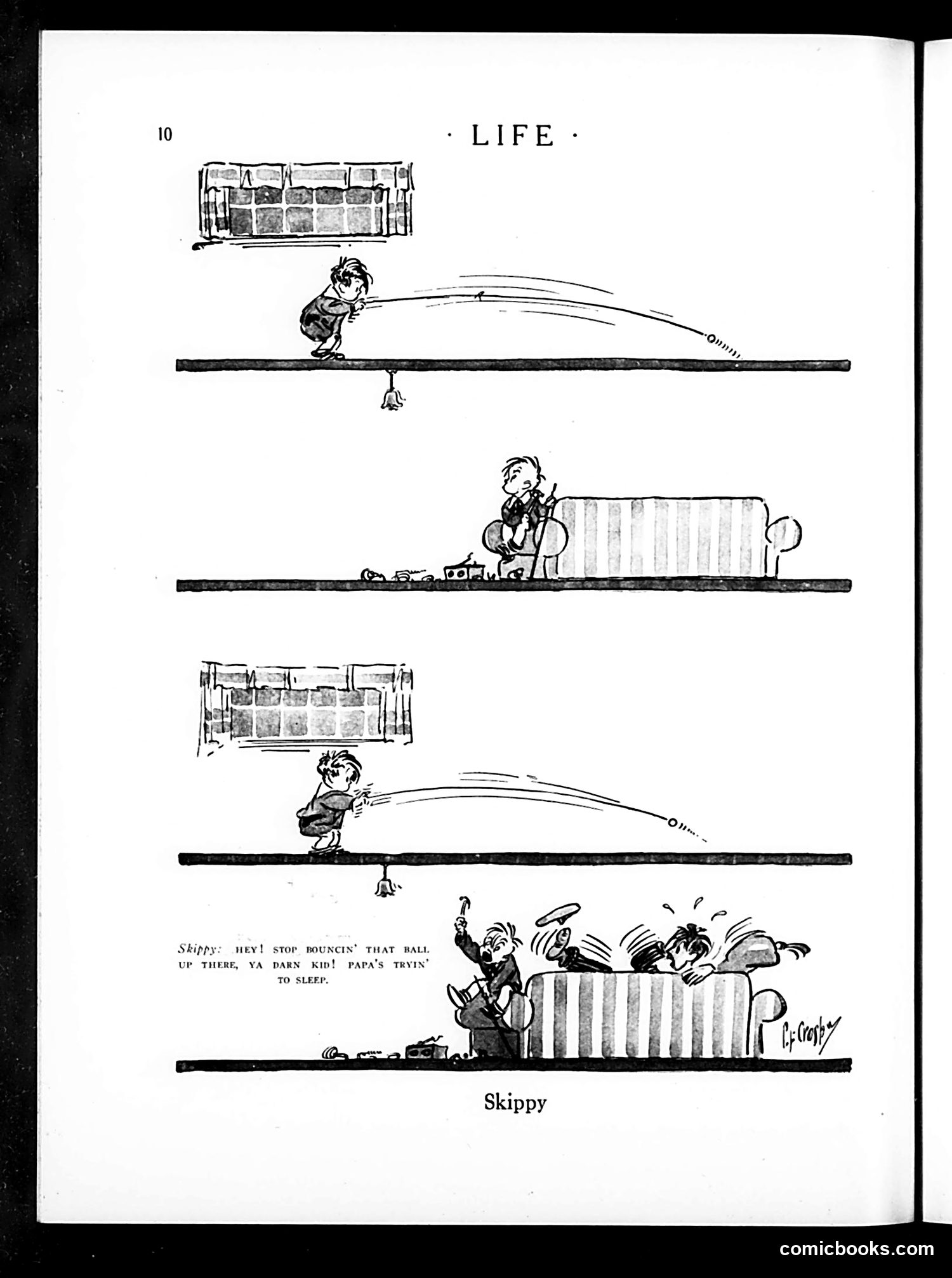
This is a comic strip titled "Skippy" showing a child's mischievous behavior. The sequence depicts: 1. A boy fishing from a seesaw/plank 2. A child sitting on a couch 3. The boy fishing again 4. The boy causing chaos—the caption reads: "SKIPPY: HEY! STOP BOUNCIN' THAT BALL UP THERE, YA DARN KID! PAPA'S TRYIN' TO SLEEP." The joke satirizes parental frustration with noisy, energetic children disrupting household peace. The boy's fishing rod appears to be trolling for balls bouncing from above—a visual metaphor for the persistent annoyance parents face. The humor targets the universal domestic conflict between children's play and adults' need for quiet rest, making light of generational household tensions in a relatable, comedic way.
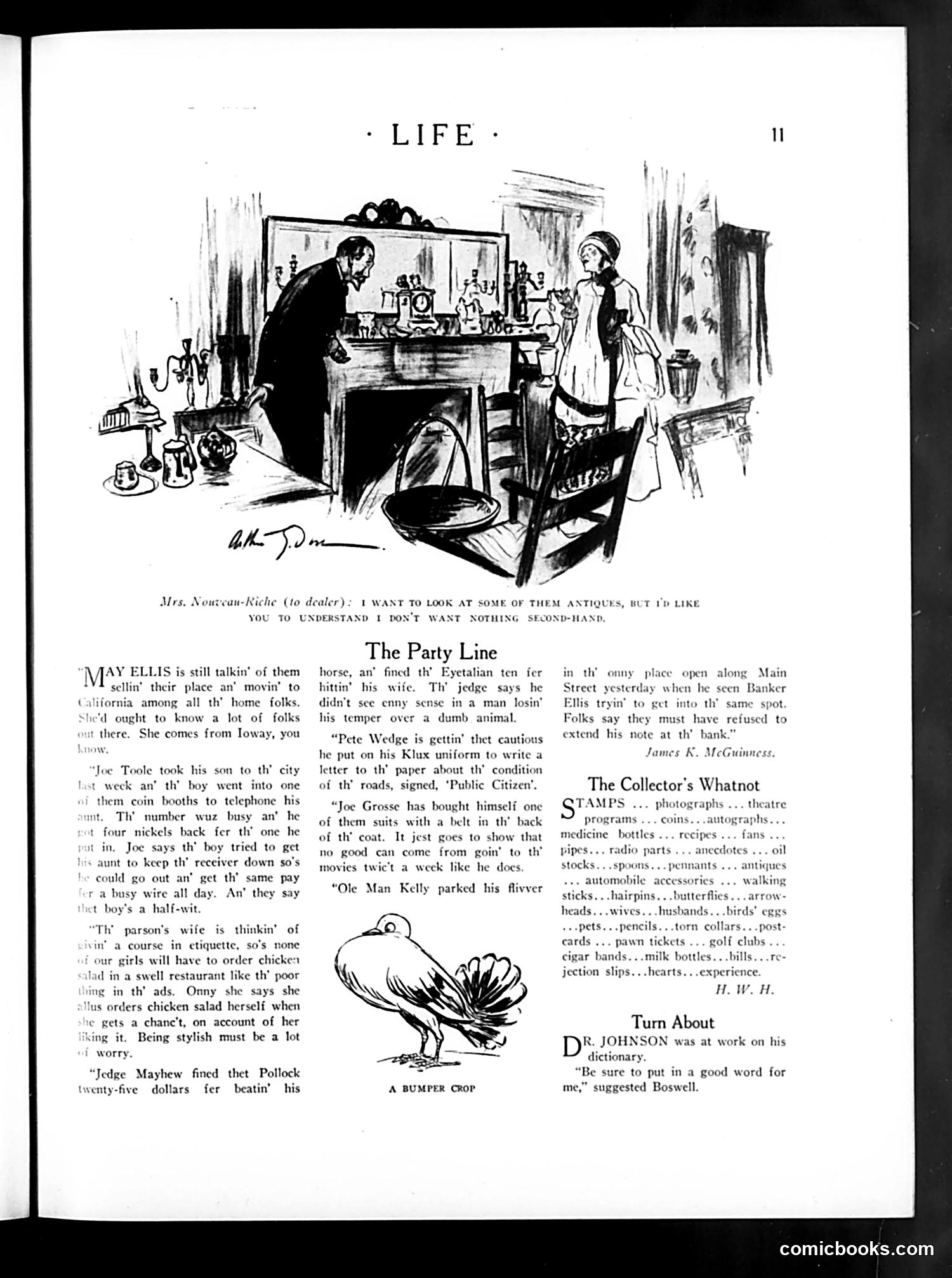
This page contains three distinct humor pieces: **Main cartoon (top):** Shows a wealthy woman (Mrs. Newnan-Riche) telling an antique dealer she wants to examine antiques but doesn't want "nothing second-hand." The joke satirizes the pretension and contradictory logic of nouveau riche (newly wealthy) socialites trying to appear refined while being oblivious. **"The Party Line":** Gossipy anecdotes about small-town life—people's affairs, legal troubles, and social drama. The humor mocks provincial attitudes and small-minded preoccupations (Judge Mayhew fining someone for beating a horse, discussions of chicken salad etiquette). **"The Collector's Whatnot":** A list-style piece humorously cataloging eccentric collecting habits. **"Turn About":** A brief joke about Dr. Johnson's dictionary work. The page reflects Life's typical satirical approach to American social classes and manners.
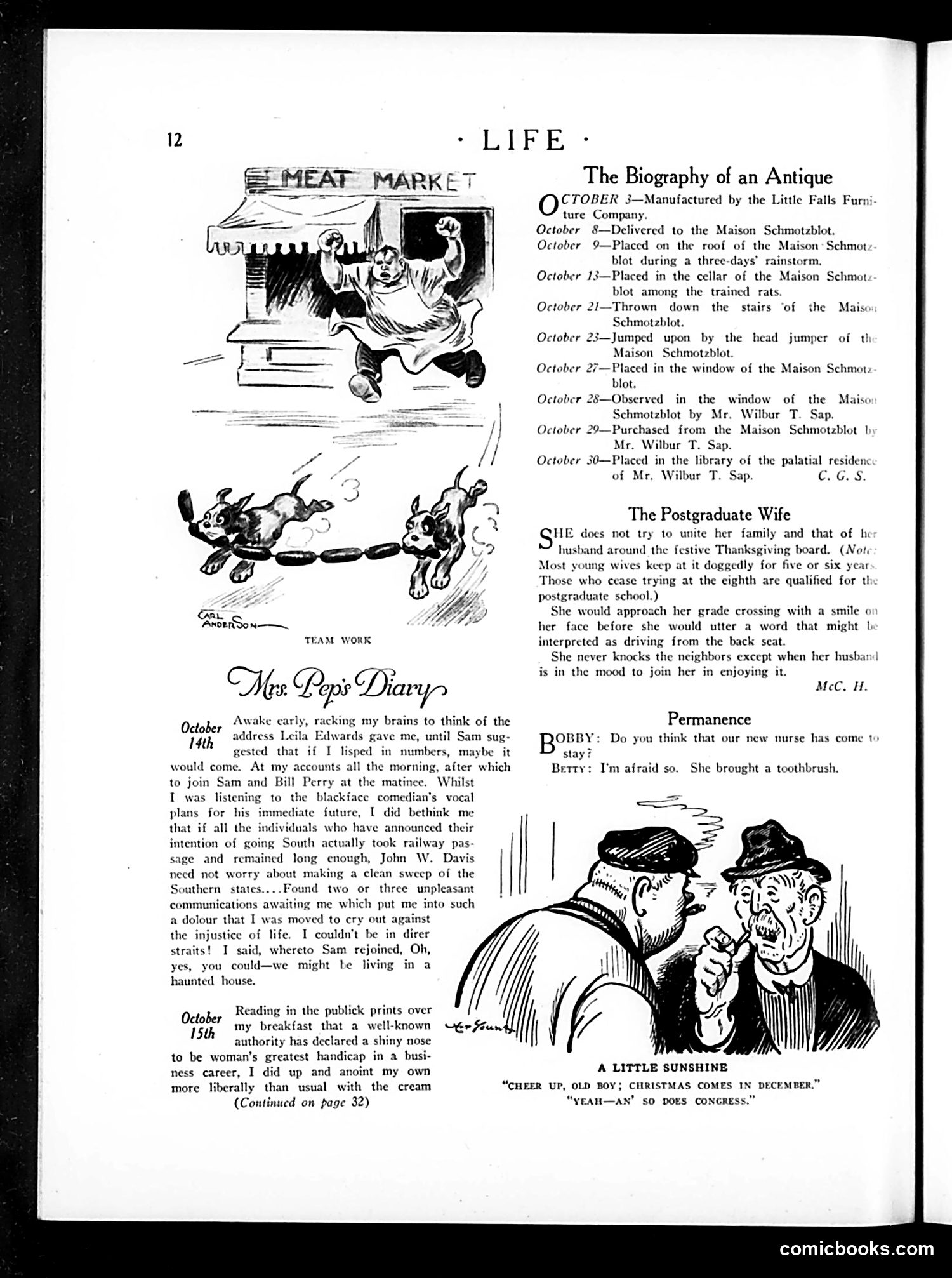
This page contains three distinct pieces of satirical content: 1. **"Meat Market"** and **"Team Work"** cartoons (top/middle): Humorous illustrations showing dogs in domestic chaos—one fleeing a meat market, another pair pulling in opposite directions. These appear to be generic comedic sketches with no specific political reference. 2. **"Mrs. Pops Diary"** (middle left): A dated entry (October 14th) describing domestic complaints about announced intentions to travel south by railroad and general life frustrations. This is personal humor rather than political satire. 3. **"A Little Sunshine"** (bottom right): A cartoon captioned with holiday-season humor ("Christmas comes in December / Yeah—an' so does Congress"), implying Congress is as unwelcome or burdensome as winter. This is generic criticism of government ineffectiveness, not tied to specific events.
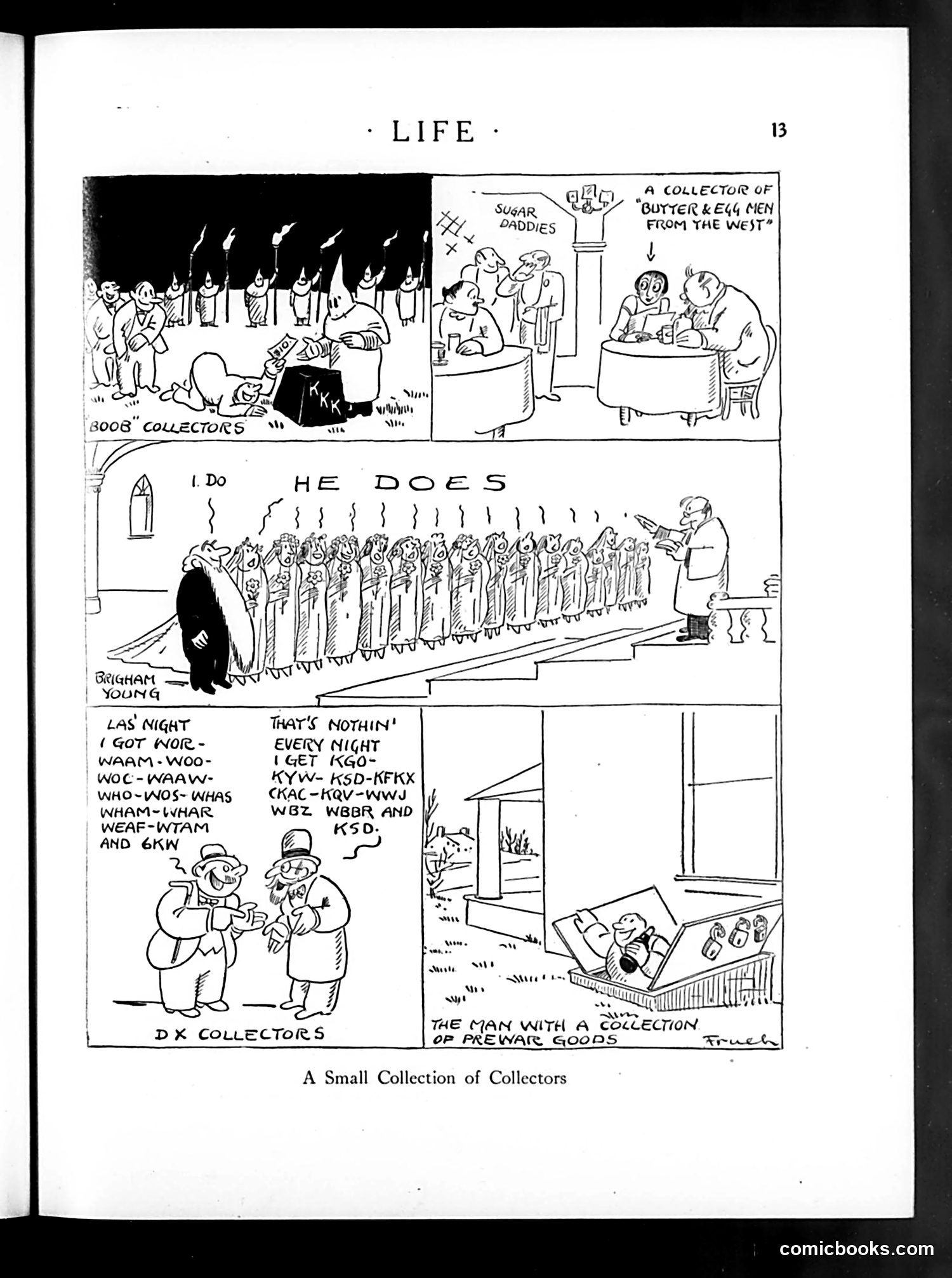
This page satirizes various types of collectors popular in early 20th-century America. The top panel mocks collectors of religious items (KKK memorabilia) and foodstuffs ("butter & egg men from the West"). The middle panel, labeled "I DO HE DOES," appears to reference religious or institutional collecting through a line of figures. The bottom panels show radio collectors (DX Collectors) obsessively tuning into distant stations, listing call letters like "KGO-KYW-KSD-KFKX." The final panel depicts "the man with a collection of prewax goods"—likely mocking Depression-era hoarding or collecting of preserved/canned foods. The cartoon ridicules Americans' tendency toward compulsive collecting across various domains, from the mundane to the eccentric.
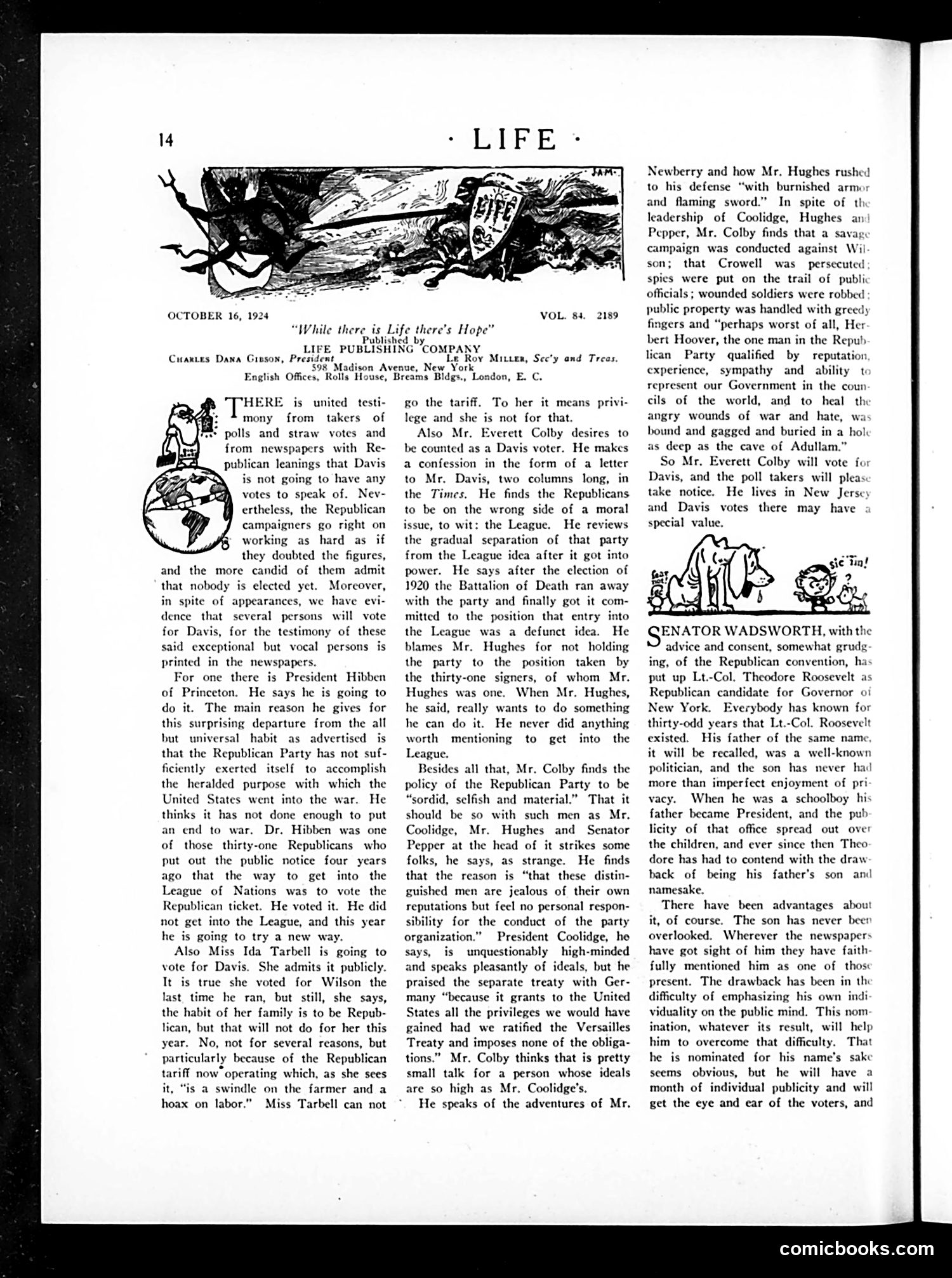
This page discusses Republican political divisions ahead of the 1924 election. The text criticizes Republican Party leadership—specifically mentioning President Coolidge, Mr. Hughes, and Senator Pepper—for allegedly conducting a "savage" campaign against opponents and mishandling public affairs. The article appears to reference internal Republican party conflicts, with particular scrutiny directed at attempts to remove certain politicians from positions. The text suggests criticism of party members who lack "personal responsibility for the conduct of the party organization." A small cartoon (bottom right) appears to depict a political figure, though specific identification is unclear from the image quality. The overall tone suggests Life magazine was satirizing Republican leadership's competence and moral authority during this election cycle.
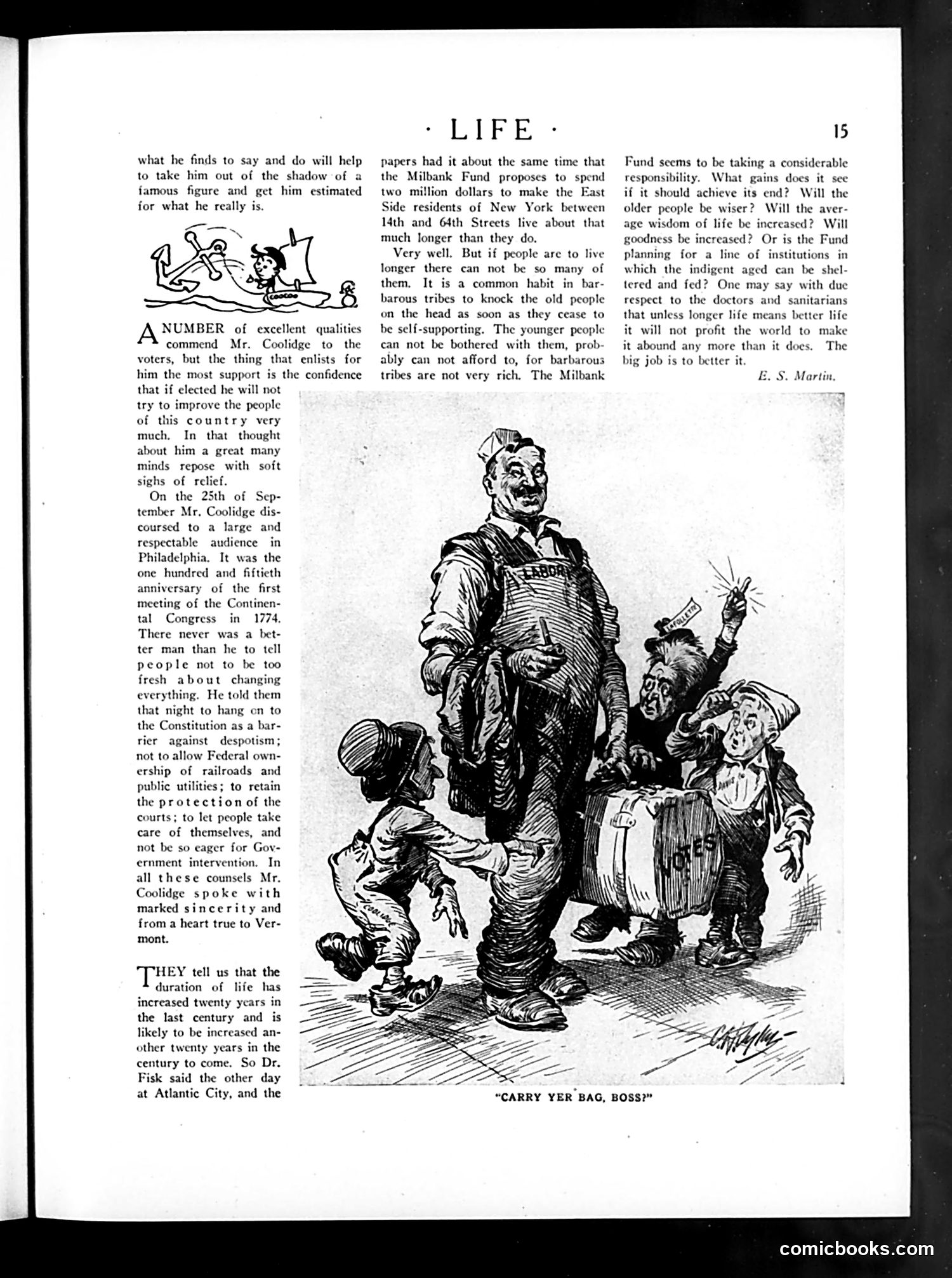
This page discusses Calvin Coolidge's political qualities and includes a cartoon titled "Carry Yer Bag, Boss?" The cartoon depicts a large man (likely representing a political figure or the wealthy) surrounded by smaller figures attempting to carry his bag or serve him. The satire appears to mock servility and political deference—suggesting people are eager to do favors for those in power or with money. The text praises Coolidge's confidence that he won't dramatically change the country if elected, emphasizing his conservative approach. It also discusses the Milbank Fund's proposal to help elderly New Yorkers, raising questions about whether extending life through institutions actually improves quality of life. The overall page combines political commentary on Coolidge with social critique about wealth, power, and aging.
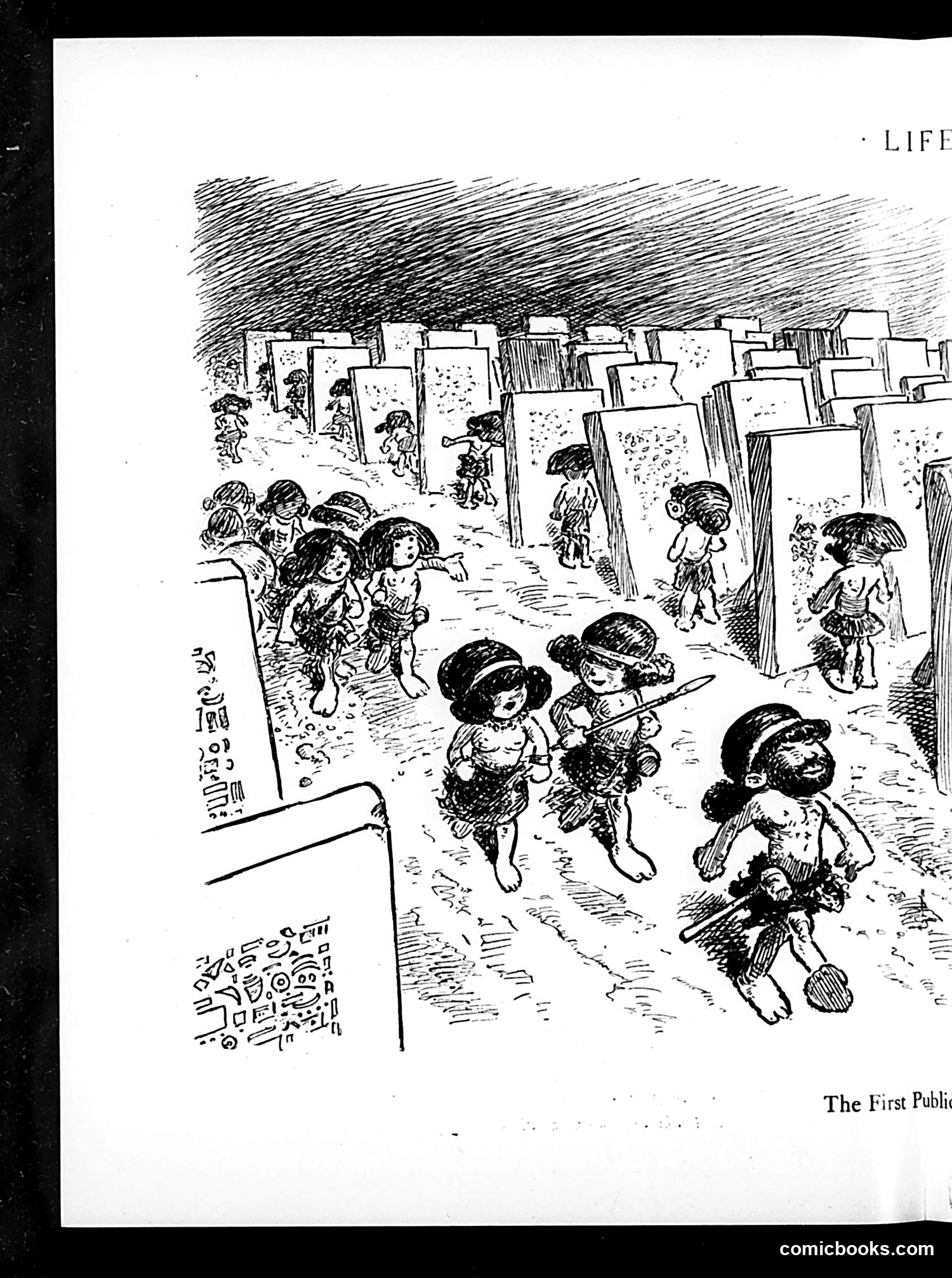
This page shows a satirical illustration of what appears to be a crowded, makeshift settlement or refugee camp. Children and adults are depicted among simple wooden structures or shelters arranged in rows. The figures wear hats and simple clothing, suggesting working-class or impoverished conditions. The caption reads "The First Public[...]" (text cut off), and there are Asian characters visible on the left side of the image, suggesting this may reference early 20th-century immigration or settlement issues, possibly related to Asian communities in America. The satirical tone—through the crowded, cramped living conditions and the way figures are portrayed—likely critiques housing conditions, poverty, or immigration policy of the era. However, without the complete caption or additional context, the specific target of this satire remains unclear.
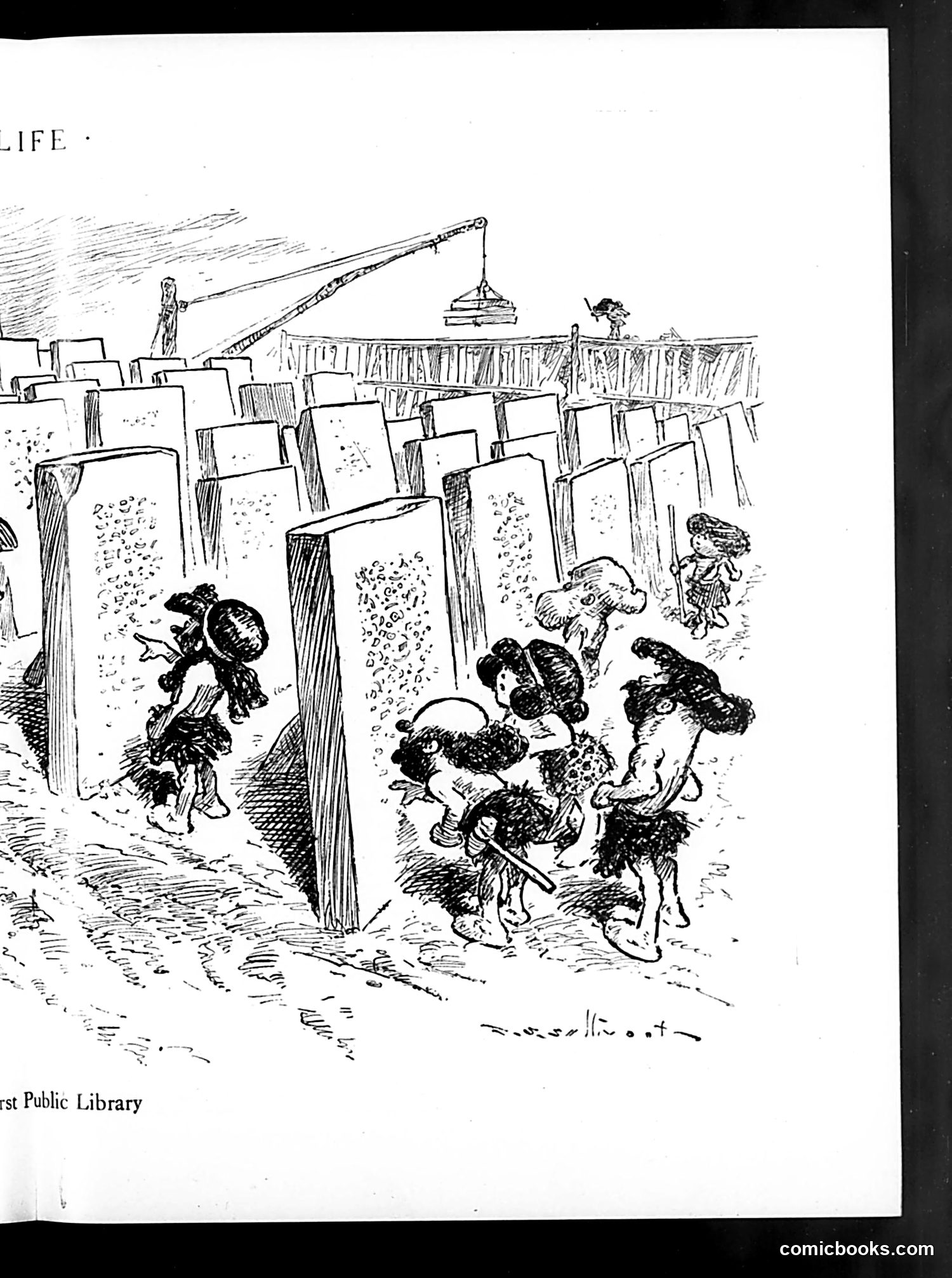
This appears to be a satirical cartoon from *Life* magazine depicting children playing in what looks like a construction or industrial site. The children are shown among tall wooden panels or walls, with construction equipment (a crane and pulley system) visible above them. The satire likely comments on **urban child labor or dangerous working conditions** for children in early 20th-century America. The children appear to be playing amid industrial hazards—or possibly working in such conditions. The juxtaposition of childhood innocence with industrial machinery suggests social critique about how children were exposed to workplace dangers during this era. The OCR text is incomplete and doesn't provide a caption that would clarify the specific reference, making precise identification of the intended message uncertain.
This page reviews three Broadway plays adapted from Hungarian playwright Ernest Vajda's works. The satire targets the commercial success of Continental imports: Vajda's plays repeatedly feature "juvenile seduction" as their theme, prompting the critic to joke that Vajda should buy a Fenjki sedan with his profits. The reviews are mixed. "The Little Angel" and "Old Man Minick" receive praise for honest execution and strong performances (notably Ina Claire and Mildred MacLeod). "Grounds for Divorce" is criticized as formulaic—the tired plot of a first wife returning to prevent her ex-husband's second marriage—saved only by Claire's talent. The underlying satire mocks the period's appetite for risqué European comedies about marriage and seduction, while acknowledging that skillful acting and adaptation can elevate mediocre source material.
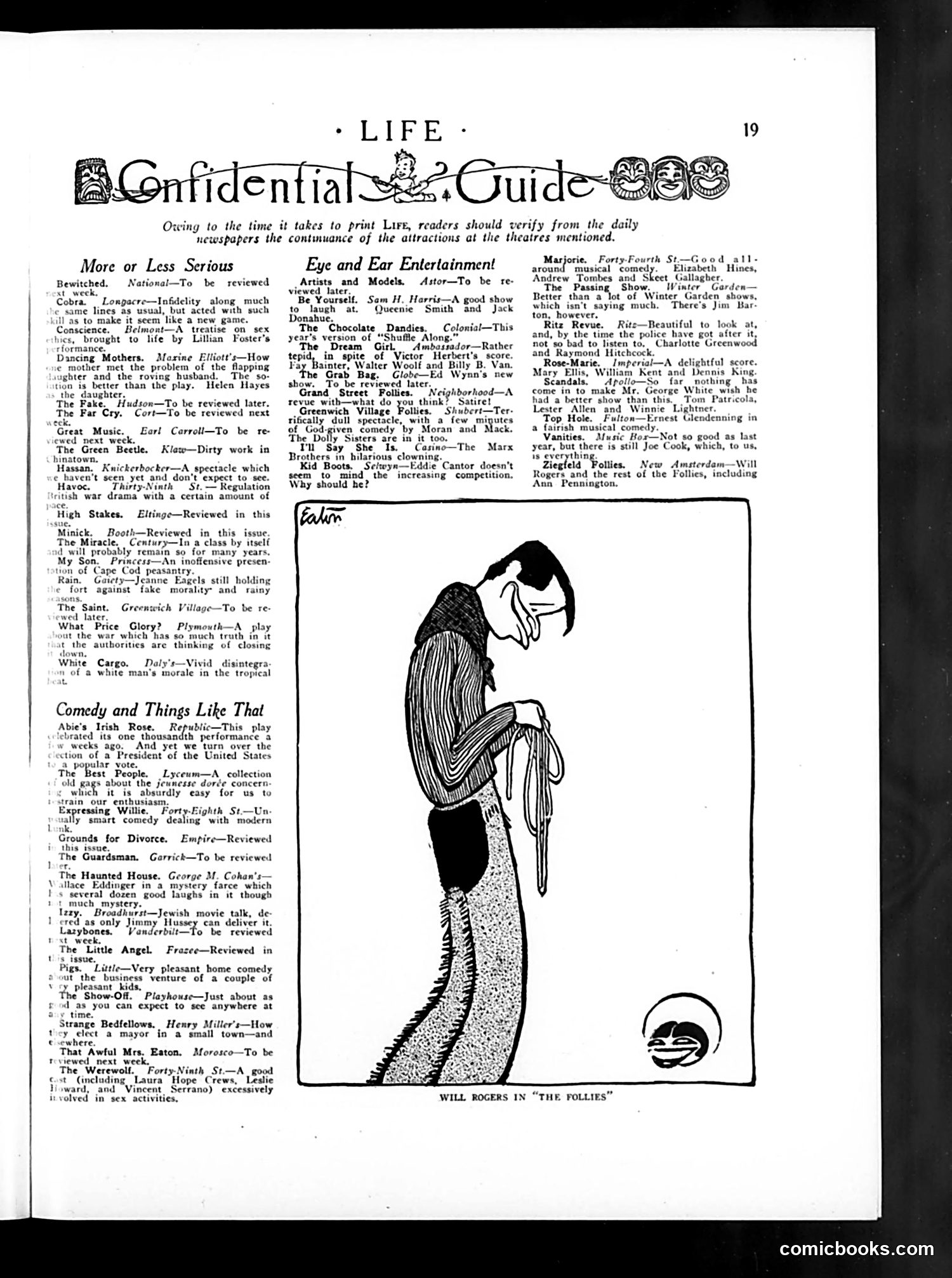
This page from *Life* magazine is a theatre guide reviewing Broadway shows from the 1920s. The image shows an illustration labeled "WILL ROGERS IN 'THE FOLLIES'" — a cartoon of a man in striped pants sitting precariously on what appears to be a rope or thin support, depicted in a humorous, precarious position. The text reviews both "serious" plays (dealing with contemporary social issues like infidelity, divorce, and morality) and comedies. Notable references include *Abie's Irish Rose* (celebrating its 1,000th performance), *The Miracle*, and *Rain*. The page reflects 1920s theatrical concerns: post-WWI dramas, "flapper" culture (*Dancing Mothers*), sexual morality debates, and vaudeville-style entertainment. The Rogers illustration humorously captures the balancing act performers maintained between artistic credibility and commercial entertainment — a central tension in 1920s show business.
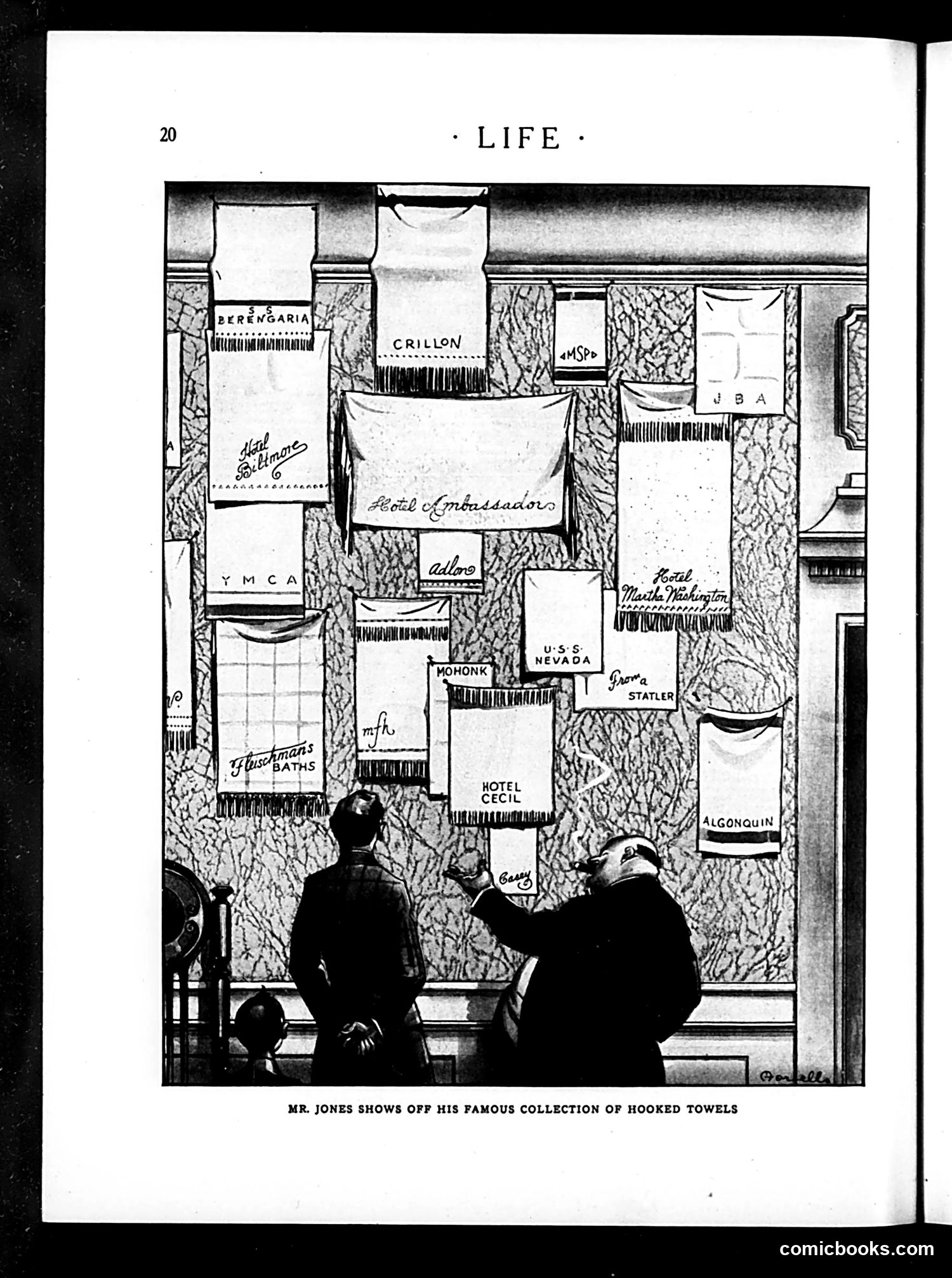
This is a satirical illustration showing two men examining a display of hotel towels with various establishment names hooked or embroidered on them—including "Hotel Ambassador," "Hotel Cecil," "YMCA," "USS Nevada," and various others. The joke is that "Mr. Jones" has assembled a "collection" of towels stolen from hotels and other establishments. The cartoon satirizes petty theft—specifically the common practice of guests pilfering towels and other items from hotels as souvenirs. By presenting this theft as if Jones were a proud collector displaying legitimate acquisitions, Life magazine mocks both the behavior and the mindset that treats it as collecting rather than stealing. The formality of the "display" and the admiring observer emphasize the absurdity of treating stolen property as a respectable hobby.
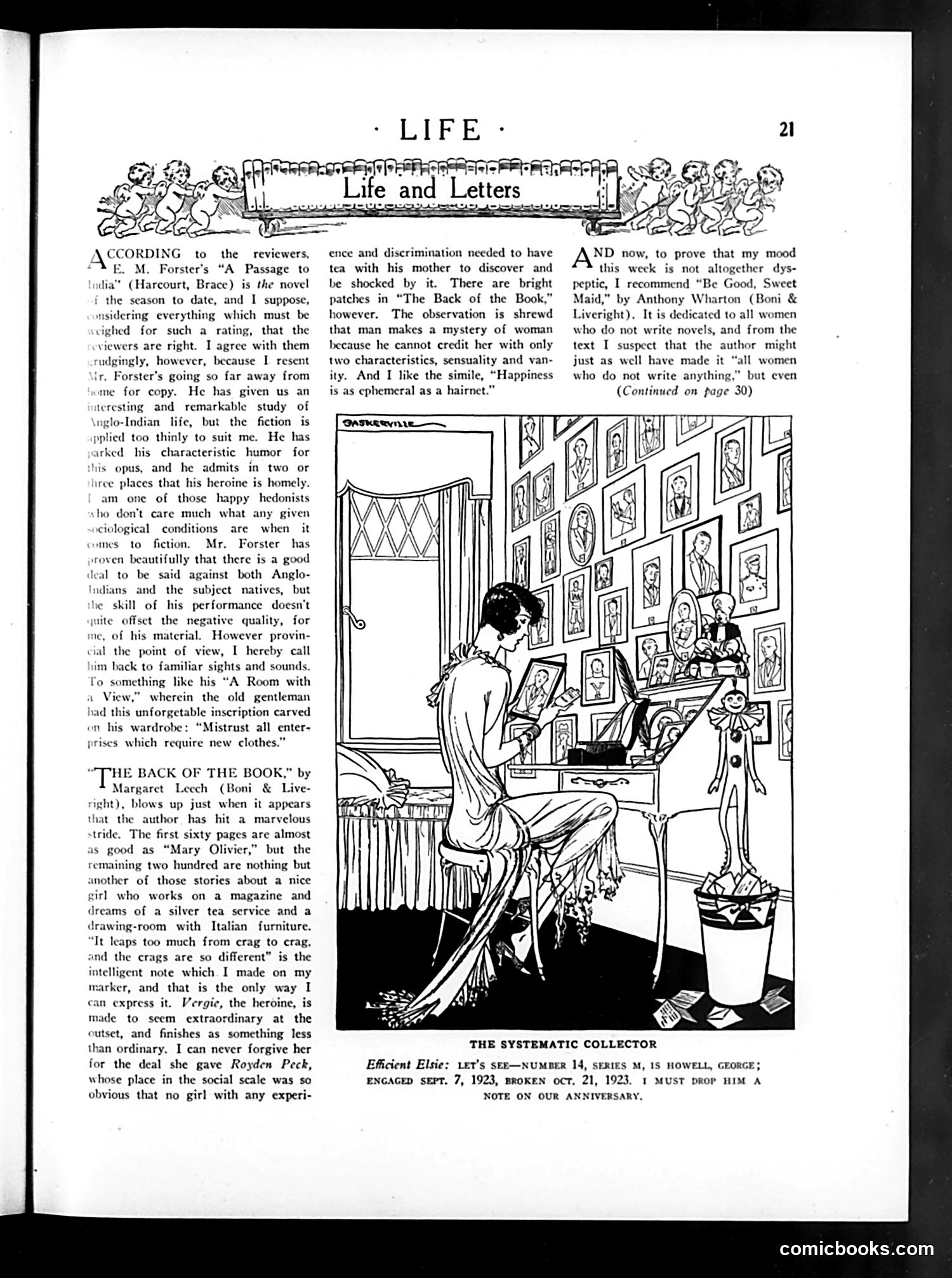
This cartoon mocks the modern woman as an obsessive cataloguer of romantic conquests. The illustration shows a woman at her vanity surrounded by portrait photographs on the wall—each apparently representing a different suitor. She's consulting an indexed filing system to track her engagements and breakups with precision and emotional detachment. The caption's humor lies in the contradiction: "Efficient Elsie" maintains meticulous records of her romantic relationships (noting engagement and breakup dates) yet treats them with bureaucratic indifference—she must "drop him a note on our anniversary" as if managing business correspondence rather than human relationships. The satire targets both modern female independence (women now had dating options and agency) and the perceived shallowness of the Jazz Age romantic culture. The "systematic" approach to love—cataloguing men like collectible items—suggests women have become calculating rather than genuinely emotional, a common satirical complaint in 1920s publications about changing gender roles.
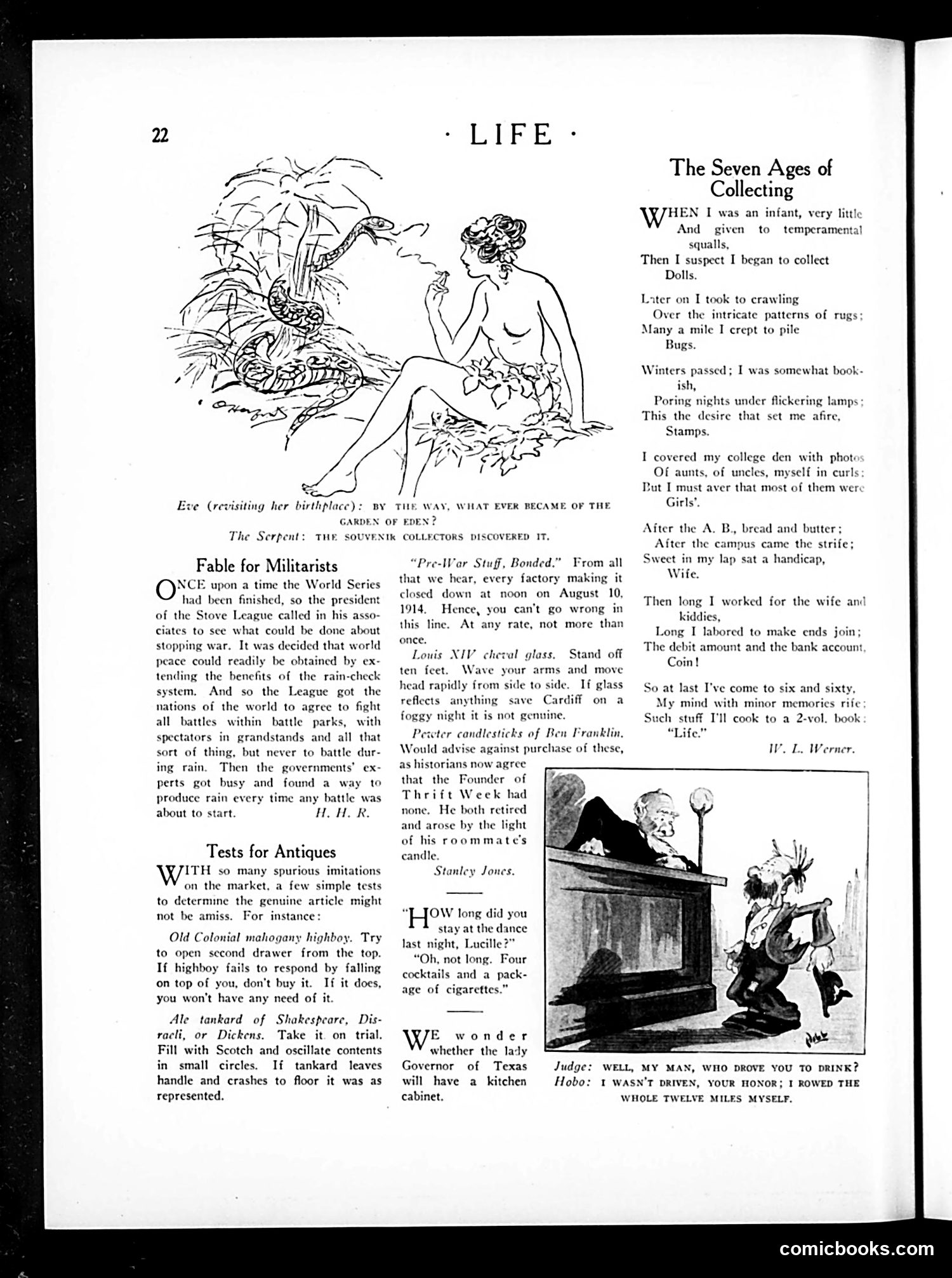
This page contains several satirical pieces typical of early 20th-century American humor: **"Fable for Militarists"** mocks pacifist proposals through absurdist logic—imagining nations agree to fight wars only during fair weather, then governments develop rain-making technology to prevent all battles. The satire targets both naive peace movements and government incompetence. **"Tests for Antiques"** humorously critiques the "antique" market, particularly the post-WWI craze for "pre-war" goods. It suggests consumers cannot reliably authenticate old items and pokes fun at how factories cynically manufactured fake antiques after August 10, 1914 (presumably claiming pre-war origins). **"The Seven Ages of Collecting"** is a Shakespearean parody tracing life stages through collecting habits—from dolls to stamps to family photos—ending with compiling one's entire life into a book. It gently satirizes human acquisitiveness. The **Eve cartoon** questions what happened to Eden, with the Serpent as respondent—likely commenting on loss of innocence post-WWI.
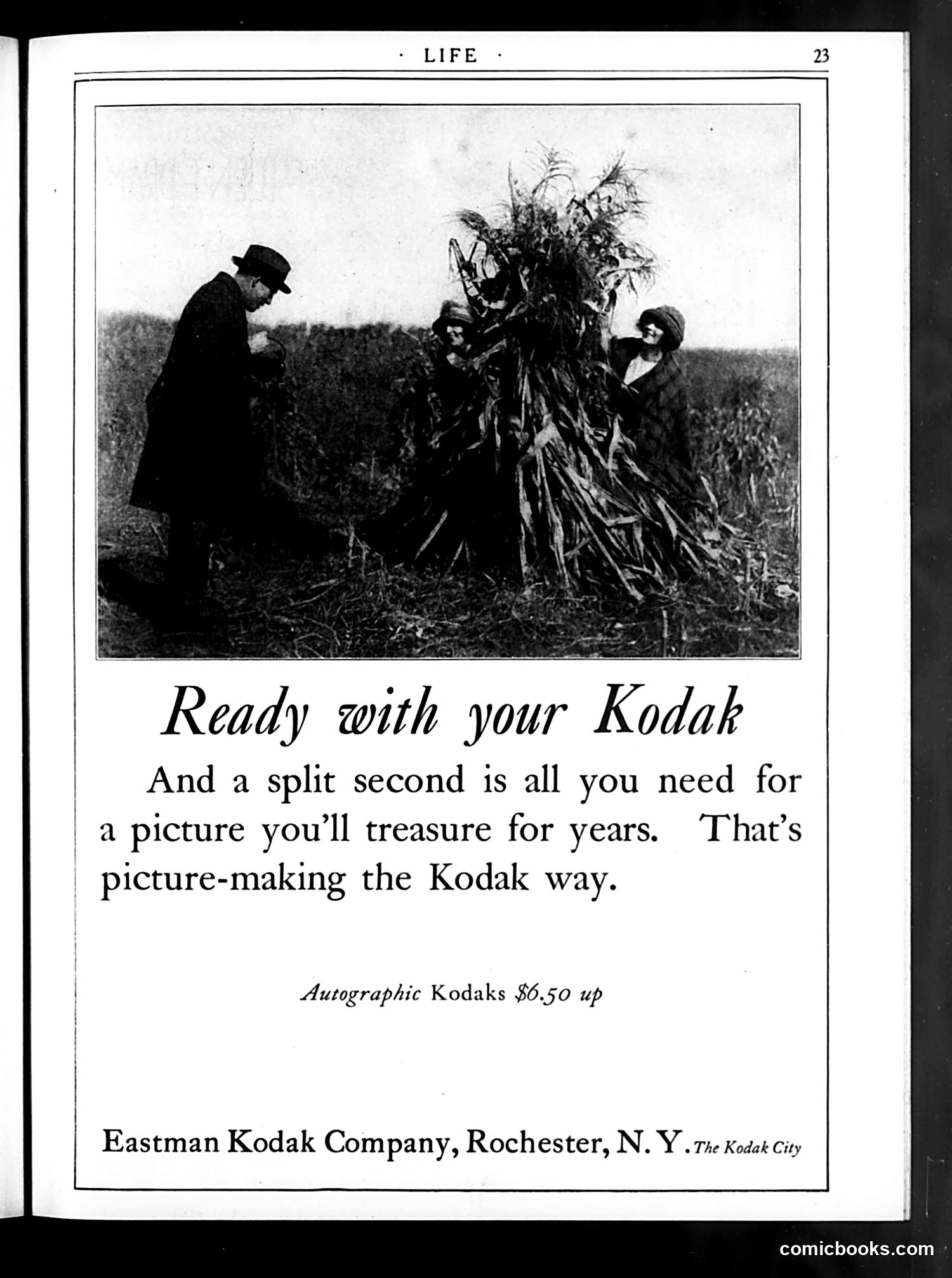
This page is primarily a **Kodak advertisement**, not political satire. It shows three men in a rural cornfield examining bundled corn stalks, positioned as if photographing or inspecting the harvest. The ad's messaging emphasizes Kodak's ease of use: you need only "a split second" to capture a treasured photograph. The cornfield scene appears chosen to appeal to rural or agricultural audiences—suggesting that even during active farm work, one can quickly document important moments. The "Autographic Kodaks $6.50 up" pricing indicates this targets middle-class consumers. This is straightforward product marketing from Life magazine's advertising section, not editorial commentary or satirical content. The image serves purely to demonstrate the camera's practical convenience for everyday life documentation.
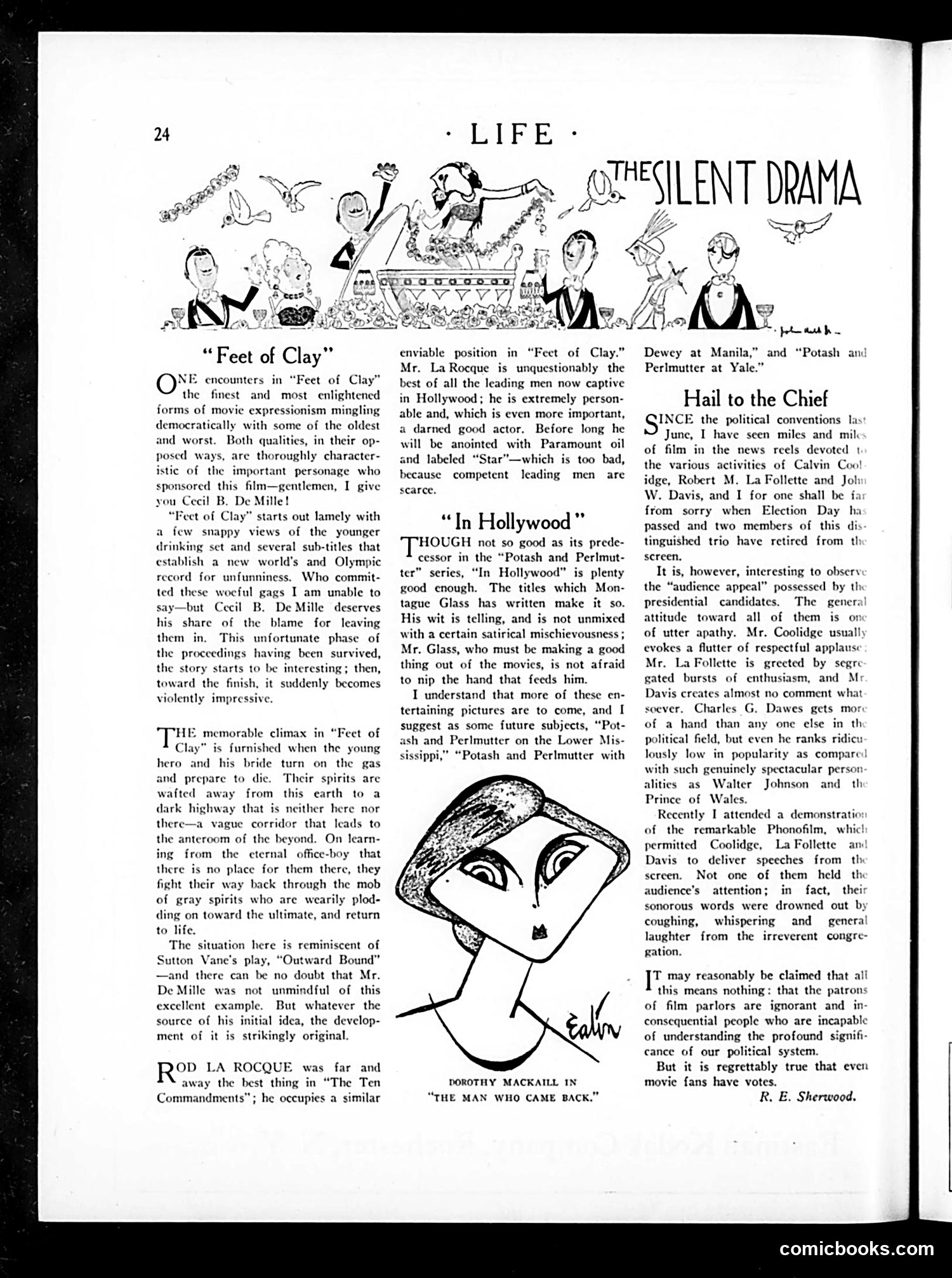
This *Life* magazine page reviews three films and critiques newsreel coverage of the 1924 U.S. presidential election. **Film Reviews:** - **"Feet of Clay"** (directed by Cecil B. De Mille): The reviewer praises its innovative afterlife sequence but criticizes De Mille for including poorly-written comedic scenes. Rod La Rocque is praised as Hollywood's finest leading man. - **"In Hollywood"**: A "Potash and Perlmutter" comedy praised for its witty titles by Montague Glass, who satirizes the industry feeding him. **"Hail to the Chief" Section:** This critiques newsreel coverage of the 1924 election candidates—Calvin Coolidge, Robert La Follette, and John W. Davis—noting audiences respond with indifference to all three. Charles G. Dawes (Coolidge's running mate) generates slightly more applause but remains unpopular compared to entertainment figures. The satire mocks how presidential candidates lack the "audience appeal" of movie stars.
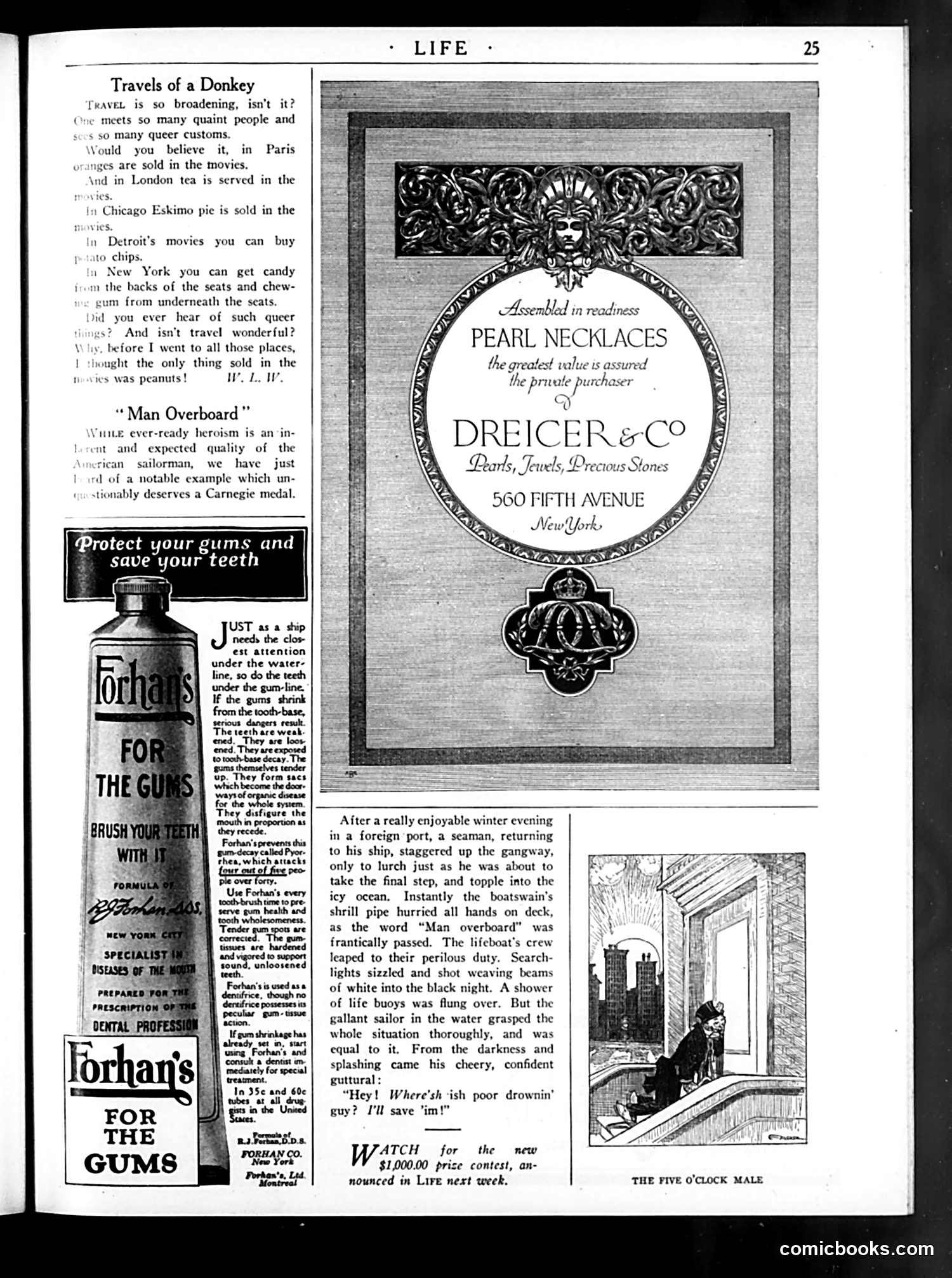
This page contains two brief humorous pieces typical of *Life* magazine's satirical style. **"Travels of a Donkey"** mocks provincial American attitudes about cinema. The joke is that different cities sell different items in movie theaters—oranges in Paris, tea in London, Eskimo pie in Chicago, potato chips in Detroit, candy in New York. The humor lies in presenting these mundane concessions as exotic "queer customs" worthy of amazement, satirizing how Americans treat ordinary regional variations as if they were remarkable discoveries from world travel. The final punchline—that the writer previously thought only peanuts were sold in theaters—exaggerates this provincial ignorance. **"Man Overboard"** depicts a stereotypical drunk sailor who falls overboard but, in a comedic twist on heroic rescue narratives, confidently declares he'll rescue himself ("J'll save 'im!") despite being the one drowning. The satire plays on literary tropes of "ever-ready heroism" while subverting expectations through the sailor's inebriated perspective and malapropism ("Where'sh 'ish poor drownin' guy?"). Both pieces use exaggeration and understatement to mock conventional expectations.
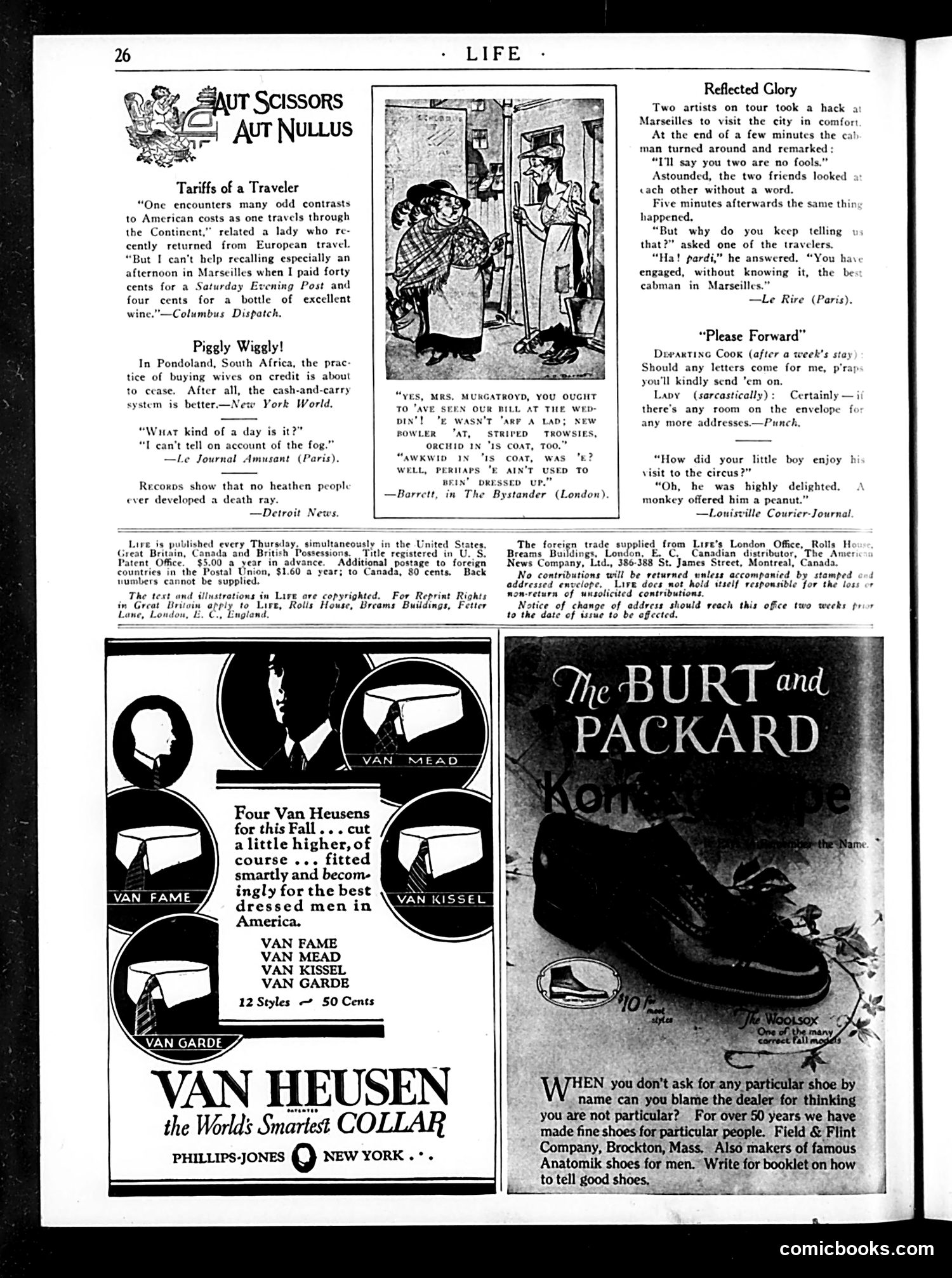
This page contains brief satirical jokes targeting American attitudes and pricing, typical of Life's early 20th-century humor style. **Key Content:** The cartoons mock American provincialism and economic awareness. "Tariffs of a Traveler" jokes about price shock—an American tourist paid 40¢ for a *Saturday Evening Post* but only 4¢ for wine in Marseilles, highlighting inflated U.S. magazine costs. "Piggly Wiggly!" compares American commerce favorably to African bride-purchasing customs using cash-and-carry logic. The central cartoon depicts working-class British characters in Cockney dialect, where a cabman boasts he's "the best cabman in Marseilles" after observing his wealthy fares—a joke about inferring class status from appearance and behavior. "Reflected Glory" extends this theme: a taxi driver in Marseilles repeatedly tells two artists "you two are no fools," eventually revealing he assumes they must be important since they hired him—satirizing how locals judge tourists by spending patterns. **Overall**: The humor relies on transatlantic stereotypes, class consciousness, and currency/pricing disparities typical of 1920s travel commentary. The page is primarily advertisements otherwise.
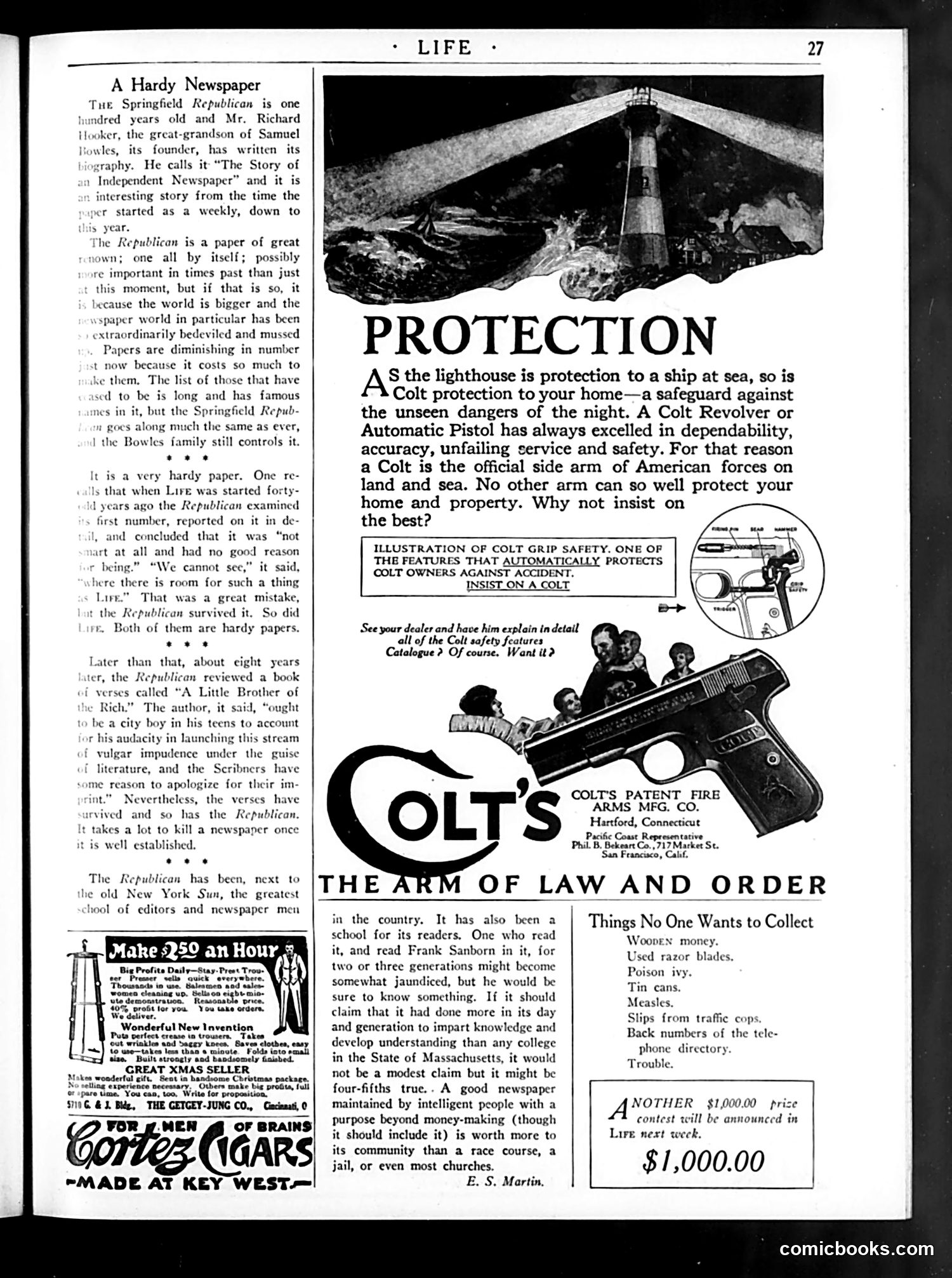
This page is primarily **advertising**, with minimal editorial cartoon content. The dominant feature is a **Colt Revolver advertisement** titled "Protection," which uses patriotic rhetoric to market firearms for home defense. The ad claims Colt is "the official side arm of American forces" and compares gun ownership to a lighthouse protecting ships—a domestic security metaphor. The left column discusses the **Springfield Republican newspaper's 100th anniversary**, praising its longevity and editorial quality. The text notes the paper survived early criticism from *Life* magazine itself, establishing a narrative about hardy American institutions. The advertisement reflects early 20th-century marketing that conflated gun ownership with patriotism and civic responsibility. The comparison to maritime safety suggests protection against undefined "unseen dangers"—a vague threat justification common in period advertising. The page also contains minor ads for a pants presser and cigars, typical of the era's eclectic magazine advertising model.
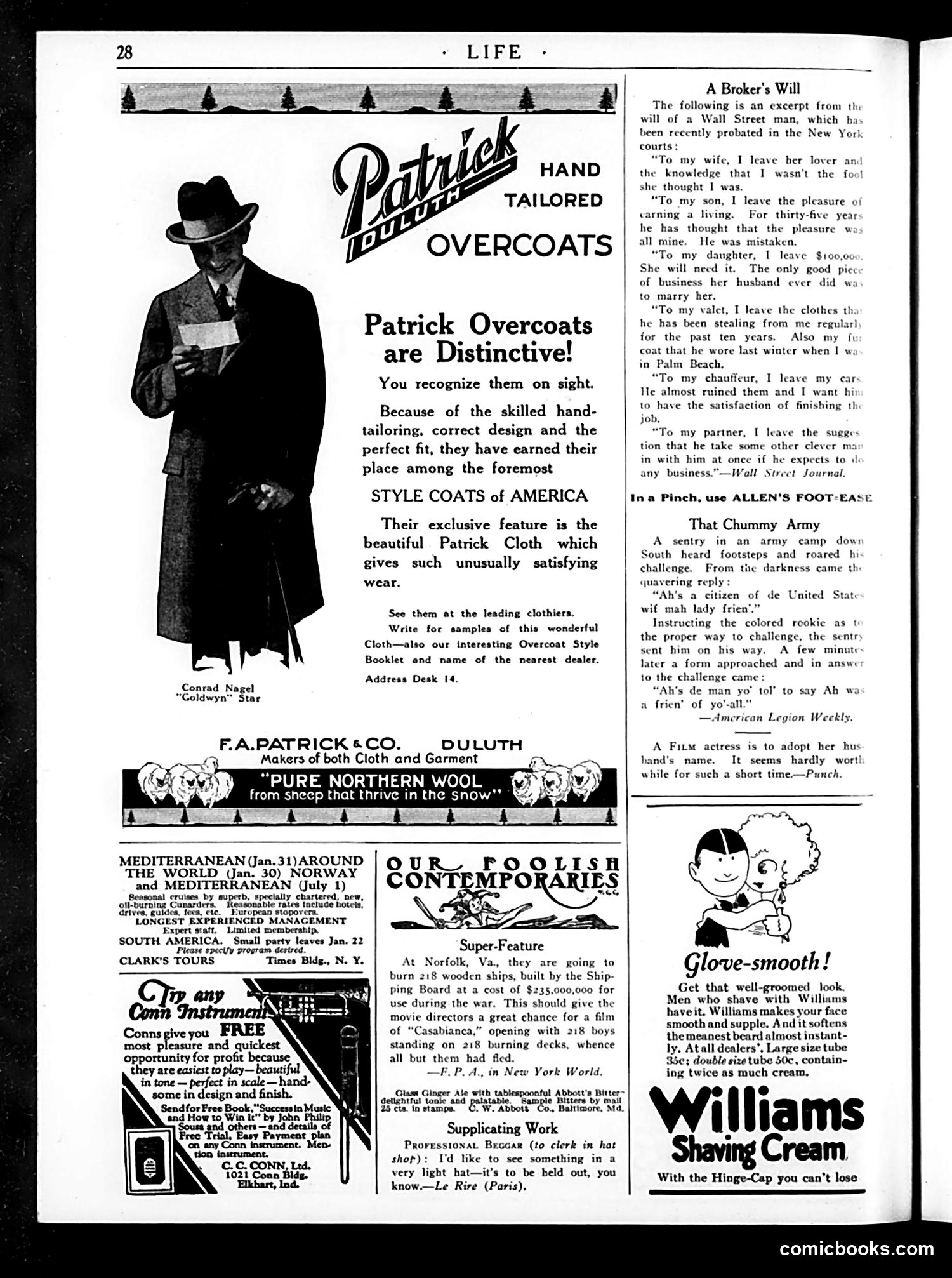
This page is primarily **advertising and humor content**, not political satire. The main elements: **"A Broker's Will"** is a satirical humor piece mocking a wealthy Wall Street broker's contempt for his family members through his will bequests. The joke lies in cruel, cynical observations: he leaves his wife "knowledge" she was fooled; his son the burden of earning; his daughter money because her husband's only good deed was marrying her; his servants the items they've been stealing. The humor targets both the broker's bitterness and his family's moral/financial failings—typical of 1920s satirical magazines. **"That Chummy Army"** is a brief anecdote joke about a Black soldier who responds to a sentry's challenge with dialect ("Ah's a citizen...wif mah lady frien'"). The humor relies on racial stereotyping common to the era. The page also contains advertisements for Patrick Overcoats, cruise lines, and Williams Shaving Cream, with period-appropriate illustrated ads. The content reflects 1920s attitudes toward class, family, and race without irony about those attitudes.
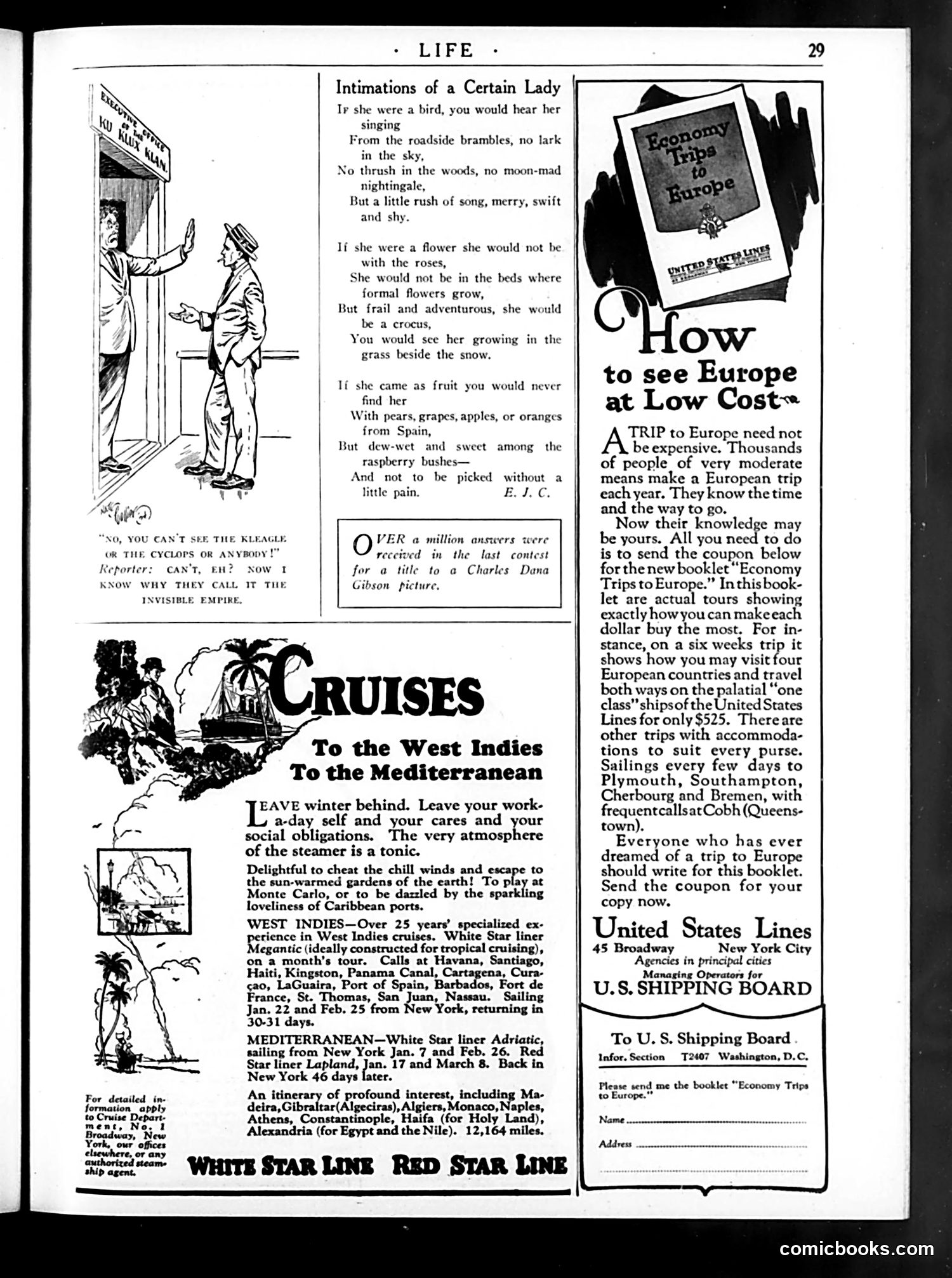
This page contains two distinct cartoons and advertisements. **Top cartoon**: A man at a doorway refuses entry to a reporter, saying "YOU CAN'T SEE THE KLEAGLE OR THE CYCLOPS OR ANYBODY!" This references the **Ku Klux Klan**—"Kleagle" and "Cyclops" were actual KKK leadership titles. The joke satirizes the Klan's secretive nature and refusal to grant public access or transparency, likely during a period when the Klan faced increased public scrutiny. **Middle poem**: "Intimations of a Certain Lady" romantically describes an unnamed woman through natural metaphors (bird, flower, fruit), suggesting she's unconventional and elusive. **Bottom half**: Cruise and travel advertisements from White Star Line and United States Lines, promoting Caribbean, Mediterranean, and European voyages at various price points—typical commercial content for the era. The page is primarily **advertising with satirical content**, targeting both leisure travelers and readers interested in contemporary social commentary.
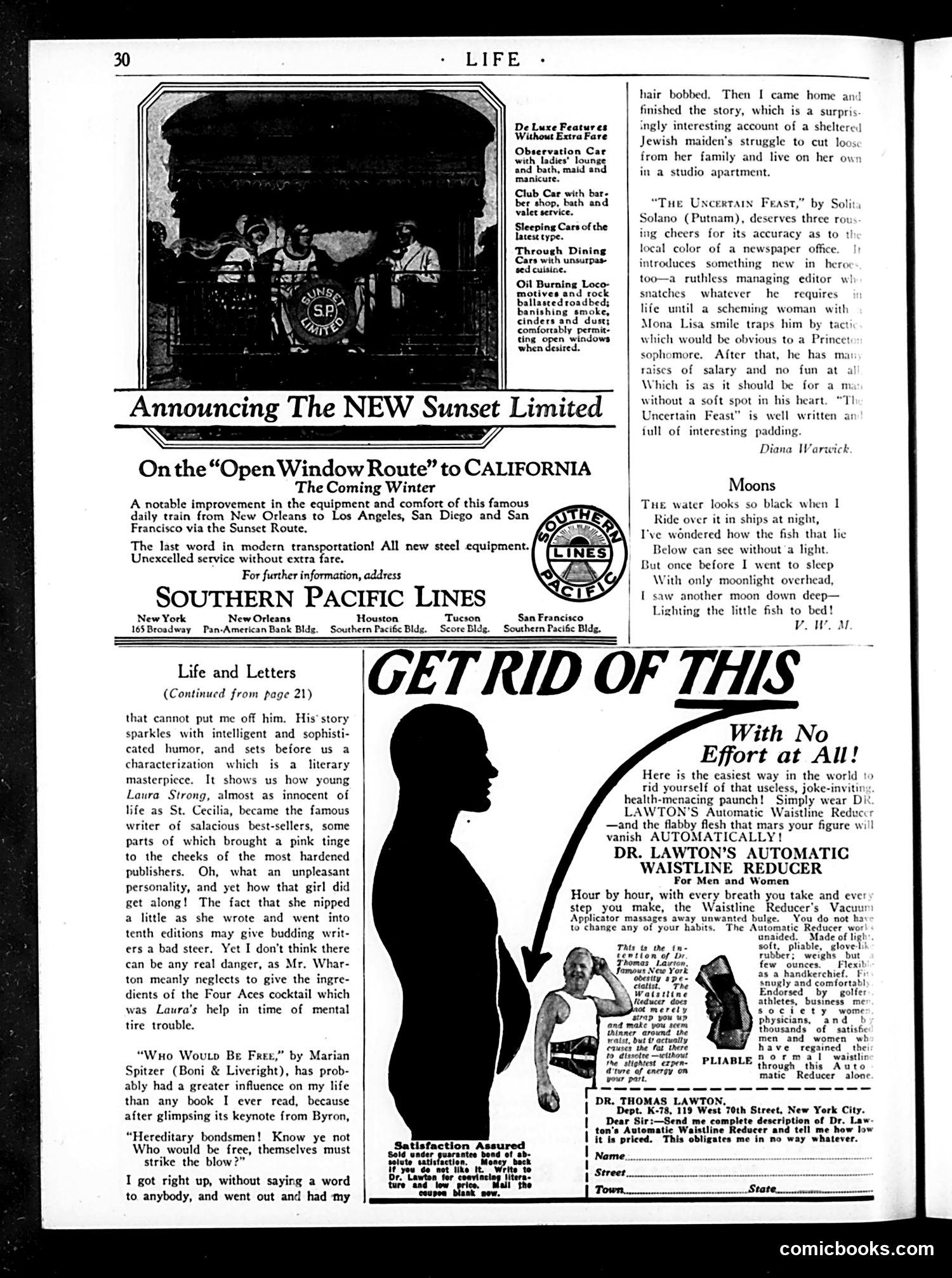
This Life magazine page (circa 1920s) mixes literary reviews with period advertisements. The main content includes book reviews praising novels about modern women—particularly one about a Jewish woman breaking free from family constraints to live independently in a studio apartment, reflecting 1920s anxieties about female independence. The large advertisement for Dr. Lawton's "Automatic Waistline Reducer" reveals the era's body-image obsessions: a corset-like device claiming to massage away belly fat "automatically" without effort. The silhouette illustration shows the device's intended effect. Also featured: a Southern Pacific Lines railroad advertisement promoting their "Open Window Route" to California with luxurious amenities. A poem about moonlight on water appears as filler content. The page reflects 1920s concerns: women's changing social roles, consumer culture promising effortless beauty, and leisure travel for the affluent.
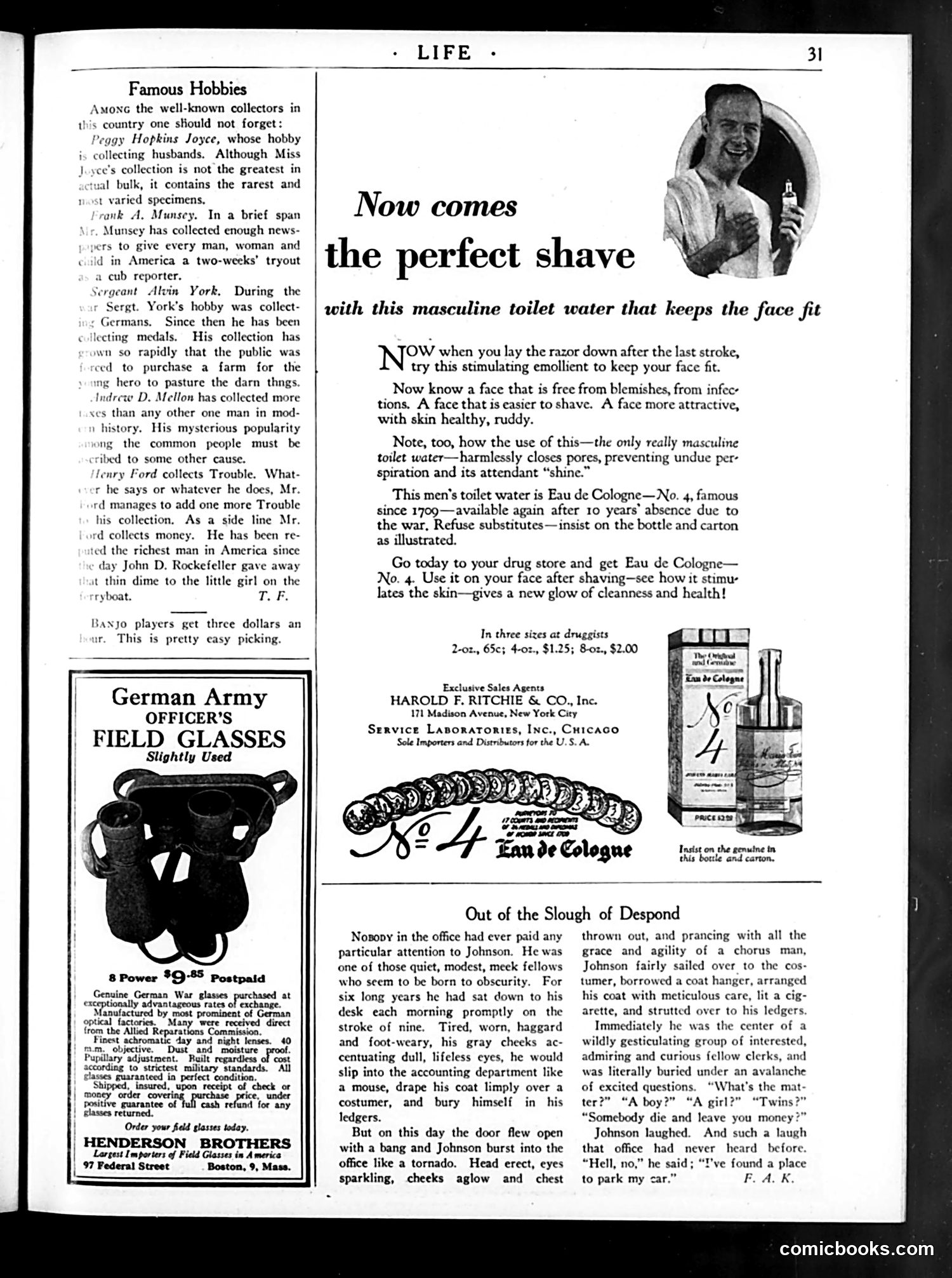
This page combines satirical commentary with period advertisements, likely from the 1920s post-WWI era. **"Famous Hobbies" section:** A humorous column mocking wealthy American celebrities and industrialists. Peggy Hopkins Joyce (known for multiple marriages), Frank Munsey, Sergeant Alvin York (WWI hero), Andrew Mellon, and Henry Ford are skewered for their collecting obsessions—husbands, newspapers, medals, paintings, and "trouble" respectively. The satire targets conspicuous consumption and eccentric wealth during the Jazz Age. **Field Glasses Advertisement:** Sells surplus German Army officer equipment, likely war reparations from WWI. This reflects America's post-war commerce in German military goods—both practical and somewhat tone-deaf given recent conflict. **"Out of the Slough of Despond":** A serialized short story (unrelated to satire) about an overlooked office worker. The page exemplifies Life magazine's mix of sharp social satire targeting the wealthy elite alongside advertisements that sometimes undercut the satire's values.
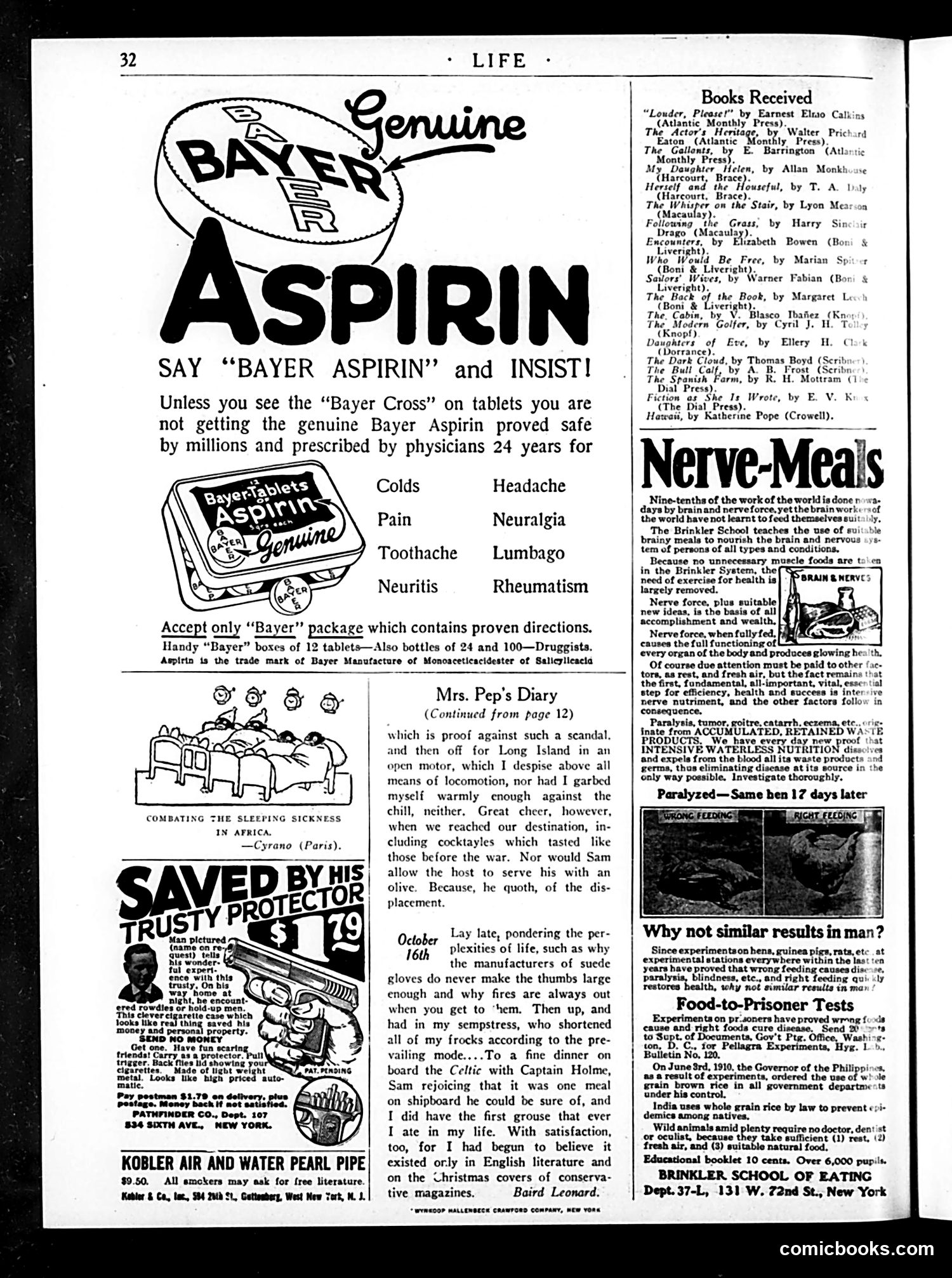
This page is primarily **advertising**, not satirical content. The dominant feature is a large Bayer Aspirin advertisement emphasizing brand authenticity—consumers must see the "Bayer Cross" on tablets to ensure they're getting genuine aspirin, which the ad claims has been "proved safe by millions and prescribed by physicians 24 years." The small cartoon titled "COMBATING THE SLEEPING SICKNESS IN AFRICA" (credited to Cyrano of Paris) appears to satirize European colonial medicine or relief efforts in Africa, though the image is too small to discern specific details. Other content includes a cigarette-case advertisement presented as humorous self-defense, Mrs. Pep's Diary (a social column about leisure activities), a "Nerve-Meals" advertisement, book reviews, and a pipe advertisement. The page reflects 1920s consumer culture: aggressive brand protection, patent medicines, and emerging nutritional pseudoscience marketed as modern scientific solutions.

This is **not a cartoon or satire**, but a **full-page advertisement** for Weyerhaeuser Forest Products, a lumber company. The top image shows an industrial mill facility with a smokestack—a real photograph, not a cartoon. The headline "Before you build a Factory or Warehouse—see Weyerhaeuser" frames the entire piece as marketing. The text targets business managers with a practical pitch: Weyerhaeuser's "Mill Construction" design can reduce industrial overhead by 15% on building costs, 15% on interest, and 75% on insurance. The company emphasizes that their sprinkler-protected mill-type buildings have proven fire safety records. The "message" isn't satirical—it's straightforward industrial advertising from the 1920s, promoting both Weyerhaeuser's consulting expertise and their Douglas Fir lumber products as ideal for factory construction. This represents how Life magazine (like modern publications) mixed editorial content with advertising.
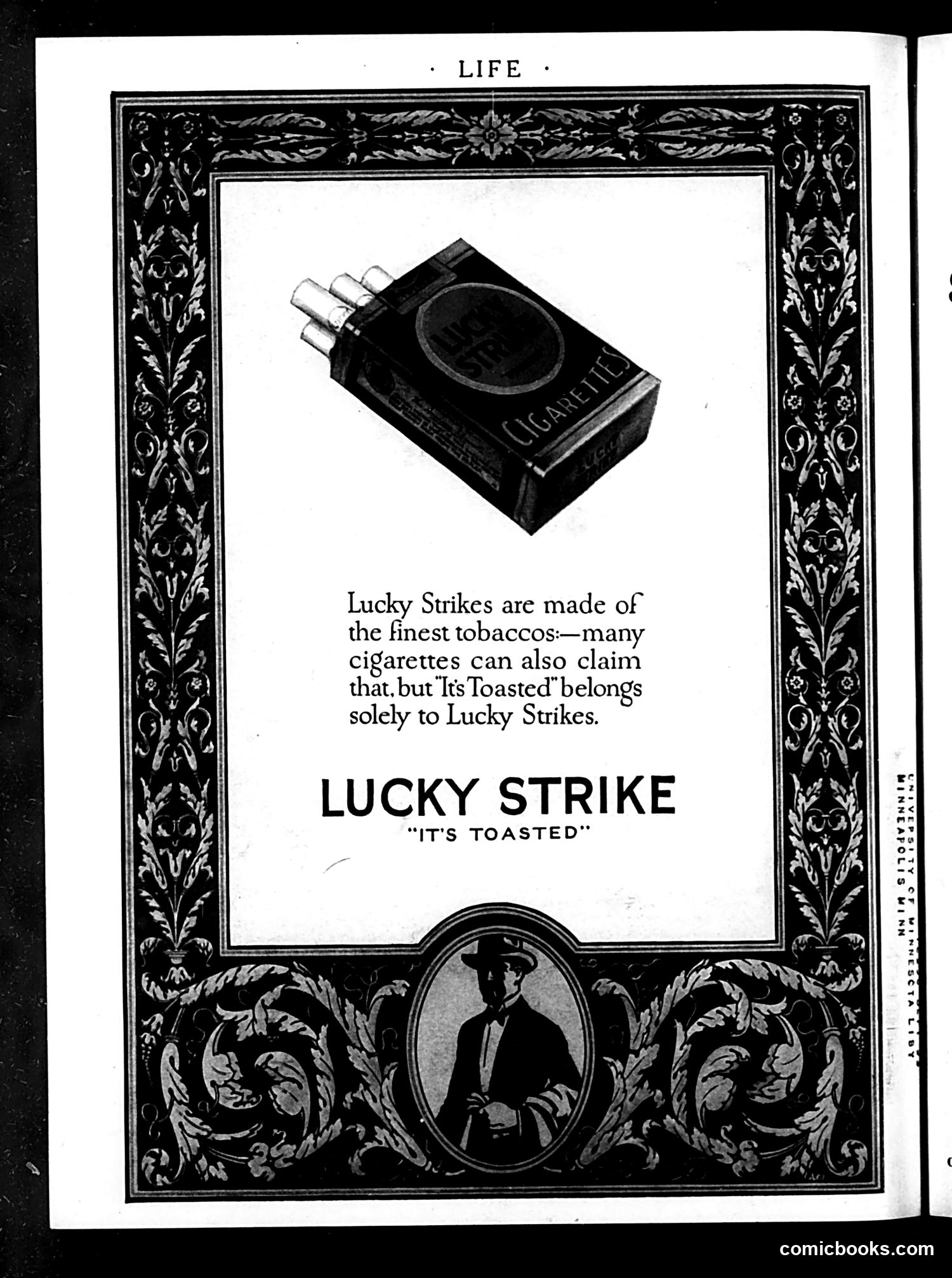
This is a **cigarette advertisement**, not political satire. It's a Lucky Strike ad from *Life* magazine promoting their cigarettes with the slogan "It's Toasted." The ad makes a competitive claim: while other cigarettes use fine tobacco, Lucky Strikes uniquely possess the "toasting" process—a marketing distinction the brand owned. The ornate decorative border and formal layout reflect early 20th-century advertising design. The central image shows a pack of Lucky Strikes cigarettes. Below is a portrait medallion of a man (likely a generic businessman or authority figure, not a specific historical person), flanked by decorative flourishes—a common design element to convey prestige and legitimacy. **For modern readers**: This represents an era when cigarette advertising was openly published in major magazines without health warnings, and when tobacco companies competed on taste and processing methods rather than health concerns.