
Life, 1924-10-16 · page 21 of 36
Life — October 16, 1924 — page 21: what you’re looking at
What you’re looking at
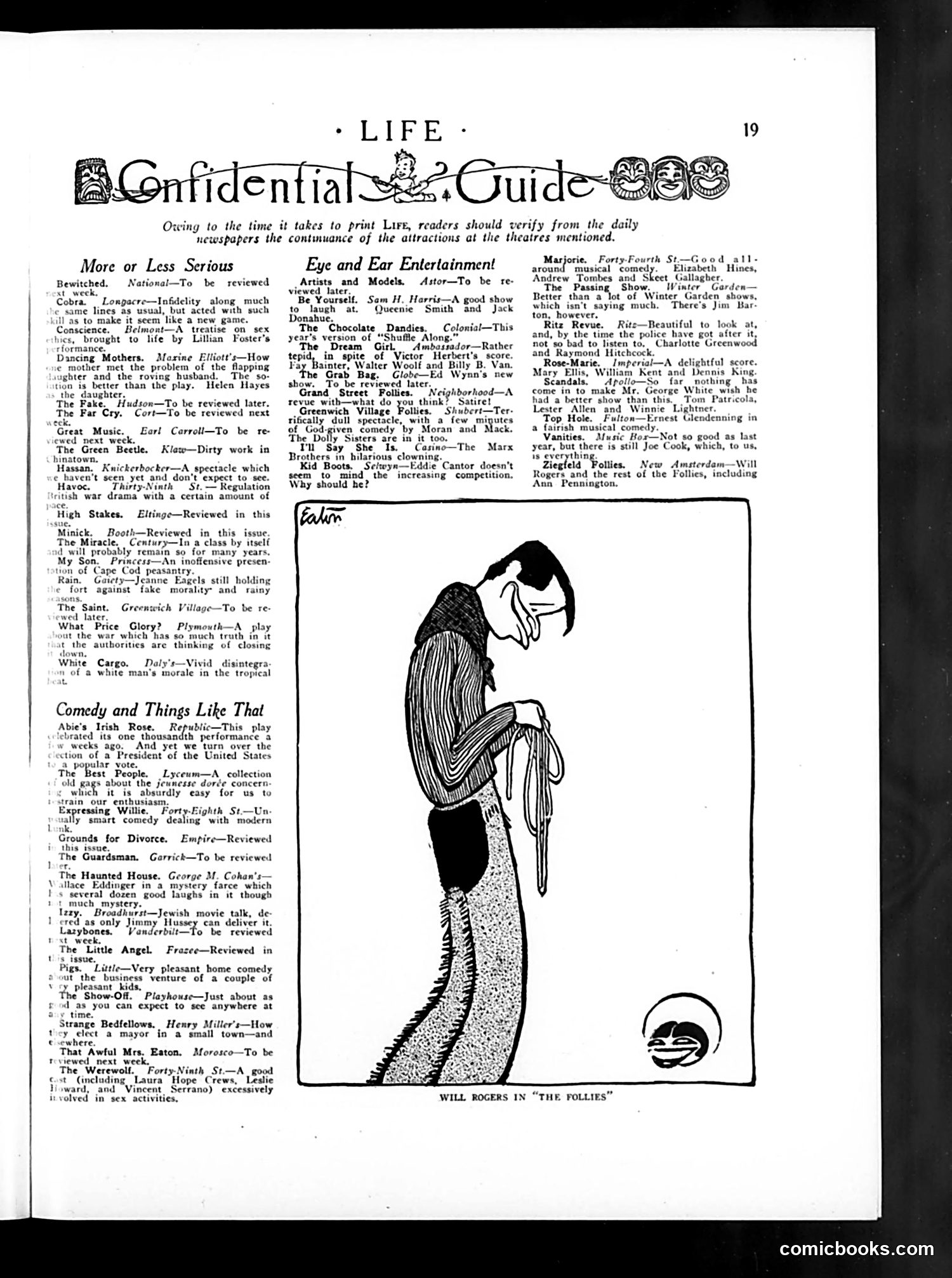
This page from *Life* magazine is a theatre guide reviewing Broadway shows from the 1920s. The image shows an illustration labeled "WILL ROGERS IN 'THE FOLLIES'" — a cartoon of a man in striped pants sitting precariously on what appears to be a rope or thin support, depicted in a humorous, precarious position. The text reviews both "serious" plays (dealing with contemporary social issues like infidelity, divorce, and morality) and comedies. Notable references include *Abie's Irish Rose* (celebrating its 1,000th performance), *The Miracle*, and *Rain*. The page reflects 1920s theatrical concerns: post-WWI dramas, "flapper" culture (*Dancing Mothers*), sexual morality debates, and vaudeville-style entertainment. The Rogers illustration humorously captures the balancing act performers maintained between artistic credibility and commercial entertainment — a central tension in 1920s show business.
📄 Transcribed text from this page (OCR, searchable)
Machine-transcribed from the original scan — historical spelling and the odd misread are preserved.
Grounds for Divorce. t t. ¥ The Haunted Hous More or Less Serious Bewitched. National—To be reviewed xt week, Cobra. Longacre—Infidelity along much e same lines as usual, but acted with such iJ as to make it seem'like a new game. Conscience. Belmont—A treatise on sex Ines, brought to life by Lillian Foster's rformance. ; Dancing Mothers. Maxine Elliott's—How © mother met the problem of the flapping ighter and the roving husband. The so- tion is better than the play. Helen Hayes the daughter. The Fake, Hudson—To be reviewed later. The Far Cry. Cort—To be reviewed next ‘Great Mu Earl Carrolt—To be re- ewed next week. The Green Beetle. Klew—Dirty work in spectacle which ¢ haven't seen yet and don’t expect to see. Havoc. Thirty-Ninth St. — Regulation ritish war drama with a certain amount of ce. High Stakes. Eltinge—Reviewed in this Minick. Booth—Reviewed in. this issue. The Miracle. Century—In a class by itself di will probably remain so for many years, My Son. Princess—An inoffensive presen: tion of Cape Cod peasantry. Rain. Gatety—Jeanne Eagels still holding fort against fake morality- and rainy The Saint. Greenwich Village—To be re- wed later, What Price Glory? Plymouth—A play out the war which has so much truth in it authorities are thinking of closing White Cargo. Daly's—Vivid disintegra. 1 of @ white man's morale in the tropical Comedy and Things Like That Abie’s Irish Rose. Republic—This play brated its one thousandth performance a w weeks ago. And yet we turn over the ction of a President of the United States 4 popular vote. The Best People. Lyceum—A collection old gags about the jeunesse dorée concern which it is absurdly easy for us to strain. our enthusiasm. Expressing Willie. Forty-Eighth St—Un. sally smart comedy dealing with modern ik. Empire—Reviewed this issue. The Guardsman. Gorrick—To be reviewed George M. Cohan's— lace Eddinger in a mystery farce which several dozen good laughs in it though 1 much mystery. Izzy, Broadhurst—Jewish movie talk, de cred as only Jimmy Hussey can deliver it. Lazybones. Vanderbilt—To be reviewed xt week, The Little Angel. Frazee—Reviewed in s issue. Pigs. Little—Very pleasant home comedy wut the business venture of a couple of y pleasant kids, The Show-Off. Playhouse—Just about as «I as you can expect to see anywhere at me. Strange Bedfellows. Henry Miller’s—How y elect a mayor in a small town—and ewhere. That Awful Mrs. Eaton, Morosco—To be viewed next week. The Werewolf. Forty. th St—A good pe Crews, Leslie st (including “Laura t errano) excessively rward, and Vincent volved in sex activities, ing to the time it takes to print Lire, readers should wv newspapers the continuance of the attractions at the theatres mentioned. Eye and Ear Entertainment Artists and Models. Astor—To be re- viewed later. Be Yourself. Sam H. Harris—A good show Queenie Smith and Jack to laugh at. Donahue. . The Chocolate, Dandies. Colonia!—This year’s version of “Shufile Along.” The Dream Girl Ambossador—Rather tepid, in spite of Victor Herbert's score. Fay Bainter, Walter Woolf and Billy B. Van. Grab Bag. Globe—Ed Wynn's new show. To be reviewed later... Grand Street Follies. ighborhood—A revue with—what do you think? Satire! Greenwich Village Follies. Shubert—Ter- rifically dull spectacle, with a few minutes of God-given comedy by Moran and Mack. The ‘Dolly Sisters are in it too. Tl Say She Is. Casino—The Brothers in hilarious clowning. Kid Boots. Seiwyn—Eddie Cantor doesn't seem to mind the increasing competition. Why should he? Marx ify from the daily all- Hines, Marjorie. Forty-Fourth St—Good around musical comedy. — Elizabeth ‘Andrew Tombes and Steet Gallagher. The Passing Show. Winter Garden— Better than a lot of Winter Garden shows, which isn't saying much, There's Jim Bar- ton, however. Ritz Revue. Rits—Beautiful to look at, and, by the time the police have got after it, not so bad to listen to. Charlotte Greenwood and Raymond Hitchcock. Rose-Marie. Imperiai—A delightful score. Mary Ellis, William Kent and Dennis King Scandals. Apollo—So far nothing has come in to make Mr. George White wish he had a better show than this. Tom Patricola, Lester Allen and Winnie Lightner. Top Hole. Fulton—Ernest Glendenning in a fairish musical comedy. Vanities. Music Hox—Not so good as last year, but there is still Joe Cook, which, to us, is everythin, Ziegfeld Potties. New Amsterdam—Will Rogers and the rest of the Follies, including Ann Pennington. WILL ROGERS IN “THE FOLLIES” comicbooks.com