
Life, 1924-10-16 · page 26 of 36
Life — October 16, 1924 — page 26: what you’re looking at
What you’re looking at
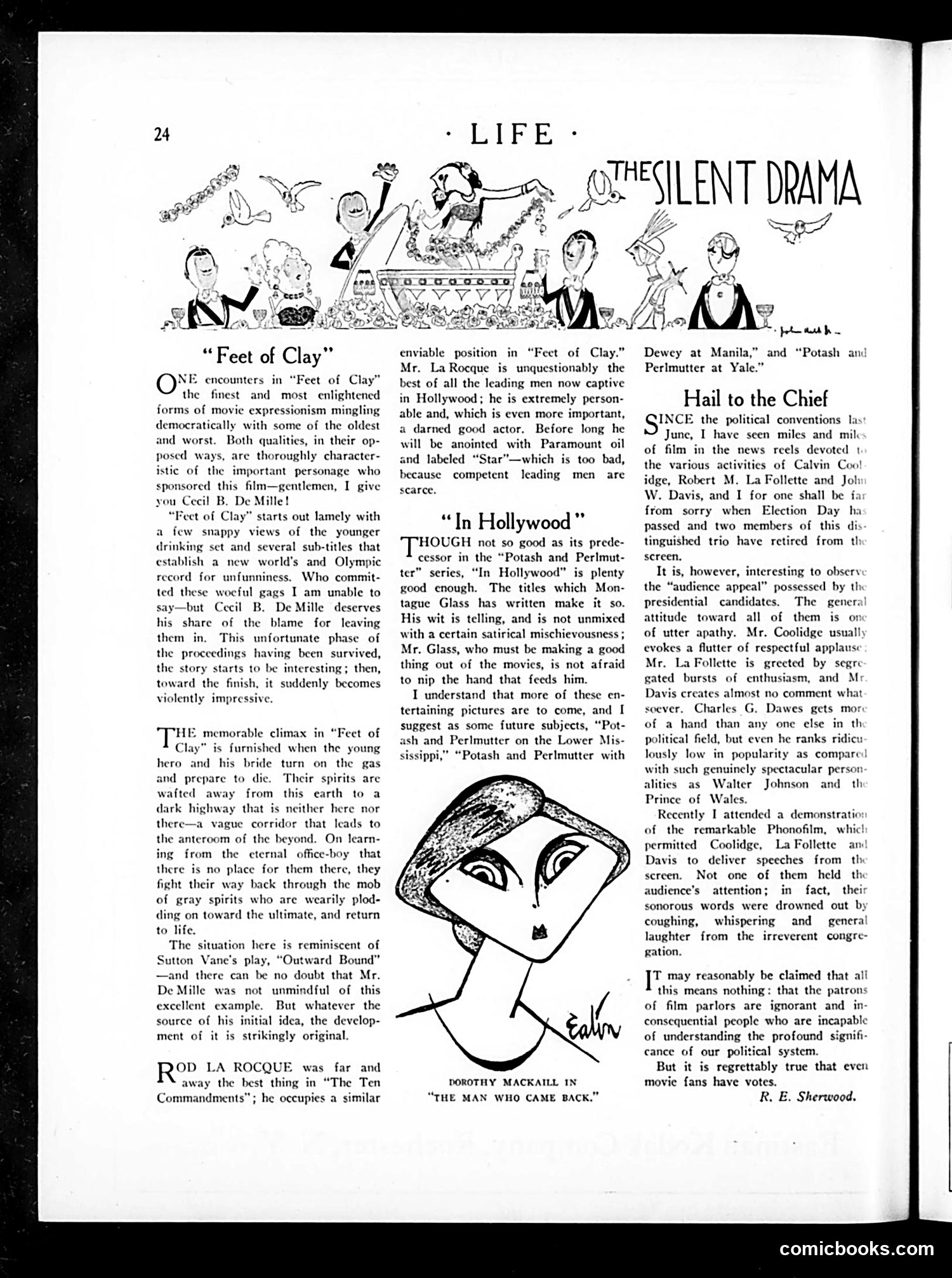
This *Life* magazine page reviews three films and critiques newsreel coverage of the 1924 U.S. presidential election. **Film Reviews:** - **"Feet of Clay"** (directed by Cecil B. De Mille): The reviewer praises its innovative afterlife sequence but criticizes De Mille for including poorly-written comedic scenes. Rod La Rocque is praised as Hollywood's finest leading man. - **"In Hollywood"**: A "Potash and Perlmutter" comedy praised for its witty titles by Montague Glass, who satirizes the industry feeding him. **"Hail to the Chief" Section:** This critiques newsreel coverage of the 1924 election candidates—Calvin Coolidge, Robert La Follette, and John W. Davis—noting audiences respond with indifference to all three. Charles G. Dawes (Coolidge's running mate) generates slightly more applause but remains unpopular compared to entertainment figures. The satire mocks how presidential candidates lack the "audience appeal" of movie stars.
📄 Transcribed text from this page (OCR, searchable)
Machine-transcribed from the original scan — historical spelling and the odd misread are preserved.
“Feet of Clay” NE encounters in “Feet of Clay” the finest and most enlightened forms of movie expressionism mingling democratically with some of the oldest and worst. Both qualities, in their op- posed ways, are thoroughly character- istic of the important personage who I give sponsored this film—gentlemen, you Cecil B. De Mille! ‘ect of Clay” starts out lamely with a few snappy views of the younger drinking set and several sub-titles that establish a new world’s and Olympic record for unfunniness. Who commit- ted these woeful gags I am unable to say—but Cecil B. De Mille deserves his share of the blame for leaving them in. This unfortunate phase of the proceedings having been survived, the story starts to be interesting; then, toward the finish, it suddenly becomes violently impressive. HE memorable climax in “Feet of Clay” is furnished when the young hero and his bride turn on the gas and prepare to dic, Their spirits are wafted aw from this earth to a dark highway that is neither here nor there—a vague corridor that leads to the anteroom of the beyond. On learn- ing from the eternal office-boy that there is no place for them there, they fight their way back through the mob of gray spirits who are wearily plod- ding on toward the ultimate, and return to life. The situation here is reminiscent of Sutton Vane's play, “Outward Bound” —and there can be no doubt that Mr. De Mille unmindful of this excellent example. But whatever the source of his initial idea, the develop- ment of it is strikingly original. was not OD LA ROCQUE was far and the best thing in “The Ten Conahsasaients" ; he occupies a similar enviable position in “Feet of Clay.” Mr. La Rocque is unquestionably the best of all the leading men now captive in Hollywood; he is extremely person- able and, which is even more important, a darned good actor. Before long he will be anointed with Paramount oil and labeled “Star”—which is too bad, because competent leading men are scarce. “In Hollywood” 'HOUGH not so good as its prede- cessor in the “Potash and Perlmut- ter” series, “In Hollywood” is plenty good enough. The titles which Mon- tague Glass has written make it so. His wit is telling, and is not unmixed with a certain satirical mischievousness ; Mr. Glass, who must be making a good thing out of the movies, is not afraid to nip the hand that feeds him. I understand that more of these en- tertaining pictures are to come, and [ suggest as some future subjects, “Pot- ash and Perlmutter on the Lower Mis- sissippi,” “Potash and Perlmutter with DOROTHY MACKAILL IN “THE MAN WHO CAME BACK.” Dewey at Manila,” Perlmutter at Yale.” Hail to the Chief INCE the political conventions las June, I have seen miles and mik of film in the news reels devoted 1 the various activities of Calvin Coo! idge, Robert M. La Follette and Joh W. Davis, and I for one shall be iar from sorry when Election Day ha passed and two members of this dis tinguished trio have retired from th screen, It is, however, interesting to observ the “audience appeal” possessed by th presidential candidates. The general attitude toward all of them is on of utter apathy. Mr. Coolidge usually evokes a flutter of respectful applause Mr. La Follette is greeted by segre gated bursts of enthusiasm, and Mr Davis creates almost no comment what soever. Charles G, Dawes gets more of a hand than any one else in th political field, but even he ranks ridicu lously low in popularity as compare: with such genuinely spectacular person alities as Walter Johnson and th Prince of Wales. Recently I attended a demonstration of the remarkable Phonofilm, whic! permitted Coolidge, La Follette an: Davis to deliver speeches from th screen. Not one of them held th audience’s attention; in fact, their sonorous words were drowned out by coughing, whispering and genera laughter from the irreverent congre- gation. and “Potash and T may reasonably be claimed that all this means nothing: that the patrons of film parlors are ignorant and in- consequential people who are incapable of understanding the profound fi- cance of our political system. But it is regrettably true that even movie fans have votes. R, E. Sherwood. comicbooks.com