
Life, 1924-10-16 · page 20 of 36
Life — October 16, 1924 — page 20: what you’re looking at
What you’re looking at
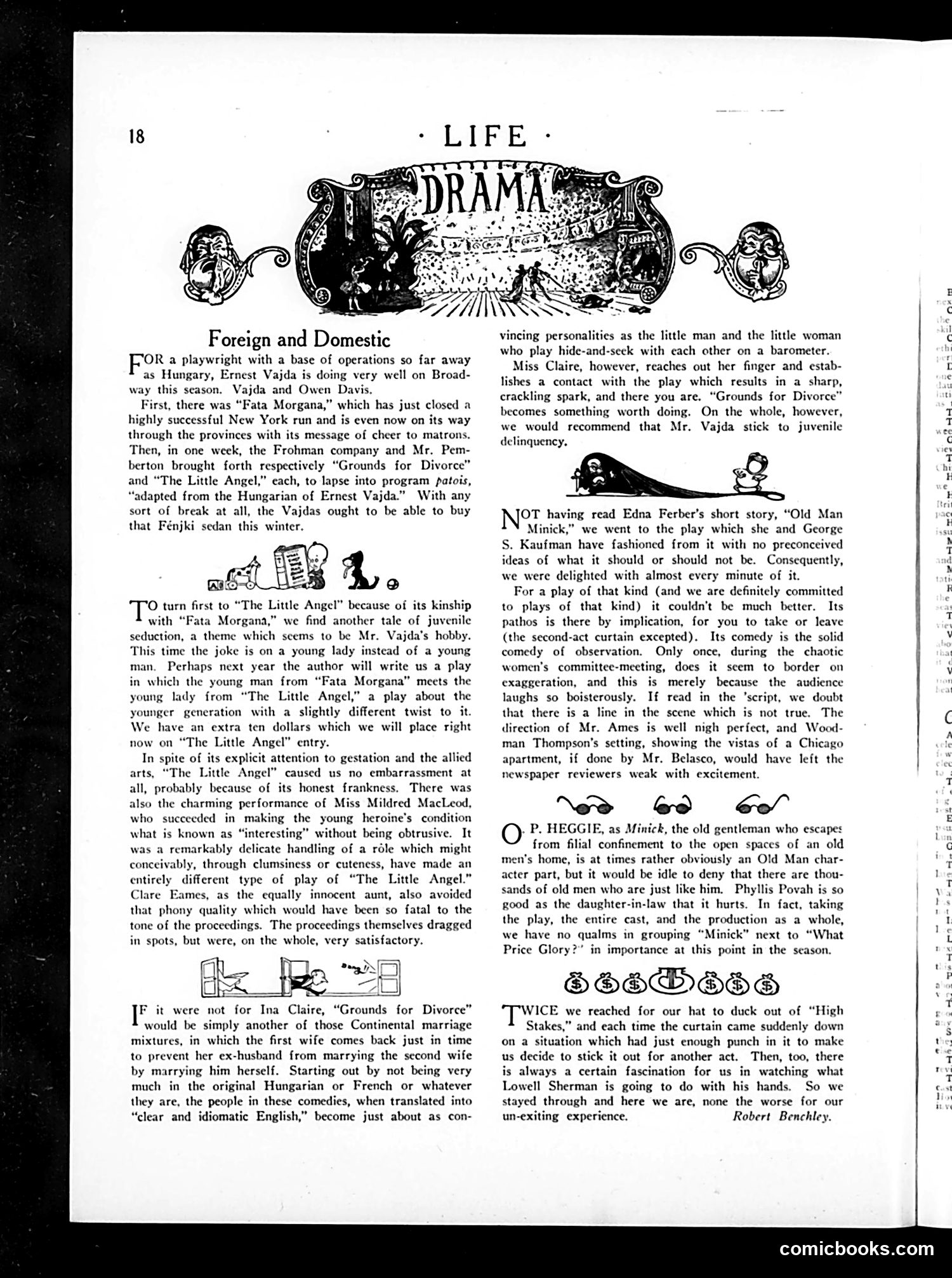
This page reviews three Broadway plays adapted from Hungarian playwright Ernest Vajda's works. The satire targets the commercial success of Continental imports: Vajda's plays repeatedly feature "juvenile seduction" as their theme, prompting the critic to joke that Vajda should buy a Fenjki sedan with his profits. The reviews are mixed. "The Little Angel" and "Old Man Minick" receive praise for honest execution and strong performances (notably Ina Claire and Mildred MacLeod). "Grounds for Divorce" is criticized as formulaic—the tired plot of a first wife returning to prevent her ex-husband's second marriage—saved only by Claire's talent. The underlying satire mocks the period's appetite for risqué European comedies about marriage and seduction, while acknowledging that skillful acting and adaptation can elevate mediocre source material.
📄 Transcribed text from this page (OCR, searchable)
Machine-transcribed from the original scan — historical spelling and the odd misread are preserved.
Foreign and Domestic For a playwright with a base of operations so far away as Hungary, Ernest Vajda is doing very well on Broad- y this season, Vajda and Owen Davis, t, there was “Fata Morgana,” which has just closed a highly successful New York run and is even now on its way through the provinces with its message of cheer to matrons. Then, in one week, the Frohman company and Mr. Pem- berton brought forth respectively “Grounds for Divorce” and “The Little Angel,” each, to lapse into program patois, “adapted from the Hungarian of Ernest Vajda.” With any sort of break at all, the Vajdas ought to be able to buy that Fénjki sedan this winter. v O turn first to “The Little Angel” because of its kinship with “Fata Morgana,” we find another tale of juvenile seduction, a theme which scems to be Mr. Vajda's hobby. This time the joke is on a young lady instead of a young man. Perhaps next year the author will write us a play in which the young man from “Fata Morgana” meets the young lady from “The Little An; a play about the younger generation with a slightly different twist to it. We have an extra ten dollars which we will place right now on “The Little Angel” entry. In spite of its explicit attention to gestation and the allied arts, “The Little Angel” caused us no embarrassment at all, probably because of its honest frankness. There was also the charming performance of Miss Mildred MacLeod, who succeeded in making the young heroine's condition what is known as “interesting” without being obtrusive. It was a remarkably delicate handling of a rdle which might conceivably, through clumsiness or cuteness, have made an entirely different type of play of “The Little Angel.” Clare Eames, as the equally innocent aunt, also avoided that phony quality which would have been so fatal to the tone of the proceedings. The proceedings themselves dragged in spots, but were, on the whole, very satisfactory. F it were not for Ina Claire, “Grounds for Divorce” would be simply another of those Continental marriage mixtures, in which the first wife comes back just in time to prevent her ex-husband from marrying the second wife by marrying him herself. Starting out by not being very much in the original Hungarian or French or whatever they are, the people in these comedies, when translated into “clear and idiomatic English,” become just about as con- vincing personalities as the little man and the little woman who play hide-and-seek with each other on a barometer. Miss Claire, however, reaches out her finger and estab- lishes a contact with the play which results in a sharp, crackling spark, and there you are. “Grounds for Divorce” becomes something worth doing. On the whole, however we would recommend that Mr. Vajda stick to juvenile delinquency, No. having read Edna Ferber’s short story, “Old Man Minick,” we went to the play which she and George S. Kaufman have fashioned from it with no preconceived ideas of what it should or should not be. Consequently, we were delighted with almost every minute of it. For a play of that kind (and we are definitely committed to plays of that kind) it couldn't be much better. Its pathos is there by implication, for you to take or leave (the second-act curtain excepted). Its comedy is the solid comedy of observation. Only once, during the chaotic women’s committee-meeting, does it scem to border on exaggeration, and this is merely because the audience laughs so boisterously. If read in the ‘script, we doubt that there is a line in the scene which is not true. The direction of Mr. Ames is well nigh perfect, and Wood- man Thompson's setting, showing the vistas of a Chicago apartment, if done by Mr. Belasco, would have left the newspaper reviewers weak with excitement. ‘Nee €20 oo . P. HEGGIE, as Minick, the old gentleman who escapes from filial confinement to the open spaces of an old men’s home, is at times rather obviously an Old Man char- acter part, but it would be idle to deny that there are thou- sands of old men who are just like him. Phyllis Povah is so good as the daughter-in-law that it hurts. In fact, taking the play, the entire cast, and the production as a whole, we have no qualms in grouping “Minick” next to “What Price Glory?” in importance at this point in the season. 460555 WICE we reached for our hat to duck out of “High Stakes,” and each time the curtain came suddenly down on a situation which had just enough punch in it to make us decide to stick it out for another act. Then, too, there is always a certain fascination for us in watching what Lowell Sherman is going to do with his hands. So we stayed through and here we are, none the worse for our un-exiting experience. Robert Benchley. comicbooks.com t ‘ T a k