
Life, 1924-10-16 · page 23 of 36
Life — October 16, 1924 — page 23: what you’re looking at
What you’re looking at
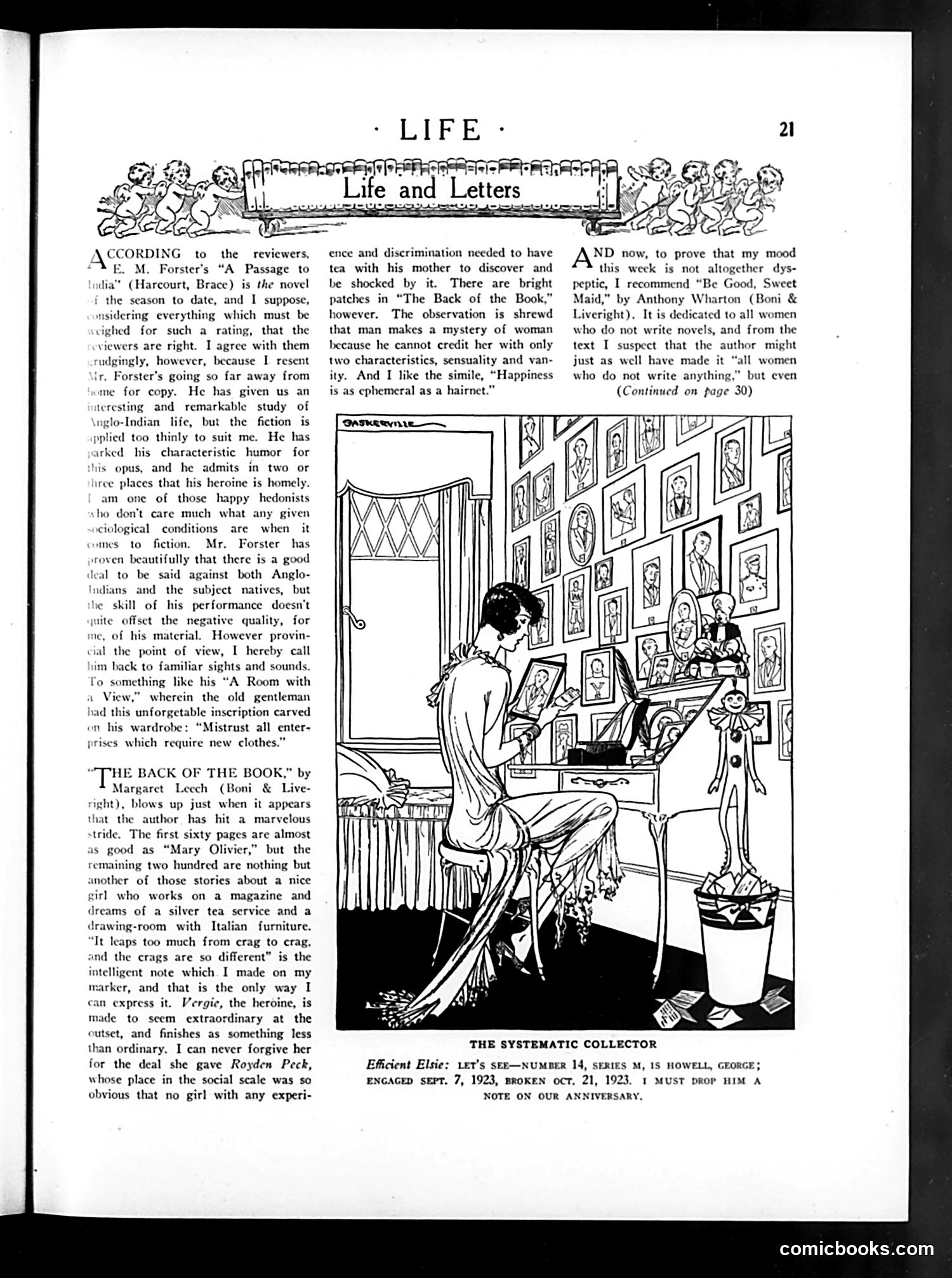
This cartoon mocks the modern woman as an obsessive cataloguer of romantic conquests. The illustration shows a woman at her vanity surrounded by portrait photographs on the wall—each apparently representing a different suitor. She's consulting an indexed filing system to track her engagements and breakups with precision and emotional detachment. The caption's humor lies in the contradiction: "Efficient Elsie" maintains meticulous records of her romantic relationships (noting engagement and breakup dates) yet treats them with bureaucratic indifference—she must "drop him a note on our anniversary" as if managing business correspondence rather than human relationships. The satire targets both modern female independence (women now had dating options and agency) and the perceived shallowness of the Jazz Age romantic culture. The "systematic" approach to love—cataloguing men like collectible items—suggests women have become calculating rather than genuinely emotional, a common satirical complaint in 1920s publications about changing gender roles.
📄 Transcribed text from this page (OCR, searchable)
Machine-transcribed from the original scan — historical spelling and the odd misread are preserved.
CCORDING to the _ reviewers, E. M. Forster's “A Passage to dia” (Harcourt, Brace) is the novel i the season to date, and I suppose, msidering everything which must be cighed for such a rating, that the viewers are right. I agree with them rudgingly, however, because I resent ir. Forster’s going so far away from me for copy. He has given us an teresting and remarkable study of \nglo-Indian life, but the fiction is pplied too thinly to suit me. He has arked his characteristic humor for his opus, and he admits in two or lirce places that his heroine is homely. am one of those happy hedonists sho don’t care much what any given ciological conditions are when it to fiction. Mr. Forster has roven beautifully that there is a good leal to be said against both Anglo- Indians and the subject natives, but he skill of his performance doesn’t juite offset the negative quality, for me, of his material. However provin- cial the point of view, I hereby call im back to familiar sights and sounds. fo something like his “A Room with a Vie wherein the old gentleman had this unforgetable inscription carved on his wardrobe: “Mistrust all enter- prises which require new clothes.” oes. “"THE BACK OF THE BOOK,” by Margaret Leech (Boni & Live- ight), blows up just when it appears that the author has hit a marvelous stride. The first sixty pages are almost as good as “Mary Olivier,” but the remaining two hundred are nothing but another of those stories about a nice girl who works on a magazine and dreams of a silver tea service and a drawing-room with Italian furniture. “It leaps too much from crag to crag, and the crags are so different” is the intelligent note which I made on my marker, and that is the only way I can express it. Vergie, the heroine, is made to seem extraordinary at the outset, and finishes as something less than ordinary. I can never forgive her for the deal she gave Royden Peck, whose place in the social scale was so obvious that no girl with any experi- =le\- et ters ence and discrimination needed to have tea with his mother to discover and be shocked by it. There are bright patches in “The Back of the Book,” however. The observation is shrewd that man makes a mystery of woman because he cannot credit her with only two characteristics, sensuality and van- ity. And I like the simile, “Happiness is as ephemeral as a hairnet.” DasKREyn Le — ND now, to prove that my mood this week is not altogether dys- peptic, I recommend “Be Good, Sweet Maid,” by Anthony Wharton (Boni & Liveright). It is dedicated to all women who do not write novels, and from the text I suspect that the author might just as well have made it “all women who do not write anything,” but even (Continued on page 30) THE SYSTEMATIC COLLECTOR Efficient Elsie: Let’s seeE—NUMBER 14, SERIES M, 1S HOWELL, GEORGE; ENGAGED SEPT. 7, 1923, BROKEN oct. 21, 1923. I MUST DROP HIM A NOTE ON OUR ANNIVERSARY. comicbooks.com