
Life, 1924-10-16 · page 16 of 36
Life — October 16, 1924 — page 16: what you’re looking at
What you’re looking at
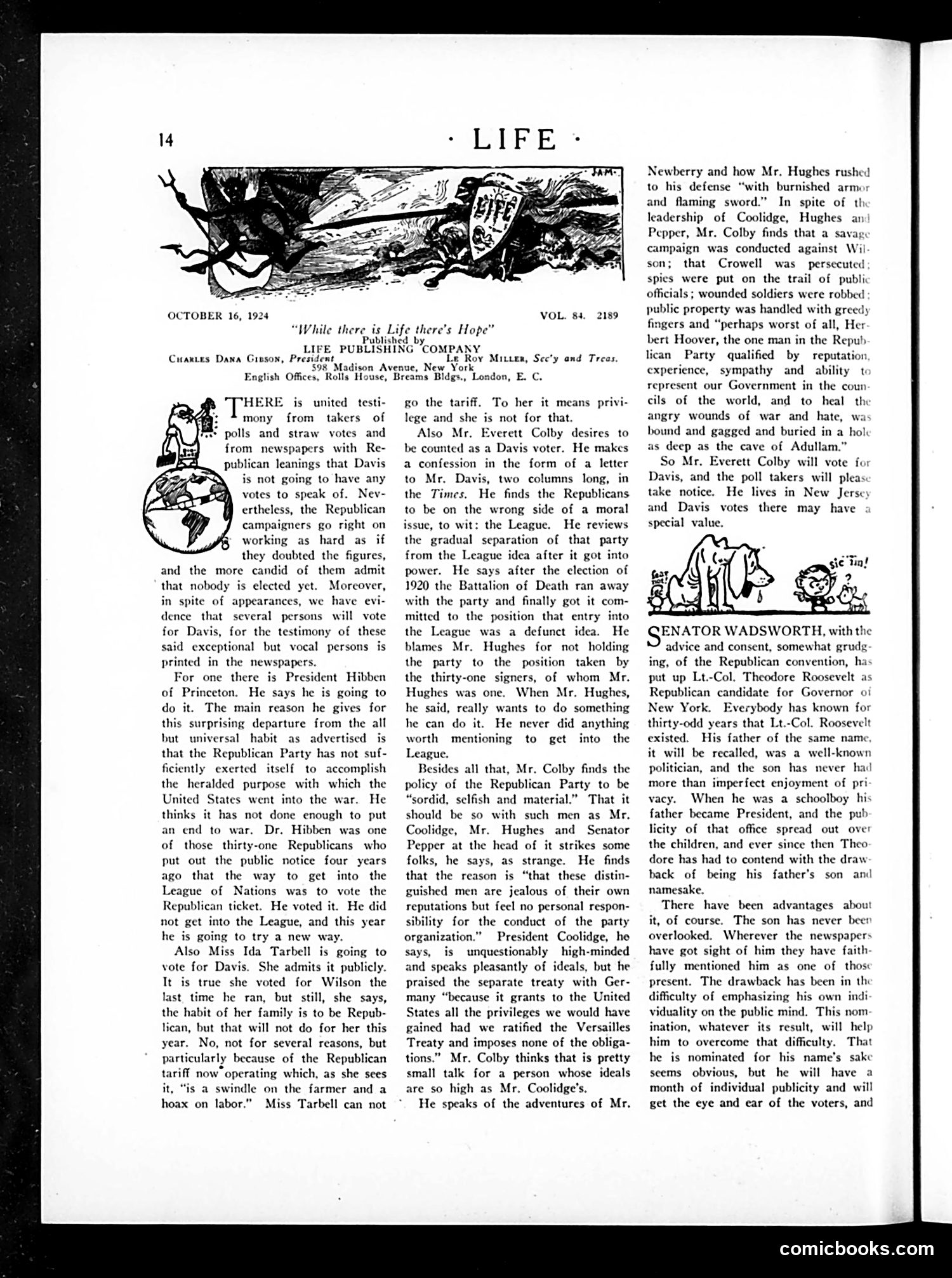
This page discusses Republican political divisions ahead of the 1924 election. The text criticizes Republican Party leadership—specifically mentioning President Coolidge, Mr. Hughes, and Senator Pepper—for allegedly conducting a "savage" campaign against opponents and mishandling public affairs. The article appears to reference internal Republican party conflicts, with particular scrutiny directed at attempts to remove certain politicians from positions. The text suggests criticism of party members who lack "personal responsibility for the conduct of the party organization." A small cartoon (bottom right) appears to depict a political figure, though specific identification is unclear from the image quality. The overall tone suggests Life magazine was satirizing Republican leadership's competence and moral authority during this election cycle.
📄 Transcribed text from this page (OCR, searchable)
Machine-transcribed from the original scan — historical spelling and the odd misread are preserved.
OCTOBER 16, 1924 VOL. 84. 2189 “While there is Life there's Ho, Published by LIFE PUBLISHING COMPANY Cuantes Dana Ginson, President 598 Madison Aven Le Roy Mitter, Sec'y and Treas, ue, New York English Offices, Rolls House, Breams Bldgs., London, E. C, “THERE is united testi- mony from takers of ™ polls and straw votes and from newspapers with Re- publican leanings that Davis is not going to have any votes to speak of. Nev- ertheless, the Republican campaigners go right on working as hard as if they doubted the figures, and the more candid of them admit that nobody is elected yet. Morcover, in spite of appearances, we have evi- dence that several persons will vote for Davis, for the testimony of these said exceptional but vocal persons is printed in the newspapers. For one there is President Hibben of Princeton. He says he is going to do it. The main reason he gives for this surprising departure from the all but universal habit as advertised is that the Republican Party has not suf- ficiently exerted itself to accomplish the heralded purpose with which the United States went into the war. He thinks it has not done enough to put an end to war. Dr. Hibben was one of those thirty-one Republicans who put out the public notice four years ago that the way to get into the League of Nations was to vote the Republican ticket. He voted it. He did not get into the League, and this year he is going to try a new way. Also Miss Ida Tarbell is going to vote for Davis. She admits it publicly. It is true she voted for Wilson the last. time he ran, but still, she says, the habit of her family is to be Repub- lican, but that will not do for her this year. No, not for several reasons, but particularly because of the Republican tariff now” operating which, as she sees it, “is a swindle on the farmer and a hoax on labor.” Miss Tarbell can not go the tariff. To her it means privi- lege and she is not for that. Also Mr. Everett Colby desires to be counted as a Davis voter. He makes a confession in the form of a letter to Mr. Davis, two columns long, in the Times. He finds the Republicans to be on the wrong side of a moral issue, to wit: the League. He reviews the gradual separation of that party from the League idea after it got into power. He says after the election of 1920 the Battalion of Death ran away with the party and finally got it com- mitted to the position that entry into the League was a defunct idea. He blames Mr. Hughes for not holding the party to the position taken by the thirty-one signers, of whom Mr. Hughes was one. When Mr. Hughes, he said, really wants to do something he can do it. He never did anything worth mentioning to get into the s all that, Mr. Colby finds the policy of the Republican Party to be “sordid, selfish and material.” That it should be so with such men as Mr. Coolidge, Mr. Hughes and Senator Pepper at the head of it strikes some folks, he says, as strange. He finds that the reason is “that these distin- guished men are jealous of their own reputations but feel no personal respon- sibility for the conduct of the party organization.” President Coolidge, he says, is unquestionably high-minded and speaks pleasantly of ideals, but he praised the separate treaty with Ger- many “because it grants to the United States all the privileges we would have gained had we ratified the Versailles Treaty and imposes none of the obliga- tions.” Mr. Colby thinks that is pretty small talk for a person whose ideals are so high as Mr. Coolidge’s. He speaks of the adventures of Mr. Newberry and how Mr. Hughes rushed to his defense “with burnished armor and flaming sword.” In spite of th leadership of Coolidge, Hughes an Pepper, Mr. Colby finds that a sava campaign was conducted against Wil son; that Crowell was persecuted spices were put on the trail of public officials ; wounded soldiers were robbed public property was handled with greedy fingers and “perhaps worst of all, Her bert Hoover, the one man in the Repub lican Party qualified by reputation. experience, sympathy and ability t represent our Government in the coun cils of the world, and to heal the angry wounds of war and hate, was bound and gagged and buried in a hol as deep as the cave of Adullam.” So Mr. Everett Colby will vote for Davis, and the poll takers will pleas take notice. He lives in New Jersey and Davis votes there may have special value, ENATOR WADSWORTH, with the advice and consent, somewhat grudg. ing, of the Republican convention, has put up Lt.-Col. Theodore Roosevelt as Republican candidate for Governor oi New York. Everybody has known for thirty-odd years that Lt.-Col. Roosevelt existed. His father of the same name, it will be recalled, was a well-known politician, and the son has never had more than imperfect enjoyment of pri vacy. When he was a schoolboy his father became President, and the pub licity of that office spread out over the children, and ever since then Theo dore has had to contend with the draw back of being his father’s son and namesake. There have been advantages about it, of course. The son has never beer overlooked. Wherever the newspapers have got sight of him they have faith fully mentioned him as one of thos: present. The drawback has been in thc difficulty of emphasizing his own indi viduality on the public mind. This nom ination, whatever its result, will help him to overcome that difficulty. That he is nominated for his name's sake seems obvious, but he will have a month of individual publicity and will get the eye and ear of the voters, and comicbooks.com