
A complete issue · 36 pages · 1924
Life — July 17, 1924
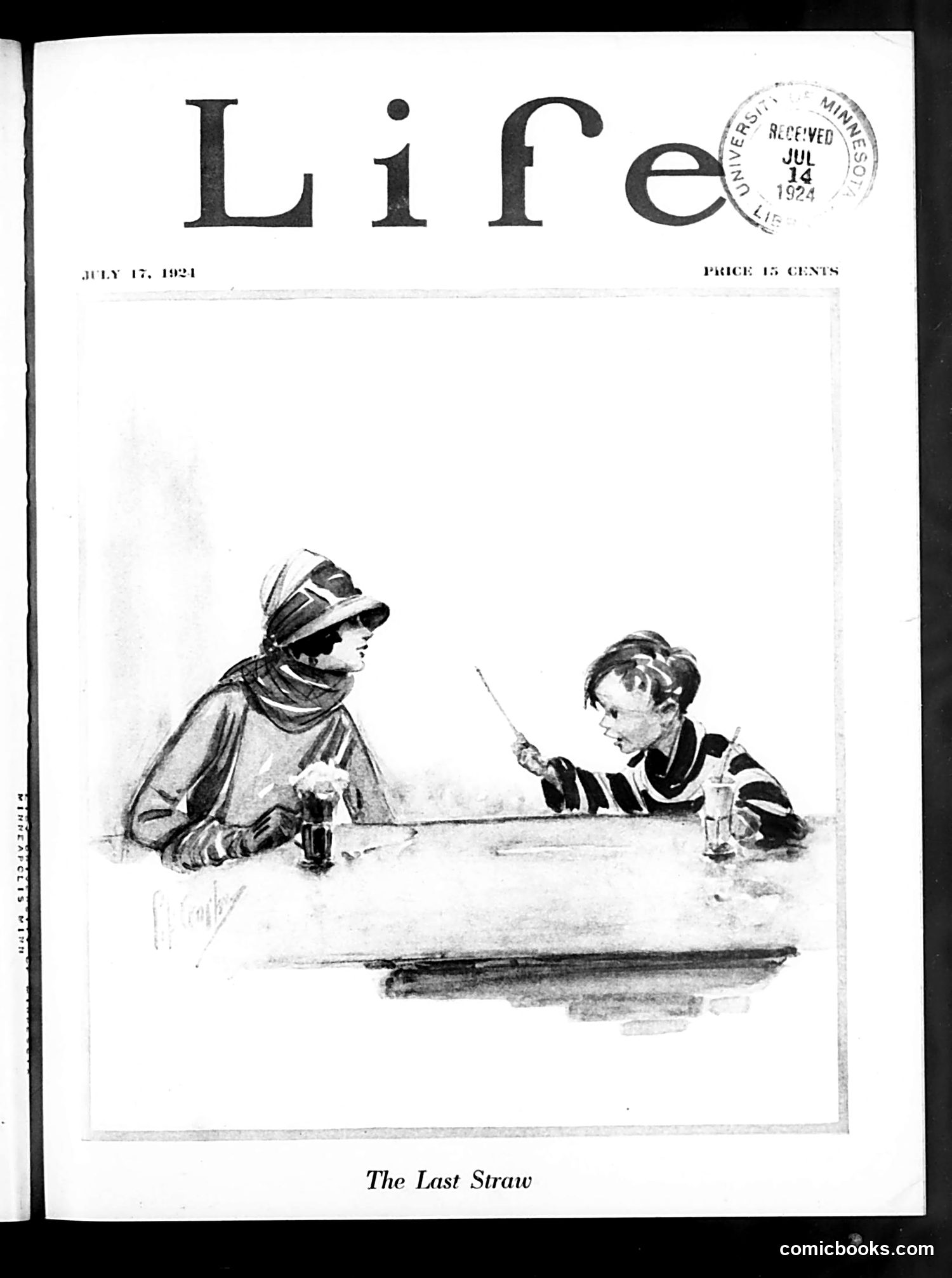
This cartoon depicts two figures in what appears to be a water-based scene. The title "The Last Straw" suggests a breaking point or final provocation. One figure wears a hat and scarf, holding what looks like a drinking straw or similar object, while the other—a young boy in striped clothing—holds a stick or pole, appearing confrontational. Without additional context from the magazine's contents, the specific political or social reference remains unclear. However, the imagery suggests either a domestic dispute, a commentary on Prohibition-era drinking practices (given the straw reference), or possibly a labor/class conflict metaphor. The "last straw" idiom typically indicates frustration reaching a critical point. The exact satirical target would require surrounding article context.
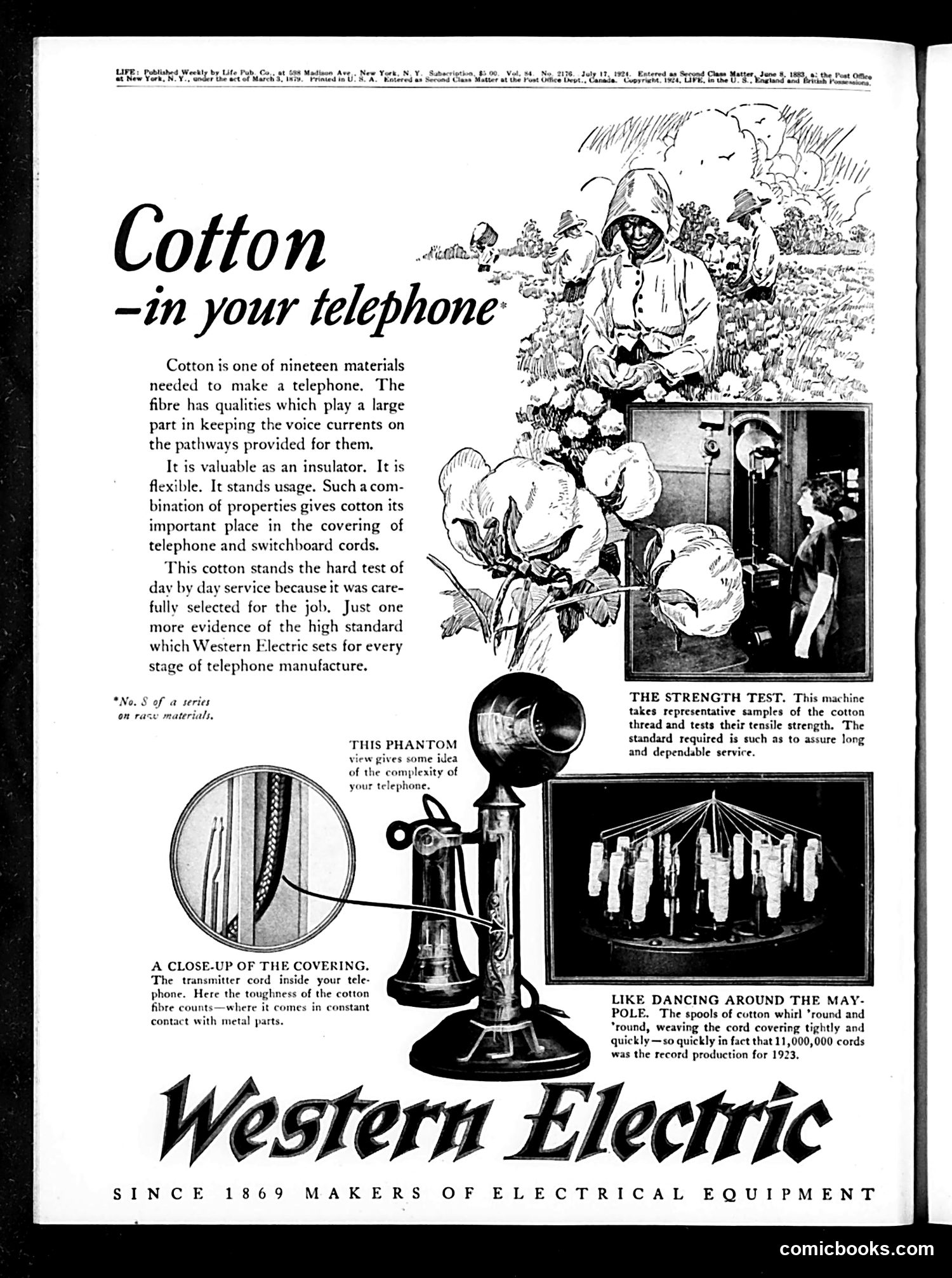
This is primarily **advertising content**, not satire or political commentary. Western Electric, a major telecommunications equipment manufacturer, created this advertisement to explain cotton's role in telephone technology. The page uses educational illustrations—a cotton field, close-ups of cord covering, strength testing machinery, and production spools—to demonstrate that cotton fiber serves as insulation for telephone wires. The "phantom" telephone diagram shows the internal construction. The "dancing around the maypole" reference humorously describes the mechanical spooling process, noting that 11,000,000 cords were produced in 1923—positioning Western Electric as an innovator meeting modern communication demands. This represents early 20th-century corporate messaging that blended technical explanation with appealing visual storytelling to build brand credibility.
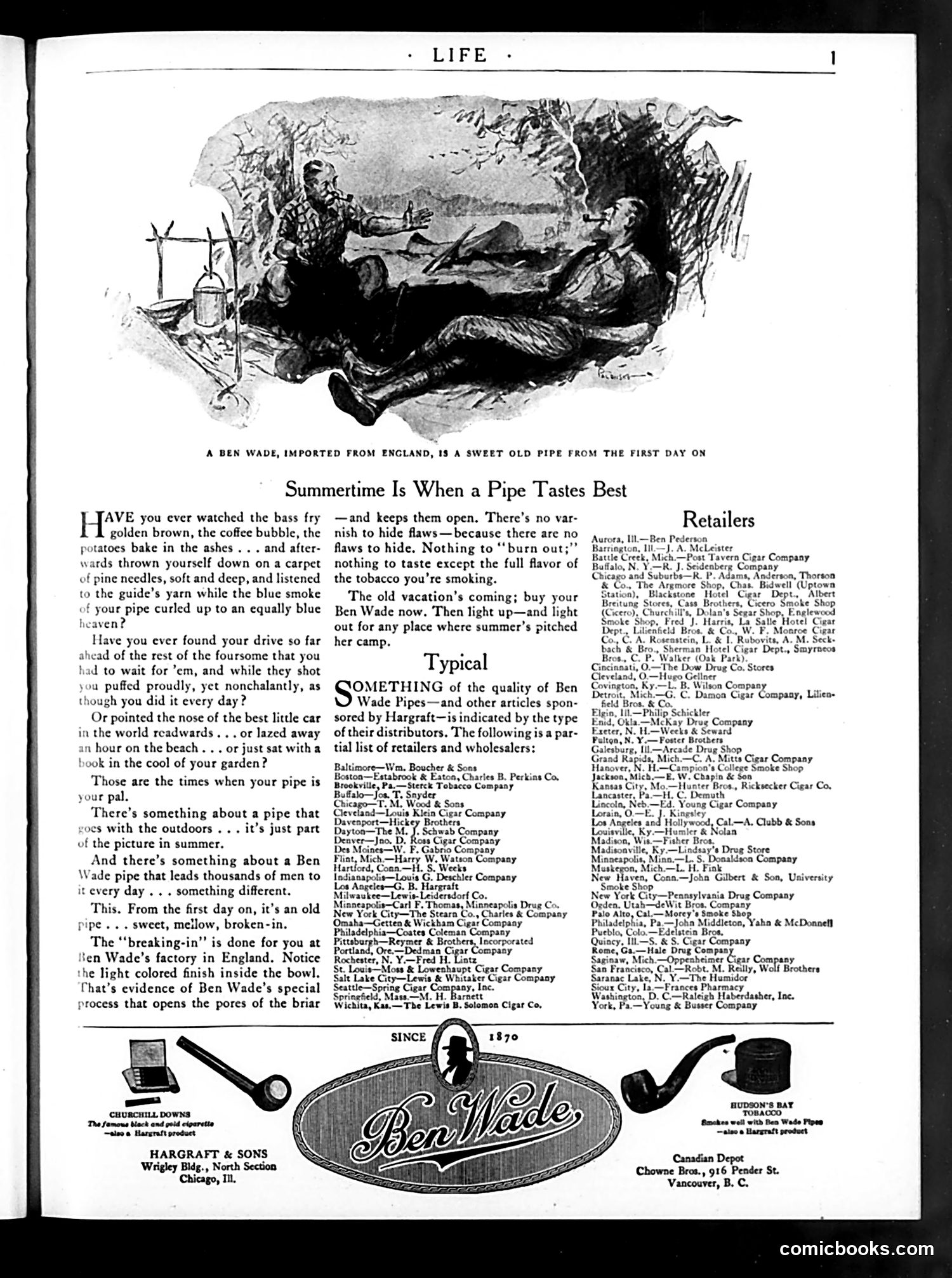
This page is primarily **advertising for Ben Wade pipes**, not political satire. The illustration shows two men relaxing outdoors—one gesturing while speaking, the other reclining—in an idealized summer camping scene. The advertisement's framing suggests that summertime is the optimal season for pipe smoking, emphasizing the product's quality and "sweet, mellow, broken-in" characteristics. The text romanticizes leisure and outdoor relaxation as contexts for enjoying the pipes. The page includes an extensive retailer list and product imagery at the bottom, confirming this is commercial content rather than satirical commentary. While *Life* magazine was known for satire, this particular page represents its advertising revenue model.
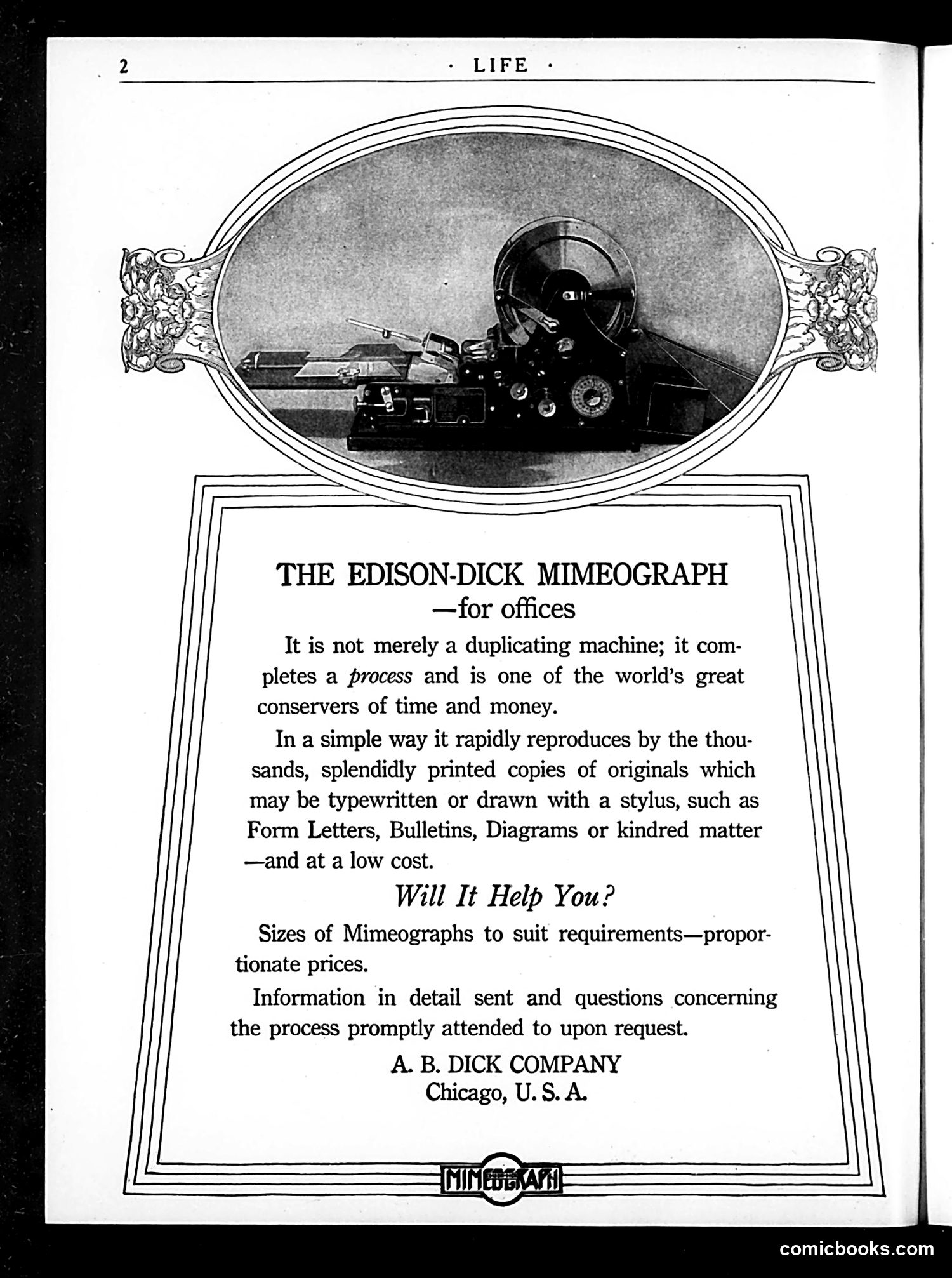
This page is primarily **advertising, not political satire**. It promotes the Edison-Dick Mimeograph, a duplicating machine for office use. The advertisement emphasizes the machine's practical business value: it rapidly reproduces typed or hand-drawn documents (letters, bulletins, diagrams) at low cost, positioning it as a time and money-saver for offices. The ornate border and formal layout are typical of early 20th-century advertising design. The machine photograph at top shows the mechanical device itself. The "Will It Help You?" section targets office managers considering whether to adopt this technology. There is no political cartoon or satire present on this page—it is straightforward commercial advertising from *Life* magazine, which supplemented satirical content with paid advertisements.
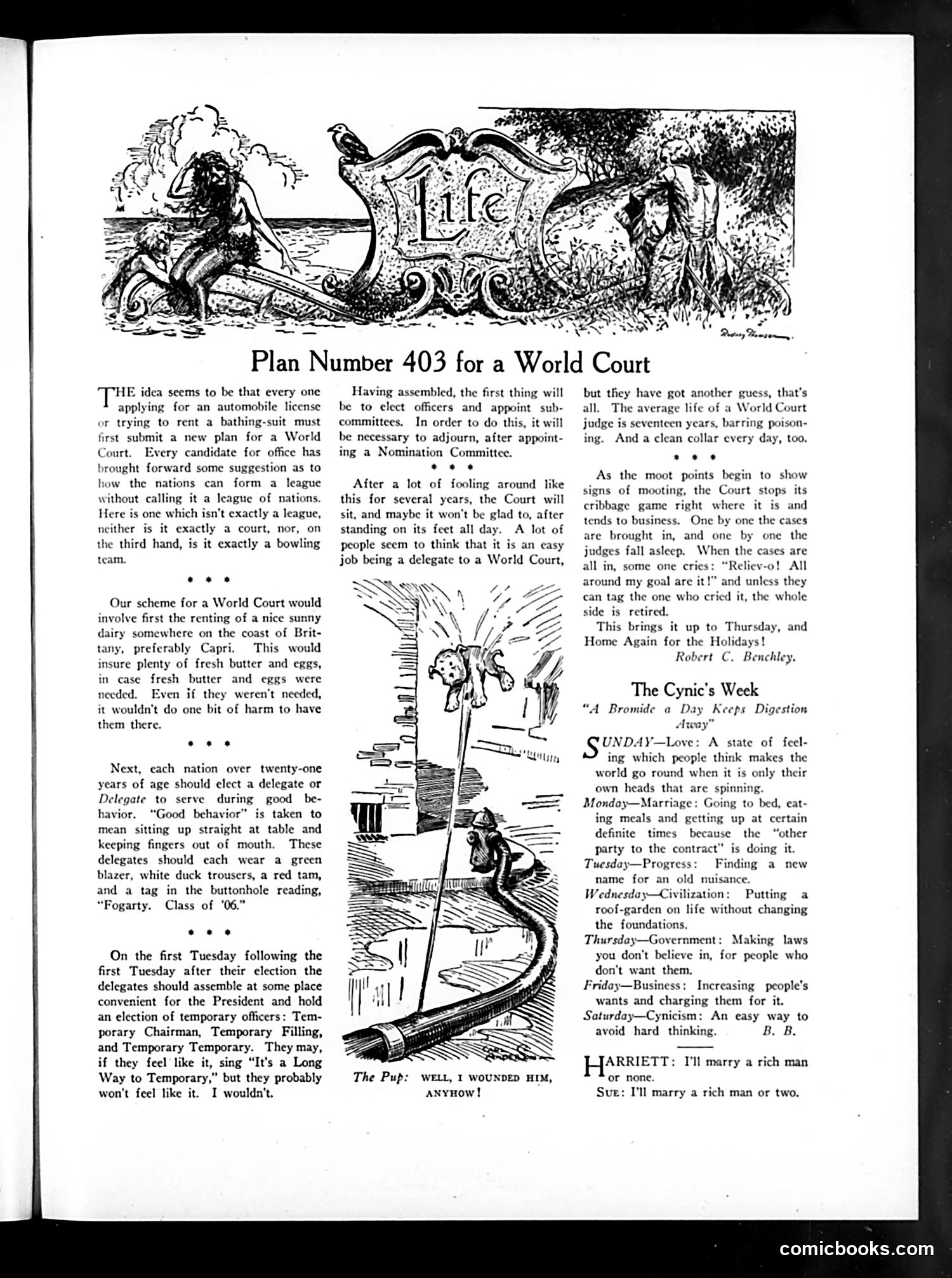
This satirical piece mocks proposals for an international governing body—likely referencing 1920s League of Nations debates. The author ridicules the impracticality of creating a functional world court by suggesting absurd alternatives: renting a dairy farm in Capri as headquarters, electing delegates based on "good behavior" (requiring them wear formal attire and refrain from cursing), and holding mock elections with titles like "Temporary Chairman" and "Temporary Temporary." The accompanying cartoon of a figure struggling with a large contraption labeled "The Pup" humorously illustrates the difficulty of managing such an unwieldy institution. The satire suggests that international cooperation schemes are inherently bureaucratic and ridiculous—that adding more rules and committees won't solve fundamental disagreements between nations.
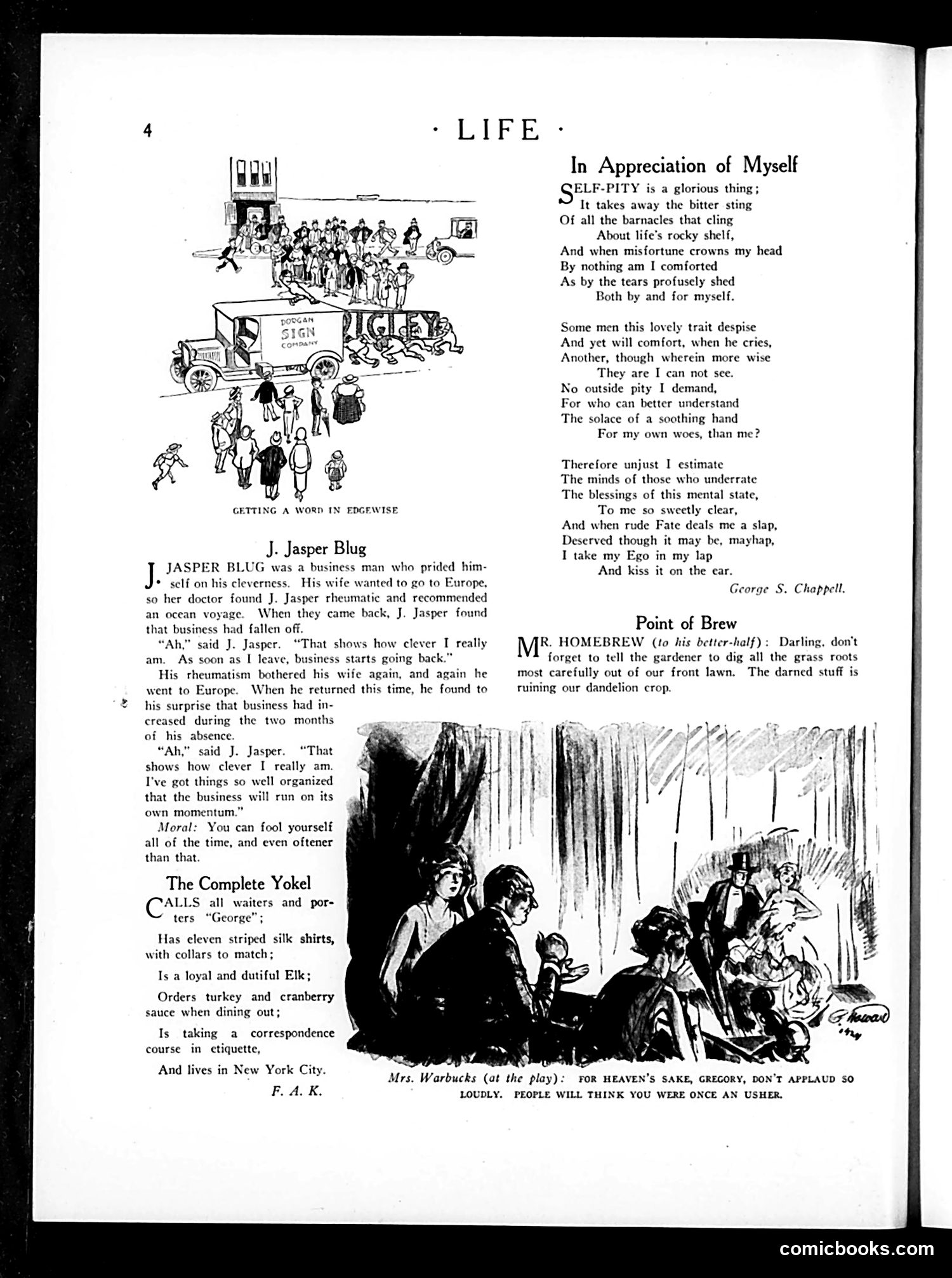
This page contains three distinct pieces of humor content: **"Getting a Word in Edgewise"** (top cartoon): A satirical illustration showing a crowded street scene with various people and a delivery truck, presumably depicting the difficulty of communicating in a chaotic urban environment. **"J. Jasper Blug"**: A short humorous anecdote about a businessman whose wife pushed him to travel for health reasons. The joke relies on his clever self-regard—he claims his business runs so well it succeeded without him during his absence, implying his competence rather than supporting his wife's original concern. **"The Complete Yokel"**: A brief poem listing absurd demands a waiter named George makes (silk shirts, elk orders, etiquette courses) while living in New York City—mocking rural pretension or social climbing. The bottom illustration appears unrelated editorial content.
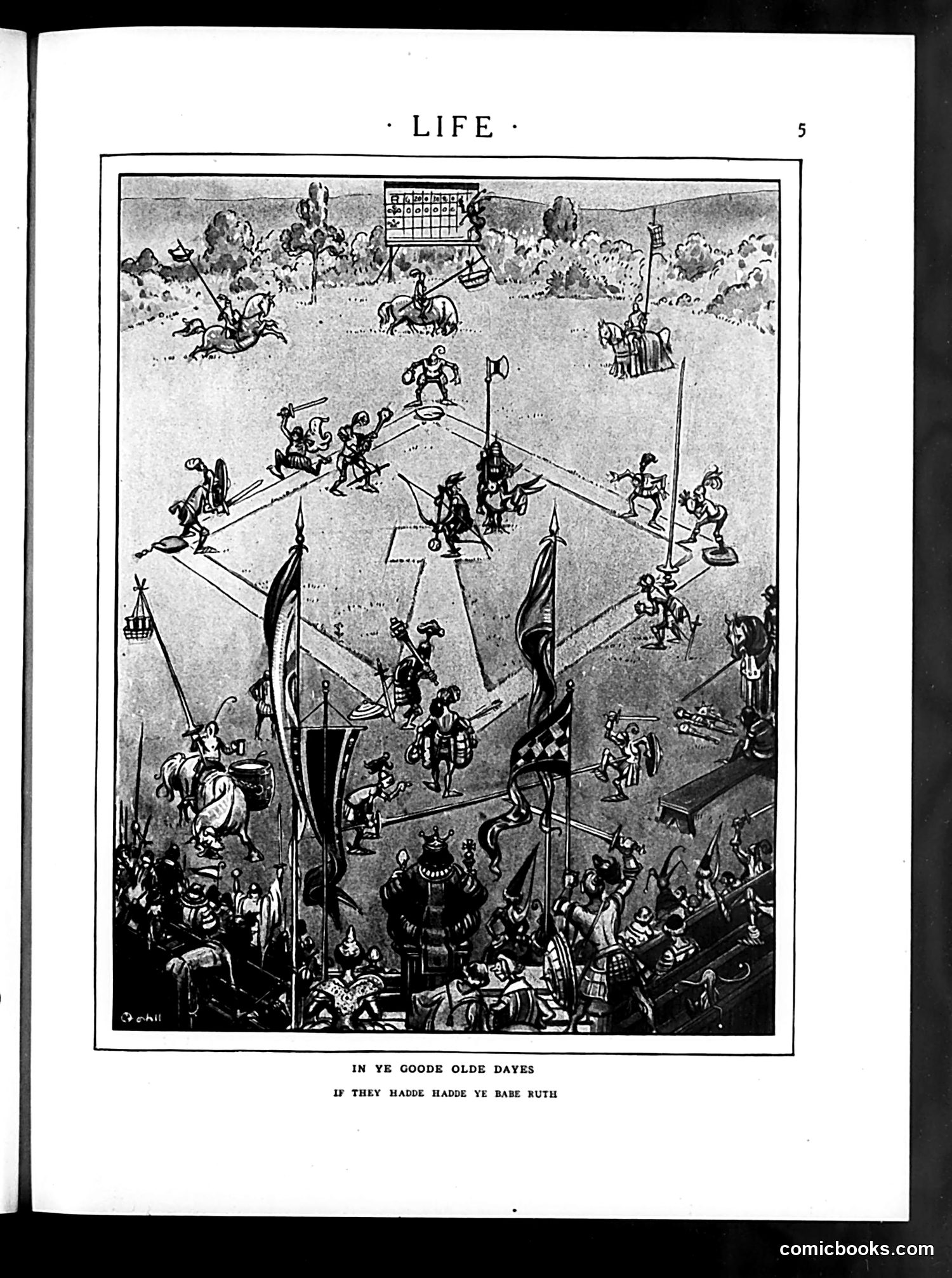
This cartoon satirizes medieval warfare and tournaments. The subtitle "If they hadde hadde ye bare ruth" uses archaic English for comic effect, suggesting this depicts "the good old days" ironically. The image shows a chaotic battle scene with two armies beneath flags, mounted knights, foot soldiers, and spectators in stands. The satire likely critiques romanticized notions of chivalric warfare—contrasting the nostalgic "glorious past" with the messy, brutal reality depicted: crowded, disorganized, with casualties strewn about. Without a specific date visible, the target is unclear, though Life magazine frequently mocked 19th-century militarism and nostalgic idealization of historical violence.
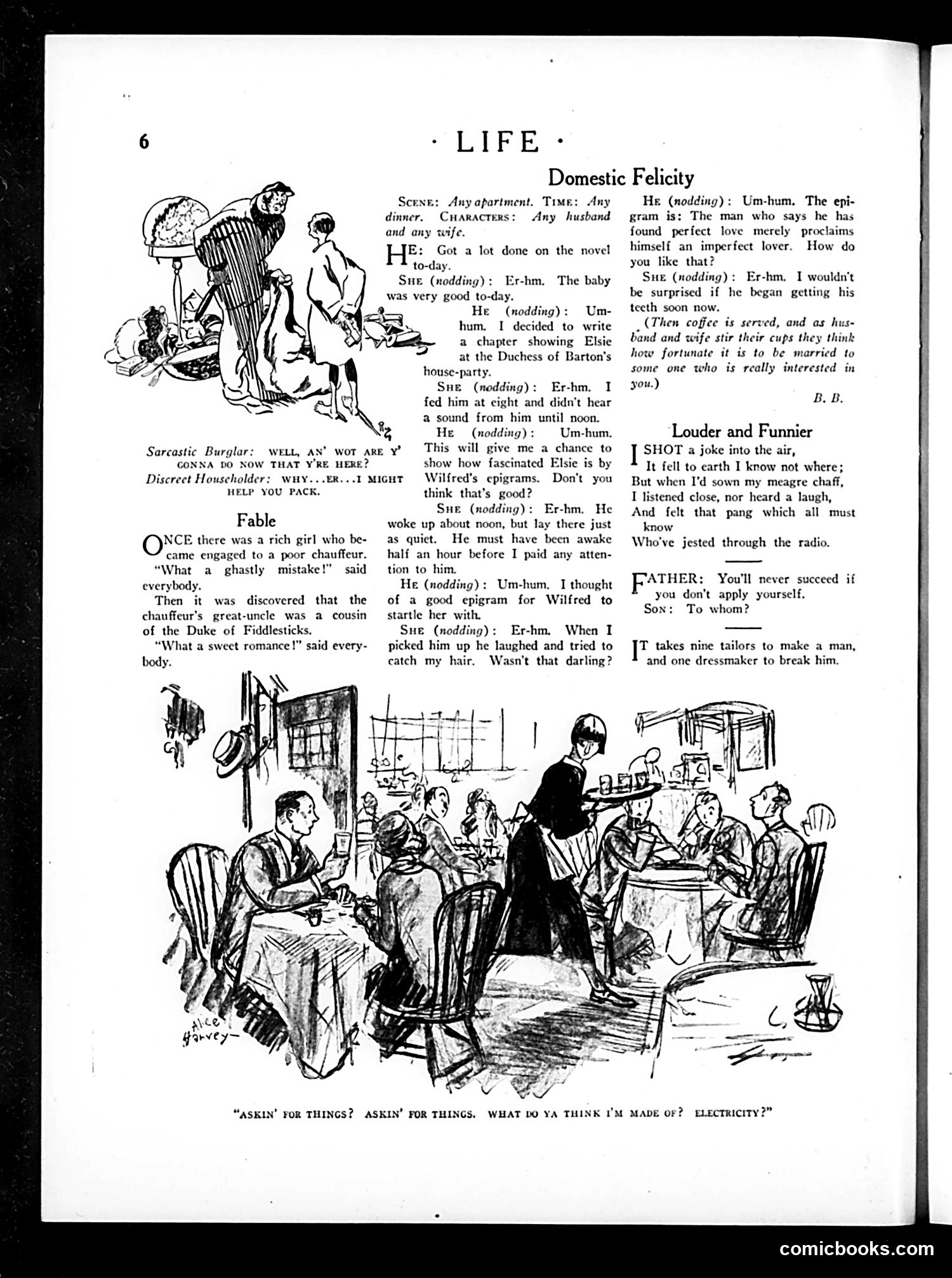
This page from *Life* magazine contains three satirical pieces: 1. **"Domestic Felicity"**: A husband and wife exchange banalities about their day—he wrote a novel chapter, she fed the baby. The satire mocks the tedium of domestic married life, presenting it as fundamentally dull despite the couple's attempts at cheerfulness. 2. **"Sarcastic Burglar" and "Fable"**: Brief humorous anecdotes. The fable mocks a rich girl engaged to a poor chauffeur whose great-uncle is a Duke—satirizing social climbing and mercenary romance. 3. **"Louder and Funnier"**: A short joke about radio entertainment disappointing the narrator. 4. **The main illustration** depicts a working-class dinner scene where someone loudly complains about "askin' for things," satirizing working-class domestic disputes and materialism.
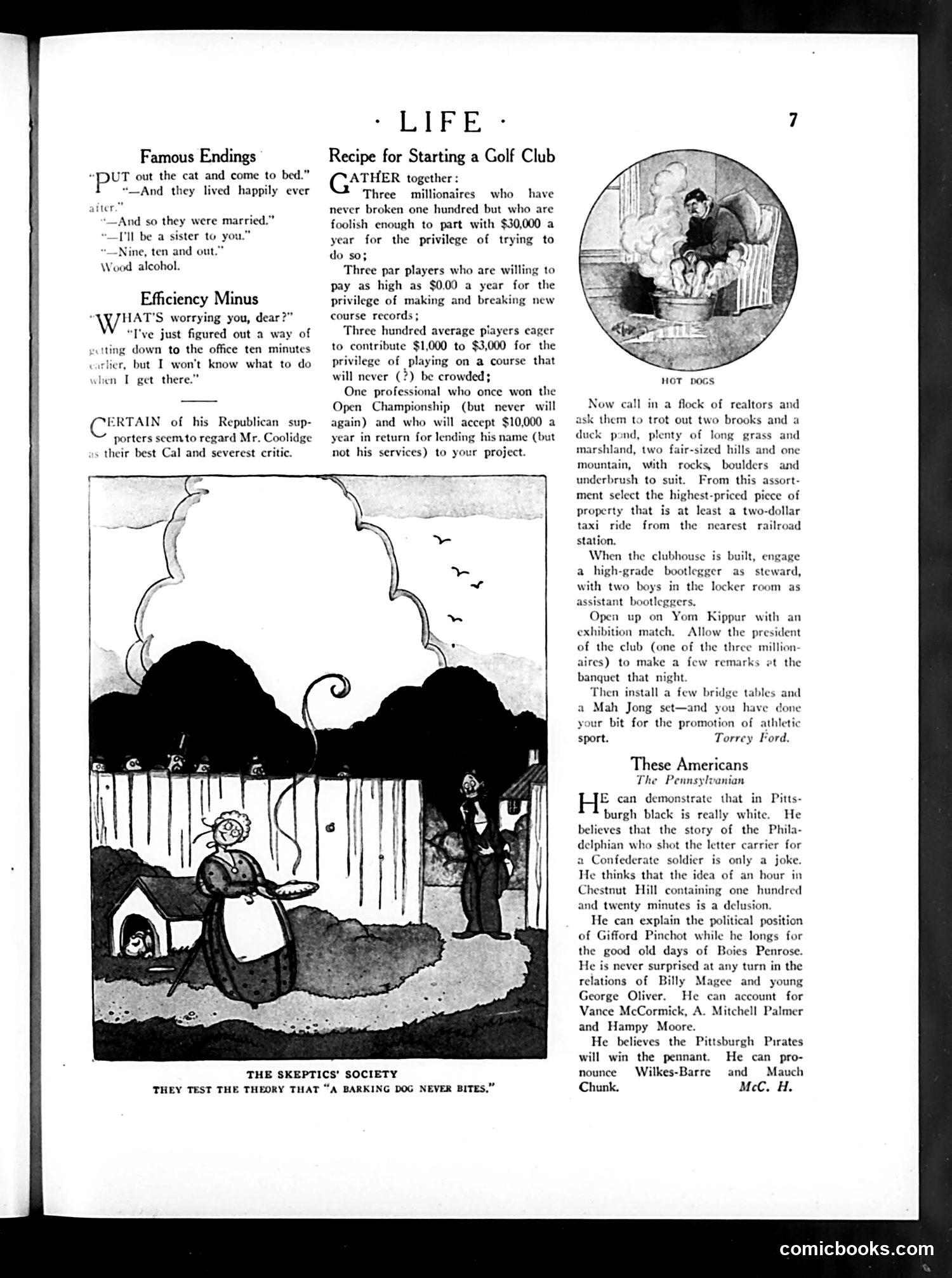
This cartoon satirizes skeptics who test whether "a barking dog never bites" by having a dog bite someone. The humor plays on the irony: the theory being tested is immediately disproven by the experiment itself—the victim becomes proof the dog *does* bite. The cartoon mocks pseudo-scientific thinking and overly literal hypothesis-testing. The "skeptics" are shown conducting their dubious experiment in what appears to be a confined space, with the unfortunate test subject experiencing the painful results firsthand. The satire targets people who claim to be rational investigators but reach absurd conclusions, or who test common wisdom in ways that produce obvious (and uncomfortable) answers. It's a jab at pretentious skepticism divorced from common sense.
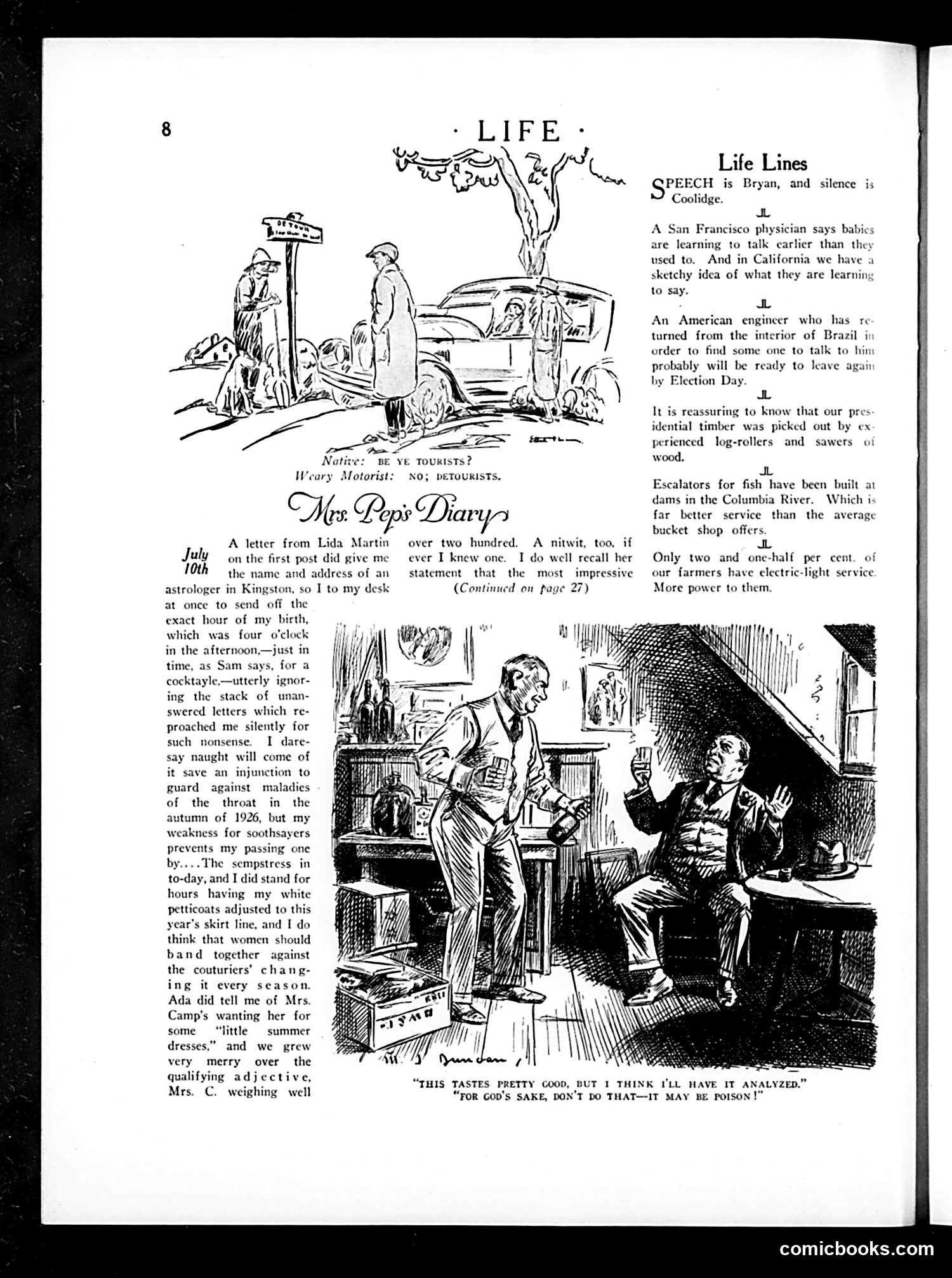
**Top Cartoon**: Shows tourists at a roadside stop asking a Native American "Are ye tourists?" The motorist responds "No; detours." This satirizes the era's car culture and the then-common phenomenon of tourists becoming lost on newly-developed American roads, ending up on unintended detours. **Mrs. Pep's Diary**: A personal column entry dated July 10th recounting domestic life—visiting an astrologer, social anxieties about fashion, and marital concerns. Typical of 1920s women's humor columns satirizing middle-class domestic preoccupations. **Bottom Comic**: A doctor warns a patient against eating something, joking it may be poison. Standard medical humor about questionable food safety or suspicious cooking.
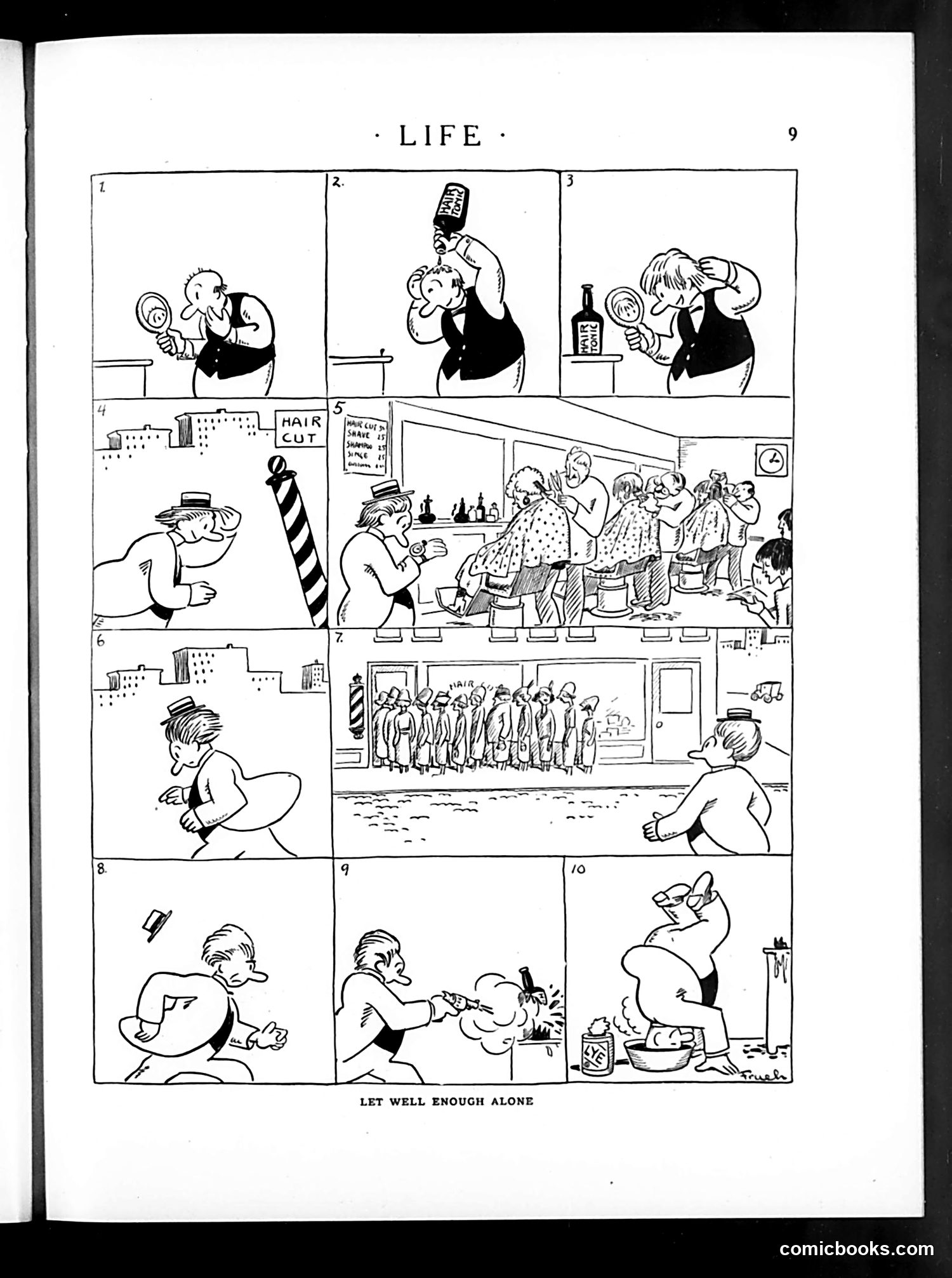
This ten-panel comic satirizes parental interference in children's lives. The title suggests parents should stop meddling. **The narrative:** A parent observes a young child's reflection, then repeatedly intervenes—applying hair treatments, arranging haircuts at a salon, and other beautification attempts. The child progressively resists and becomes distressed. **The satire:** The comic mocks parents who obsessively "improve" their children's appearances and behavior rather than accepting them naturally. Each panel shows escalating chaos resulting from the parent's interventions: the child grows increasingly upset, eventually playing in dirt and making messes—the opposite of the parent's intended refinement. **The joke:** By trying to "fix" the child, the parent creates worse problems, illustrating the period's emerging parenting debate about over-control versus permissiveness.
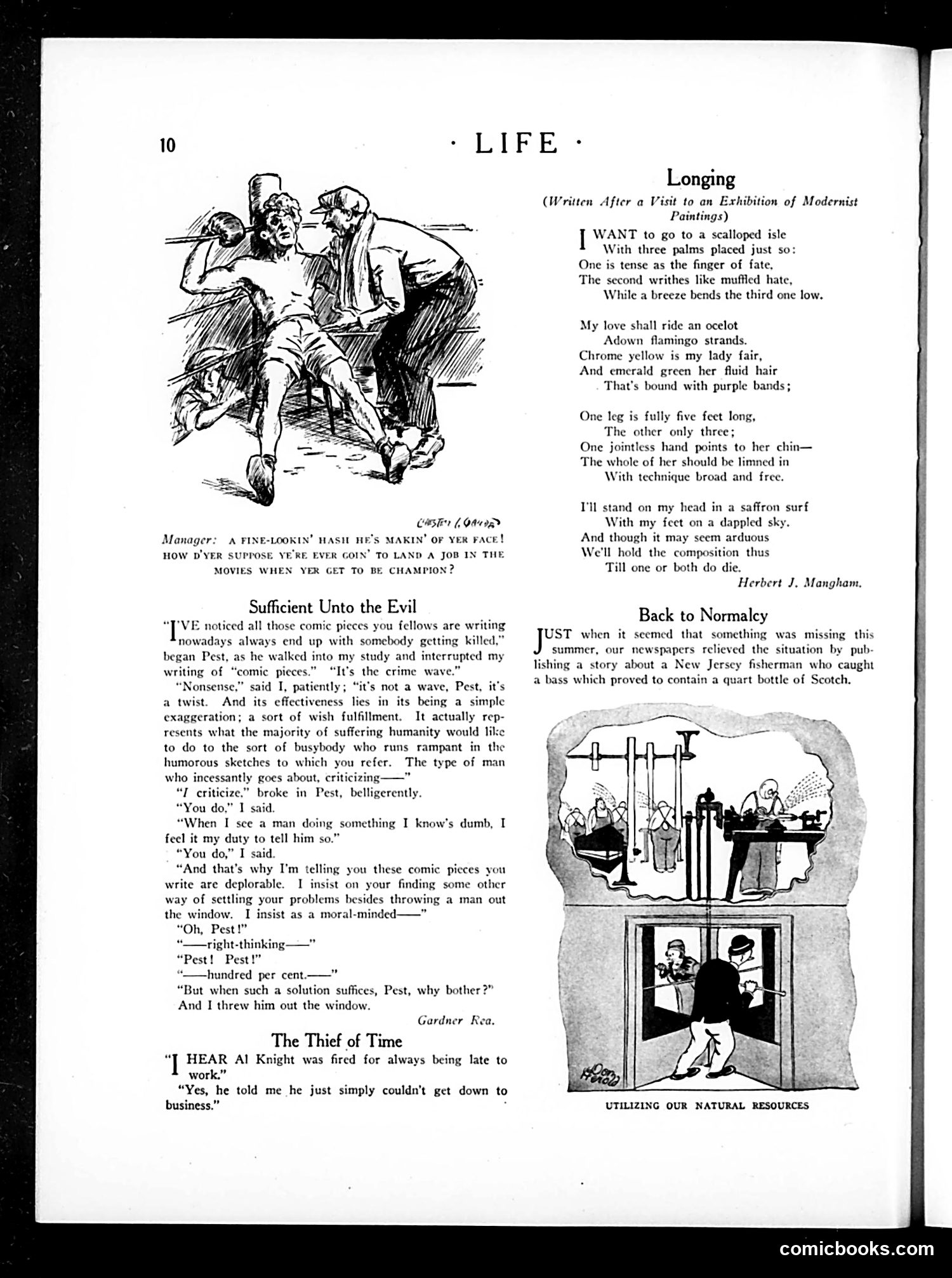
This page contains several satirical pieces typical of Life's humor: **Top cartoon**: Shows three men carrying an unconscious or limp figure. The caption mocks Hollywood's approach to creating movie "champions," suggesting the film industry manufactures stars rather than discovering genuine talent. **"Sufficient Unto the Evil"**: Gardner Rea critiques comic writing that always ends with someone killed. He argues this represents lazy problem-solving—that flinging a character out a window is easier than genuinely resolving conflicts. The piece advocates for more sophisticated humor that addresses real problems people face. **"The Thief of Time"**: A brief joke about an employee fired for chronic lateness, who claims he "couldn't get down to business"—a pun on time management. **"Back to Normalcy"**: A cartoon about a New Jersey fisherman who caught a bass containing a bottle of Scotch—likely a Prohibition-era reference to bootlegging or smuggled liquor.
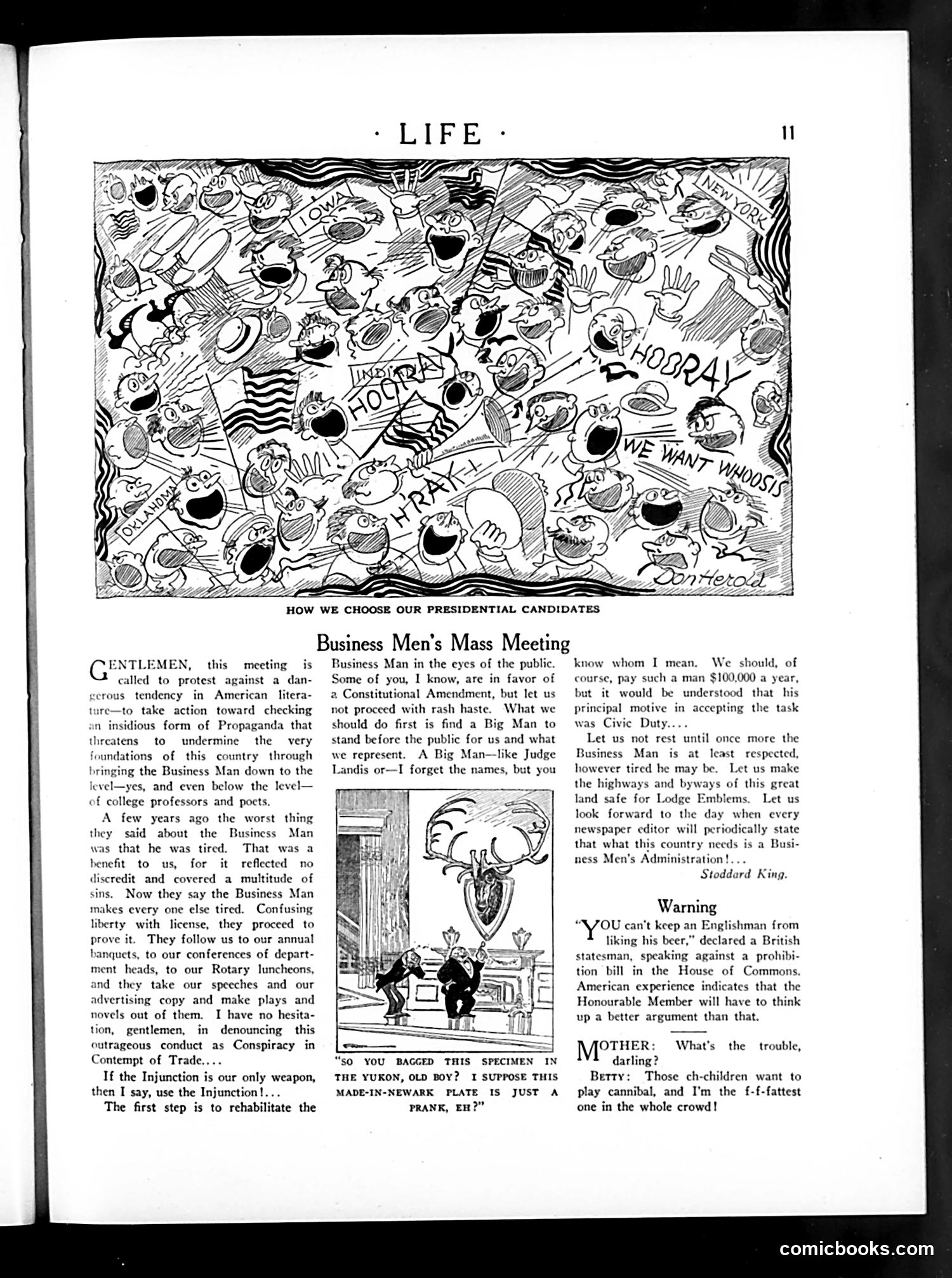
The top cartoon depicts a chaotic "Business Men's Mass Meeting" with caricatured figures shouting "HOORAY!", "WE WANT WINDOSIS", and other exclamations—satirizing corporate enthusiasm and mob mentality among businessmen. The accompanying article criticizes businessmen as sources of propaganda threatening American institutions. The author argues businessmen should be respected public figures but warns against their influence on policy. The lower cartoon mocks Prohibition enforcement, showing officials examining a suspicious "Yukon Old Boy" specimen supposedly made in Newark—a veiled reference to illegal alcohol production during Prohibition. The final dialogue between "Mother" and "Betty" jokes about children's cannibalistic impulses, appearing unrelated to the main political content. Overall, the page satirizes both corporate influence on American democracy and Prohibition-era hypocrisy.
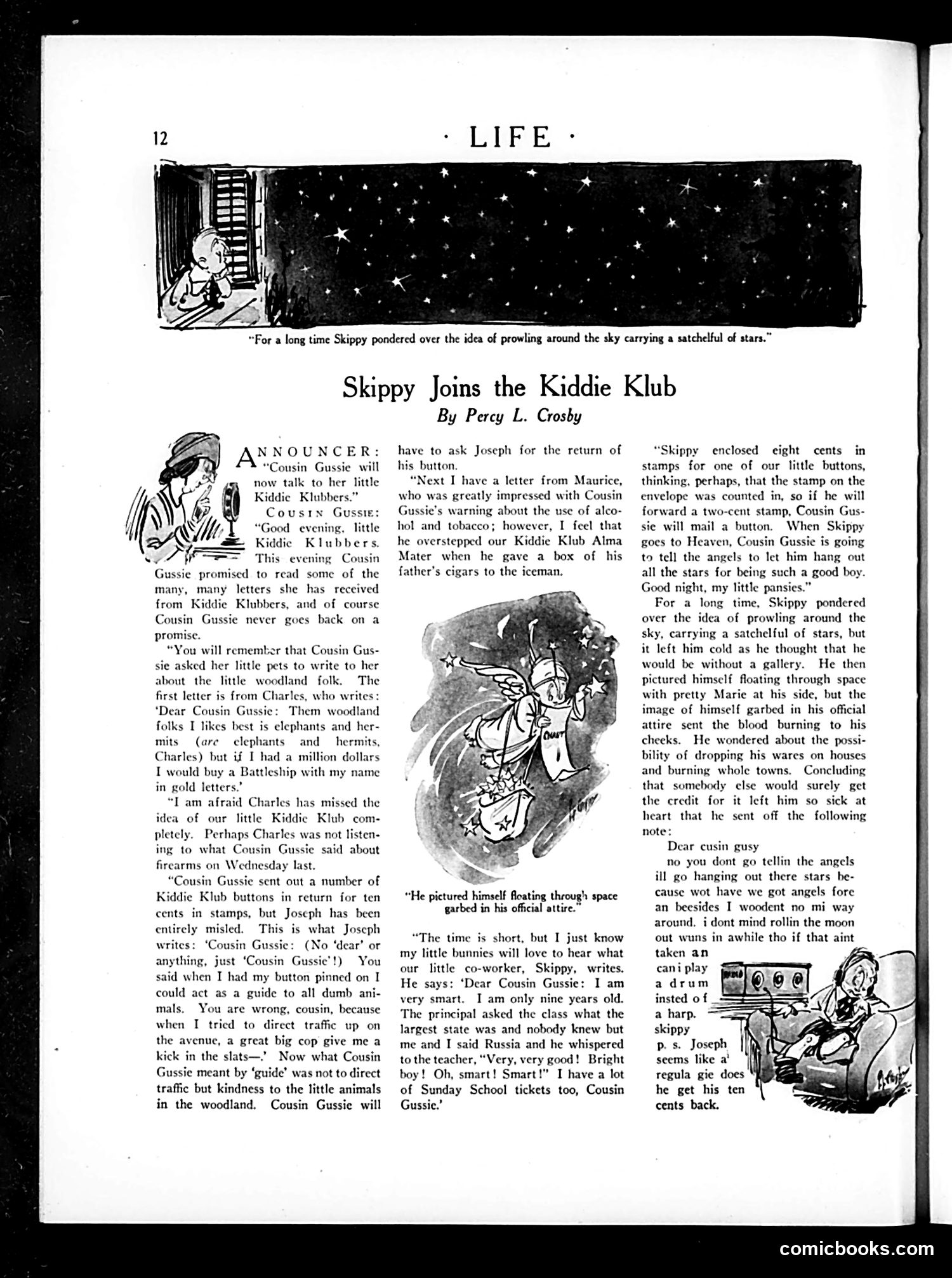
This is a children's story by Percy L. Crosby featuring **Skippy**, a popular comic strip character of the era. The narrative involves Skippy's cousin Gussie receiving letters from the "Kiddie Klub," a children's club that awards buttons for membership. The story satirizes children's clubs and mail-order schemes—common in early 20th-century America—that encouraged kids to collect stamps, buttons, and tickets. The humor centers on Skippy's imaginative fantasies (shown in the illustration of him floating through space) and the innocent logic of children responding to these club promotions. The tale gently mocks both children's gullibility and the marketing tactics targeting them, while celebrating childhood imagination.
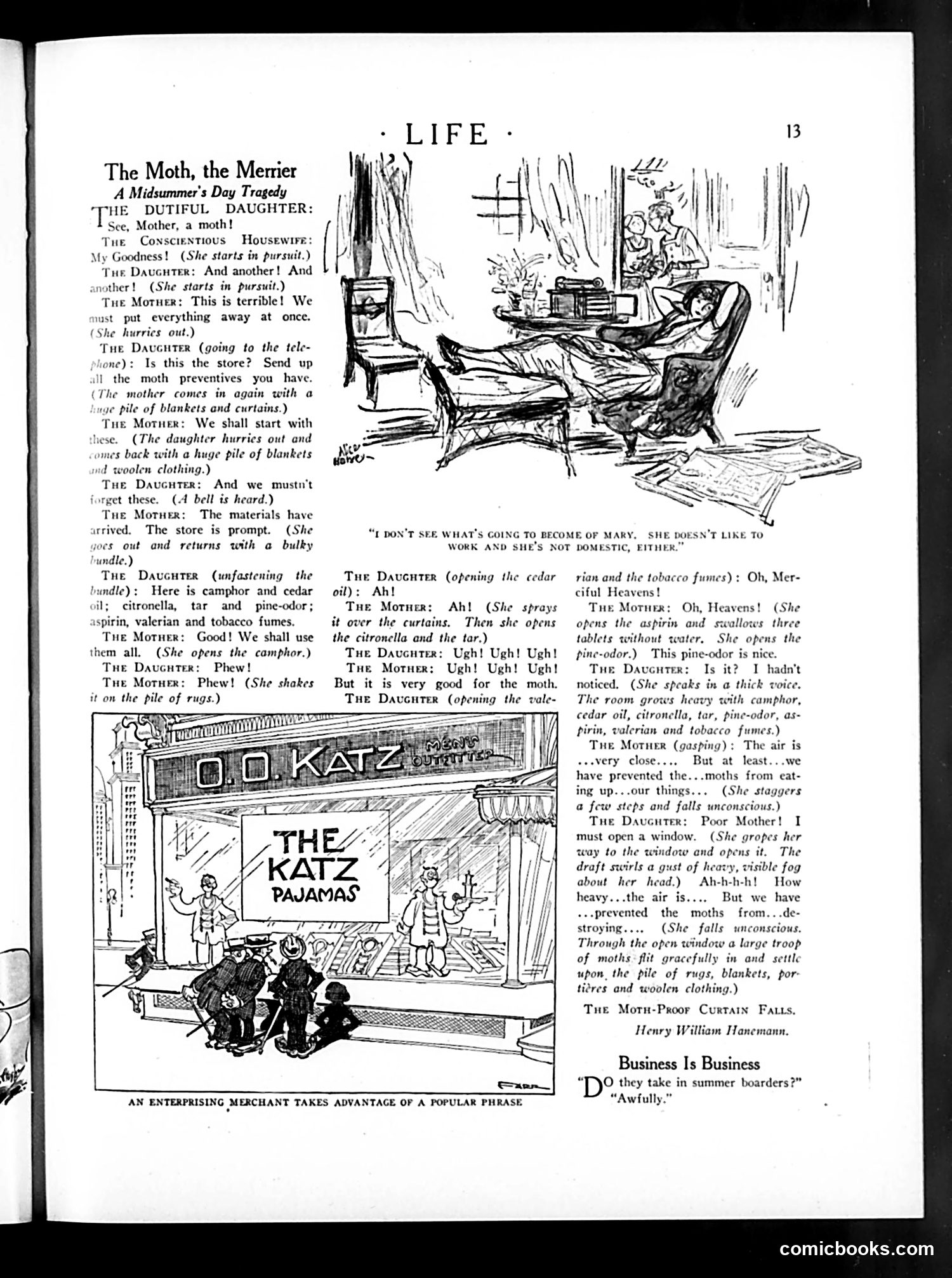
This sketch satirizes domestic chaos. A mother and daughter argue about pest control while preparing their home. The daughter insists on calling a store to order moth preventatives, while the conscientious mother proposes using camphor, cedar oil, and other traditional fumigants to protect their belongings from moths—a genuine household concern of the era. The humor lies in the clash between the daughter's modern consumer impulse (ordering from a store) and the mother's practical, old-fashioned approach. The sketch also includes a Katz Pajamas advertisement (visible storefront), suggesting the connection between clothing, moths, and consumer anxiety about protecting one's wardrobe and household goods.
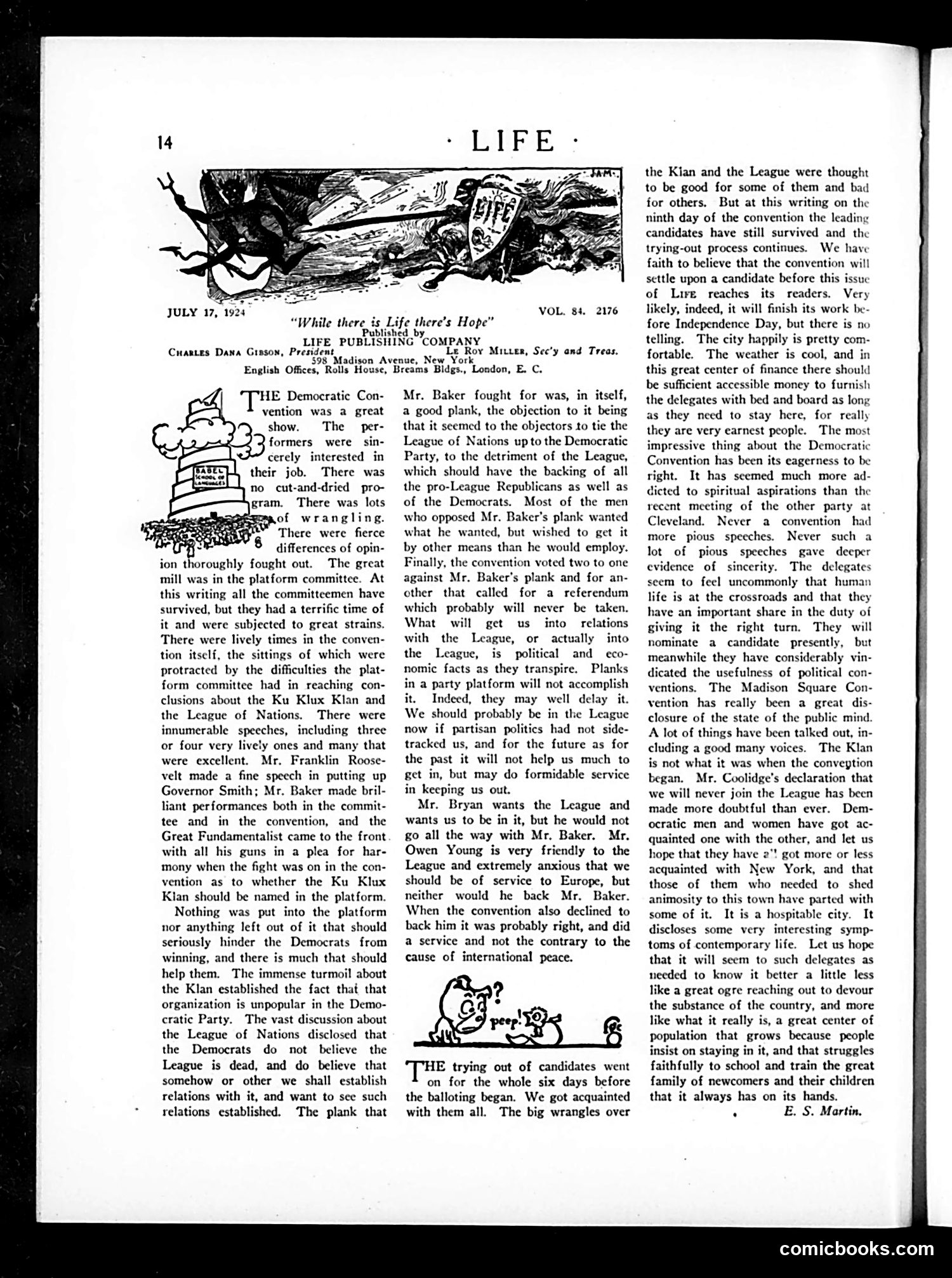
This page discusses the 1924 Democratic National Convention. The text criticizes the convention's bitter divisions over the League of Nations and the Ku Klux Klan's influence in American politics. The first cartoon (top) depicts a skeletal figure labeled "DIFF" (likely representing "Difference"), suggesting the convention's internal conflicts were deadening. The second cartoon (bottom) shows a pig labeled "PEEP" being prodded, apparently satirizing the candidate selection process, which the text notes was contentious and lasted six days before balloting began. The author (E.S. Martin) expresses hope that delegates would resolve their differences and nominate a viable candidate, while acknowledging the city was "comfortable" and well-supplied during these protracted negotiations.
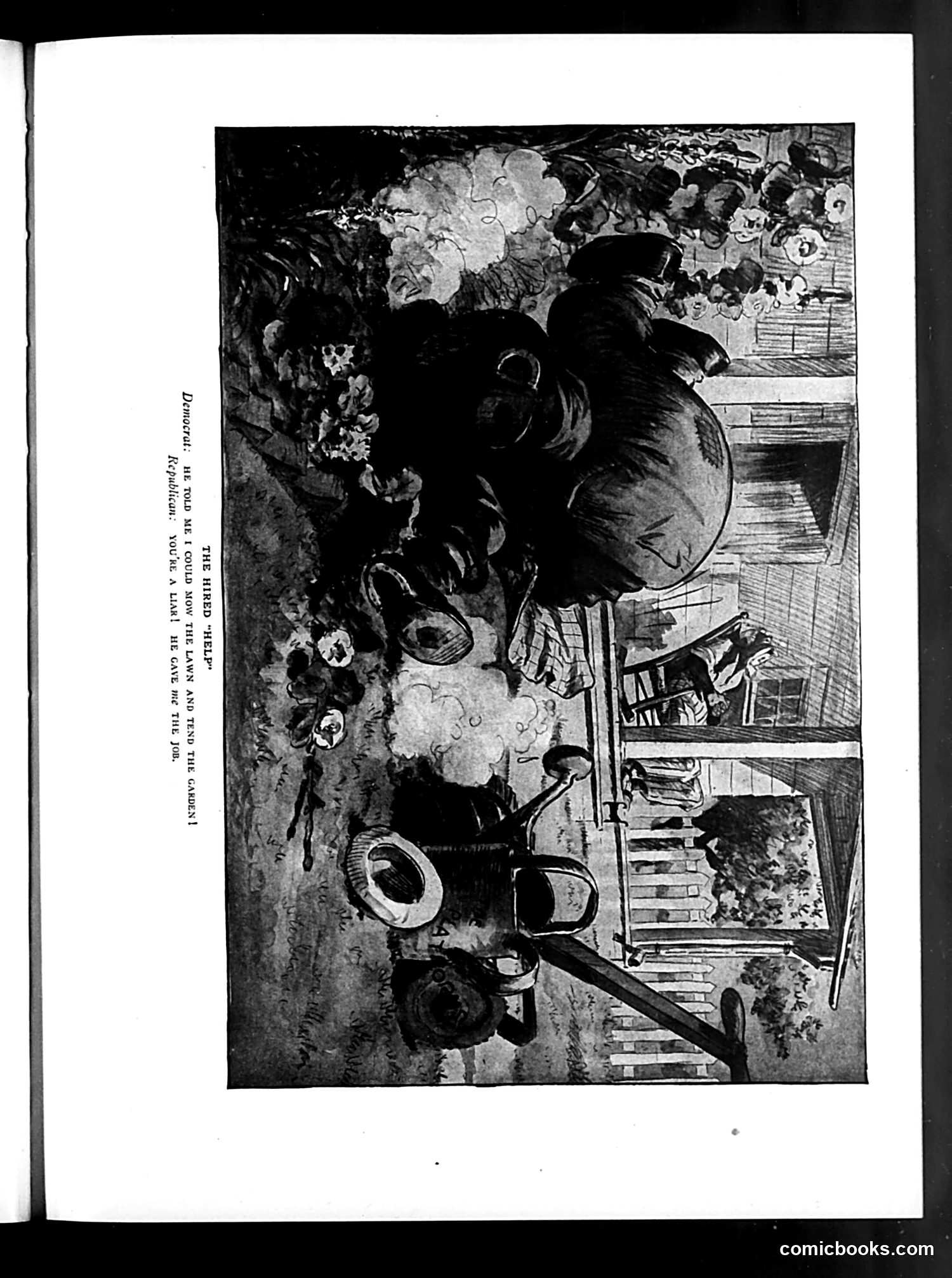
This appears to be a rotated illustration from Life magazine showing an interior domestic scene. The image depicts what looks like a parlor or sitting room with figures engaged in social interaction. Based on the style and the OCR text mentioning "The Three-Penny Opera" and references to "Beggar's Opera," this likely illustrates a scene from a theatrical adaptation or satirical commentary on Bertolt Brecht's work. The scene appears to show characters in period costume in an indoor setting with furniture and architectural details. However, without clearer visibility of specific faces or more legible text, I cannot definitively identify the particular figures being caricatured or the precise satirical point being made. The theatrical reference suggests this may be social or political commentary through dramatic adaptation rather than direct political satire.
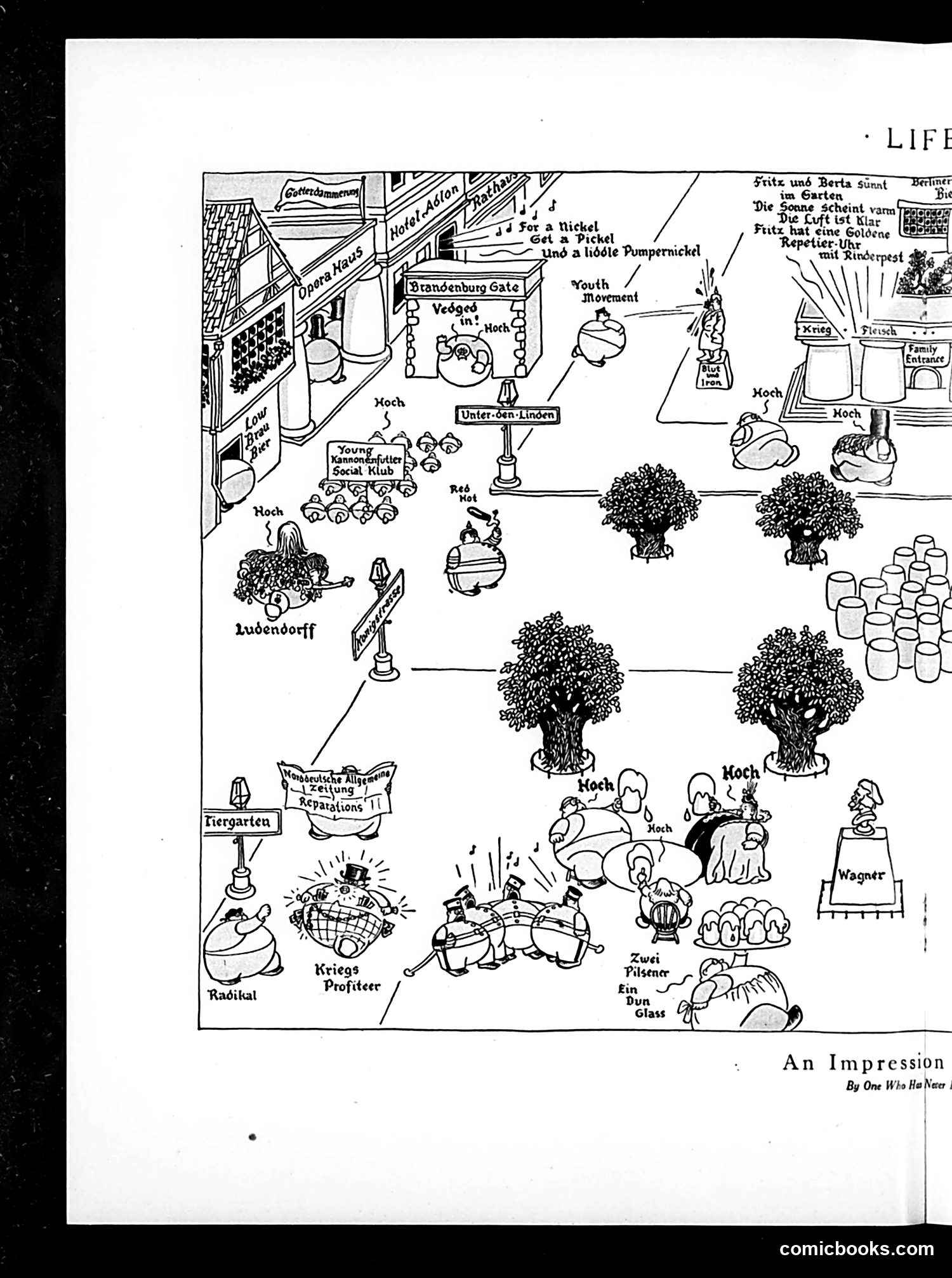
This is a German-language satirical cartoon titled "An Impression" depicting a Berlin street scene during what appears to be World War I or its aftermath. The map labels locations like "Brandenburg Gate" and "Unter den Linden," identifying this as Berlin. The cartoon mocks war profiteers and social chaos. "Kriegs Profiteer" (War Profiteer) is shown as a grotesque figure hoarding wealth while ordinary citizens struggle below. References to "Rinderpest" (cattle plague) and casual mentions of disease suggest food shortages and hardship. The contrast between the comfortable buildings above and the suffering masses below satirizes economic inequality during wartime. German captions mix cheerful observations ("The sun shines, the air is clear") with dark realities, creating bitter irony about civilian conditions while elites prospered from war.
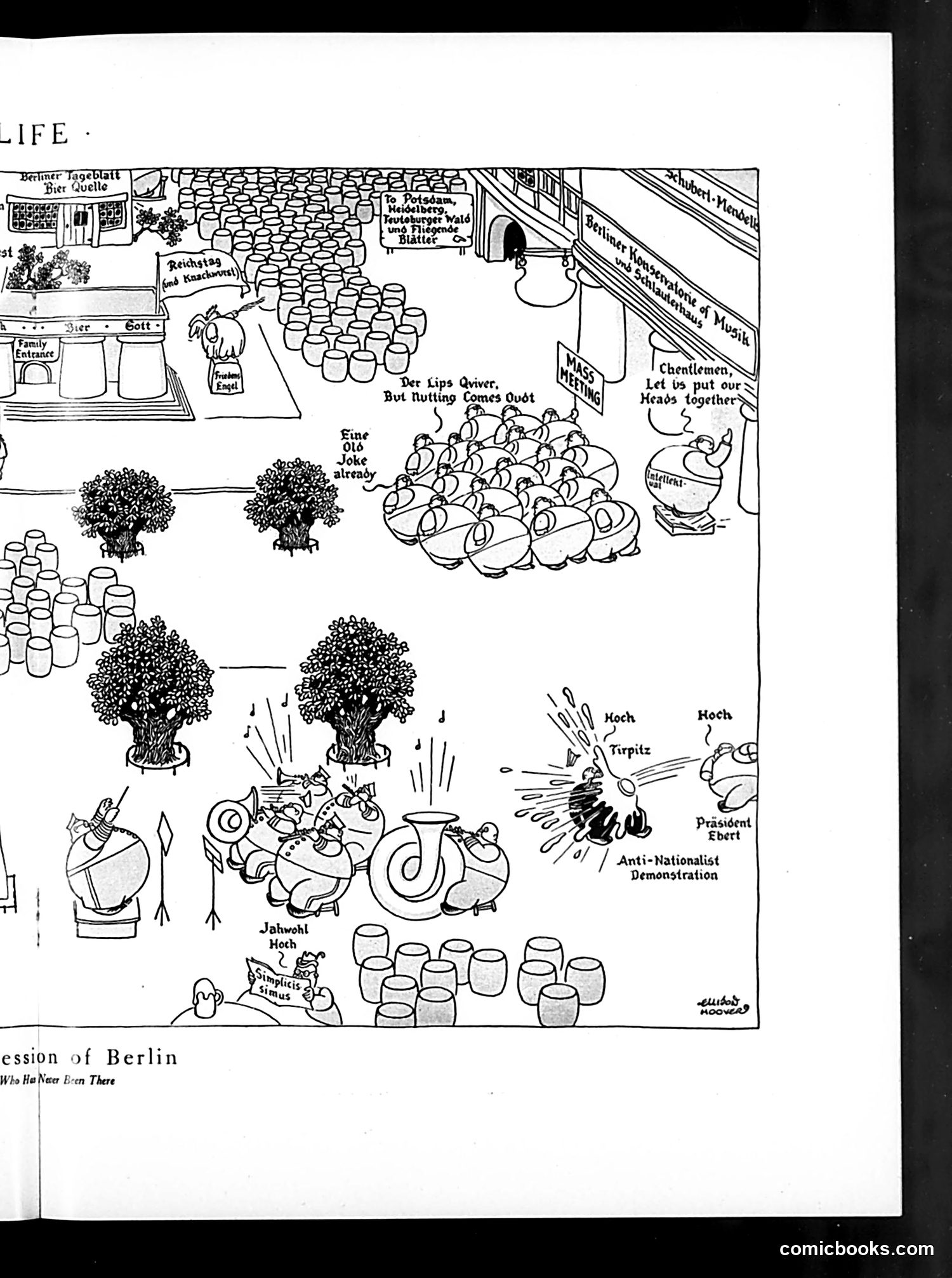
This satirical cartoon depicts post-WWI Berlin political turmoil. The scene shows President Ebert (identified by label) amid chaos including an "Anti-Nationalist Demonstration" with figures labeled "Hoch" (meaning "hurrah"), "Türpitz" (likely referring to German admiral Alfred von Tirpitz), and various disturbances with trees being uprooted and beer barrels scattered. The cartoon satirizes Berlin's instability during the Weimar Republic's early years (circa 1919-1920), when political violence, nationalist agitation, and competing ideological factions threatened civil order. The "secession" title suggests the threat of the city fragmenting politically. The chaotic imagery—upended trees, scattered barrels, fighting figures—visualizes the disorder and competing political forces (nationalists, communists, republicans) battling for control of post-imperial Germany.
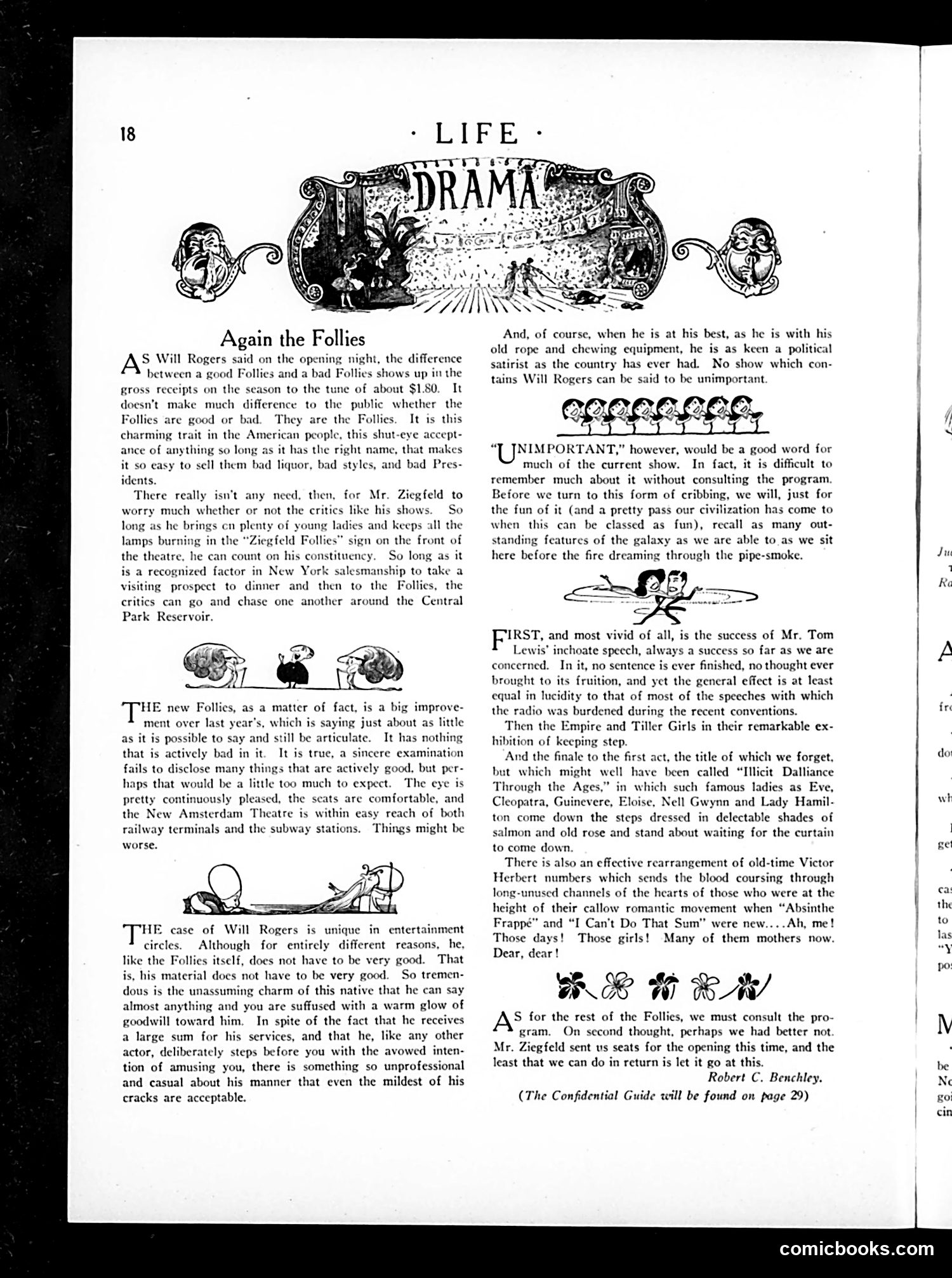
This is a theater review by Robert C. Benchley critiquing the Ziegfeld Follies, a famous American musical revue. The piece uses satire to comment on both entertainment and politics. **Key figures mentioned:** - **Will Rogers**: A comedian-performer whose charm and political wit ("keen a political satirist") make him valuable regardless of material quality - **Florenz Ziegfeld**: Producer of the Follies, unconcerned with critics because the show's brand-name appeal guarantees commercial success - **Tom Lewis**: A performer whose rambling, unfinished speeches mirror actual radio convention speeches—satirizing contemporary political discourse **The satire's point**: Benchley argues that Americans uncritically accept anything branded "the Follies," just as they accept "bad liquor, bad styles, and bad Presidents"—a pointed jab at 1920s consumer culture and political gullibility. The Follies succeed through reputation and spectacle rather than merit, reflecting broader American complacency. The review is witty social commentary disguised as theater criticism.
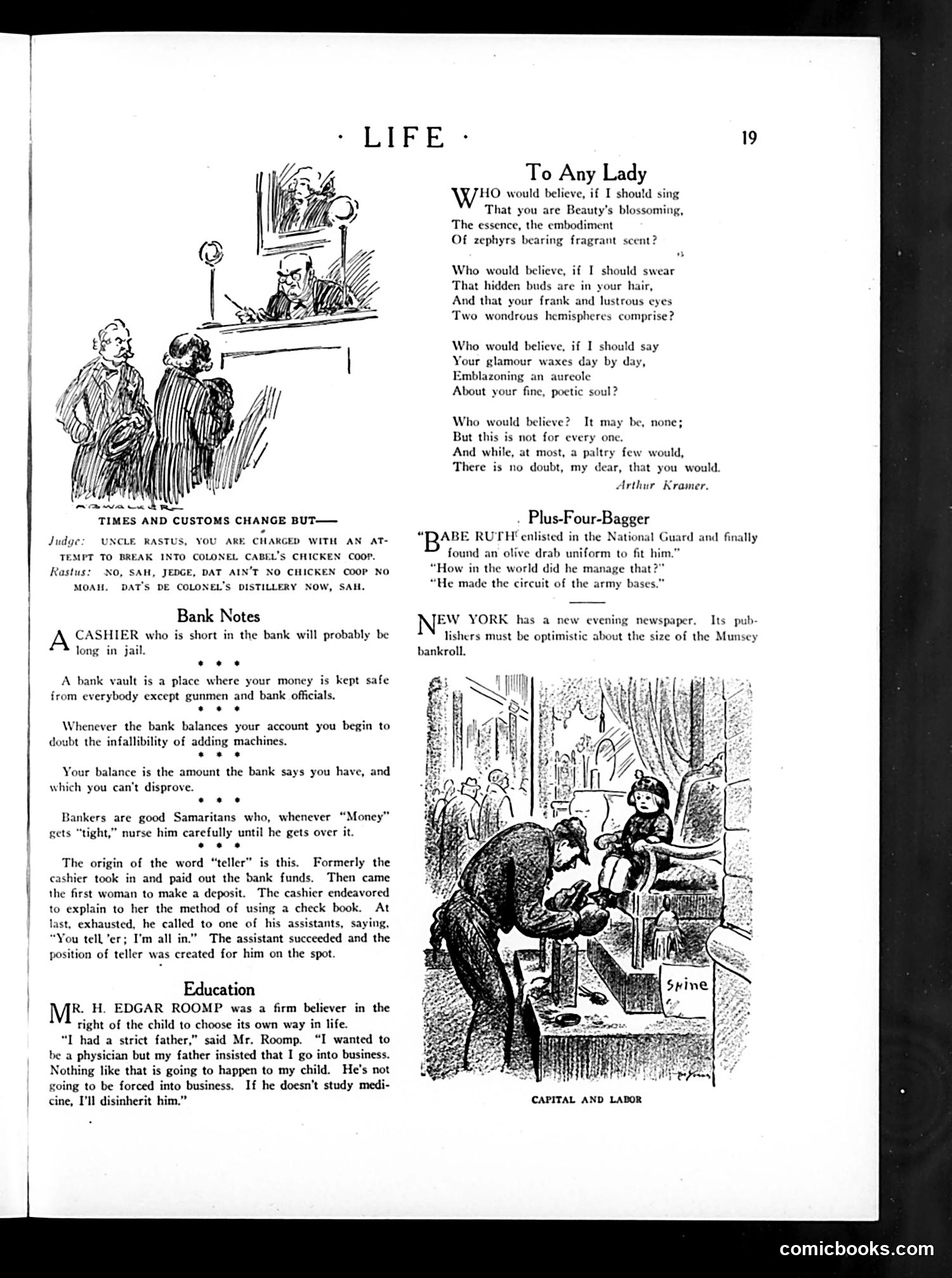
This page contains three satirical pieces from *Life* magazine: **"Times and Customs Change But—"**: A racist dialect joke playing on Prohibition-era hypocrisy. An African American man ("Uncle Rastus") is arrested for attempting to break into what he thought was a chicken coop, but it's now the Colonel's illegal distillery. The humor relies on period racial stereotypes and mocking Black vernacular speech. **"Bank Notes"**: A series of humorous one-liners satirizing banking practices—skepticism about bank math, inability to dispute bank statements, and the etymology of "teller" (supposedly from a cashier telling an assistant to "tell her" how checks work). **"Education"**: A brief anecdote mocking parental hypocrisy: a father who resented his own strict upbringing swears he won't force his child into business—yet threatens to disinherit him if he doesn't study medicine instead. The page also includes a small cartoon about labor and capital (unclear without full context) and brief items about Babe Ruth and a new New York newspaper.
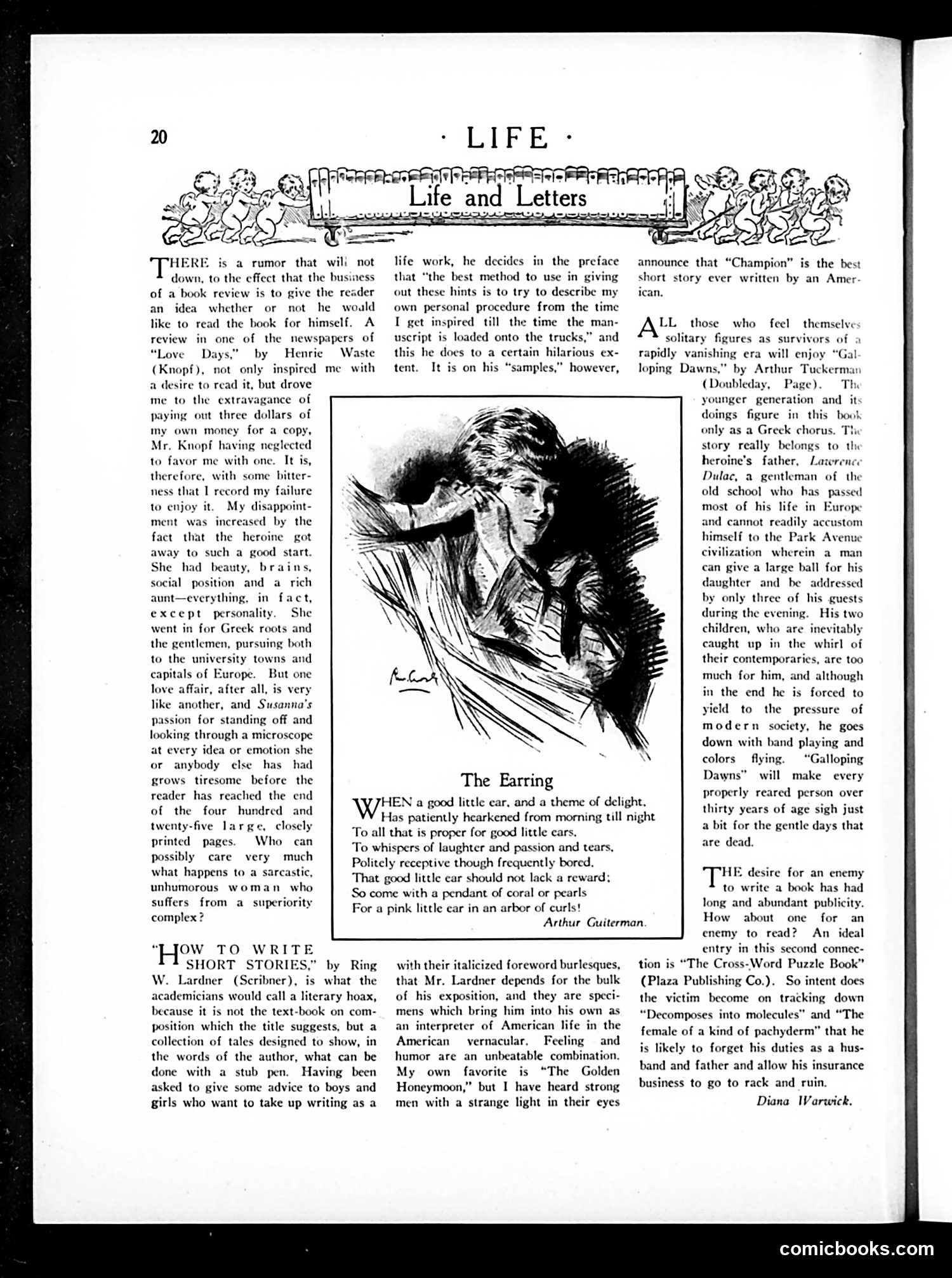
This page from *Life* magazine presents literary reviews and commentary. The central illustration depicts "The Earring," accompanying a whimsical poem by Arthur Guiterman celebrating a "good little ear" receiving jewelry—likely satirizing sentimental Victorian verse. The reviews critique contemporary novels. One dismisses "Love Days" by Henrie Waste as featuring a heroine with every advantage except personality, whose obsessive intellectualism becomes tedious. Another praises "Galloping Dawns" by Arthur Tuckerman as appealing to those nostalgic for a vanishing aristocratic era—the protagonist an old-school European gentleman bewildered by modern Park Avenue society. The page also discusses Ring W. Lardner's "How to Write Short Stories," which the reviewer frames as deliberate literary satire rather than genuine instruction, using exaggerated examples to showcase American vernacular life. The overall tone critiques both overwrought literary pretension and nostalgia for disappearing upper-class customs.
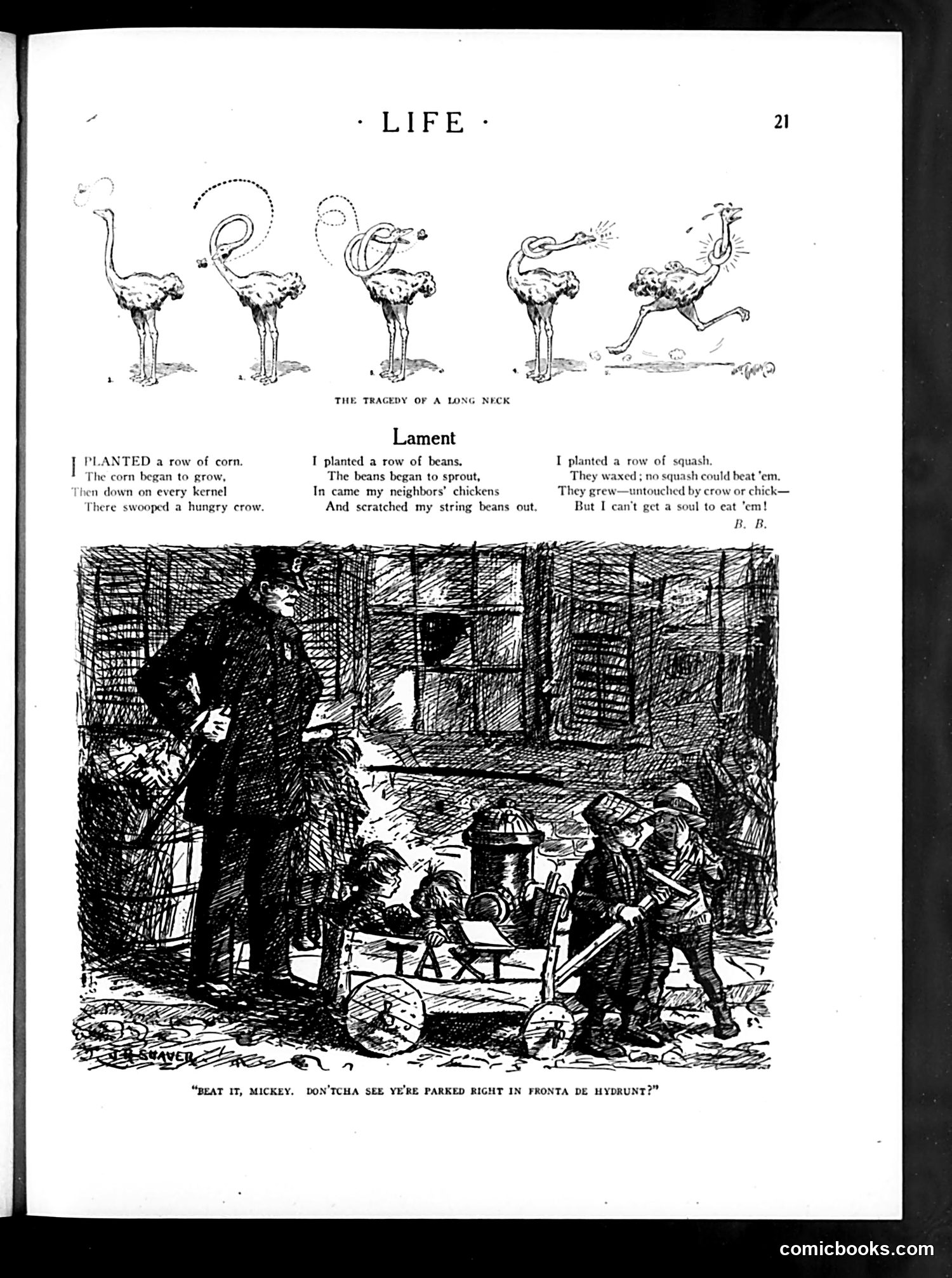
**Top Section ("The Tragedy of a Long Neck"):** A cartoon sequence showing an ostrich with progressively contorted neck positions, illustrating the bird's attempts to manage various problems—likely a visual gag about the impracticality of having an excessively long neck. **"Lament" Poem:** Three farmers lament crop failures: one loses corn to a crow, another loses beans to chickens, and a third cannot sell squash. This is straightforward agricultural humor about rural hardships and poor harvests. **Bottom Cartoon:** A street scene where a policeman orders "Mickey" (a child) to move a toy/miniature taxi parked in front of a fire hydrant. The joke plays on formal traffic enforcement language applied to a child's toy—a satire of overzealous municipal regulation, or humorous commentary on how even children's play must comply with city rules. The page reflects early-20th-century American life: farming struggles, urban growth, and bureaucratic absurdity.
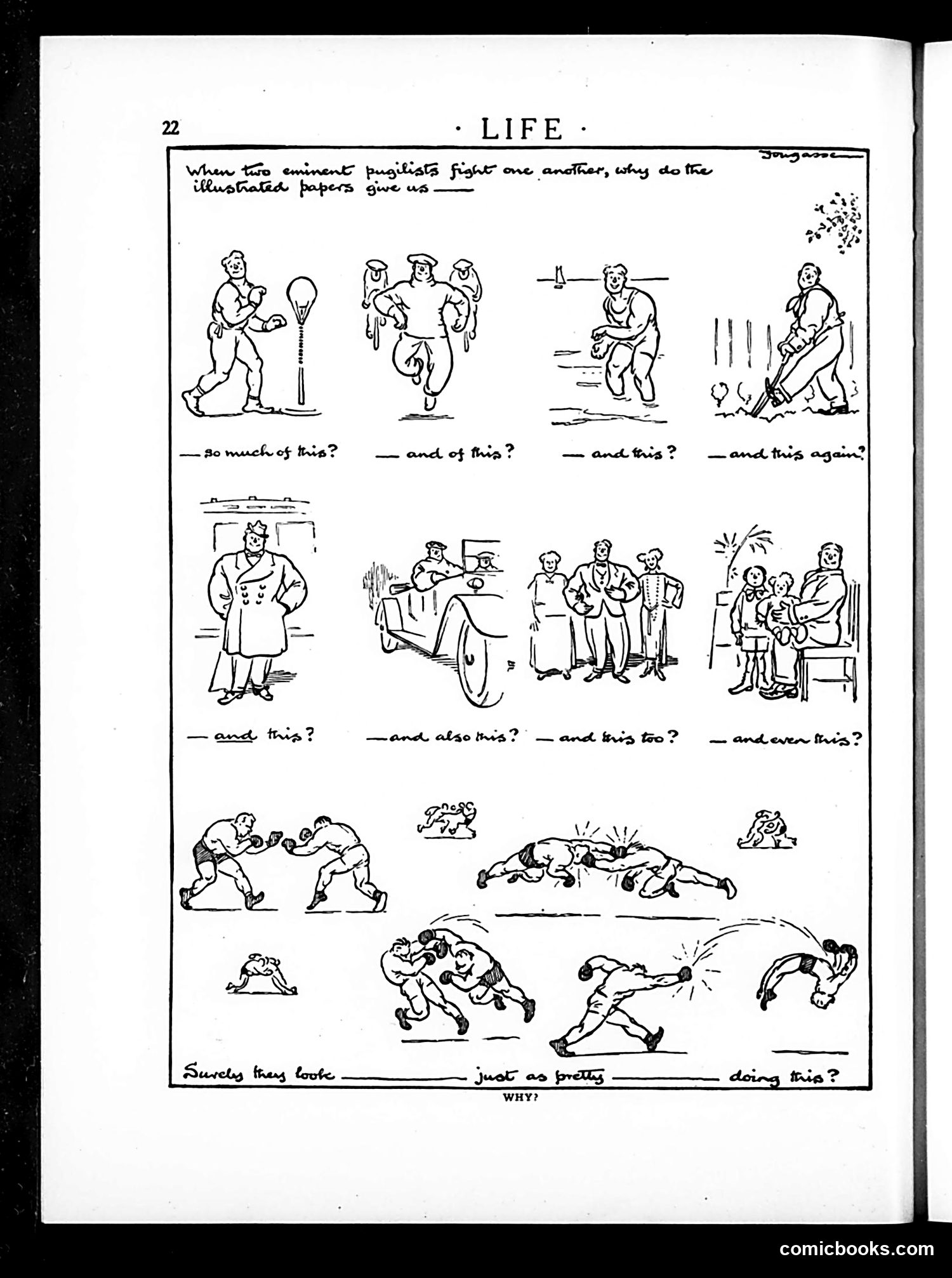
This single-page cartoon satirizes the bewildering variety of activities and pursuits that occupy human life. The top section shows everyday leisure activities (sports, hobbies, domestic tasks) with repeated captions asking "So much of this? and of this? and this again?" The bottom half depicts increasingly violent and aggressive behaviors—fighting, boxing, wrestling—captioned "Surely they look ___ just as pretty ___ doing this?" The cartoon's central joke is captured in the final word: "WHY?" The satire suggests the absurdity and contradiction of human priorities: we engage in countless trivial pursuits, yet devote equal or greater energy to violence and conflict. The piece critiques either human nature's violent impulses or society's acceptance of aggression alongside civilized activities.
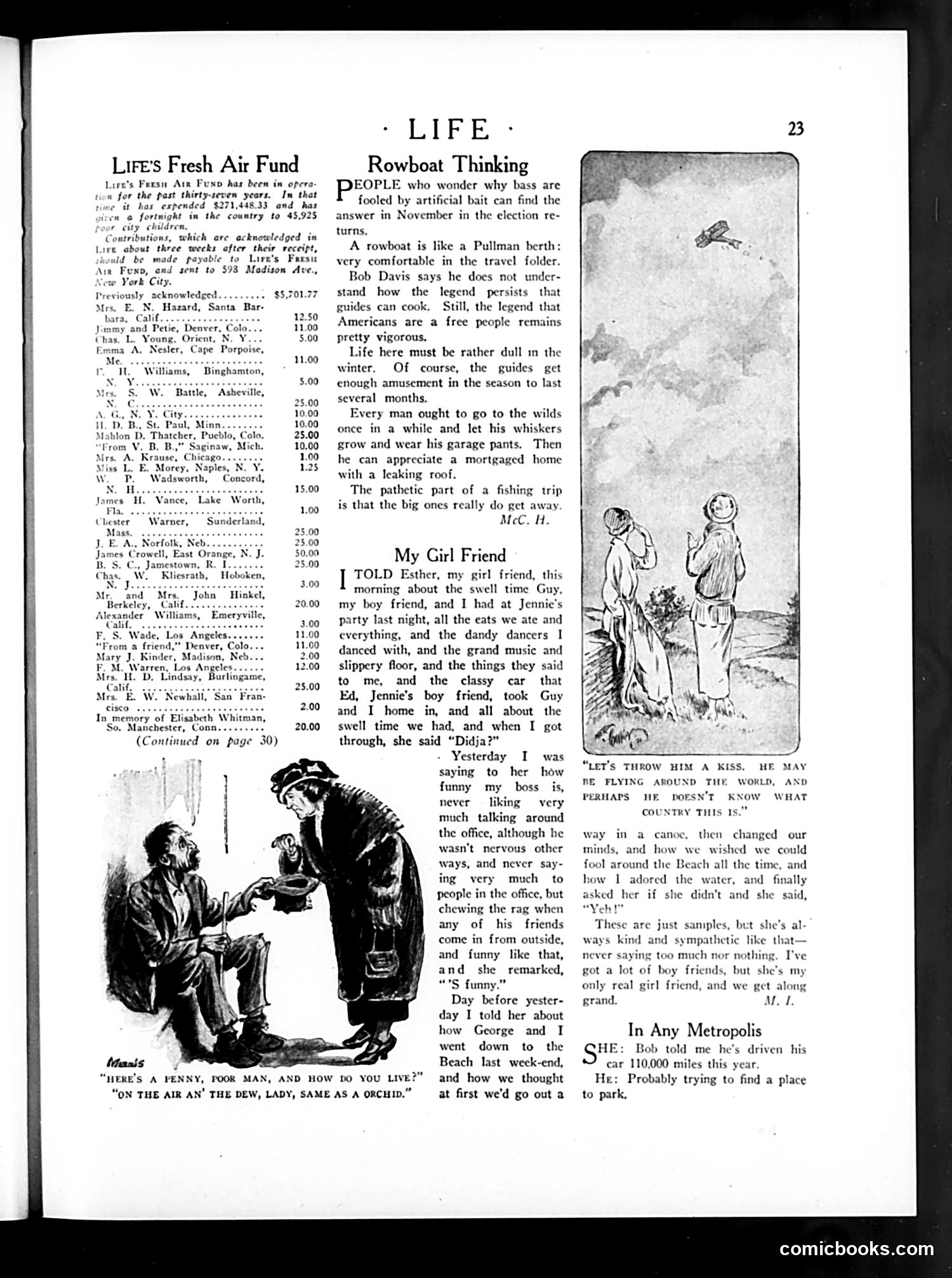
This page contains three distinct pieces of social satire typical of Life magazine's humor: **"Life's Fresh Air Fund"** (left column): A charitable donations list for Life's program sending poor urban children to the countryside—a real philanthropic initiative the magazine promoted for 37 years. **The Penny Cartoon** (bottom left): A visual gag where a wealthy woman gives a penny to a poor man, asking how he survives. His reply—"on the air and the dew, lady, same as an orchid"—satirizes the condescension of the wealthy toward the poor. The orchid reference suggests the poor man equates himself to something delicate and useless, mocking both the woman's patronizing charity and society's indifference to actual poverty. **"Rowboat Thinking," "My Girl Friend," and "In Any Metropolis"** (right side): Brief humorous observations about human nature—comparing bass-fishing deception to election gullibility, describing a sympathetic female friend, and joking about car parking difficulties in cities. These are light social commentary on modern life's absurdities rather than political satire. The overall page blends charitable appeals with satirical humor about class, gender dynamics, and urban existence.
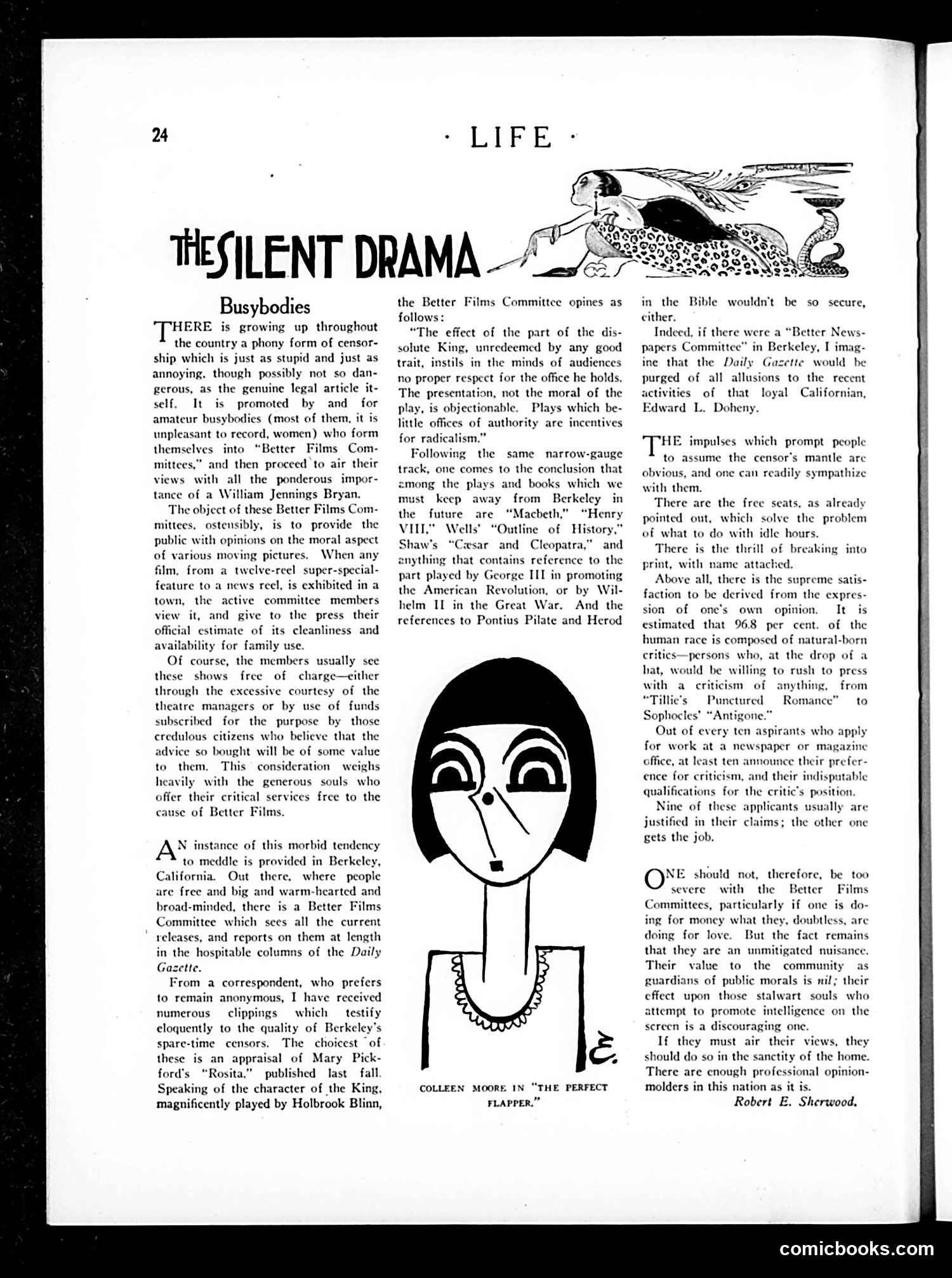
This article satirizes amateur "Better Films Committees"—citizen groups, mostly women, who self-appointed themselves as moral censors of movies and published their views in local newspapers. The author mocks their hypocrisy: they watched films free (courtesy of theaters or subscriptions), then lectured the public about propriety. He ridicules their absurd logic through example: Berkeley's committee condemned Mary Pickford's "Rosita" for depicting an immoral king, arguing it disrespected authority and encouraged "radicalism." Following this logic, they'd have to ban *Macbeth*, *Henry VIII*, history books, biblical references, and accounts of the American Revolution. The cartoon of "Colleen Moore in 'The Perfect Flapper'" illustrates the kind of modern, potentially "immoral" content these committees targeted. The author suggests these busybodies are mostly motivated by vanity—the free entertainment, idle hours filled, and ego satisfaction of seeing their opinions printed. He concludes such amateur censorship, while annoying rather than dangerous, discourages genuine intelligent cultural discussion.
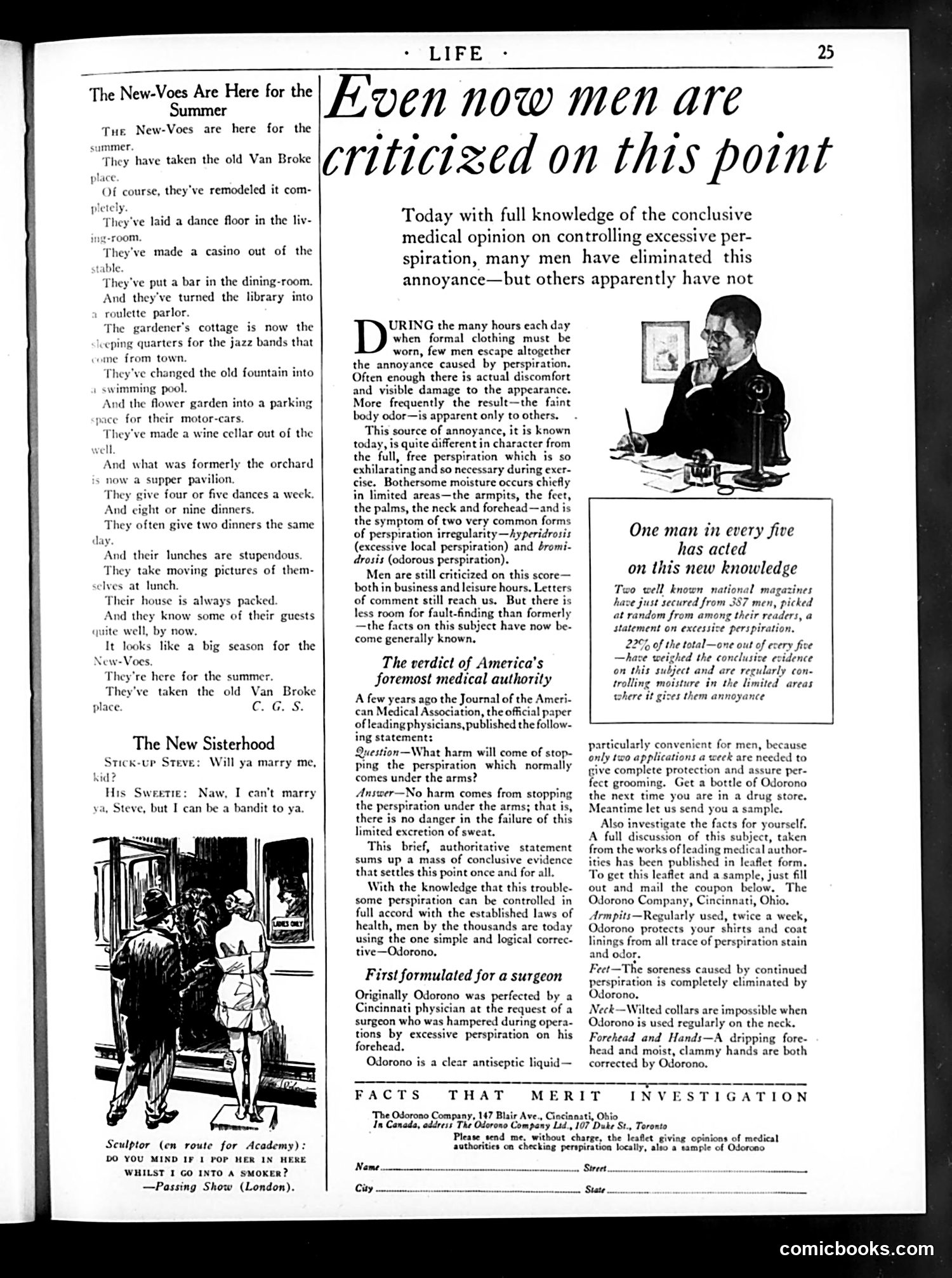
This page contains satirical content mocking the wealthy leisure class of 1920s America. **"The New-Voes Are Here for the Summer"** satirizes the newly rich ("New-Voes," a pun on "nouveaux riches") who have rented the Van Broke estate. The humor lies in their vulgar transformation of a traditional mansion: converting the library into a roulette parlor, the orchard into a supper pavilion, and installing multiple bars and casinos. The repetitive listing of constant parties, dinners, and jazz bands emphasizes their ostentatious excess and lack of restraint—they "know some of their guests quite well, by now" suggests they don't even remember who attends their own parties. **"The New Sisterhood"** is a brief joke about changing gender roles: a criminal ("Stick-up Steve") asks a woman to marry him, and she refuses but offers to be "a bandit" instead—implying women are now pursuing independent criminal careers rather than traditional domesticity. The remainder is a straightforward **Odorono antiperspirant advertisement**, citing medical authority to address male self-consciousness about perspiration—not satirical.
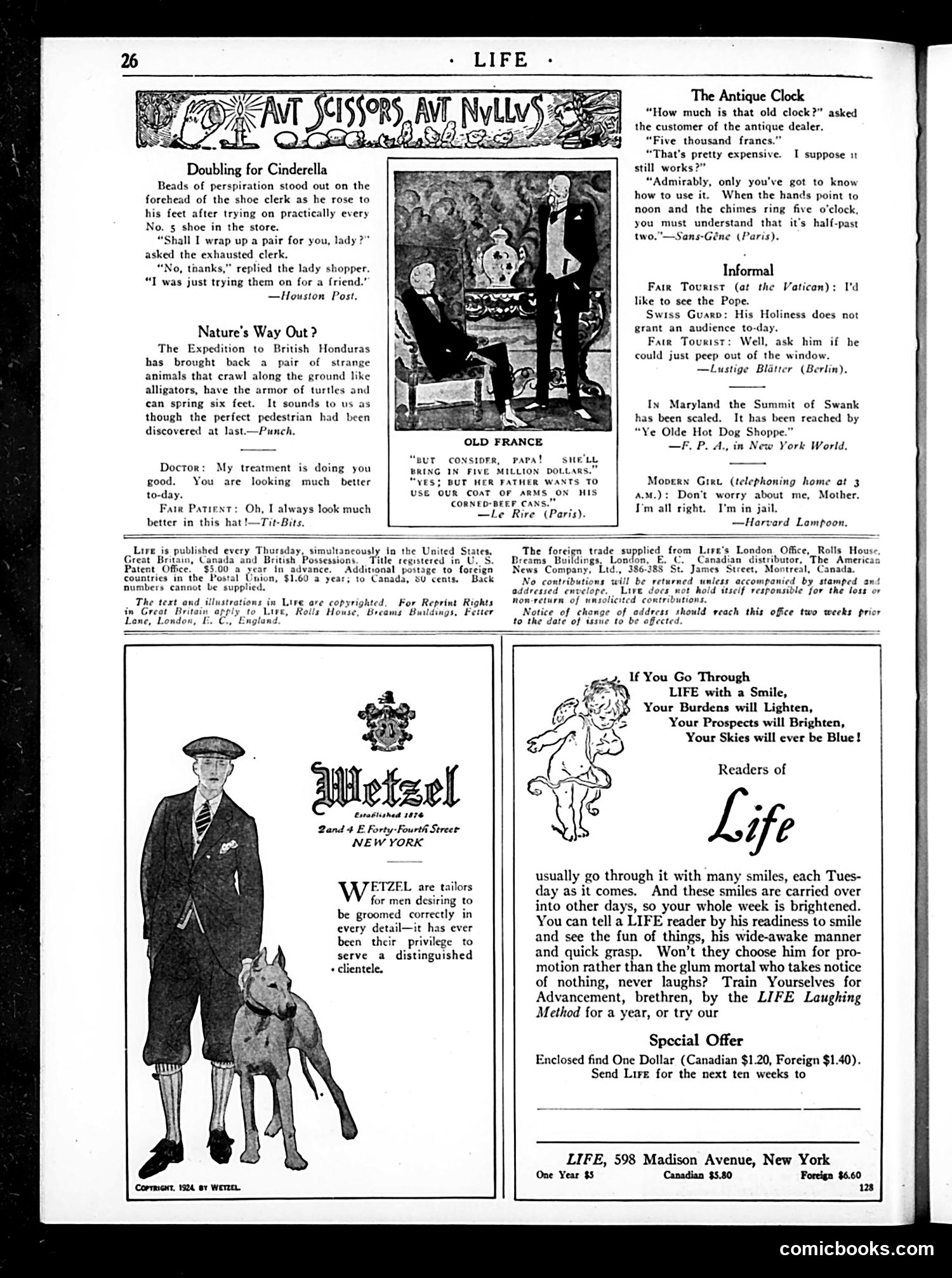
This page contains several short humor pieces typical of Life's satirical format, alongside advertisements. The cartoons reference: **"Doubling for Cinderella"**: A shoe clerk's frustration—a woman tries on many shoes, claiming they're "for a friend," wasting his time without buying anything. The joke plays on the Cinderella fairy tale (finding the perfect shoe) while satirizing women shoppers' behavior. **"Nature's Way Out?"**: Reports of strange Honduran animals inspire absurdist speculation that these creatures represent "the perfect pedestrian"—humor about pedestrian safety concerns. **"Old France"**: A father negotiates his daughter's dowry at five million dollars, but demands use of the family's coat of arms on corned-beef cans—mocking old European aristocratic pretensions meeting modern commercialism. The page also includes brief jokes from various European humor magazines (Punch, Tit-Bits, Lustige Blätter) and includes a Wetzel tailoring advertisement. The overall tone reflects 1920s American middle-class humor and consumer culture concerns.
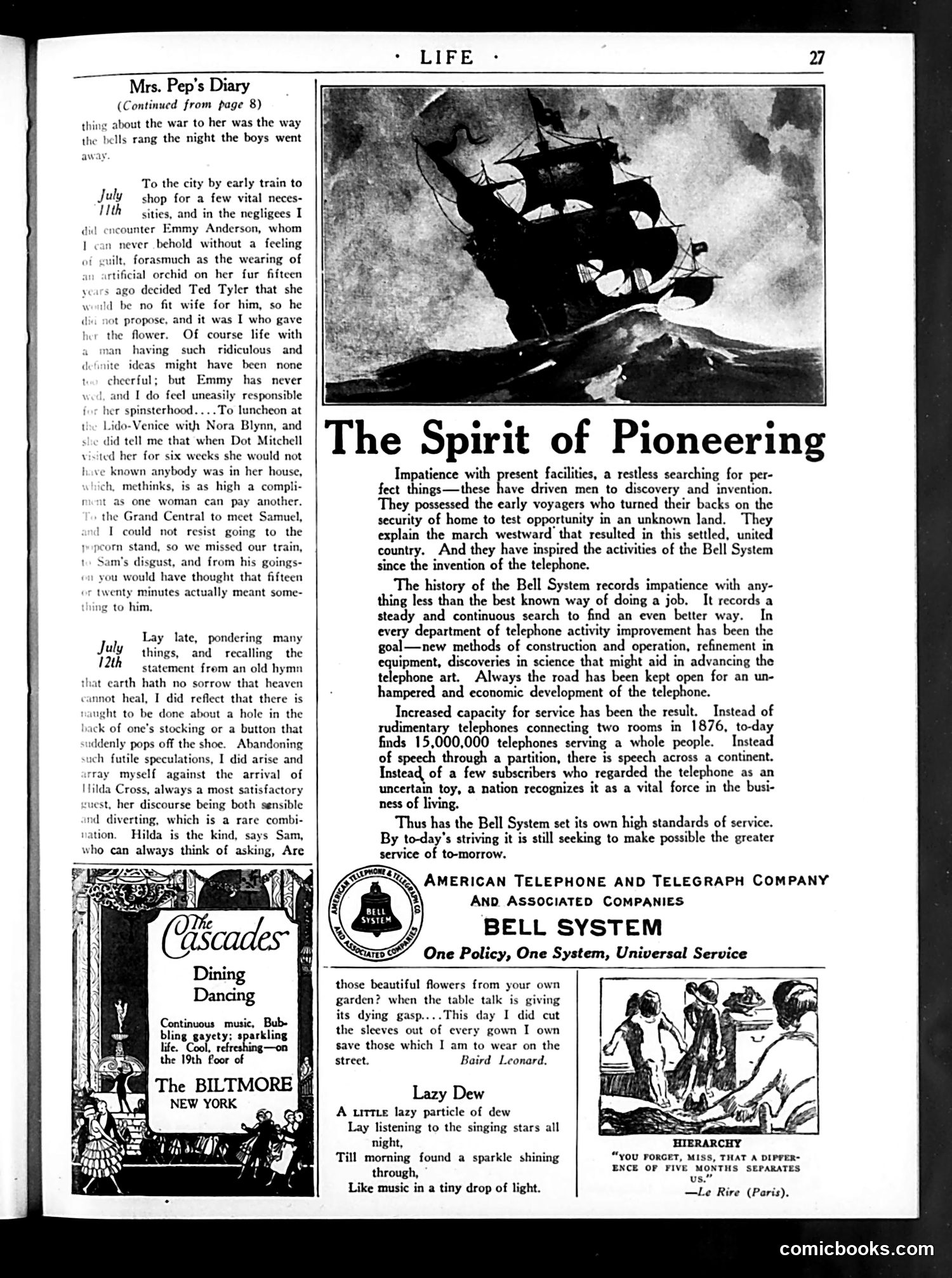
This page combines a humorous domestic diary column with corporate advertising. **The Diary Section** ("Mrs. Pep's Diary"): A lighthearted account of upper-middle-class social life, featuring trivial concerns—missing trains, encounters with an old acquaintance, household guests—written in a gossipy tone that satirizes women's supposed preoccupations. The diary entries mock domestic anxieties and social embarrassments. **The Advertisement**: The large "Spirit of Pioneering" feature is Bell System advertising disguised as editorial content. It invokes American frontier mythology—pioneers, westward expansion, discovery—to legitimize telephone monopoly as continuous with American progress. The claim that 15,000,000 telephones now serve "a whole people" presents infrastructure expansion as national achievement rather than corporate profit. **The Satire**: The juxtaposition is deliberate: frivolous feminine concerns versus grand technological narratives. The page implies phones serve serious national needs while simultaneously showing their use for gossip and social coordination—undercutting the "pioneering spirit" rhetoric with everyday banality.
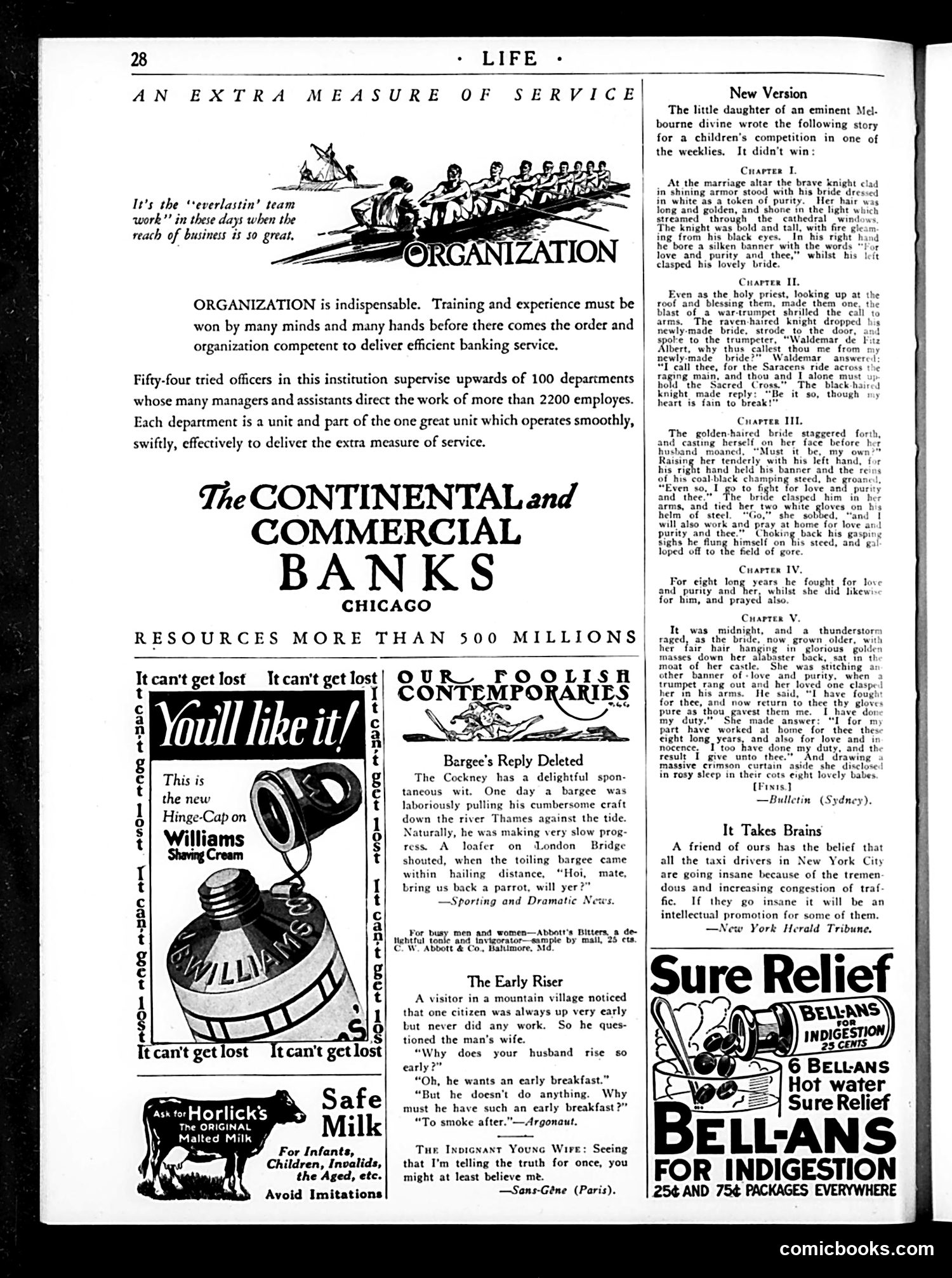
This page is primarily **advertising and filler content** typical of early-20th-century magazines. The dominant feature is a bank advertisement for Continental and Commercial Banks (Chicago), emphasizing organizational efficiency and scale—55 officers managing 100+ departments and 2,200 employees with "$500 million in resources." The remainder consists of **short humorous anecdotes** and **product advertisements**: - "Bargee's Reply Deleted" and "The Early Riser" are brief jokes about working-class characters (a Thames bargeman, a lazy villager) - A children's story parody mocking overwrought Victorian melodrama in a "knight and maiden" narrative - Ads for **Williams Shaving Cream**, **Horlick's Malted Milk**, and **Bellans indigestion remedy** The satirical content is minimal and domesticated. The page reflects magazine conventions of the era: mixing corporate institutional advertising with light comedy, domestic humor, and patent medicine promotions.
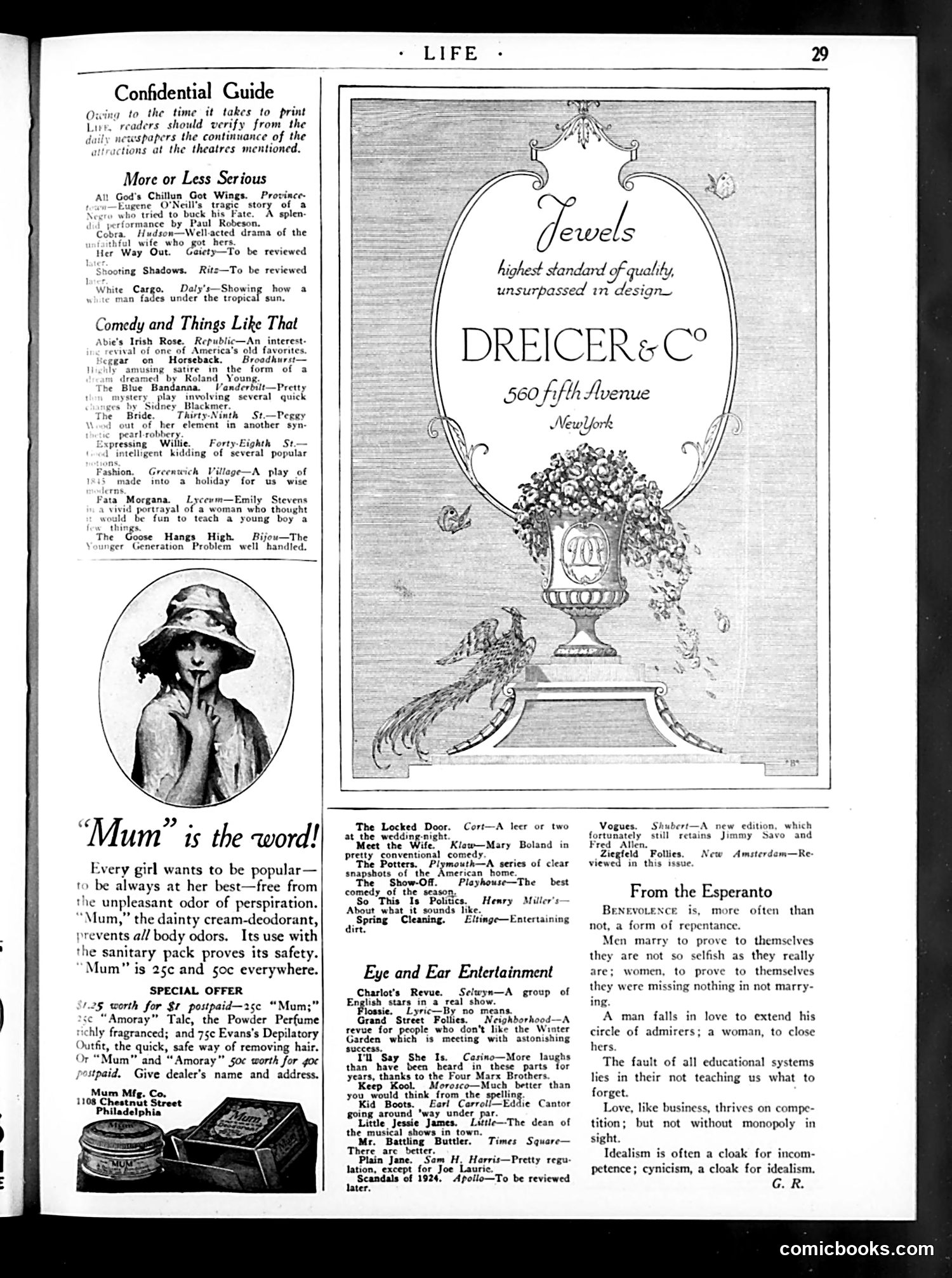
This page (from the 1920s) is primarily **advertising and theater listings**, not political satire. The main content includes: 1. **Theater reviews** — A "Confidential Guide" to current Broadway shows, with brief capsule critiques. Notable: Eugene O'Neill's "All God's Chillun Got Wings" is mentioned, featuring Paul Robeson in a "tragic story of a negro who tried to buck his Fate" — reflecting the racist language and attitudes of the era. 2. **Advertising** — The large central image advertises **Dreicer & Co. jewelry** (560 Fifth Avenue, New York) with ornate Art Deco design. 3. **"Mum" deodorant ad** — Features a woman in a cloche hat, marketing a cream deodorant to girls wanting to be "popular" and avoid body odor — reflecting 1920s advertising's emphasis on female grooming anxieties. 4. **Philosophical aphorisms** — A brief "From the Esperanto" column with cynical observations about marriage and education. The page reflects 1920s consumer culture, theatrical life, and period attitudes rather than containing satirical commentary.
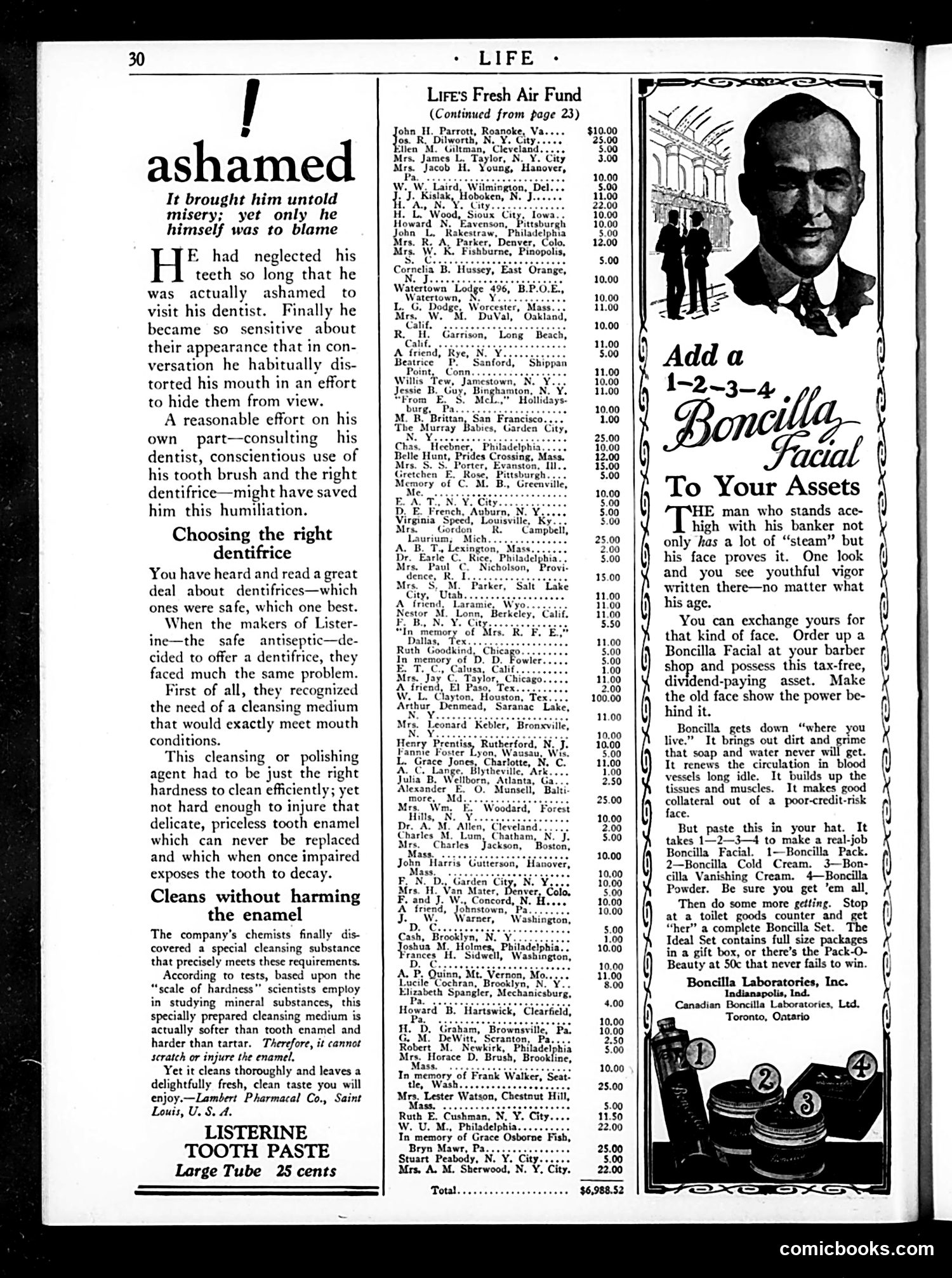
This page contains a morality tale advertisement rather than a political cartoon. The narrative titled "ashamed" depicts a man who neglected his teeth so severely that he became socially embarrassed, habitually distorting his mouth to hide them in conversation. Only after consulting a dentist did he address the problem. The story serves as an advertisement for Listerine Tooth Paste, promoting its specially formulated cleansing medium that cleans teeth effectively without damaging enamel—a significant concern for early-20th-century dental care. The advertisement emphasizes that the formula is softer than tooth enamel yet harder than tartar. The right side shows a Boncilla Facial advertisement featuring a man's portrait, targeting male grooming and personal appearance as business assets. The bulk of the page lists donors to "Life's Fresh Air Fund," a charitable initiative providing outdoor recreation to underprivileged children—typical of Progressive Era philanthropy.
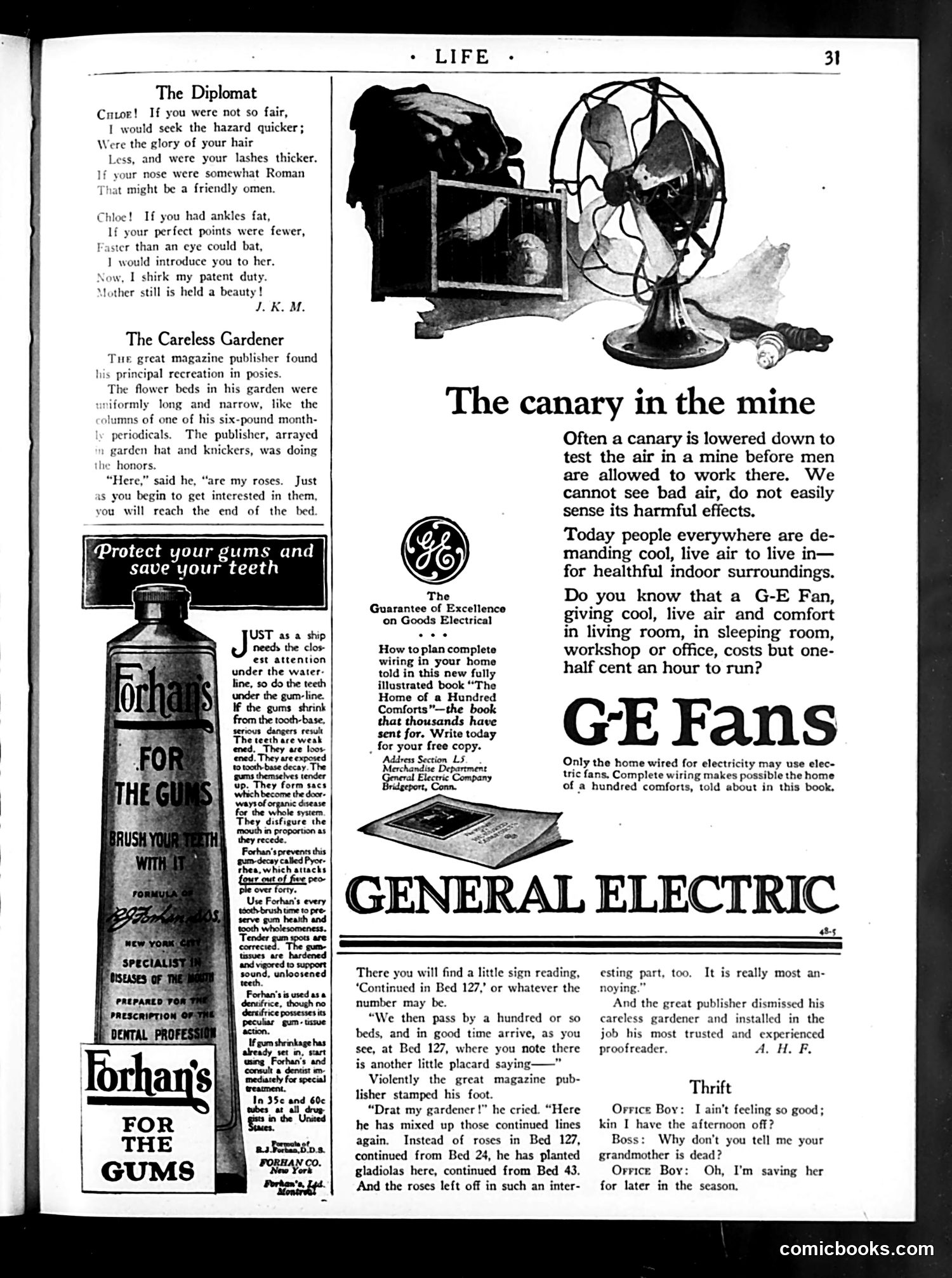
This page contains two satirical pieces and period advertisements. **"The Diplomat"** is a short poem (by J.K.M.) humorously addressing a woman named Chloe. The speaker lists her physical imperfections—unfair complexion, thin lashes, non-Roman nose, thin ankles—as reasons he *won't* pursue her, claiming loyalty to his mother. The joke satirizes diplomatic flattery and male vanity by inverting compliments into rejections. **"The Careless Gardener"** mocks a magazine publisher who arranges his flower garden in narrow columns mirroring his publication's layout. When the gardener plants wrong flowers in wrong beds (gladiolas instead of roses), the publisher fires him—replacing him with a proofreader. The satire targets editorial carelessness and suggests proofreading matters more than horticultural skill. The remaining content is advertising: Forhan's toothpaste, General Electric fans (promoting electrical home comfort), and a brief "Thrift" joke about an office boy saving his grandmother's death as an excuse for future time off.
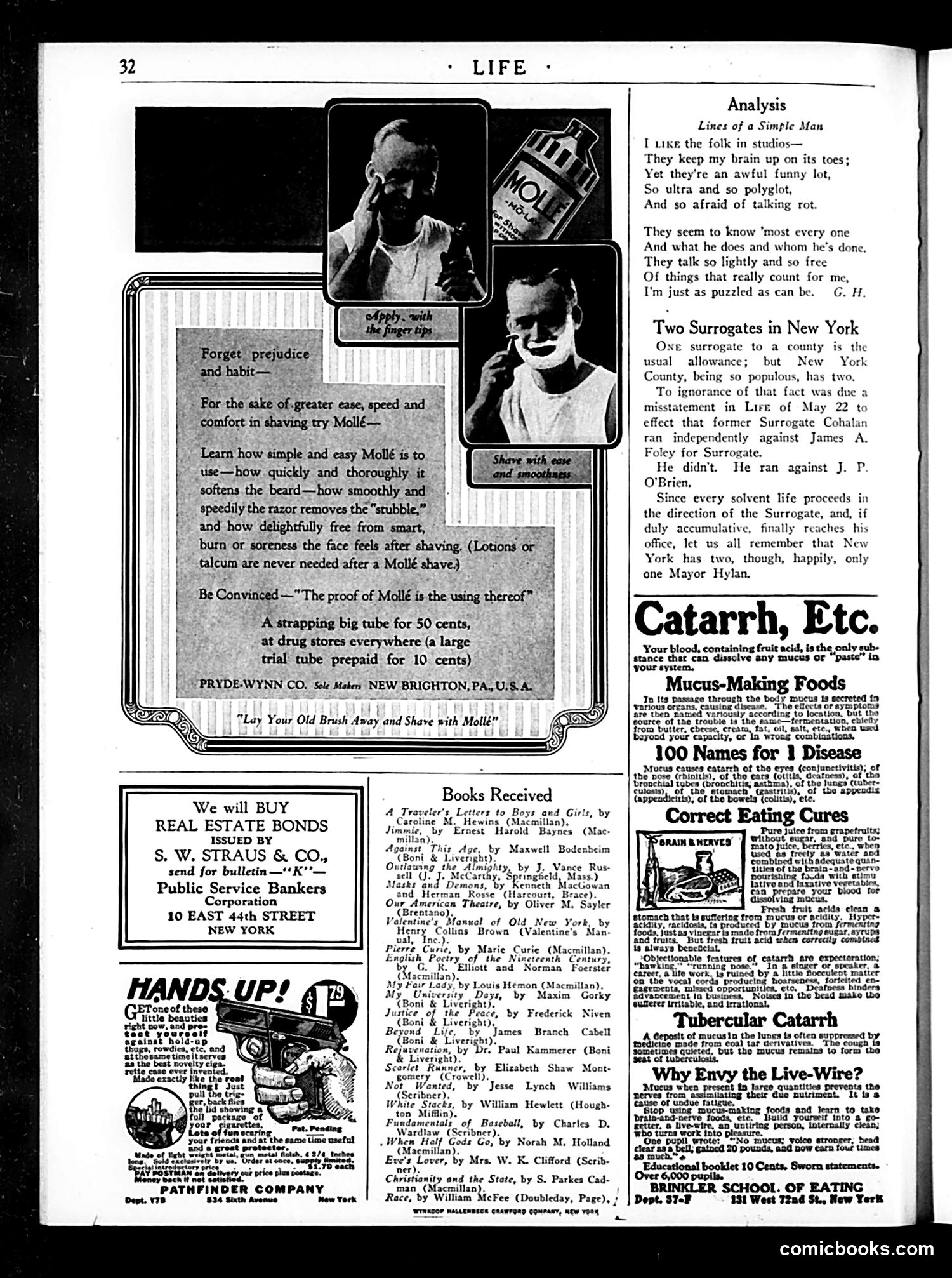
This is primarily an **advertising and miscellaneous content page** from Life magazine, with minimal satirical cartooning. The main advertisement is for **Mollé shaving cream**, featuring photographs of men demonstrating the product's ease and effectiveness—standard early 20th-century product marketing. The page includes a poetry section titled "Lines of a Simple Man" by G.H., mocking intellectual bohemians in studios as pretentious and disconnected from ordinary life—a common satirical theme of the era. A brief correction appears regarding **New York City surrogates** (court officials), clarifying that the county has two such officials, not one as previously stated in Life. The remaining content comprises a "Books Received" list, real estate bond advertisements, and medical advertisements for remedies addressing catarrh and related ailments—reflecting common health concerns and patent medicine marketing of the period. The page reflects 1920s American consumer culture and publishing practices rather than sustained political or social satire.
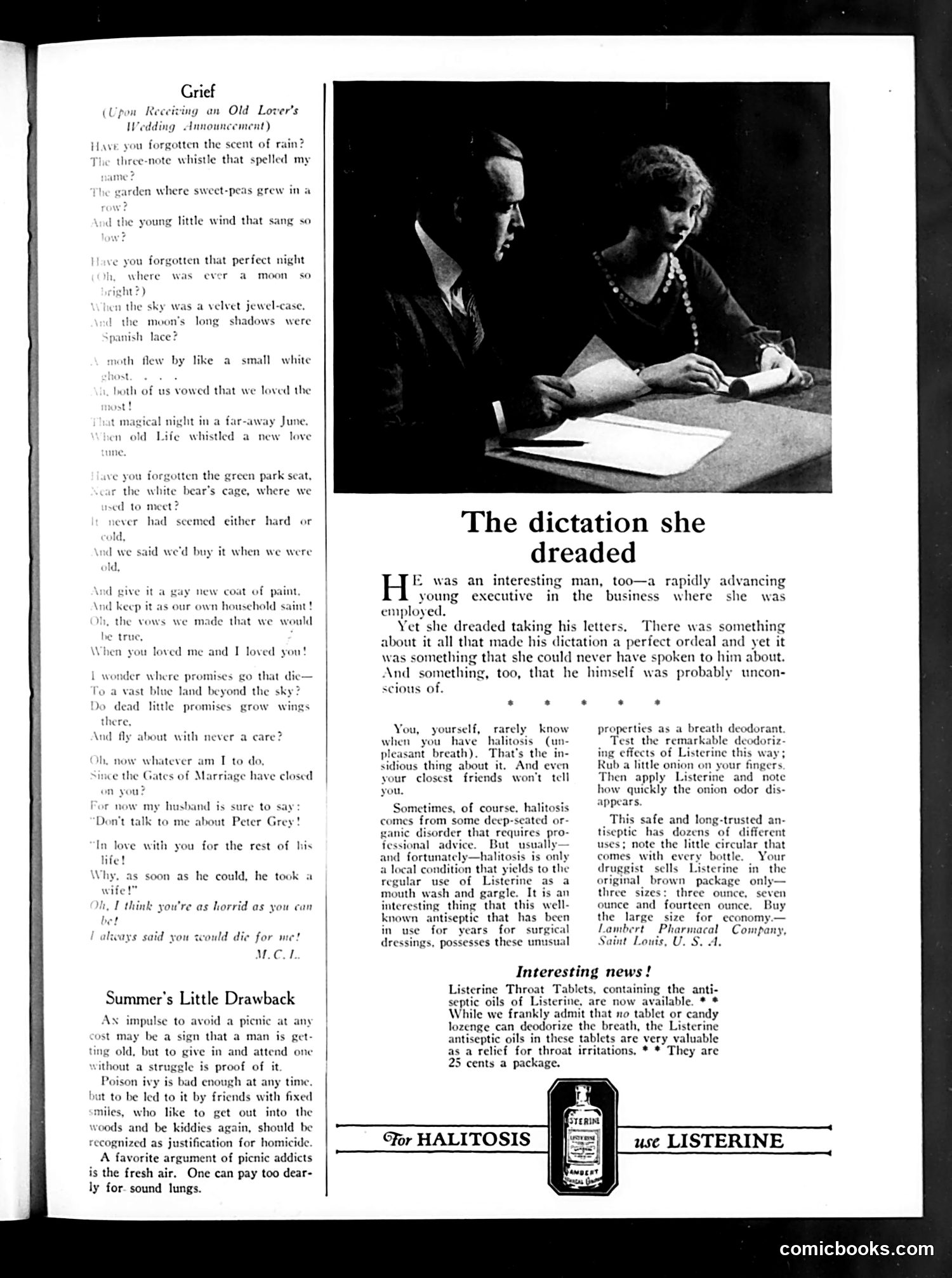
This short story satirizes the social awkwardness of the era regarding **halitosis** (bad breath). A young female secretary dreads taking dictation from her attractive boss—not because of work itself, but because she suspects he has bad breath. The story plays on the period's social anxiety: polite society forbade directly mentioning such personal hygiene issues, leaving the woman trapped in embarrassed silence. The piece functions as advertising for **Listerine**, the mouthwash brand shown at page bottom. The narrative illustrates the product's social utility by depicting the very problem Listerine claimed to solve—undetectable bad breath that even "closest friends won't tell" you about. The other content includes sentimental poetry ("Grief") about lost romance and humorous commentary ("Summer's Little Drawback") mocking people who attend picnics. This is typical Life magazine content: mix of satire, verse, and advertising disguised as editorial material.
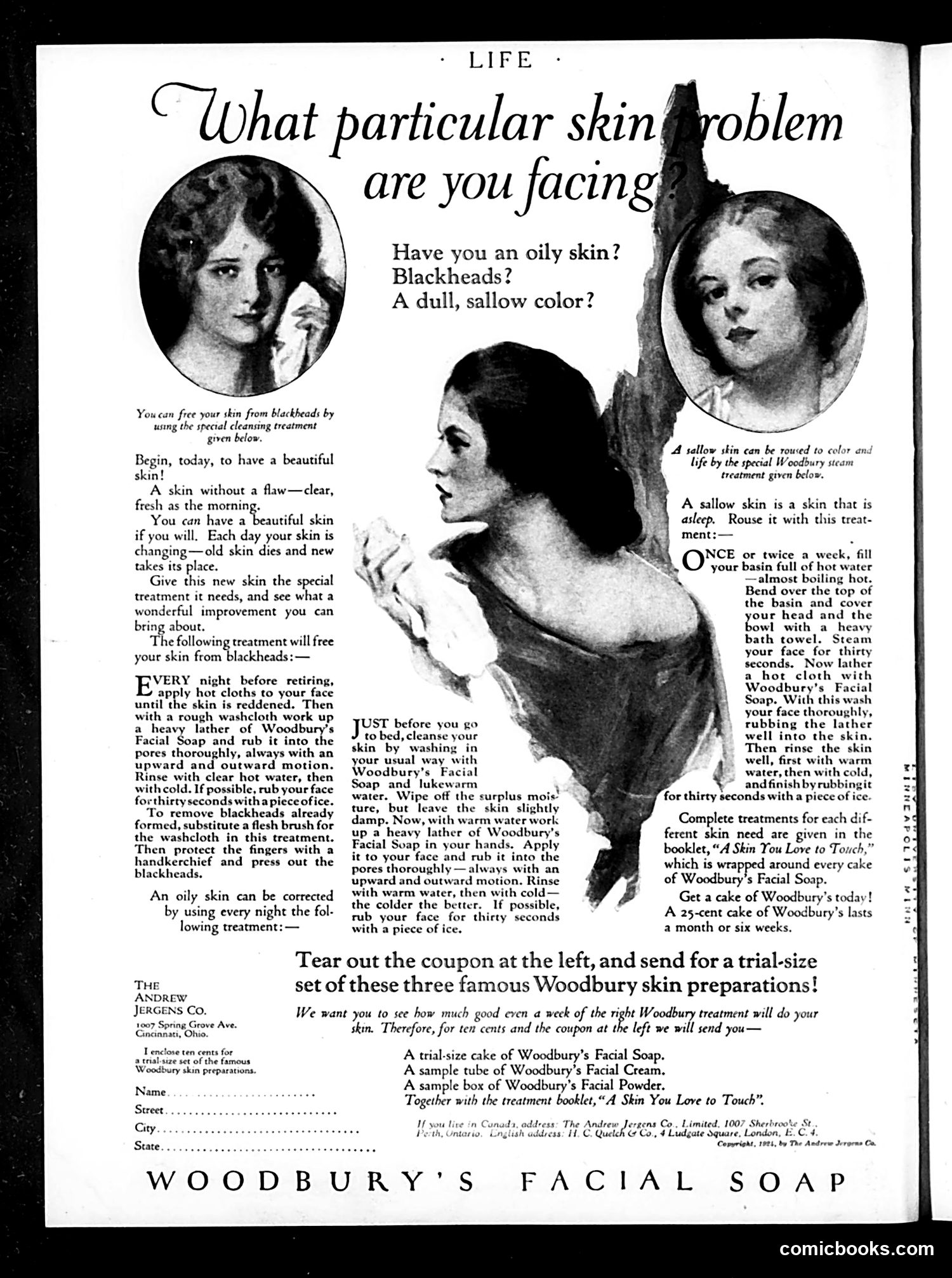
This is a full-page advertisement, not satire. It promotes Woodbury's Facial Soap by addressing common skin concerns—oily skin, blackheads, and sallow complexion—through photographs of women displaying these conditions and prescribed treatments. The page presents three idealized female faces alongside detailed skincare regimens involving hot water, soap, and ice. The advertisement promises transformation: clear, fresh skin achievable through nightly treatments. This reflects early 20th-century cosmetic marketing that medicalized beauty, positioning soap as a scientific solution to skin "flaws." The coupon offers a trial-size set for ten cents. The copy emphasizes that skin naturally regenerates daily, so proper treatment yields visible improvement—a marketing strategy linking product use to bodily processes. This represents typical 1920s *Life* magazine advertising content aimed at female readers concerned with appearance.