
Life, 1924-07-17 · page 16 of 36
Life — July 17, 1924 — page 16: what you’re looking at
What you’re looking at
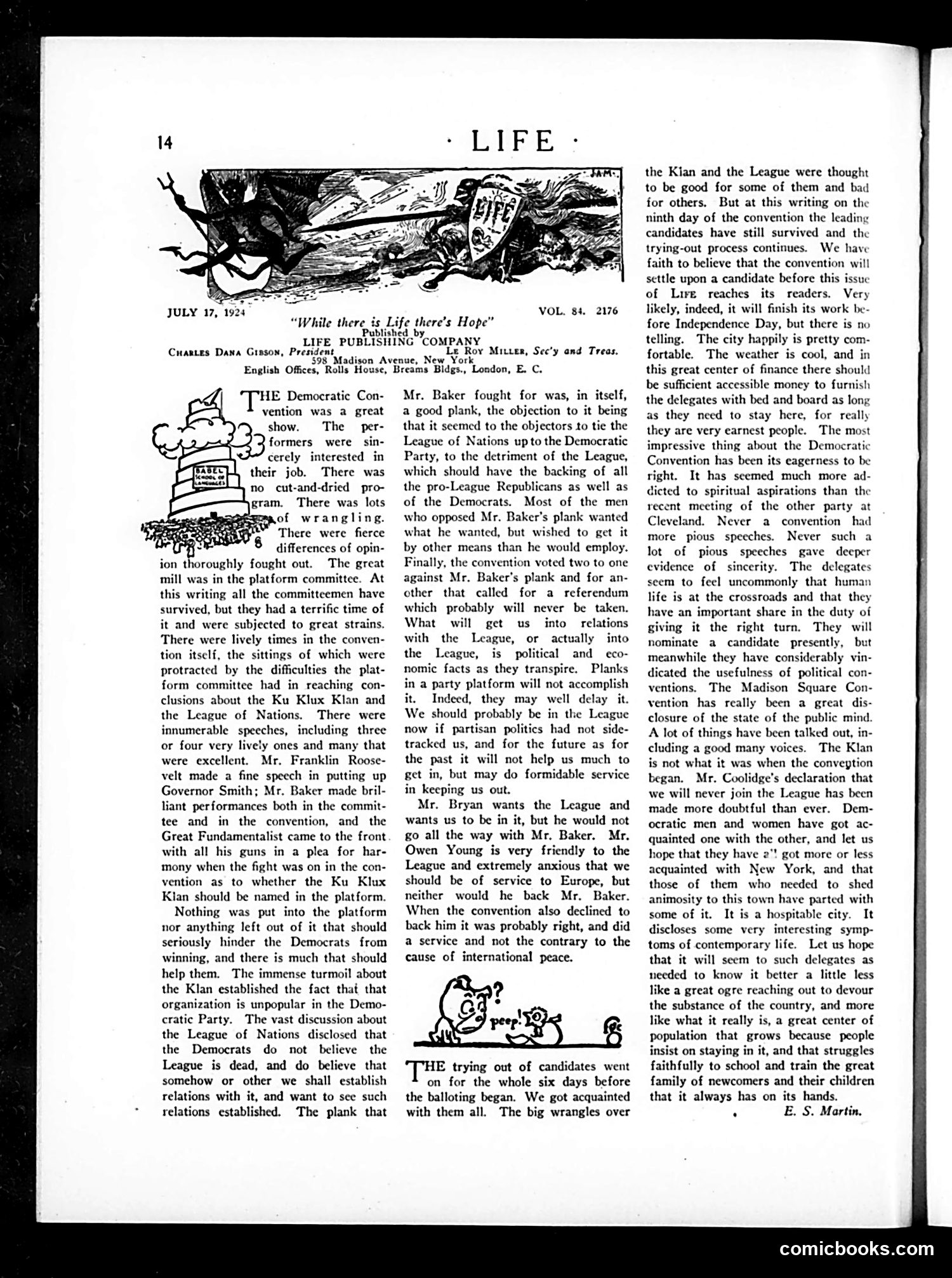
This page discusses the 1924 Democratic National Convention. The text criticizes the convention's bitter divisions over the League of Nations and the Ku Klux Klan's influence in American politics. The first cartoon (top) depicts a skeletal figure labeled "DIFF" (likely representing "Difference"), suggesting the convention's internal conflicts were deadening. The second cartoon (bottom) shows a pig labeled "PEEP" being prodded, apparently satirizing the candidate selection process, which the text notes was contentious and lasted six days before balloting began. The author (E.S. Martin) expresses hope that delegates would resolve their differences and nominate a viable candidate, while acknowledging the city was "comfortable" and well-supplied during these protracted negotiations.
📄 Transcribed text from this page (OCR, searchable)
Machine-transcribed from the original scan — historical spelling and the odd misread are preserved.
JULY 17, 192 VOL. 84. 2176 “While there is Life there’s Hope” Published by. LIFE PUBLISHING COMPANY Cuantes Dana Giason, President Le Roy Mitter, Sec’y and Treas, 398 Madison Avenue, New York English Offices, Rolls House, Breams Bldgs., London, E. C. 'HE Democratic Con- vention was a great show. The per- formers were sin- cerely interested in their job. There was no cut-and-dried pro- gram. There was lots of wrangling. There were fierce differences of opin- ion thoroughly fought out. The great mill was in the platform committee. At this writing all the committeemen have survived, but they had a terrific time of it and were subjected to great strains, There were lively times in the conven- tion itself, the sittings of which were protracted by the difficulties the plat- form committee had in reaching con- clusions about the Ku Klux Klan and the League of Nations. There were innumerable speeches, including three or four very lively ones and many that were excellent. Mr. Franklin Roose- velt made a fine speech in putting up Governor Smith; Mr. Baker made bril- liant performances both in the commit- tee and in the convention, and the Great Fundamentalist came to the front with all his guns in a plea for har- mony when the fight was on in the con- vention as to whether the Ku Klux Kian should be named in the platform. Nothing was put into the platform nor anything left out of it that should seriously hinder the Democrats from winning, and there is much that should help them. The immense turmoil about the Klan established the fact that that organization is unpopular in the Demo- cratic Party. The vast discussion about the League of Nations disclosed that the Democrats do not believe the League is dead, and do believe that somehow or other we shall establish relations with it, and want to see such relations established. The plank that Re g Mr. Baker fought for was, in itself, a good plank, the objection to it being that it seemed to the objectors to tie the League of Nations upto the Democratic Party, to the detriment of the League, which should have the backing of all the pro-League Republicans as well as of the Democrats. Most of the men who opposed Mr. Baker's plank wanted what he wanted, but wished to get it by other means than he would employ. Finally, the convention voted two to one against Mr. Baker's plank and for an- other that called for a referendum which probably will never be taken. What will get us into relations with the League, or actually into the League, is political and eco- nomic facts as they transpire. Planks in a party platform will not accomplish it. Indeed, they may well delay it. We should probably be in the League now if partisan politics had not side- tracked us, and for the future as for the past it will not help us much to get in, but may do formidable service in keeping us out. Mr. Bryan wants the League and wants us to be in it, but he would not go all the way with Mr. Baker. Mr. Owen Young is very friendly to the League and extremely anxious that we should be of service to Europe, but neither would he back Mr, Baker. When the convention also declined to back him it was probably right, and did a service and not the contrary to the cause of international peace. TH trying out of candidates went on for the whole six days before the balloting began. We got acquainted with them all. The big wrangles over the Kian and the League were thought to be good for some of them and bad for others. But at this writing on the ninth day of the convention the leading candidates have still survived and the trying-out process continues. We have faith to believe that the convention will settle upon a candidate before this issuc of Lire reaches its readers. Very likely, indeed, it will finish its work be- fore Independence Day, but there is no telling. The city happily is pretty com- fortable. The weather is cool, and in this great center of finance there should be sufficient accessible money to furnish the delegates with bed and board as long as they need to stay here, for really they are very earnest people. The most impressive thing about the Democratic Convention has been its eagerness to be right. It has seemed much more ad- dicted to spiritual aspirations than the recent meeting of the other party at Cleveland. Never a convention had more pious speeches. Never such a lot of pious speeches gave deeper evidence of sincerity. The delegates seem to feel uncommonly that human life is at the crossroads and that they have an important share in the duty of giving it the right turn. They will nominate a candidate presently, but meanwhile they have considerably vin- dicated the usefulness of political con- ventions. The Madison Square Con- vention has really been a great dis- closure of the state of the public mind. A lot of things have been talked out, in- cluding a good many voices. The Klan is not what it was when the conveytion began. Mr. Coolidge’s declaration that we will never join the League has been made more doubtful than ever. Dem- ocratic men and women have got ac- quainted one with the other, and let us hope that they have 2"! got more or less acquainted with New York, and that those of them who needed to shed animosity to this town have parted with some of it. It is a hospitable city. It discloses some very interesting symp- toms of contemporary life. Let us hope that it will seem to such delegates as needed to know it better a little less like a great ogre reaching out to devour the substance of the country, and more like what it really is, a great center of population that grows because people insist on staying in it, and that struggles faithfully to school and train the great family of newcomers and their children that it always has on its hands. . E, S. Martin, comicbooks.com