
Life, 1924-07-17 · page 20 of 36
Life — July 17, 1924 — page 20: what you’re looking at
What you’re looking at
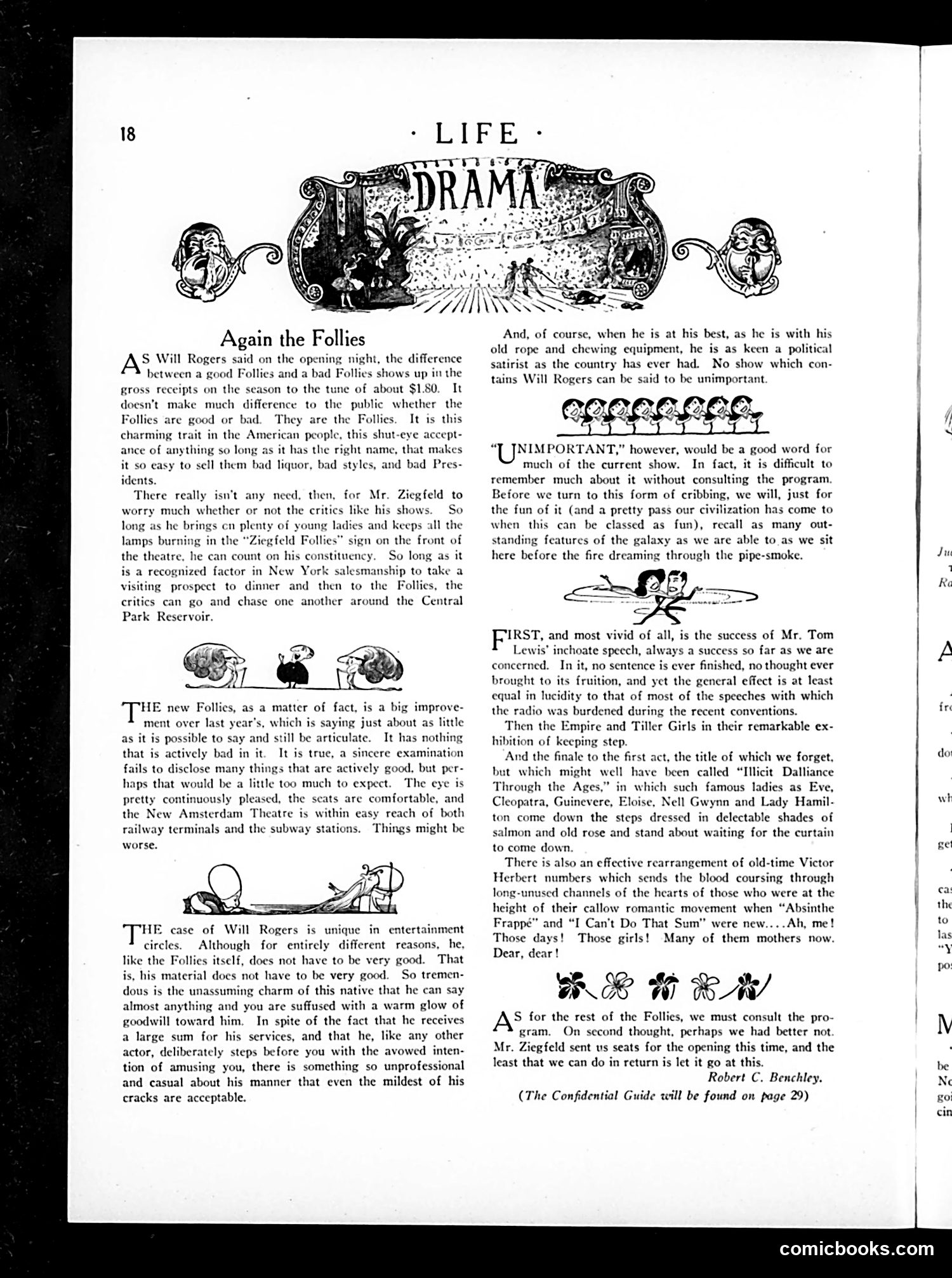
This is a theater review by Robert C. Benchley critiquing the Ziegfeld Follies, a famous American musical revue. The piece uses satire to comment on both entertainment and politics. **Key figures mentioned:** - **Will Rogers**: A comedian-performer whose charm and political wit ("keen a political satirist") make him valuable regardless of material quality - **Florenz Ziegfeld**: Producer of the Follies, unconcerned with critics because the show's brand-name appeal guarantees commercial success - **Tom Lewis**: A performer whose rambling, unfinished speeches mirror actual radio convention speeches—satirizing contemporary political discourse **The satire's point**: Benchley argues that Americans uncritically accept anything branded "the Follies," just as they accept "bad liquor, bad styles, and bad Presidents"—a pointed jab at 1920s consumer culture and political gullibility. The Follies succeed through reputation and spectacle rather than merit, reflecting broader American complacency. The review is witty social commentary disguised as theater criticism.
📄 Transcribed text from this page (OCR, searchable)
Machine-transcribed from the original scan — historical spelling and the odd misread are preserved.
Again the Follies S Will Rogers said on the opening night, the difference between a good Follies and a bad Follies shows up in the gross receipts on the season to the tune of about $1.80. It doesn’t make much difference to the public whether the Follies are good or bad. They are the Follies. It is this charming trait in the i this shut-eye accept- ance of anything so long as it has the right name, that makes it so easy to sell them bad liquor, bad styles, and bad Pres- idents. There really isn’t any need, then, for Mr. Ziegfeld to worry much whether or not the critics like his shows. So long as he brings cn plenty of young ladies and keeps all the lamps burning in the Id Follie the theatre, he can count on his constituen So long as it is a recognized factor in New York salesmanship to take a visiting prospect to dinner and then to the Follies, the critics can go and chase one another around the Central Park Reservoir. sign on the front of HE new Follies, as a matter of fact, is a big improve- ment over last year’s, which is saying just about as little as it is possible to say and still be articulate. It has nothing that is actively bad in it. It is true, a sincere examination fails to disclose many things that are actively good, but per- haps that would be a little too much to expect. The eye is pretty continuously pleased, the seats are comfortable, and the New Amsterdam Theatre is within ¢ reach of both railway terminals and the subway stations. ings might be worse. HE case of Will Rogers is unique in entertainment circles. Although for entirely different reasons, he, like the lies itself, does not have to be very good. That is, his material does not have to be very good. So tremen- dous is the unassuming charm of this native that he can say almost anything and you are suffused with a warm glow of goodwill toward him. In spite of the fact that he receives a large sum for his services, and that he, like any other actor, deliberately steps before you with the avowed inten- tion of amusing you, there is something so unprofessional and casual about his manner that even the mildest of his cracks are acceptable. And, of course, when he is at his best, as he is with his old rope and chewing equipment, he is as keen a political satirist as the country has ever had. No show which con- tains Will Rogers can be said to be unimportant. “T JNIMPORTANT,” however, would be a g much of the current show. In fact, it is difficult to remember much about it without consulting the program. Before we turn to this form of cribbing, we will, just for the fun of it (and a pretty pass our civilization has come to when this can be classed as fun), recall as many out- standing features of the galaxy as we are able to_as we sit here before the fire dreaming through the pipe-smoke. IRST, and most vivid of all, is the success of Mr. Tom Lewis’ inchoate speech, always a success so far as we are concerned. In it, no sentence is ever finished, no thought ever brought to its fruition, and yet the general effect is at least equal in lucidity to that of most of the speeches with which the radio was burdened during the recent conventions. Then the Empire and Tiller Girls in their remarkable ex- hibition of keeping step. And the finale to the first act, the title of which we forget, but which might well have been called “Illicit Dalliance Through the Ages,” in which such famous ladies as Eve, Cleopatra, Guinevere, Eloise, Nell Gwynn and Lady Hamil- ton come down the steps dressed in delectable shades of salmon and old rose and stand about waiting for the curtain to come down. There is also an effective rearrangement of old-time Victor Herbert numbers which sends the blood coursing through long-unused channels of the hearts of those who were at the height of their callow romantic movement when “Absinthe Frappé” and “I Can't Do That Sum” were new....Ah, me! Those days! Those girls! Many of them mothers now. Dear, dear! RE BAY S for the rest of the Follies, we must consult the pro- gram. On second thought, perhaps we had better not Mr. Ziegfeld sent us seats for the opening this time, and the least that we can do in return is let it go at this. Robert C. Benchley. (The Confidential Guide will be found on page 29) comicbooks.com Ju Ra do’ wt gel