
Life, 1924-07-17 · page 22 of 36
Life — July 17, 1924 — page 22: what you’re looking at
What you’re looking at
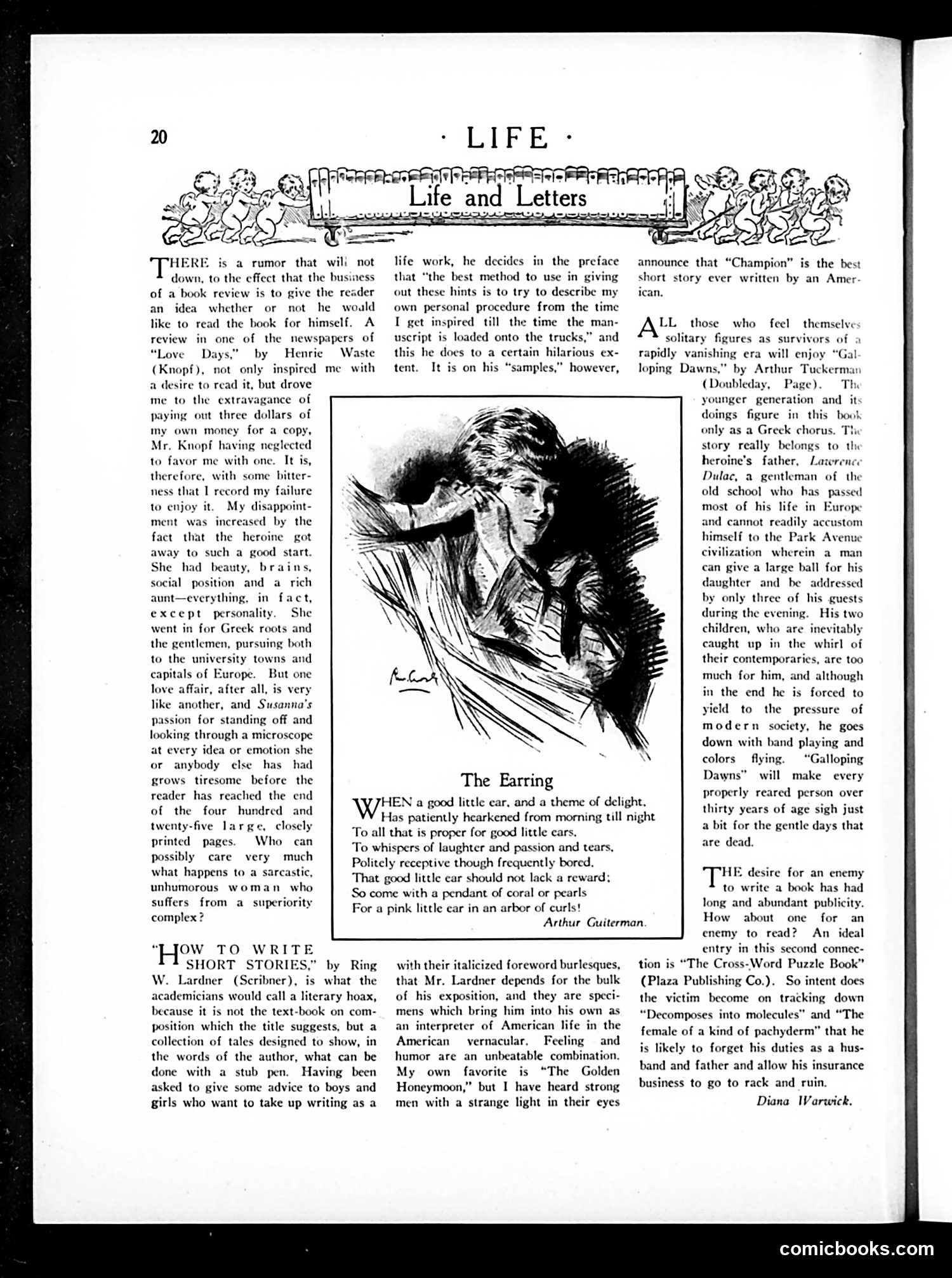
This page from *Life* magazine presents literary reviews and commentary. The central illustration depicts "The Earring," accompanying a whimsical poem by Arthur Guiterman celebrating a "good little ear" receiving jewelry—likely satirizing sentimental Victorian verse. The reviews critique contemporary novels. One dismisses "Love Days" by Henrie Waste as featuring a heroine with every advantage except personality, whose obsessive intellectualism becomes tedious. Another praises "Galloping Dawns" by Arthur Tuckerman as appealing to those nostalgic for a vanishing aristocratic era—the protagonist an old-school European gentleman bewildered by modern Park Avenue society. The page also discusses Ring W. Lardner's "How to Write Short Stories," which the reviewer frames as deliberate literary satire rather than genuine instruction, using exaggerated examples to showcase American vernacular life. The overall tone critiques both overwrought literary pretension and nostalgia for disappearing upper-class customs.
📄 Transcribed text from this page (OCR, searchable)
Machine-transcribed from the original scan — historical spelling and the odd misread are preserved.
HERE is a rumor that wili not down, to the effect that the business of a book review is to give the reader an idea whether or not he would like to read the book for himself. A review in one of the newspapers of “Love Days,” by Henrie Waste (Knopf), not only inspired me with a desire to read it, but drove me to the extravagance of paying out three dollars of my own money for a copy, Mr. Knopf having neglected to favor me with one. It is, therefore, with some bitter- I record my failure My disappoint- ness t to enjoy it. ment was increased by the fact that the heroine got ay to such a good start. She had beauty, brains, social position and a rich aunt—everything, in fact, except personality. She went in for Greek roots and the gentlemen, pursuing both to the university towns and capitals of Europe. But one love ir, after all, is very like another, and Susanna’s passion for standing off and looking through a microscope at every idea or emotion she or anybody has had grows tiresome before the reader has reached the end else Life and life work, he decides in the preface that “the best method to use in giving out these hints is to try to describe my own personal procedure from the time I get inspired till the time the man- uscript is loaded onto the trucks,” and this he does to a certain hilarious ex- tent. It is on his “samples,” however, The Earring announce that “Champion” is the best short story ever written by an Amer- ican, All those who feel themselves litary figures as survivors of a rapidly vanishing era will enjoy “Gal loping Dawns,” by Arthur Tuckerman (Doubleda Page). The younger generation and its doings figure in this bc only as a Greek chorus. story really belongs to th heroine’s father, Lawrence: Dulac, a gentleman of the old school who has passed most of his life in Europe and cannot readily accustom himself to the Park Avenue civilization a man can give a large ball for his daughter and be addressed by only three of his guests during the evening. His two children, who are inevitably caught up in the whirl of their contemporaries, are too much for him, and although in the end he is forced to yield to the pressure of modern society, he goes down with band playing and colors flying. “Galloping Dawns” will make every properly reared person over wherein Wier a good little ear, and a theme of delight. Has patiently hearkened from morning till night To all that is proper for good little cars. of the four hundred and twenty-five large, closely thirty years of age sigh just a bit for the gentle days that printed pages. Who can possibly care very much what happens to a sarcastic, unhumorous woman who suffers from a superiority complex ? OW TO WRIT SHORT STORIES,” by Ring W. Lardner (Scribner), what the academicians would call a literary hoax, because it is not the text-book on com- position which the title suggests, but a collection of tales designed to show, in the words of the author, what can be done with a stub pen. Having been asked to give some advice to boys and girls who want to take up writing as a To whispers of laughter and passion and tears, Politely receptive though frequently bored, That good little ear should not lac! So come with a pendant of coral or pearls For a pink little ear in an arbor of curls! Arthur Guiterman. a reward; with their italicized foreword burlesques, that Mr. Lardner depends for the bulk of his exposition, and they are speci- mens which bring him into his own as an interpreter of American life in the American vernacular, Feeling and humor are an unbeatable combination. My own favorite is “The Golden Honeymoon,” but I have heard strong men with a strange light in their eyes are dead. HE desire for an enemy to write a book has had long and abundant publicity. How about one for an enemy to read? An_ ideal entry in this second connec- tion is “The Cross-Word Puzzle Book” (Plaza Publishing Co.). So intent does the victim become on tracking down “Decomposes into molecules” and “The female of a kind of pachyderm” that he is likely to forget his duties as a hus- band and father and allow his insurance business to go to rack and ruin. Diana Warwick, comicbooks.com