
Life, 1924-07-17 · page 26 of 36
Life — July 17, 1924 — page 26: what you’re looking at
What you’re looking at
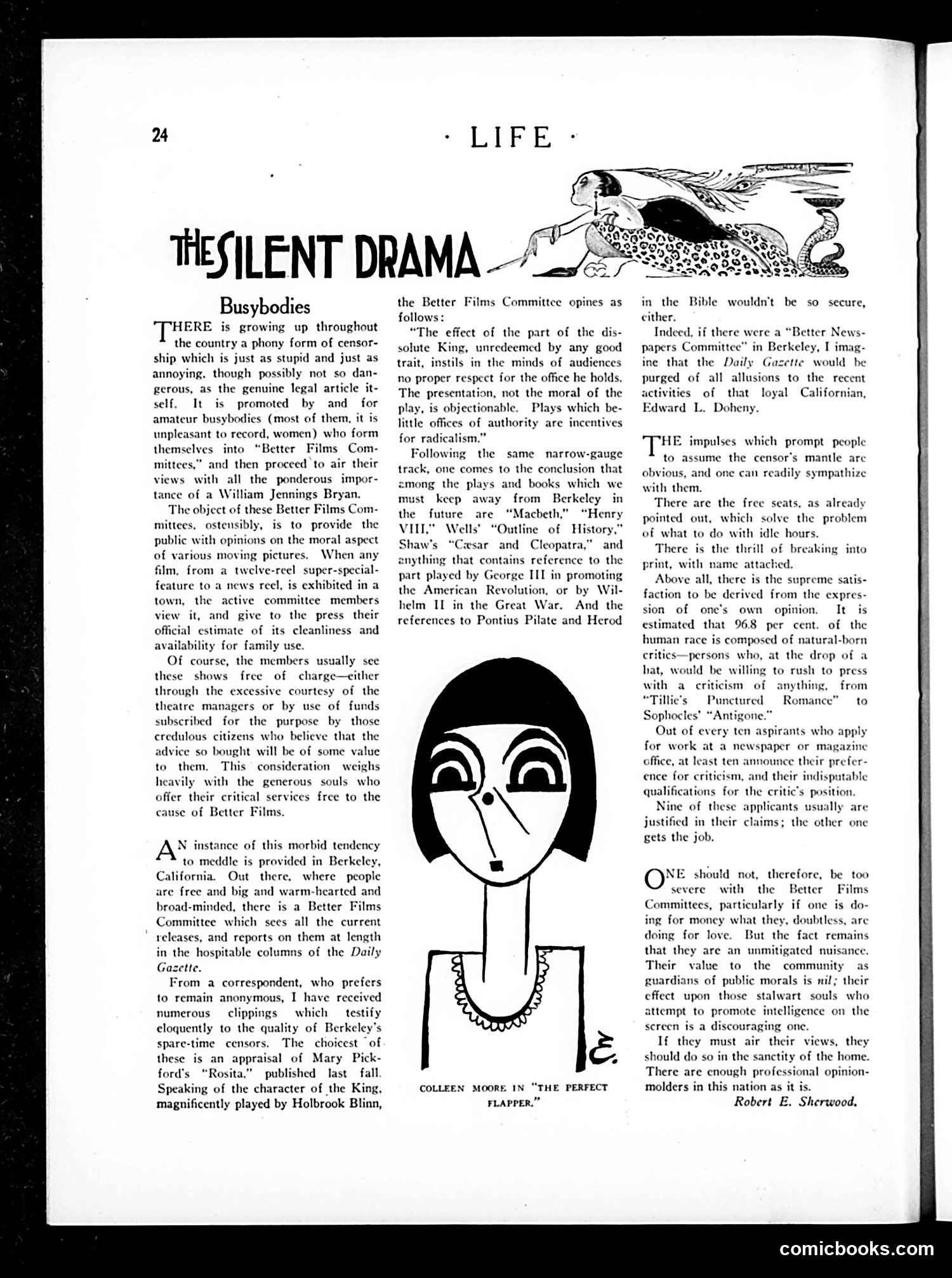
This article satirizes amateur "Better Films Committees"—citizen groups, mostly women, who self-appointed themselves as moral censors of movies and published their views in local newspapers. The author mocks their hypocrisy: they watched films free (courtesy of theaters or subscriptions), then lectured the public about propriety. He ridicules their absurd logic through example: Berkeley's committee condemned Mary Pickford's "Rosita" for depicting an immoral king, arguing it disrespected authority and encouraged "radicalism." Following this logic, they'd have to ban *Macbeth*, *Henry VIII*, history books, biblical references, and accounts of the American Revolution. The cartoon of "Colleen Moore in 'The Perfect Flapper'" illustrates the kind of modern, potentially "immoral" content these committees targeted. The author suggests these busybodies are mostly motivated by vanity—the free entertainment, idle hours filled, and ego satisfaction of seeing their opinions printed. He concludes such amateur censorship, while annoying rather than dangerous, discourages genuine intelligent cultural discussion.
📄 Transcribed text from this page (OCR, searchable)
Machine-transcribed from the original scan — historical spelling and the odd misread are preserved.
LIFE * TESILENT DRAMA Busybodies HERE is growing up throughout the country a phony form of censor- ship which is just as stupid and just as annoying. though possibly not so dan- gerous, as the genuine legal article it- self, It is promoted by and for amateur busybodies (most of them, it is unpleasant to record, women) who form themselves into “Better Films Com- mittees,” and then proceed to air their views with all the ponderous impor- tance of a William Jennings Bryan. The object of these Better Films Com- mittees, ostensibly, is to provide the public with opinions on the moral aspect of various moving pictures. When any film, from a twelve-reel super-special- feature to a news reel, is exhibited in a town, the active committee members view it, and give to the press their official estimate of its cleanliness and availability for family use. Of course, the members usually see these shows free of charge—either through the excessive courtesy of the theatre managers or by use of funds subscribed for the purpose by those credulous citizens who believe that the advice so bought will be of some value to them. This consideration weighs heavily with the generous souls who offer their critical services free to the cause of Better N instance of this morbid tendency to meddle is provided in Berkeley, California. Out there, where people are free and big and warm-hearted and broad-minded, there is a Better Films Committee which sees all the current releases, and reports on them at length in the hospitable columns of the Daily Gazette. From a correspondent, who prefers to remain anonymous, I have received numerous clippings which _ testify eloquently to the quality of Berkeley's spare-time censors. The choicest “of these is an appraisal of Mary Pick- ford’s “Rosita,” published last fall. Speaking of the character of the King, magnificently played by Holbrook Blinn, the Better Films follows: “The effect of the part of the dis- solute King, unredeemed by any good trait, instils in the minds of audiences No proper respect for the office he holds. The presentation, not the moral of the play, is objectionable. Plays which be- little offices of authority are incentives for radicalism.” Following the same narrow-gauge track, one comes to the conclusion that zmong the plays and books which we must keep away from Berkeley in the future are “Macbeth,” “Henry VIII,” Wells’ “Outline of History, Shaw's “Cxsar and Cleopatra,” and nything that contains reference to the part played by George III in promoting the American Revolution, or by Wil- helm IL in the Great War. And the references to Pontius Pilate and Herod Committee opines as COLLEEN MOORE IN “THE PERFECT FLAPPER.” in the Bible wouldn't be cither, Indeed, if there were a “Better News- papers Committee” in Berkeley, I imag- ine that the Daily Gazette would be purged of all allusions to the recent activities of that loyal Californian, ward L. Doheny. THe impulses which prompt people to assume the censor’s mantle arc sympathize so secure, obvious, and one can readily with them. There are the free seats, as already pointed out, which solve the problem of what to do with idle hours. There is the thrill of print, with name a breaking into tached. Above all, there is the supreme satis- faction to be derived from the expres- own opinion. It is estimated that 96.8 per cent. of the human race is composed of natural-born critics—persons who, at the drop of a hat, would be willing to rush to press with a criticism of anything, from “Tillie’s Punctured — Romance to Sophocles’ “Antigone.” Out of every ten aspirants who apply for work at a newspaper or ma: office, at least ten announce their prefer- ence for criticism, and their indisputable qualifications for the critic's position. Nine of these applicants usually are justified in their claims; the other one gets the job. O* severe sion of one's should not, therefore, be too with the Better Films Committees, particularly if one is do- ing for money what they, doubtless, are doing for love. But the fact remains that they are an unmitigated nuisane Their value to the community as guardians of public morals is nil; thei effect upon those stalwart souls who attempt to promote intelligence on the screen is a discouraging one. If they must air their views, they should do so in the sanctity of the home. There are cnough professional opinion- molders in this nation as it is. Robert E. Sherwood. comicbooks.com