
A complete issue · 36 pages · 1924
Life — July 10, 1924
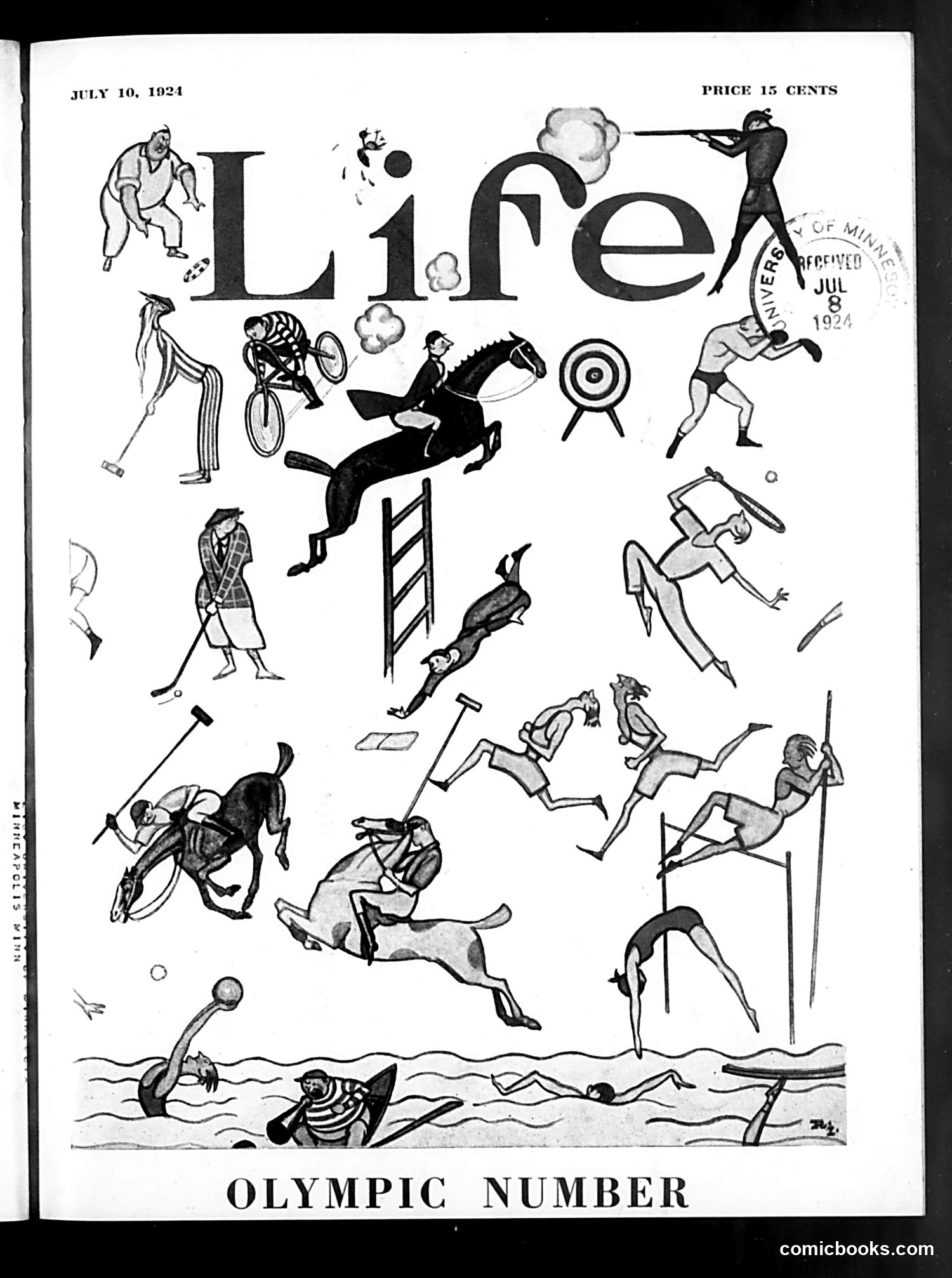
This is Life's satirical take on the 1924 Olympic Games (likely the Paris Summer Olympics). The cover celebrates athletics through humorous cartoon vignettes showing various sports: horseback riding, cycling, boxing, golf, target shooting, track and field, diving, and swimming. The satire appears gentle rather than pointed—the exaggerated, stick-figure style athletes demonstrate Life's comedic approach to Olympic competition. The "Olympic Number" designation suggests this was a special issue capitalizing on public excitement around the Games. The cover's humor relies on visual gags: athletes in awkward positions, unlikely collisions, and the general absurdity of competitive sport. This reflects Life magazine's established formula of combining contemporary events with humorous illustration for popular entertainment.
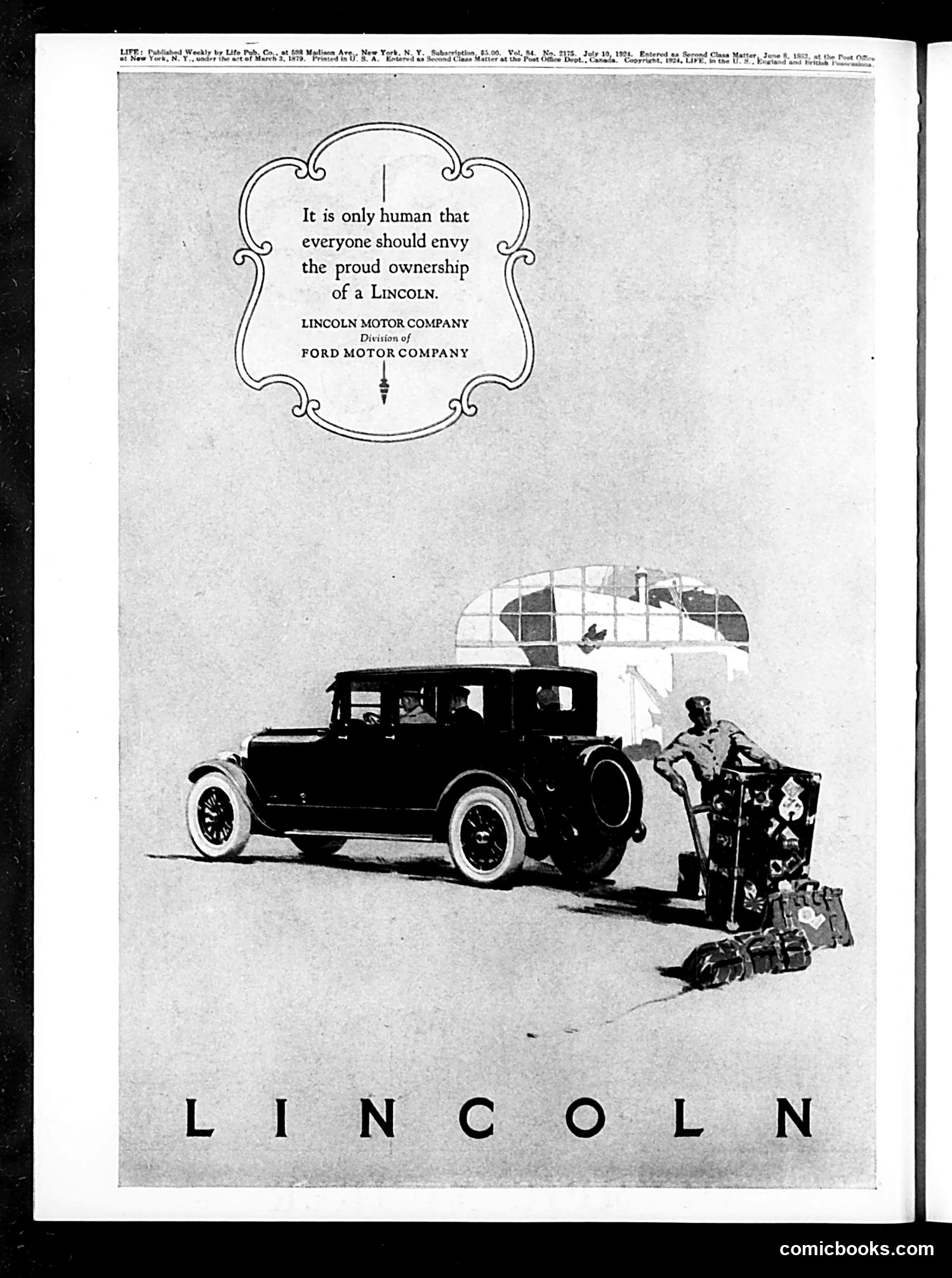
This is a **Lincoln automobile advertisement**, not satire. The page promotes Lincoln cars as a luxury vehicle, a division of Ford Motor Company. The ad's tagline—"It is only human that everyone should envy the proud ownership of a LINCOLN"—uses flattery and aspirational messaging typical of 1920s marketing. The imagery shows a well-dressed man with luggage and a travel case beside a Lincoln sedan, emphasizing luxury, travel, and social status. The accompanying airplane illustration suggests modernity and sophistication. The ad appeals to wealthy consumers by suggesting that owning a Lincoln signals success and taste. This reflects the post-World War I automotive boom when cars represented status symbols for the affluent middle and upper classes.
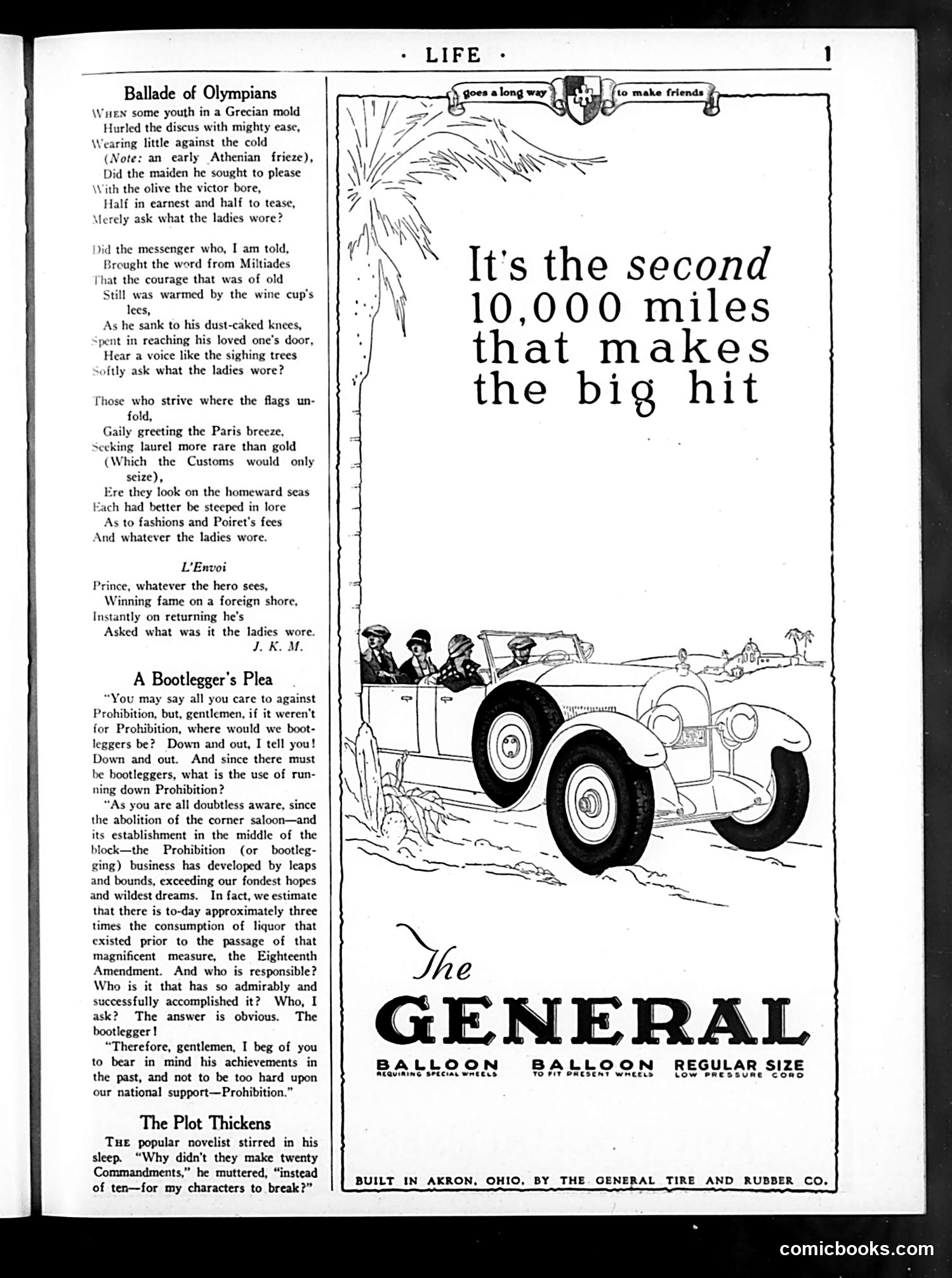
This page contains **literary content and advertising rather than political cartoons**. The left side features three humorous poems: "Ballade of Olympians" (about Olympic athletes and their romantic appeal), "L'Envoi" (on fame and travel), "A Bootlegger's Plea" (satirizing Prohibition's failure), and "The Plot Thickens" (a brief anecdote). The dominant right side is a **General Tire advertisement** showing a 1920s-era racing car on a long road with passengers. The ad's central claim—"It's the second 10,000 miles that make the big hit"—emphasizes tire durability and longevity. The "Bootlegger's Plea" poem is the only political content, sardonically arguing Prohibition increased rather than decreased alcohol consumption, making bootleggers successful and raising the question of who bears responsibility.
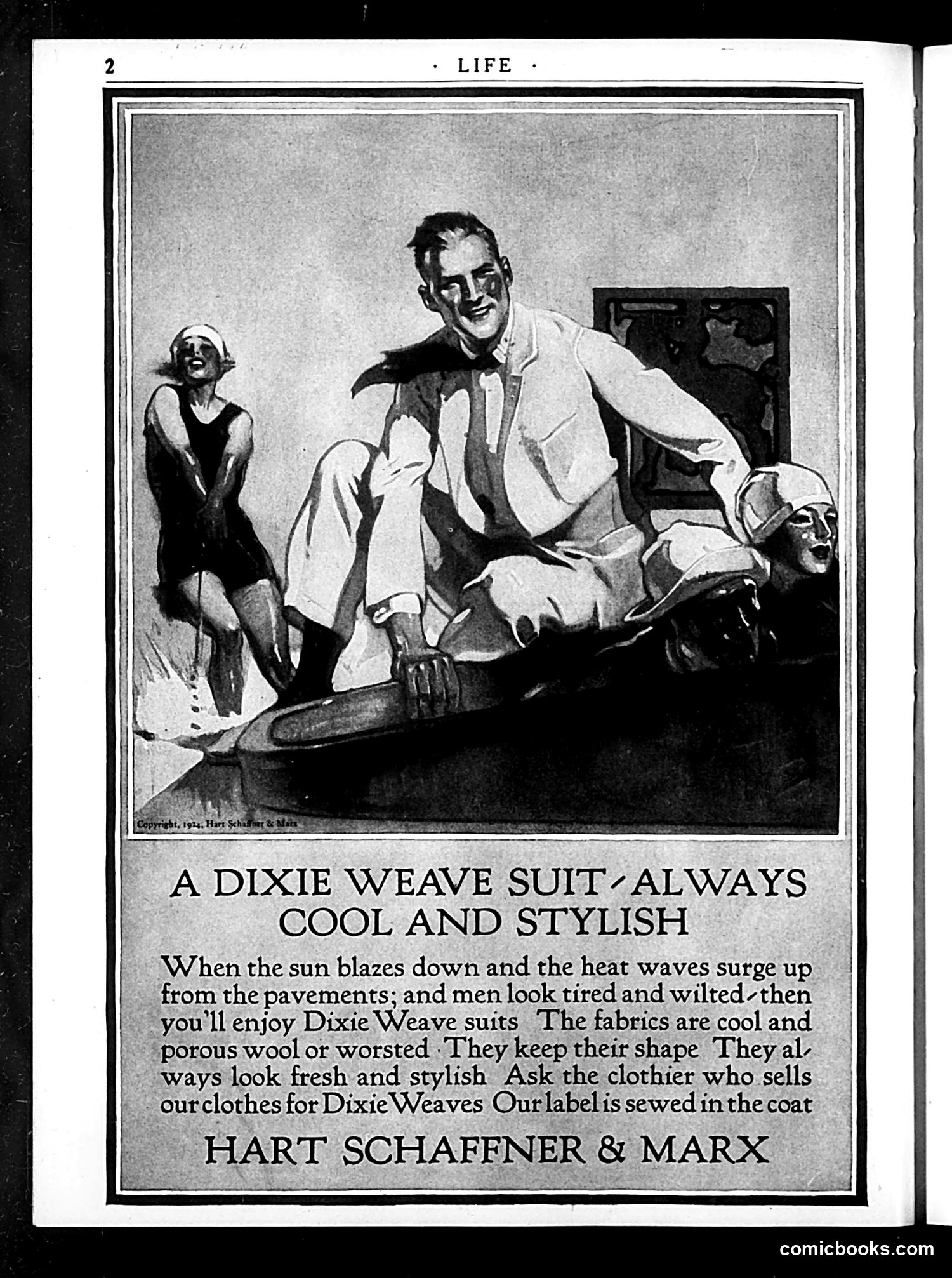
This page is **primarily an advertisement**, not satire or editorial content. It advertises Dixie Weave suits made by Hart Schaffner & Marx, a major American clothier. The image shows a well-dressed man in a light-colored suit at what appears to be a beach or poolside setting, with other figures in swimming attire nearby. The ad copy emphasizes that Dixie Weave suits remain "cool and stylish" in hot weather because they use "cool and porous wool or worsted" fabric that "keeps their shape" and "always look fresh." This is straightforward product marketing targeting warm-weather business wear—there is no political cartoon or satirical commentary on this page. The advertisement simply positions the suit brand as practical for summer conditions.
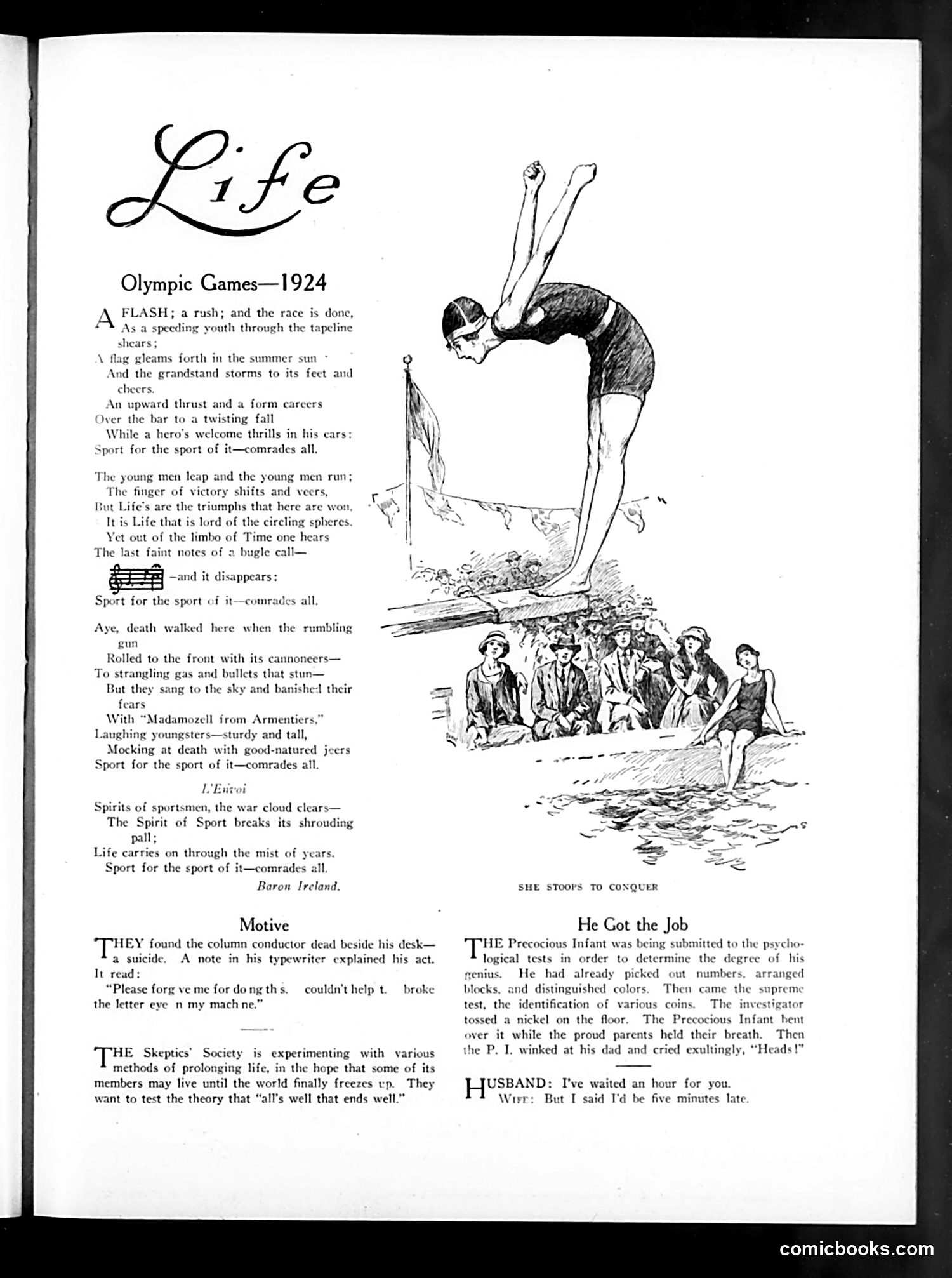
This page from *Life* magazine features a poem titled "Life: Olympic Games—1924" celebrating athletic competition as noble human endeavor, contrasting sports with the brutality of war. The accompanying illustration shows a female diver mid-leap, watched by spectators below—visualizing the poem's theme of athletic prowess and graceful human achievement. Below are three brief satirical pieces: "Motive" describes a suicide note; "He Got the Job" mocks psychological testing of an infant; and a husband-wife dialogue jokes about punctuality. These represent *Life*'s typical format of mixing serious commentary with humor about contemporary social absurdities—here targeting bureaucratic testing methods and domestic stereotypes rather than specific political figures.
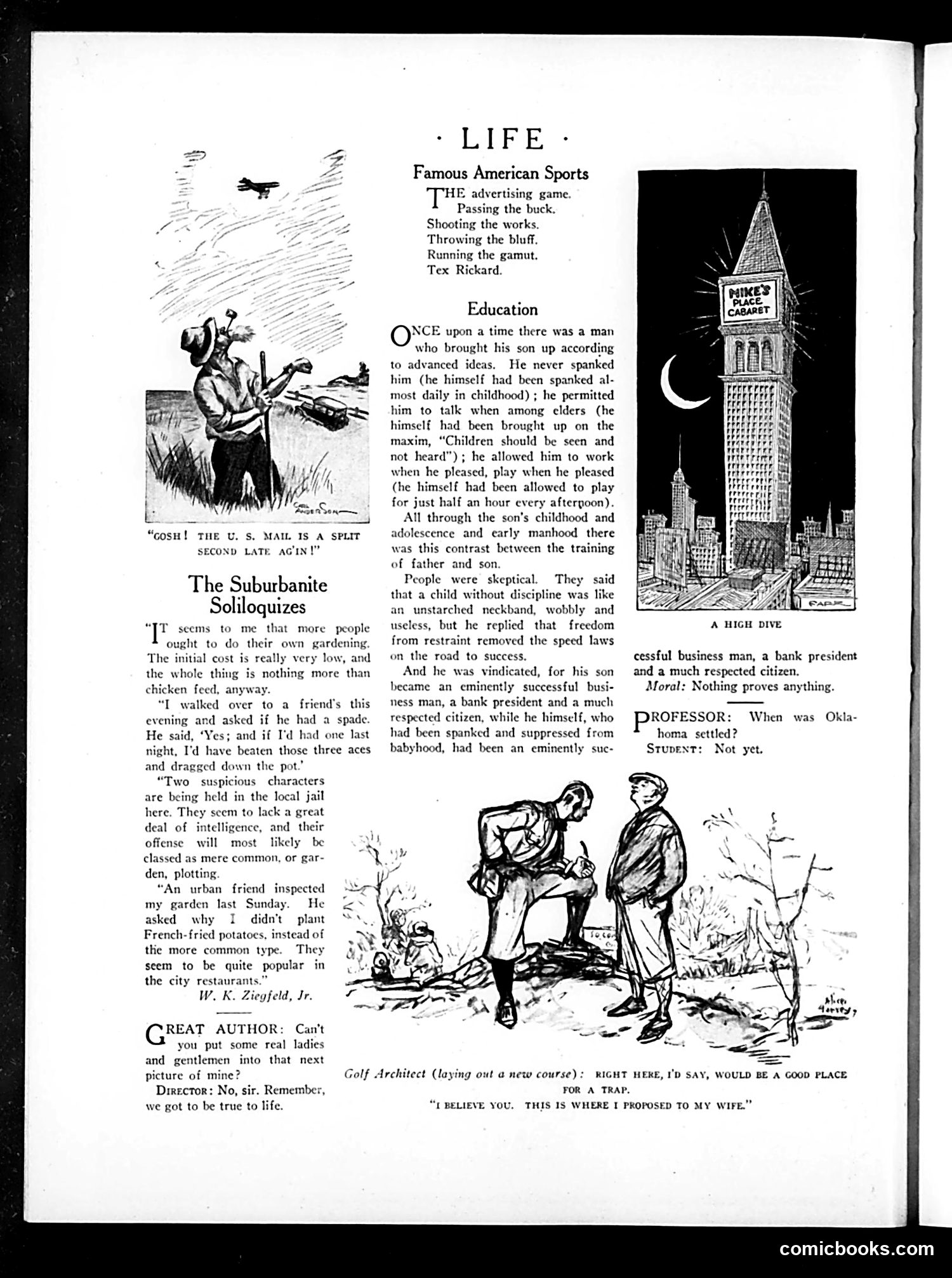
This page contains several humor pieces satirizing early 20th-century American life: **"Famous American Sports"** lists contemporary pastimes (advertising, passing the buck, shooting works, throwing bluff, running the gaunt, Tex Rickard), mocking them as "sports" worthy of national attention. **"The Suburbanite Soliloquizes"** jokes about suburban gardening pretensions—a friend's boasting about French-fried potatoes suggesting city restaurants' sophistication. **"Education"** contrasts modern permissive parenting (allowing freedom, play) with traditional spanking, suggesting the son's success despite unconventional upbringing. The golf cartoon jokes about marriage proposal locations, with the architect suggesting a golf course as the spot where he proposed to his wife—satirizing both male obsession with golf and romantic clichés. The humor targets class anxiety, suburban aspirations, and changing social customs of the era.
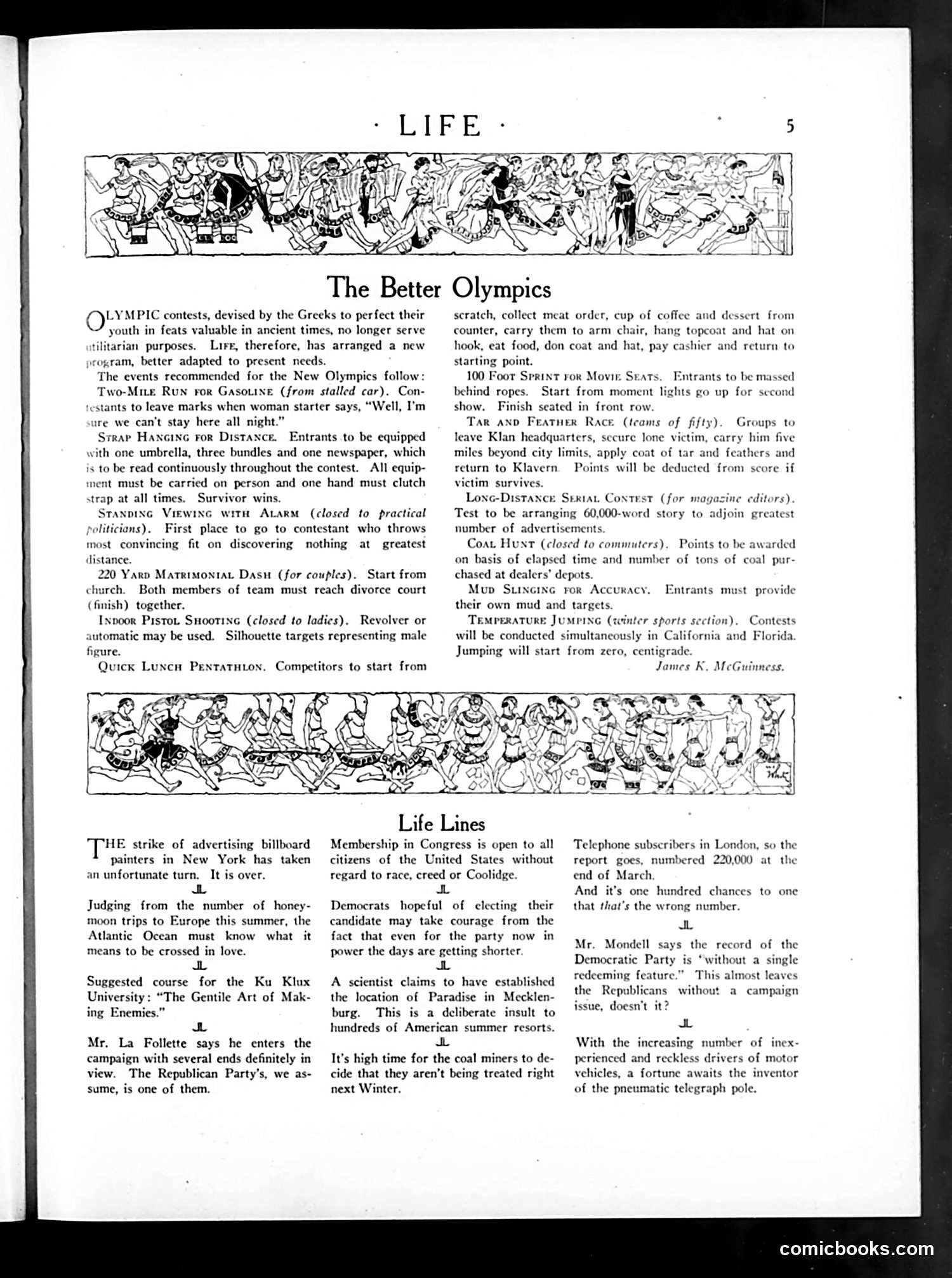
This page satirizes modern American social problems by proposing absurd athletic "events" that mock contemporary issues. The cartoons depict exaggerated competitions like: - A "Two-Mile Run for Gasoline" (reflecting fuel shortages) - "Strap Hanging on a Dustpan" (crowded public transit) - "Matrimonial Dash to divorce court" (high divorce rates) - "Coal Hunt" and "Mud Slinging" (economic and political corruption) The satire suggests these everyday struggles are more "Olympic" than actual sports. The accompanying "Life Lines" section contains brief political commentary, including jabs at both Democrats and Republicans regarding campaign issues and party leadership. The overall message: American society faces more pressing, absurd challenges than athletic competition—a characteristic Life magazine approach blending humor with social criticism.
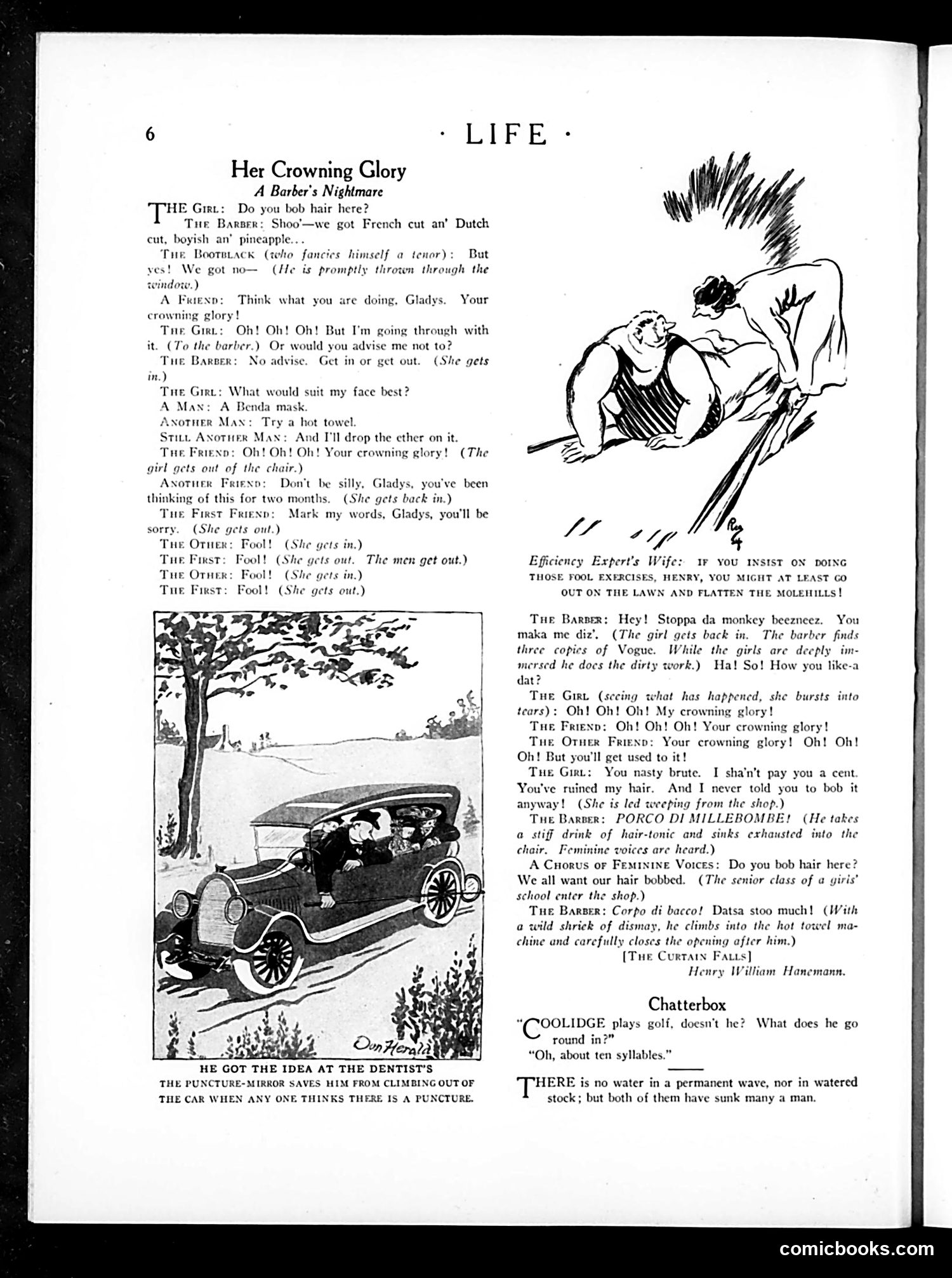
This page contains two distinct pieces: **"Her Crowning Glory"** (top): A comic dialogue about a woman getting a bob haircut—a controversial 1920s trend. Friends worry she'll regret it; a barber defends the style. The satire mocks both the heated debate over women's short hair (seen as scandalous) and women's anxieties about appearance. The "crowning glory" phrase ironically refers to hair women were literally cutting off. **Bottom cartoon**: Shows a car with a puncture. The caption explains a man used the car's puncture-mirror to check for flats, saving himself from climbing out—absurd logic played for humor about automotive paranoia. Both pieces are lightweight social comedy typical of Life's satirical approach to modern manners and fads of the era.
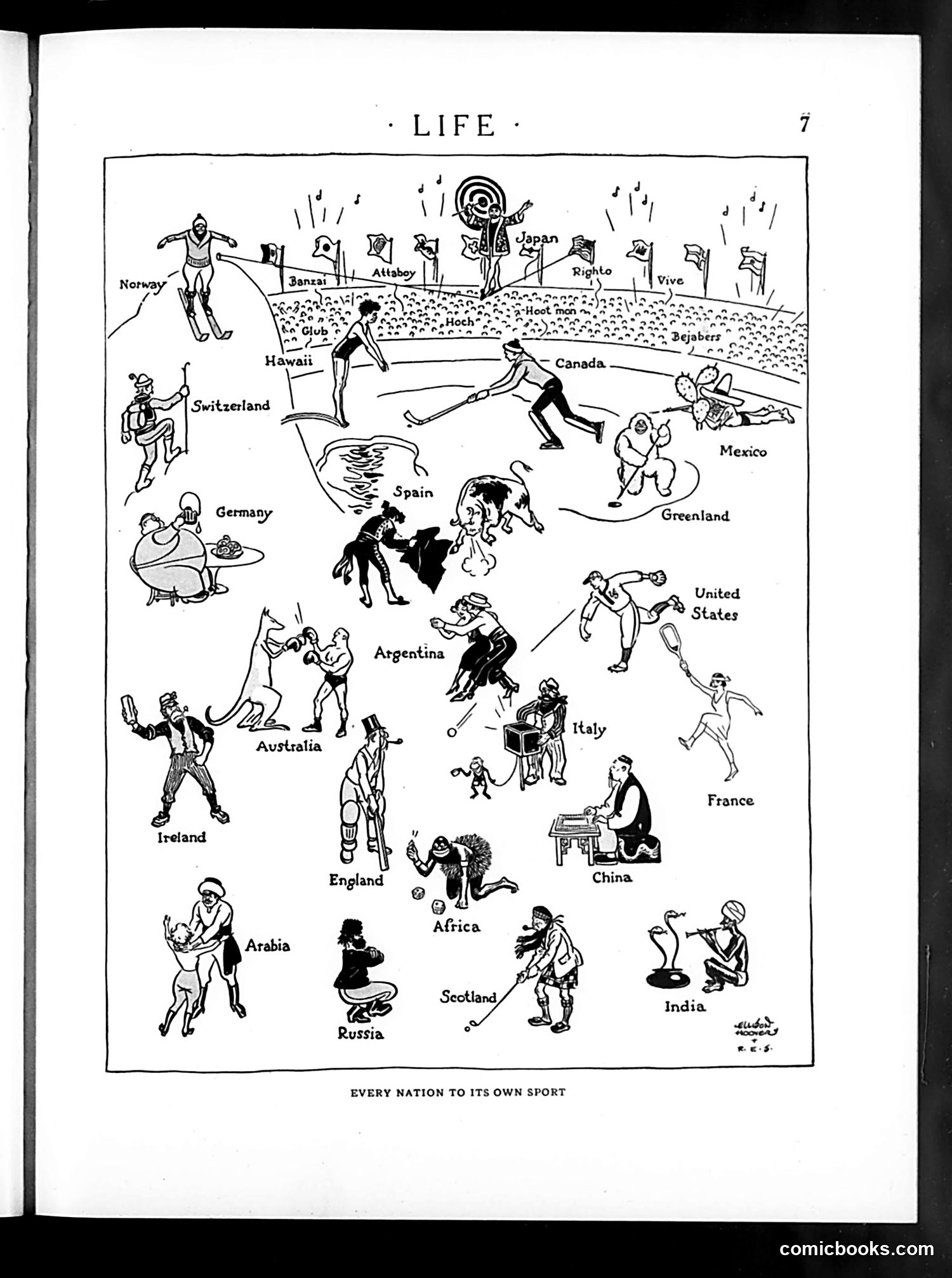
This satirical cartoon maps countries onto a world depicted as a sports field, with each nation represented by a figure engaged in a characteristic activity. The caption suggests national stereotypes or perceived national traits expressed through sport and leisure: - Norway: skiing - Switzerland: mountaineering - Germany: eating/feasting - Spain: bullfighting - France: refined pursuits - England: cricket - Scotland: golf - Russia: appears inactive/crouching - China: scholarly/sedentary activity - United States: baseball - Argentina: wrestling - Australia: boomerang throwing - Japan: traditional activity The cartoon uses physical caricatures and activities to humorously express early 20th-century Western stereotypes about national character and cultural priorities. It's a lighthearted anthropological commentary common to Life magazine's satirical approach.
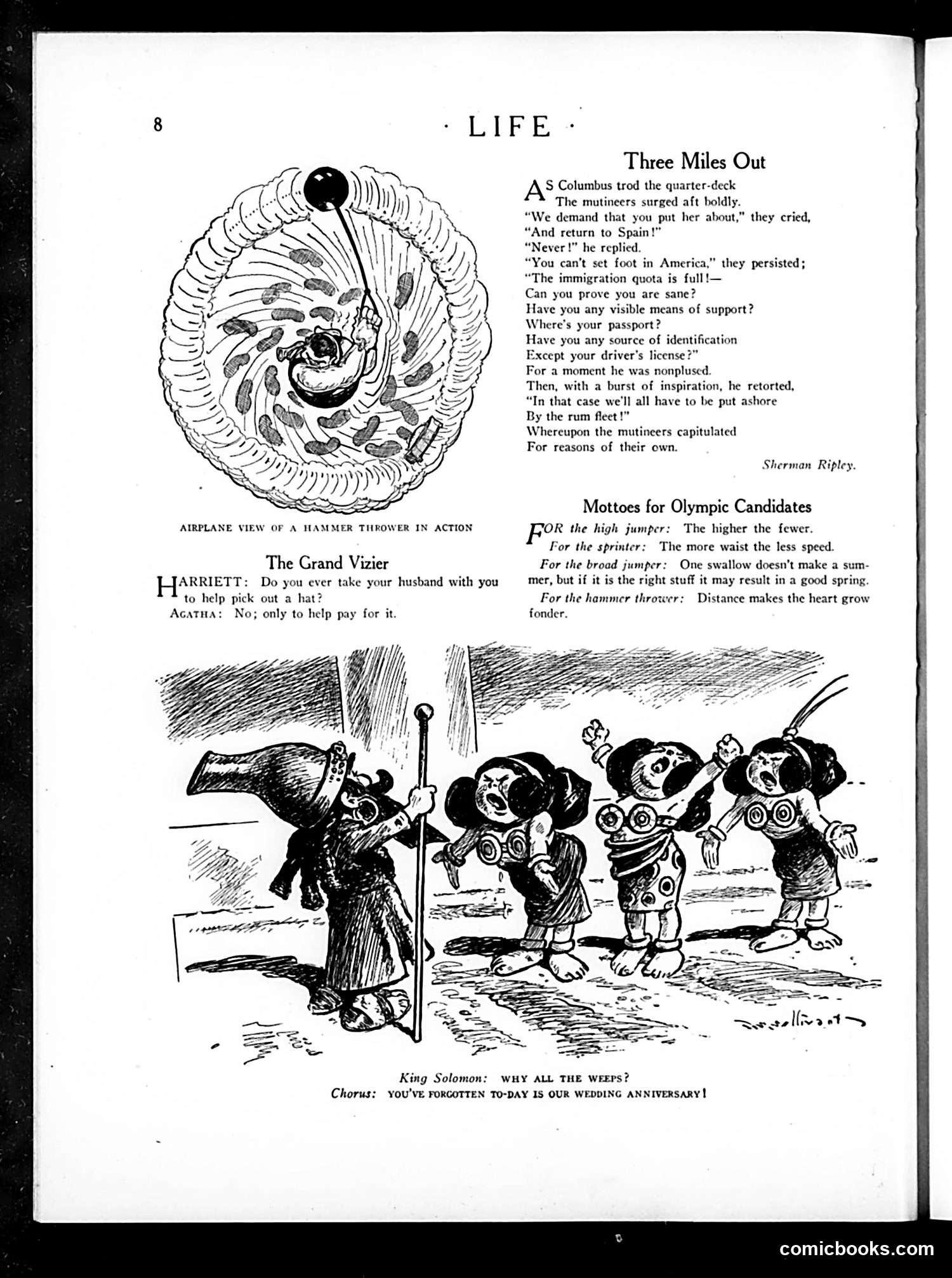
This page contains three distinct pieces of satire: 1. **"Three Miles Out"** (by Sherman Ripley): A poem about Columbus encountering mutineers demanding return to Spain. The accompanying aerial illustration of a ship's hammer thrower shows the vessel's mechanics. 2. **"The Grand Vizier"**: A brief comedic dialogue between Harriett and Agatha about hat-purchasing, likely poking fun at domestic expense and marital dynamics. 3. **"King Solomon" cartoon**: Depicts the biblical king with multiple wives/attendants, with the punchline that they've forgotten their wedding anniversary. This satirizes marital discord and the challenges of polygamy, using biblical reference for humorous effect. The page combines maritime history satire, domestic humor, and classical biblical comedy typical of early 20th-century American satirical magazine content.
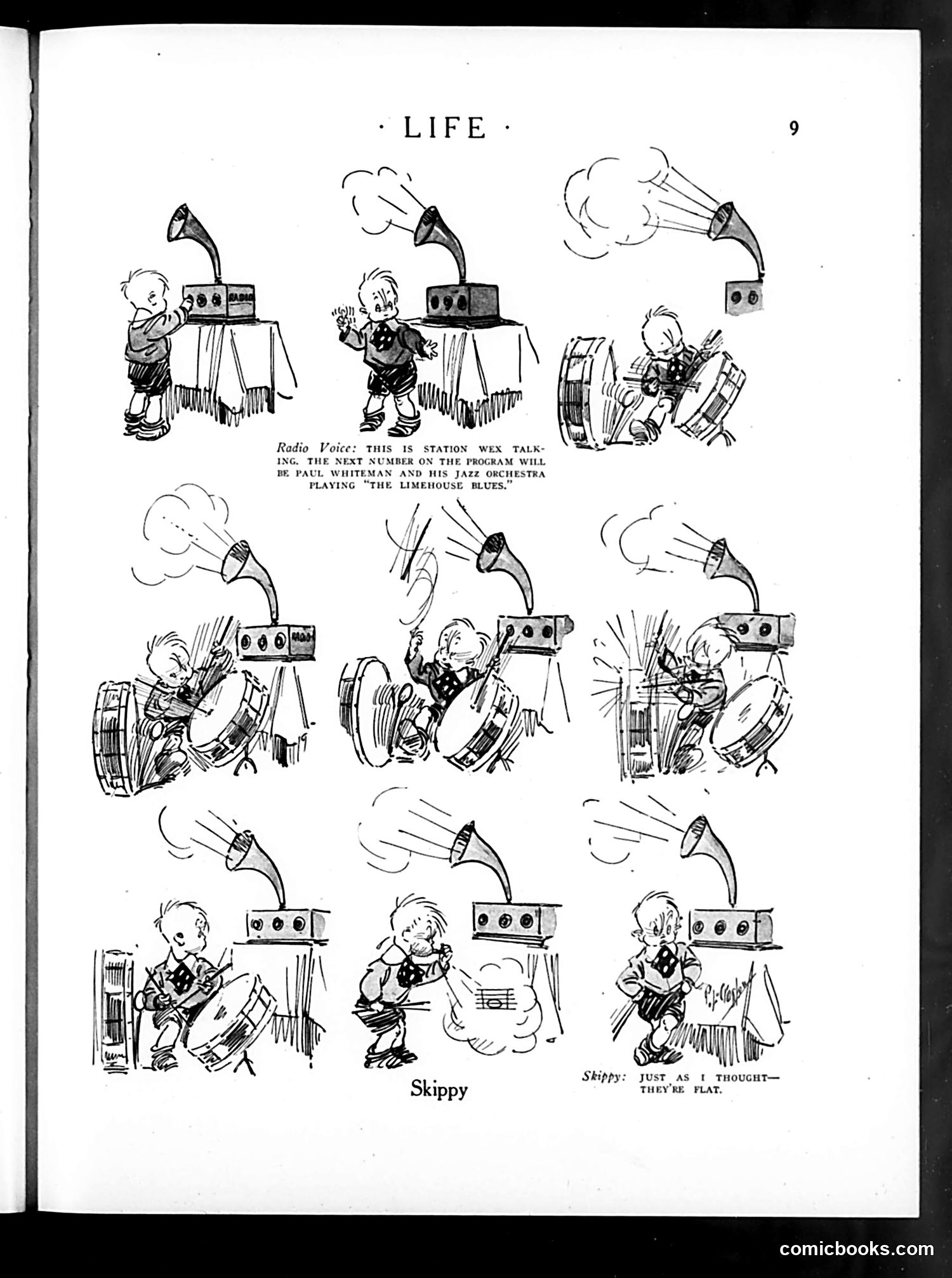
This is a comic strip sequence titled "Skippy" featuring a child character and a radio setup. The humor centers on a radio announcement: a voice announces the next program will feature "Paul Whiteman and his Jazz Orchestra playing 'The Limehouse Blues.'" The joke appears to turn on the child's literal interpretation of the broadcast. As the sequence progresses, the child's radio speaker produces increasingly wild and chaotic effects—bursting speakers, flying debris, and general destruction—culminating in flattened drums. The punchline, delivered by the character "Skippy," suggests the child expected the music to sound destructive based on the announcement, but was surprised to find it literally destroyed his equipment. This plays on jazz music's reputation at the time for being wild, loud, or "hot"—a common target of satire in the 1920s-30s.
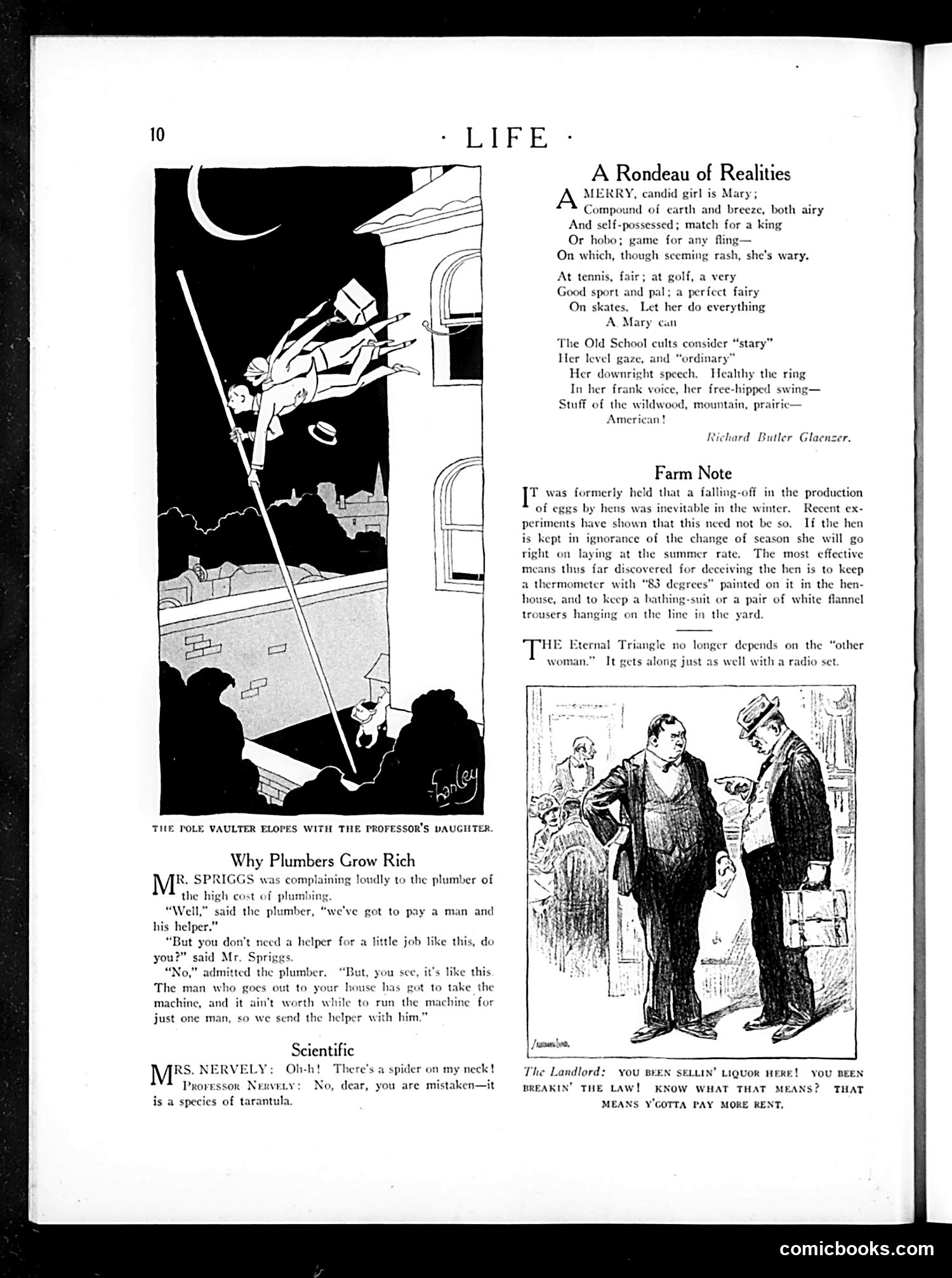
This page contains several satirical pieces typical of early 20th-century Life magazine: **"A Rondeau of Realities"** (poem by Richard Butler Glaenzer) celebrates a modern girl named Mary—athletic, independent, and self-possessed—contrasting her with traditional expectations of femininity. It reflects 1920s attitudes toward women's liberation. **"Why Plumbers Crow Rich"** depicts Mr. Spriggs complaining about plumbing costs. The joke illustrates class commentary: plumbers command high wages because they require skilled assistants, making the work expensive—a satire on labor economics and skilled trades' profitability. **"Scientific"** is a brief joke about Mrs. Nervely mistaking a tarantula spider for a common variety, with Professor Nervely correcting her—poking fun at amateur naturalism or women's ignorance. The page balances social commentary on modernity with lighthearted domestic humor.
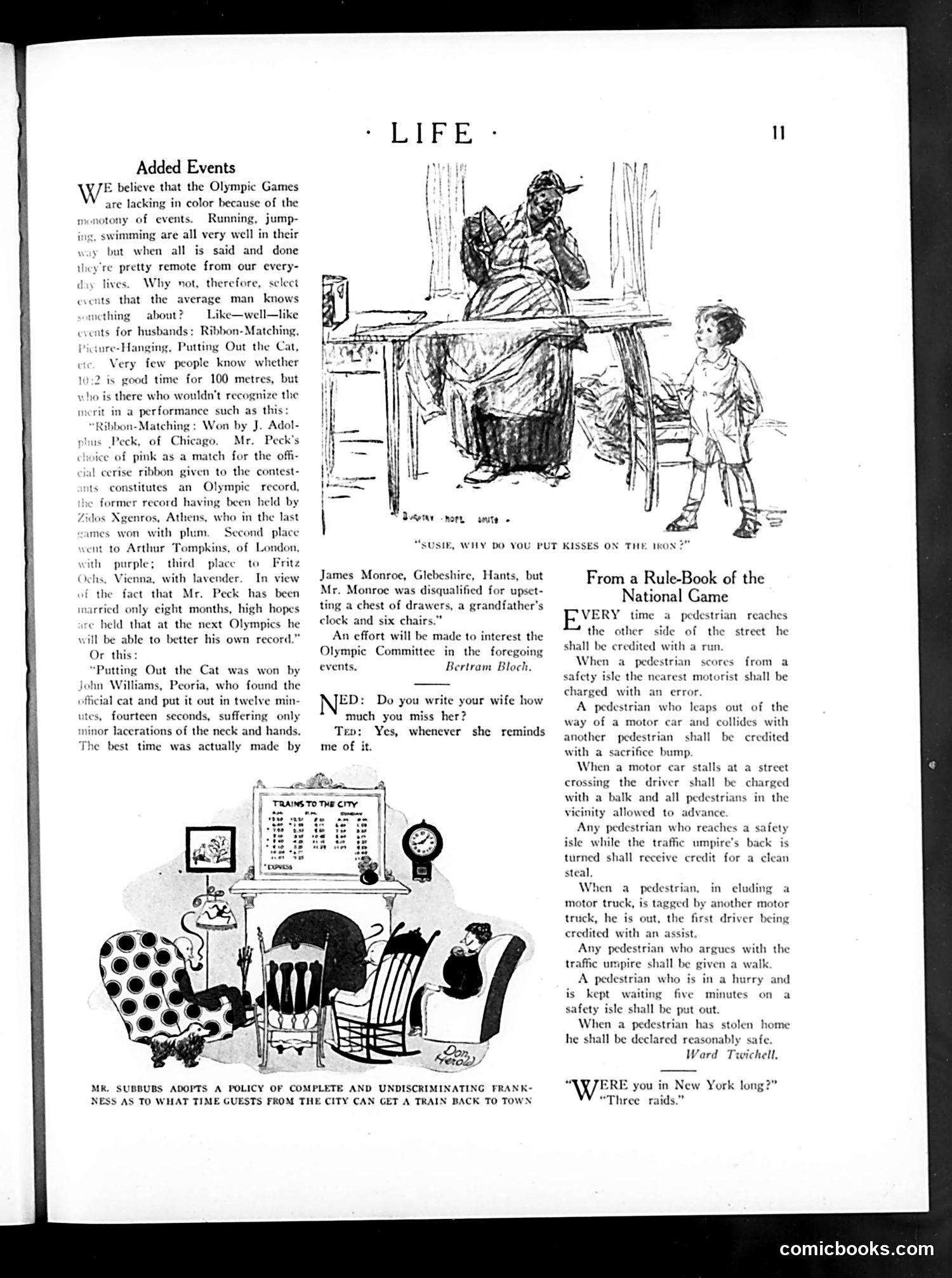
This page contains several distinct items: **"Added Events" section:** Satirizes Olympic Games organizers for lacking "color" in events. It mocks proposed additions like "Ribbon-Matching" and "Picture-Hanging, Putting Out the Cat"—deliberately mundane domestic tasks—to critique how boring the actual Olympic events are. The joke is that even absurd household chores would be more interesting to watch. **Main cartoon:** Shows a woman asking a child "Susie, why do you put kisses on the iron?" It's a gentle humor piece about childhood confusion regarding common domestic expressions. **"Rule-Book of the National Game":** A satirical take on pedestrian safety rules for urban traffic, treating street-crossing like a competitive sport with complex scoring rules—social commentary on the chaotic, dangerous relationship between cars and pedestrians in modern cities.
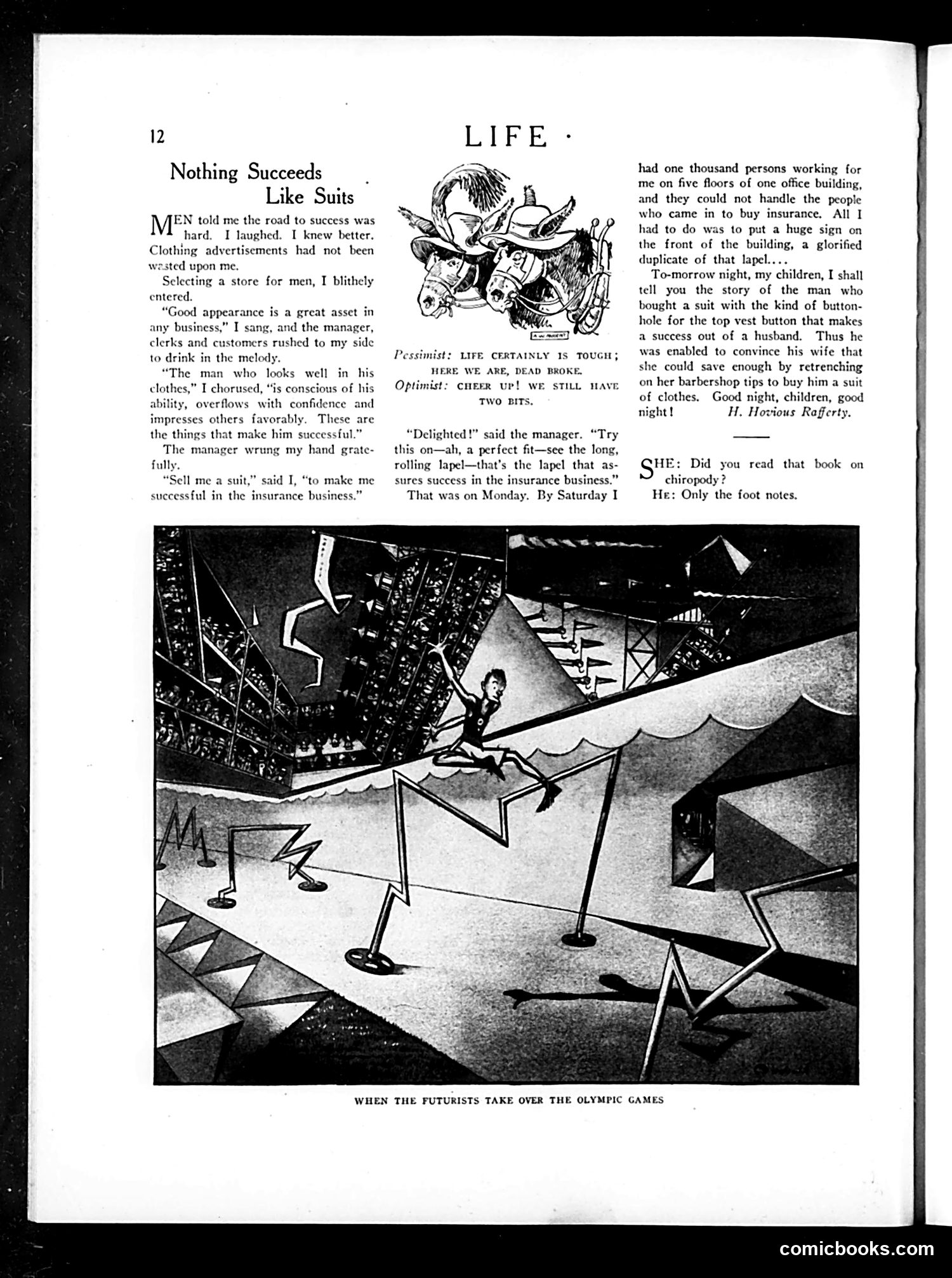
This page contains two distinct pieces: **Top section:** A humorous article about how wearing a well-fitted suit helped a man succeed in the insurance business. The narrative emphasizes that good appearance and confidence matter in professional success—a satirical jab at the superficiality of business culture. **Bottom illustration:** Titled "When the Futurists Take Over the Olympic Games," this is a surreal, modernist artwork depicting an imaginary future Olympics with abstract, angular athletic equipment and a figure performing in an impossibly geometric stadium. It mocks the Futurist art movement's obsession with angular, mechanical forms and speed, suggesting that if Futurist aesthetic principles governed sports, they'd become absurdly impractical and unwatchable. Both pieces satirize early 20th-century cultural pretensions.
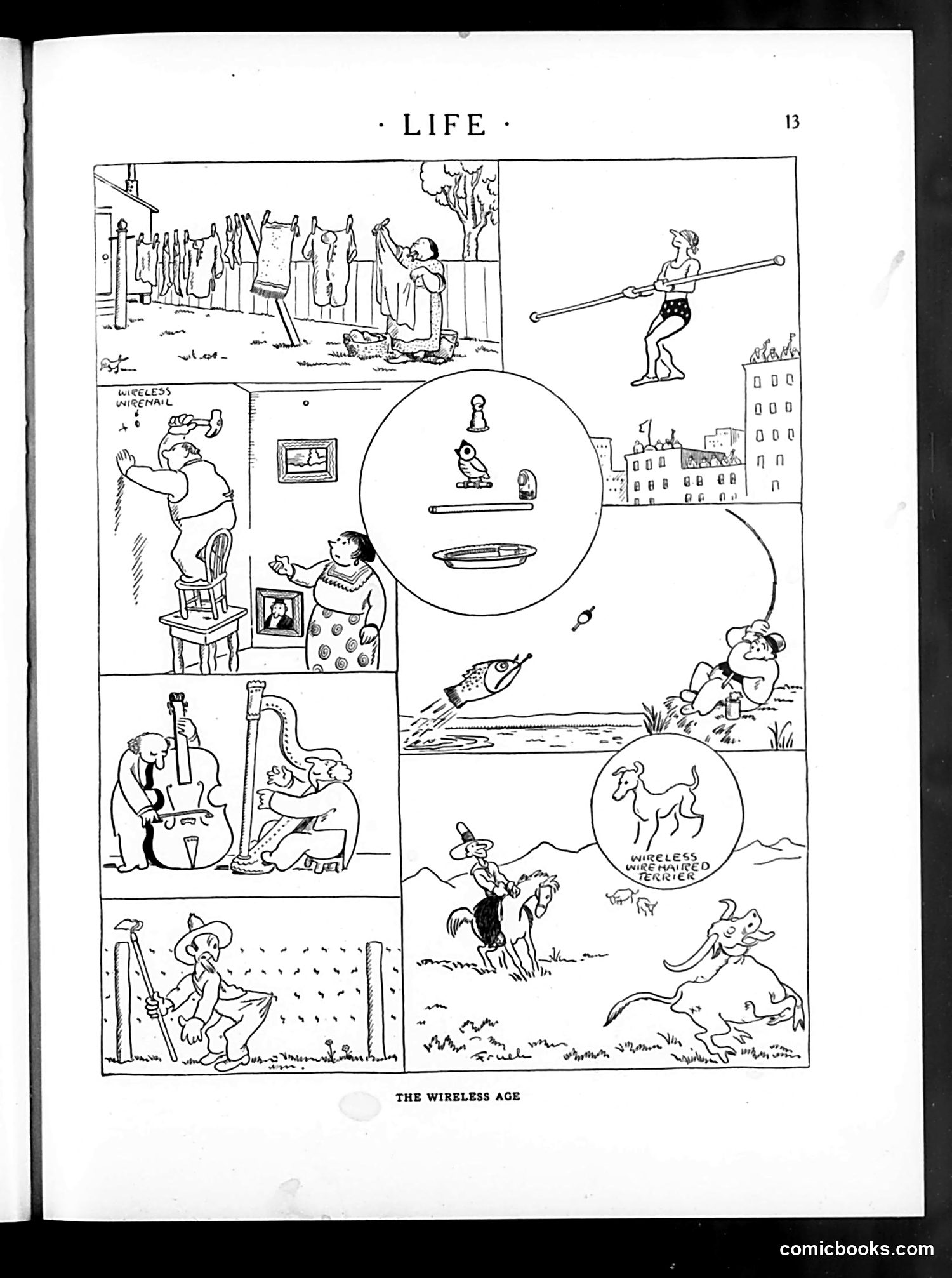
This page satirizes the early wireless/radio technology era through humorous vignettes showing how wireless devices disrupted daily life. The central circle depicts wireless toys and technology, surrounded by scenes of chaos: - A man using a wireless device while ignoring his wife - Musicians with wireless instruments creating confusion - A cowboy with wireless equipment on horseback - A dog labeled "wireless wire-haired terrier" - People operating wireless devices outdoors The satire mocks how this new technology invaded every aspect of life—entertainment, romance, work, and even pets—often at the expense of social interaction and traditional activities. The title "THE WIRELESS AGE" suggests this technology was becoming inescapable and reshaping society in both comic and disruptive ways.
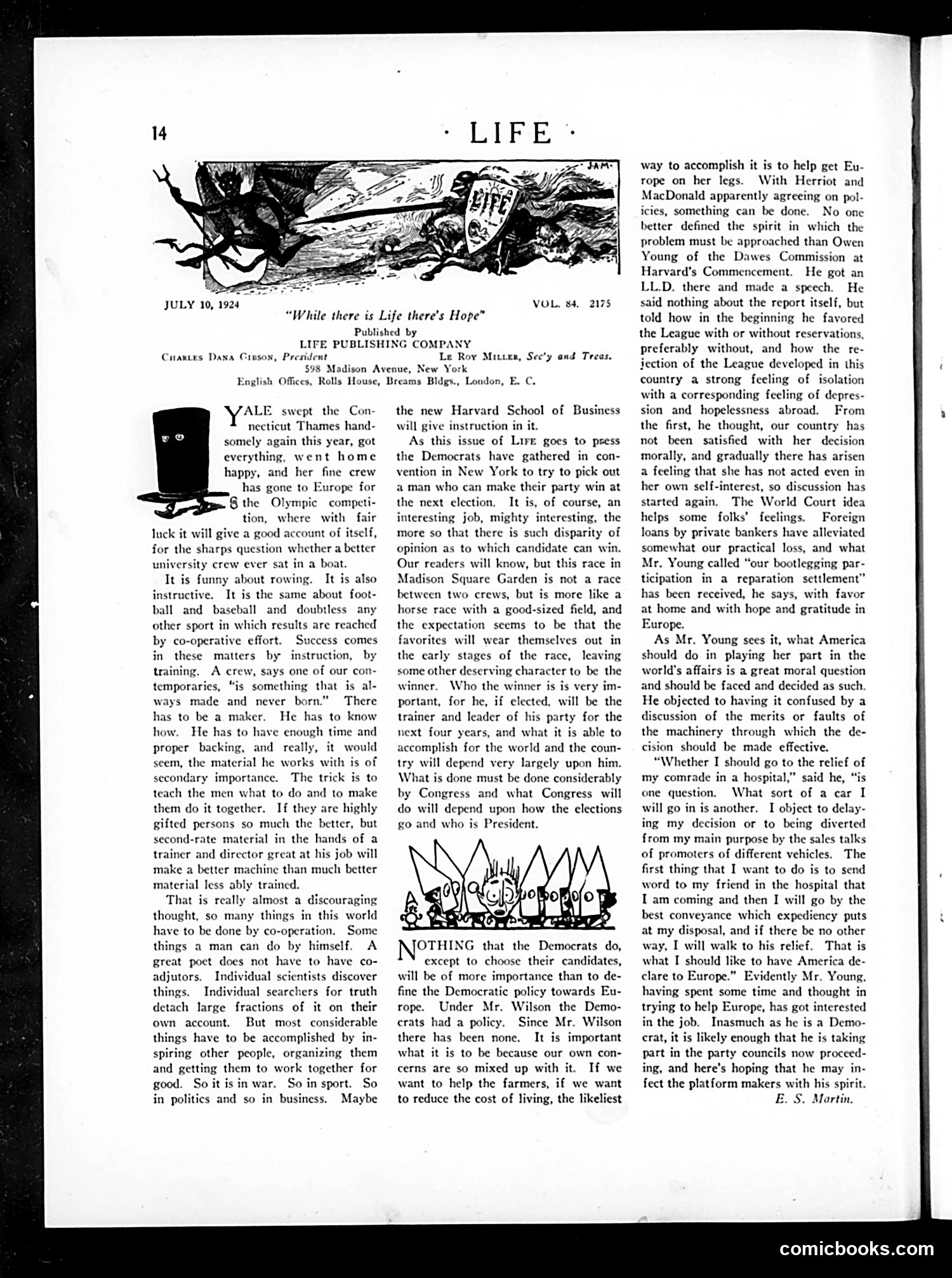
**The Cartoon:** The small illustration shows silhouettes of people with raised fists or arms in celebratory poses, labeled "NOTHING that the Democrats do." It satirizes the Democratic Party's inability to take decisive action—particularly regarding defining policy toward Europe. The cartoon suggests Democrats are making empty gestures rather than implementing substantive programs. **The Context:** The text discusses the 1924 Democratic Convention in New York, where party leaders are selecting a presidential candidate. The author criticizes the Democrats for lacking a clear European policy since President Wilson left office, contrasting this with the need for practical solutions to post-WWI economic problems and farm relief. The satire targets Democratic ineffectiveness and political posturing during a period requiring serious international engagement.
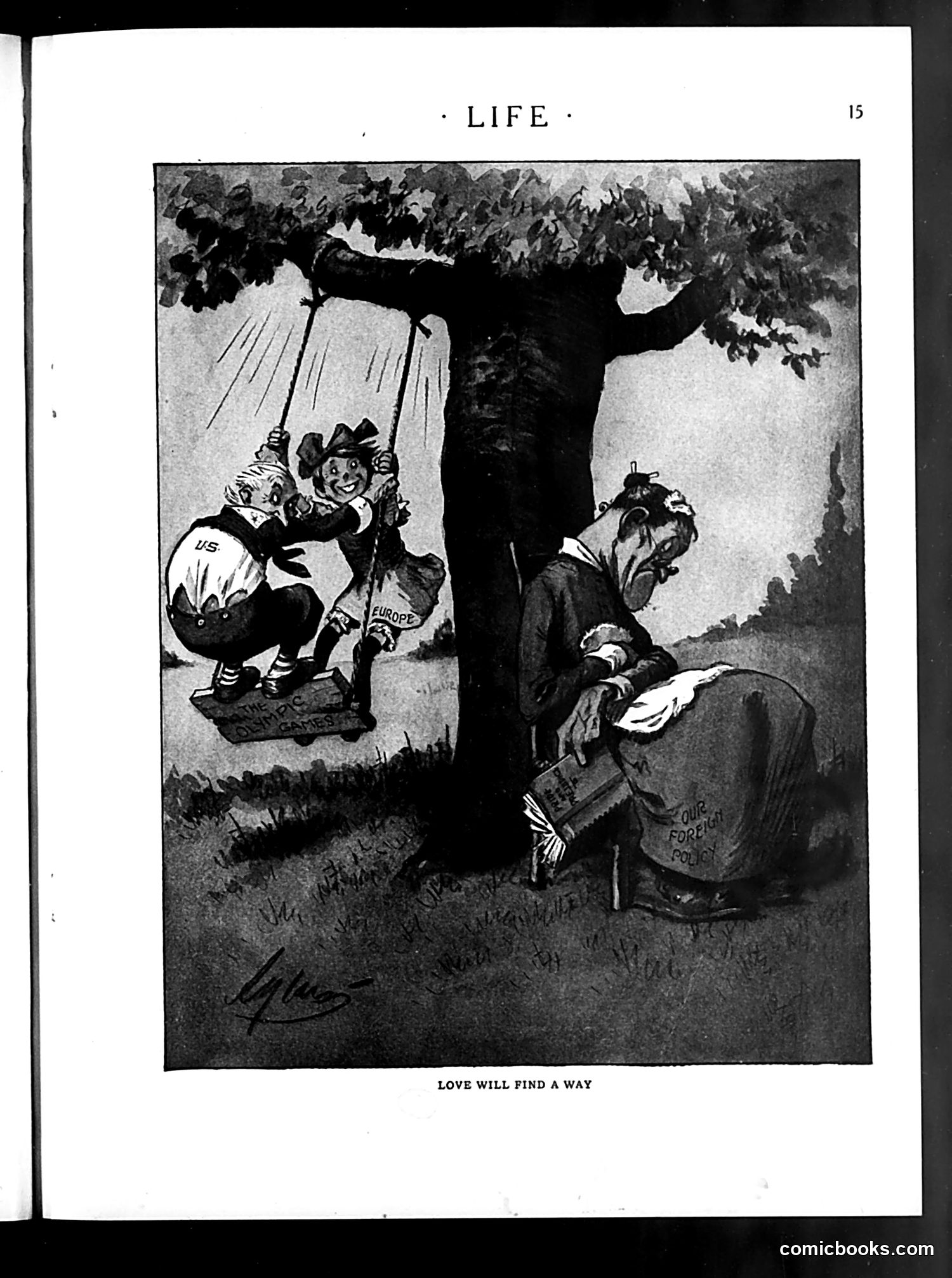
This political cartoon depicts two figures beneath a tree. On the left, a caricatured character labeled "US" on clothing swings on a swing with another figure labeled "EUROPE," both appearing cheerful and romantic. On the right, a hunched, worried figure sits with a barrel labeled "OUR SUPPLY FOR RELIEF" (text partially visible). The satire contrasts American optimism about European romance/relations with the serious humanitarian crisis of food shortages or poverty in post-war Europe. The caption "Love Will Find a Way" ironically suggests that sentiment and goodwill alone will solve material problems, while the starving figure demonstrates the inadequacy of such optimism without actual relief supplies. This likely addresses American aid debates following World War I.
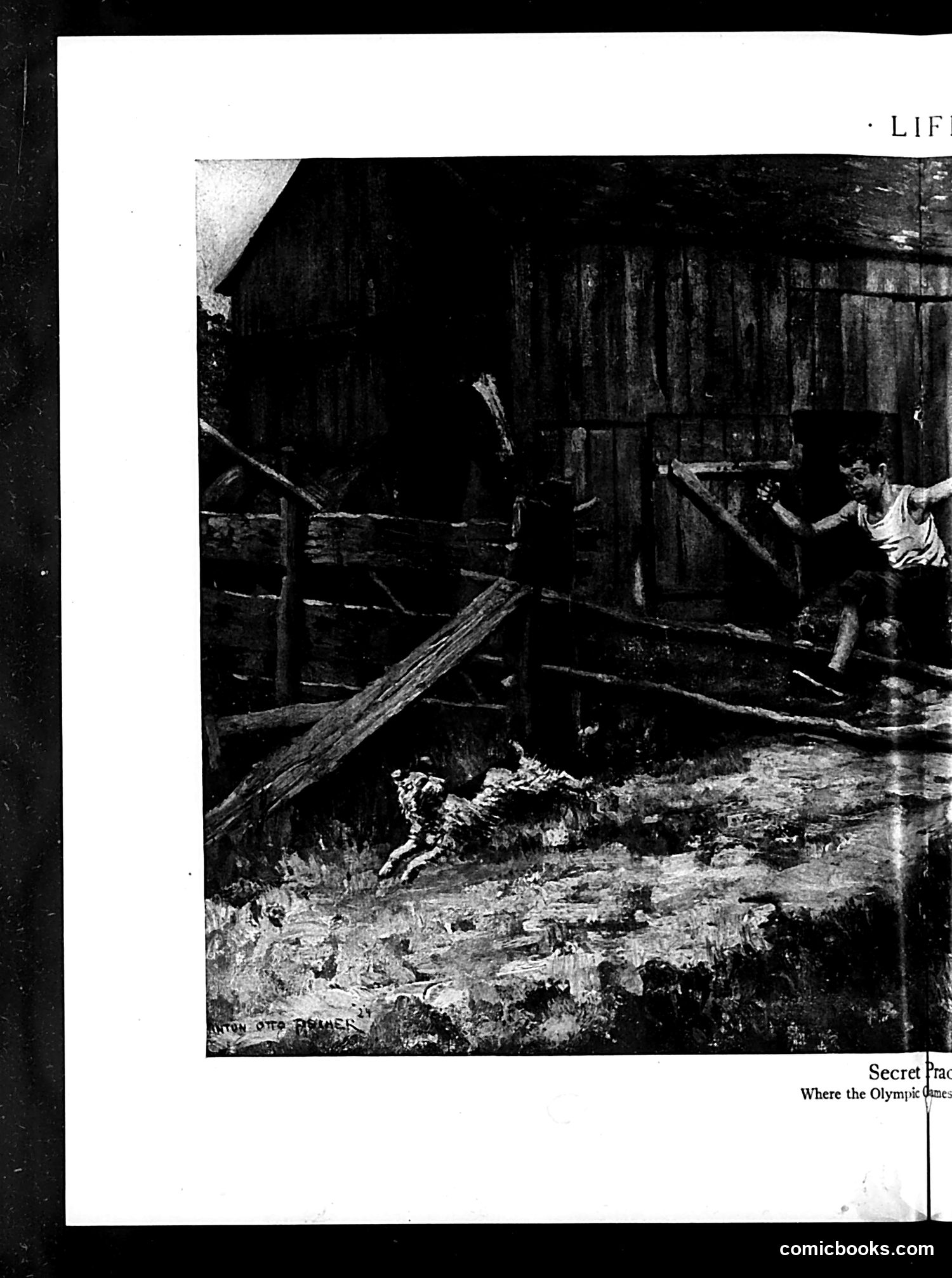
This page shows a dramatic black-and-white photograph of what appears to be a rural or farm setting, with wooden structures and fencing visible. A figure in light-colored clothing is visible on the right side of the image. The caption references "Where the Olympic" (text cuts off), suggesting this relates to the Olympic Games, though the specific connection between this rural scene and the Olympics is unclear from the visible portion. The photograph's stark, documentary style and the reference to "Secret" (visible at bottom right) suggest this may be exposing some hidden or controversial aspect of Olympic-related activities. However, without the complete caption or additional context, the specific satirical point remains unclear. The comicbooks.com watermark indicates this is a digitized archive image.
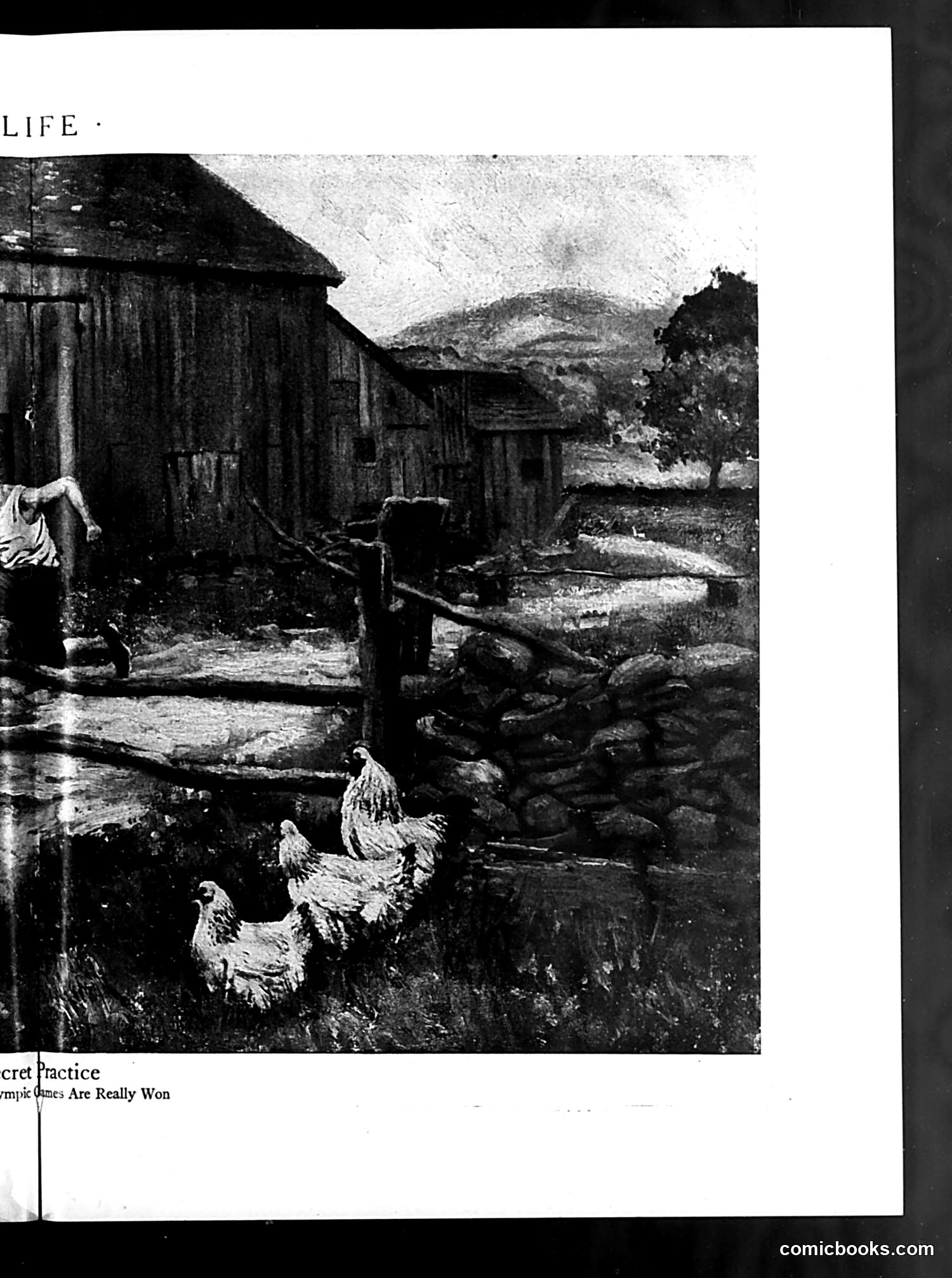
This appears to be a page from *Life* magazine featuring a rural farmyard scene with roosters and chickens in the foreground, weathered wooden buildings, and mountains in the background. The photograph is credited at the bottom. The visible text fragments reference "Secret Practice" and mention "Olympic Games Are Really Won," though the complete context is unclear from this partial page view. Without seeing the full article or caption accompanying this image, it's difficult to determine the specific satirical point. The juxtaposition of humble farm animals with Olympic Games language *suggests* possible commentary on rural American life versus grand national competition, but the exact satirical target or joke remains uncertain from the image alone.
This page reviews two Broadway plays from the 1920s era. The main focus is **"The Blue Bandanna,"** starring **Sidney Blackmer**, a Southern actor whom the critic praises for his energetic performance. Blackmer plays multiple roles—a young gentleman, a burglar, and "Gentleman Jim"—requiring constant quick changes and physical comedy. The critic notes approvingly that this challenging dual role forces Blackmer to "act" rather than rely on his typical "soft-spoken" Southern charm, and predicts he'll become popular in rough "apache" (tough guy) roles. The page also briefly reviews **"The Locked Door,"** which the critic dislikes, dismissing its reliance on wedding-night complications as cheap humor. The critic attributes his discomfort to inherited New England Puritanism rather than actual prudery. The small illustrations show theatrical scenes typical of 1920s stage comedy—slapstick physical business and interior settings.
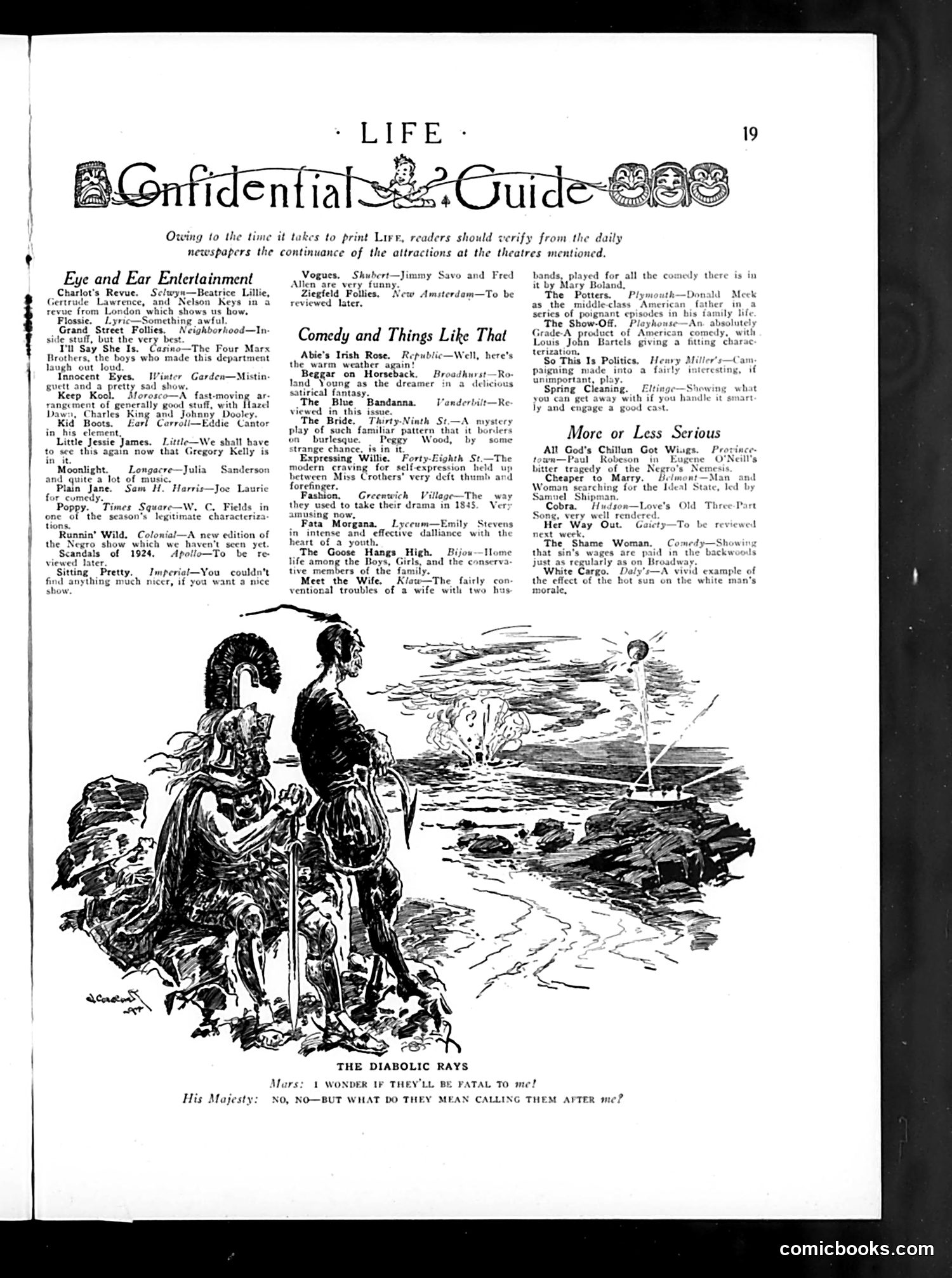
This page is primarily a **theater listings and reviews section** for Broadway shows, typical of Life magazine's entertainment coverage. The cartoon at the bottom depicts two elegantly dressed figures (appearing to be a woman and a devil or demonic character) observing mysterious rays emanating from the ocean. The joke plays on a double meaning: the "diabolic rays" are being named after the female figure, who protests that being associated with something destructive or dangerous is unflattering—essentially, "why would they name something terrible after *me*?" This is **social satire about vanity and reputation**: a witty jab at how even vain individuals might object to having harmful things named in their honor, subverting the typical vanity that would seek such notoriety. The humor relies on the contrast between desiring fame and being horrified by *what kind* of fame one receives. The page itself catalogs current Broadway productions with brief critical notes—shows like the Marx Brothers' "I'll Say She Is," W.C. Fields in "Poppy," and "Abie's Irish Rose."
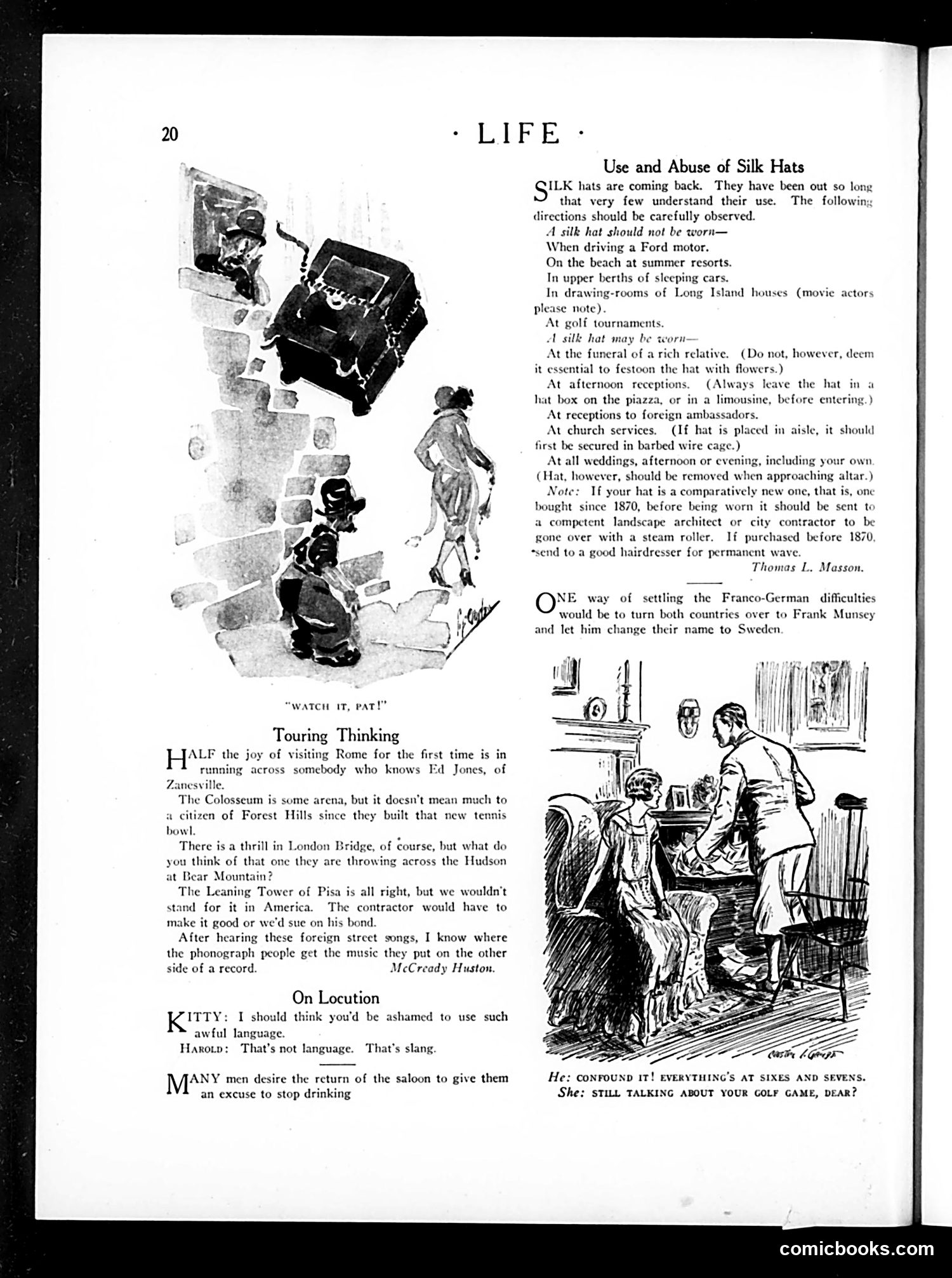
This *Life* magazine page contains satirical humor about early 20th-century American social customs and attitudes. **"Use and Abuse of Silk Hats"** is a mock-etiquette guide listing absurd rules for formal wear—poking fun at rigid class conventions. The joke is that silk hats were outdated yet still signaled social status. References to "movie actors" on Long Island and the note about hats purchased before 1870 needing a "steam roller" or hairdresser treatment satirize both newfound wealth (movie industry) and the pretension of maintaining ancient formal dress. **"Touring Thinking"** mocks American provincialism: travelers visiting Rome or the Colosseum are unimpressed because they're comparing everything to American attractions (Bear Mountain, Forest Hills tennis bowl). It's satire on American insularity and the belief that American accomplishments rival European landmarks. The brief "Franco-German difficulties" joke references World War I tensions, suggesting Frank Munsey (a real publisher/magnate) should manage both countries—implying he'd mismanage them as badly as he ran his business. **"On Locution"** jokes about class distinctions between "language" (proper speech) and "slang" (working-class speech).
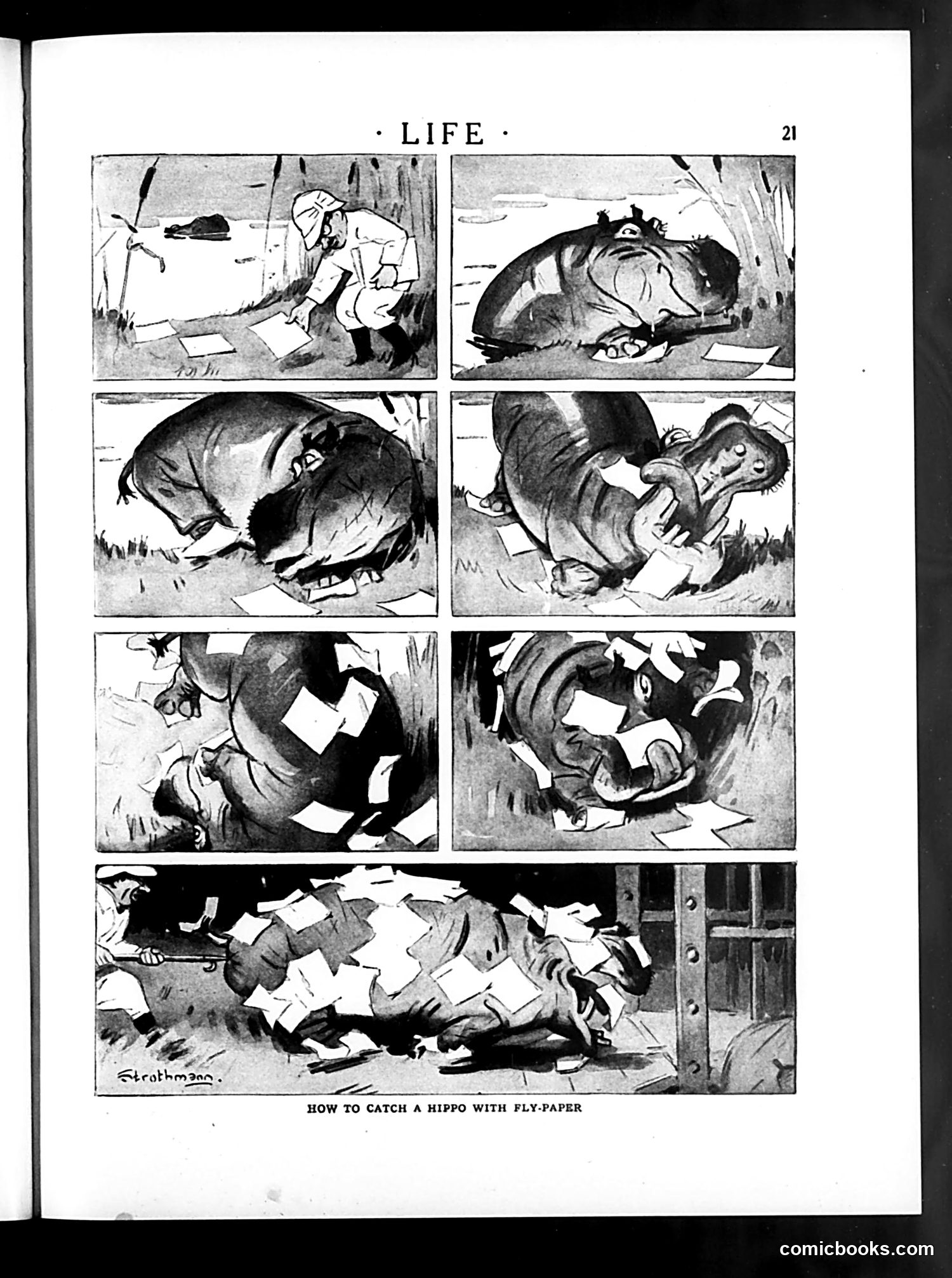
This is a humorous comic strip showing a slapstick sequence where someone attempts to catch a hippopotamus using fly-paper. The panels depict escalating chaos: a person applies fly-paper to what appears to be a hippo by water, gets increasingly entangled with the sticky paper themselves, and ultimately ends up completely wrapped and immobilized alongside the hippo near a building. The joke is the absurdist premise—using a tool designed for catching insects to capture a massive animal—combined with the physical comedy of the plan backfiring spectacularly. The cartoonist (signed "Strothmann") uses exaggerated poses and expressions to emphasize the character's misfortune. This appears to be early 20th-century satirical humor relying on visual gags rather than political commentary.
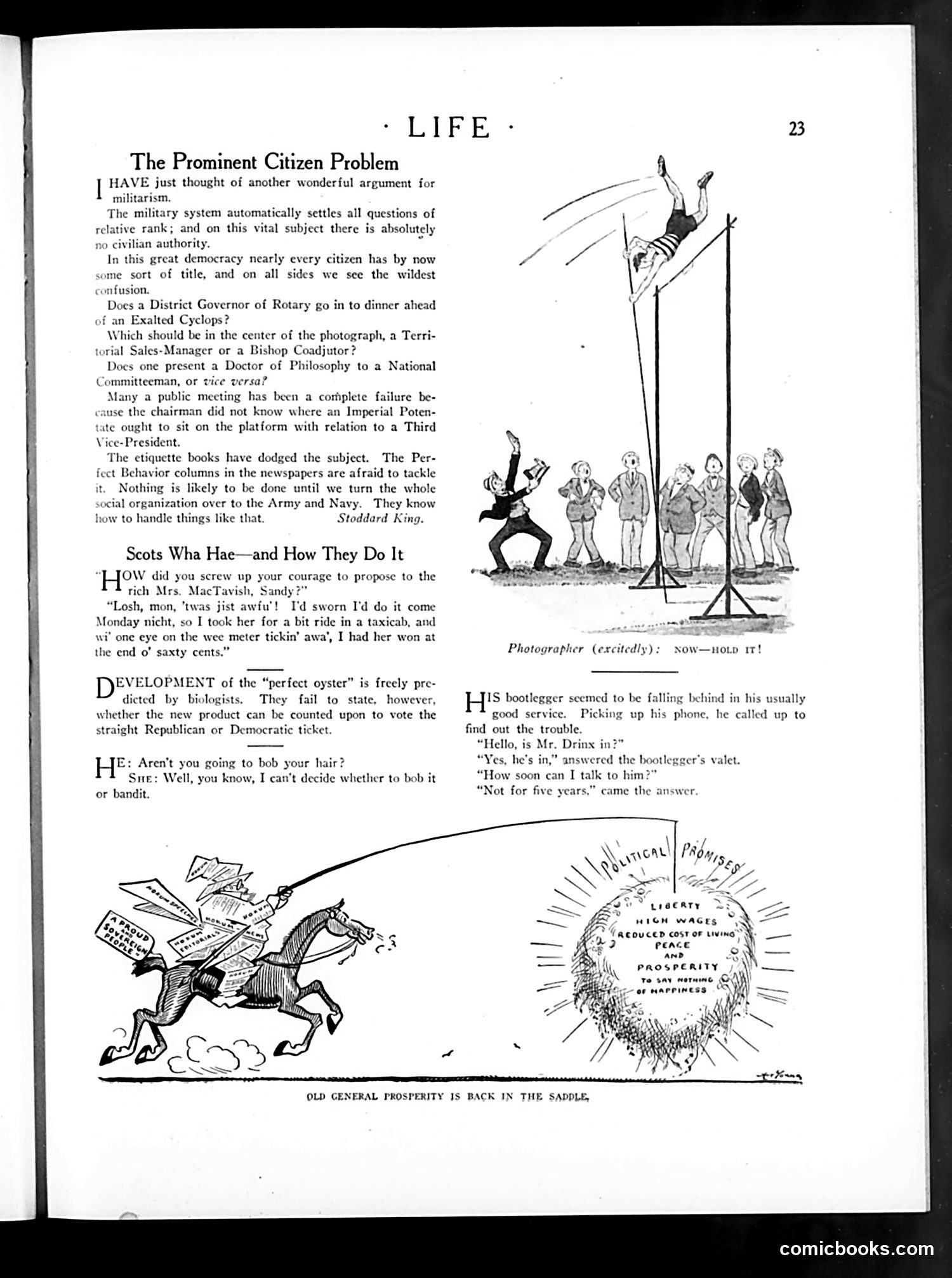
This satirical page mocks early 1920s American social pretension and confusion over hierarchical rank in civilian organizations. **"The Prominent Citizen Problem"** (by Stoddard King) jokes that democratic America has created ridiculous title inflation—Rotary governors, Exalted Cyclops (fraternal lodge titles), bishops, and various executives—creating etiquette chaos about who sits where at dinners and photos. The satire argues the military's clear rank system would solve this absurd problem, though King presents this "argument for militarism" tongue-in-cheek. **"Scots Wha Hae"** is a humorous anecdote where a Scottish man proposes to a wealthy woman during a taxicab ride, using the meter's ticking (costing sixty cents) as motivation—economic pressure replacing romance. **The bottom cartoon**, captioned "Old General Prosperity Is Back in the Saddle," depicts a mounted general figure holding a sphere labeled with political promises (Liberty, reduced cost of living, peace, prosperity). This likely references post-WWI optimism about economic recovery, though presented with satirical skepticism about such grandiose claims.
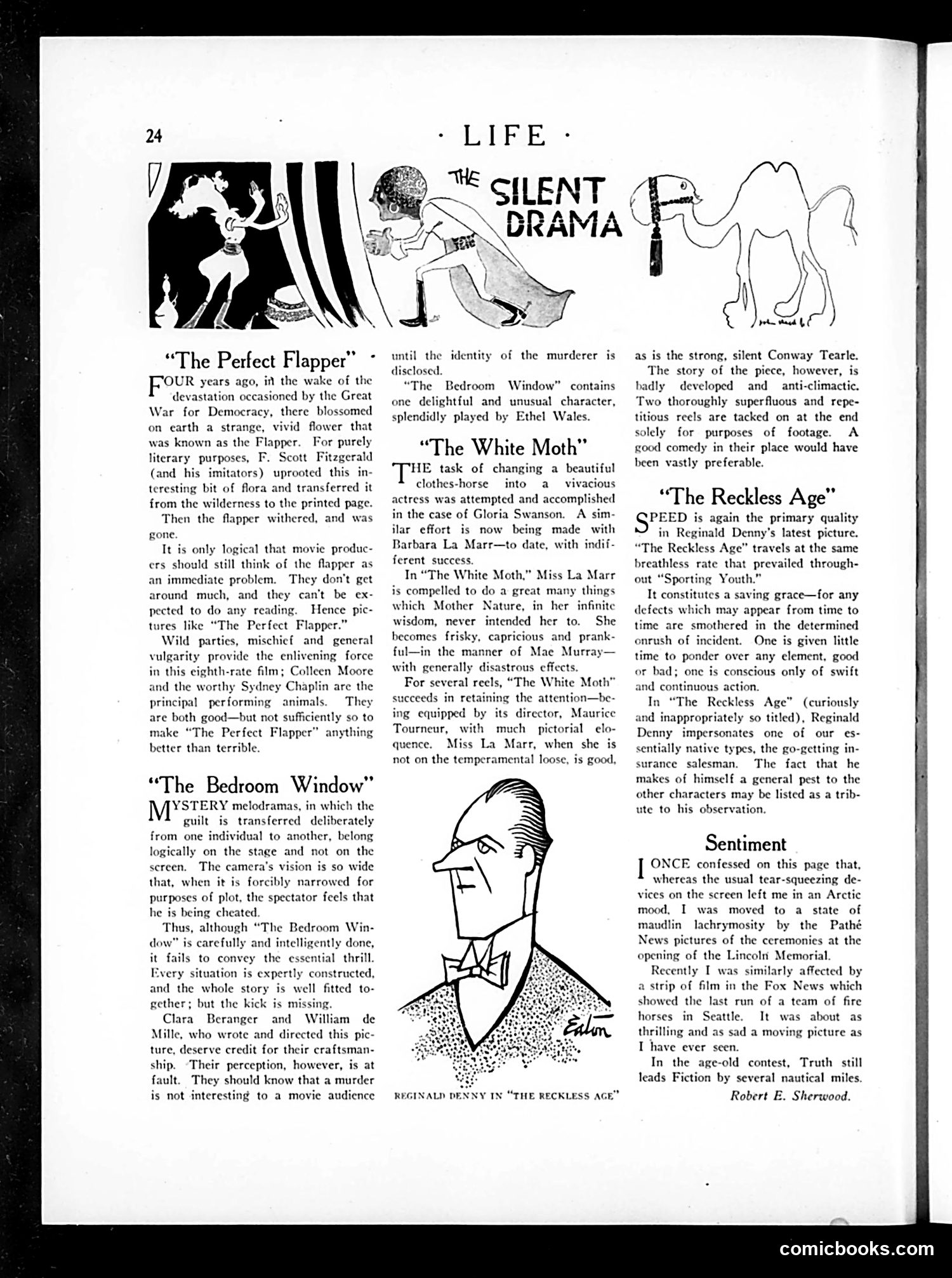
This page reviews four silent films with sharp, satirical commentary. The critic dismisses "The Perfect Flapper" as an "eighth-rate film" exploiting a dated trend—F. Scott Fitzgerald had already immortalized flappers in literature, yet movies still recycled the concept for audiences who "don't get around much." "The Bedroom Window" is criticized for poor dramatic structure: mystery films shouldn't narrow the camera's vision artificially, and revealing the murderer's identity late undermines viewer engagement. "The White Moth" features Barbara La Marr attempting dramatic acting beyond her abilities (she's a "clothes-horse"), though Conway Tearle and Maurice Tourneur's direction provide some quality. The film suffers from padding. "The Reckless Age" succeeds through relentless pacing—Reginald Denny's speed obscures plot weaknesses. He plays an "insurance salesman," representing a distinctly American type the critic finds noteworthy. The cartoon header satirizes how the film industry recycles exhausted trends.
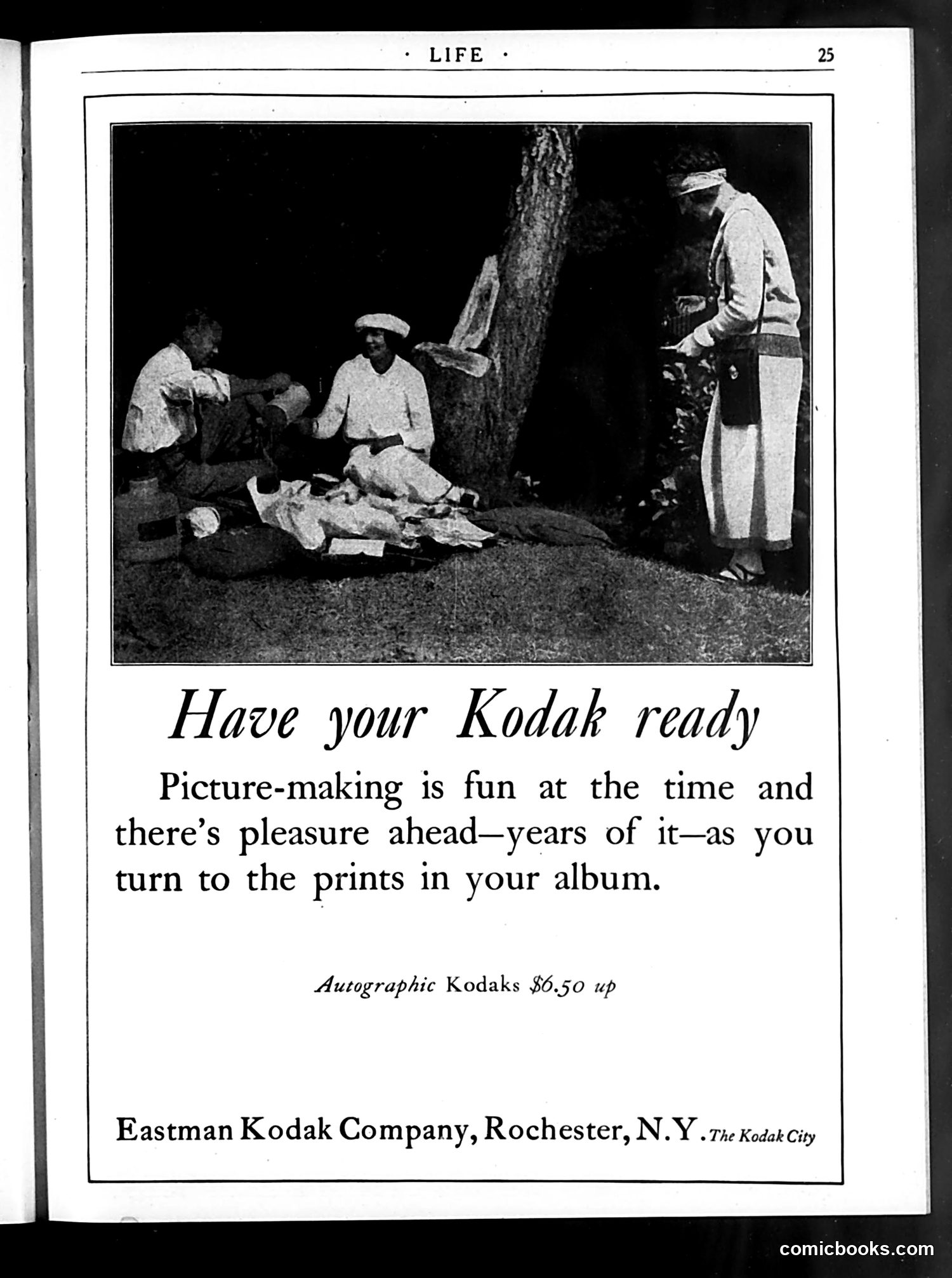
This is a Kodak advertisement, not a political cartoon. The image shows four people in casual outdoor attire posing near a tree, apparently during a picnic or leisure outing. The ad's message is straightforward product promotion: Kodak cameras enable people to capture memories that provide long-lasting enjoyment when reviewing photo albums years later. The advertisement targets amateur photographers by emphasizing both the immediate fun of picture-taking and the future pleasure of revisiting prints. "Autographic Kodaks" refers to Kodak's line of cameras featuring an autographic back—allowing photographers to write notes directly on the film negative. There is no satire or political commentary here. This is simply vintage commercial messaging from Eastman Kodak Company promoting their consumer camera line at an accessible price point ($6.50 and up).
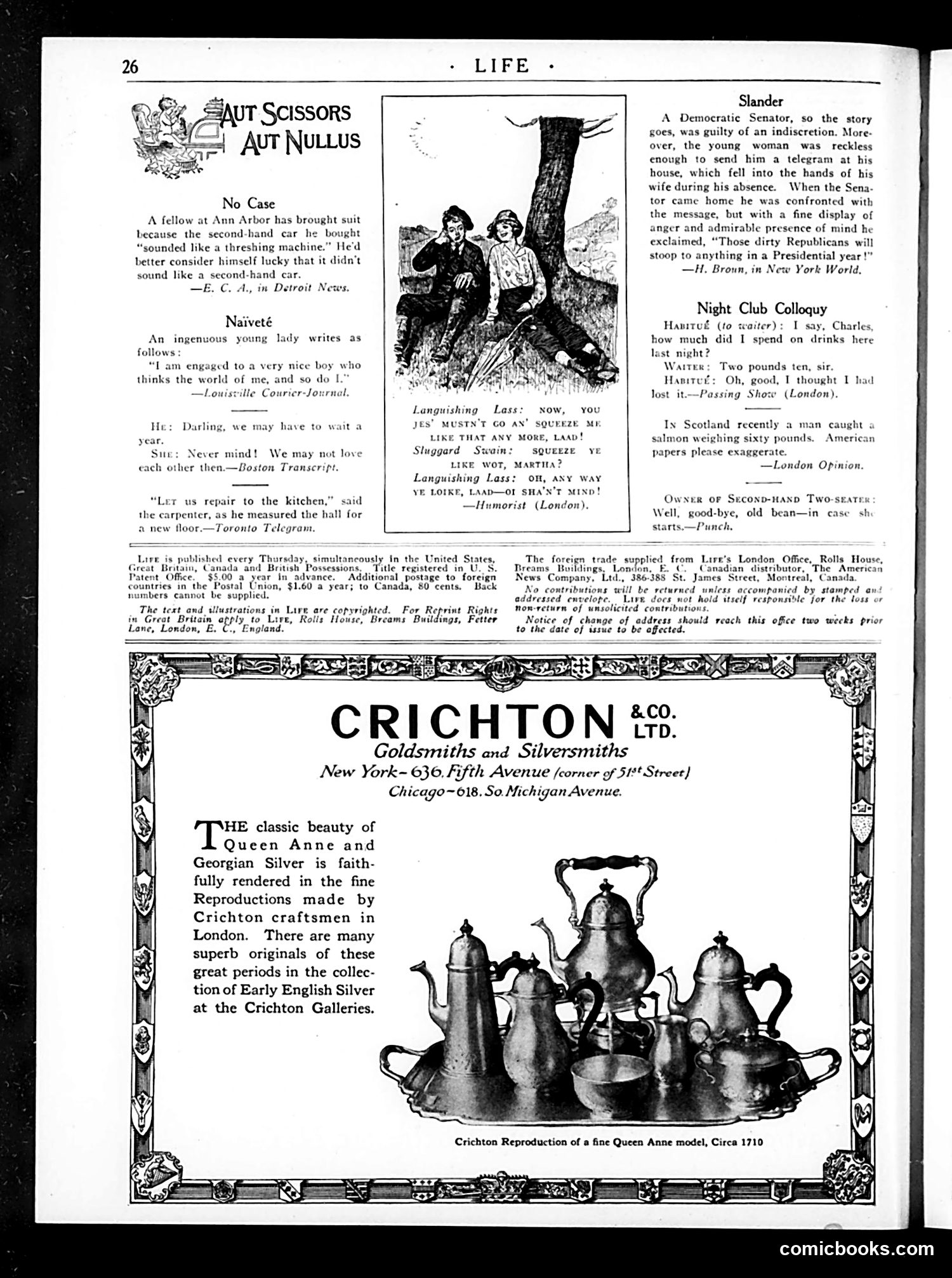
This page contains several short humorous items typical of Life's satirical format, plus an advertisement. **The "Slander" item** references a Democratic Senator (identity unclear from text alone) who received a compromising telegram from a young woman. When his wife confronts him, he deflects by blaming Republicans for orchestrating the scandal as a "Presidential year" dirty trick. The joke satirizes political hypocrisy—the Senator's immediate instinct is to spin the situation as partisan sabotage rather than accept responsibility. **Other brief items** mock various social situations: naive courtship, second-hand cars, and Scottish fishing exaggeration—standard Light humor about human folly. **The cartoon** (center) shows a couple beneath a tree. The dialogue depicts working-class flirtation with dialectal speech, apparently British based on the "Humorist (London)" attribution. **The bottom half** is a Crichton & Co. advertisement for reproduction silverware. The page is primarily humorous filler and advertising rather than sustained political commentary.
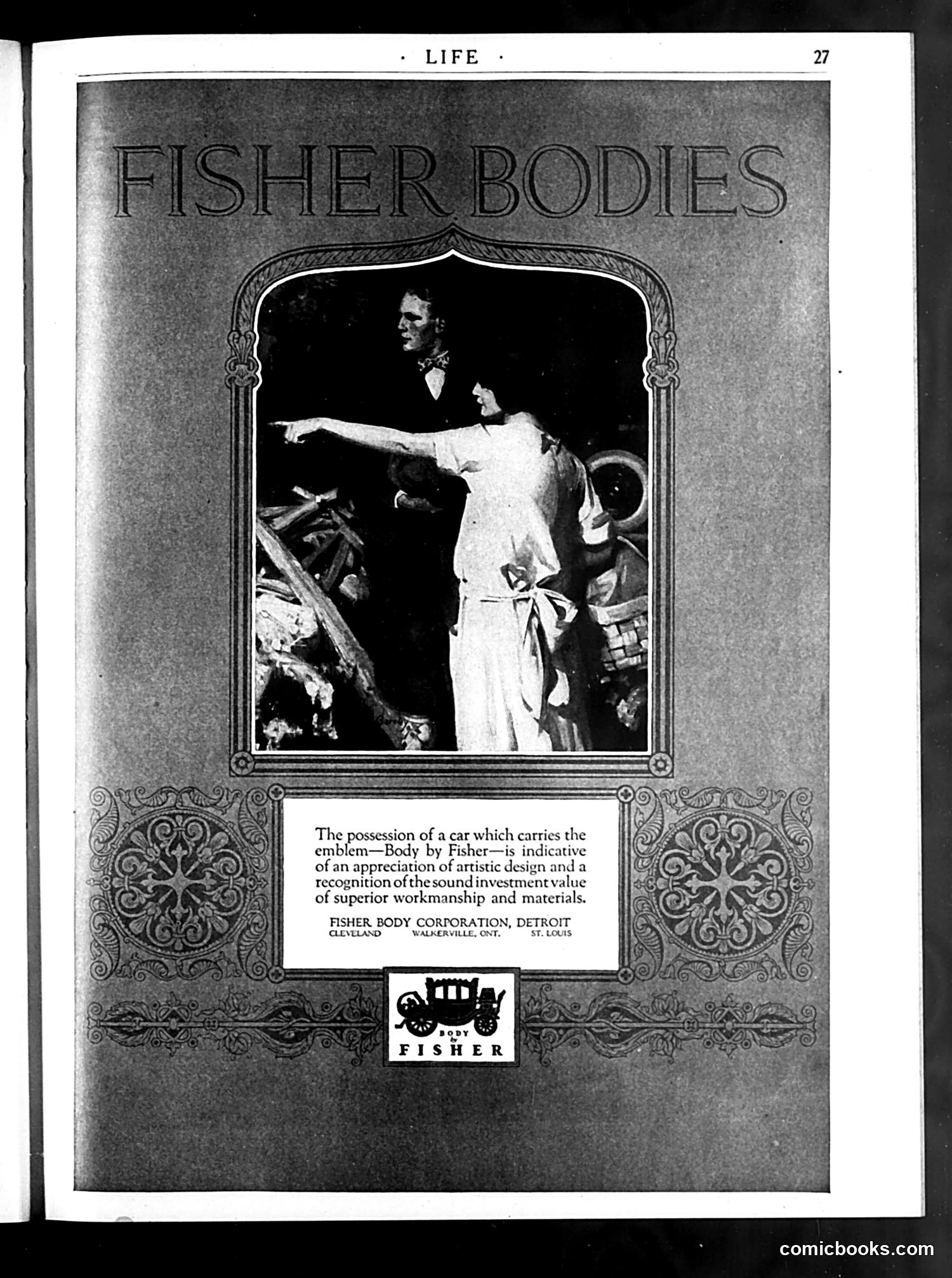
This is a Fisher Body Corporation advertisement, not political satire. It appeared in *Life* magazine (page 27) promoting automobile bodies manufactured by Fisher. The image shows an elegantly dressed couple with a man in formal wear gesturing toward a luxurious car. The ad's text emphasizes that owning a "Body by Fisher" demonstrates aesthetic appreciation and sound financial judgment—associating the product with refined taste and intelligent investment. The decorative art deco border and classical imagery reinforce messages of sophistication and quality craftsmanship. This represents early automotive advertising's strategy of linking car ownership to social status and artistic sensibility, targeting affluent consumers during the era when custom car bodies were luxury items.
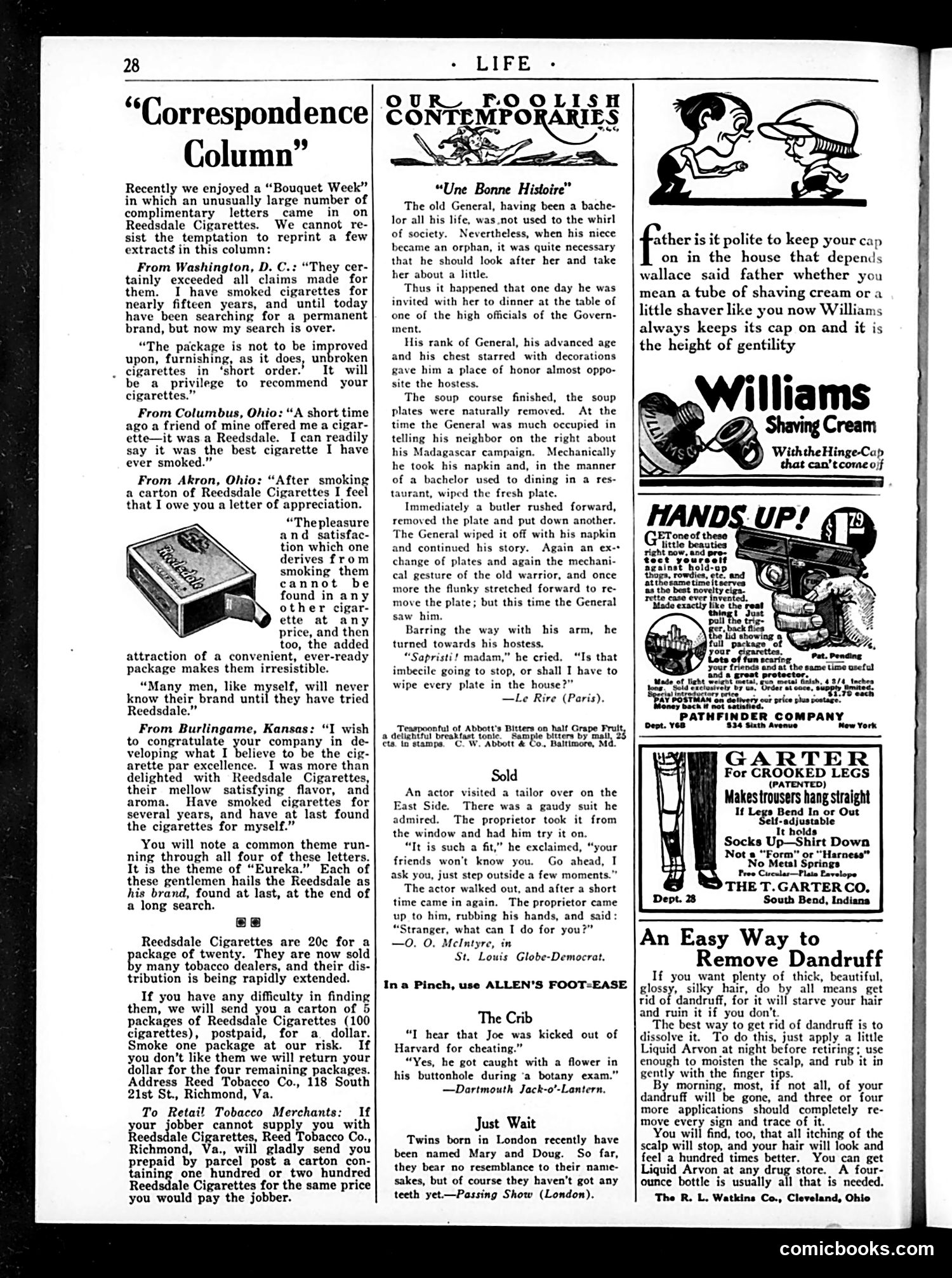
This is a satirical anecdote mocking an elderly, socially inexperienced military general. The story depicts a bachelor officer attending a formal dinner with his orphaned niece. Absorbed in recounting his Madagascar campaign to a dinner neighbor, the General absent-mindedly wipes each fresh plate with his napkin—a crude restaurant habit unsuitable for high society. Each time he does this, an increasingly flustered butler removes the soiled plate and replaces it. The satire targets the General's obliviousness to proper dining etiquette and social conventions. The joke plays on the contrast between his prestigious military rank and decorations versus his complete lack of refinement and awareness of civilized behavior. The piece mocks both military men's social incompetence and the fastidious rules of formal dining that bewildered outsiders to polite society.
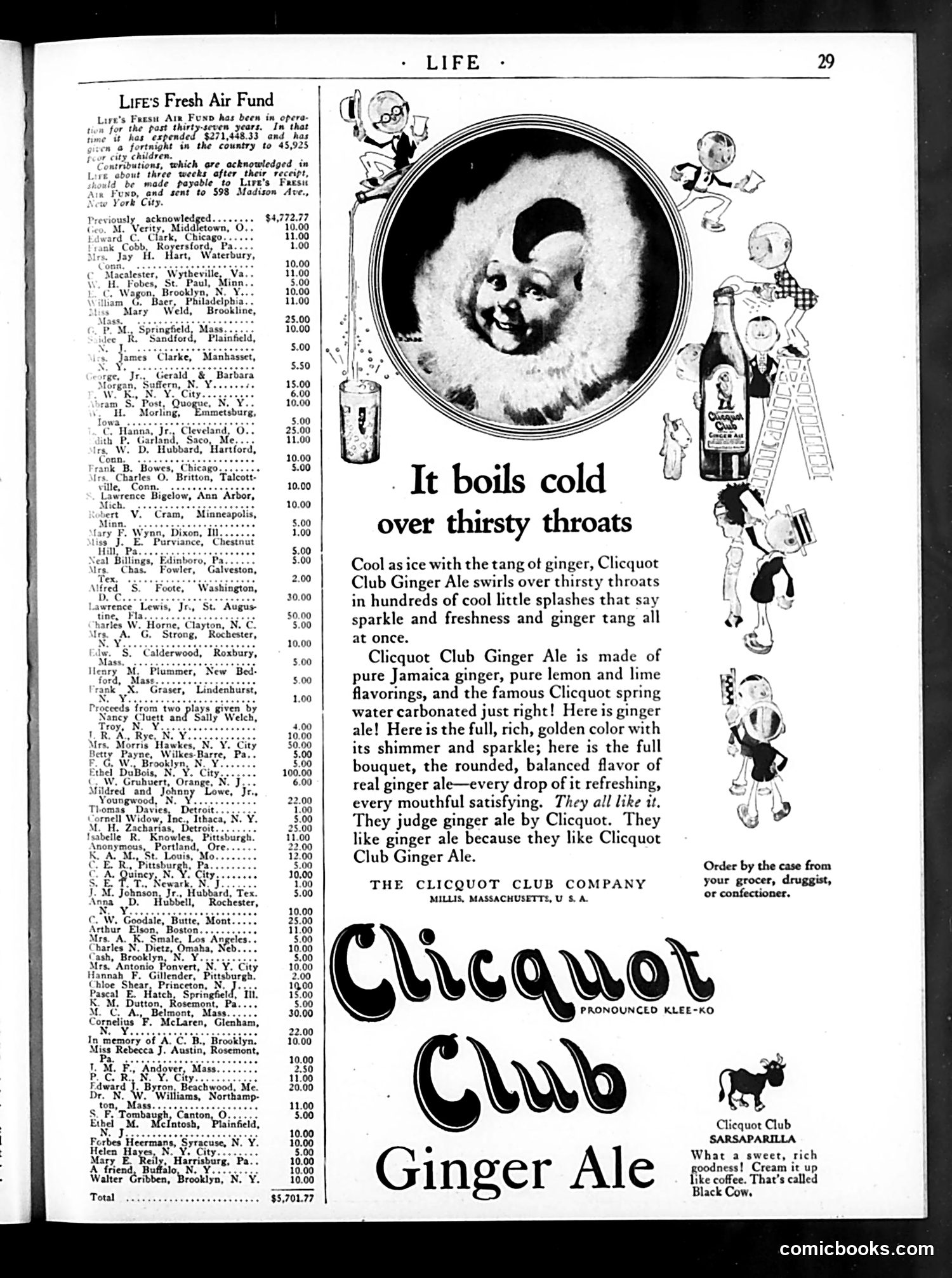
This page is primarily **advertising and charitable fundraising**, not political satire. The left column lists **donations to Life's Fresh Air Fund**, a 37-year-old charitable program that provided country vacations for poor city children. Contributors' names and donation amounts are listed—typical of early 20th-century magazine practice to publicly acknowledge donors. The right side features a large **Clicquot Club Ginger Ale advertisement**. The central image shows a smiling baby's face in a circle, surrounded by illustrated figures consuming the beverage. The ad copy emphasizes the drink's "ginger tang" and refreshing qualities, ending with the slogan "Black Cow" (mixing ginger ale with cream/milk). The baby imagery was common in period advertising to suggest purity, wholesomeness, and family appeal—though by modern standards, the prominent infant face seems incongruous with alcohol-adjacent beverage marketing. No political commentary is evident; this reflects typical 1920s-era magazine layout mixing philanthropy with commercial advertising.
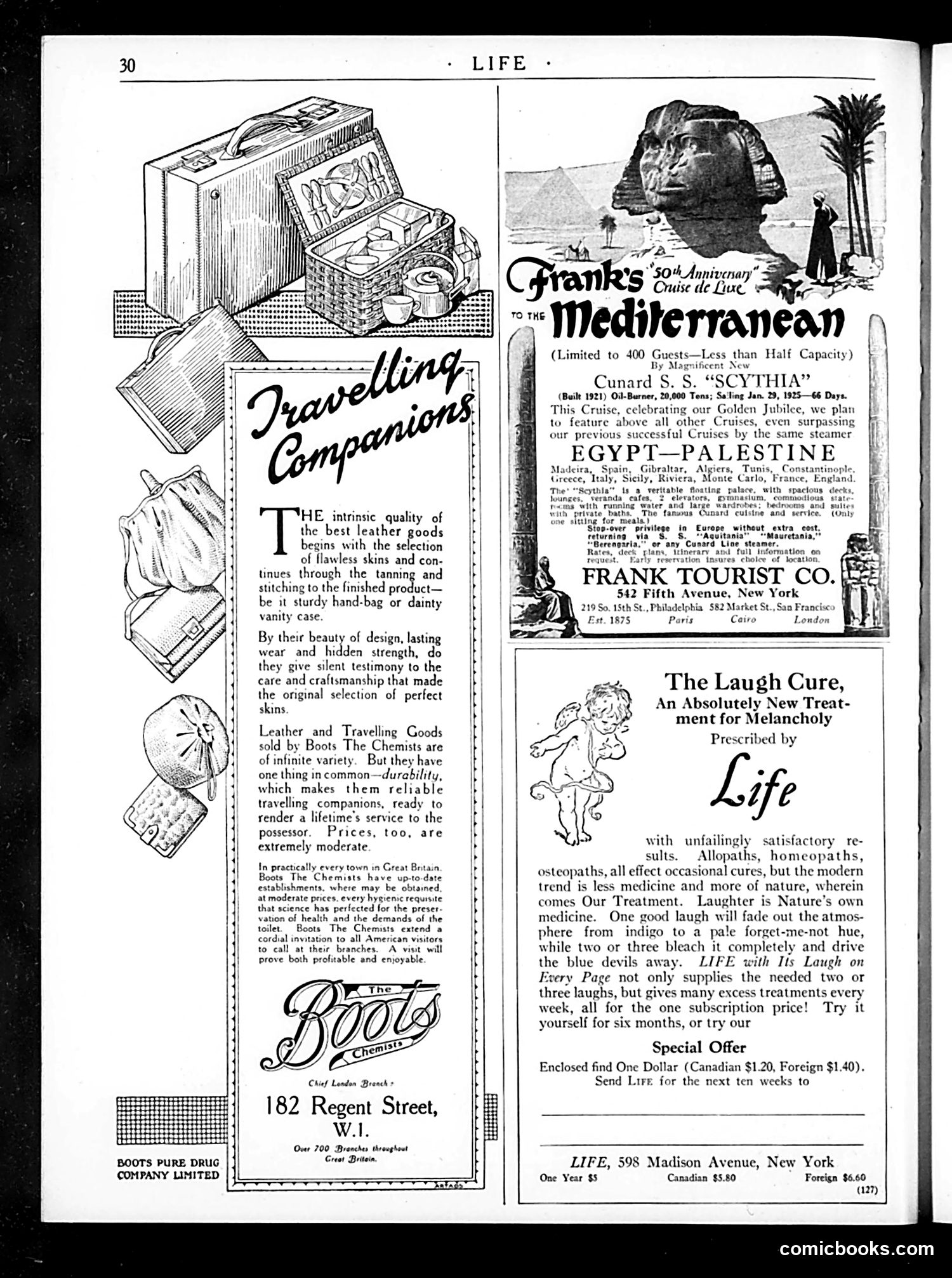
This page is primarily **advertising**, not political satire. It contains four distinct ads: 1. **Travelling Companions** (left): Boots the Chemists advertises leather goods—luggage, handbags, vanity cases—emphasizing durability and craftsmanship. The illustrations show typical travel accessories of the 1920s era. 2. **Frank's Mediterranean Cruise** (top right): A luxury cruise advertisement for the Cunard liner "Scythia," offering a 66-day voyage to Egypt and Palestine, celebrating the company's golden jubilee. Limited to 400 guests. 3. **The Laugh Cure** (bottom right): Life magazine's self-promotional ad, humorously marketing laughter as medical treatment for melancholy, positioning the magazine itself as therapeutic. This reflects 1920s optimism about humor's health benefits. The page reflects 1920s consumer culture, leisure travel, and the magazine's role in promoting modern wellness through entertainment.
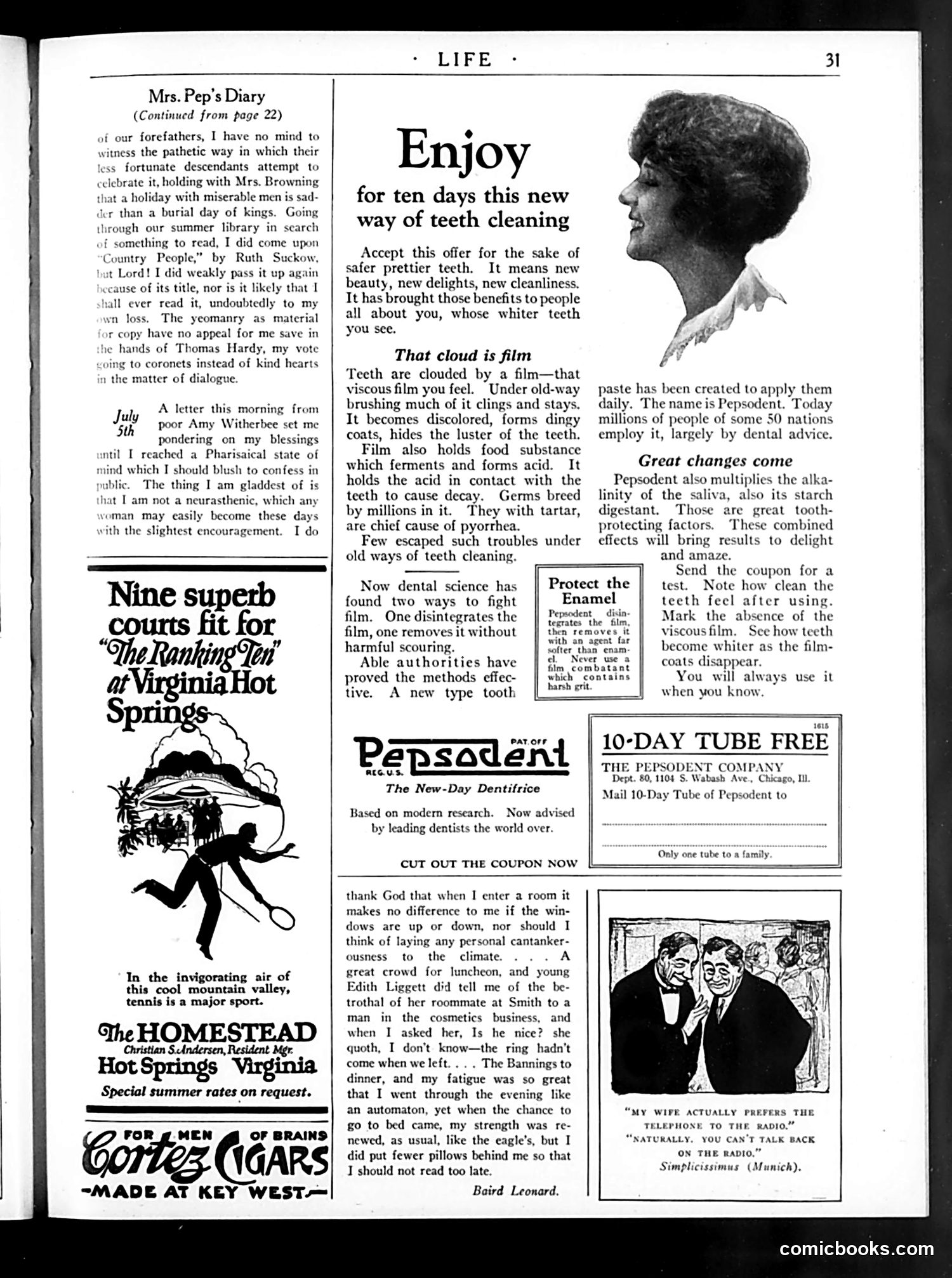
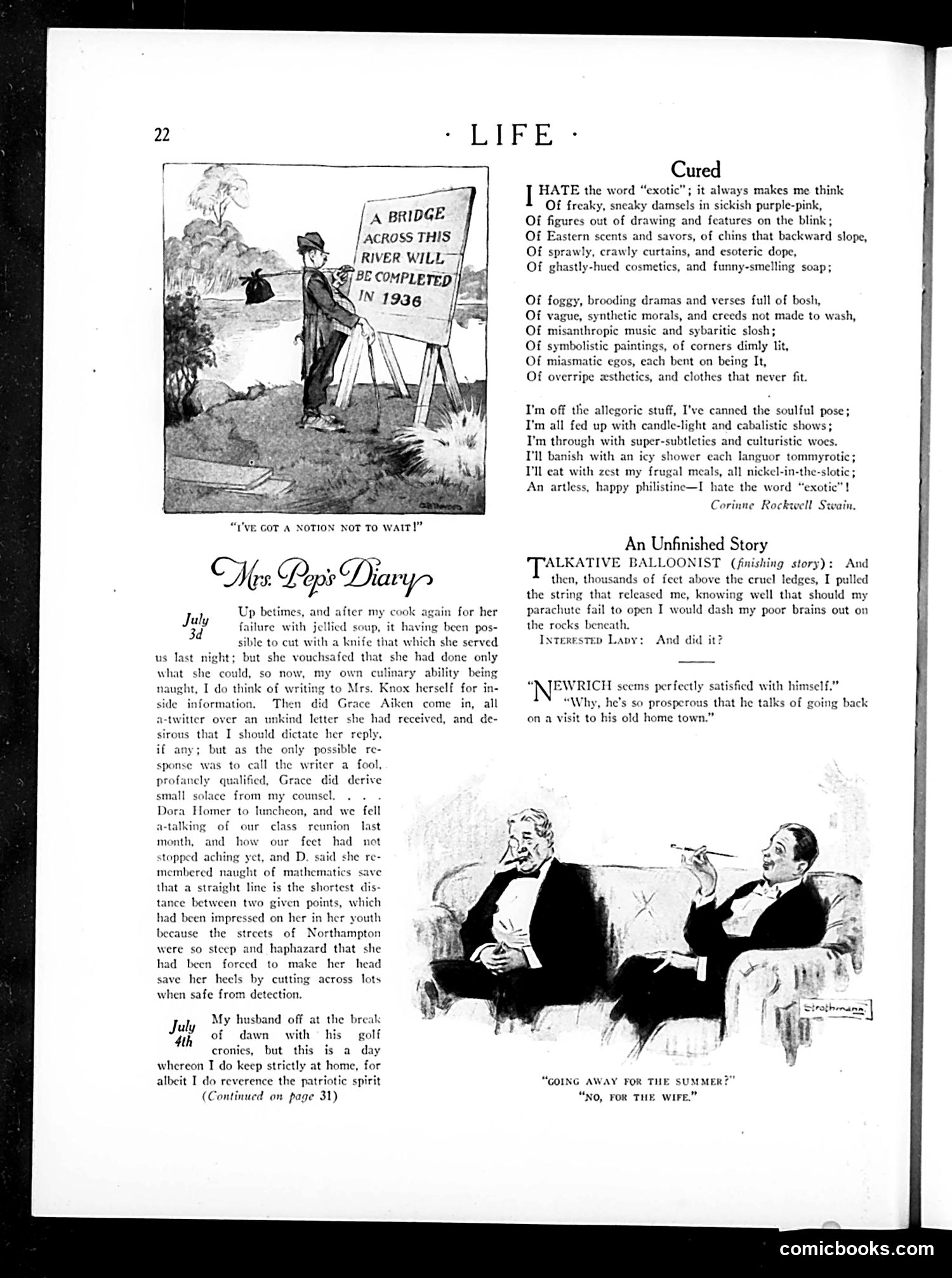
This page is primarily **advertising** for Pepsodent toothpaste, with supporting editorial content. The main advertisement uses early 20th-century dental marketing language, explaining that teeth develop a "film" causing discoloration and decay. Pepsodent claims to disintegrate this film without damaging enamel—a novel selling point for the era. The ad offers a free 10-day tube to encourage trial. The upper left contains "Mrs. Pep's Diary," a society column satirizing upper-class pretension. The diarist boasts of her emotional resilience and refined taste (preferring Thomas Hardy to rural literature), then complains about a cosmetics businessman—suggesting satire of nouveau-riche social climbers. Secondary ads promote Virginia Hot Springs resorts and Cortez cigars ("for men of brains"). **The satire**: The juxtaposition mocks genteel society's obsession with appearances—whether dental whiteness or social status—while pretending to intellectual superiority. Mrs. Pep's self-congratulation about not being "neurasthenic" ironically reveals her as precisely the anxious, status-conscious figure she criticizes.
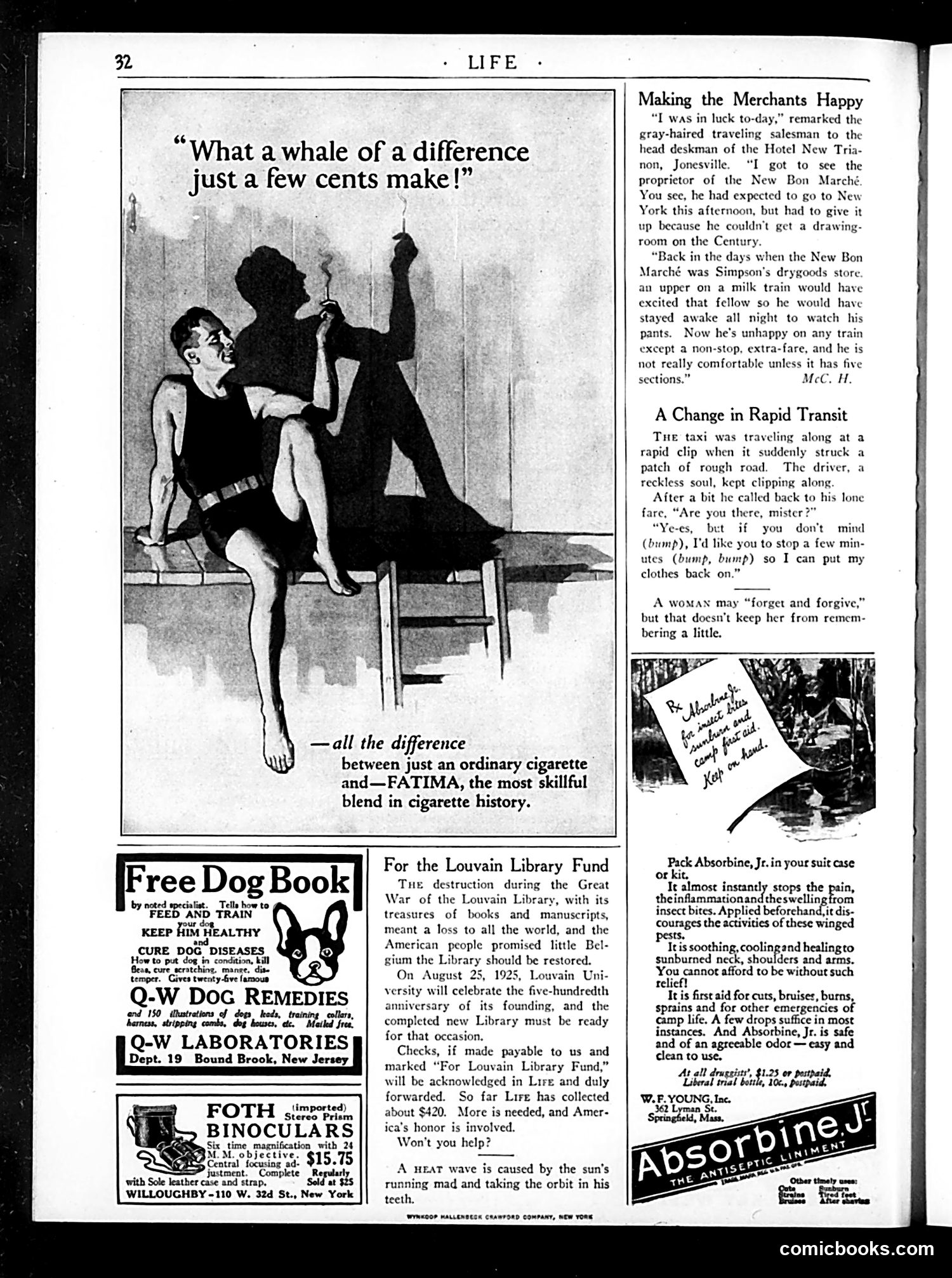
This page combines cigarette advertising with humorous anecdotes and patent medicine ads typical of 1920s Life magazine. The main cartoon advertises **Fatima cigarettes**, showing a woman in a state of undress (suggestively posed) with the caption about how a "few cents" difference makes cigarettes superior. The joke equates small price differences with significant quality improvements—a common advertising trope. The surrounding text includes satirical **short humor pieces**: one mocks how commercial travelers' expectations have inflated (once thrilled by basic train accommodations, now demanding luxury); another jokes about a taxi passenger being jostled so badly he must reassemble his clothing; a third offers cynical commentary on women's memory for grudges. The ads showcase typical period products: dog remedies, binoculars, and **Absorbine Jr.** (a liniment marketed as first aid). A **Louvain Library Fund appeal** notes the library's WWI destruction and requests donations for its 1925 restoration—referencing post-war reconstruction efforts. The overall tone is period-appropriate satirical humor targeting middle-class aspirations and consumer culture.
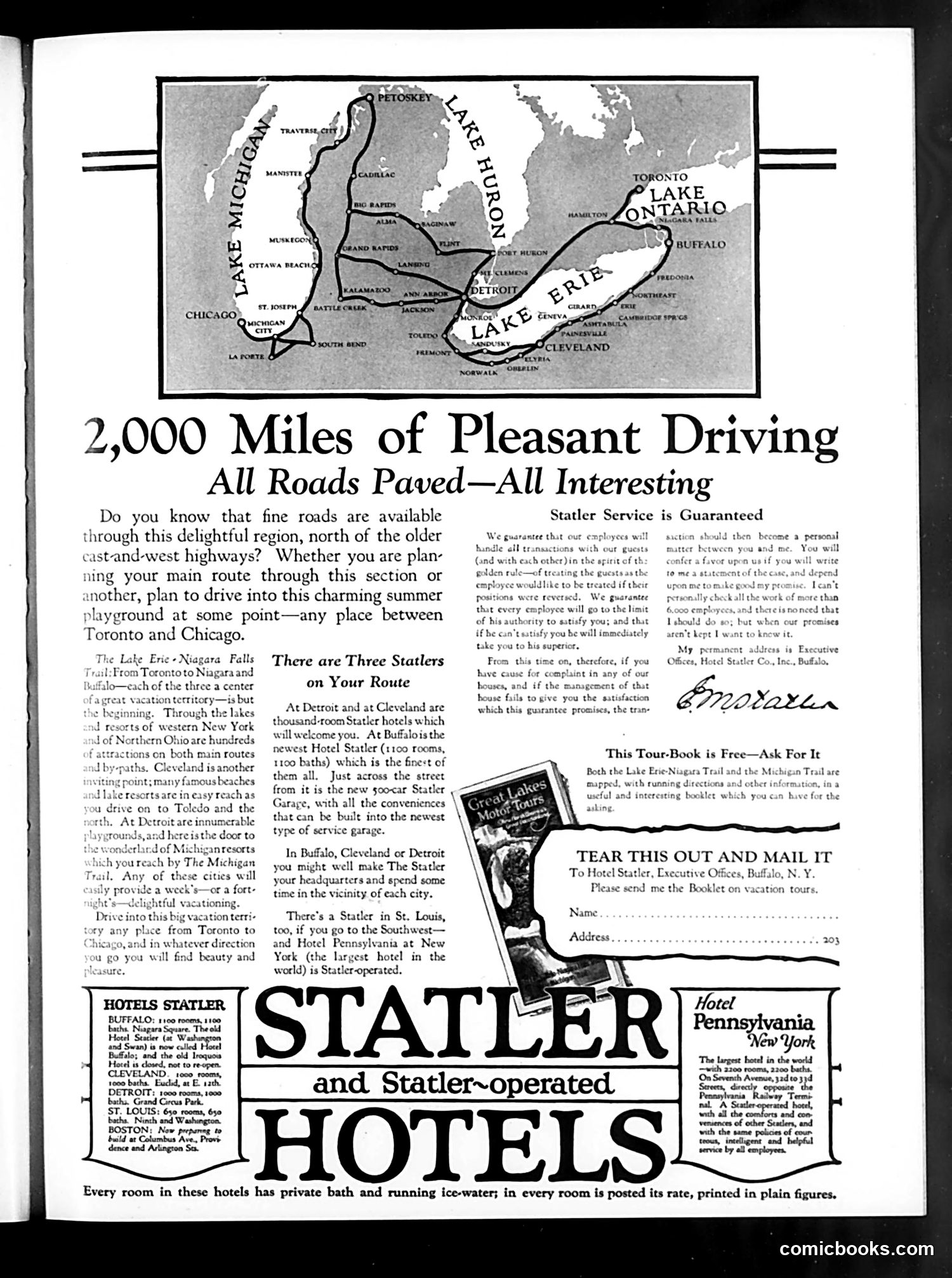
This is primarily **a hotel advertisement**, not a cartoon or satirical piece. The page promotes Statler Hotels and the scenic driving route between Toronto and Chicago. **What it shows:** - A map displaying 2,000 miles of paved roads through the Great Lakes region (Michigan, Erie, Ontario, Huron) - Three Statler Hotel locations positioned as convenient stops for motorists: Buffalo, Cleveland, and Detroit - Marketing copy emphasizing road quality and tourist attractions (Niagara Falls, Lake Erie) **Historical context for modern readers:** This reflects the **1920s American automobile boom**—when paved highways were still a novelty and driving vacations were aspirational leisure activities. The advertisement targets middle-class motorists discovering newly improved roads. Statler Hotels were luxury establishments; mentioning "private bath and running ice-water in every room" highlights amenities that were then significant selling points. The "Statler Service is Guaranteed" section promises consistent service standards across locations—an early corporate chain-hotel concept. This is **not satirical content** but straightforward period advertising capitalizing on the excitement of automobile travel and modern hotel infrastructure.
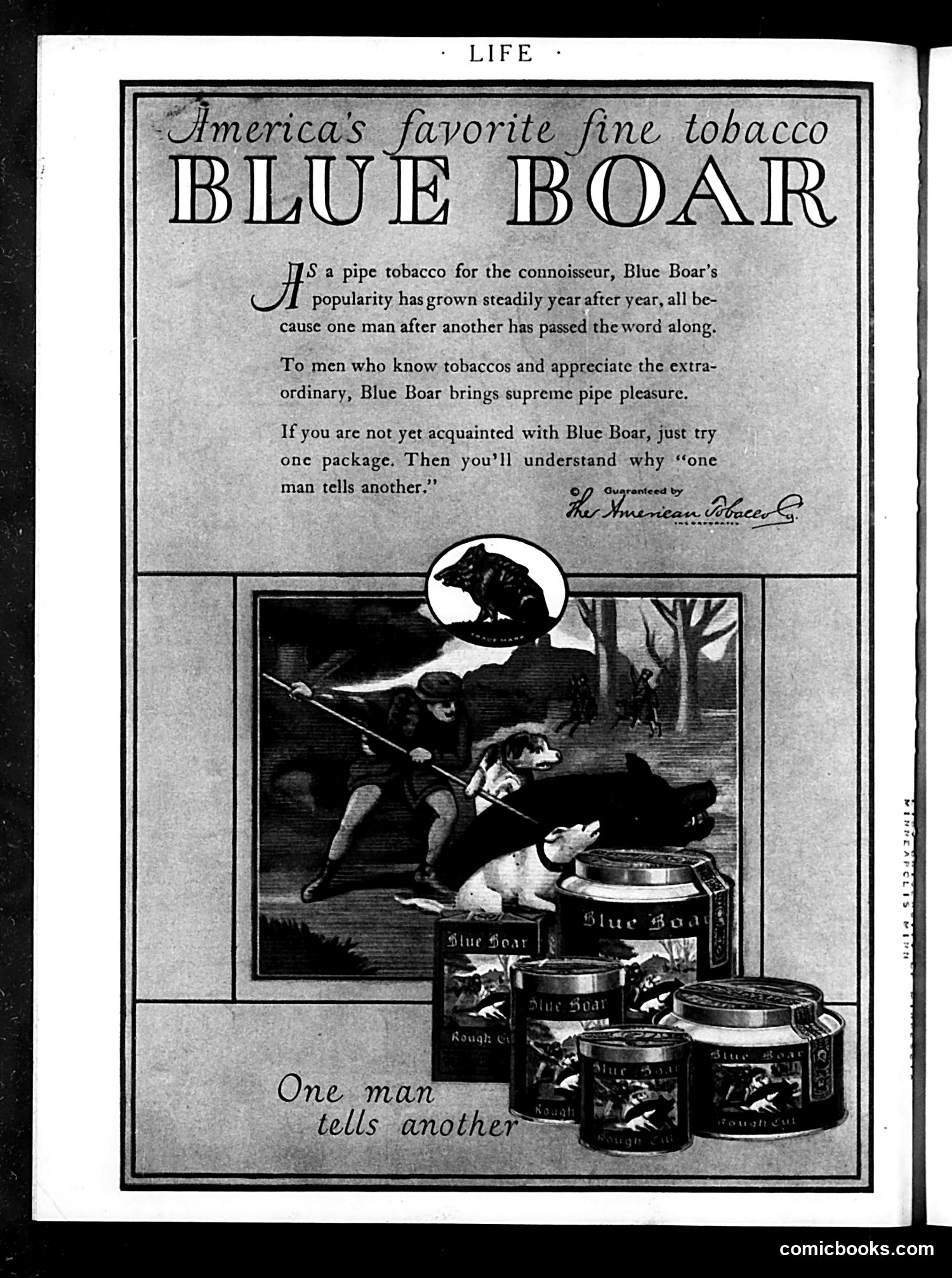
This is a straightforward **tobacco advertisement**, not political satire. The page promotes "Blue Boar" pipe tobacco in Life magazine, using the slogan "one man tells another" to suggest word-of-mouth marketing and peer recommendation. The illustration shows a hunting scene with a blue boar (the product's namesake) and dogs, establishing the brand's masculine, outdoor-oriented identity. Multiple product packages are displayed at the bottom. The advertisement appeals to male connoisseurs and relies on social proof—the idea that satisfied customers naturally recommend the product to others. This was typical early-20th-century advertising strategy targeting educated, affluent male consumers who smoked pipes. There is no political commentary or satirical commentary here; it's a commercial product endorsement typical of Life's advertising content.