
Life, 1924-07-10 · page 20 of 36
Life — July 10, 1924 — page 20: what you’re looking at
What you’re looking at
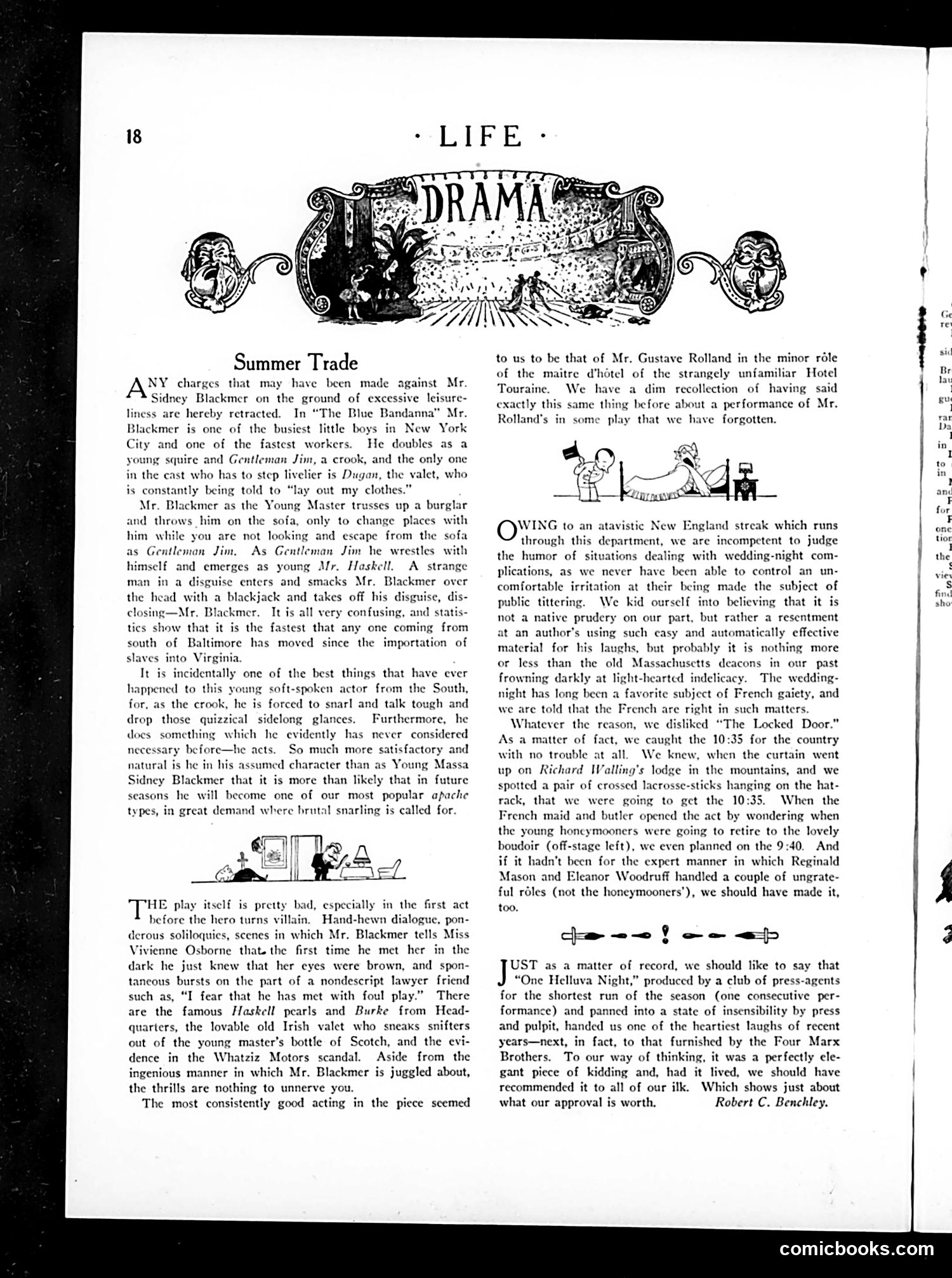
This page reviews two Broadway plays from the 1920s era. The main focus is **"The Blue Bandanna,"** starring **Sidney Blackmer**, a Southern actor whom the critic praises for his energetic performance. Blackmer plays multiple roles—a young gentleman, a burglar, and "Gentleman Jim"—requiring constant quick changes and physical comedy. The critic notes approvingly that this challenging dual role forces Blackmer to "act" rather than rely on his typical "soft-spoken" Southern charm, and predicts he'll become popular in rough "apache" (tough guy) roles. The page also briefly reviews **"The Locked Door,"** which the critic dislikes, dismissing its reliance on wedding-night complications as cheap humor. The critic attributes his discomfort to inherited New England Puritanism rather than actual prudery. The small illustrations show theatrical scenes typical of 1920s stage comedy—slapstick physical business and interior settings.
📄 Transcribed text from this page (OCR, searchable)
Machine-transcribed from the original scan — historical spelling and the odd misread are preserved.
Summer Trade NY charges that may have been made against Mr. idney Blackmer on the ground of excessive leisure- liness are hereby retracted. In “The Blue Bandanna” Mr. Blackmer is one of the busiest little boys in New York y and one of the fastest workers. He doubles as a young squire and Gentleman Jim, a crook, and the only one in the cast who has to step livelier is Dugan, the valet, who is constantly being told to “lay out my clothes.” Mr. Blackmer as the Young Master trusses up a burglar and throws him on the sofa, only to change places with him while you are not looking and escape from the sofa as Gentleman Jim. As Gentleman Jim he wrestles with himself and emerges as young Mr. Haskell. A strange man in a disguise enters and smacks Mr. Blackmer over the head with a blackjack and takes off his disguise, dis- closing—Mr. Blackmer. It is all very confusing, and statis- tics show that it is the fastest that any one coming from south of Baltimore has moved since the importation of slaves into Virginia. It is incidentally one of the best things that have ever happened to this young soft-spoken actor from the South, for, as the crook, he is forced to snarl and talk tough and drop those quizzical sidelong glances. Furthermore, he docs something which he evidently has never considered necessary before—he acts. So much more satisfactory and natural is he in his assumed character than as Young Massa Sidney Blackmer that it is more than likely that in future seasons he will become one of our most popular apache types, in great demand where brutal snarling is called for. HE play itself is pretty bad, especially in the first act hefore the hero turns villain. Hand-hewn dialogue, pon- derous soliloquies, scenes in which Mr. Blackmer tells Miss Vivienne Osborne that. the first time he met her in the dark he just knew that her eyes were brown, and spon- taneous bursts on the part of a nondescript lawyer friend such as, “I fear that he has met with foul pla There are the famous Haskell pearls and Burke from Head- quarters, the lovable old Irish valet who sneaks snifters out of the young master’s bottle of Scotch, and the evi- dence in the Whatziz Motors scandal. Aside from the ingenious manner in which Mr. Blackmer is juggled about, the thrills are nothing to unnerve you. The most consistently good acting in the piece scemed to us to be that of Mr. Gustave Rolland in the minor role of the maitre d’hotel of the strangely unfamiliar Hotel Touraine. We have a dim recollection of having said exactly this same thing before about a performance of Mr. Rolland’s in some play that we have forgotten. WING to an atavistic New England streak which runs through this department, we are incompetent to judge the humor of situations dealing with wedding-night com- plications, as we never have been able to control an un- comfortable irritation at their being made the subject of public tittering. We kid ourself into believing that it is not a native prudery on our part, but rather a resentment at an author's using such casy and automatically effective material for his laughs, but probably it is nothing more or less than the old Massachusetts deacons in our past frowning darkly at light-hearted indelicacy. The wedding- night has long been a favorite subject of French gaiety, and we are told that the French are right in such matters. Whatever the reason, we disliked “The Locked Door.” As a matter of fact, we caught the 10:35 for the country with no trouble at all. We knew, when the curtain went up on Richard Walling’s lodge in the mountains, and we spotted a pair of crossed lacrosse-sticks hanging on the hat- rack, that we were going to get the 10:35. When the French maid and butler opened the act by wondering when the young honcymooners were going to retire to the lovely boudoir (off-stage left), we even planned on the 9:40. And if it hadn't been for the expert manner in which Reginald Mason and Eleanor Woodruff handled a couple of ungrate- ful rdles (not the honeymooners’), we should have made it, too. UST as a matter of record, we should like to sa “One Helluva Night,” produced by a club of press-agents for the shortest run of the season (one consecutive per- formance) and panned into a state of insensibility by press and pulpit, handed us one of the heartiest laughs of recent years—next, in fact, to that furnished by the Four Marx Brothers. To our way of thinking, it was a perfectly ele- gant piece of kidding and, had it lived, we should have recommended it to all of our ilk. Which shows just about what our approval is worth, Robert C. Benchley. comicbooks.com