
Life, 1924-07-10 · page 6 of 36
Life — July 10, 1924 — page 6: what you’re looking at
What you’re looking at
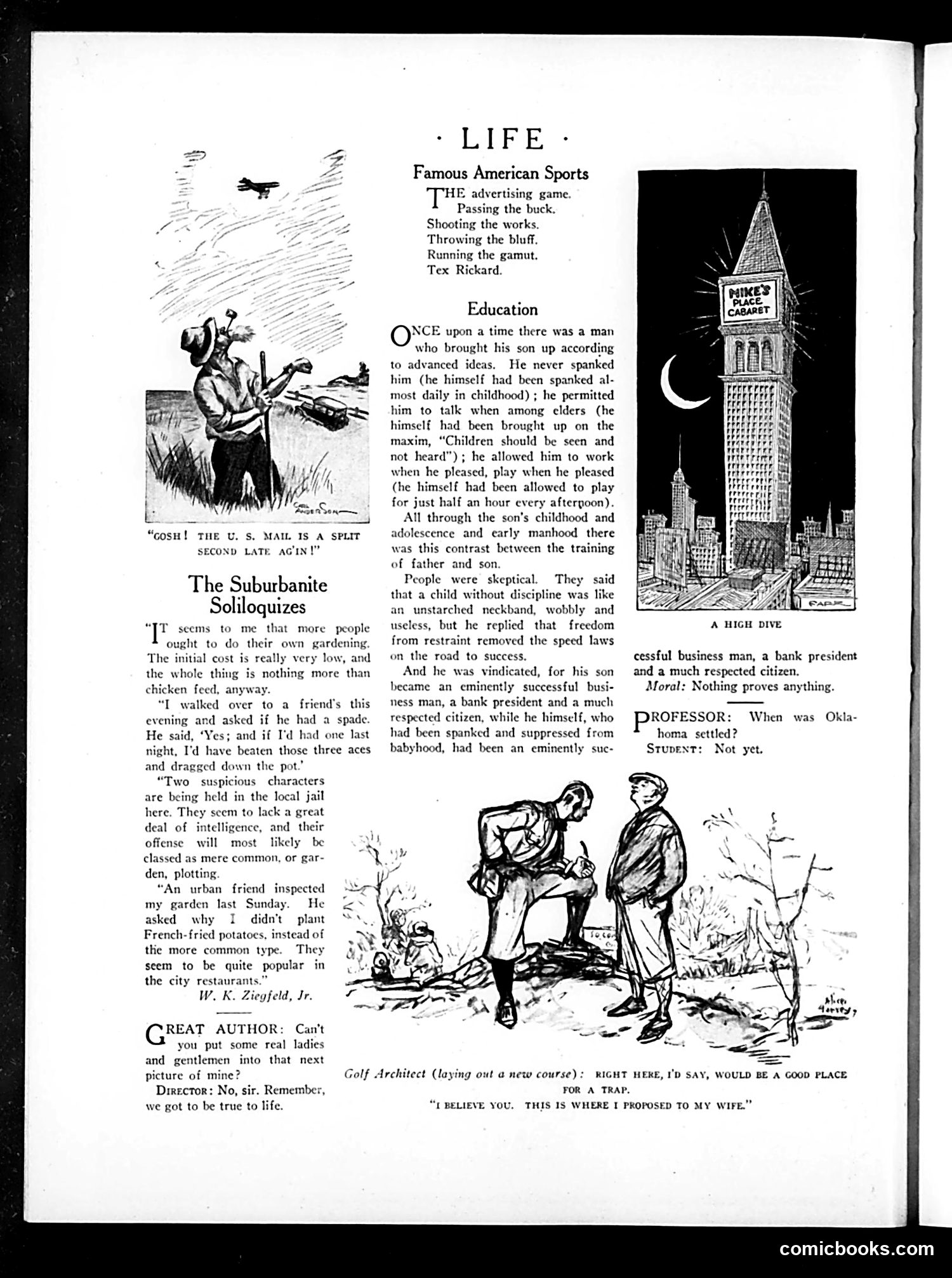
This page contains several humor pieces satirizing early 20th-century American life: **"Famous American Sports"** lists contemporary pastimes (advertising, passing the buck, shooting works, throwing bluff, running the gaunt, Tex Rickard), mocking them as "sports" worthy of national attention. **"The Suburbanite Soliloquizes"** jokes about suburban gardening pretensions—a friend's boasting about French-fried potatoes suggesting city restaurants' sophistication. **"Education"** contrasts modern permissive parenting (allowing freedom, play) with traditional spanking, suggesting the son's success despite unconventional upbringing. The golf cartoon jokes about marriage proposal locations, with the architect suggesting a golf course as the spot where he proposed to his wife—satirizing both male obsession with golf and romantic clichés. The humor targets class anxiety, suburban aspirations, and changing social customs of the era.
📄 Transcribed text from this page (OCR, searchable)
Machine-transcribed from the original scan — historical spelling and the odd misread are preserved.
“cosu! THE U. S. MAIL IS A SPLIT SECOND LATE AG'IN!” The Suburbanite Soliloquizes ‘JT seems to me that more people ought to do their own gardening. The initial cost is really very low, and the whole thing is nothing more than chicken feed, anyway. “I walked over to a friend's this evening and asked if he had a spade. He said, ‘Yes; and if I'd had one night, I'd have beaten those three aces and dragged down the pot.’ “Two characters are being held in the local jail here. They scem to lack a great deal of intelligence, and their offense will most likely be classed as mere common, or gar- den, plotting “An urban friend inspected my garden last Sunday. He asked why I didn’t plant French-fried potatoes, instead of the more common type. They seem to be quite popular in the city restaurants.” W. K. Ziegfeld, Jr. REAT AUTHOR: Can't you put some real ladies and gentlemen into that next picture of mine? Director: No, sir. Remember, we got to be true to life. suspicious Golf Architect (laying out a new course): Famous American Sports | HE advertising game. Passing the buck. Shooting the works. Throwing the bluff. Running the gamut. Tex Rickard. Education NCE upon a time there was a man who brought his son up according to advanced ideas. He never spanked him (he himself had been spanked al- most daily in childhood) ; he permitted him to talk when among elders (he himself had been brought up on the maxim, “ Idren should be seen and not heard”); he allowed him to work when he pleased, play when he pleased (he himself had been allowed to play for just half an hour every afterpoon). All through the son’s childhood and adolescence and early manhood there was this contrast between the training of father and son. People were skeptical. They said that a child without discipline was like an unstarched neckband, wobbly and useless, but he replied that freedom from restraint removed the speed laws on the road to success. And he was vindicated, for his son became an eminently successful busi- ness man, a bank president and a much respected citizen, while he himself, who had been spanked and suppressed from babyhood, had been an eminently suc- RIGHT FOR A TRAP. “I BELIEVE YOU. A HIGH DIVE cessful business man, a bank president and a much respected citizen. Moral: Nothing proves anything. ROFESSOR: homa settled? Stupext: Not yet. When Okla- was HERE, I'D SAY, WOULD BE A GOOD PLACE THIS IS WHERE I PROPOSED TO MY WIFE.” comicbooks.com