
Life, 1924-07-10 · page 16 of 36
Life — July 10, 1924 — page 16: what you’re looking at
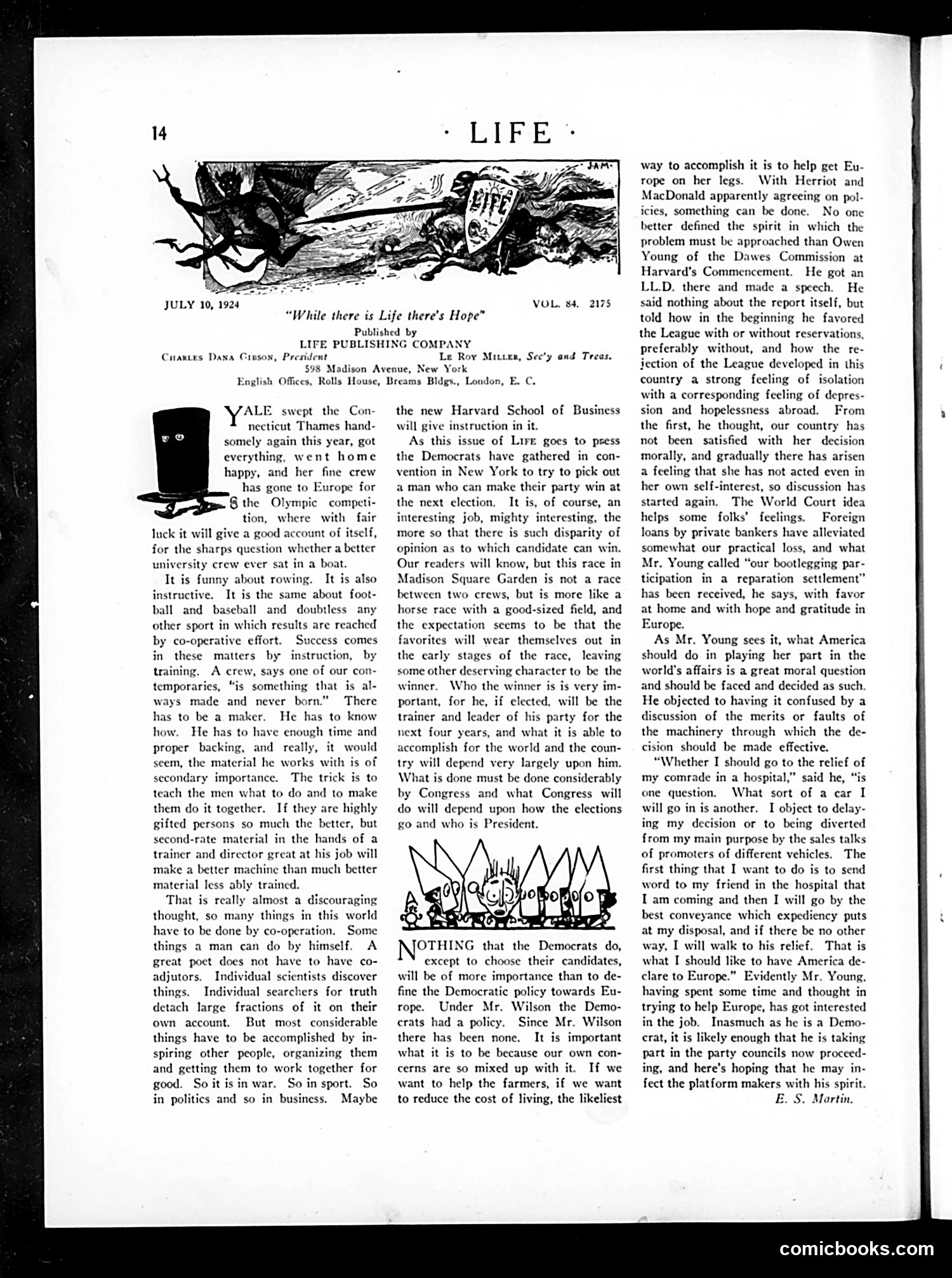
What you’re looking at
**The Cartoon:** The small illustration shows silhouettes of people with raised fists or arms in celebratory poses, labeled "NOTHING that the Democrats do." It satirizes the Democratic Party's inability to take decisive action—particularly regarding defining policy toward Europe. The cartoon suggests Democrats are making empty gestures rather than implementing substantive programs. **The Context:** The text discusses the 1924 Democratic Convention in New York, where party leaders are selecting a presidential candidate. The author criticizes the Democrats for lacking a clear European policy since President Wilson left office, contrasting this with the need for practical solutions to post-WWI economic problems and farm relief. The satire targets Democratic ineffectiveness and political posturing during a period requiring serious international engagement.
📄 Transcribed text from this page (OCR, searchable)
Machine-transcribed from the original scan — historical spelling and the odd misread are preserved.
JULY 10, 1924 VOL, 84. 2175 “While there is Life there's Hope” Published by LIFE PUBLISHING COMPANY Cuartes Dana Cinson, President Le Roy Mutter, Sec'y and Treas. $98 Madison Avenue, New York English Offices, Rolls House, Breams Bldgs., London, E. C. YALE swept the Con- necticut Thames hand- somely again this year, got everything, went home happy, and her fine crew has gone to Europe for 'G the Olympic competi- tion, where with fair luck it will give a good account of itself, for the sharps question whether a better university crew ever sat in a boat. It is funny about rowing. It is also instructive. It is the same about foot- ball and baseball and doubtless any other sport in which results are reached by co-operative effort. Success comes in these matters by instruction, by training. A crew, says one of our con- temporaries, “is something that is al- ways made and never born.” There has to be a maker. He has to know how. He has to have enough time and proper backing, and really, it would seem, the material he works with is of secondary importance. The trick is to teach the men what to do and to make them do it together. If they are highly gifted persons so much the better, but second-rate material in the hands of a trainer and director great at his job will make a better machine than much better material less ably trained. That is really almost a discouraging thought, so many things in this world have to be done by co-operation. Some things a man can do by himself. A great poet does not have to have co- adjutors. Individual scientists discover things. Individual searchers for truth detach large fractions of it on their own account. But most considerable things have to be accomplished by in- spiring other people, organizing them and getting them to work together for good. So it isin war. So in sport. So in politics and so in business. Maybe the new Harvard School of Business will give instruction in it. As this issue of Lire goes to press the Democrats have gathered in con- vention in New York to try to pick out a man who can make their party win at the next election. It is, of course, an interesting job, mighty interesting, the more so that there is such disparity of opinion as to which candidate can win. Our readers will know, but this race in Madison Square Garden is not a race between two crews, but is more like a horse race with a good-sized field, and the expectation seems to be that the favorites will wear themselves out in the early stages of the race, leaving some other deserving character to be the winner. Who the winner is is very im- portant, for he, if elected, will be the trainer and leader of his party for the next four years, and what it is able to accomplish for the world and the coun- try will depend very largely upon him. What is done must be done considerably by Congress and what Congress will do will depend upon how the elections go and who is President. OTHING that the Democrats do, except to choose their candidates, will be of more importance than to de- fine the Democratic policy towards Eu- rope. Under Mr. Wilson the Demo- crats had a policy. Since Mr. Wilson there has been none. It is important what it is to be because our own con- cerns are so mixed up with it. If we want to help the farmers, if we want to reduce the cost of living, the likeliest way to accomplish it is to help get Eu- rope on her legs. With Herriot and MacDonald apparently agreeing on pol- icies, something can be done. No one better defined the spirit in which the problem must be approached than Owen Young of the Dawes Commission at Harvard's Commencement. He got an LL.D. there and made a speech. He said nothing about the report itself, but told how in the beginning he favored the League with or without reservations, preferably without, and how the re- jection of the League developed in this country a strong feeling of isolation with a corresponding feeling of depres- sion and hopelessness abroad. From the first, he thought, our country has not been satisfied with her decision morally, and gradually there has arisen a feeling that she has not acted even in her own self-interest, so discussion has started again. The World Court idea helps some folks’ feelings. Foreign loans by private bankers have alleviated somewhat our practical loss, and what Mr. Young called “our bootlegging par- ticipation in a reparation settlement” has been received, he says, with favor at home and with hope and gratitude in Europe. As Mr. Young sees it, what America should do in playing her part in the world’s affairs is a great moral question and should be faced and decided as such. He objected to having it confused by a discussion of the merits or faults of the machinery through which the de- cision should be made effective. “Whether I should go to the relief of my comrade in a hospital,” said he, “is one question, What sort of a car I will go in is another. I object to delay- ing my decision or to being diverted from my main purpose by the sales talks of promoters of different vehicles. The first thing that I want to do is to send word to my friend in the hospital that I am coming and then I will go by the best conveyance which expediency puts at my disposal, and if there be no other way, I will walk to his relief. That is what I should like to have America de- clare to Europe.” Evidently Mr. Young, having spent some time and thought in trying to help Europe, has got interested in the job. Inasmuch as he is a Demo- crat, it is likely enough that he is taking part in the party councils now proceed- ing, and here’s hoping that he may in- fect the platform makers with his spirit. E. S. Martin, comicbooks.com