
Life, 1924-07-10 · page 26 of 36
Life — July 10, 1924 — page 26: what you’re looking at
What you’re looking at
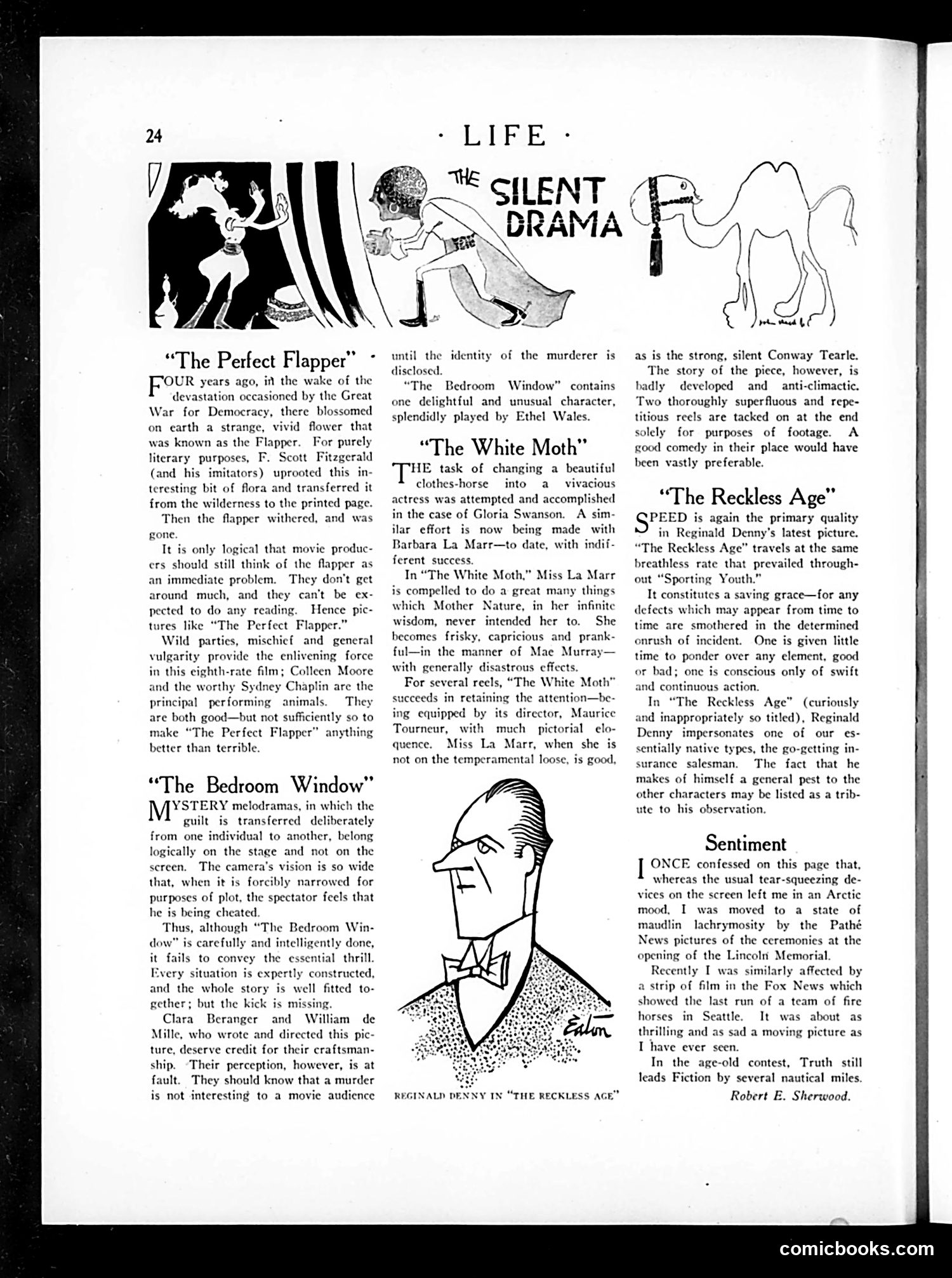
This page reviews four silent films with sharp, satirical commentary. The critic dismisses "The Perfect Flapper" as an "eighth-rate film" exploiting a dated trend—F. Scott Fitzgerald had already immortalized flappers in literature, yet movies still recycled the concept for audiences who "don't get around much." "The Bedroom Window" is criticized for poor dramatic structure: mystery films shouldn't narrow the camera's vision artificially, and revealing the murderer's identity late undermines viewer engagement. "The White Moth" features Barbara La Marr attempting dramatic acting beyond her abilities (she's a "clothes-horse"), though Conway Tearle and Maurice Tourneur's direction provide some quality. The film suffers from padding. "The Reckless Age" succeeds through relentless pacing—Reginald Denny's speed obscures plot weaknesses. He plays an "insurance salesman," representing a distinctly American type the critic finds noteworthy. The cartoon header satirizes how the film industry recycles exhausted trends.
📄 Transcribed text from this page (OCR, searchable)
Machine-transcribed from the original scan — historical spelling and the odd misread are preserved.
” “The Perfect Flapper Four years ago, iN the wake of the devastation occasioned by the Great War for Democracy, there blossomed on earth a strange, vivid flower that was known as the Flapper. For purely literary purposes, F. Scott Fitzgerald (and his imitators) uprooted this in- teresting bit of flora and transferred it from the wilderness to the printed page. Then the flapper withered, and was gone. It is only logical that movie produc- ers should still think of the flapper as an immediate problem. They don't get around much, and they can't be ex- pected to do any reading. Hence pic- tures like “The Perfect Flappei Wild parties, mischief and general vulgarity provide the enlivening force in this eighth-rate film; Colleen Moore and the worthy Sydney Chaplin are the principal performing animals. They are both good—but not sufficiently so to make “The Perfect Flapper” anything better than terrible. “The Bedroom Window” YSTERY melodramas, in which the guilt is transferred deliberately from one individual to another, belong logically on the stage and not on the screen. The camera's vision is so wide that, when it is forcibly narrowed for purposes of plot, the spectator fcels that he is being cheated. Thus, although “The Bedroom Win- dow” is carefully and intelligently done, it fails to convey the essential thrill. Every situation is expertly constructed, and the whole story is well fitted to- gether; but the kick is missing. Clara Beranger and William de Mille, who wrote and directed this pic- ture, deserve credit for their craftsman- ship. ‘Their perception, however, is at fault. They should know that a murder is not interesting to a movie audience until the identity of the murderer is disclosed. The Bedroom Window" contains one delightful and unusual character, splendidly played by Ethel Wales. “The White Moth” THE task of changing a beautiful clothes-horse into a vivacious actress was attempted and accomplished in the case of Gloria Swanson. A sim- ilar effort is now being made with Barbara La Marr—to date, with indif- ferent success. In “The White Moth,” Miss La Marr is compelled to do a great many things which Mother Nature, in her infinite wisdom, never intended her to. She becomes frisky, capricious and prank- ful—in the manner of Mae Murray— with generally disastrous effects. For several reels, “The White Moth” succeeds in retaining the attention—be- ing equipped by its director, Maurice Tourneur, with much pictorial elo- quence. Miss La Marr, when she is not on the temperamental loose, is good, REGINALD DE IN “THE RECKLESS AGE” as is the strong, silent Conway Tearle. The story of the piece, however, badly developed and _ anti-climactic. Two thoroughly superfluous and repe- titious reels are tacked on at the end solely for purposes of footage. A good comedy in their place would have been vastly preferable. “The Reckless Age” Ss? D is again the primary quality in Reginald Denny's latest picture. “The Reckless Age” travels at the same breathless rate that prevailed through- out “Sporting Youth.” It constitutes a saving grace—for any defects which may appear from time to time are smothered in the determined onrush of incident. One is given little time to ponder over any element, good or bad; one is conscious only of swift and continuous action. In “The Reckless Age” (curiously and inappropriately so titled), Reginald Denny impersonates one of our es- sentially native types, the go-getting in- surance salesman. The fact that he makes of himself a general pest to the other characters may be listed as a trib- ute to his observation. Sentiment I ONCE confessed on this page that, whereas the usual tear-squeezing de- vices on the screen left me in an Arctic mood, I was moved to a state of maudlin lachrymosity by the Pathé News pictures of the ceremonies at the opening of the Lincoli Memorial. Recently I was similarly affected by a strip of film in the Fox News which showed the last run of a team of fire horses in Seattle. It about as thrilling and as sad a moving picture as I have ever seen. In the age-old contest, Truth still leads Fiction by several nautical miles. Robert E. Sherwood. comicbooks.com