
A complete issue · 40 pages · 1923
Life — November 15, 1923
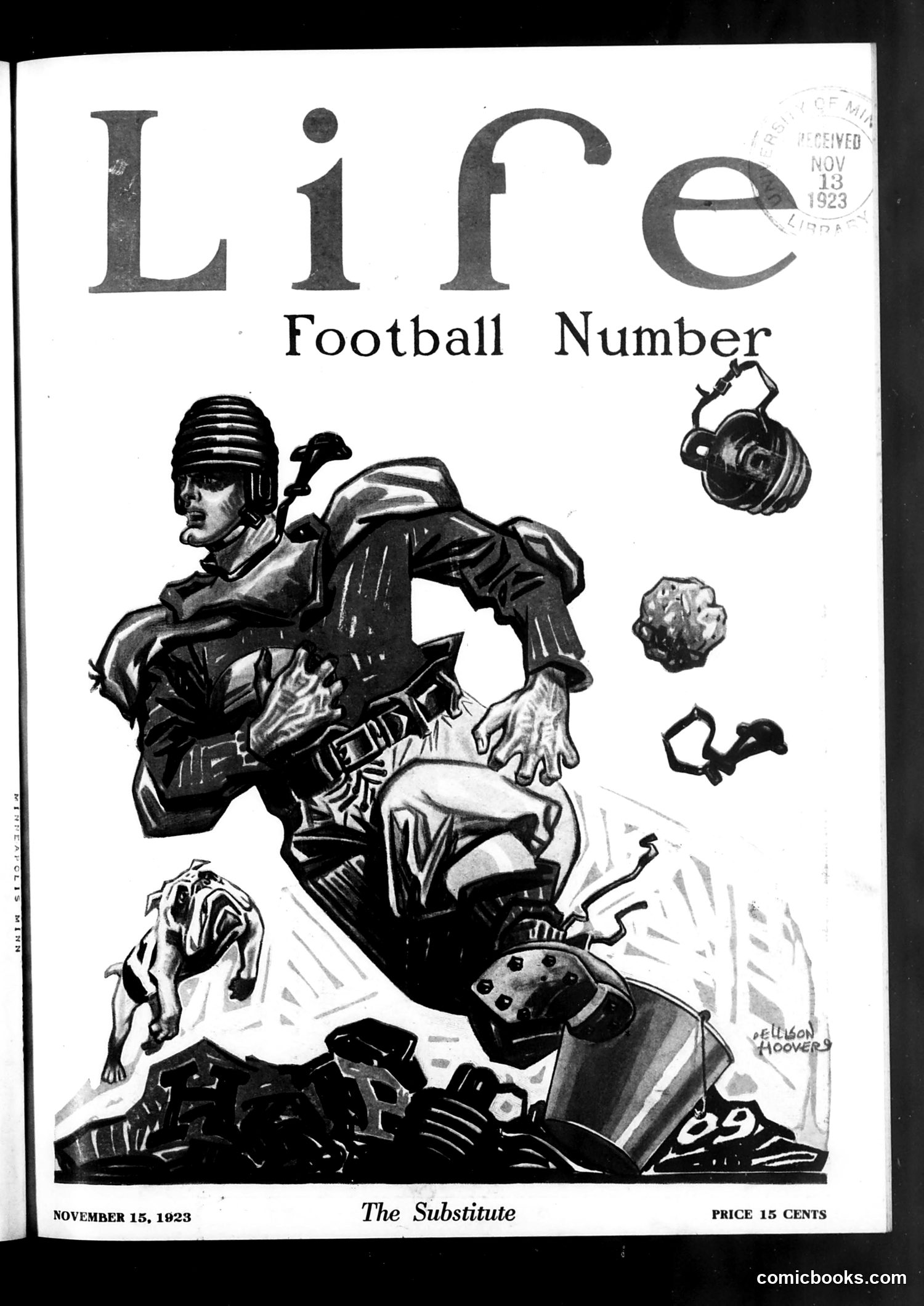
This is the cover of *Life* magazine's special football issue. The central illustration by artist Hoover depicts a football player in action, evading opponents mid-play. The player is shown in dynamic motion, leaping over a prone defender while clutching the ball, with additional football equipment scattered around (helmet, football, cleats). The illustration exemplifies the magazine's popular sports coverage during the 1920s—the "Golden Age of Sports." The dramatic, energetic artwork celebrates football as a major American pastime and entertainment phenomenon. The cartoonish style and action-packed composition were typical of *Life*'s approach to sports illustration during this era. The cover's prominence suggests football had become sufficiently prominent in American culture to warrant a dedicated special edition.
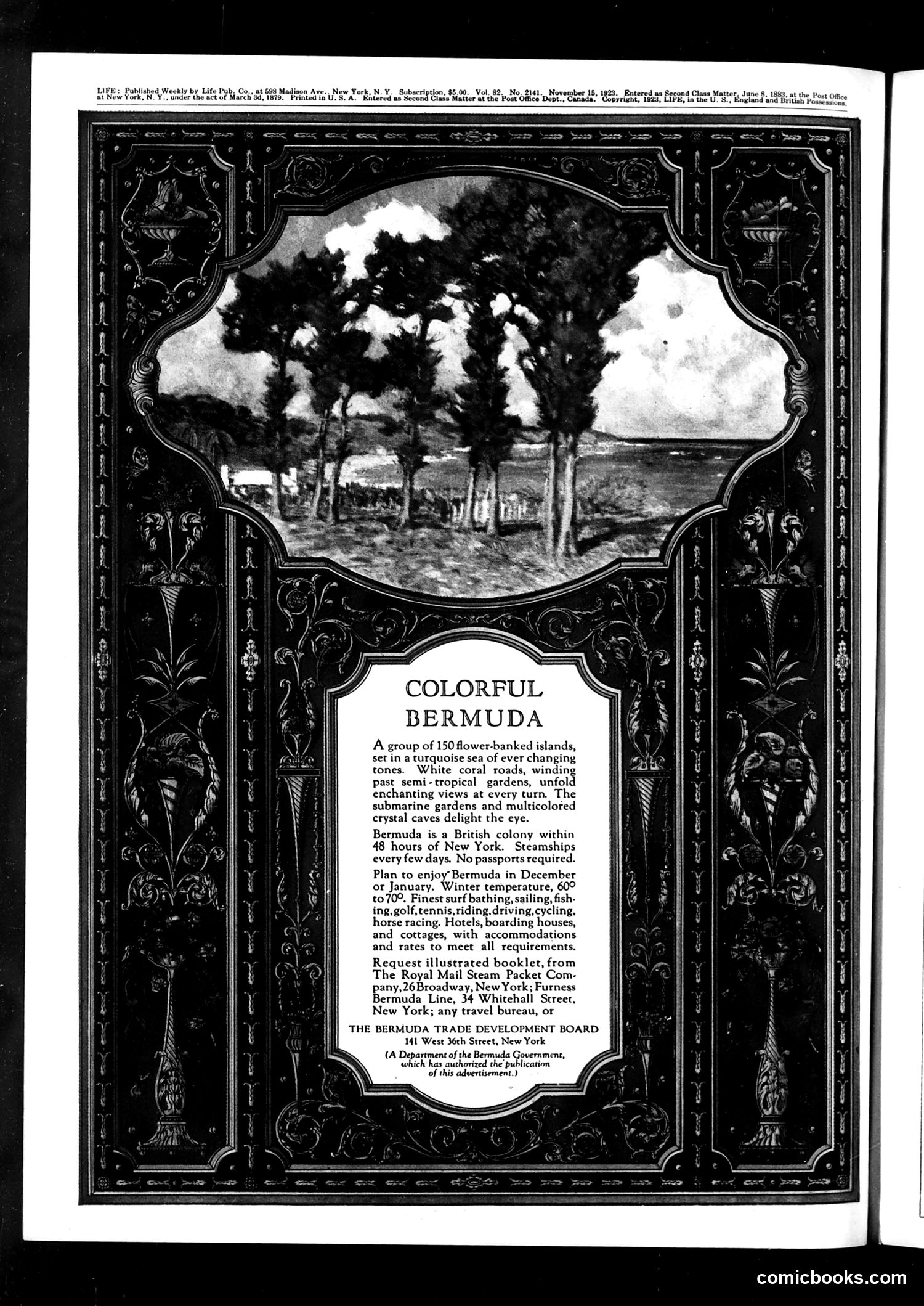
This page is primarily a **travel advertisement**, not political satire or a cartoon. It promotes Bermuda as a vacation destination, published in Life magazine's November 15, 1925 issue. The ad emphasizes Bermuda's appeal: a group of 150 flower-banked islands with turquoise waters, white coral roads, and crystal caves. It highlights practical travel details—located within 48 hours of New York, no passports required, steamships departing frequently, and winter temperatures of 60-70°F. The ornate decorative border frames a landscape photograph showing palm trees and coastal scenery. The text suggests activities like surfing, sailing, golf, and tennis, while promoting hotels and cottages with various accommodations. The ad is authorized by the Bermuda Trade Development Board, positioning it as official promotional material rather than editorial content or satire.
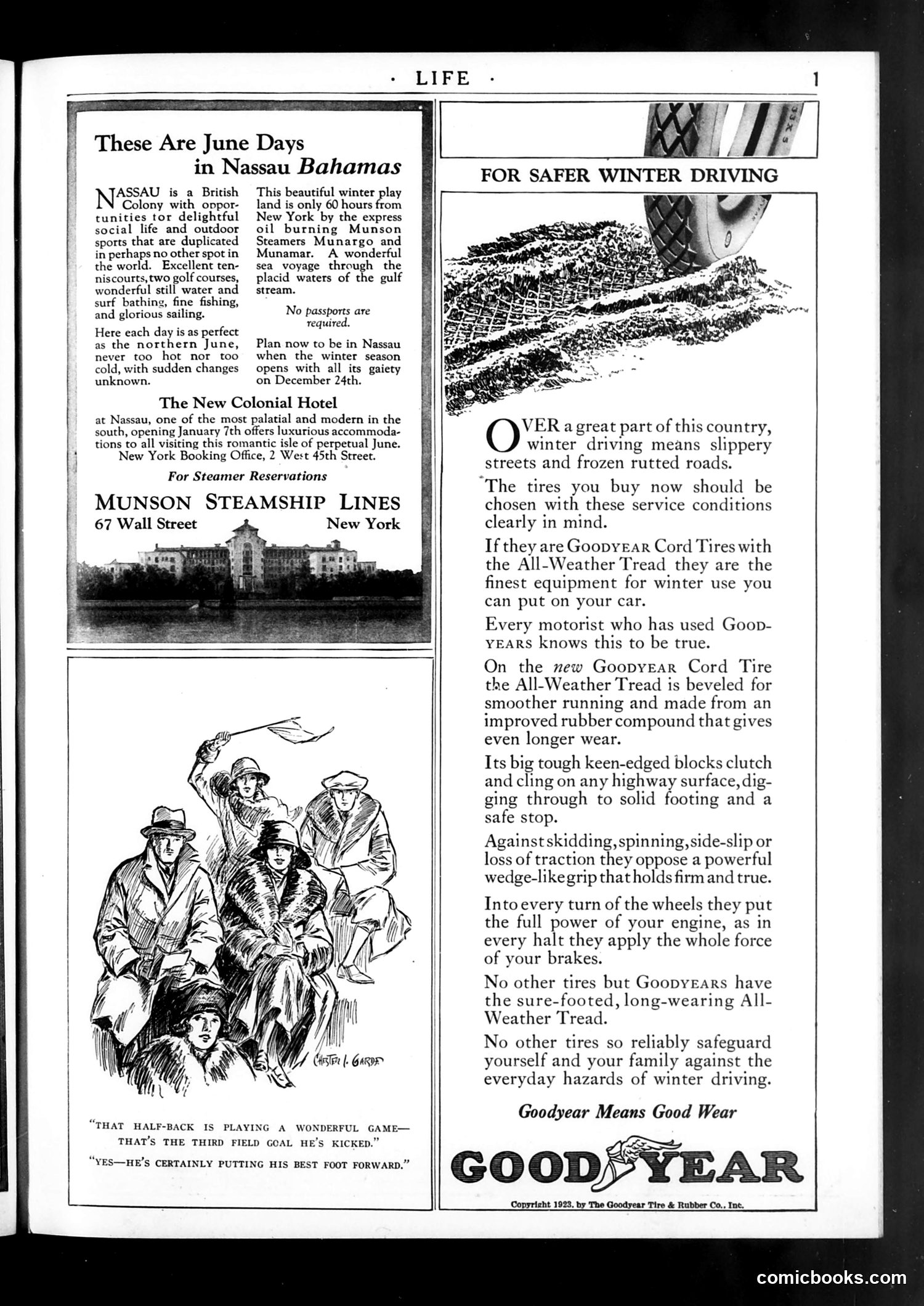
This page contains advertisements rather than political satire. The left side promotes Nassau, Bahamas tourism and the New Colonial Hotel, emphasizing June as an ideal travel month with "perfect" weather and outdoor activities. Below is a sketch of what appears to be people engaged in recreational activities, with a caption about a "half-back" playing football—likely promoting leisure and sports as vacation attractions. The right side is a full Goodyear tire advertisement for winter driving safety, emphasizing the All-Weather Tread design's superior grip on slippery, frozen roads. The text stresses that Goodyear tires uniquely prevent skidding and loss of traction during winter conditions. Overall, this is commercial rather than satirical content typical of Life magazine's revenue model.
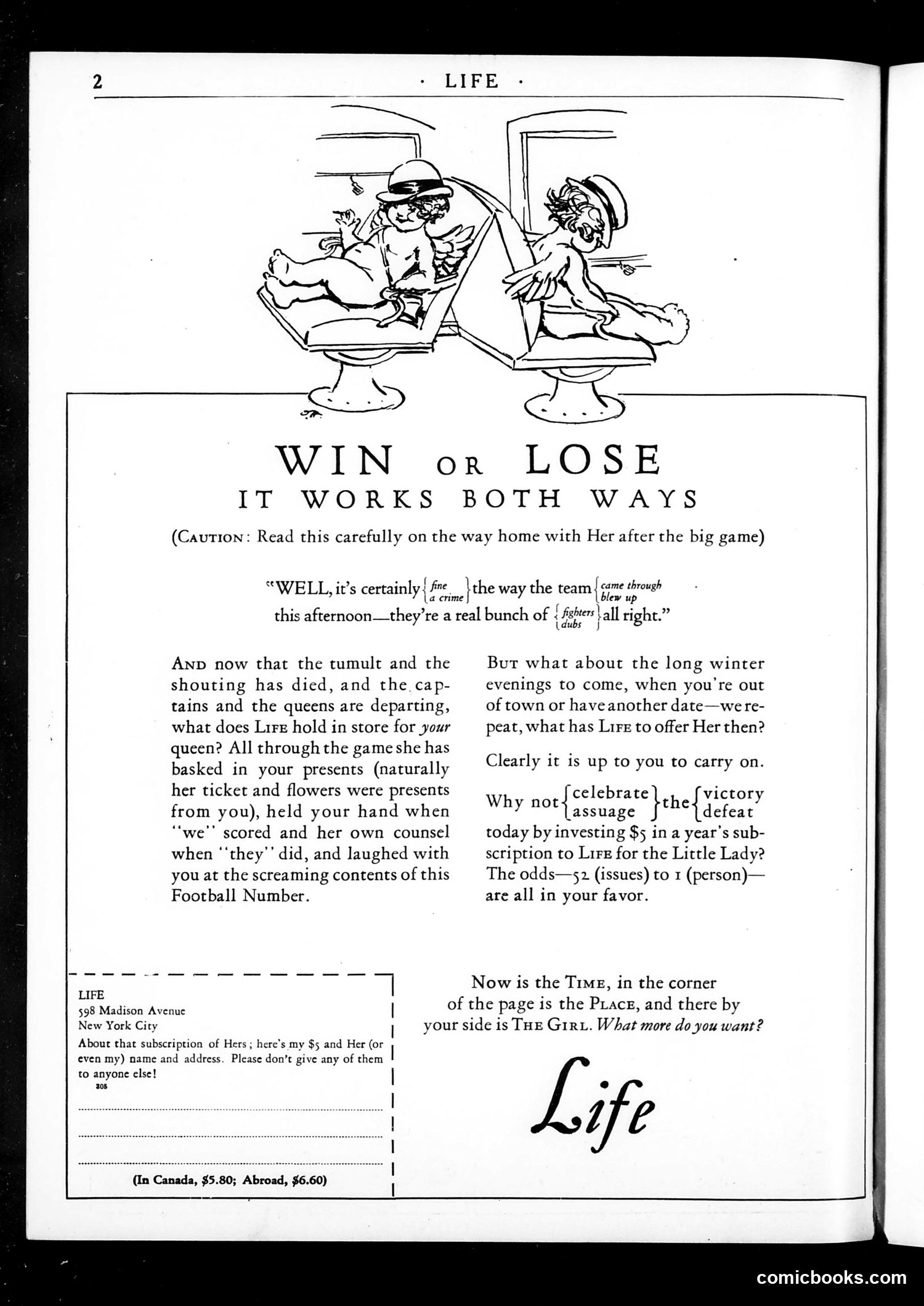
This page is primarily an **advertisement for Life magazine subscriptions**, disguised as romantic/dating advice humor. The cartoon depicts two figures in barber chairs—a common visual metaphor for relaxation and male bonding. The illustration plays on the "win-win" premise: whether a sports team wins or loses "the big game," a man's date benefits either way. If the team wins, he's in good spirits; if they lose, he needs consoling—both scenarios justify spending time together. The text mocks men's obsession with sports while urging readers to subscribe to Life as an alternative source of entertainment for "long winter evenings." The satire targets masculine sports culture and suggests Life magazine offers superior entertainment for couples compared to sports obsession. The subscription form at bottom offers $5 yearly domestically, $6.60 abroad.
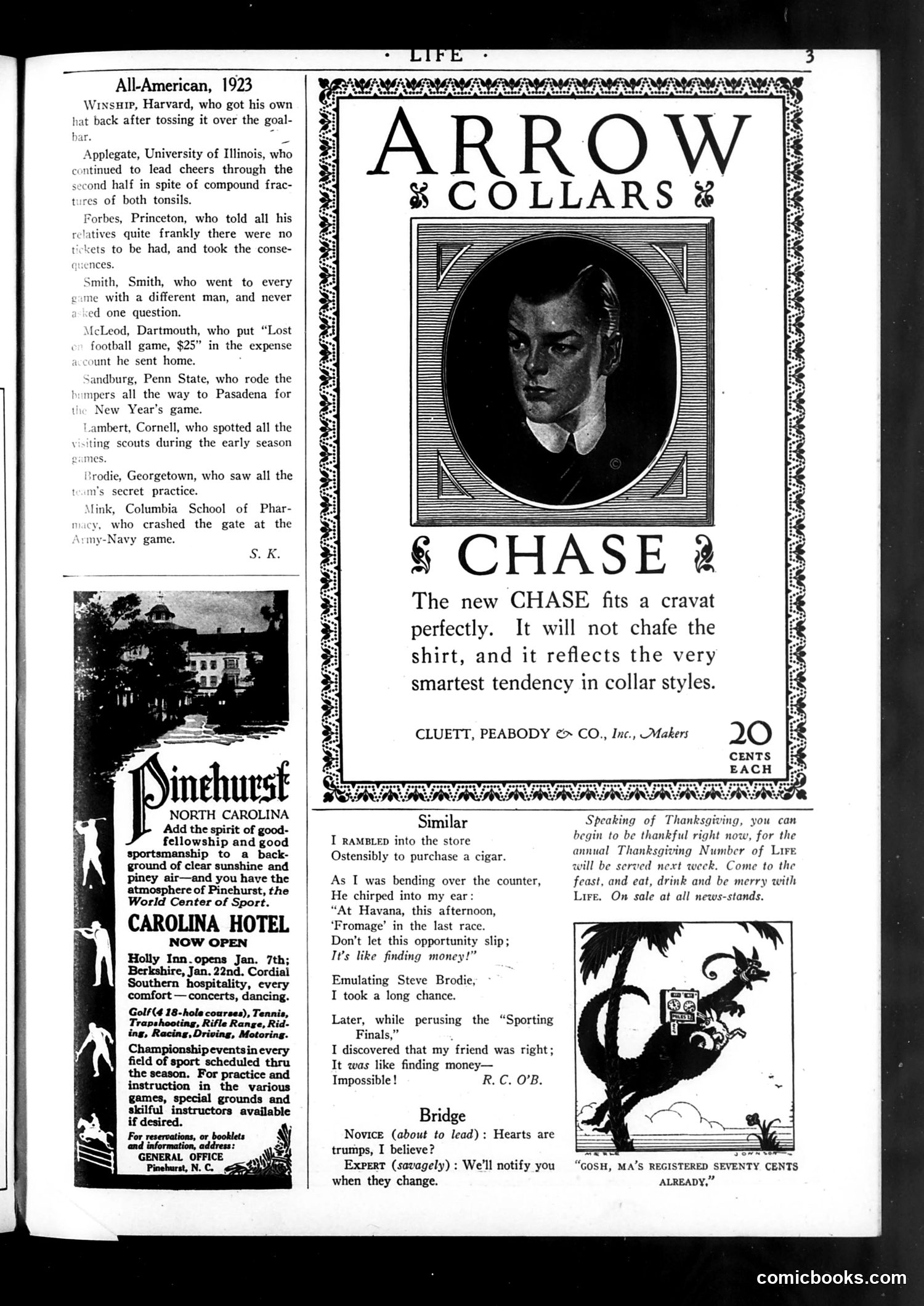
This page is **primarily advertising** rather than political satire. The dominant content features: 1. **Arrow Collars advertisement** - A major collar brand promoting their "Chase" collar style as fitting cravats perfectly without chafing shirts, reflecting 1920s menswear fashion trends. 2. **Pinehurst, North Carolina resort advertisement** - Promoting a golf and sports destination hotel offering "fellowship and good sportsmanship." 3. **"Similar" section** - A brief humorous anecdote about someone discovering a cigar while shopping, playing on the phrase "like finding money." 4. **Bridge section** - A light joke about card game rules regarding hearts as trumps. The cartoon with "Gosh, Ma's registered seventy cents already" appears to be a small illustration accompanying the anecdote, likely depicting the discovery scenario. Overall, this reflects typical 1920s magazine advertising and light humor.
This is primarily a **commercial advertisement**, not satire or political commentary. It's a Phoenix Hosiery company ad from Milwaukee promoting their socks and stockings. The "Women vs. men" framing is a marketing hook: the text argues that women take more steps daily than men, so their feet work harder, making durable hosiery essential. Phoenix claims their brand combines both elegance and durability for all genders. The ornate decorative border and formal typography reflect early 20th-century advertising aesthetics. The sole "joke" is the gentle gendered observation that women's feet are busier—used to justify premium hosiery as practical rather than purely decorative. This reflects period assumptions about women's roles while marketing durability as equally important as fashion.
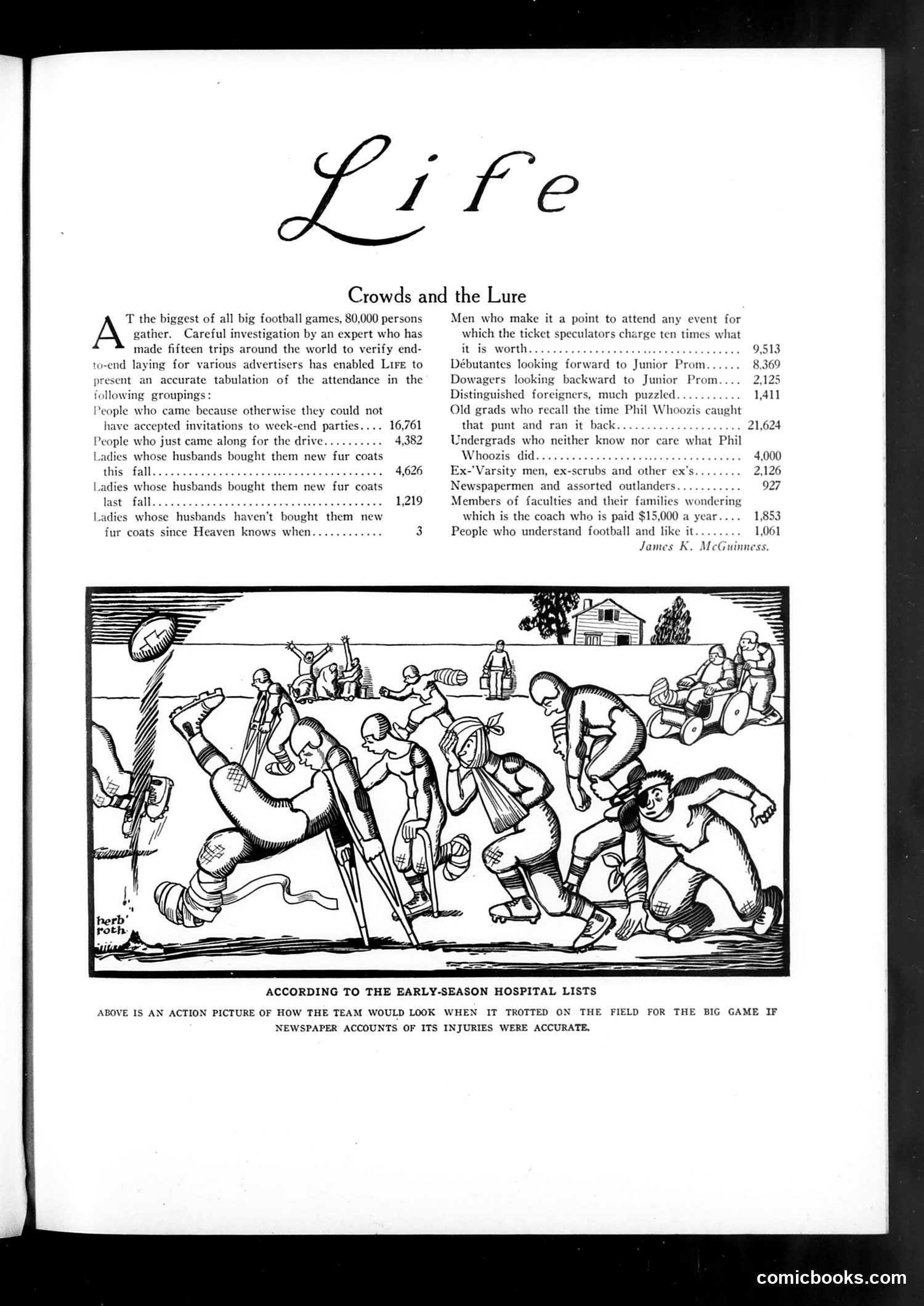
This satirical piece mocks the injuries sustained by football players at major games. The text lists supposedly verified reasons why 80,000 people attended a big football game, including absurd categories like "Ladies whose husbands bought them new fur coats this fall" and "Ladies whose husbands bought them new fur coats last fall." The accompanying cartoon depicts a chaotic football scene where players are severely injured—broken limbs, collisions, and medical emergencies dominate the field. The caption notes this represents "how the team would look when it trotted on the field for the big game if newspaper accounts of its injuries were accurate." The satire targets sensationalized injury reporting in sports journalism, suggesting newspapers exaggerated player damage to draw crowds. It's a commentary on media hype and public morbid curiosity about football's dangers.
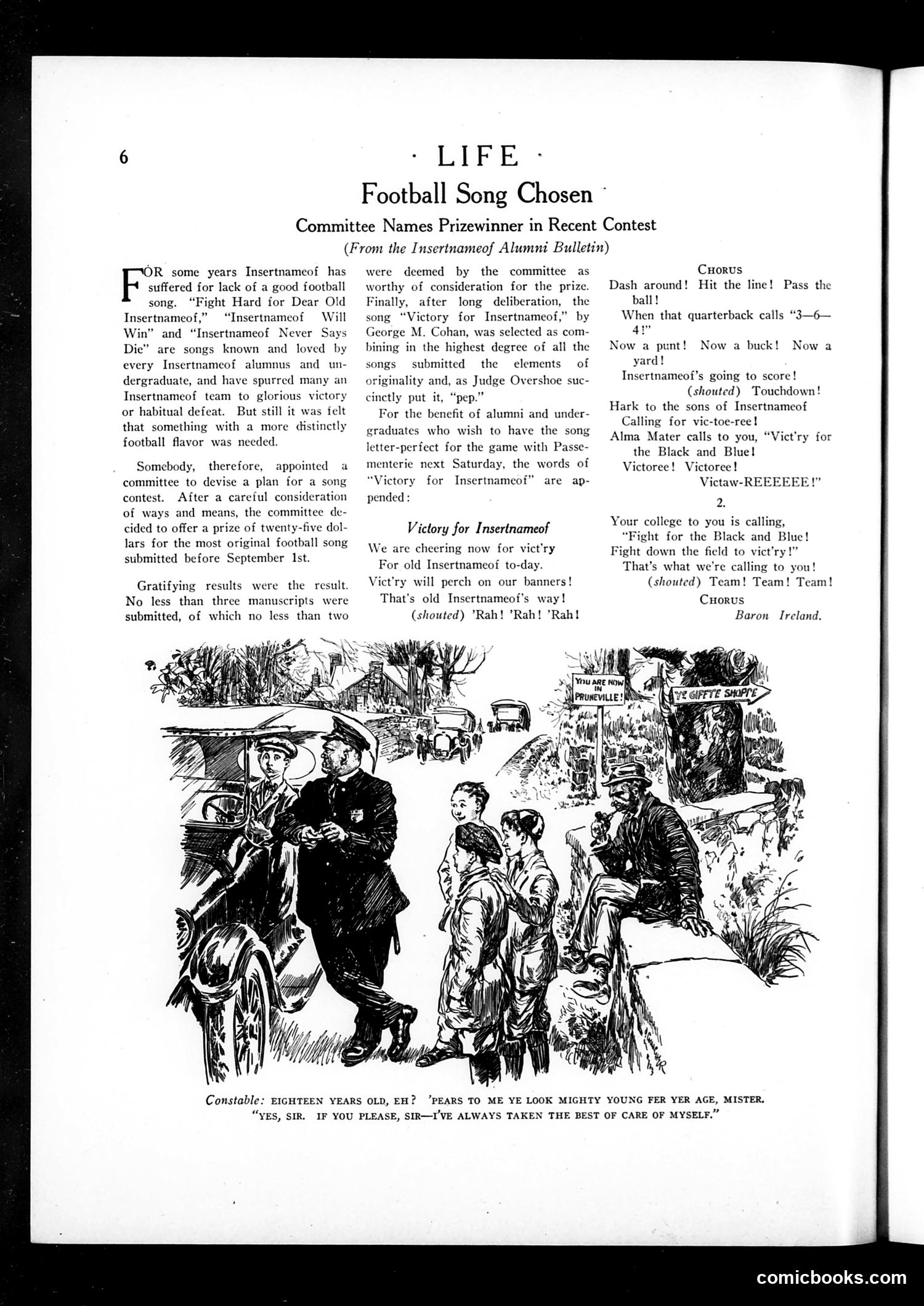
This page documents a college football song competition for Insertnameof (likely a fictional college). The main illustration depicts a constable (British police officer) encountering what appears to be rowdy young people, with the caption humorously suggesting the constable claims to be only eighteen years old despite his aged appearance—"pears to me ye look mighty young fer yer age, mister." The joke plays on the constable's obvious age contradicting his stated youth, likely satirizing either: 1. Police corruption or dishonesty 2. The universal tendency to deny aging 3. Possibly British police procedures of the era The winning song "Victory for Insertnameof" appears above, with its chorus emphasizing school spirit and scoring touchdowns. The overall content reflects early 20th-century American college culture and British humor conventions common in *Life* magazine.
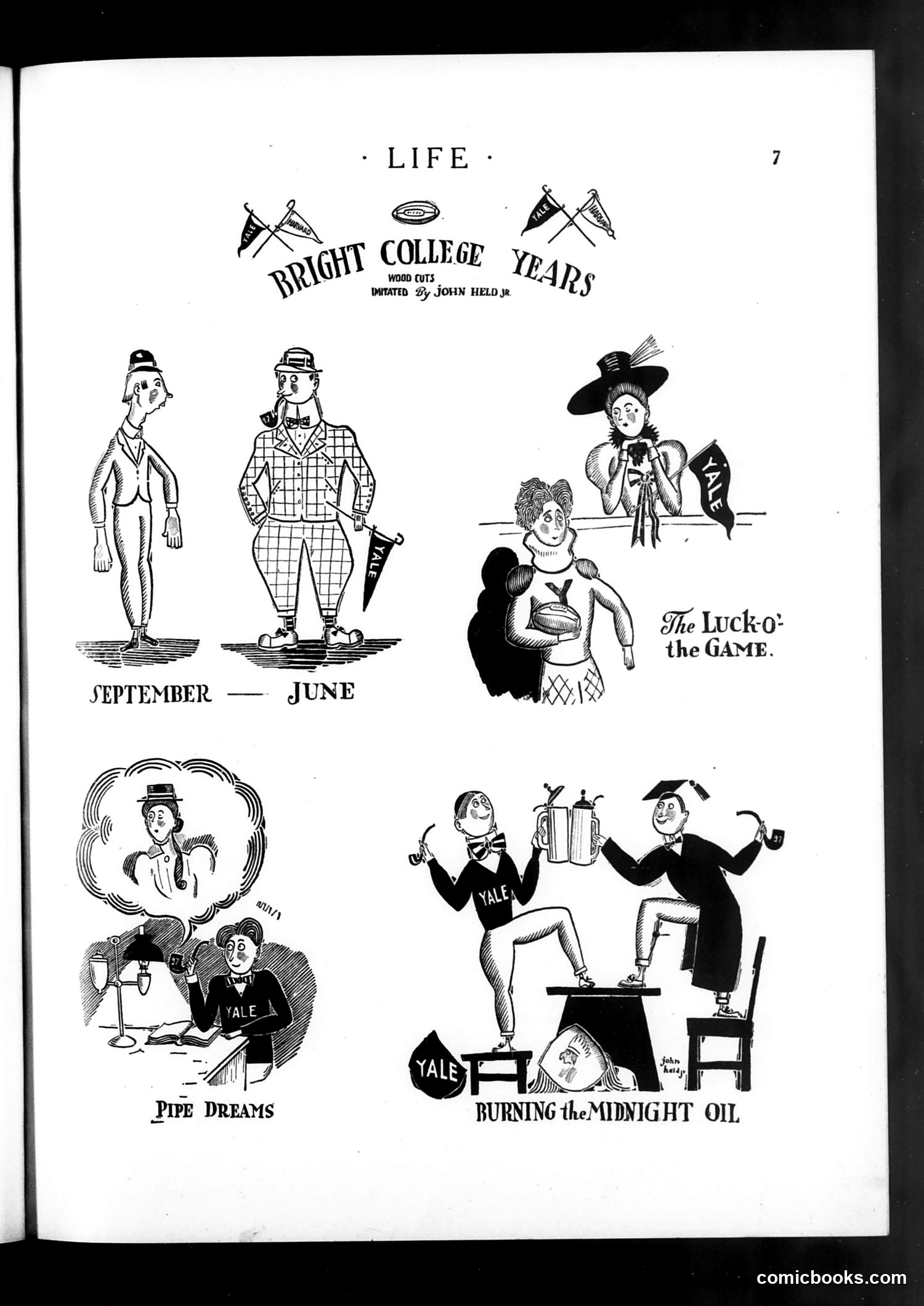
This page satirizes college life at Yale University through six vignettes labeled "September-June," documenting a student's transformation across the academic year. The progression shows: initial arrival as a thin, nervous freshman (September); transformation into a portly, confident upperclassman in plaid by June. "The Luck o' the Game" depicts romantic/social pursuits. "Pipe Dreams" shows a student daydreaming of success while studying. "Burning the Midnight Oil" illustrates students cramming before exams with coffee and cigarettes. The satire mocks typical college experiences: the physical and personality changes wrought by student life, romantic entanglements, procrastination, and last-minute studying. Yale's "Y" insignia appears throughout, establishing institutional context for this humorous commentary on undergraduate life.
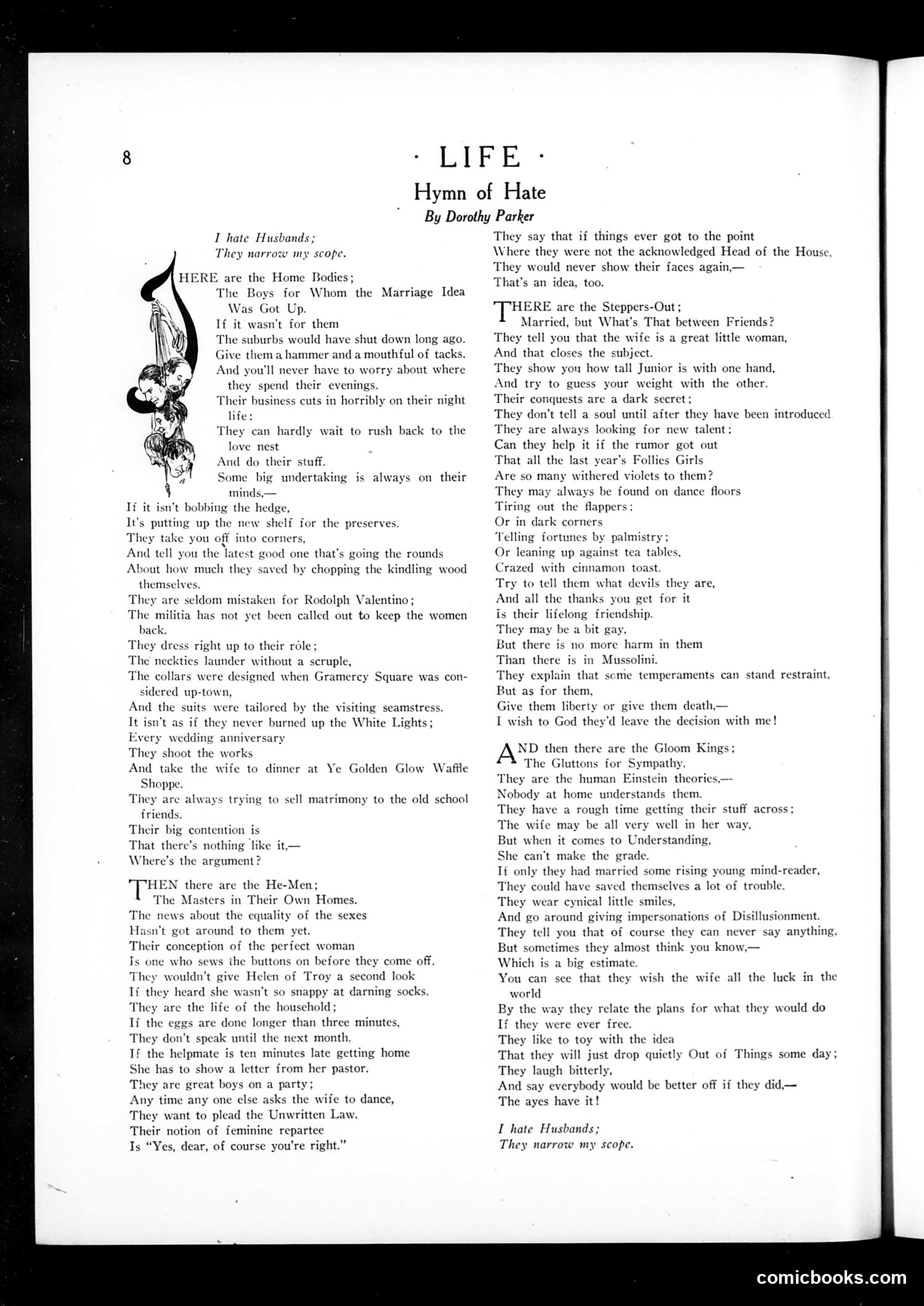
This is Dorothy Parker's satirical poem attacking various categories of married men and their social behaviors. The illustration shows a grotesque caricatured figure (likely representing an unappealing husband type). Parker systematically mocks: - **Home Bodies**: dull husbands who avoid social life - **He-Men**: domineering "masters of their own homes" - **Steppers-Out**: unfaithful men with secret affairs - **Gloom Kings**: intellectually pretentious men - Various other husband archetypes and their annoying habits The poem's refrain—"I hate Husbands; / They narrow my scope"—frames marriage as restrictive for women. Parker satirizes both husband types and their wives' resigned acceptance of poor treatment, concluding that women "would be better off if they did." This reflects 1920s-30s social commentary on marital dissatisfaction and gender dynamics.
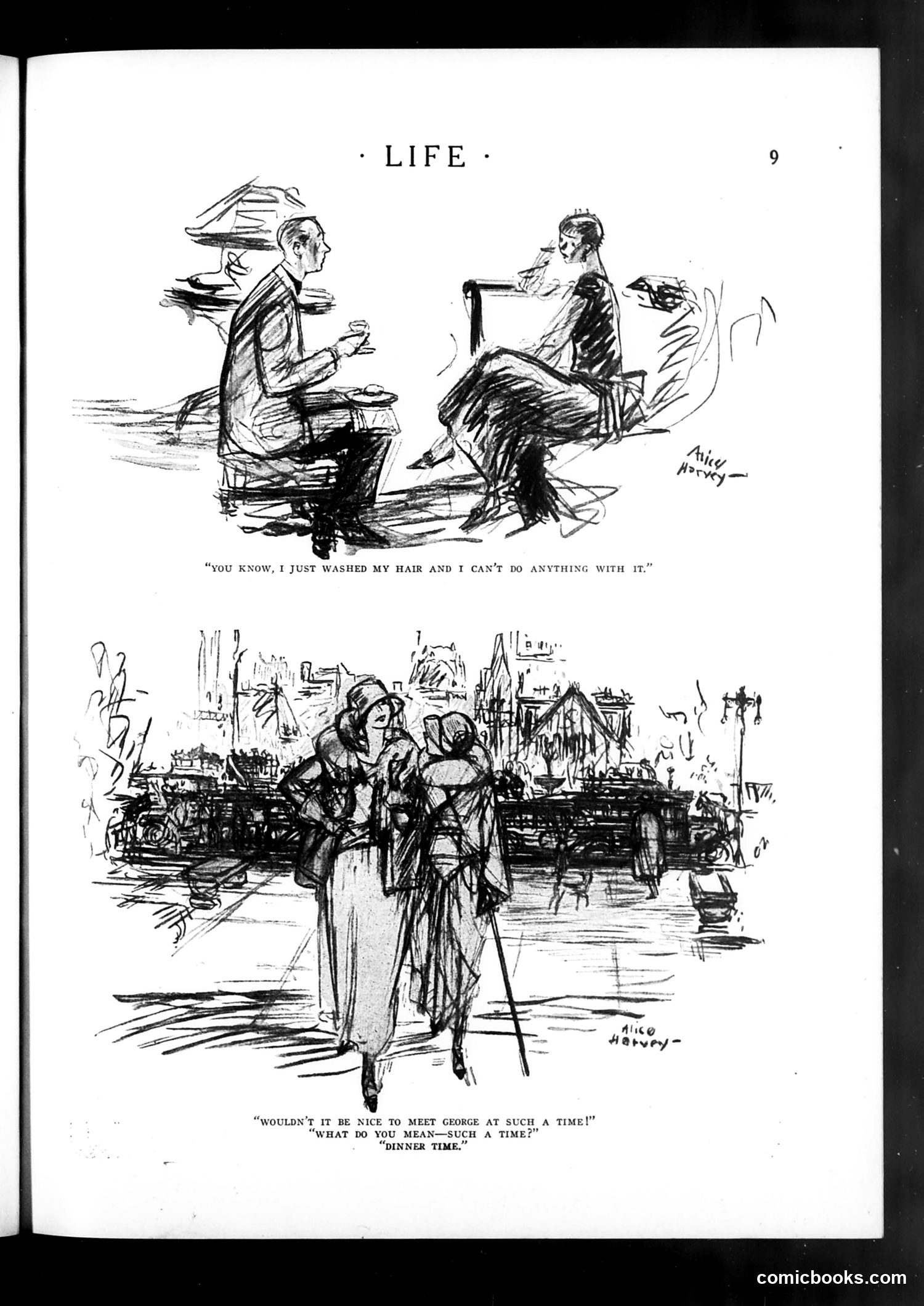
This page contains two satirical cartoons by Alice Harvey: **Top cartoon**: A man and woman in conversation. The woman complains: "You know, I just washed my hair and I can't do anything with it." This is gentle domestic satire about a common female complaint regarding hair management after washing. **Bottom cartoon**: Two women in what appears to be a city street or plaza setting. One asks: "Wouldn't it be nice to meet George at such a time?" The other responds: "What do you mean—such a time? 'Dinner time.'" This satirizes women's preoccupations with meal planning and entertaining—suggesting that even romantic encounters with men are primarily considered in the context of when to serve dinner. It reflects period gender stereotypes about women's domestic roles.
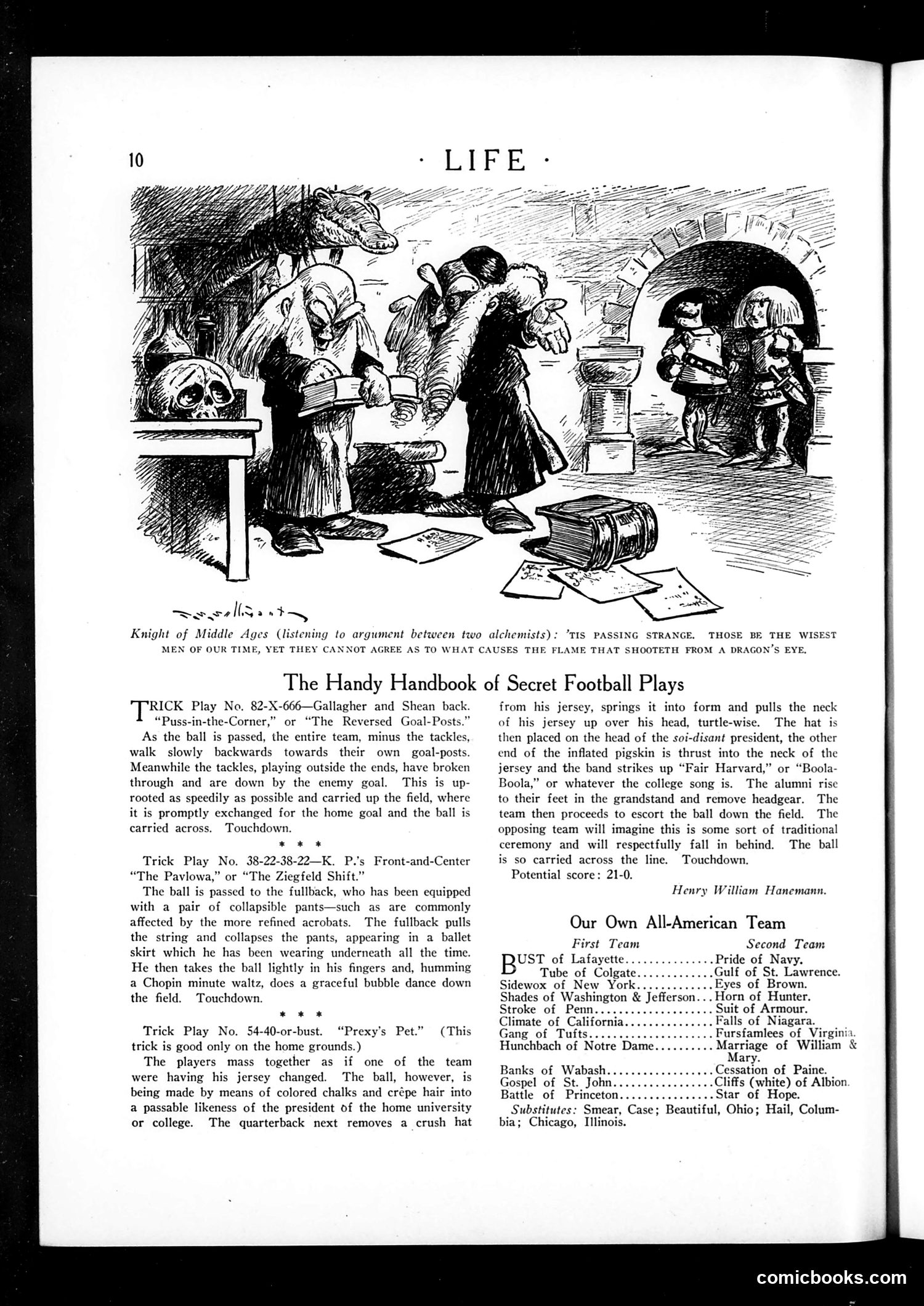
The top illustration depicts **medieval alchemists arguing**, with the caption explaining they represent "the wisest men of our time" who cannot agree on fundamental questions—a satirical commentary on expert disagreement and the limits of knowledge. Below this is "**The Handy Handbook of Secret Football Plays**," describing absurdist trick plays with deliberately ridiculous names like "Pass-in-the-Corner" and "The Pavlova." The satire targets the era's obsession with elaborate football strategy and coaching complexity. The bottom section lists "**Our Own All-American Team**" with humorous player nicknames derived from college names (Lafayette = "Pride of Navy," Penn = "Suit of Armour"), mocking both college football's prestige and the tendency to create grand-sounding team identities. The overall theme satirizes institutional pomposity and overcomplicated systems.
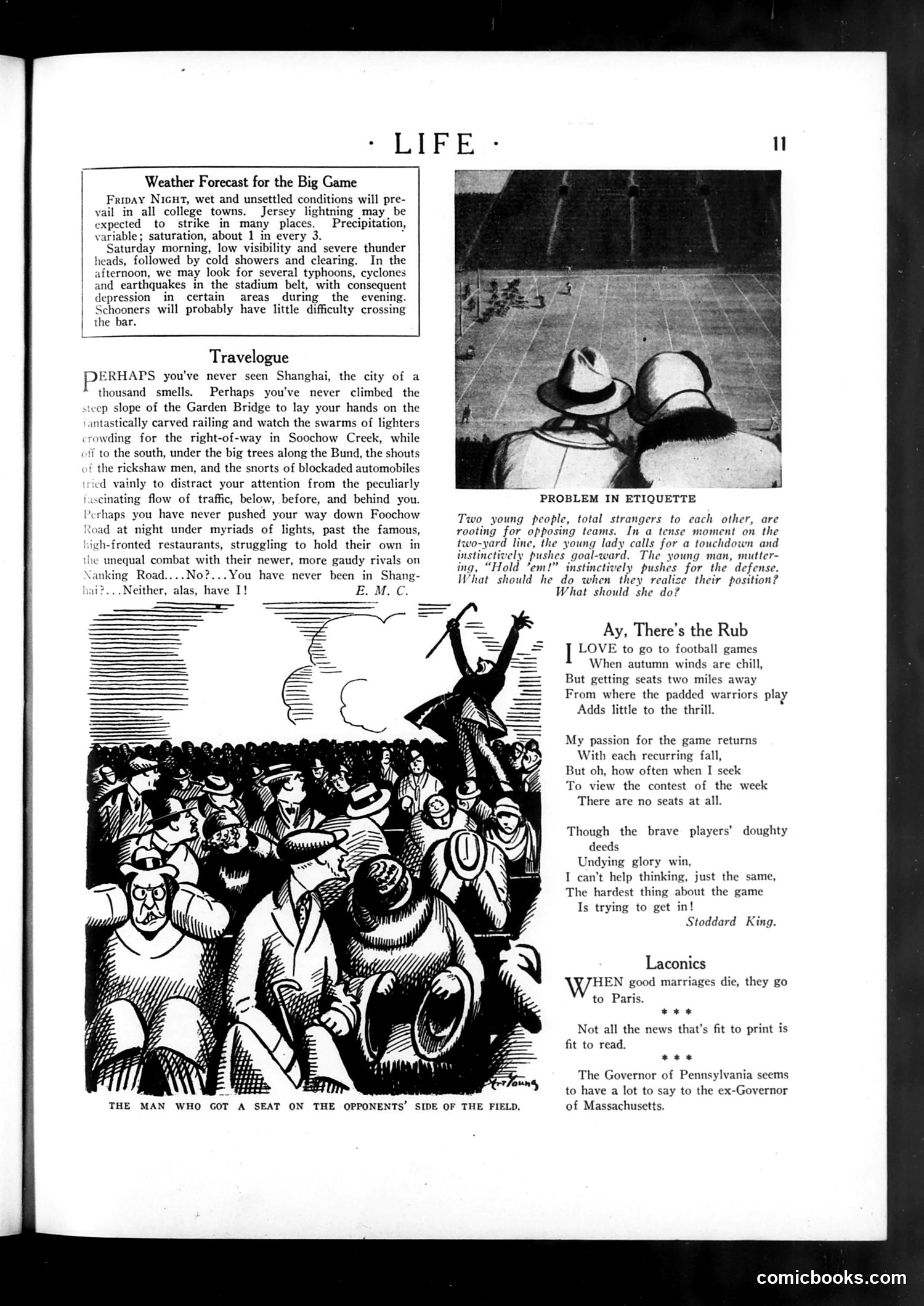
This page contains sports and social commentary rather than political cartoons. The main illustration shows a crowded football stadium scene captioned "The Man Who Got a Seat on the Opponents' Side of the Field"—satirizing the difficulty of obtaining good football tickets. The "Problem in Etiquette" photograph depicts two young people at a football game in an ambiguous situation, asking readers how they should handle their seating position—likely a humorous social dilemma about proper stadium behavior. "Ay, There's the Rub" is a poem by Stoddard King lamenting that genuine football enthusiasm is dampened by the practical challenge of securing decent seats, reducing the game's thrill to mere effort in getting in. The page reflects early 20th-century American leisure culture and the growing popularity of college football as a social event.
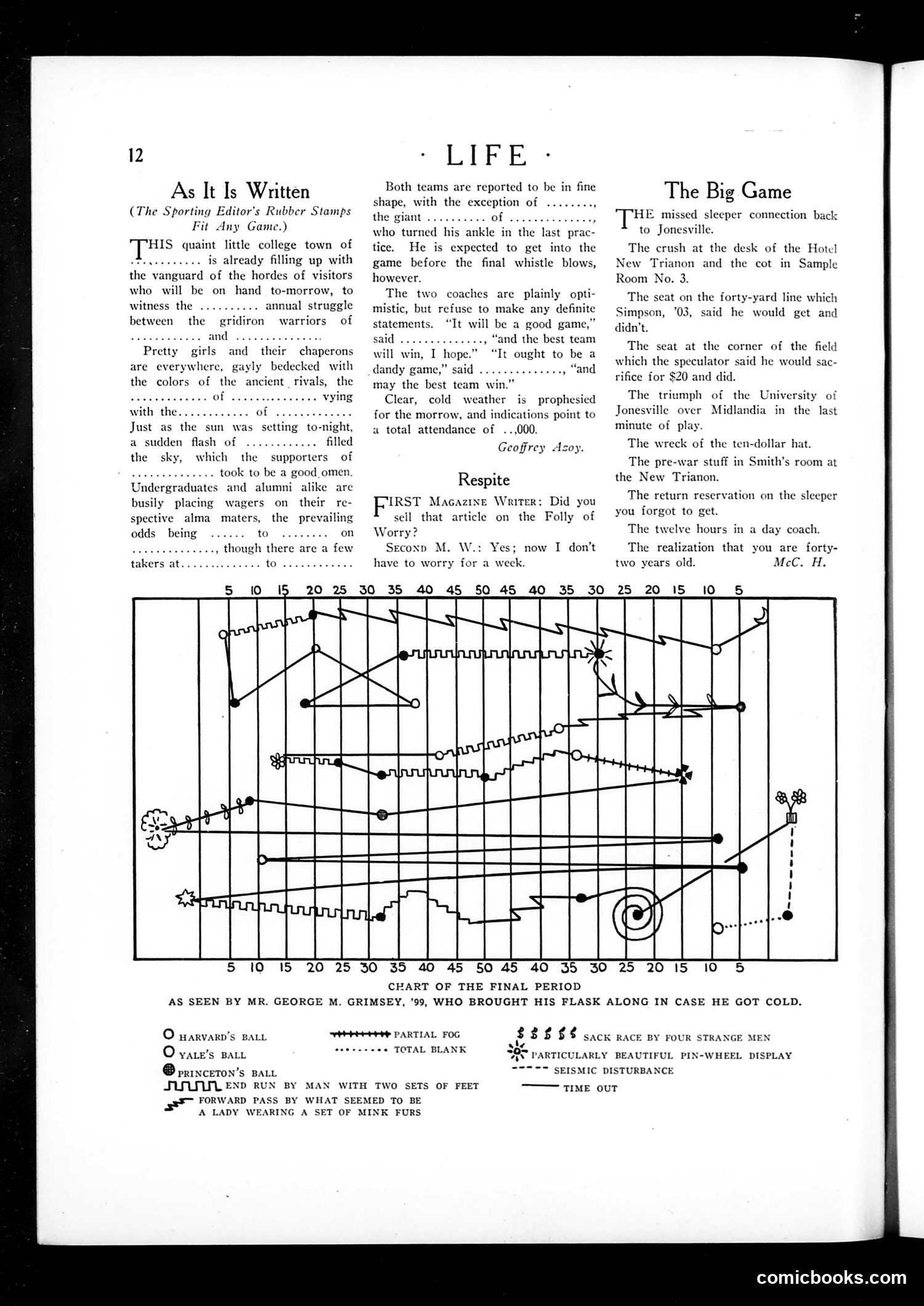
This page contains sports humor rather than political satire. The main feature is a detailed football play diagram titled "Chart of the Final Period" showing a Harvard-Yale game, credited to George M. Gribskey, '99. The diagram uses symbols to humorously track ball movement, including references to "partial fog," "sack race by four strange men," and a "particularly beautiful pin-wheel display." These absurdist annotations mock the overwrought detail of sports reporting while poking fun at the actual chaos of live football. The surrounding text—"As It Is Written," "Respite," and "The Big Game"—features brief humorous commentary about college football culture, including references to betting and spectator enthusiasm at this elite Northeastern matchup. The satire targets both the sport's intensity and contemporary journalism's breathless coverage style.
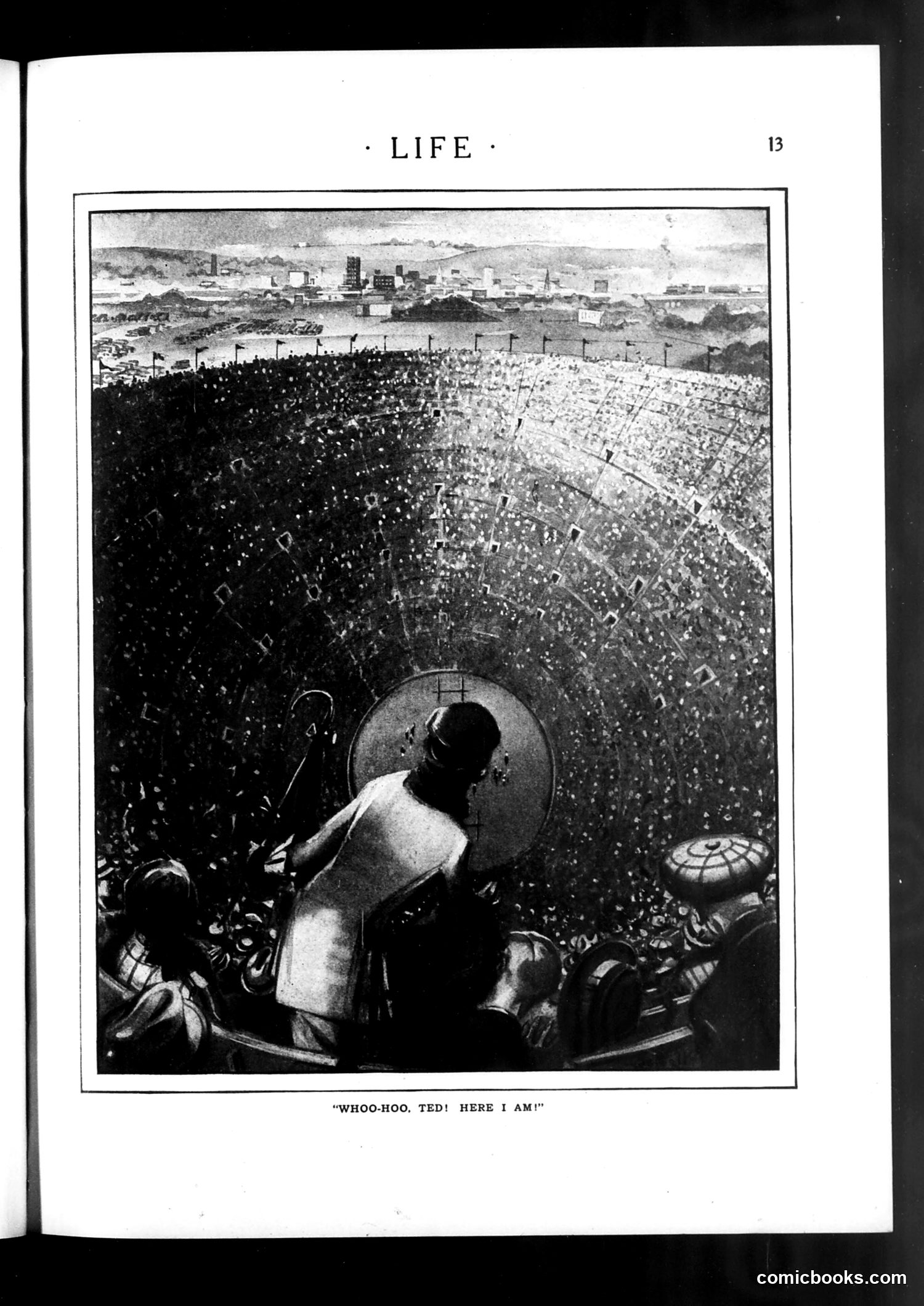
This Life magazine page (page 13) shows a sports-themed illustration captioned "Whoo-hoo, Ted! Here I am!" The image depicts a shirtless athlete viewed from behind, holding what appears to be a large disc or shield, addressing a massive crowd in a stadium. A cityscape is visible in the background. The illustration appears to be satirizing enthusiastic sports fandom or an athlete's triumphant moment before a crowd. The figure addressed as "Ted" is likely a specific athlete or public figure, though the image alone doesn't definitively identify who. The exaggerated scale of the crowd and the dramatic perspective suggest this is mocking either excessive hero-worship of athletes or hyperbolic sports celebration. Without additional context about the magazine's publication date, the specific reference remains somewhat unclear.
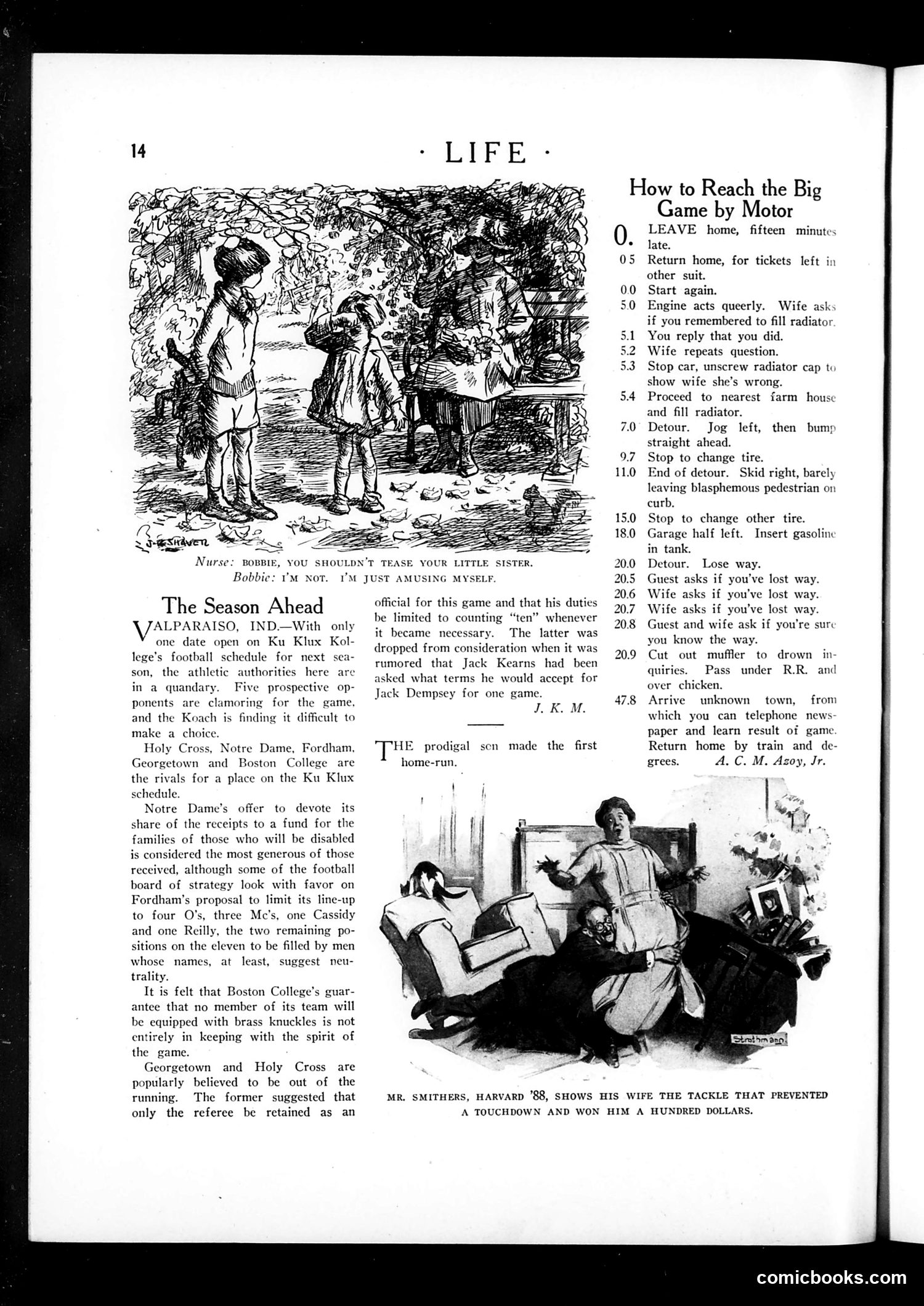
This page contains two distinct humor pieces: **Top Illustration**: "Nurse: Bobbie, you shouldn't tease your little sister. Bobbie: I'm sorry. I'm just amusing myself." A sketch showing children in what appears to be a teasing scenario—basic domestic humor about sibling rivalry. **Main Content**: "How to Reach the Big Game by Motor"—a humorous step-by-step guide satirizing the complications of an early automotive journey to a football game. The joke catalogs typical 1920s car troubles: engine problems, radiator issues, tire changes, getting lost, requiring farm assistance. **Bottom Illustration**: Shows Mr. Smithers from Harvard '88 with his wife, captioned that her "tackle prevented a touchdown and won him a hundred dollars"—likely joking that her intervention in his football betting proved financially beneficial. The satire targets early automobile culture's unreliability and spousal dynamics around sports gambling.
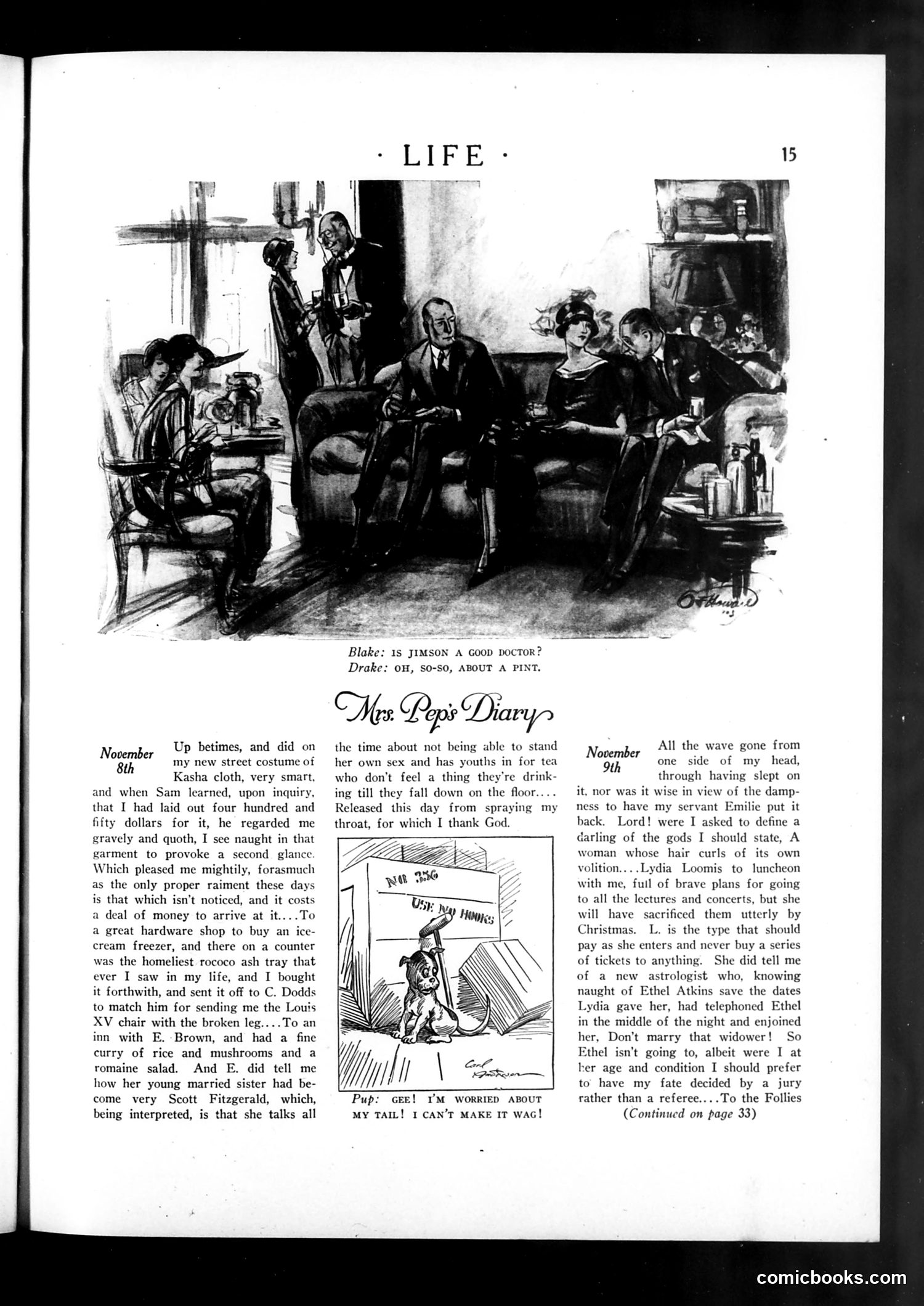
This is a satirical diary entry from the magazine *Life*. The top illustration shows a social gathering where someone asks "Is Jimson a good doctor?" and another replies "Oh, so-so, about a pint." The joke satirizes doctors who drink excessively—suggesting "a pint" (of alcohol) measures his competence rather than his medical skills. This reflects Prohibition-era concerns about professional conduct and drinking culture. The diary entries mock upper-class social pretensions: Mrs. Pops complains about her new street costume, gossips about acquaintances, and discusses her social calendar. The small illustration shows a frustrated woman with her dog, captioned about worrying over her tail and making a wag—likely a double entendre typical of *Life's* humor. The satire targets wealthy women's superficiality and social anxiety during the 1920s era.
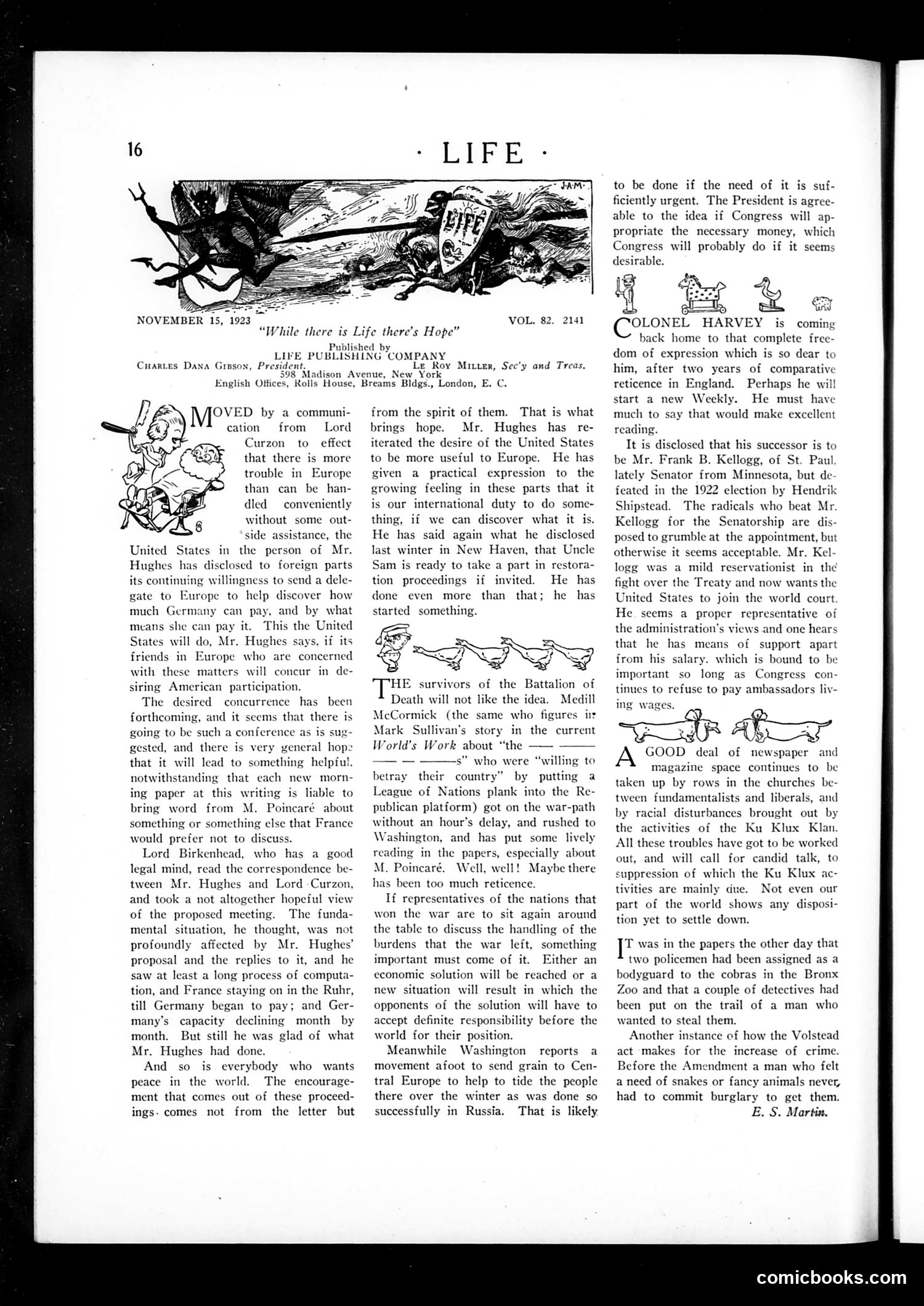
This editorial page discusses post-WWI diplomacy, particularly Secretary of State Charles Evans Hughes's proposal to send American delegates to a European conference on German reparations and war debts. **The Main Cartoon** (top): Shows a skeletal "Death" figure clutching a bag labeled "LIFE," illustrating the editorial's grim opening about European troubles requiring outside help. **Key References:** - **Lord Curzon**: British Foreign Secretary appealing for U.S. involvement - **Hughes**: U.S. Secretary of State proposing American participation in European economic discussions - **Medill McCormick**: A Republican senator and war-hawk who opposed Hughes's diplomatic approach, dismissed here as part of the "Battalion of Death"—those favoring military solutions over negotiation - **Poincaré**: French Premier resistant to cooperation - **Germany's reparations**: The central economic problem requiring settlement **The Satire**: Life supports Hughes's diplomatic initiative but mocks resistance from American militarists like McCormick, suggesting they prefer confrontation to constructive international cooperation for post-war recovery.
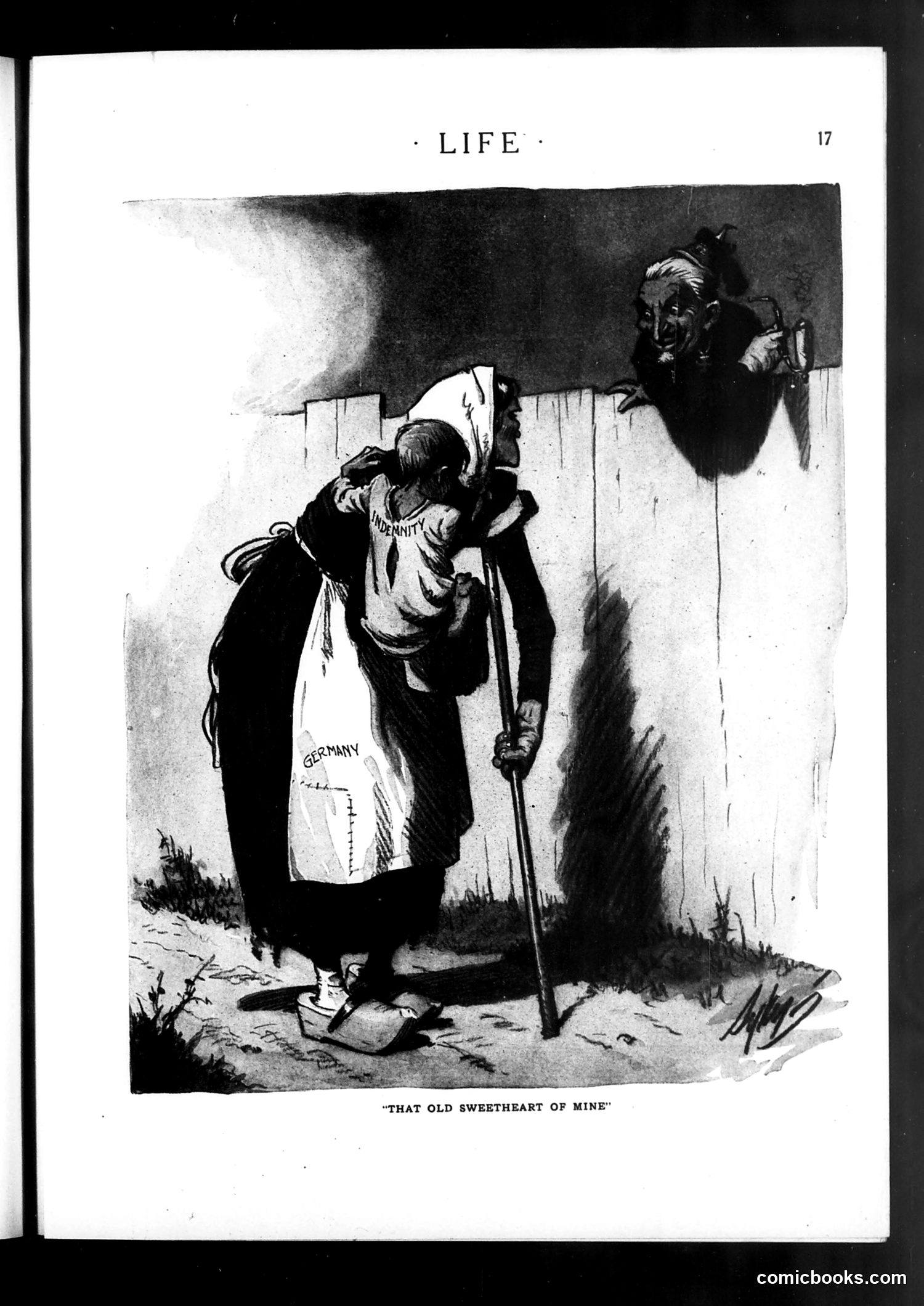
This political cartoon depicts a German soldier carrying a large bundle labeled "GERMANY" on his back, approaching a wooden wall/fortification. A demonic or grotesque figure peers over the wall, appearing to welcome or beckon him forward. The satire uses the metaphor of a romantic reunion ("sweetheart") to mock Germany's relationship with war or conflict. The soldier is literally burdened by his nation, suggesting Germany carries an unsustainable weight. The ominous figure represents death, destruction, or the consequences of war waiting on the other side of the fortification. This appears to reflect WWI-era American sentiment criticizing German militarism and the human cost of warfare. The cartoon warns that Germany's romantic nostalgia for conflict will only lead to ruin.
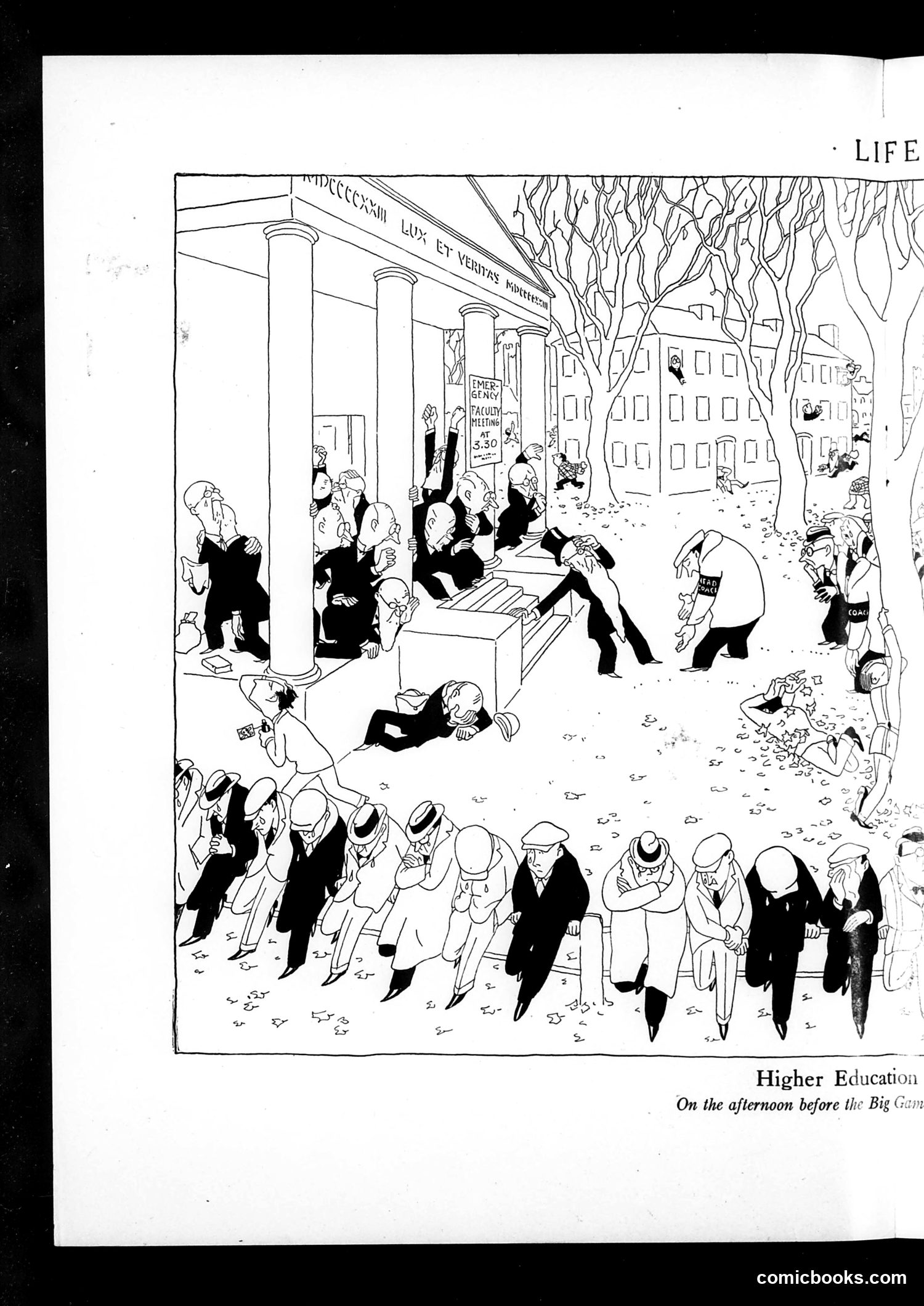
This satirical cartoon titled "Higher Education" depicts a funeral or solemn ceremony at what appears to be a classical institution (shown by the columns and formal architecture). The caption "On the afternoon before the Big Game" suggests this is set at a university before an important athletic event. The satire mocks collegiate priorities: while dignified officials conduct what seems to be an academic or institutional ceremony, the crowd of students below appears indifferent or distracted. The juxtaposition implies that students care more about the upcoming "Big Game" (likely football) than about serious academic or institutional matters happening simultaneously. This reflects early 20th-century critiques of American higher education's over-emphasis on sports and athletics at the expense of genuine scholarship and intellectual pursuits.
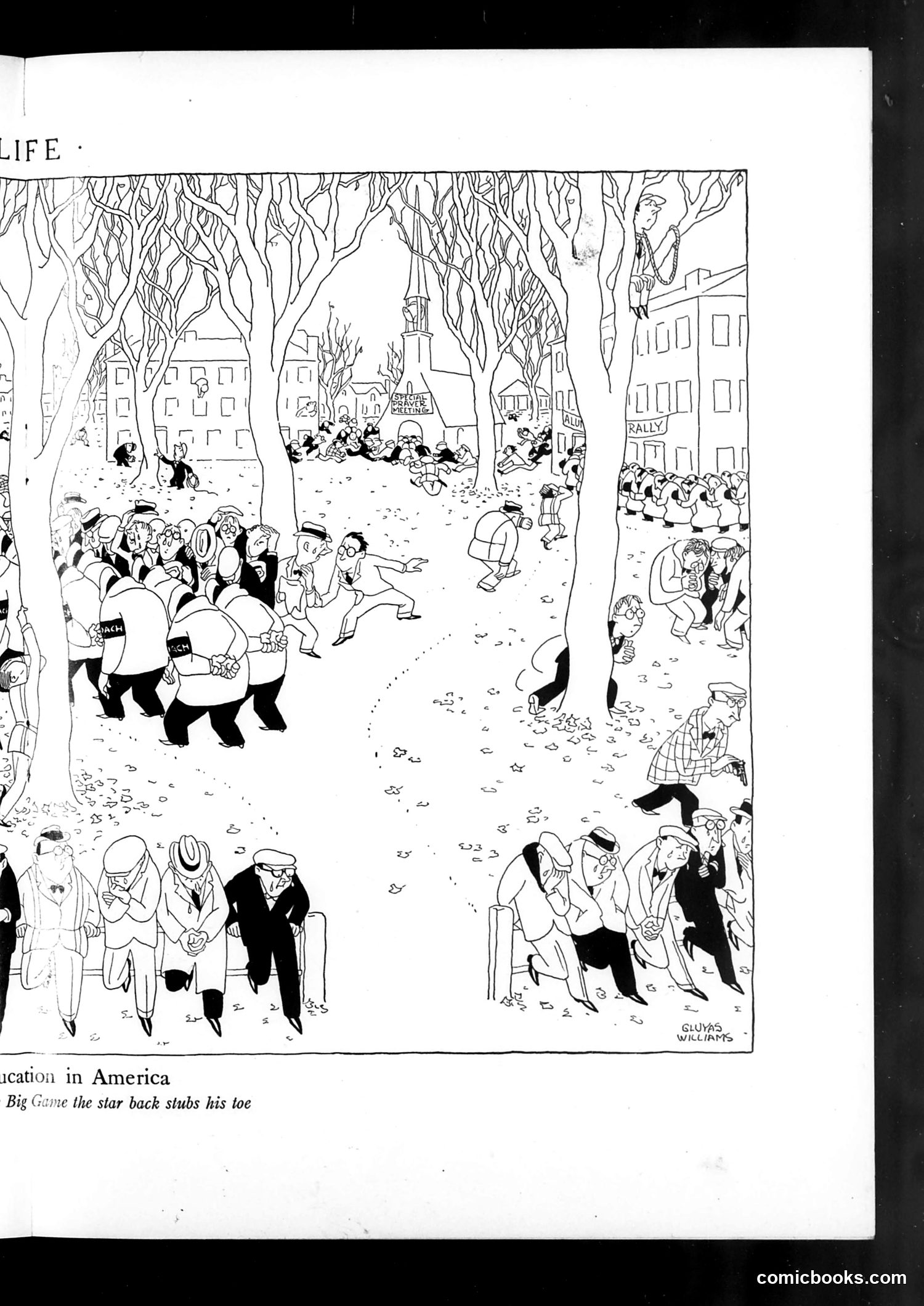
This cartoon satirizes American celebrity and sports culture. The scene depicts a public square gathering centered on a church, with crowds of well-dressed observers arranged around the perimeter. The caption "Big Game the star back stubs his toe" suggests the cartoon mocks the excessive public attention given to a prominent football player's minor injury. The satire appears to critique how Americans obsess over celebrity athletes—treating a trivial accident as a major event worthy of drawing large crowds and media attention. The formal dress of onlookers and the church setting emphasize the absurdity of elevating such a mundane occurrence to quasi-religious significance. This reflects Life magazine's recurring theme of ridiculing American culture's celebrity worship and misplaced priorities.
This page reviews three theatrical productions: *The Swan*, *Scaramouche*, and an unnamed Greek drama adaptation. The reviewer praises *The Swan* starring Eva Le Gallienne and Basil Rathbone, though finds the male lead ("tutor-hero") an irritating prig—too self-serious and self-important to be likable. *Scaramouche* is critiqued as old-fashioned romance with sword-fighting and French Revolutionary melodrama. The reviewer notes such "good old-fashioned lace romance" was expected to succeed commercially against modern "realistic potato-peelings" (naturalistic plays), but confesses boredom despite its expense and star power (Sidney Blackmer, Margalo Gillmore). The Greek drama—likely a classical adaptation—receives dismissal: the reviewer sat through 25 minutes of uncomfortable heat and creaking dress-shirt before abandoning it, admitting no credibility to critique it given prior walkouts from Sir John Martin-Harvey's productions. The tone is wry, self-aware theater criticism for sophisticated readers.
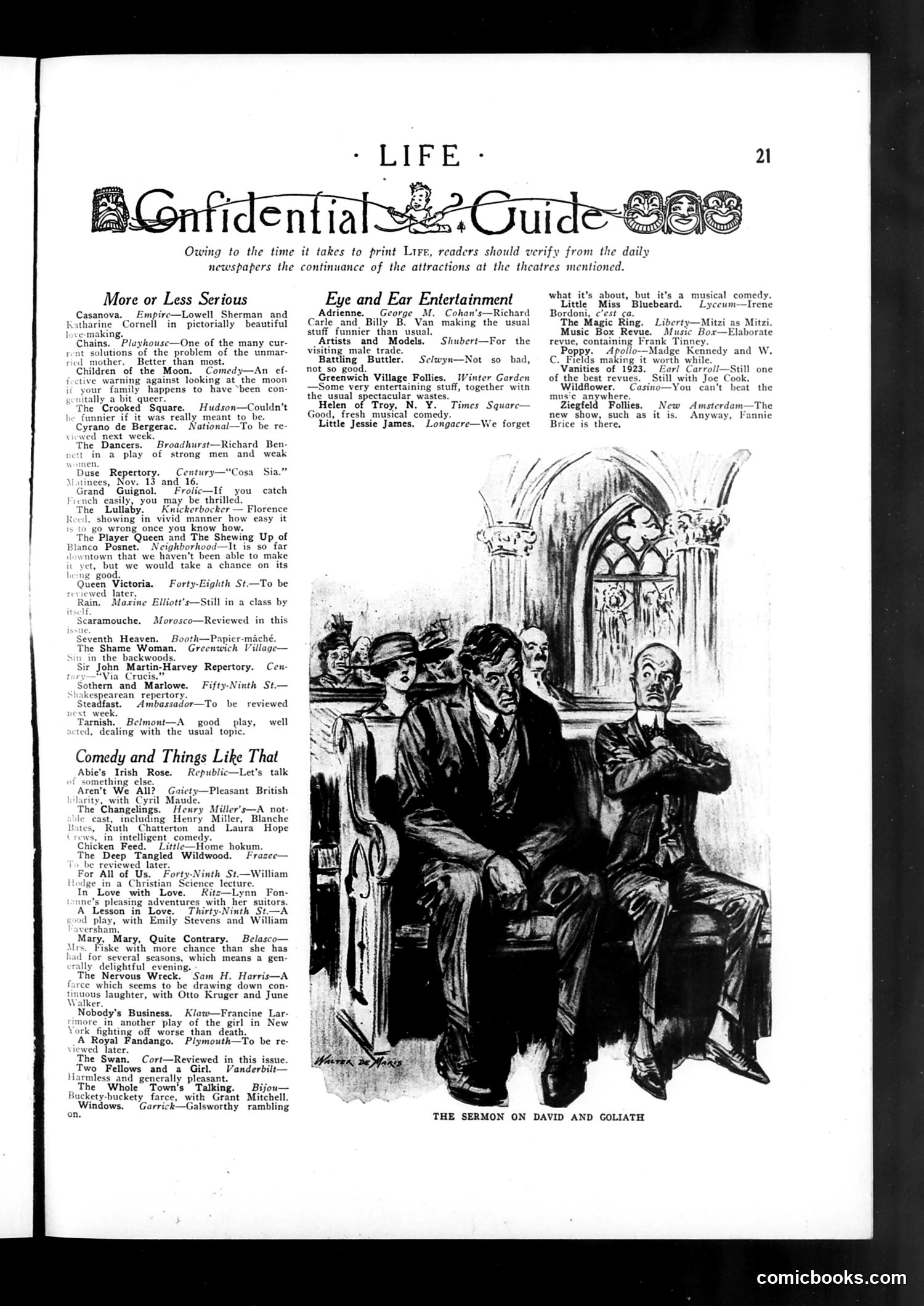
This illustration depicts a religious sermon or church scene. Three figures sit in pews listening to a preacher (right, bald, gesturing), while Gothic church architecture frames the scene above. The caption references the Biblical story of David and Goliath, traditionally a parable about overcoming impossible odds through faith and courage. Without additional context from the article text (which is obscured or not provided), the specific satirical point is unclear. However, this appears in a theatrical review section of *Life* magazine, suggesting the cartoon may be mocking either: (1) a contemporary sermon or religious figure; (2) a theatrical production of a religious play; or (3) period attitudes toward organized religion. The image's prominent placement suggests social commentary on religious practice or preaching styles of the 1920s era, but the exact target and satirical intent cannot be determined from the image alone.
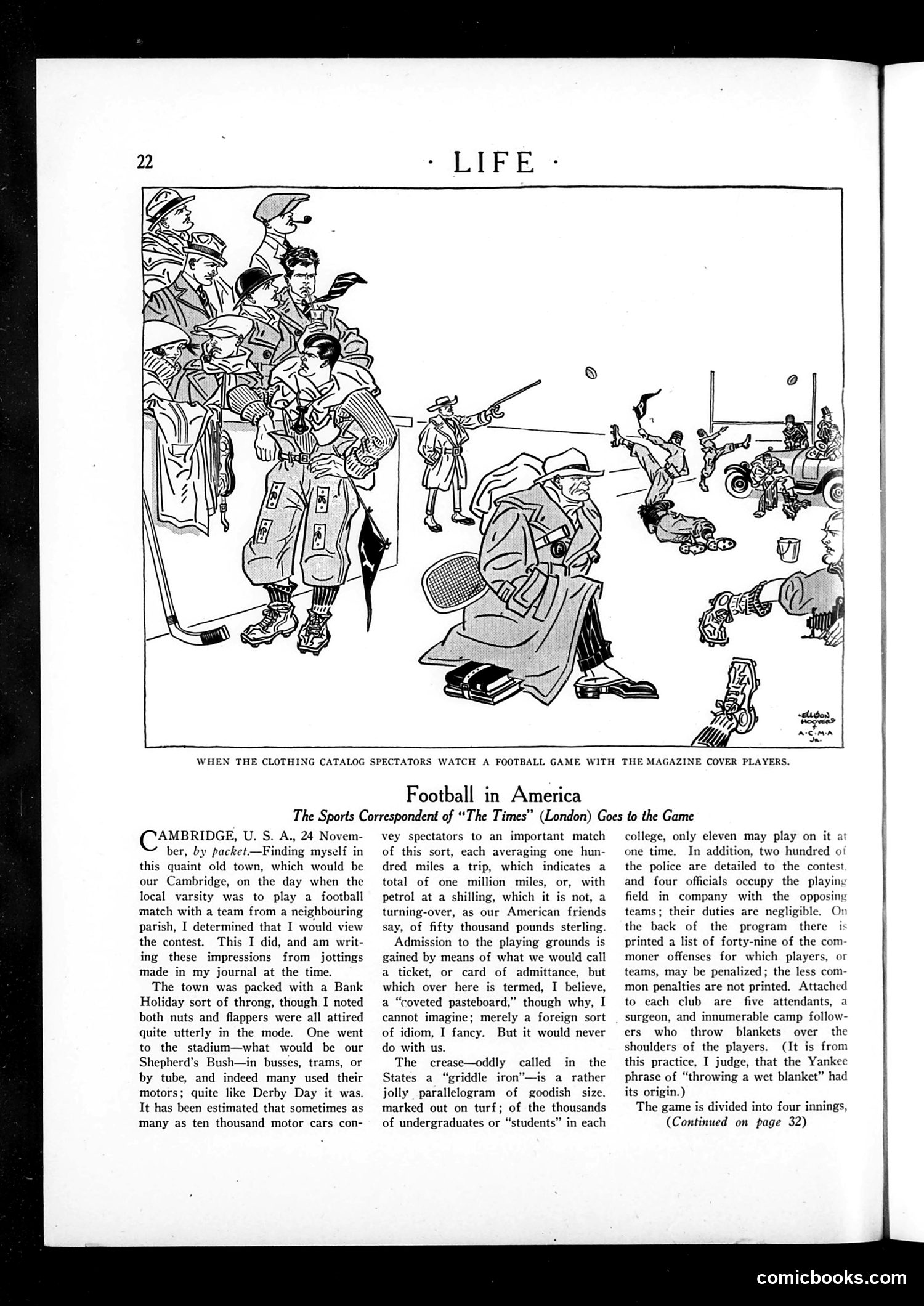
This is a satirical article by a correspondent from *The Times* (London) observing an American college football game, likely at Cambridge, Massachusetts. The humor derives from a British observer encountering American football for the first time and describing it in deliberately confused, exaggerated terms. The cartoon above illustrates the article's joke: well-dressed clothing catalog models (left) watch actual football players in action (right), highlighting the contrast between stylized fashion imagery and rough athletic reality. Key satirical points include: misidentifying the playing field as a "griddle iron," calling the ticket a "coveted pasteboard," exaggerating the scale (10,000 cars, 200 police), and misusing terminology ("innings" instead of quarters). The piece pokes fun at both American football's complexity and British unfamiliarity with the sport—presenting it as bewilderingly elaborate compared to cricket or rugby.
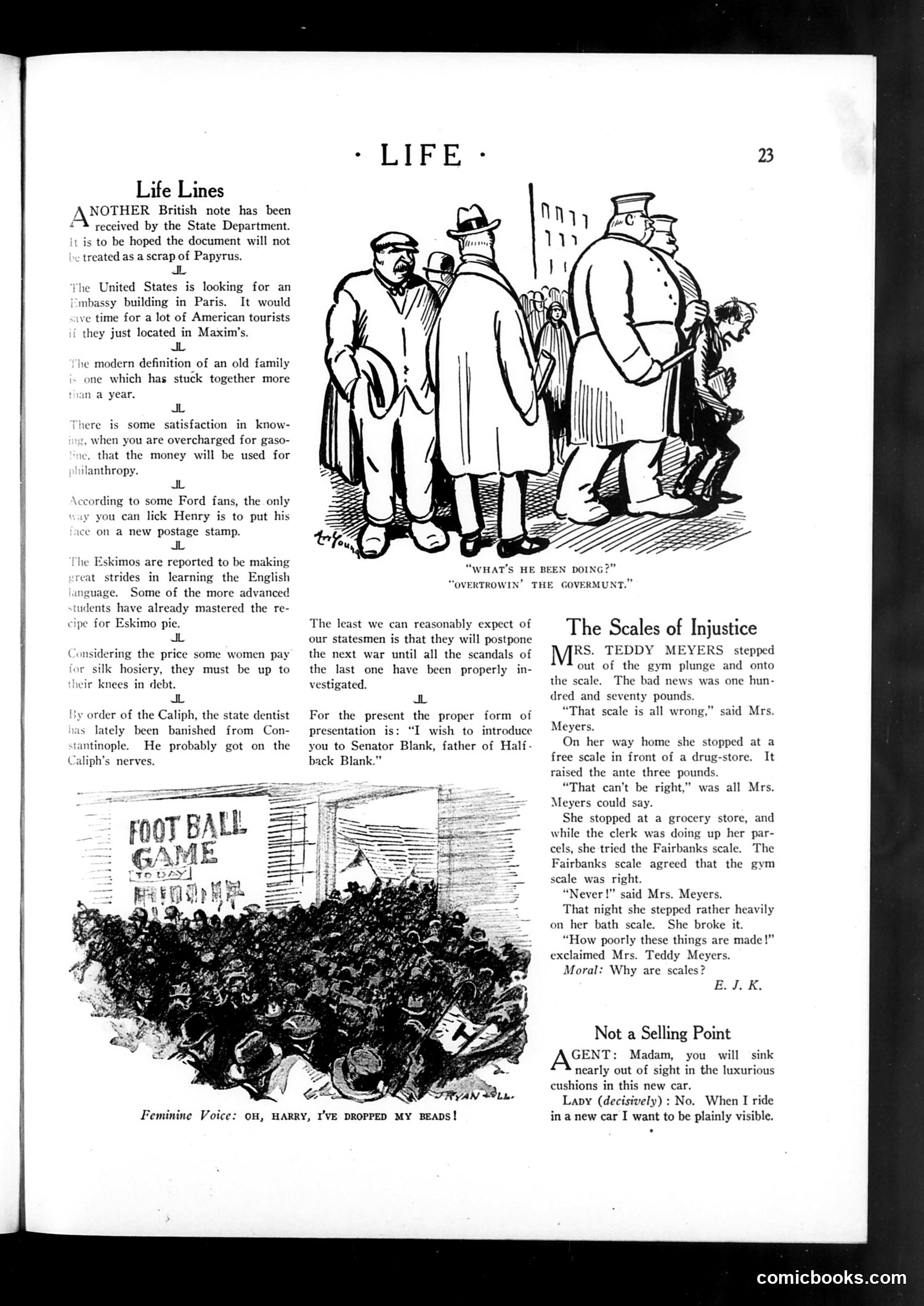
This page contains several satirical short pieces typical of Life's humor section: **"Life Lines"** is a column of brief quips mocking contemporary issues: diplomatic tensions with Britain, American tourists abroad, family stability, gasoline prices, Henry Ford's influence, Eskimos learning English, women's spending on hosiery, and a Caliph banishing a dentist. These are lightweight social commentary. **The main cartoon** shows a portly official labeled "OVERTHROWING THE GOVERNMENT," satirizing anxieties about radical political activity. The figure appears menacing to observers, but the joke suggests government opponents are actually ineffectual or imaginary threats—reflecting post-WWI American concerns about communism and anarchism. **"The Scales of Injustice"** is a humorous story about Mrs. Teddy Meyers rejecting successive scale readings that show her gaining weight, ultimately breaking her bathroom scale in denial. The moral humorously asks "Why are scales?"—suggesting women's frustration with evidence of weight gain. **"Not a Selling Point"** jokes about car marketing: a salesman's pitch about luxurious cushions backfires when a lady prefers visibility, suggesting women valued conspicuousness in public.
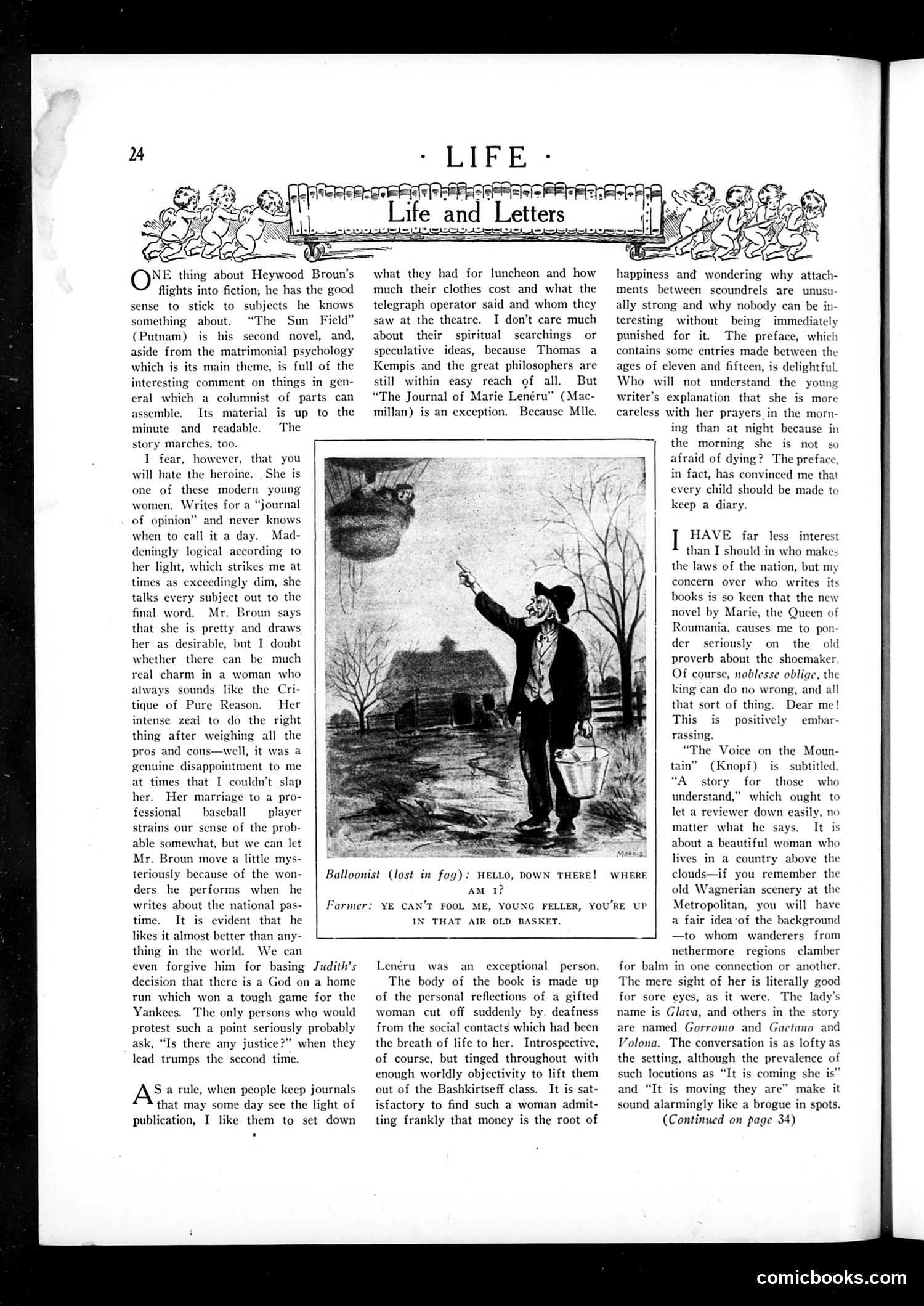
This page contains a book review column with one embedded cartoon titled "Balloonist (lost in fog)." The cartoon depicts a man in a hot air basket floating above a farmer on the ground below. **The Cartoon's Joke:** The balloonist, unable to see through the fog, calls down asking "HELLO, DOWN THERE! WHERE AM I?" The farmer responds: "YE CAN'T FOOL ME, YOUNG FELLER, YOU'RE UP IN THAT AIR OLD BASKET." This is a classic absurdist joke playing on the farmer's literalism and deliberate misunderstanding. The balloonist seeks navigational help; the farmer pedantically states only the obvious—that he's in a basket in the air—offering no useful information whatsoever. The humor derives from the gap between what's asked (location) and what's answered (a tautology). The cartoon exemplifies *Life* magazine's tradition of simple, accessible visual humor targeting everyday situations and human foibles rather than specific political events.
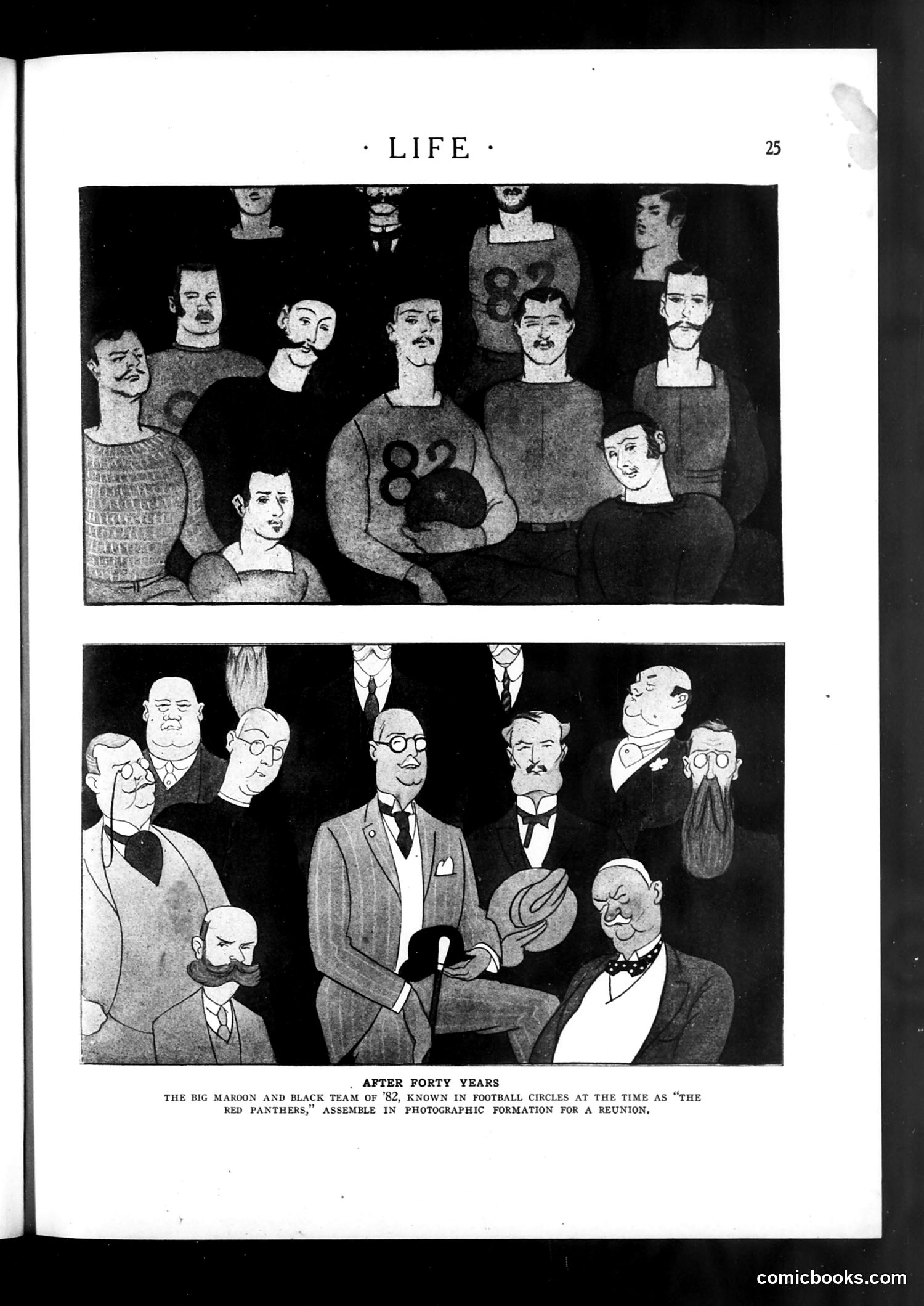
This page features two illustrations depicting a football team reunion. The top image shows young men from 1882, drawn in a naturalistic style typical of the era. The bottom image, captioned "After Forty Years," shows the same team as older men four decades later, rendered in caricature style with exaggerated features—baldness, weight gain, facial lines, and prominent noses. The satire contrasts youthful vigor with aging's physical toll. The team was apparently known as "The Red Panthers" in football circles. By reuniting after 40 years and presenting both versions side-by-side, Life magazine humorously emphasizes how dramatically the players have changed, playing on readers' recognition of mortality and the passage of time—a common comedic theme in period humor.
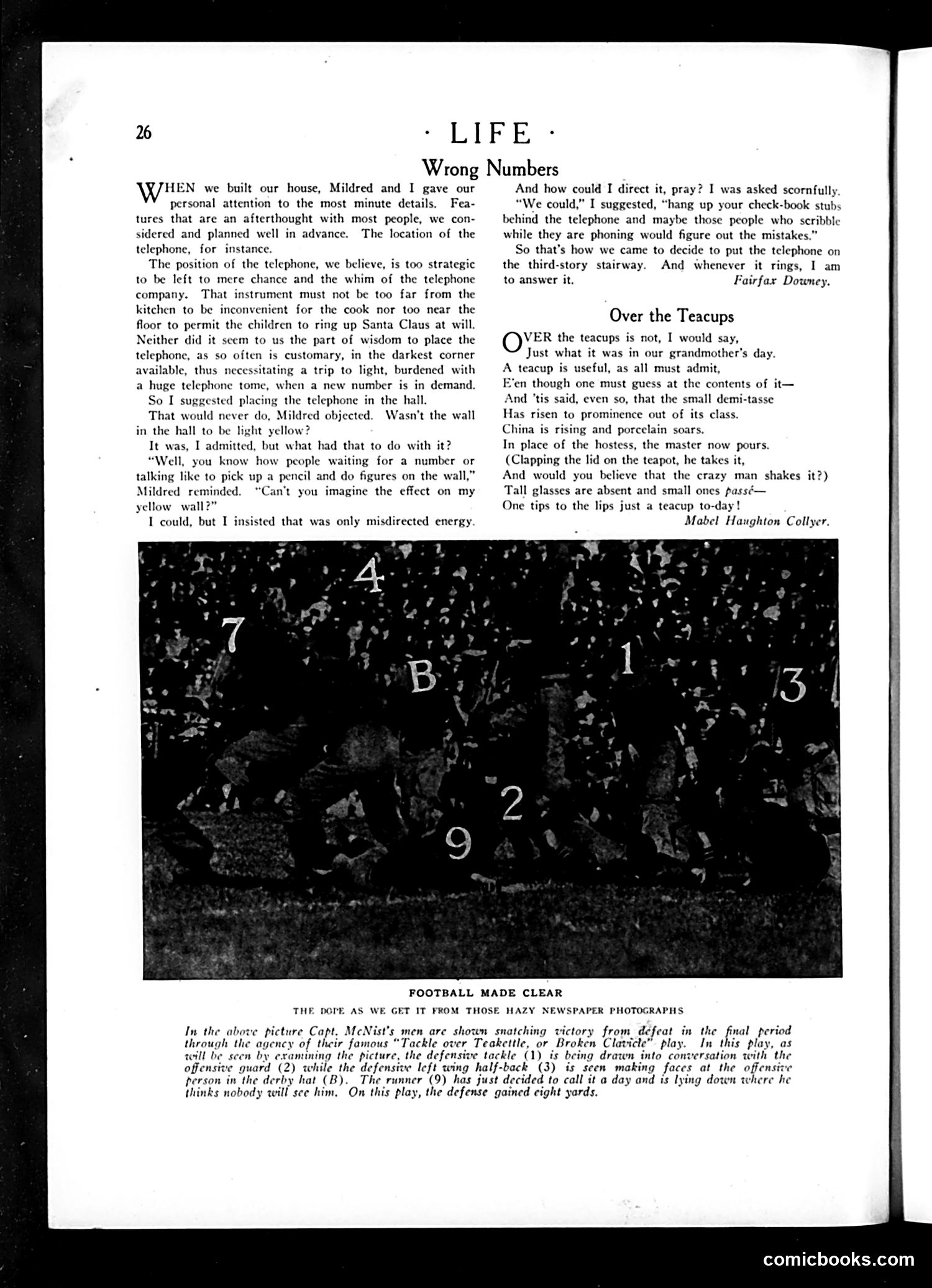
This page contains three humorous pieces from *Life* magazine (a satirical publication): **"Wrong Numbers"** satirizes domestic decision-making. A couple obsesses over precise telephone placement during house construction, ultimately choosing an impractical third-story stairway location because the husband fears guests will doodle on the yellow hallway walls. The satire mocks both overwrought planning and spousal compromise in home design. **"Over the Teacups"** is light verse lamenting social changes in tea service customs. It humorously notes that modern hosts now pour tea (rather than hostesses), small cups replace traditional larger ones, and hosts shake teapots erratically—suggesting tea service has become less graceful and refined than grandmother's era. **"Football Made Clear"** is a humorous sports diagram attempting to explain a nonsensical football play called "Tackle over Teakettle." The numbered players engage in absurd actions (conversation, face-making, lying down), and the caption ironically notes the defense "gained eight yards"—inverting expected outcomes. The satire mocks confusing sports journalism and vague newspaper football photography.
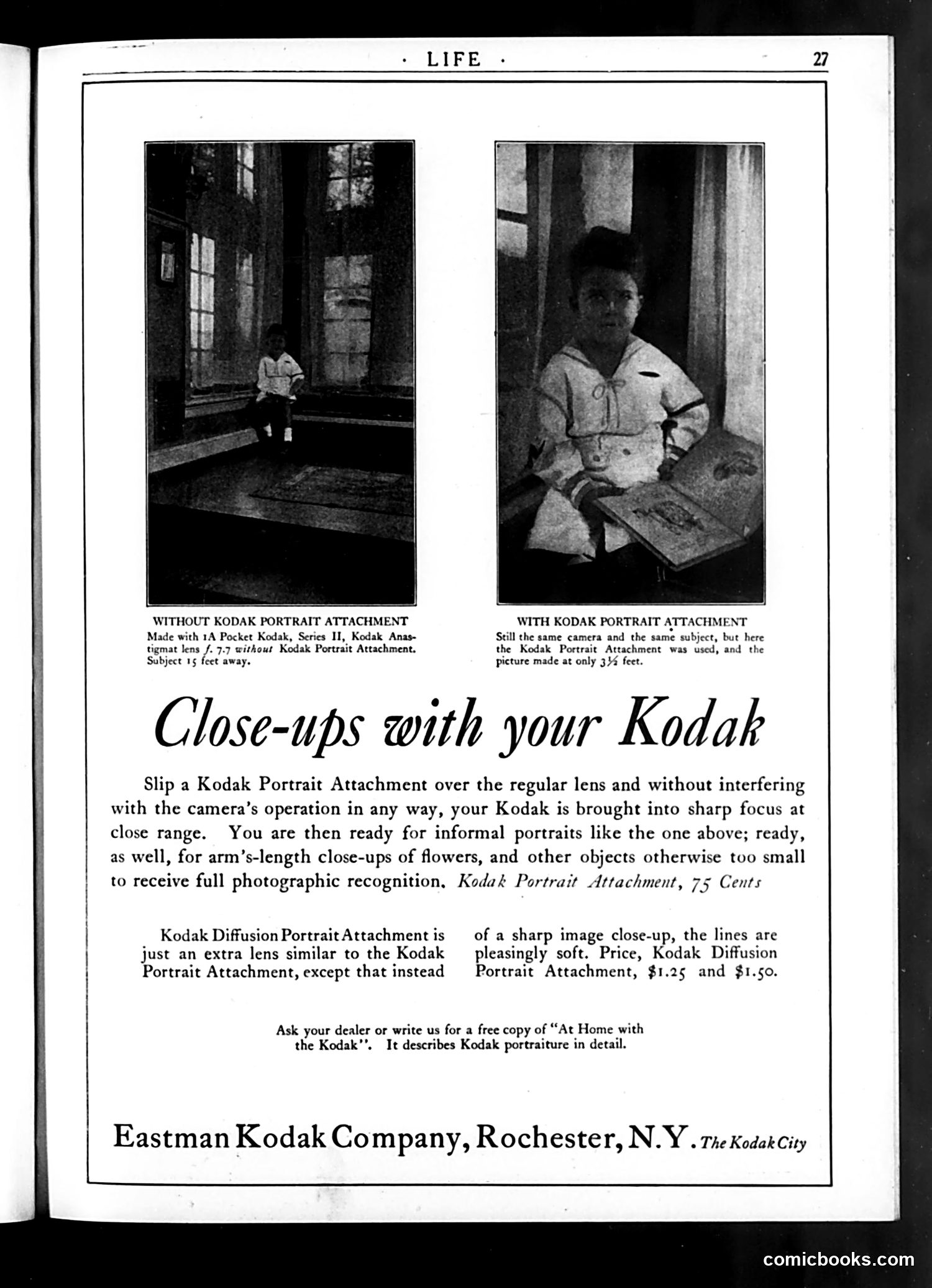
This is **not a cartoon or satire** — it's a straightforward **product advertisement** for Kodak camera attachments, appearing in *Life* magazine (page 27). The page demonstrates the practical benefits of the "Kodak Portrait Attachment," a lens accessory priced at 75 cents. Two photographs illustrate the difference: the left image shows a distant subject (15 feet away) taken with a standard 1A Pocket Kodak; the right shows the same subject photographed at close range (3¾ feet) using the Portrait Attachment, achieving better detail and focus. The text explains that this inexpensive add-on lens allows amateur photographers to capture close-up portraits and small objects without special training. A variant "Diffusion Portrait Attachment" ($1.25–$1.50) provided softer image lines for flattering portraits. This represents the democratization of photography in the early 20th century — making quality close-up photography accessible to ordinary consumers rather than professional photographers alone.
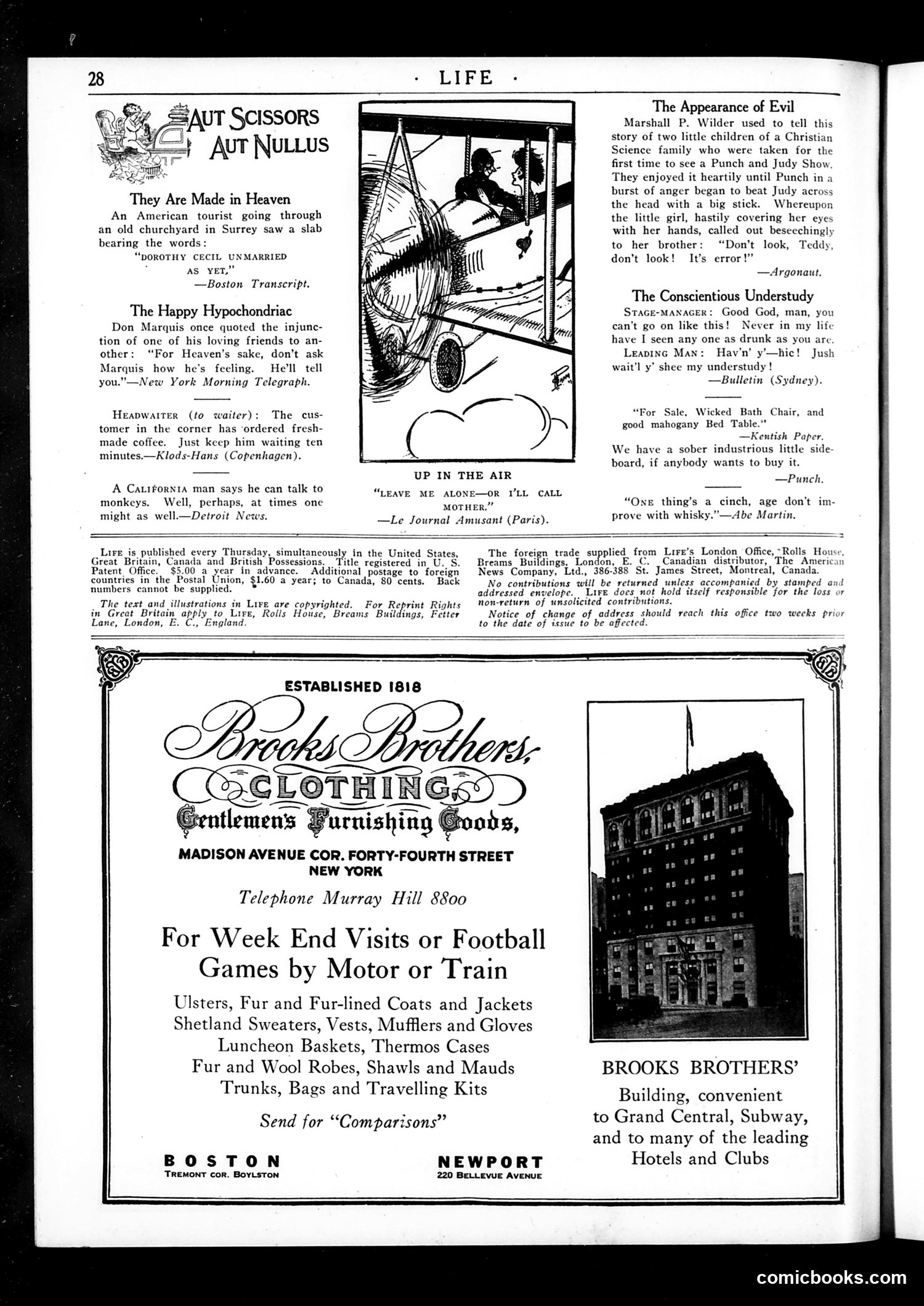
This page is primarily **advertising** with minor humorous anecdotes. The Brooks Brothers ad dominates the lower half, promoting gentlemen's clothing for leisure travel. The upper section contains brief jokes reprinted from various sources: - **"They Are Made in Heaven"**: Humor from finding an unmarked grave inscription - **"The Happy Hypochondriac"**: Don Marquis joke about someone oversharing health complaints - **"The Appearance of Evil"**: Christian Science children at a Punch and Judy show, shielding their eyes from "error" (violence treated as illusion rather than reality)—satire of Christian Science beliefs - **"The Conscientious Understudy"**: Stage manager criticizing a drunk actor; the actor claims his understudy is worse - **"Up in the Air"**: Small cartoon showing someone threatening to call "mother"—likely mocking someone's immaturity The cartoons mock human folly: hypochondria, prudishness, drunkenness, and childishness. Most are reprinted from international sources, typical of *Life*'s satirical compilation format.
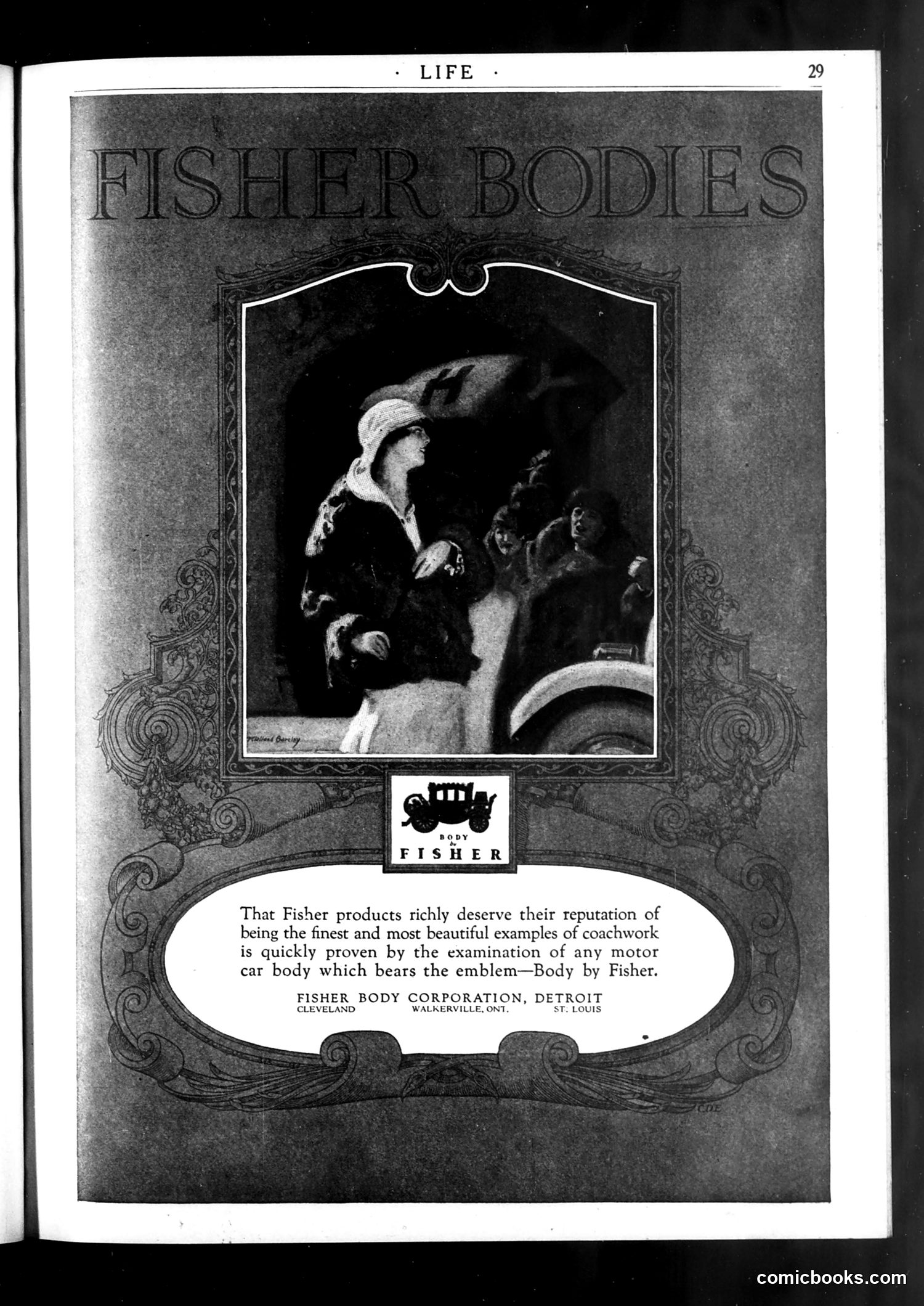
This is an advertisement, not political satire. The page promotes Fisher Body Corporation, a major automotive coachwork manufacturer of the era. The heading "Fisher Bodies" and the ornate framing suggest quality craftsmanship. The image shows an elegantly dressed woman in a fur coat examining or admiring what appears to be an automobile interior or detail, emphasizing luxury and refinement. The ad's message claims that Fisher-bodied cars represent "the finest and most beautiful examples of coachwork," positioning the company as a premium supplier. The multiple locations listed (Detroit, Cleveland, Walkerville, St. Louis) indicate Fisher's substantial manufacturing reach. This represents typical early-20th-century advertising associating automobiles with sophistication and status.
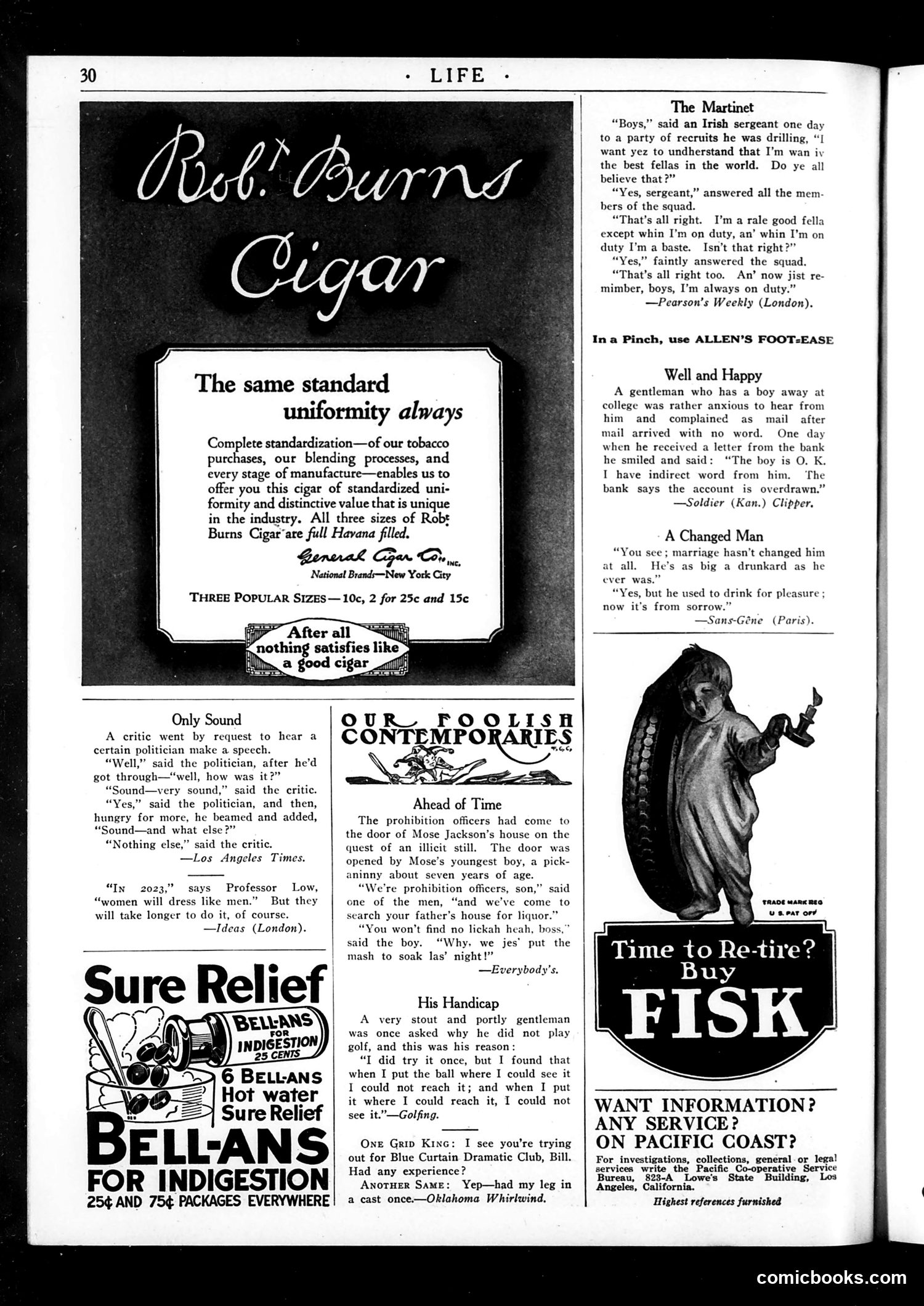
This page combines advertisements with brief humorous anecdotes typical of early 20th-century American satirical magazines. **Main Content:** The page features short jokes and comic sketches reflecting period attitudes: - **"The Martinet"**: An Irish sergeant's paradoxical authority—claiming to be a "good fella" off-duty but "a baste" (beast) while on duty, then revealing he's always on duty. The humor relies on Irish dialect stereotyping common to the era. - **"Ahead of Time"**: A Prohibition-era joke mocking enforcement. A Black child's innocent slip reveals his family is illegally distilling alcohol, satirizing both Prohibition's ineffectiveness and using racist dialect ("lickah"). - **Various one-liners** about politics, gender, indigestion, and golf reflect contemporary concerns. **Advertisements** for Bob Burns cigars, Bellans antacid, and Fisk tires dominate the layout, typical of Life's revenue model. The page's humor depends on period-specific references (Prohibition, gender roles, ethnic stereotypes) now requiring historical context to understand.
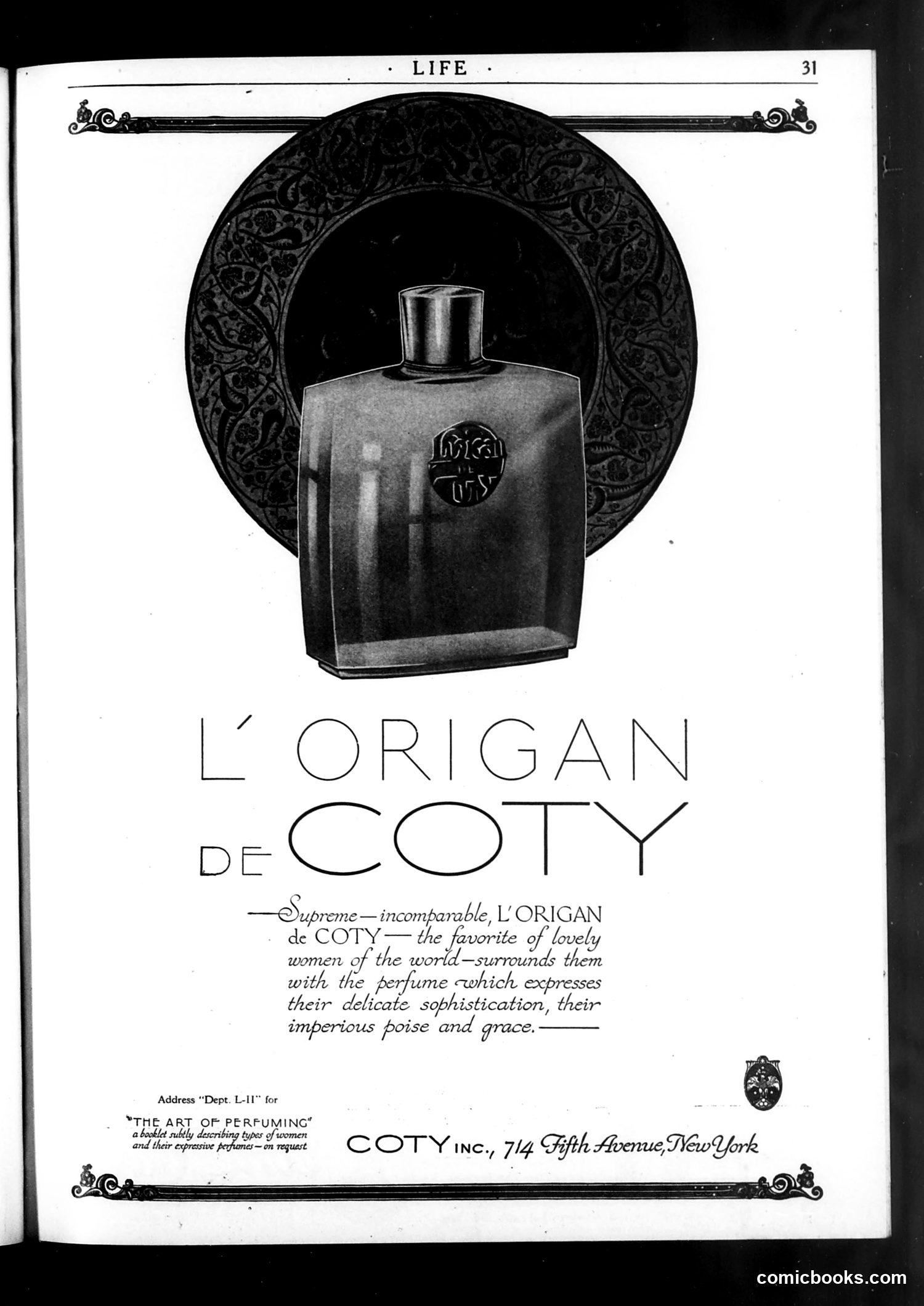
This is **not a cartoon or satire**—it's a straightforward perfume advertisement for L'Origan de Coty, placed in Life magazine (page 31). The ad features a luxury fragrance bottle against an ornate circular backdrop. The copy employs the marketing language typical of 1920s-30s high-end cosmetics advertising: appeals to sophistication, elegance, and aspirational femininity ("the favorite of lovely women of the world"). The address line references "The Art of Perfuming," suggesting Coty offered educational materials to consumers. The company, Coty Inc., was a real New York-based perfume manufacturer. There is no political content, social commentary, or satire present. This is period advertising designed to associate the product with refined taste and status.
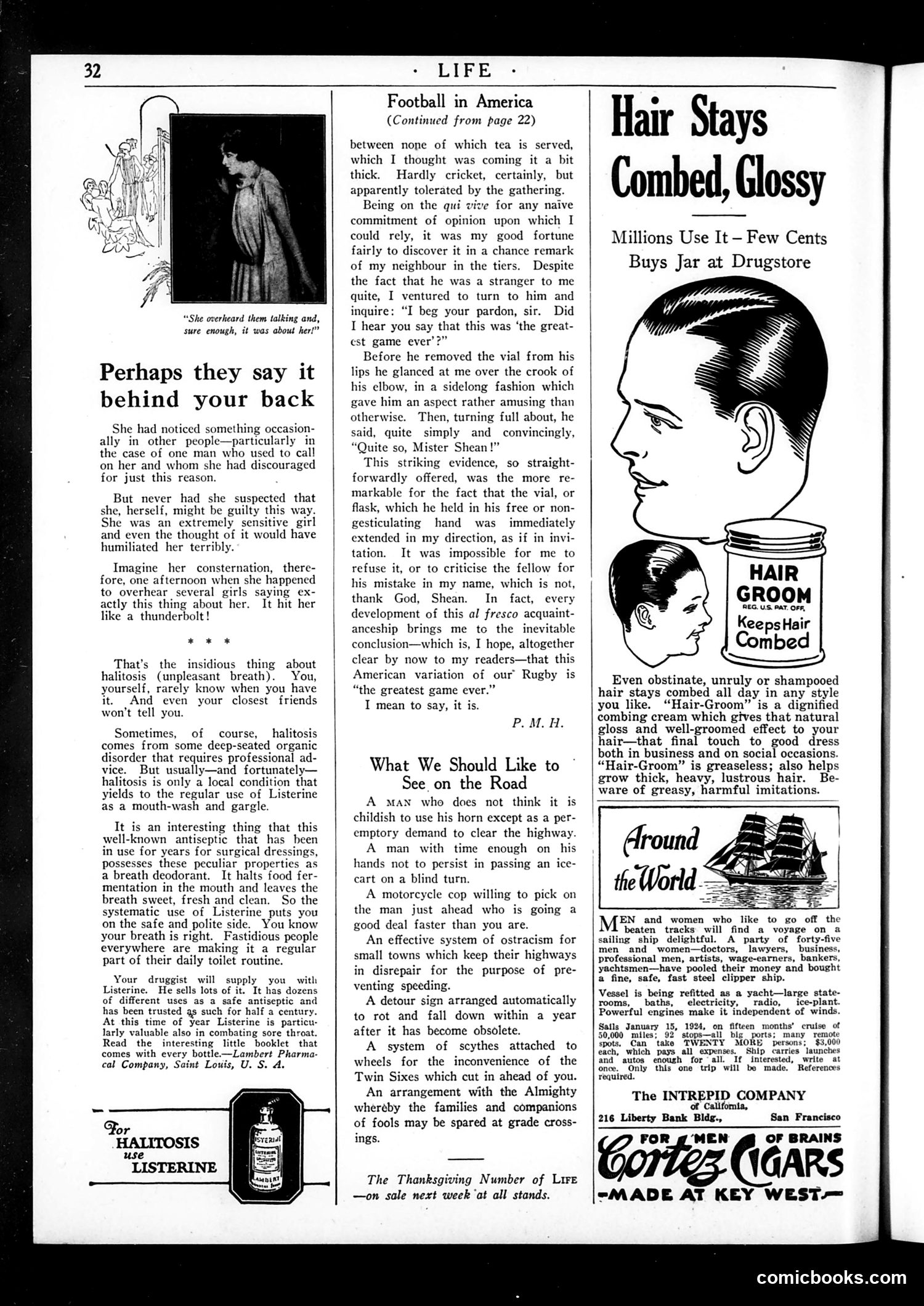
This page contains **primarily advertisements** mixed with editorial content, typical of Life magazine's format. The main visual satire is the **halitosis (bad breath) advertisement** featuring a distressed young woman. The accompanying story describes her humiliation upon overhearing girls discussing her unpleasant breath—a social anxiety the ad exploits to sell Listerine mouthwash. The pitch: bad breath is an invisible social liability that even close friends won't mention, so you must vigilantly guard against it through regular use of their product. This represents classic early 20th-century advertising psychology—manufacturing anxiety about social acceptability to drive consumer purchases. The page also continues an article about American football, with a British author's bemused observations about enthusiastic American fans. Additional advertisements promote Hair-Groom (hair product) and cigars. The "Perhaps they say it behind your back" headline exemplifies the paranoia-based marketing prevalent in this era.
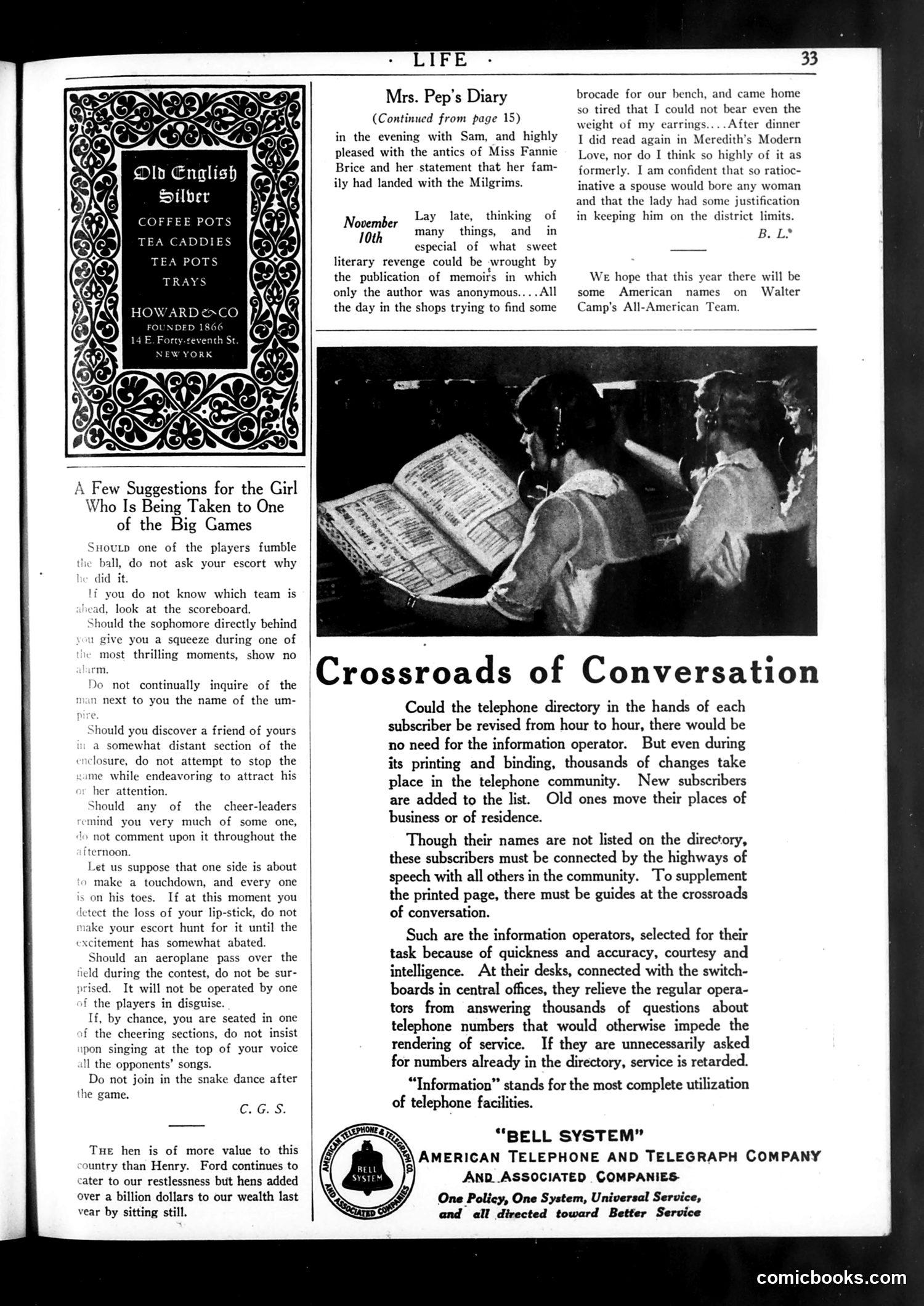
This page contains miscellaneous content rather than a unified cartoon. The main elements are: **"Mrs. Pep's Diary"** — A serialized humor column featuring domestic observations. The November 10th entry mentions actress Fannie Brice and a humorous aside about publishing anonymous memoirs as "literary revenge." The tone is lighthearted domestic satire typical of the era. **"A Few Suggestions for the Girl Being Taken to One of the Big Games"** — Etiquette humor advising female football spectators on proper behavior: don't ask why players fumble, don't flirt with cheerleaders, don't lose your composure. This reflects 1920s social conventions and the novelty of women attending sporting events. **Bell System Advertisement** — A full advertisement explaining telephone information operators as necessary "guides at the crossroads of conversation" for unlisted subscribers. The accompanying photo shows people consulting what appears to be a telephone directory. The page is primarily **humorous social commentary and advertising**, not political satire. It captures period attitudes toward women's emerging public roles and early telephone infrastructure.
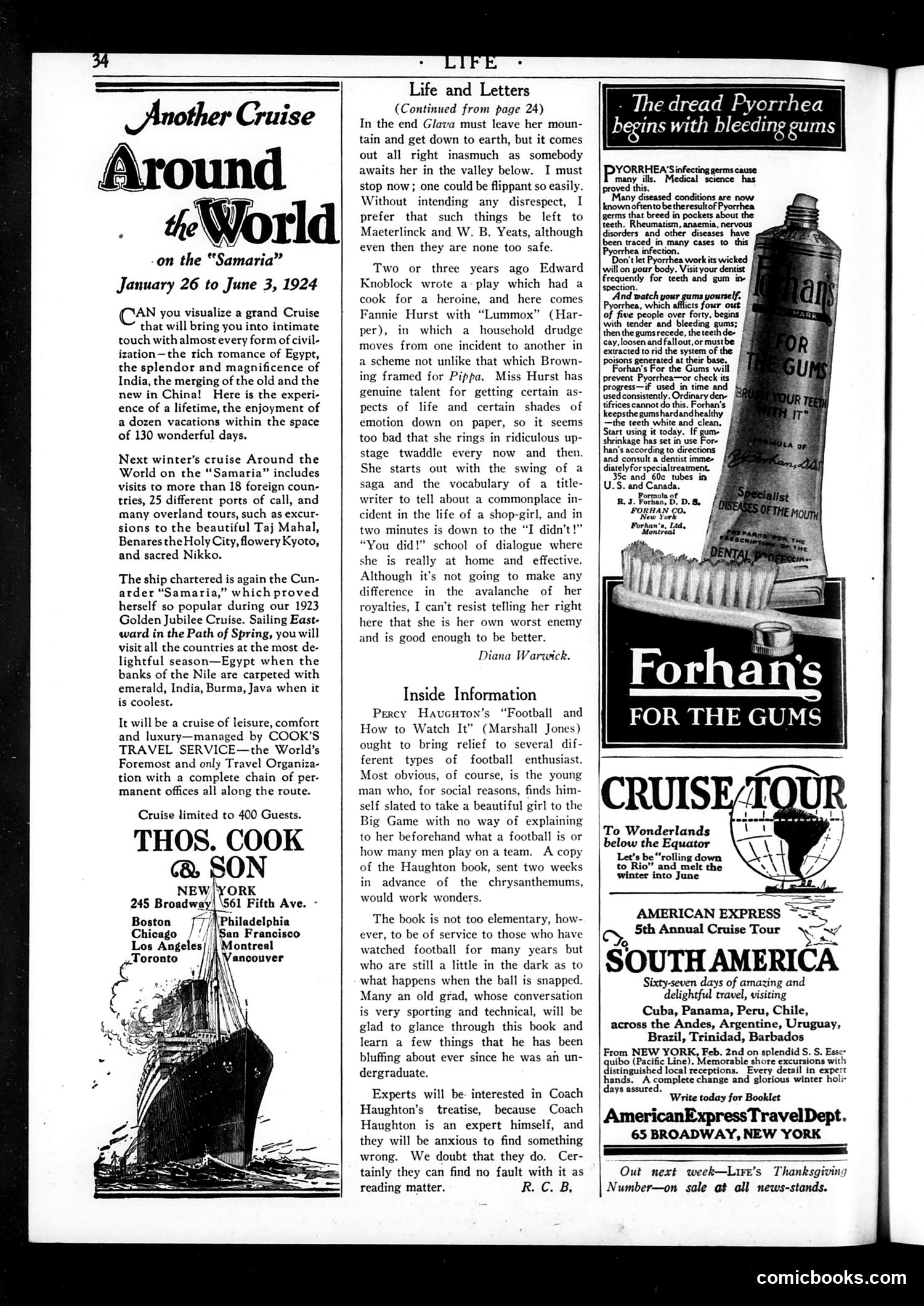
This page is primarily **advertising and travel promotion**, not political satire. The dominant content features: **"Another Cruise Around the World"** — A Thomas Cook & Son advertisement for a luxury cruise on the Cunard liner *Samaria*, departing January 26, 1924. The ad emphasizes exotic destinations (Egypt, India, China, Japan) and appeals to wealthy travelers seeking leisure and culture during the "season" when weather is optimal in each region. **"Life and Letters"** section reviews Fannie Hurst's novel *Lummox* (about a household servant) and Percy Haughton's instructional book on football. The Forhan's toothpaste advertisement occupies the right column. **American Express cruise advertisement** promotes a South American tour competing with Cook's offering. There is **no political cartoon** on this page. The visual elements are ship illustrations and product advertisements typical of 1920s *Life* magazine, which balanced satirical articles with commercial content targeting affluent readers.
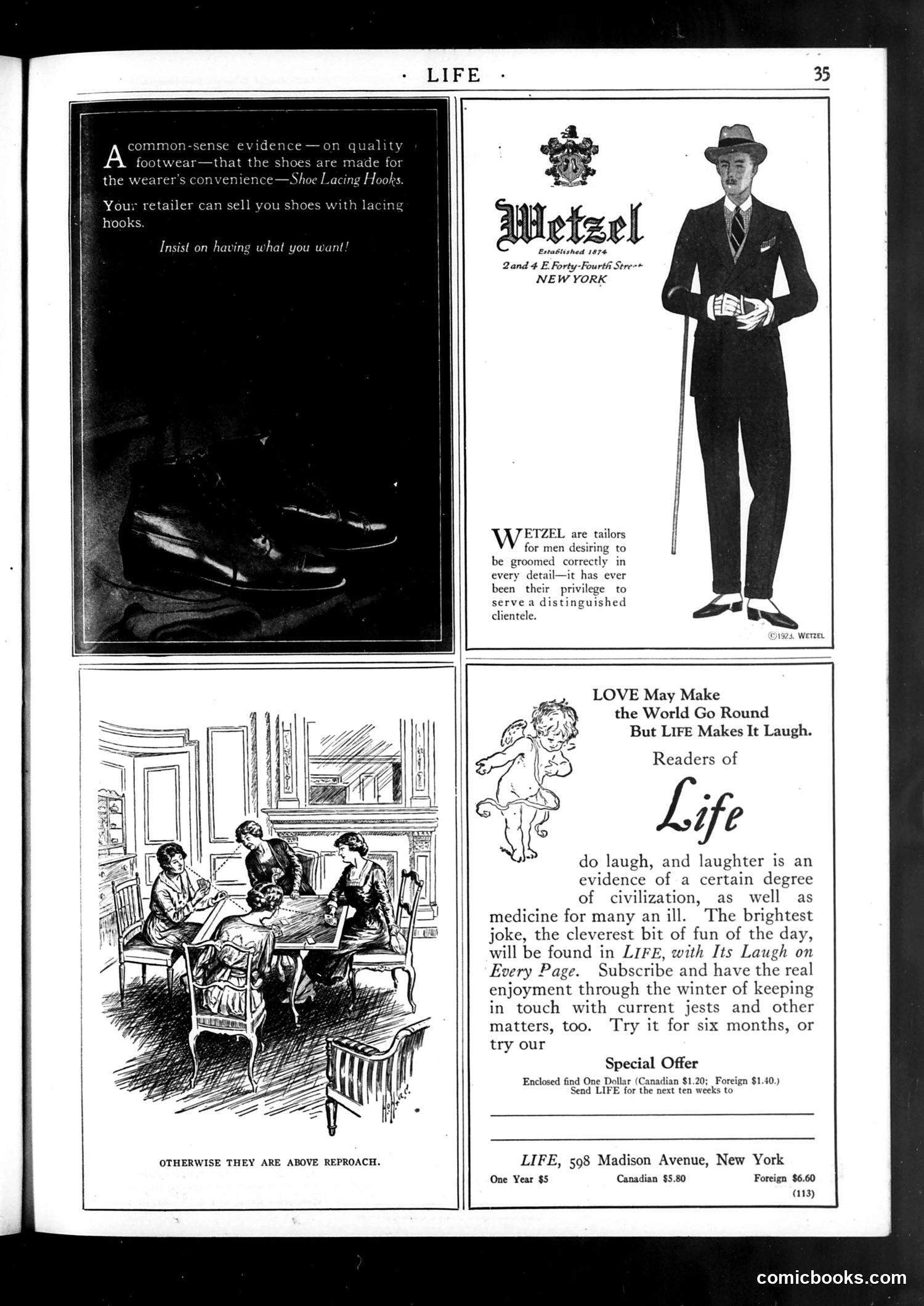
This is primarily **advertising and house promotion**, not political satire. The page contains four advertisements: 1. **Shoe Lacing Hooks** (top left): A practical product advertisement emphasizing consumer choice—"insist on having what you want"—reflecting early 20th-century consumer advocacy messaging. 2. **Wetzel Tailors** (top right): A clothier advertisement showing a well-dressed man, established 1876, targeting affluent clientele seeking quality tailoring. 3. **Social Commentary Cartoon** (bottom left): Shows three well-dressed people in a parlor with caption "OTHERWISE THEY ARE ABOVE REPROACH." The joke appears to reference hypocrisy—people who appear respectable in public but whose private behavior contradicts their social standing (meaning unclear without fuller context). 4. **Life Magazine Self-Promotion** (bottom right): The magazine advertises itself as humorous and civilizing, promoting subscription with a special offer ($1 for ten weeks). Emphasizes laughter as evidence of civilization. The page reflects 1920s consumer culture and Life's identity as a humor and satire publication.
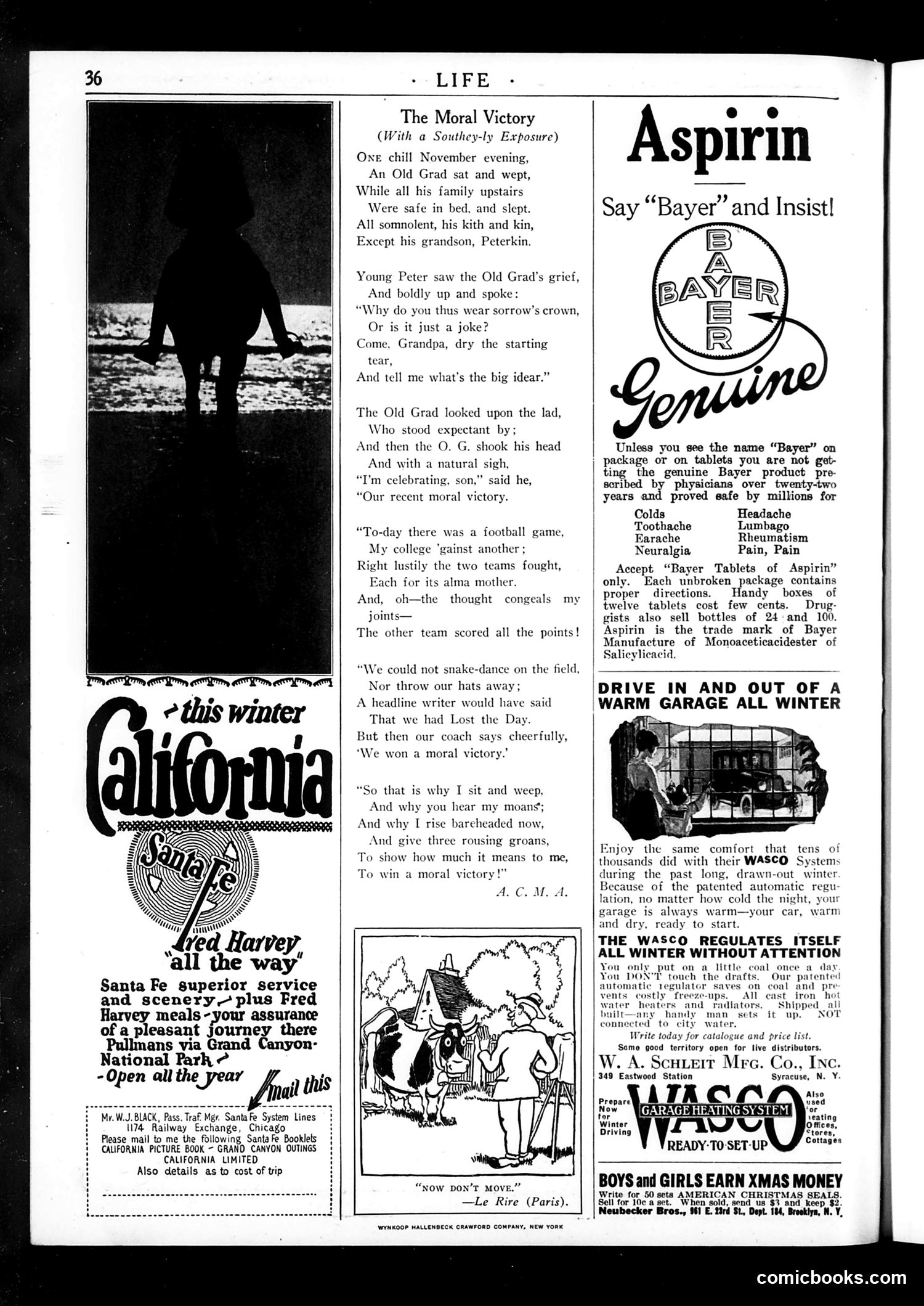
This poem satirizes the hollow consolation of a college football loss. An Old Grad weeps after his alma mater was decisively defeated—"the other team scored all the points." When his grandson asks why he's grieving, the grandfather explains he's "celebrating" a "moral victory," the coach's euphemism for losing nobly. The satire targets the gap between actual defeat and the comforting language used to spin it. The grandfather's absurd response—sitting weeping while claiming victory, then giving "three rousing groans" in celebration—exposes how ridiculous this rationalization is. The poem mocks both the self-deception of disappointed fans and coaches who invoke "moral victories" to salvage pride from tangible failure. This reflects early-20th-century college football culture, where institutional pride ran high and losing was genuinely shameful, making such verbal cushioning common.
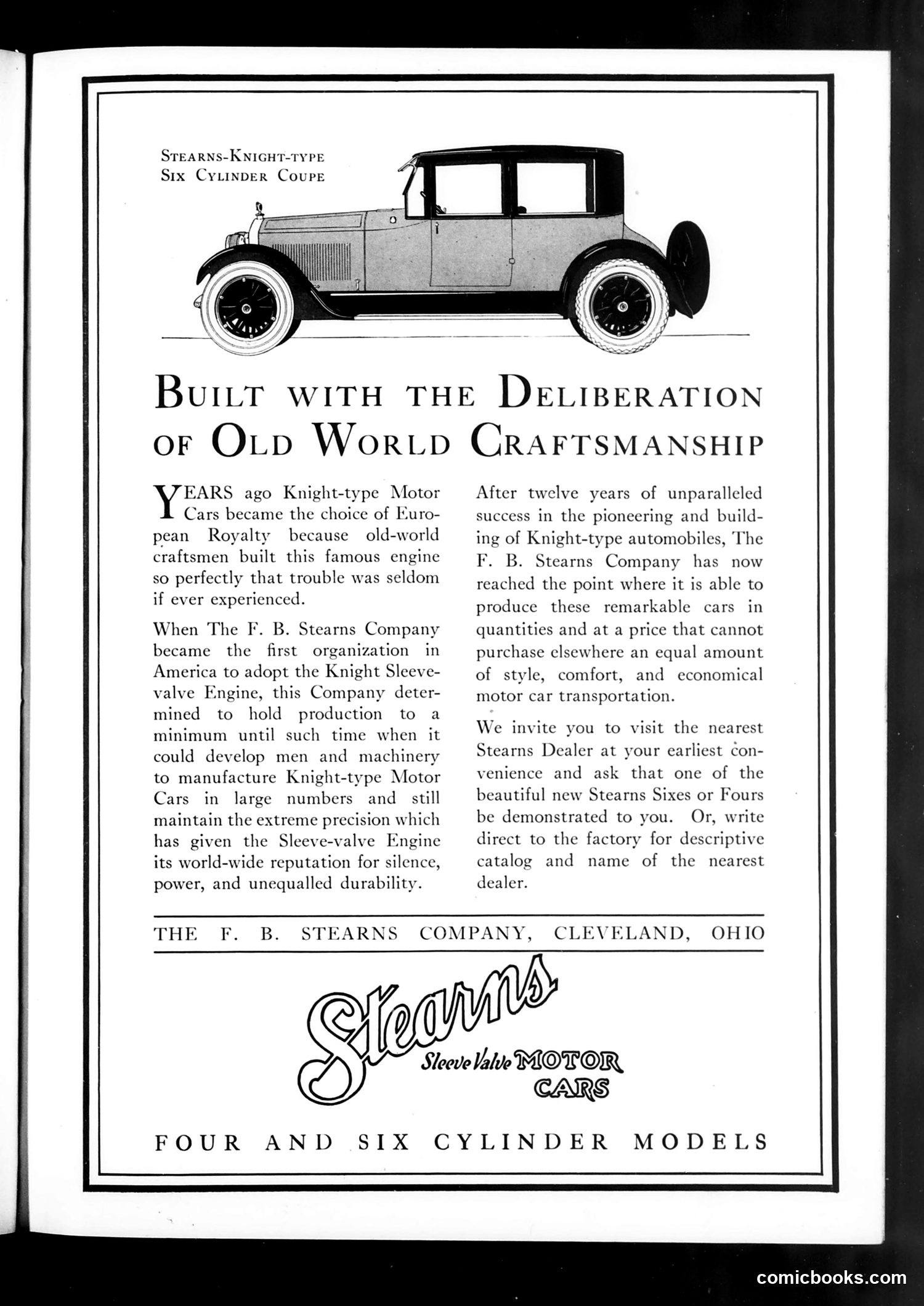
This is **not a political cartoon or satire** — it's a straightforward automobile advertisement from an early 20th-century issue of *Life* magazine. The page advertises the Stearns-Knight automobile, a six-cylinder coupe manufactured by the F. B. Stearns Company of Cleveland, Ohio. The ad emphasizes the vehicle's use of a "Knight Sleeve-valve Engine," which the text claims was favored by European royalty for its reliability and precision engineering. The marketing strategy positions Stearns as a quality manufacturer willing to limit production to maintain craftsmanship standards — contrasting with mass-produced competitors. The ad claims twelve years of success and now promises affordability alongside luxury. The illustration shows a side-profile drawing of the coupe in typical period automotive advertising style. There is no satire or political commentary present; this is purely promotional content typical of *Life* magazine's advertising section during the automobile's early commercial era.
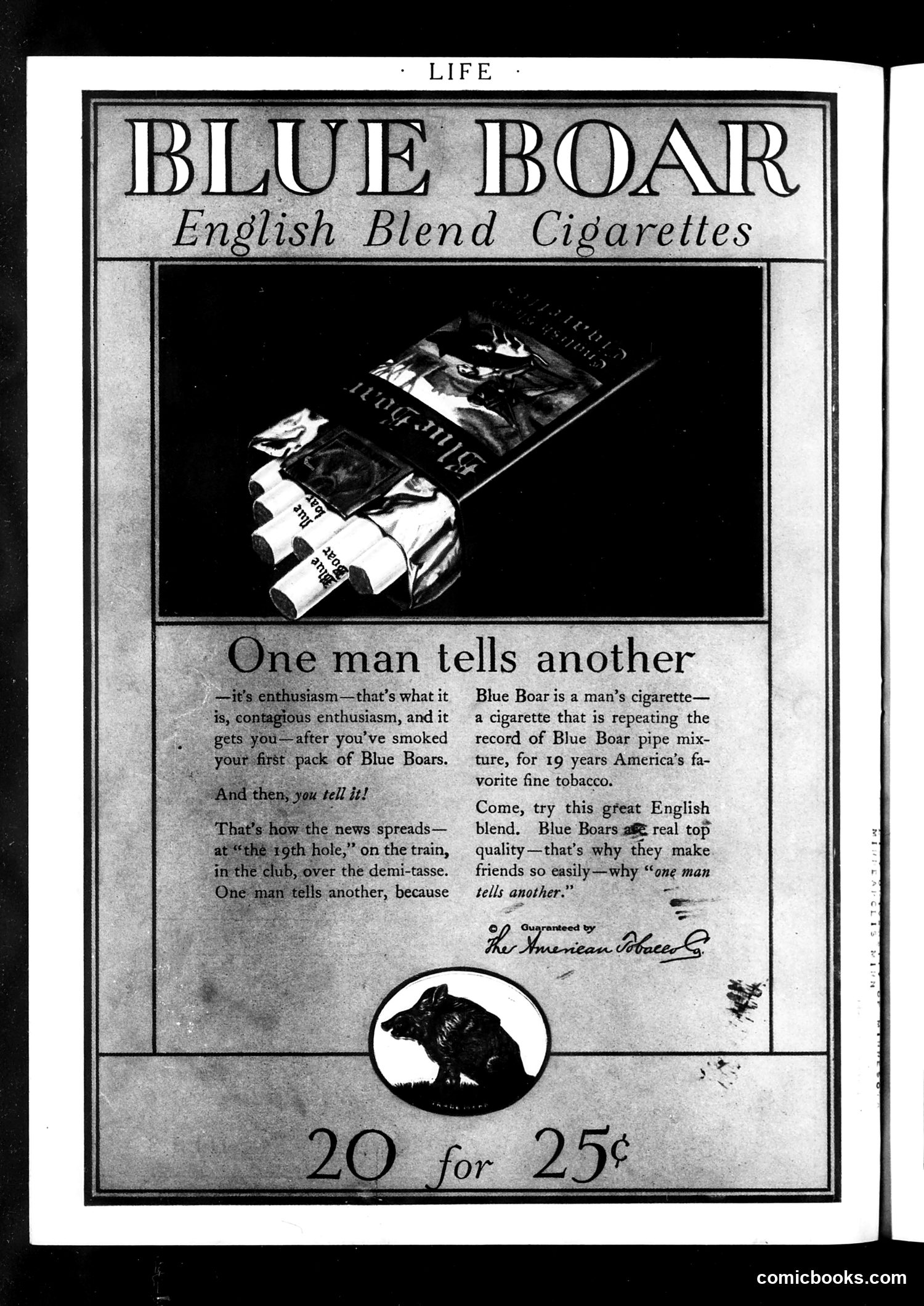
This is a straightforward **cigarette advertisement**, not satire or political commentary. The page promotes Blue Boar English Blend cigarettes using the slogan "One man tells another." The ad's central message is that Blue Boar's quality creates word-of-mouth enthusiasm—smokers naturally recommend the product to friends at social venues (golf courses, trains, clubs). The text emphasizes the brand's 19-year history as "America's favorite fine tobacco," now available as cigarettes. The boar logo at the bottom serves as the brand's mascot/emblem. The pricing ("20 for 25¢") indicates this is vintage advertising, likely early-to-mid 20th century. There is no political or satirical content—this is period advertising before health warnings, targeting male consumers through appeals to quality and social prestige.