
Life, 1923-11-15 · page 18 of 40
Life — November 15, 1923 — page 18: what you’re looking at
What you’re looking at
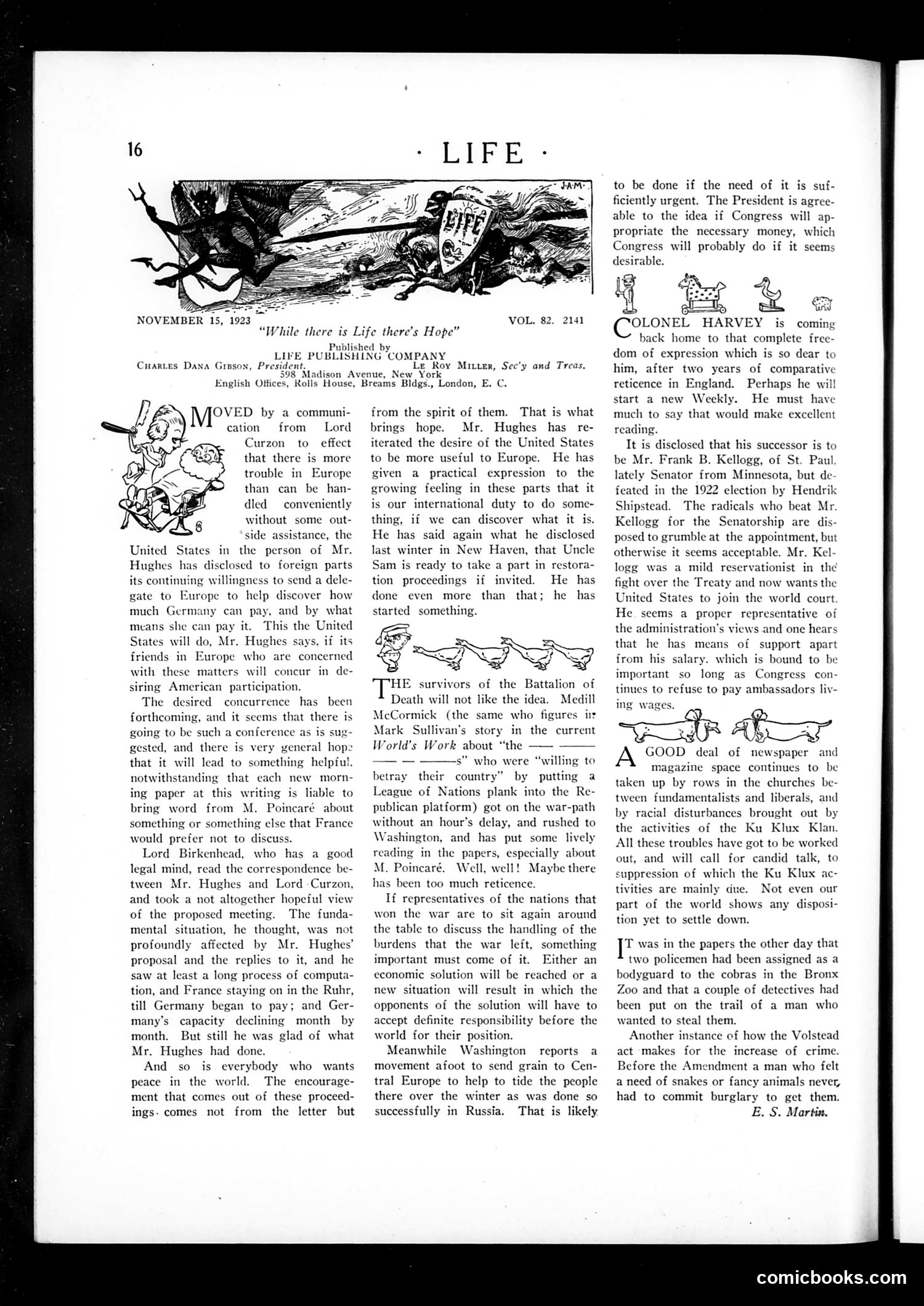
This editorial page discusses post-WWI diplomacy, particularly Secretary of State Charles Evans Hughes's proposal to send American delegates to a European conference on German reparations and war debts. **The Main Cartoon** (top): Shows a skeletal "Death" figure clutching a bag labeled "LIFE," illustrating the editorial's grim opening about European troubles requiring outside help. **Key References:** - **Lord Curzon**: British Foreign Secretary appealing for U.S. involvement - **Hughes**: U.S. Secretary of State proposing American participation in European economic discussions - **Medill McCormick**: A Republican senator and war-hawk who opposed Hughes's diplomatic approach, dismissed here as part of the "Battalion of Death"—those favoring military solutions over negotiation - **Poincaré**: French Premier resistant to cooperation - **Germany's reparations**: The central economic problem requiring settlement **The Satire**: Life supports Hughes's diplomatic initiative but mocks resistance from American militarists like McCormick, suggesting they prefer confrontation to constructive international cooperation for post-war recovery.
📄 Transcribed text from this page (OCR, searchable)
Machine-transcribed from the original scan — historical spelling and the odd misread are preserved.
ad MBER 15, 1923 VOL. 82. 2141 “While there is Life there’s Hope” Published by LIFE PUBLISHING COMPANY Cuartes Dana Grnson, President, 598 Madison nglish Offic Me ED by a communi- cation from Lord Curzon to effect that there is more trouble in Europe than can be han- dled conveniently without some out- side assistance, the United States in the person of Mr. Hughes has disclosed to foreign parts its continuing willingness to send a dele- gate to Europe to help discover how much Germany can pay, and by what means she can pay it. This the United States will do, Mr. Hughes says, if its friends in Europe who are concerned with these matters will concur in de- siring American participation. The desired concurrence has been forthcoming, and it seems that there is going to be such a conference as is sug- gested, and there is very yeneral hop: that it will lead to something helpful. notwithstanding that each new morn- ing paper at this writing is liable to bring word from M. Poincaré about something or something else that France would prefer not to discuss. Lord Birkenhead, who has a good legal mind, read the correspondence be- tween Mr. Hughes and Lord Curzon, and took a not altogether hopeful view of the proposed meeting. The funda- mental situation, he thought, not profoundly affected by Mr. Hughes proposal and the replies to it, and he saw at least a long process of compu tion, and France staying on in the Ruhr, till Germany began to pi and Ger- many’s capacity declining month by month. But still he was glad of what Mr. Hughes had done. And so is everybody who wants peace in the world. The encourage- ment that comes out of these proceed- ings. comes not from the letter but s, Rolls House, Le Roy Minter, Sec'y and Treas. e, New York ns Bldgs., London, E. C. from the spirit of them. That is what brings hope. Mr. Hughes has re- iterated the desire of the United States to be more useful to Europe. He has given a practical expression to the growing feeling in these parts that it is our international duty to do some- thing, if we can discover what it is. He has said again what he disclosed last winter in New Haven, that Uncle Sam is ready to take a part in restora- tion proceedings if invited. He has done even more than that; he has started something. HE survivors of the Battalion of Death will not like the idea. Medill McCormick (the same who figures iit Mark Sullivan's story in the current World's Work about “the —— —_—— s” who were “willing to their country” by putting a League of Nations plank into the Re- publican platform) got on the war-path without an hour's delay, and rushed to Washington, and has put some lively betray reading in the papers, especially about M. Poincaré. Well, well! Maybe there has been too much reticence. If representatives of the nations that won the war are to sit again around the table to discuss the handling of the burdens that the war left, something important must come of it. Either an economic solution will be reached or a new situation will result in which the opponents of the solution will have to accept definite responsibility before the world for their position. Meanwhile Washington reports a movement afoot to send grain to Cen- tral Europe to help to tide the people there over the winter as was done so successfully in Russia. That is likely. to be done if the need of it is suf- ficiently urgent. The President is agree- able to the idea if Congress will ap- propriate the necessary money, which Congress will probably do if it seems desirable. pil Sal coming OLONEL HARVEY is back home to that complete free- dom of expression which is so dear to him, after two years of comparative reticence in England. Perhaps he wil! start a new Weekly. He must have much to say that would make excellent reading. It is disclosed that his successor is to be Mr. Frank B. Kellogg, of St. Paul, lately Senator from Minnesota, but de feated in the 1922 election by Hendrik Shipstead. The radicals who beat Mr. Kellogg for the Senatorship are dis- posed to grumble at the appointment, but otherwise it seems acceptable. Mr. Kel- logg was a mild reservationist in the fight over the Treaty and now wants the United States to join the world court He seems a proper representative of the administration's views and one hears that he has means of support apart from his salary. which is bound to be important so long as Congress con- tinues to refuse to pay ambassadors liv- ing wages. A GOOD deal of newspaper and magazine space continues to be taken up by rows in the churches be- tween fundamentalists and liberals, and by racial disturbances brought out by the activities of the Ku Klux Klan. All these troubles have got to be worked out, all for candid talk, to suppression of which the Ku Klux ac tivities are mainly due. Not even our part of the world shows any disposi- tion yet to settle down. ds will ie was in the papers the other day that two policemen had been assigned as a bodyguard to the cobras in the Bronx Zoo and that a couple of detectives had been put on the trail of a man who wanted to steal them. Another instance of how the Volstead act makes for the increase of crime. Before the Amendment a man who felt a need of snakes or fancy animals never, had to commit burglary to get them. E. S. Martin, comicbooks.com