
Life, 1923-11-15 · page 24 of 40
Life — November 15, 1923 — page 24: what you’re looking at
What you’re looking at
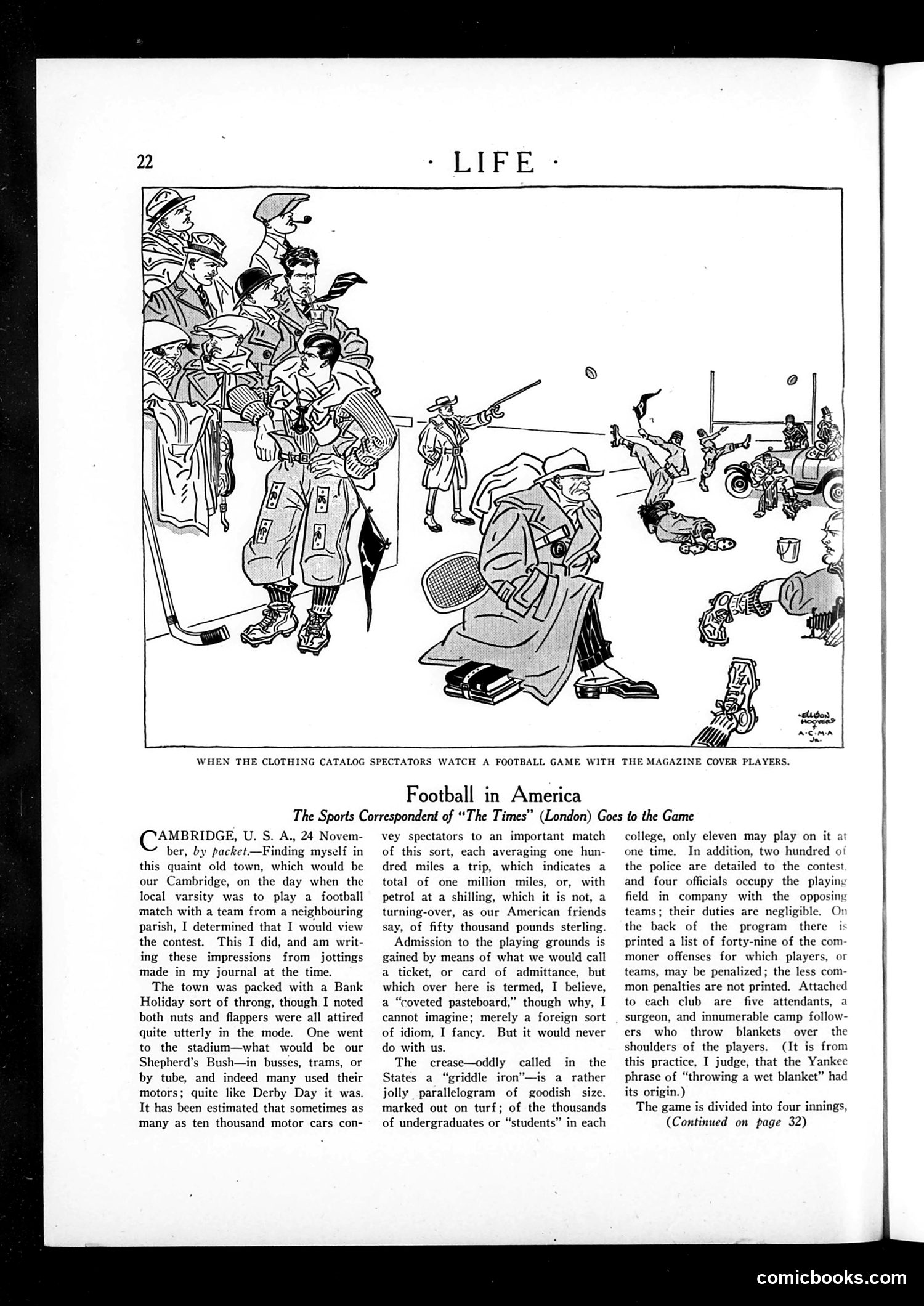
This is a satirical article by a correspondent from *The Times* (London) observing an American college football game, likely at Cambridge, Massachusetts. The humor derives from a British observer encountering American football for the first time and describing it in deliberately confused, exaggerated terms. The cartoon above illustrates the article's joke: well-dressed clothing catalog models (left) watch actual football players in action (right), highlighting the contrast between stylized fashion imagery and rough athletic reality. Key satirical points include: misidentifying the playing field as a "griddle iron," calling the ticket a "coveted pasteboard," exaggerating the scale (10,000 cars, 200 police), and misusing terminology ("innings" instead of quarters). The piece pokes fun at both American football's complexity and British unfamiliarity with the sport—presenting it as bewilderingly elaborate compared to cricket or rugby.
📄 Transcribed text from this page (OCR, searchable)
Machine-transcribed from the original scan — historical spelling and the odd misread are preserved.
WHEN THE CLOTHING CATALOG SPECTATORS WATCH A FOOTBALL GAME WITH THE MAGAZINE COVER PLAYERS. Football in America The Sports Correspondent of ‘The Times’ (London) Goes to the Game AMBRIDGE, U. S. A., 24 Novem- ber, by packet—Finding myself in this quaint old town, which would be our Cambridge, on the day when the local varsity was to play a football match with a team from a neighbouring parish, I determined that I would view the contest. This I did, and am writ- ing these impressions from jottings made in my journal at the time. The town was packed with a Bank Holiday sort of throng, though I noted both nuts and flappers were all attired quite utterly in the mode. One went to the stadium—what would be our Shepherd’s Bush—in busses, trams, or by tube, and indeed many used their motors; quite like Derby Day it was. It has been estimated that sometimes as many as ten thousand motor cars con- vey spectators to an important match of this sort, each averaging one hun- dred miles a trip, which indicates a total of one million miles, or, with petrol at a shilling, which it is not, a turning-over, as our American friends say, of fifty thousand pounds sterling. Admission to the playing grounds is gained by means of what we would call a ticket, or card of admittance, but which over here is termed, I believe, a “coveted pasteboard,” though why, I cannot imagine; merely a foreign sort of idiom, I fancy. But it would never do with us. The crease—oddly called in the States a “griddle iron’—is a rather jolly parallelogram of goodish size, marked out on turf; of the thousands of undergraduates or “students” in each college, only eleven may play on it at one time. In addition, two hundred oi the police are detailed to the contest and four officials occupy the playing field in company with the opposing teams; their duties are negligible. On the back of the program there is printed a list of forty-nine of the com moner offenses for which players, or teams, may be penalized; the less com- mon penalties are not printed. Attached to each club are five attendants, a surgeon, and innumerable camp follow- ers who throw blankets over the shoulders of the players. (It is from this practice, I judge, that the Yankee phrase of “throwing a wet blanket” had its origin.) The game is divided into four innings, (Continued on page 32) comicbooks.com