
Life, 1923-11-15 · page 10 of 40
Life — November 15, 1923 — page 10: what you’re looking at
What you’re looking at
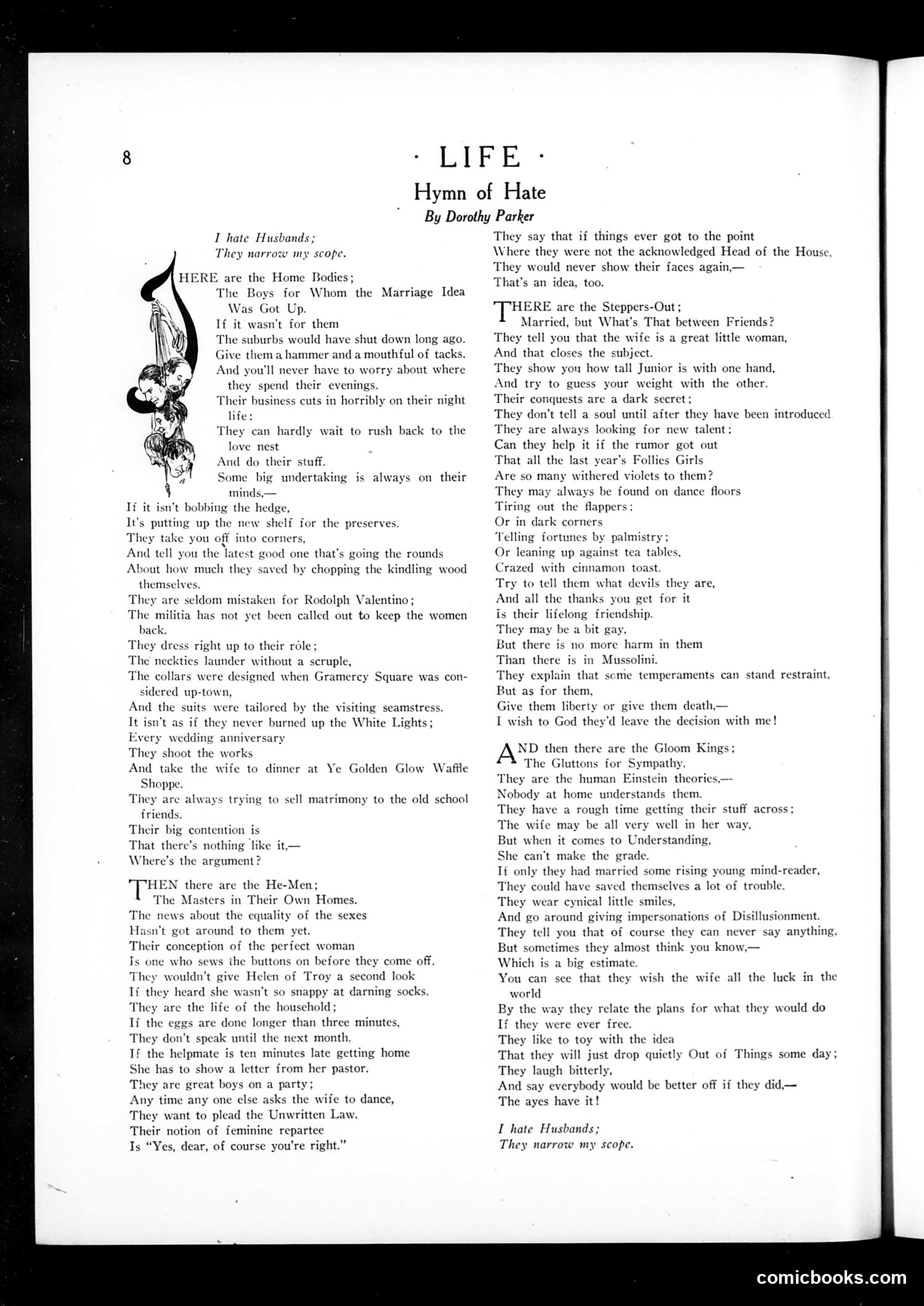
This is Dorothy Parker's satirical poem attacking various categories of married men and their social behaviors. The illustration shows a grotesque caricatured figure (likely representing an unappealing husband type). Parker systematically mocks: - **Home Bodies**: dull husbands who avoid social life - **He-Men**: domineering "masters of their own homes" - **Steppers-Out**: unfaithful men with secret affairs - **Gloom Kings**: intellectually pretentious men - Various other husband archetypes and their annoying habits The poem's refrain—"I hate Husbands; / They narrow my scope"—frames marriage as restrictive for women. Parker satirizes both husband types and their wives' resigned acceptance of poor treatment, concluding that women "would be better off if they did." This reflects 1920s-30s social commentary on marital dissatisfaction and gender dynamics.
📄 Transcribed text from this page (OCR, searchable)
Machine-transcribed from the original scan — historical spelling and the odd misread are preserved.
: EP'E - Hymn of Hate By Dorothy Parker I hate Husbands They narrow my scope. HERE are the Home Bodies; The Boys for Whom the Marriage Idea Was Got Up. If it wasn't for them The suburbs would have shut down long ago. Give thema hammer and a mouthful of tack: And you'll never have to worry about where they spend their evenings. Their business cuts in horribly on their night life: They can hardly wait to rush back to the love nest And do their stuff. Some big undertaking is always on their minds,— If it isn't bobbing the hedge, It's putting up the new shelf for the preserves. The » you off into corners, And tell you the latest good one that’s going the rounds About how much they saved by chopping the kindling wood themselves. They are seldom mistaken for Rodolph Valentino ; The militia has not yet been called out to keep the women back. They dress right up to their role; The neckties launder without a scruple, The collars were designed when Gramercy Square was con- sidered up-town, And the suits were tailored by the visiting seamstre: It isn’t as if they never burned up the White Light y wedding anniversar: They shoot the works And take the wife to dinner at Ye Golden Glow Waffle Shoppe. They are always trying to sell matrimony to the old school friends. Their big contention is That there’ Where's the argument? 's nothing like it,— HEN there are the He-Men; he Masters in Their Own Homes. The news about the equality of the sexes Hasn't got around to them yet. Their conception of the perfect woman Ts one who sews the buttons on before they come off. They wouldn't give Helen of Troy a second look If they heard she wasn’t so snappy at darning socks. They are the life of the household; If the eggs are done longer than three minutes, They don’t speak until the next month, If the helpmate is ten minutes late getting home She has to show a letter from her pastor. They are great boys on a part Any time any one else asks the wife to dance, They want to plead the Unwritten Law. Their notion of feminine repartee Ts “Yes, dear, of course you're right.” They say that if things ever got to the point Where they were not the acknowledged Head of the House They would never show their faces again,— That's an idea, too. HERE are the Steppers-Out ; Married, but What's That between Friends? They tell you that the wife is a great little woman, And that closes the subject. They show you how tall Junior is with one hand, And try to guess your weight with the other. Their conquests are a dark secret; They don’t tell a soul until after they have been introduced They are always looking for new talent; Can they help it if the rumor got out That all the last year's Follies Girls Are so many withered violets to them? They may always be found on dance floors Tiring out the flappers: Or in dark corners ‘Telling fortunes by palmistry; Or leaning up against tea tables, Crazed with cinnamon toast. Try to tell them what devils they are, And all the thanks you get for it is their lifelong friendship. They may be a bit gay But there is no more harm in them Than there is in Mussolini. They explain that scme temperaments can stand restraint, But as for them, e them liberty or give them death— I wish to God they'd leave the decision with me! ND then there are the Gloom Kings; The Gluttons for Sympathy. They are the human Einstein theories,— obody at home understands them. They have a rough time getting their stuff acro: The wife may be all very well in her w But when it comes to Understanding, She can't make the grade. If only they had married some rising young mind-reader, They could have saved themselves a lot of trouble. They wear cynical little smiles, And go around giving impersonations of Disillusionment They tell you that of course they can never say anything But sometimes they almost think you know,— Which is a big estimate. You can see that they wish the wife all the luck in the world By the way they relate the plans for what they would do If they were ever free. They like to toy with the idea That they will just drop quietly Out of Things some day; They laugh bitterly, And say everybody would be better off if they did— The ayes have it! I hate Husbands; They narrow my scope. comicbooks.com