
Life, 1923-11-15 · page 26 of 40
Life — November 15, 1923 — page 26: what you’re looking at
What you’re looking at
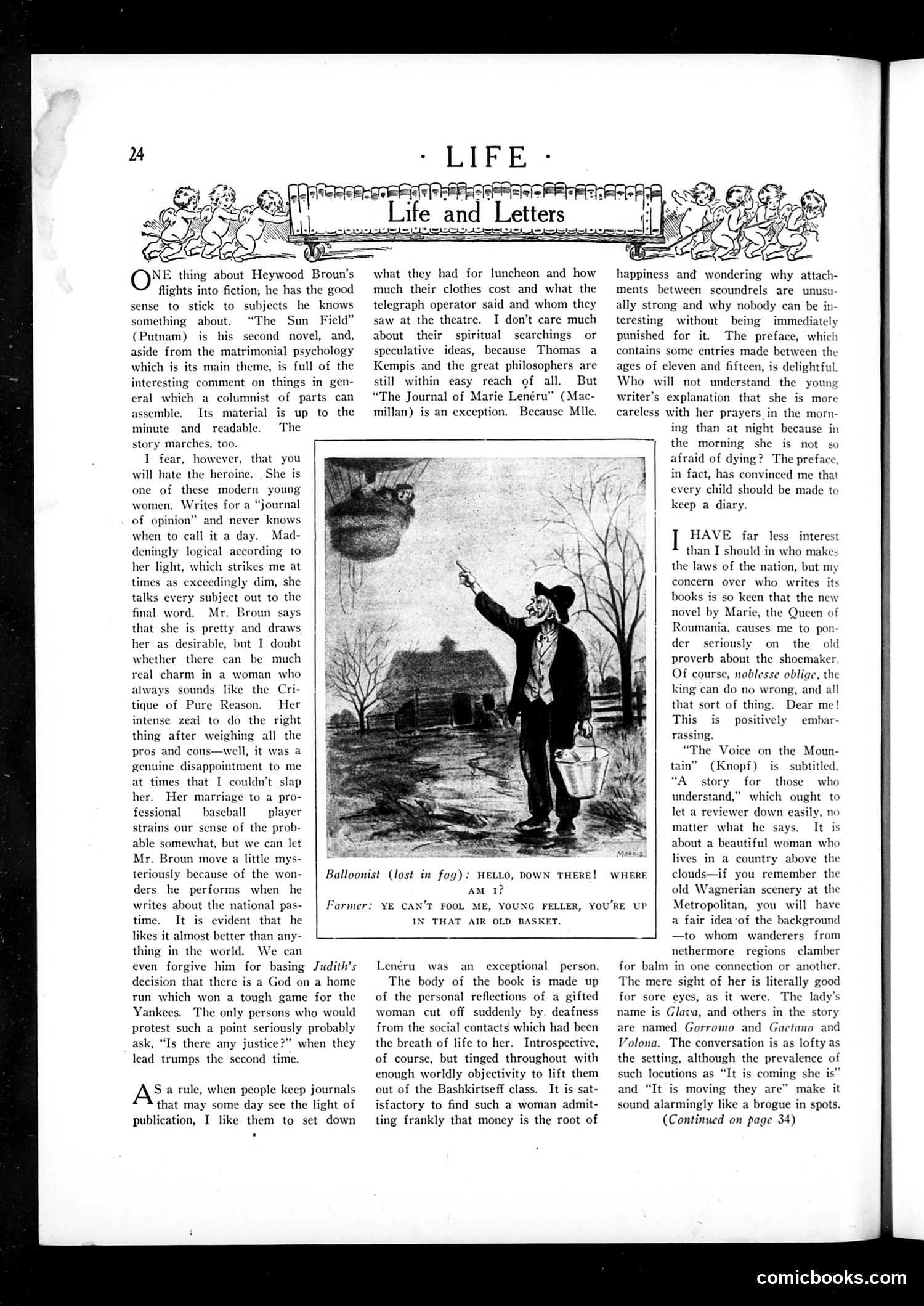
This page contains a book review column with one embedded cartoon titled "Balloonist (lost in fog)." The cartoon depicts a man in a hot air basket floating above a farmer on the ground below. **The Cartoon's Joke:** The balloonist, unable to see through the fog, calls down asking "HELLO, DOWN THERE! WHERE AM I?" The farmer responds: "YE CAN'T FOOL ME, YOUNG FELLER, YOU'RE UP IN THAT AIR OLD BASKET." This is a classic absurdist joke playing on the farmer's literalism and deliberate misunderstanding. The balloonist seeks navigational help; the farmer pedantically states only the obvious—that he's in a basket in the air—offering no useful information whatsoever. The humor derives from the gap between what's asked (location) and what's answered (a tautology). The cartoon exemplifies *Life* magazine's tradition of simple, accessible visual humor targeting everyday situations and human foibles rather than specific political events.
📄 Transcribed text from this page (OCR, searchable)
Machine-transcribed from the original scan — historical spelling and the odd misread are preserved.
NE thing about Heywood Broun’s flights into fiction, he has the good sense to stick to subjects he knows something about. “The Sun Field” (Putnam) is his second novel, and, aside from the matrimonial psychology which is its main theme, is full of the interesting comment on things in gen- eral which a columnist of parts can assemble. Its material is up to the and The minute readable. « LIFE = Letters and “Life what they had for luncheon and how much their clothes cost and what the telegraph operator said and whom they saw at the theatre. I don’t care much about their spiritual searchings or speculative ideas, because Thomas a Kempis and the great philosophers are still within easy reach of all. But “The Journal of Marie Lenéru” (Mac- millan) is an exception. Because Mlle. happiness and wondering why attach- ments between scoundrels are unusu- ally strong and why nobody can be in- teresting without being immediately punished for it. The preface, which contains some entries made between the ages of eleven and fifteen, is delightful. Who will not understand the young writer’s explanation that she is more careless with her prayers in the morn- ing than at night because in story marches, too. 1 fear, however, that you will hate the heroine. She is one of these modern young women. Writes for a “journal of opinion” and never knows when to call it a day. Mad- deningly logical according to her light, which strikes me at times as exceedingly dim, she talks every subject out to the final word. Mr. Broun says that she is pretty and draws her as desirable, but I doubt whether there can be much real charm in a woman who always sounds like the Cri- tique of Pure Reason. Her intense zeal to do the right thing after weighing all the pros and cons—well, it was a genuine disappointment to me at times that I couldn't slap her, Her marriage to a pro- player strains our sense of the prob- able somewhat, but we can let Mr. Broun move a little mys- teriously because of the won- ders he performs when he writes about the national pas- time. It is evident that he likes it almost better than any- fessional _ baseball Farmer: Balloonist (lost in fog): HELLO, DOWN THERE! AM I? N’T FOOL ME, IN THAT AIR OLD BASKET. YE CA YOUNG FELLER, YOU'RE UP the morning she is not so afraid of dying? The preface, in fact, has convinced me that every child should be made to keep a diary. HAVE far interest than I should in who makes the laws of the nation, but my over who writes its books is so keen that the new novel by Marie, the Queen of Roumania, causes me to pon- der on the old proverb about the shoemaker Of course, noblesse oblige, the king can do no wrong, and all that sort of thi Dear me! is embar- less concern seriously “The Voice on the Moun- tain” (Knopf) subtitled, “A story for those who understand,” which ought to let a reviewer down easily, no matter what he It is about a beautiful woman who lives in a country above the clouds—if you remember the old Wagnerian scenery at the Metropolitan, you will have a fair idea-of the background to whom wanderers from is Means WHERE thing in the world. We can even forgive him for basing Judith’s decision that there is a God on a home run which won a tough game for the Yankees. The only persons who would protest such a point seriously probably ask, “Is there any justice?” when they lead trumps the second time. Sa rule, when people keep journals that may some day see the light of publication, I like them to set down Lenéru exceptional person. The body of the book is made up of the personal reflections of a gifted woman cut off suddenly by. deafness from the social contacts which had been the breath of life to her. Introspective, of course, but tinged throughout with enough worldly objectivity to lift them out of the Bashkirtseff class. It is sat- isfactory to find such a woman admit- ting frankly that money is the root of was an nethermore regions clamber for balm in one connection or another. The mere sight of her is literally good for sore eyes, as it were. The lady name is Glava, and others in the story are named Gorromo and Gactano and Volona. The conversation is as lofty as the setting, although the prevalence of such locutions as “It is coming she is” and “It is moving they are” make it sound alarmingly like a brogue in spots. (Continued on page 34) comicbooks.com